How to choose a mortgage lender: compare, verify, ask
How to find and compare mortgage lenders, check their license on NMLS, what to ask the loan officer and which warning signs to watch for.
Verified against official sources on October 17, 2026 17 official sources

Show contents
In short
What you need to know
Quick answer
The CFPB recommends contacting at least three lenders and comparing their offers in writing, on the Loan Estimate: ask for the same kind of loan and compare fees, the APR and the five-year table, not just the rate. Before you hand your documents to anyone, check on NMLS Consumer Access that the company and the loan officer are licensed in your state. Credit checks from mortgage lenders within 45 days count as one, and you are not committed to any lender until you sign the final documents.
What matters most
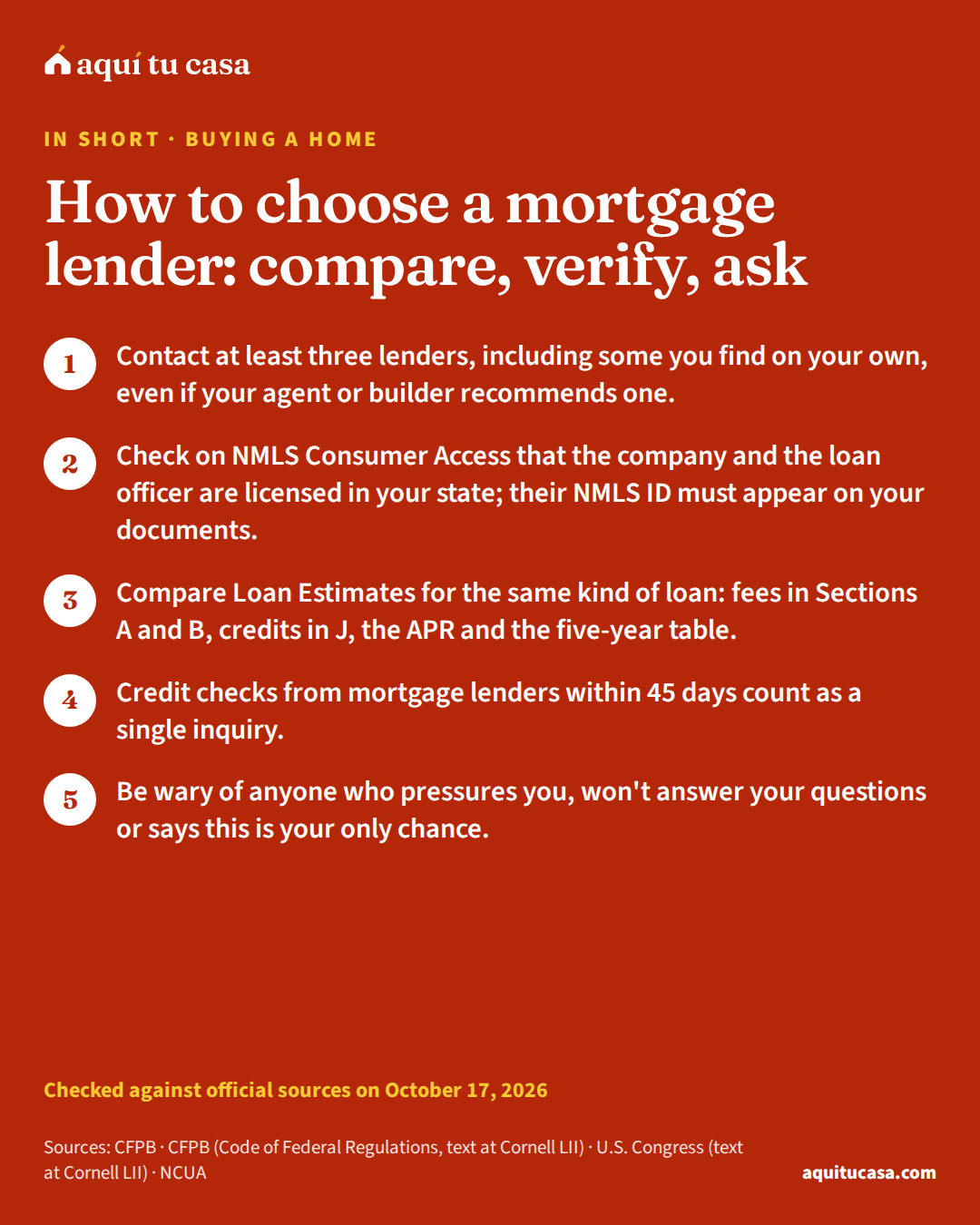
- Contact at least three lenders, including some you find on your own, even if your agent or builder recommends one.
- Check on NMLS Consumer Access that the company and the loan officer are licensed in your state; their NMLS ID must appear on your documents.
- Compare Loan Estimates for the same kind of loan: fees in Sections A and B, credits in J, the APR and the five-year table.
- Credit checks from mortgage lenders within 45 days count as a single inquiry.
Is this for you?
This guide is for you if…
- You are about to apply for a mortgage to buy a home and do not know who to go with.
- An agent, a builder or a friend recommended a lender and you want to compare before deciding.
- You want to know whether the person offering you a loan is licensed in your state.
Get direct help first if…
- You already have several Loan Estimates and only want to read the costs line by line: start with the closing costs guide.
- You are behind on the mortgage you already have: the guide on what to do if you can't pay your mortgage is the one for you.
Who lends you the money for your home shapes your rate, your fees and how the whole purchase goes. This guide is for anyone about to apply for a mortgagemortgageA mortgage is an agreement between you and a lender (a bank, a credit union or a mortgage company) that gives the lender the right to take your property if you do not repay the money it lent you, plus interest. Mortgage loans are used to buy a home or to borrow money against the value of a home you already own. You repay it in monthly payments that cover the principal (the money borrowed) and the interest, and often the property taxes and insurance as well. In Spanish, "hipoteca" and "préstamo hipotecario" mean the same thing.See the full definition: it explains who is who, how to check a license, how to compare offers in writing, what to ask and which warning signs to take seriously.
Lender, broker and loan officer: who is who
According to the CFPB, a lenderlenderThe lender is the financial institution that lends you the money for your mortgage. The mortgage is the agreement that gives the lender the right to take your home if you do not repay what it lent you. After closing, it is common for another company, the loan servicer, to collect your payments and keep track of the loan; it may be the same company that lent you the money or a different one. On the Loan Estimate, the lender's name appears on the first page, and the last page lists it as "Lender" with its NMLS or license number.See the full definition is a financial institution that makes direct loans. A mortgage broker does not lend money: they help you find different lenders or loans, and you pay them a fee for their service on that loan. Some institutions work as both, so ask whether a broker is involved in your loan.2
The person you deal with is the loan officerloan originatorA loan originator is the person or company that, for pay, takes your mortgage application, offers or negotiates the loan terms or helps you get the loan. It includes the loan officer, who often works for one lender, and the mortgage broker, who typically works with several lenders. It does not include someone who only does clerical work. Originators are usually paid a fee or commission by you or by the lender, and federal law prohibits that commission from varying based on your loan's terms. In general they must be licensed or registered through the NMLS.See the full definition or the broker. Loan officers often work for one specific lender; brokers usually work with several. They are generally paid a fee or commission per loan, paid by you or by the lender. Before you work with one, the CFPB suggests understanding their fees and who pays them.3
Direct lender and mortgage broker
Lends its own money
Direct lender
With either one, compare terms, rates and fees.2
The law also protects you from conflicts of interest. Federal law prohibits commissions from varying based on the terms of your mortgage.3 And under Regulation Z, an originator may not steer you into a loan because the lender will pay them more for it than for others they offered or could have offered you, unless that loan is in your interest.4
Where to look? The CFPB’s “Your home loan toolkit” says mortgages are offered by community banks, credit unionscredit unionA credit union is a not-for-profit financial institution that, like a bank, accepts deposits, makes loans and offers other services, but is owned by its members. Members elect a volunteer board of directors, and profits go back to them as lower fees, higher savings rates and lower loan rates. To join you need a common bond, such as your employer, your family, where you live or a group you belong to. It is chartered by the NCUA, a federal agency, or by a state. If the credit union is federally insured, your deposits are protected by the NCUA's insurance fund.See the full definition, mortgage brokers, online lenders and large banks.9 Recommendations may come from friends, relatives or real estate agents. Even so, the CFPB suggests also searching on your own: your local bank or credit union and other lenders in your area. A housing counselor can help you identify lenders.1
Check the license: the NMLS ID
Before you hand your documents to anyone, confirm they can make mortgage loans in your state. Under the federal SAFE Act, no one may work as a loan originator without a registration or a state license, and without a unique identifier.5 That identifier is the NMLSNMLS IDThe NMLS (Nationwide Multistate Licensing System) is the official system state regulators use to license and register financial-services companies and individuals, such as mortgage loan originators. Loan originators get a unique number, the NMLS ID, that identifies them and lets the public see their employment history and any disciplinary actions against them. The loan originator must put its name and NMLS ID on the application, the Loan Estimate, the Closing Disclosure, the promissory note and the security instrument. With NMLS Consumer Access you can check for free whether they are authorized in your state.See the full definition ID, from the Nationwide Mortgage Licensing System & Registry.
The ID is not hidden. Under Regulation Z, the company and the responsible loan officer must put their names and NMLS IDs on the credit application, the Loan Estimate and Closing Disclosure, the note and the security instrument. Among other things, the ID lets the public see an originator’s employment history and the disciplinary actions published against them.4
How to check a lender
1. Ask for the NMLS IDs
Before you hand over documents
One belongs to the company and one to the loan officer. Both must appear on your application and your Loan Estimate.4
2. Look them up on NMLS Consumer Access
The same day
It is a free service to see whether the company or person is authorized in your state.6
3. Check for disciplinary actions
Before you apply
The site may list some, and your state regulator can tell you about orders against them.7
4. Match names and IDs to your paperwork
When you get the Loan Estimate
The name and NMLS ID on your documents should be the ones you checked.4
According to the CFPB, NMLS runs a free service to see whether a company or financial professional is authorized in your state, and your state regulator can tell you whether there is a disciplinary order against the loan officer or company.6 Its homebuyer toolkit gives the address: nmlsconsumeraccess.org. If you have a problem with how a loan officer treats you, it suggests asking to talk to a supervisor.9 If the problem is with a broker, you can file a complaint with the CFPB online or at (855) 411-2372.7

How to compare offers in writing
The CFPB recommends contacting at least three lenders1 and getting at least three offers in writing.9 That written offer is the Loan EstimateLoan EstimateThe Loan Estimate is a three-page form you receive from the lender within days of applying for a mortgage. In the same format at every bank, it sums up the terms of the loan being offered: amount, interest rate, whether the payment can change, the estimated monthly payment with taxes and insurance, the itemized closing costs and how much cash you need at closing. Because every lender uses the same form, it lets you compare offers side by side. It commits you to nothing: requesting one is not accepting the loan.See the full definition: a three-page form the lender must give you within three business days of your application. Everyone uses the same form, so you can compare. Getting one does not mean the loan is approved.11
Asking for one is cheap. Before you receive it and say you want to proceed, no one may charge you for your application except a bona fide and reasonable fee for your credit report.12 Getting a Loan Estimate does not commit you either: you are not committed to any lender until you sign the final closing documents. When you choose, you tell the loan officer you want to proceed (“intent to proceed”). Only then can they require the application fee, the appraisal fee or most other fees.9
With the Loan Estimates in hand, compare the same things on each:
- Loan costs. The total is in Section D on page 2. Focus on Sections A and B, because you can shop for the Section C services with any lender. Section J shows lender credits.9 The closing costs guide explains each block.
- APR and TIP. On page 3, the APRannual percentage rate (APR)The annual percentage rate (APR) is a broader measure of the cost of borrowing money than the interest rate. Besides the interest, it includes certain loan charges, such as discount points and some lender fees, spread over the life of the loan and expressed as a yearly percentage. That is why the APR is almost always a little higher than the interest rate. It is useful for comparing offers: if two loans have the same interest rate but a different APR, the one with the higher APR charges more in fees.See the full definition measures your costs over the loan term, expressed as a rate. A loan with a low APR or TIP could have high upfront costs: also check the table for the first five years.9
- Points and credits. Discount pointsdiscount pointsDiscount points are a payment you make to the lender at closing in exchange for a lower interest rate over the life of the loan. Each point costs a percentage of the loan amount. The opposite is lender credits: the bank lowers your closing costs today in exchange for a higher rate. Buying points only pays off if you keep the loan long enough for the monthly savings to exceed what you paid. Points appear on the Loan Estimate, in section A of the closing costs.See the full definition lower your rate in exchange for paying more at closing; one point is one percent of the loan. Lender credits lower your closing costs in exchange for a higher rate. Ask each lender for the same amount of points or credits.13
- The rate lock. A rate lockrate lockA rate lock (or lock-in) means your interest rate will not change between the offer and closing, as long as you close within the agreed time frame and your application does not change. Rates can change daily; if yours is not locked, it can change at any time. Even when locked, it can change if your loan amount, credit score, verified income or appraisal changes. Extending a lock can cost money, and if rates fall you may be stuck with the higher rate. The first page of the Loan Estimate says whether your rate is locked and until when.See the full definition sets your rate for a period of time. The rate on the Loan Estimate is not a guarantee, and extending the lock can be expensive if the purchase is delayed.9

What about your credit? Each lender’s check is reported as an inquiryhard inquiryA hard inquiry happens when a lender checks your credit report because you applied for a loan or a card, to decide whether to approve you. It can affect your score, because most scoring models look at how often and how recently you apply for credit, and other businesses that buy your report can see it. A single inquiry has little impact. Scoring models also allow for comparison shopping: several inquiries for the same type of loan, such as a mortgage, within a short period usually count as one.See the full definition, which usually lowers your scores a little. But within a 45-day window, several checks from mortgage lenders count as one. Checking your own credit does not affect you. What you should avoid is applying for another card or loan right before or during the process.8 After a check, you may get offers you did not ask for (“trigger leads”); you have the right to opt out of them.1
Example with real numbers
What is at stake on a typical loan
With the typical US home value, an FHA loan with the minimum down payment and the average 30-year rate as of November 5, 2026.
- Home price (typical US value)
- $332,700
- FHA loan, without the upfront premium
- $321,056
- One discount point (1% of that loan)
- $3,211
- Average 30-year rate
- 7.18%
- Principal and interest per month, with the upfront premium financed
- $2,213
- Interest over 30 years, if you pay the full term
- $470,007
This is an example with national numbers. With amounts like these, the CFPB says borrowers who shop around can save thousands of dollars.1 One point is 1% of the loan.13 Put the offers you get side by side in the tool.
Run it with your numbersCompare loansWhat to ask the loan officer
The CFPB suggests setting up an appointment with a loan officer at each lender. Bring these questions:
- Does my plan make sense? Share the basics of your situation and the kind of loan you are considering. If they recommend something different, ask why.1
- Can you show me two or three options? Ask for the interest rate, APR, estimated fees and monthly payment of each.1
- Do you see anything in my papers that could keep me from qualifying? Ask them to review your documents for that.1
- Is a broker involved in this loan? How much do they charge and who pays them?23
- Do you offer a discount for taking a class? Some lenders offer one to borrowers who completed a homebuyer education coursehomebuyer education courseA homebuyer education course is a class with a set curriculum that covers the homebuying process, how to maintain a home, budgeting and why good credit matters. It can be in a group, in person, online or by phone. It is not the same as housing counseling, which is one-on-one help with an action plan for your situation. Some loans and some down payment assistance programs require you to finish a course before closing, especially first-time homebuyers. When you finish, you get a certificate.See the full definition.9
- How long is the rate locked? Also ask whether a shorter or longer lock is available and what it costs, and what happens if closing is delayed and the lock expires. Policies vary by lender.9
Bring your documents to the first meeting. Lenders have very specific guidelines for counting and documenting your income, your assets and the source of your down paymentdown paymentThe down payment is the part of the home's price you pay out of your own pocket when you buy; the loan covers the rest. In U.S. Spanish it is also called enganche, cuota inicial or entrada. Each loan type has its own minimum: FHA requires at least 3.5% of the value, VA and USDA loans may require none, and conventional loans ask for more if you want to avoid private mortgage insurance. A larger down payment lowers the loan, the monthly payment and the total interest; many state programs help families put it together.See the full definition. If your application might be complicated, for example if you are self-employed, the CFPB says it is best to find out sooner rather than later.1 The document checklist tool helps you gather them.
And start early. The CFPB suggests not deciding yet at this stage and exploring options before you find a home: once a seller accepts your offer, you may have as little as a couple of days to line up financing.1 The preapproval and prequalification guide explains the letter sellers expect with an offer.
If you are buying with an ITIN: what kind of lender to look for
If you have an ITINITIN (Individual Taxpayer Identification Number)An ITIN is a nine-digit number the IRS, the federal tax agency, issues to people who need a U.S. taxpayer identification number to file taxes and are not eligible for a Social Security number. It is for tax purposes only: it does not authorize you to work in the United States, does not qualify you for Social Security benefits or the Earned Income Tax Credit, and says nothing about your immigration status. You apply with Form W-7, and it expires if it goes unused for several years. Some lenders accept an ITIN for a mortgage.See the full definition, ask on the first call whether the lender makes ITIN loans. We do not name lenders here, but official sources show which kinds of institutions offer them:
- Banks. FDIC public evaluations document banks with ITIN mortgage programs, designed for people who earn income in the United States but do not qualify for a Social Security number.15
- Credit unions. The NCUA, their federal regulator, saw no legal impediment to a federal credit union lending to members who use an ITIN instead of a Social Security number, as long as it manages the risks.14
- CDFIs. Community development financial institutionsCommunity Development Financial Institution (CDFI)A CDFI (Community Development Financial Institution) is an organization whose primary mission is community development. It provides loans, investments and other financial services in low-income communities and to people who lack access to financing. It can be a community development bank or credit union, or a loan fund that is not a bank. The law requires that it not be a government agency, that it be accountable to the community it serves and that it offer services such as financial and credit counseling along with its loans. The Treasury Department's CDFI Fund certifies them.See the full definition serve low-income communities and people without access to financing. The CDFI Fund publishes the list of certified ones.16
The comparison rules are the same: ask for the Loan Estimate and compare it the same way.11 Credit law protects you too. The Equal Credit Opportunity Act (ECOA) makes it illegal to discriminate based on national origin, among other factors, and bars charging you a higher rate or fees because of those factors. Within limits, the lender may consider your income, debt and credit history.10 The ITIN mortgage guide explains the loan types.
If this is you
You are buying with an ITIN
Ask on the first call whether they make ITIN loans. The FDIC documents banks with programs like these.15
You are self-employed
If your application might be complicated, the CFPB says it is best to find out sooner rather than later.1 Bring your proof of income to the first meeting.
You are buying for the first time
Some lenders offer a discount to borrowers who completed a homebuyer education course.9 Ask when you compare.
You do not know where to start
A HUD-approved housing counselor can help you identify lenders, often for free or at low cost.17

Warning signs and your rights
The CFPB gives several signs that it is time to switch lenders:
- You are pressured or get no answers. If a loan officer makes you uncomfortable, can’t answer your questions or is too pushy, look for another. Always check that your documents say what you were told.1
- You are told it is your “only chance.” Do not believe anyone who says that, or who says you must “act fast.”9
- You are charged too early. Before the Loan Estimate and before you say you will proceed, only the credit report fee is allowed.12
- You are treated differently. Being treated differently in person than on the phone or online, being discouraged from applying or being pushed toward worse terms are signs of discrimination.10
If your agent or builder has a preferred lender, you can use them, but the CFPB says to keep comparing.1
Mistake: Going with the first lender, or the one you were referred to.
Instead: Contact at least three and compare Loan Estimates in writing.1
Mistake: Comparing only the interest rate.
Instead: Also look at Sections A, B and J, the APR and the five-year table.9
Mistake: Paying an application fee before you have the Loan Estimate.
Instead: Until you say you will proceed, only the credit report fee is allowed.12
Mistake: Handing over documents without checking the license.
Instead: Look up the company's and the loan officer's NMLS IDs on NMLS Consumer Access.6
Mistake: Waiting until you find a home to look for a lender.
Instead: Start sooner: once your offer is accepted you may have only a couple of days.1
Mistake: Opening a credit card or car loan in the middle of the process.
Instead: Avoid applying for other credit right before or during the mortgage process.8

What to do this week
- List at least three lenders: your bank or credit union, others in your area and at least one you find on your own.1
- Look up each company’s and each loan officer’s NMLS ID on NMLS Consumer Access.6
- Gather your proof of income, bank statements and the source of your down payment money.1
- Ask each one for a Loan Estimate, for the same kind of loan and within 45 days.8
- Compare Sections A, B, D and J, the APR and the five-year table, and use the compare loans tool.9
- If you want help, a HUD-approved housing counselorHUD-approved housing counselorA HUD-approved housing counselor works at an agency HUD has approved to provide housing counseling: independent, expert advice customized to your situation about buying a home, renting, a missed mortgage payment, a foreclosure or credit problems. The agencies usually charge little or nothing; many serve in Spanish and offer the homebuyer education course several assistance programs require. They are not lenders or real estate agents and sell you nothing. Your county page lists the official agencies with phone numbers.See the full definition gives independent advice, often for free or at low cost.17 The housing counselors guide explains how to find one.
Your numbers
We start with the typical home value in the United States. Enter the price you are looking at.
Adjust advanced details
FHA
Estimated monthly payment
$2,759
Principal and interest, tax, homeowners insurance and mortgage insurance.
- Down payment
- $11,645 (3.5%)
- Mortgage insurance
- $147 a monthFHA annual premium · whole term
- Upfront premium or fee
- $5,618FHA upfront mortgage insurance · added to the loan
- Paid in 5 years
- $141,609
- Balance after 5 years
- $308,088
- County limit
- Find your county to see the limit
Rules and notes
- Minimum down payment of 3.5% with a score of 580 or more; between 500 and 580 at least 10% is required.In effect since September 14, 2016 · Source ↗
- Mortgage insurance: 1.75% upfront plus an annual premium; with less than 10% down it lasts the whole term.In effect since March 20, 2023 · Source ↗
- Only citizens, lawful permanent residents and citizens of the Freely Associated States; non-permanent residents are no longer eligible.In effect since May 25, 2025 · Source ↗
Conventional, 3% down
Estimated monthly payment
$2,747
Principal and interest, tax, homeowners insurance and mortgage insurance.
- Down payment
- $9,981 (3%)
- Mortgage insurance
- $161 a monthPMI (example) · ends around year 13
- Upfront premium or fee
- None
- Paid in 5 years
- $140,854
- Balance after 5 years
- $304,358
- County limit
- Find your county to see the limit
Rules and notes
- Fannie Mae requires a minimum score of 620 on manually underwritten fixed-rate loans; its automated system (DU) sets no fixed minimum.In effect since April 22, 2026 · Source ↗
- Private mortgage insurance (PMI) with less than 20% down; it cancels on its own at 78% of the original value.In effect since January 1, 2024 · Source ↗
- Fannie Mae buys loans to lawful permanent and non-permanent residents on the same terms as citizens; the lender verifies the status.In effect since July 28, 2015 · Source ↗
Conventional, 5% down
Estimated monthly payment
$2,698
Principal and interest, tax, homeowners insurance and mortgage insurance.
- Down payment
- $16,635 (5%)
- Mortgage insurance
- $158 a monthPMI (example) · ends around year 12
- Upfront premium or fee
- None
- Paid in 5 years
- $137,950
- Balance after 5 years
- $298,082
- County limit
- Find your county to see the limit
Rules and notes
- Fannie Mae requires a minimum score of 620 on manually underwritten fixed-rate loans; its automated system (DU) sets no fixed minimum.In effect since April 22, 2026 · Source ↗
- Private mortgage insurance (PMI) with less than 20% down; it cancels on its own at 78% of the original value.In effect since January 1, 2024 · Source ↗
- Fannie Mae buys loans to lawful permanent and non-permanent residents on the same terms as citizens; the lender verifies the status.In effect since July 28, 2015 · Source ↗
Conventional, 20% down
Lowest paymentEstimated monthly payment
$2,202
Principal and interest, tax, homeowners insurance and mortgage insurance.
- Down payment
- $66,540 (20%)
- Mortgage insurance
- None
- Upfront premium or fee
- None
- Paid in 5 years
- $108,184
- Balance after 5 years
- $251,017
- County limit
- Find your county to see the limit
Rules and notes
- Fannie Mae requires a minimum score of 620 on manually underwritten fixed-rate loans; its automated system (DU) sets no fixed minimum.In effect since April 22, 2026 · Source ↗
- Private mortgage insurance (PMI) with less than 20% down; it cancels on its own at 78% of the original value.In effect since January 1, 2024 · Source ↗
- Fannie Mae buys loans to lawful permanent and non-permanent residents on the same terms as citizens; the lender verifies the status.In effect since July 28, 2015 · Source ↗
VA
Estimated monthly payment
$2,702
Principal and interest, tax, homeowners insurance and mortgage insurance.
- Down payment
- $0 (0%)
- Mortgage insurance
- None
- Upfront premium or fee
- $7,153VA funding fee · added to the loan
- Paid in 5 years
- $138,137
- Balance after 5 years
- $320,517
- County limit
- Find your county to see the limit
Rules and notes
- Military service requirements by period of service; you must meet VA's and your lender's credit standards.In effect since September 22, 2026 · Source ↗
- No down payment as long as the price is not above the appraisal; funding fee of 2.15% on first use with no down payment (exempt: zero). No monthly mortgage insurance.In effect since April 7, 2023 · Source ↗
- Up to the conforming limit with no down payment in most areas; more with a down payment.In effect since January 7, 2026 · Source ↗
USDA
Estimated monthly payment
$2,773
Principal and interest, tax, homeowners insurance and mortgage insurance.
- Down payment
- $0 (0%)
- Mortgage insurance
- $97 a monthUSDA annual fee · whole term
- Upfront premium or fee
- $3,327USDA upfront fee · added to the loan
- Paid in 5 years
- $142,404
- Balance after 5 years
- $316,909
- County limit
- No county limit
Rules and notes
- Home in an eligible rural area and income within the area limit; finances the full price for those who qualify.In effect since December 9, 2013 · Source ↗
- Upfront fee of 1% and annual fee of 0.35% of the balance.In effect since October 1, 2026 · Source ↗
- Each lender sets the score.
- Applicants must show they are U.S. citizens, U.S. non-citizen nationals or qualified aliens, as the federal rule defines them.In effect since November 29, 2022 · Source ↗
ITIN loan (example)
ExampleEstimated monthly payment
$2,315
Principal and interest, tax, homeowners insurance and mortgage insurance.
- Down payment
- $49,905 (15%)
- Mortgage insurance
- None
- Upfront premium or fee
- None
- Paid in 5 years
- $114,945
- Balance after 5 years
- $266,705
- County limit
- No county limit
Rules and notes
- Not a federal program: each lender sets the down payment, rate and documents. The 15% is only an example; rates are usually higher.
- They usually ask for ITIN tax returns for the last two years and more reserves; compare several lenders.
An educational estimate, not a loan offer. The same rate for every program (the real one differs); homeowners insurance is an example (0.5% of the value a year) and so is PMI (0.6% a year). The rules quoted are dated; check with your lender.
Ready to see the numbers? Find your county here
See how this applies in your county: its loan limits, prices and rents, from the official data.
Printable checklist
Frequently asked questions
How many lenders should I compare?
The CFPB recommends contacting at least three lenders on your list and getting at least three offers in writing, on the Loan Estimate. It says borrowers who shop around can save thousands of dollars and that different lenders can offer different kinds of loans.
Will getting offers from several lenders hurt my credit score?
Very little. According to the CFPB, within a 45-day window, multiple credit checks from mortgage lenders count as a single inquiry on your credit report. Checking your own credit does not affect your scores.
How do I know if a lender is licensed?
Ask for the NMLS ID of the company and of the loan officer, and look them up on NMLS Consumer Access (nmlsconsumeraccess.org), a free service that shows whether they are authorized in your state. Your state regulator can also tell you about disciplinary orders. The ID must appear on your application and your Loan Estimate.
Is a bank or a mortgage broker better?
It depends on what each one offers you. A lender lends directly; a broker does not lend money, shops among several lenders and charges a fee for that service. With either one, the CFPB recommends comparing terms, rates and fees, and asking who pays the broker.
Do I have to use the lender my agent or builder recommends?
No. The CFPB says that even if a real estate agent or homebuilder has a preferred lender, you can and should shop around for a better deal.
Can a lender charge me for a Loan Estimate?
Before you receive it and say you want to proceed, Regulation Z only allows a bona fide and reasonable fee for your credit report. The application fee, the appraisal fee and most other fees come later.
Where do I find lenders that make ITIN loans?
Official sources document banks, credit unions and CDFIs that offer them. Ask on the first call and compare Loan Estimates the same way you would for any loan. A HUD-approved housing counselor can help you identify lenders, often for free or at low cost.
When should I start looking for a lender?
Before you look for a home. The CFPB explains that once a seller accepts your offer, you may have as little as a couple of days to line up financing. Exploring early gives you time to compare without rushing.
Sources
Every figure in this guide comes from one of these official sources. The number next to a sentence leads to the source behind it.
Each source on one line: who publishes it, its title, its address and the date we read it.
- 1. CFPB · Contact multiple lenders · consumerfinance.gov · Accessed October 17, 2026
- 2. CFPB · What is the difference between a mortgage lender and a mortgage broker? · consumerfinance.gov · Accessed October 17, 2026
- 3. CFPB · How does a mortgage loan officer or broker get paid? · consumerfinance.gov · Accessed October 17, 2026
- 4. CFPB (Code of Federal Regulations, text at Cornell LII) · Regulation Z, 12 CFR §1026.36, Prohibited acts or practices and certain requirements for credit secured by a dwelling · law.cornell.edu · Accessed October 17, 2026
- 5. U.S. Congress (text at Cornell LII) · 12 U.S.C. §5103, License or registration required (SAFE Act) · law.cornell.edu · Accessed October 17, 2026
- 6. CFPB · Is there any way I can check to see if the company or person I contact is permitted to make or broker mortgage loans? · consumerfinance.gov · Accessed October 17, 2026
- 7. CFPB · Is there any way I can see if there have been disciplinary actions against my broker? · consumerfinance.gov · Accessed October 17, 2026
- 8. CFPB · What happens when a mortgage lender checks my credit? · consumerfinance.gov · Accessed October 17, 2026
See the other 9 sources
- 9. CFPB · Your home loan toolkit: A step-by-step guide · files.consumerfinance.gov · Accessed October 17, 2026
- 10. CFPB · Credit discrimination is illegal · consumerfinance.gov · Accessed October 17, 2026
- 11. CFPB · What is a Loan Estimate? · consumerfinance.gov · Accessed October 17, 2026
- 12. CFPB (Code of Federal Regulations, text at Cornell LII) · Regulation Z, 12 CFR §1026.19, Certain mortgage and variable-rate transactions · law.cornell.edu · Accessed October 17, 2026
- 13. CFPB · How should I use lender credits and points (also called discount points)? · consumerfinance.gov · Accessed October 17, 2026
- 14. NCUA · NCUA Legal Opinion 03-0964: Individual Taxpayer Identification and Matricula Consular Numbers for Credit Reporting Purposes · ncua.gov · Accessed October 17, 2026
- 15. FDIC · Community Reinvestment Act Performance Evaluation (July 8, 2024) · crapes.fdic.gov · Accessed October 17, 2026
- 16. CDFI Fund, U.S. Department of the Treasury · CDFI Certification · cdfifund.gov · Accessed October 17, 2026
- 17. CFPB · Find a Housing Counselor · consumerfinance.gov · Accessed October 17, 2026
Keep reading
Related guides
If this guide helped, these follow the same path.

Buying a home 14 minute read
Preapproval vs. prequalification: what each letter means
What prequalification and preapproval letters are, what lenders check, why neither one is a loan, and how to compare lenders without hurting your credit.
- Prequalification and preapproval have no fixed meaning: ask whether the lender verified your information and what assumptions it made.
- Neither letter is a guaranteed offer or commits you to that lender; when a letter has an expiration date, it is typically 30 to 60 days.
- Multiple credit checks from mortgage lenders within 45 days are recorded as a single inquiry on your credit report.
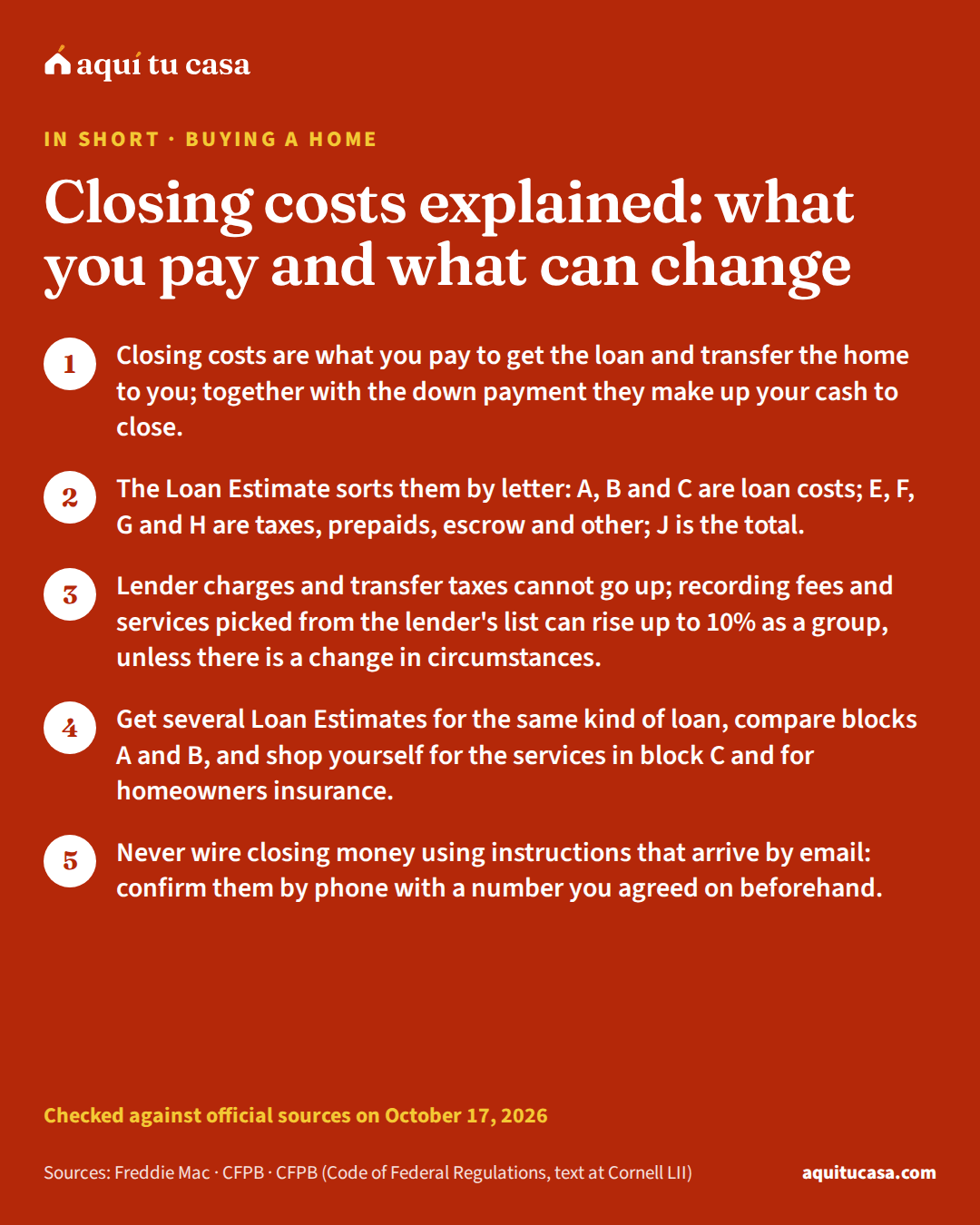
- Buying a home Closing costs explained: what you pay and what can change What closing costs are, how to read them on your Loan Estimate, which charges cannot go up before closing and how to compare offers to pay less. 14 minute read
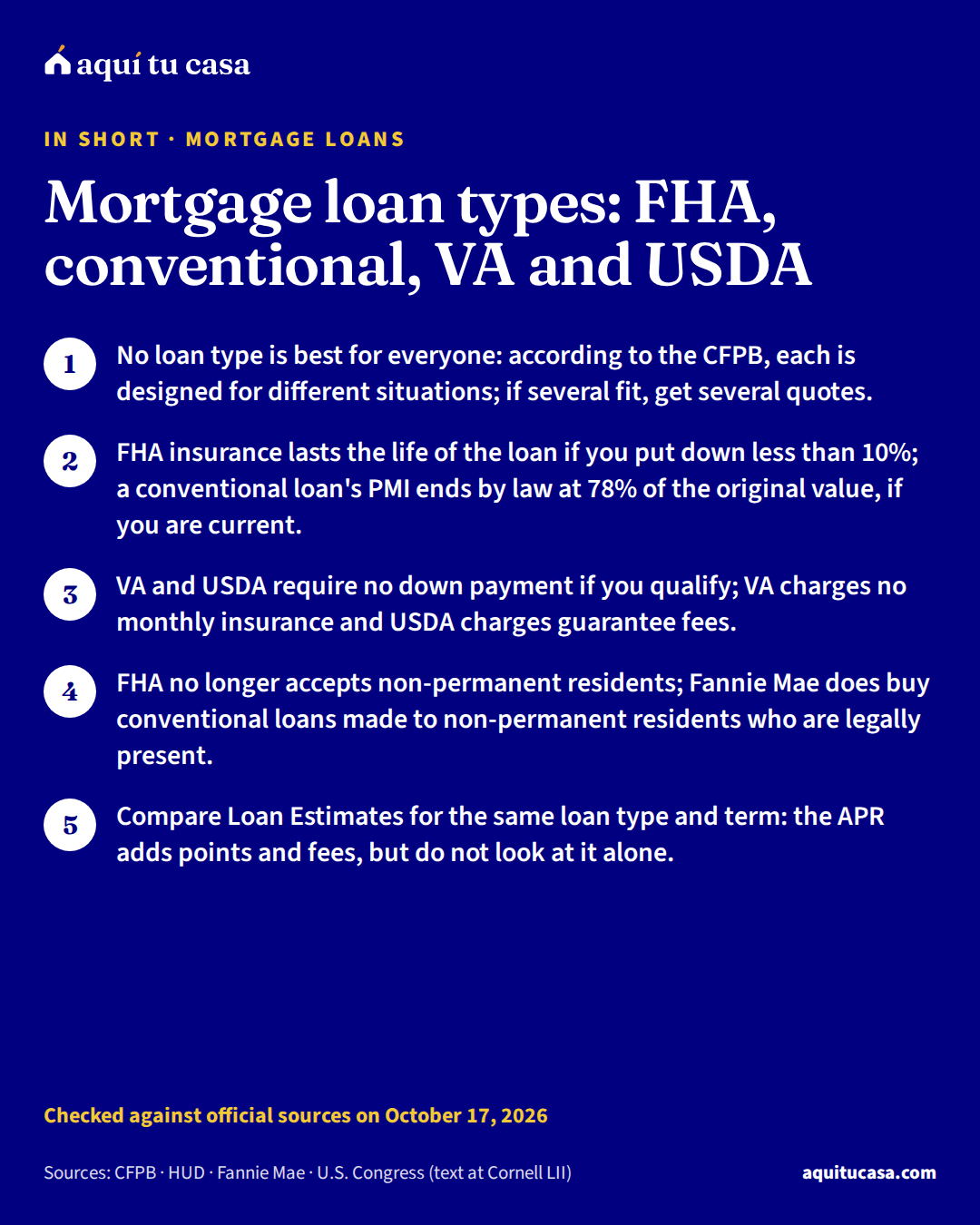
- Mortgage loans Mortgage loan types: FHA, conventional, VA and USDA What each mortgage type asks for, what its insurance costs, fixed or adjustable rate, points and APR. A neutral comparison with official sources. 14 minute read
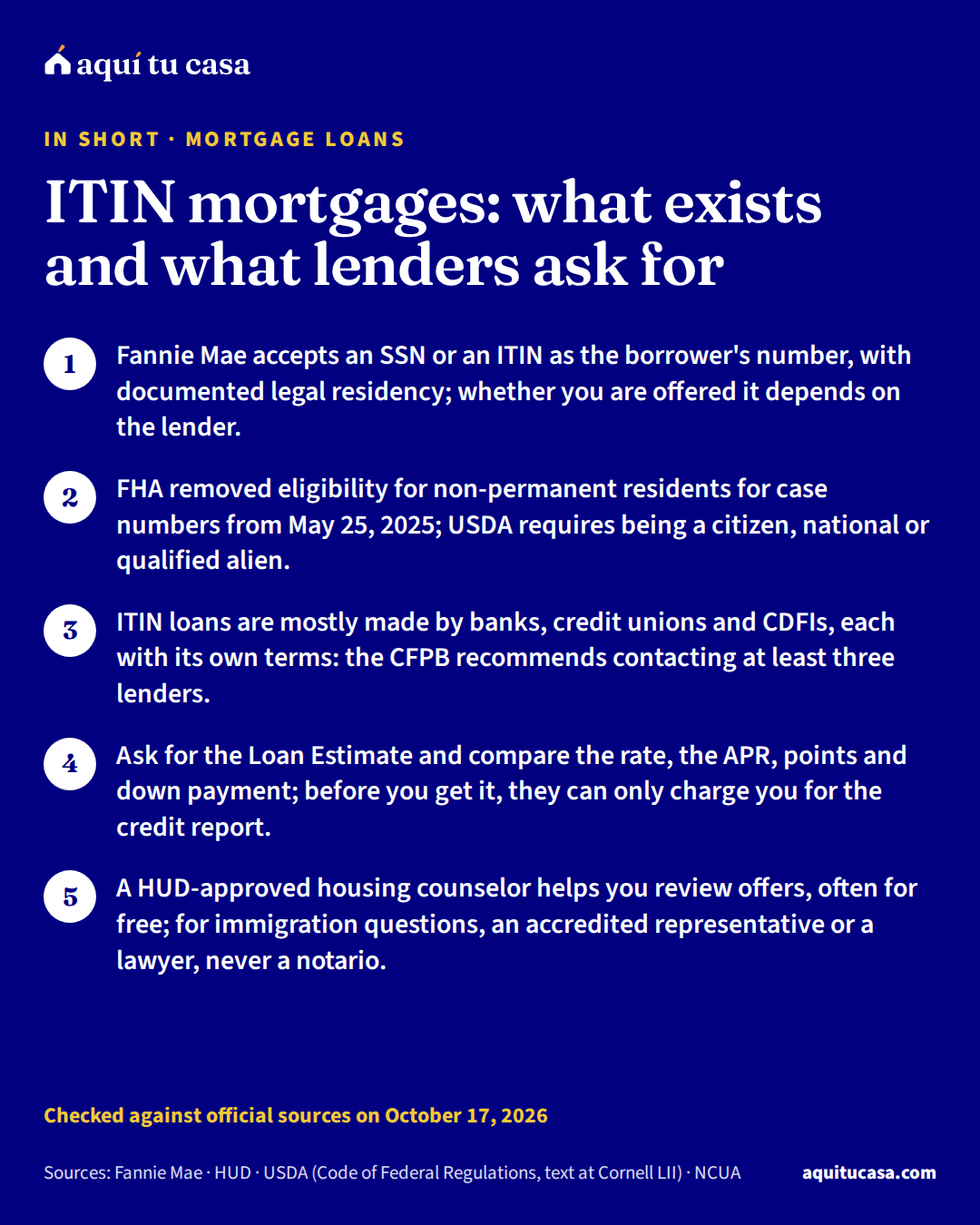
- Mortgage loans ITIN mortgages: what exists and what lenders ask for Which home loans accept an ITIN and which do not: Fannie Mae's rule, what FHA and USDA say, who lends and how to compare offers. 12 minute read
Tools for this topic
Was this guide useful?
Thank you. Your answer stays in your browser; nothing is sent.