No-overdraft-fee bank accounts: what Bank On means
What a Bank On certified account is, why an account helps you save and buy a home, credit unions, FDIC/NCUA insurance, check cashing and remittances.
Verified against official sources on October 17, 2026 20 official sources

Show contents
In short
What you need to know
Quick answer
A Bank On certified account is a basic bank or credit union account that meets a national standard: an opening deposit of $25 or less, a low or waivable monthly fee, and no overdraft, insufficient funds, inactivity or low balance fees. The list of certified accounts, by state, is on joinbankon.org, and you can search for credit unions on MyCreditUnion.gov. Before you open one, confirm the money is insured by the FDIC or the NCUA and ask which IDs they accept. An account can save you check-cashing costs and gives you the statements a lender reviews when you buy a home.
What matters most
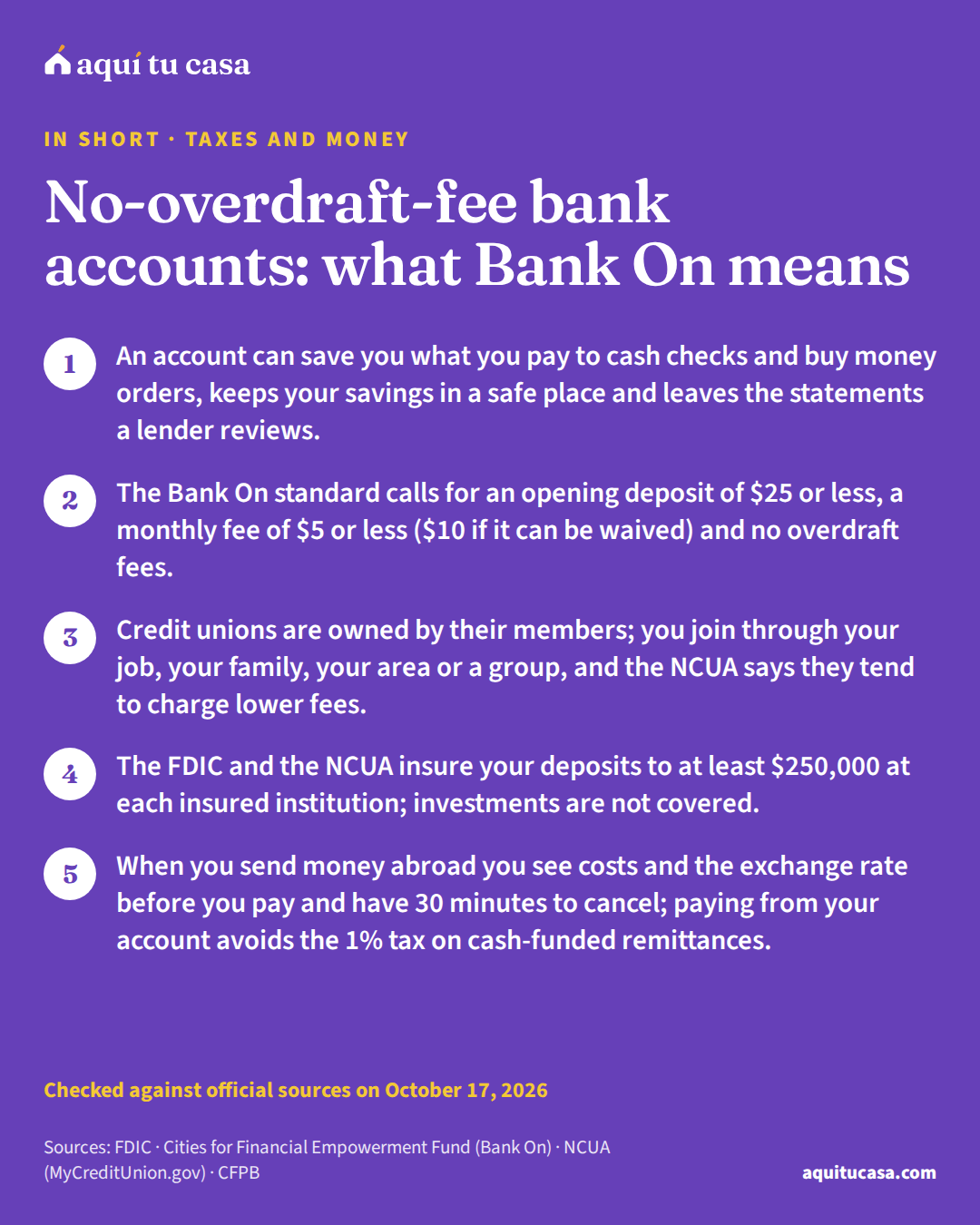
- An account can save you what you pay to cash checks and buy money orders, keeps your savings in a safe place and leaves the statements a lender reviews.
- The Bank On standard calls for an opening deposit of $25 or less, a monthly fee of $5 or less ($10 if it can be waived) and no overdraft fees.
- Credit unions are owned by their members; you join through your job, your family, your area or a group, and the NCUA says they tend to charge lower fees.
- The FDIC and the NCUA insure your deposits to at least $250,000 at each insured institution; investments are not covered.
Is this for you?
This guide is for you if…
- You are paid in cash or by check and pay a fee every time you cash it.
- Your account charges you for overdrafts, a low balance or not using it, and you want something cheaper.
- You send money abroad and want to know your rights and how to pay less.
- You want to start saving for rent, a security deposit or a down payment on a home.
Get direct help first if…
- You do not have a Social Security number and want the step-by-step for opening the account, or a bank already turned you down: start with the guide on opening a bank account without a Social Security number.
- Your question is about your tax return or your ITIN: an IRS VITA site helps for free; this guide does not replace that visit.
This guide is for you if you are paid in cash or by check, pay a fee to cash your checks, or want to start saving to rent or buy a home. You will see what a Bank On certified account is, where to find one, how to tell whether your money is insured, what the alternatives cost and what rights you have when you send money abroad.
What an account does for you: saving, paying and, later, buying a home
According to the FDIC, a deposit account can save you check-cashing fees: depositing checks is free in a bank, and paying bills can be cheaper without money orders.1 The CFPB adds that without an account you might have to pay to cash your paycheck, and that cash leaves no record of payment, which can be important for bills.9
For savings, the CFPB says a bank or credit union account is generally considered one of the safest places for your money; cash can be stolen, lost or destroyed.12 That is where your emergency fundemergency fundAn emergency fund is cash you set aside only for unplanned expenses or emergencies, such as car or home repairs, medical bills or a loss of income. It is not for routine monthly spending. The CFPB explains that without savings, even a small financial shock can push you into debt that is hard to pay off. How much you need depends on your situation; the CFPB suggests thinking about the unexpected expenses you have had before. You can keep it in a bank or credit union account, on a prepaid card or in cash, and it grows more easily with automatic saving or part of a tax refund.See the full definition and your down paymentdown paymentThe down payment is the part of the home's price you pay out of your own pocket when you buy; the loan covers the rest. In U.S. Spanish it is also called enganche, cuota inicial or entrada. Each loan type has its own minimum: FHA requires at least 3.5% of the value, VA and USDA loans may require none, and conventional loans ask for more if you want to avoid private mortgage insurance. A larger down payment lowers the loan, the monthly payment and the total interest; many state programs help families put it together.See the full definition savings begin.
When you apply for a mortgage, according to Fannie Mae’s Selling Guide, the lender can verify the money for closing, the down payment and reserves with your bank statementsbank statementA bank statement is the summary your bank or credit union gives you of the activity in your account over a period: deposits, withdrawals, payments and the ending balance. Most send one every month, on paper or online; the law only requires a monthly statement when there was at least one electronic transfer that month, and otherwise it may come quarterly. When you apply for a mortgage, the lender can use your statements to verify you have money for the down payment, closing and reserves. Under Fannie Mae's rules, they must show the bank's name, your name, part of the account number, the period, all transactions and the ending balance.See the full definition. They must identify the bank and you as the account holder, show all deposits and withdrawals and, for a purchase, cover the most recent full two months.13 An account does not give you credit by itself, but according to the FDIC it can be a first step toward other financial products;1 continue with credit from zero.
If this is you
You are paid in cash or by check
With an account, the bank generally cashes your check for free and your payments leave a record.9
You do not have a Social Security number
Some banks accept a foreign passport or a Matricula Consular; interest-bearing accounts require an SSN or an ITIN.8 The step by step is in how to open an account without a Social Security number.
You send money to your family
If you pay for the remittance from your account, the federal tax on cash-funded remittances does not apply.18
You are saving to buy a home
Your statements will be the proof of the money for the down payment and closing.13
What a Bank On certified account is
Bank On is the Cities for Financial Empowerment Fund’s (CFE Fund) national platform for connecting people to safe, affordable accounts. The CFE Fund developed the Bank On National Account Standards, inspired by an FDIC model for safe accounts, and banks and credit unions with accounts that meet them can apply for certification for free.3 According to the FDIC, those accounts have low and transparent costs and do not allow overdraft fees.1
This is what the 2025–2026 standards call for:4
| Item | What the Bank On standard calls for |
|---|---|
| Account type | Checking (including checkless checking) or prepaid, offered directly by the bank or credit union |
| Opening deposit | $25 or less |
| Monthly fee | $5 or less if it cannot be waived; $10 or less if a single transaction can waive it (for example, a direct deposit, an online bill payment or a debit card purchase) |
| Overdraft, insufficient funds, activation, closure, inactivity or low balance | No fee |
| ATMs | Free in network; $2.50 or less out of network (up to $3.00 if a partner network is also free) |
| Deposits | Free cash and check deposits in branch and at the ATM (where available); free direct deposit |
| Statements | Free electronic; paper for $2 or less (if offered) |
| Insurance | FDIC, NCUSIF (the NCUA’s insurance fund) or a regulator-sanctioned equivalent |
Beyond the core, the standard “strongly recommends” accepting ITINs and consular IDs as primary documentation, denying new customers only for actual fraud, and offering free savings, credit-building products and remittance services.4
How to find a Bank On account or a credit union
- On the Bank On list. The joinbankon.org website publishes certified bank and credit union accounts, by state.5 The FDIC also points to Bank On for opening an account online with a low opening deposit.1
- At a credit union. A credit unioncredit unionA credit union is a not-for-profit financial institution that, like a bank, accepts deposits, makes loans and offers other services, but is owned by its members. Members elect a volunteer board of directors, and profits go back to them as lower fees, higher savings rates and lower loan rates. To join you need a common bond, such as your employer, your family, where you live or a group you belong to. It is chartered by the NCUA, a federal agency, or by a state. If the credit union is federally insured, your deposits are protected by the NCUA's insurance fund.See the full definition is a not-for-profit financial institution owned by its members. To join you need a common bond: your employer, your family, living, working, worshiping or going to school in a certain area, or belonging to a group. The NCUA says that on average credit unions pay more on savings and charge less on loans, and tend to charge lower fees and require lower balances.6 You can search with the Find a Credit Union tool on MyCreditUnion.gov.7
- At your usual bank. Ask whether it has a Bank On certified account.

Your money, insured: FDIC and NCUA
At an FDIC-insured bank, deposit insurance covers $250,000 per depositor, per bank, for each account ownership category (single, joint and others). It covers checking, savings and money market deposit accounts and certificates of deposit (CDs). It does not cover stocks, bonds, mutual funds, annuities or crypto assets, even when a bank sells them. And it only covers deposits at FDIC-insured banks: check with the FDIC’s BankFind tool.2
At a federally insured credit union, NCUA share insurance is automatic when you join and covers at least $250,000 per member, backed by the U.S. government. Some state-chartered credit unions carry private insurance without that backing; federally insured ones must display the official NCUA sign.7
Which documents you may be asked for
According to the CFPB, the bank or credit union verifies your name, date of birth, address and an identification number: a Social Security number, an ITINITIN (Individual Taxpayer Identification Number)An ITIN is a nine-digit number the IRS, the federal tax agency, issues to people who need a U.S. taxpayer identification number to file taxes and are not eligible for a Social Security number. It is for tax purposes only: it does not authorize you to work in the United States, does not qualify you for Social Security benefits or the Earned Income Tax Credit, and says nothing about your immigration status. You apply with Form W-7, and it expires if it goes unused for several years. Some lenders accept an ITIN for a mortgage.See the full definition, your passport number and country, or another government-issued number. If you do not have a U.S. or state photo ID, some accept foreign passports and the Matricula Consularconsular ID cardA Matricula Consular is an official Mexican government ID document issued by Mexico's consulates in the United States. Other countries offer similar IDs, sometimes called consular identification (CID) cards. According to the CFPB, many banks require a U.S. or state government-issued photo ID; if you do not have one, some banks and credit unions accept foreign passports and consular IDs such as the Matricula, but not all, and the CFPB suggests asking first. You usually also need another document, such as a bill with your name and address, and an interest-bearing account requires an SSN or ITIN.See the full definition; each has its own policy. They usually also ask for a second document, such as a bill with your name and address.8 The FDIC confirms that many banks open accounts for people who are not citizens.1
The step-by-step, and what to do if you are turned down, is in Open a bank account without a Social Security number.
Check cashing and prepaid cards: what they cost
Without an account, you might have to pay to cash your paycheck; a bank or credit union where you have an account generally cashes it for free. Many payroll and prepaid cards charge for inactivity, purchases, ATM use and a monthly fee.9 The CFPB notes that most prepaid cards charge to maintain the account, make purchases or withdraw money, and that your employer cannot force you to take your wages on a payroll card.10
If a prepaid card works for you, compare: the CFPB’s rule requires providers to give you fee information before you choose, and generally you cannot spend more than you loaded. Even so, the CFPB suggests considering alternatives, such as a bank account.11
Three ways to handle your money
Bank or credit union
Bank On certified account
Check its fees
Prepaid or payroll card
The CFPB suggests considering a bank account before a prepaid card.11
Example with real numbers
Add up one month without a bank account
An example to fill in with your own receipts; we use no figures because every place charges differently.
- Cashing your paychecks
- What you were charged each time, for each check
- Money orders for rent and utilities
- The fee on each money order
- Your prepaid card
- Reload, ATM, purchase or monthly fees
- Compare it with a Bank On account
- A low or waivable monthly fee, with no overdraft or inactivity fees
Without an account you may pay to cash checks,9 and a Bank On account charges no overdraft or inactivity fees.4 What you stop paying can go into your savings plan.
Run it with your numbersDown payment savings planSending money abroad: your rights and how to pay less
Under federal law, a remittanceremittance transferA remittance transfer is an electronic money transfer you send from the United States to a person or company in another country through a remittance transfer provider, such as a bank or another financial services company. Federal law protects transfers above a minimum amount made by a provider in the normal course of its business. The provider must tell you, before and after you pay, the fees, taxes, exchange rate and how much the other person will receive, in your language if it advertises in it or served you in it. You have up to thirty minutes to cancel at no charge, if the money has not been picked up, and one hundred eighty days to report an error.See the full definition is an electronic transfer of more than $15 that you send from the U.S. to another country through a remittance provider.14 Your rights:
- Before you pay, the provider generally gives you, in writing, the amount being sent, the fees and taxes, the total, the exchange rate and how much your family will receive. When you pay, it gives you a receipt with that information, the date the money will be available and your rights.15
- In your language, generally, if the provider uses your language in its advertising where you send the money.14
- 30 minutes to cancel (with your details and the transfer’s), if the money has not been picked up or deposited: the provider must refund everything, fees included, within three business days. Transfers scheduled in advance follow a different rule.16
- 180 days to report a mistake, counted from the date the money was supposed to be available; the provider generally has 90 days to investigate.14
Sending money abroad with your rights
1. Compare companies
Before you send
Because you see the costs before you pay, you can compare with other companies.17
2. Read the disclosure before you pay
When you request the transfer
Amount, fees, taxes, total, exchange rate and what your family will receive, generally in writing.15
3. Pay from your account or with a U.S. card
On transfers made after December 31, 2025
That way the federal tax on cash-funded remittances does not apply.18
5. If you change your mind, cancel
Up to 30 minutes after you pay
If no one has picked up the money, you get everything back, fees included, within three business days.16
6. If there is a mistake, report it
Up to 180 days after the delivery date
The provider generally has 90 days to investigate.14
7. If they do not fix it, file a complaint
After trying with the company
You can submit a complaint to the CFPB.17
Because you see the costs before you pay, you can compare companies. If something goes wrong, contact the company right away; if it does not fix it, submit a complaint to the CFPB.17

Mistakes that cost you money
Mistake: Keeping an account that charges overdraft fees.
Instead: A Bank On account does not allow overdraft or insufficient funds fees.4
Mistake: Believing an app or a card is insured because it says so.
Instead: A prepaid card is only insured if it offers it and you register it; ask which bank holds the money.11
Mistake: Keeping all your savings in cash at home.
Instead: Cash can be lost or stolen; an account is one of the safest places for your money.12
Mistake: Paying for remittances with cash or a money order.
Instead: From your account, or with a U.S. debit or credit card, the federal remittance tax does not apply.18
Mistake: Letting months go by before reporting a mistake on a remittance.
Instead: You have 180 days from the delivery date to tell the provider.14
The family budget with several incomes guide helps you decide how much to send and how much to save each month.
What to do this week
- Add up what you paid last month to cash checks, buy money orders and use prepaid cards.
- Look up two or three accounts in your state on the Bank On list, or a credit union you can join.5
- Ask which IDs they accept and get the fee schedule in writing.8
- Confirm the insurance with the FDIC’s BankFind or the NCUA’s Find a Credit Union.2
- Open the account with your direct deposit and an automatic transfer to savings, and keep every statement.12 Set a goal with the down payment savings plan and move on to the credit plan.
- For help with your budget or your credit, a HUD-approved housing counselorHUD-approved housing counselorA HUD-approved housing counselor works at an agency HUD has approved to provide housing counseling: independent, expert advice customized to your situation about buying a home, renting, a missed mortgage payment, a foreclosure or credit problems. The agencies usually charge little or nothing; many serve in Spanish and offer the homebuyer education course several assistance programs require. They are not lenders or real estate agents and sell you nothing. Your county page lists the official agencies with phone numbers.See the full definition can go over it with you, often at no cost.20
Your numbers
We start with the typical home value in the United States ($332,700). Enter the price you are looking at.
Adjust advanced details
The minimum for this loan is 3.5%. A larger down payment lowers the monthly payment but takes longer to save.
As a share of the price. It is an example; your lender's Loan Estimate has the real figure.
Annual interest of the account where you keep the money. Leave it at zero if you do not know.
Let's do the math
Time to reach your goal
Enter how much you can save each month.
Your goal
- Down payment (3.5% of the price)
- $11,645
- Closing costs (3% of the price)
- $9,981
- Savings target
- $21,626
- You already have
- $0
- Still missing
- $21,626
What helps
- Set up an automatic transfer on payday into a separate account you do not use for spending.
- Ask about your state's and city's assistance programs before setting the goal: many cover part of the down payment or closing costs.
- If family gives you part of it, the lender usually asks for a gift letter and the transfer record; ask beforehand how they want it.
- Revisit the goal whenever the price you are looking at, the loan type or what you can save changes.
An educational estimate, not a loan offer. Closing costs are an example (3% of the price); the real figure comes in the Loan Estimate. We do not count the reserves some lenders require after closing.
Ready to see the numbers? Find your county here
See how this applies in your county: its loan limits, prices and rents, from the official data.
Printable checklist
Frequently asked questions
Is a Bank On account free?
Not always. The standard allows a monthly fee of $5 or less, or $10 or less if a single transaction such as a direct deposit can waive it. What it does not allow are overdraft, insufficient funds, activation, closure, inactivity or low balance fees.
Can I open an account with a Matricula Consular or an ITIN?
It depends on each bank or credit union. According to the CFPB, some accept foreign passports and consular IDs, each with its own policy; the Bank On standard recommends accepting ITINs and consular IDs. For an interest-bearing account you will be asked for a Social Security number or an ITIN.
Which is better, a bank or a credit union?
Both work if they are insured (FDIC or NCUA). The NCUA says credit unions, on average, pay more on savings, charge less on loans and tend to have lower fees, but you have to be able to join. Compare each account's actual fees using the CFPB checklist questions.
Does opening an account give me a credit history?
A deposit account is not a loan. The FDIC explains that a relationship with a bank can be a first step toward other financial products, and the Bank On standard recommends access to credit-building products. The step-by-step plan is in the credit-from-zero guide.
Why send remittances from an account?
Because, for transfers made after December 31, 2025, federal law taxes remittances funded with cash, money orders or cashier's checks at 1%, but not those withdrawn from a bank or credit union account or paid with a debit or credit card issued in the U.S. Whatever way you pay, you have the right to see the cost and the exchange rate before you pay.
How long do I have to cancel a remittance?
Generally 30 minutes after you pay, if the money has not been picked up or deposited into the recipient's account. The provider must refund everything, fees included, within three business days. Transfers scheduled in advance follow a different rule.
Is my prepaid card insured?
Only if the card offers FDIC or NCUA insurance and you register it. If something says “insured,” ask which bank or credit union holds the money and look it up yourself with the FDIC's BankFind or the NCUA's Find a Credit Union.
Sources
Every figure in this guide comes from one of these official sources. The number next to a sentence leads to the source behind it.
Each source on one line: who publishes it, its title, its address and the date we read it.
- 1. FDIC · #GetBanked · fdic.gov · Accessed October 17, 2026
- 2. FDIC · Understanding Deposit Insurance · fdic.gov · Accessed October 17, 2026
- 3. Cities for Financial Empowerment Fund (Bank On) · About (Bank On) · joinbankon.org · Accessed October 17, 2026
- 4. Cities for Financial Empowerment Fund (Bank On) · Bank On National Account Standards (2025–2026) · joinbankon.org · Accessed October 17, 2026
- 5. Cities for Financial Empowerment Fund (Bank On) · Accounts (list of Bank On certified accounts) · joinbankon.org · Accessed October 17, 2026
- 6. NCUA (MyCreditUnion.gov) · What is a Credit Union? · mycreditunion.gov · Accessed October 17, 2026
- 7. NCUA (MyCreditUnion.gov) · Share Insurance · mycreditunion.gov · Accessed October 17, 2026
- 8. CFPB · Checklist for opening a bank or credit union account (A Newcomer's Guide to Managing Money) · files.consumerfinance.gov · Accessed October 17, 2026
See the other 12 sources
- 9. CFPB · Ways to receive your money (A Newcomer's Guide to Managing Money) · files.consumerfinance.gov · Accessed October 17, 2026
- 10. CFPB · Prepaid cards and other prepaid accounts · consumerfinance.gov · Accessed October 17, 2026
- 11. CFPB · Choose the right card for your situation · consumerfinance.gov · Accessed October 17, 2026
- 12. CFPB · An essential guide to building an emergency fund · consumerfinance.gov · Accessed October 17, 2026
- 13. Fannie Mae · Fannie Mae Selling Guide B3-4.2-01, Verification of Deposits and Assets · selling-guide.fanniemae.com · Accessed October 17, 2026
- 14. CFPB · What is a remittance transfer and what are my rights? · consumerfinance.gov · Accessed October 17, 2026
- 15. CFPB (Code of Federal Regulations, text at Cornell LII) · 12 CFR §1005.31, Disclosures (remittance transfers, Regulation E) · law.cornell.edu · Accessed October 17, 2026
- 16. CFPB (Code of Federal Regulations, text at Cornell LII) · 12 CFR §1005.34, Procedures for cancellation and refund of remittance transfers · law.cornell.edu · Accessed October 17, 2026
- 17. CFPB · Problems sending money to another country? · consumerfinance.gov · Accessed October 17, 2026
- 18. U.S. Congress (United States Code, text at Cornell LII) · 26 U.S.C. §4475, Imposition of tax (remittance transfer tax) · law.cornell.edu · Accessed October 17, 2026
- 19. U.S. Congress (United States Code, text at Cornell LII) · 31 U.S.C. §5312, Definitions and application · law.cornell.edu · Accessed October 17, 2026
- 20. CFPB · Find a Housing Counselor · consumerfinance.gov · Accessed October 17, 2026
Keep reading
Related guides
If this guide helped, these follow the same path.

ITIN 11 minute read
How to open a bank account without a Social Security number
What banks and credit unions ask for to open an account without a Social Security number (ITIN, passport or consular ID) and which account to pick.
- Federal law allows opening an account with an ITIN, a passport, an alien identification card or another government document; the bank chooses which it accepts.
- Bring a photo ID, a second proof (a bill or birth certificate), your ITIN if you have one and the opening deposit, usually between $25 and $100.
- Without a Social Security number or an ITIN you may only be able to open a no-interest account; with an ITIN, you sign the W-9 with that number.
- Taxes and money A family budget with several incomes: how to build it How to budget when several incomes, cash and remittances come into the home: tracking, weekly cash flow, rent and the emergency fund. 11 minute read
- Credit Credit from zero: how to start your history in the U.S. What credit reports and scores are, how to get them for free, and how to start a history from nothing with a secured card or a credit-builder loan. 16 minute read
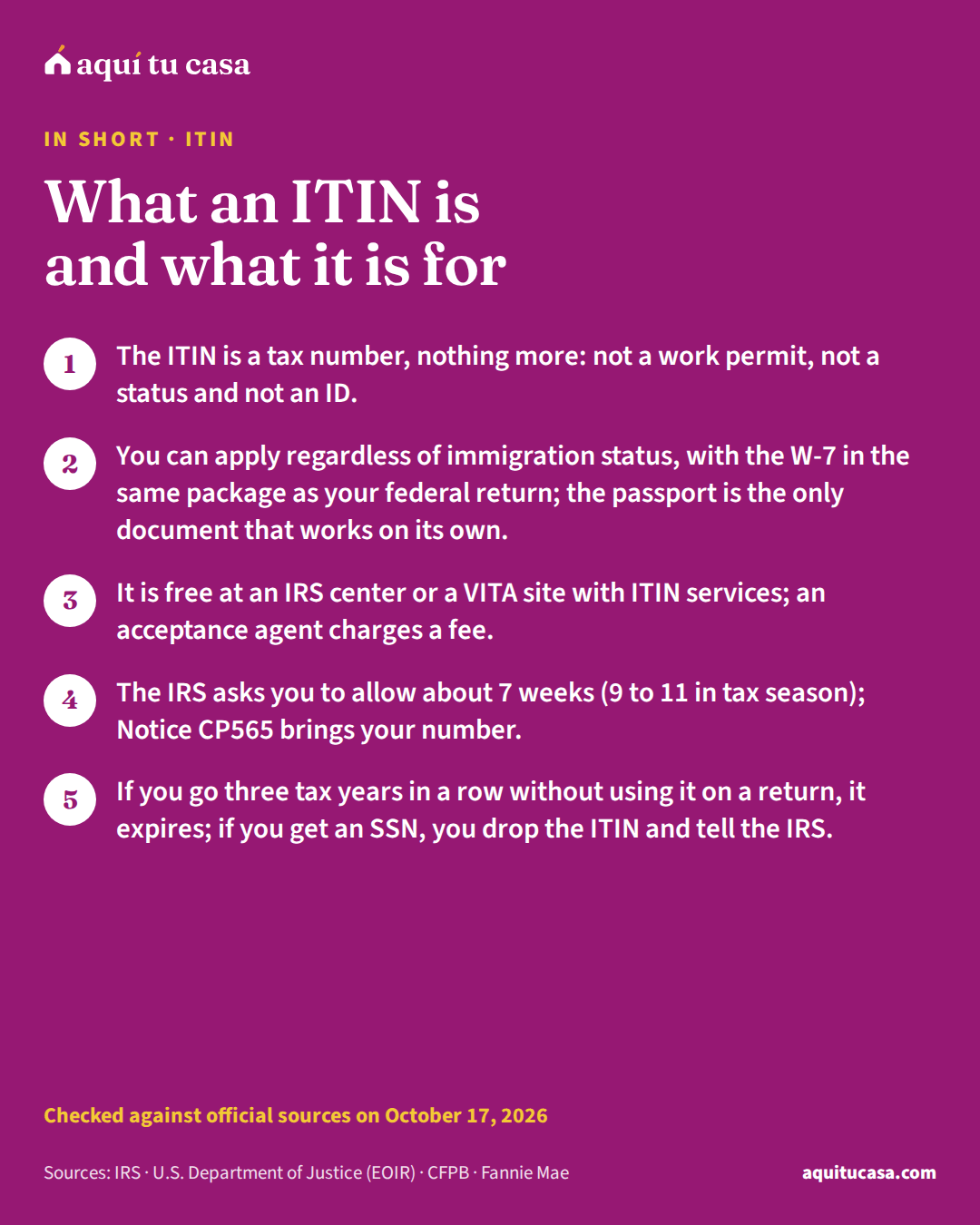
- ITIN What an ITIN is and what it is for The ITIN is the IRS number for filing taxes without a Social Security number: what it does and does not do, how to apply with Form W-7, timing and expiry. 15 minute read
Tools for this topic
Was this guide useful?
Thank you. Your answer stays in your browser; nothing is sent.