When your home is too cold or too hot: heat and air conditioning
What to do if the heat goes out or your home gets dangerously hot: temperature rules, safe space heaters, carbon monoxide and help paying.
Verified against official sources on October 31, 2026 7 official sources
Show contents
In short
What you need to know
Quick answer
If the heat goes out or your home gets too hot, first look after the people most at risk: babies, older adults, pregnant women and anyone with a chronic illness. If you rent, notify your landlord in writing; some cities set minimum temperatures, such as New York during heat season. Meanwhile, use space heaters carefully: away from anything that burns, without extension cords and never while you sleep. Never heat your home with a gas oven or use a generator or grill inside, and install carbon monoxide detectors. To pay for heating or cooling, apply for LIHEAP.
What matters most
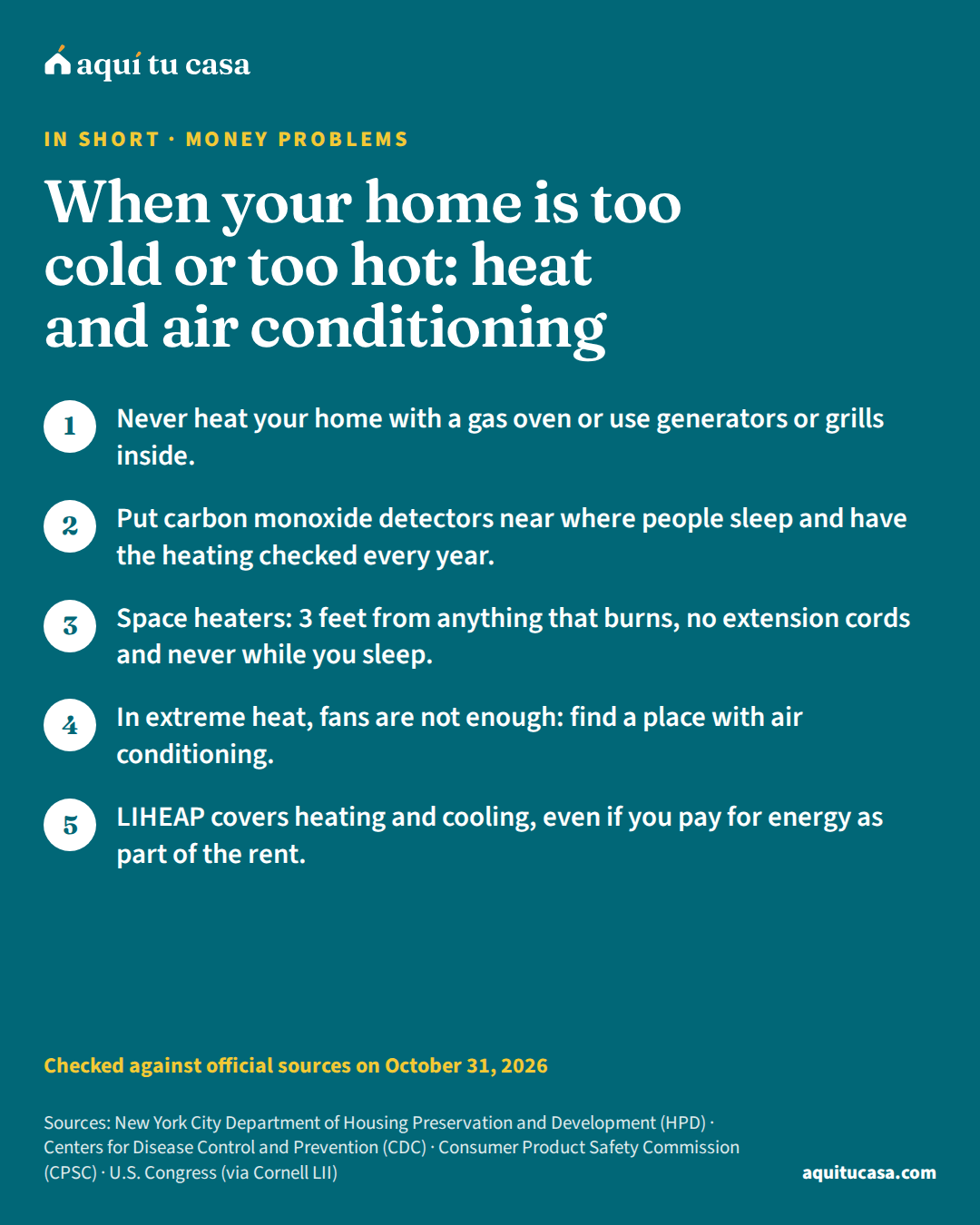
- Never heat your home with a gas oven or use generators or grills inside.
- Put carbon monoxide detectors near where people sleep and have the heating checked every year.
- Space heaters: 3 feet from anything that burns, no extension cords and never while you sleep.
- In extreme heat, fans are not enough: find a place with air conditioning.
Is this for you?
This guide is for you if…
- Your heat or air conditioning broke down and you do not know what to do while it gets fixed.
- You rent and your landlord does not provide enough heat in winter.
- You use space heaters or a generator and want to do it safely.
Get direct help first if…
- You smell gas, your carbon monoxide alarm is sounding or someone feels sick: get out of the home and call 911.
- You got a notice that your power or gas will be shut off: read «Utility shutoffs» first.
When the heat breaks down in the middle of winter, or the air conditioning in a heat wave, a home becomes dangerous quickly, especially for babies and older adults. And many of the quick fixes people use, such as turning on the oven or bringing a generator inside, can be more dangerous than the cold. This guide explains what to do while the problem gets fixed, what a renter can ask of a landlord and where to look for help paying. If your power or gas is about to be shut off, the guide Utility shutoffs explains the notices and state protections, including the medical certificate.
First: who is most at risk
Cold and heat do not affect everyone the same way. According to the CDC, people aged 65 or older are more prone to heat-related health problems; infants and young children rely on others to stay cool and hydrated; heat is especially dangerous for people with chronic conditions; and pregnancy makes you more likely to get sick when it is very hot. People without air conditioning are also at risk.5 Carbon monoxide is similar: everyone is at risk, but more so infants, the elderly and people with heart disease, anemia or breathing problems.2
If someone like that lives in your home, act early. Have a plan to take them somewhere safe, and if they depend on medical equipment that uses electricity, ask your power company about its rules for customers with medical needs. The guide to utility shutoffs explains how the medical certificatemedical certificate (utility shutoff)A medical certificate, for services like electricity or gas, is a statement from a doctor or other health professional telling the company that a shutoff would endanger the health of someone who lives in the home. The rules vary by state. In New York, the company cannot shut off service while a certified medical emergency exists. In Arizona, a customer who cannot pay provides documentation from a licensed medical practitioner every year. In Texas, the doctor calls the company and sends a written statement, and you enter a payment plan. In New York and Texas, the protection lasts a limited time.See the full definition works in several states.
If the heat goes out: staying warm safely
The urge to warm up fast leads to mistakes that kill. The CDC is clear:
- Never heat your home with a gas oven.2
- Do not use generators or grills in or next to your home. The generator goes outside, at least 20 feet from doors, windows and vents.3
- Install carbon monoxide detectors, battery-operated or with battery back-up, near every sleeping area.2
- Have a qualified technician service your heating system, water heater and gas, oil or coal-burning appliances every year.2
If you use a portable space heater, the CPSC gives these rules:4
- Keep at least 3 feet clear on all sides: away from beds, clothes, curtains, papers and sofas.
- Never plug it into an extension cord or power strip, and do not run the cord under rugs.
- Place it on a stable, level surface where it will not be knocked over, and away from water.
- Never leave it on with nobody in the room or while you sleep.
- If the cord or plug is hot, disconnect it.
- Check SaferProducts.gov to see whether your model has been recalled.
The first night without heat
2. Notify whoever must fix it
Today
Your landlord, in writing, or your technician if you own the home.1
3. Gather the family in one room
Tonight
With warm clothes and blankets; never turn on the oven for heat.2
4. Use the heater by the rules
If you need it
3 feet from everything, plugged straight into the wall and off when you sleep.4
5. If there is risk, leave the home
If the cold continues
Go to relatives or a shelter; whoever is most at risk goes first.5
If you rent: what you can ask your landlord for
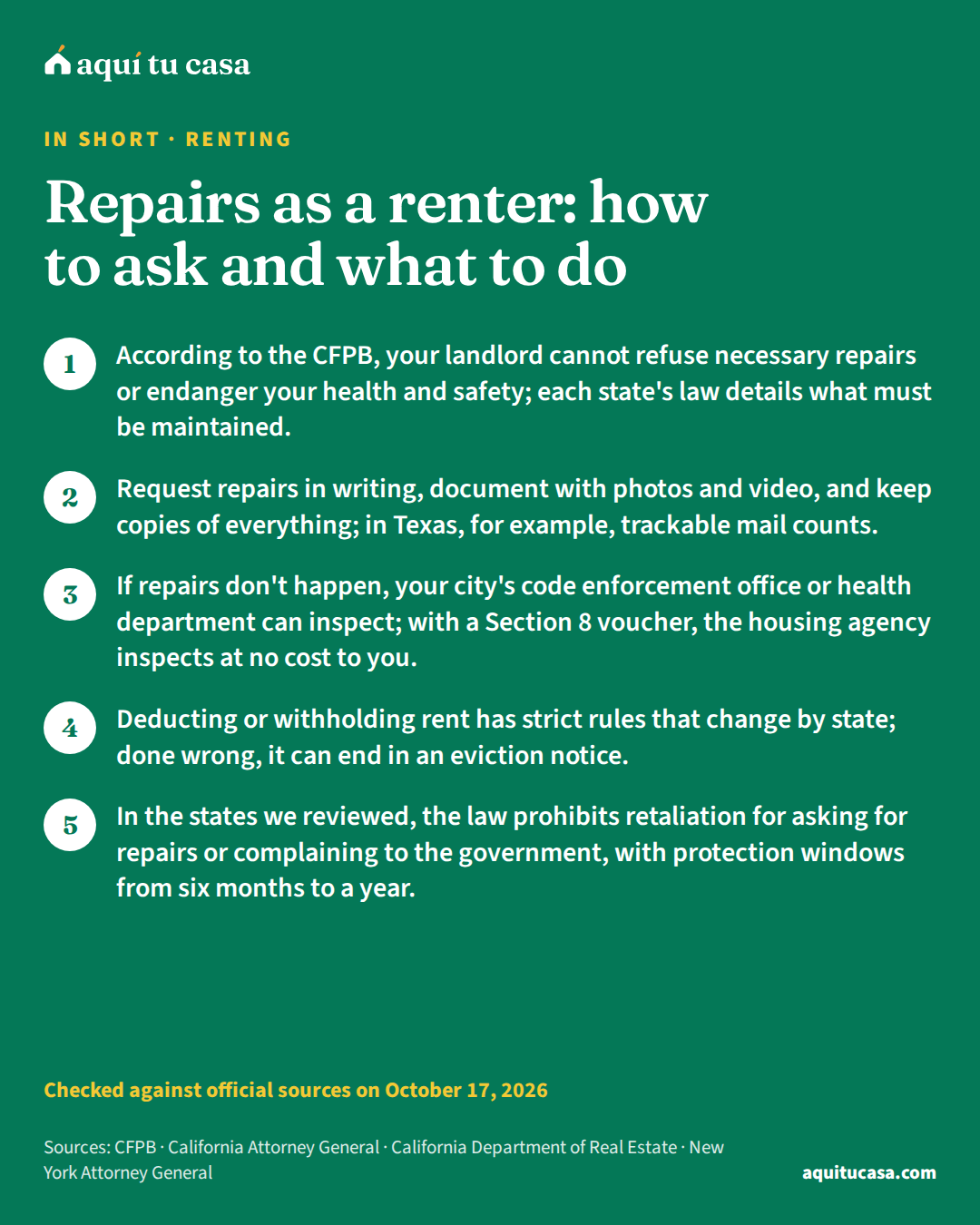
The guide Repairs and housing conditions explains the warranty of habitabilitywarranty of habitabilityThe warranty of habitability is a tenant's right to a livable, safe and sanitary home. The rules depend on the state. In New York, according to the Attorney General's office, this right is implied in every written or oral residential lease, and a lease clause that waives it is void; it is breached, for example, when heat or hot water is not provided regularly. In California, the landlord must keep plumbing, heating, electrical equipment and locks in working order and keep the unit free of pests. In Arizona, the law requires keeping the home in a fit and habitable condition.See the full definition, with examples from several states that include heating among what the landlord must maintain, and how to request a repair in writing.
Some cities go further and set minimum temperatures. One example: in New York City, from October 1 to May 31, owners must provide heat. Between 6:00 a.m. and 10:00 p.m., if it is below 55 °F outside, it must be at least 68 °F inside. Between 10:00 p.m. and 6:00 a.m., at least 62 °F, however cold it is. They must also provide hot water at a minimum of 120 °F all year. The city says to contact the owner first, and if it is not fixed, to complain to 311, online or through the app.1
If your city has similar rules, ask the code inspection or housing office. Meanwhile, document: take photos of your thermometer with the time and keep a copy of each notice. And if the landlord threatens you for complaining, read Landlord retaliation.
Example with real numbers
How to document a lack of heat
An example in words, not a real case, using New York City's rule.
- January night, 11:00 p.m.
- The thermometer reads below 62 °F: photo with the time
- Next day, 9:00 a.m., 40 °F outside
- Inside reads below 68 °F: another photo
- Notice to the owner
- In writing, dated, and you keep a copy
- If it is not fixed
- Complaint to 311 or through the app
- What you have in the end
- Photos, dates and notices that prove the problem
The temperatures come from New York's HPD.1 In other cities, the rule may be different; ask your code office.
If your home is too hot
According to the CDC, if you have no air conditioning, do not rely only on fans: when it is very hot, they will not prevent heat-related illness. What it does recommend:6
- Contact your local health department or find an air-conditioned shelter. A few hours at a mall or public library help.
- Drink more water than usual, without waiting until you are thirsty.
- Use a buddy system: check on a friend or neighbor, and ask someone to do the same for you.
- Take cool showers or baths.
- Use the stove and oven less so the home does not heat up more.
If your air conditioning broke and you rent, notify the landlord in writing just as you would for heat. If you own the home and cannot pay for the repair, the guide to USDA 504 home repair loans and grants explains an option in rural areas, and Budgeting for home maintenance and repairs helps you prepare for next time.
If this is your situation
You rent and there is no heat
Notify the owner in writing; in New York, if it is not fixed, you can complain to 311.1
An older adult lives with you
They are at higher risk in the heat; take them somewhere with air conditioning.56
You have a baby at home
Babies depend on you to stay cool and hydrated; act early.5
The power is out and you have a generator
Outside, 20 feet from doors, windows and vents; never inside.3
You cannot pay for heating or cooling
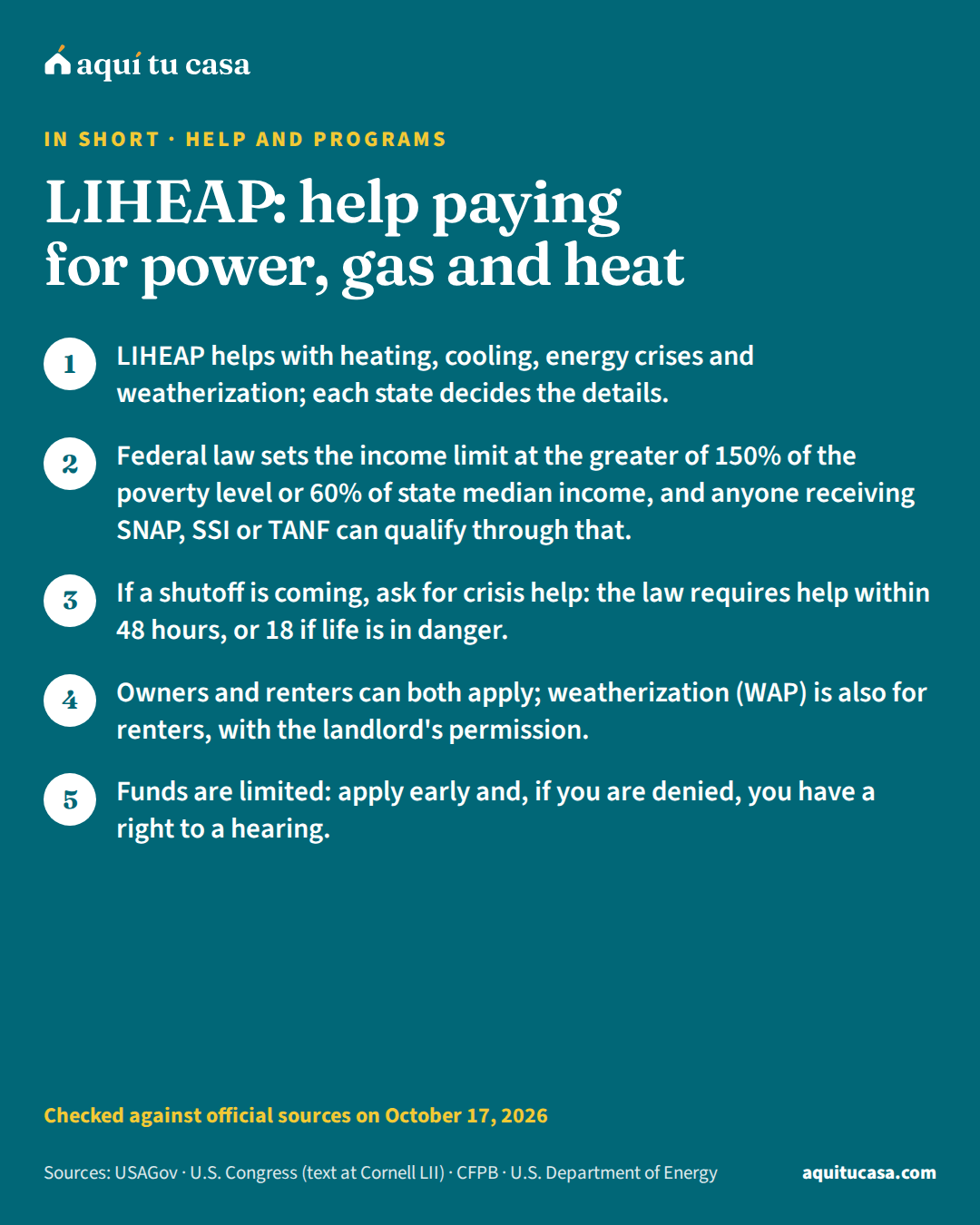
LIHEAP covers heating and cooling, even if you pay for energy in the rent.7
Get ready before the season starts
Many cold and heat emergencies can be avoided with a few weeks’ notice. Before winter, have a qualified technician check the heating, water heater and gas appliances, as the CDC recommends, and change the batteries in your carbon monoxide detectors.2 If you are keeping a space heater from last year, check it on SaferProducts.gov before turning it on.4
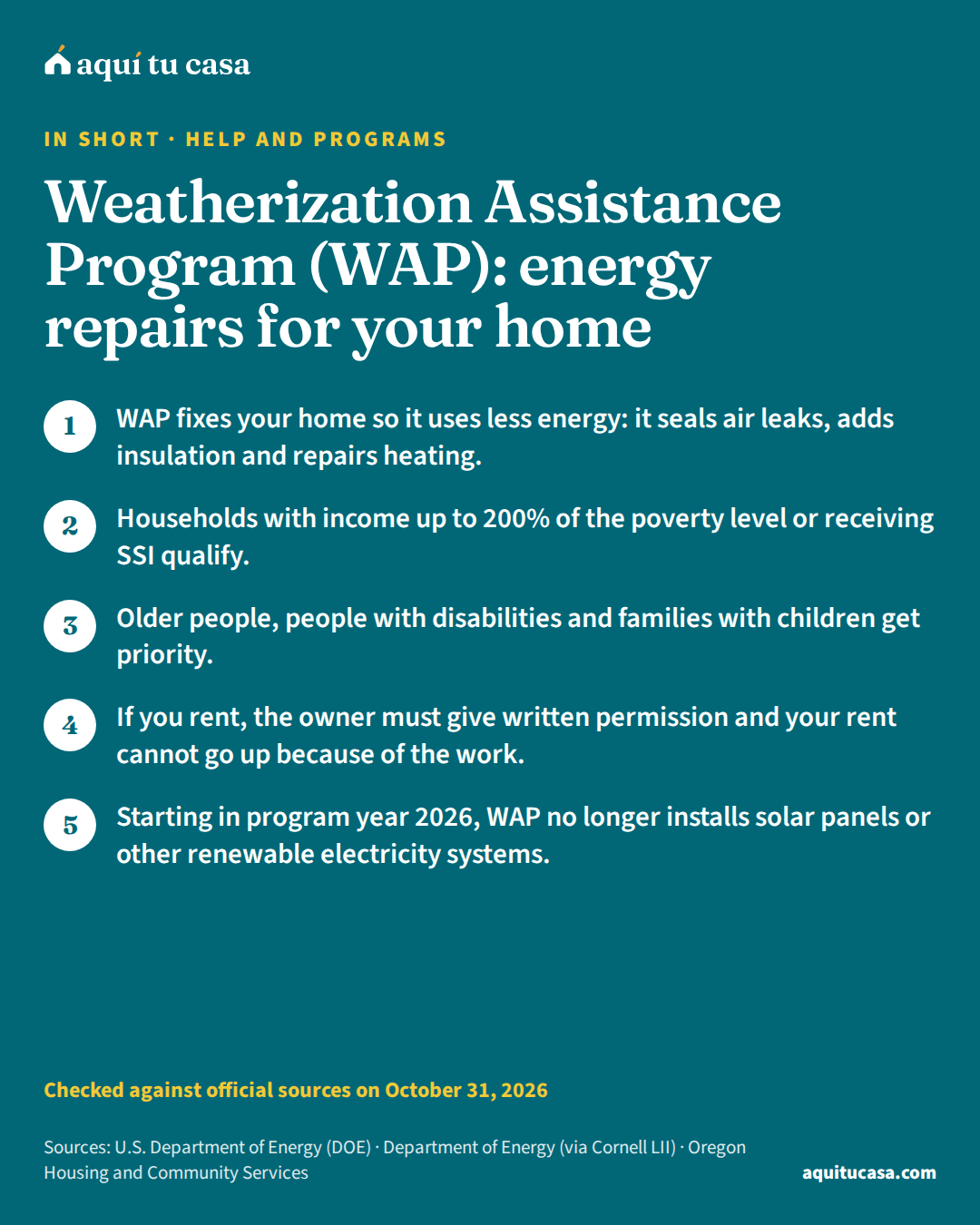
Before summer, find the nearest air-conditioned shelter or place and agree with a neighbor or relative to check on each other on the hottest days.6 If you have a generator for outages, decide now where you will put it outside, away from doors and windows.3 And if your home loses a lot of heat or cool air through windows, doors or the roof, the weatherization program can help you spend less.

Help paying for heating and cooling
The LIHEAP law defines home energy as a source of heating or cooling, so the program can also help you with air conditioning. A weather-related or supply shortage emergency counts as an energy crisis. And a fact few people know: the law counts as a household people who pay for energy as part of the rent.7 If heat is included in your rent, ask your LIHEAP office whether you can apply. The CDC also recommends contacting LIHEAP if you need help paying for cooling.6
The guide LIHEAP: help with utility bills explains how to apply, and the one on the Weatherization Assistance Program (WAP) explains how to make your home use less energy. The utility costs tool helps you see how much energy weighs in your budget.
Costly mistakes
Mistake: Turning on the gas oven to heat the home.
Instead: Never do it; use warm clothes and a safe heater.2
Mistake: Putting the generator in the garage or by the window.
Instead: Outside, at least 20 feet from doors, windows and vents.3
Mistake: Plugging the heater into an extension cord.
Instead: Plug it straight into the wall and do not run the cord under a rug.4
Mistake: Sleeping with the heater on.
Instead: Turn it off before you sleep or when you leave the room.4
Mistake: Relying only on a fan in a heat wave.
Instead: Find a place with air conditioning for a few hours.6
Mistake: Not having a carbon monoxide detector.
Instead: Put a battery-operated one near every sleeping area.2
What to do this week
- Buy or check your battery-operated carbon monoxide detectors.2
- Schedule a check of your heating and gas appliances before winter.2
- Check your space heater on SaferProducts.gov and follow the CPSC rules.4
- If you rent and the heat is out, notify the landlord in writing and keep a copy.1
- Write down where the nearest shelter or air-conditioned place is.6
- If paying is hard, apply for LIHEAP and review your family budget.7
Your household this month
Let's do the math
Left each month
Enter what at least one person takes home to see the result.
What helps
- Pay savings first: set the goal aside the day the money arrives, before flexible spending.
- Add up the bills that come every few months (car insurance, school) and divide by twelve.
- If income changes, plan on a low month and save the extra from good months.
- A HUD-approved housing counselor can go over the budget with you, often for free.
This is a planning tool with your numbers, not a credit evaluation or an approval. The split reference is only a guide.
Ready to see the numbers? Find your county here
See how this applies in your county: its loan limits, prices and rents, from the official data.
Printable checklist
Frequently asked questions
The heat went out and it is very cold. Can I turn on the oven for heat?
No. The CDC says never heat your house with a gas oven, because of the carbon monoxide risk. Dress warmly, gather the family in one room and, if you use a space heater, follow the safety rules.
How much heat does my landlord have to provide?
It depends on your state and city. In New York City, from October 1 to May 31, it must be at least 68 °F during the day when it is below 55 °F outside, and at least 62 °F at night. Ask your city what its rule is.
How do I use a space heater safely?
The CPSC recommends keeping 3 feet clear around it, plugging it straight into the wall rather than an extension cord, placing it on a stable surface and never leaving it on unattended or while you sleep.
Where do I put the generator when the power goes out?
Outside, at least 20 feet from doors, windows and vents, according to the CDC. Never inside the home, the garage or next to the house.
What are the signs of carbon monoxide?
Headache, dizziness, weakness, upset stomach, vomiting, chest pain and confusion, similar to the flu. If you suspect it, get to fresh air and call 911.
I have no air conditioning. Is a fan enough?
Not always. The CDC says that when it is very hot, fans will not prevent heat-related illness. Find an air-conditioned shelter or spend a few hours at a library or mall.
Heat is included in my rent. Can I apply for LIHEAP?
Possibly. The LIHEAP law counts as a household people who pay for energy as part of the rent. Ask your state's LIHEAP office.
Sources
Every figure in this guide comes from one of these official sources. The number next to a sentence leads to the source behind it.
Each source on one line: who publishes it, its title, its address and the date we read it.
- 1. New York City Department of Housing Preservation and Development (HPD) · Heat and Hot Water Information · nyc.gov · Accessed October 31, 2026
- 2. Centers for Disease Control and Prevention (CDC) · Carbon Monoxide (CO) Poisoning Basics · cdc.gov · Accessed October 31, 2026
- 3. Centers for Disease Control and Prevention (CDC) · Avoiding Carbon Monoxide Poisoning · cdc.gov · Accessed October 31, 2026
- 4. Consumer Product Safety Commission (CPSC) · 7 Highly Effective Portable Heater Safety Habits · cpsc.gov · Accessed October 31, 2026
- 5. Centers for Disease Control and Prevention (CDC) · Heat and Your Health: Risk Factors · cdc.gov · Accessed October 31, 2026
- 6. Centers for Disease Control and Prevention (CDC) · Heat and People without Air Conditioning · cdc.gov · Accessed October 31, 2026
- 7. U.S. Congress (via Cornell LII) · 42 U.S.C. §8622, Definitions (Low-Income Home Energy Assistance) · law.cornell.edu · Accessed October 31, 2026
Keep reading
Related guides
If this guide helped, these follow the same path.

Money problems 11 minute read
Power or gas shutoff notice: your protections and next steps
If your power or gas is about to be shut off for non-payment: notice periods, health and extreme-weather protections, crisis help and how to complain.
- Before cutting you off for non-payment, the utility must give you notice: the period depends on the state.
- If someone at home is sick or depends on medical equipment, in several states a doctor's certificate can stop the shutoff.
- Texas, Arizona and New York have protections for extreme cold or heat.
- Help and programs LIHEAP: help paying for power, gas and heat What LIHEAP is, who qualifies, how to apply in your state, crisis help when a shutoff is coming and free weatherization (WAP) to lower your bills. 10 minute read
- Help and programs Weatherization Assistance Program (WAP): energy repairs for your home How DOE's Weatherization Assistance Program (WAP) works: who qualifies, what gets fixed in your home, how to apply and what protects renters. 10 minute read
- Renting Repairs as a renter: how to ask and what to do Which repairs fall on the landlord, how to request them in writing, when to call your city's code inspectors and the risks of withholding rent. 13 minute read
Tools for this topic
Was this guide useful?
Thank you. Your answer stays in your browser; nothing is sent.