Power or gas shutoff notice: your protections and next steps
If your power or gas is about to be shut off for non-payment: notice periods, health and extreme-weather protections, crisis help and how to complain.
Verified against official sources on October 17, 2026 12 official sources

Show contents
In short
What you need to know
Quick answer
If you got a notice that your power or gas will be cut for non-payment, you still have time and options. Each state sets its own rules: for example, in Texas the shutoff must be at least ten days after the notice, in Florida you need at least 5 working days' written notice and in New York the final notice comes 15 days ahead. Several states protect households with someone sick at home or during extreme cold or heat. Call the utility now to ask for a payment plan, ask for LIHEAP crisis help and, if they cut you off without following the rules, complain to your state's utility commission.
What matters most
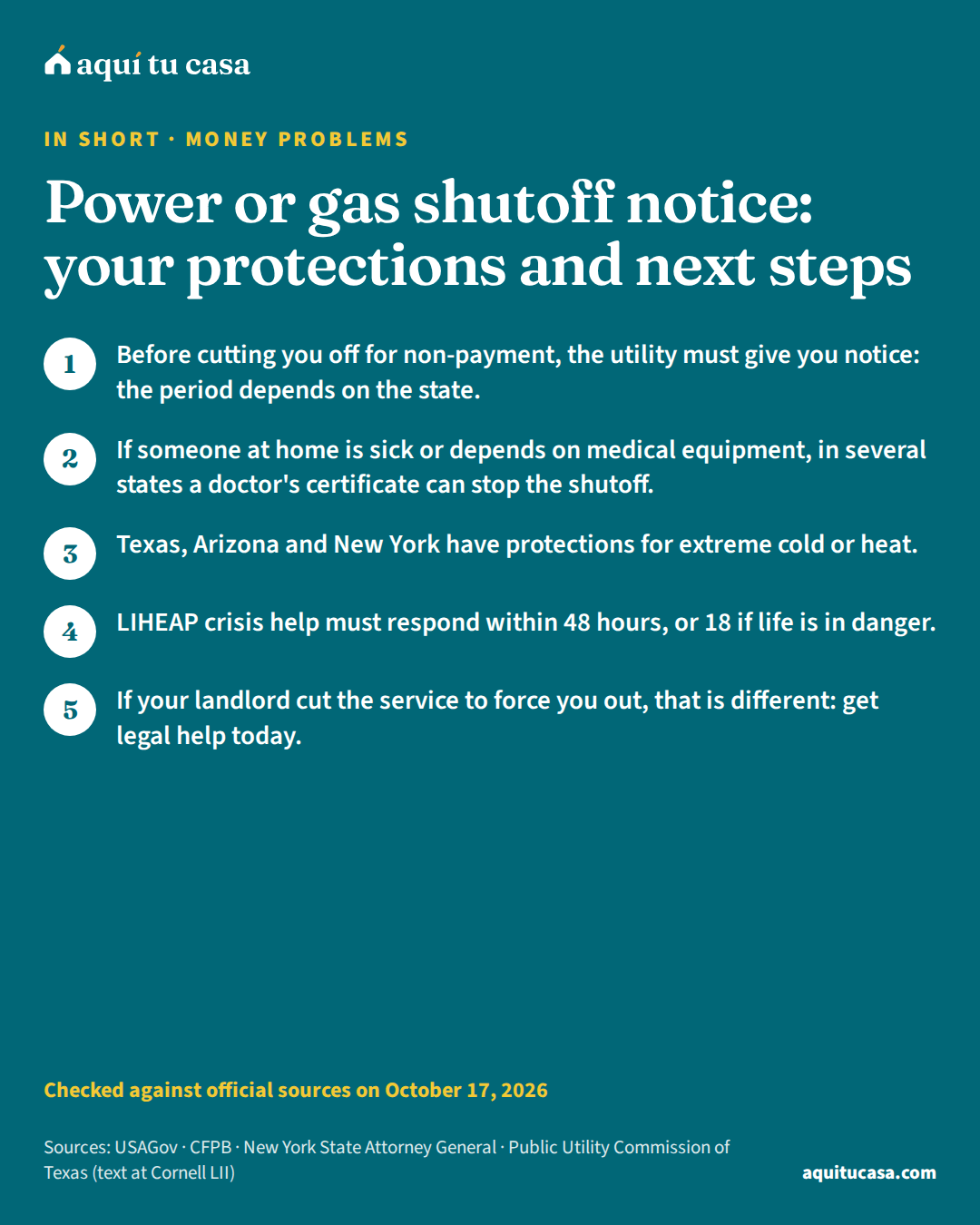
- Before cutting you off for non-payment, the utility must give you notice: the period depends on the state.
- If someone at home is sick or depends on medical equipment, in several states a doctor's certificate can stop the shutoff.
- Texas, Arizona and New York have protections for extreme cold or heat.
- LIHEAP crisis help must respond within 48 hours, or 18 if life is in danger.
Is this for you?
This guide is for you if…
- You got a notice that your power or gas will be shut off because you could not pay.
- Your service was already cut and you want to know how to get it back.
- Someone in your home is sick, older or depends on medical equipment, and you fear a shutoff.
Get direct help first if…
- Your landlord cut your service to make you leave: that is a different problem; start with the guide on illegal lockouts and utility shutoffs.
- You only want help paying your bills, with no shutoff notice: start with the LIHEAP guide.
- You smell gas, there is a fire, or someone is in danger from cold or heat: call 911.
A notice that your power or gas will be shut off is frightening, but it is almost never the end: there are deadlines between the notice and the shutoff, and several rules protect families with someone sick or during extreme cold and heat. This guide is for anyone who could not pay the bill and has a notice in hand, or has already lost service: it explains what the rules in several states say, where to get fast help and how to complain.
First: who is cutting off your service?
A utility cutting you off for non-payment is not the same as a landlord cutting your service to make you leave. USAGov explains that each state has a different policy on when utilities can disconnect electricity or gas for non-payment, which may depend on the weather and on which utility you have.1 A landlord, on the other hand, cannot fail to pay for utilities under their control, the CFPB says.2
Two different problems
Non-payment
The utility cuts you off
If your landlord cut your service, read the guide on illegal lockouts and utility shutoffs.2
The rules in this guide come from state utility commissions and apply to the power and gas utilities those commissions regulate. In Arizona, for example, the Corporation Commission notes that it does not handle complaints about municipally owned utilities.7
The shutoff notice: deadlines vary by state
Before cutting you off for non-payment, the utility must give you notice. These are the deadlines and rules in the states we reviewed:
| State | Notice before the shutoff | When they cannot cut you off |
|---|---|---|
| Texas (retail electric providers, REPs) | Separate notice with the shutoff date, at least 10 days after the notice4 | Holidays, weekends and days payments cannot be taken4 |
| Florida (electric utilities) | At least 5 working days’ written notice, separate from the bill5 | From noon Friday to 8 a.m. Monday, and the day before a holiday5 |
| Arizona (regulated electric utilities) | Two written notices and a phone call, at least 48 hours before6 | If its offices and call center are not open that day and the next6 |
| New York | Final notice at least 15 days before the shutoff date8 | See the health and cold-weather protections below9 |
Read your notice carefully. In New York, the final notice must state the earliest shutoff date, how much must be paid, how to avoid the shutoff and how to complain.8 In Texas, it must say you may be able to make a payment arrangement, set up a deferred payment plan or get help paying.4
Some debts are not a reason to cut you off. In Florida, a previous occupant’s debt is not, unless you already lived there when the debt arose and that person still lives with you and uses the service; you can also name someone else to receive copies of notices.5 In Arizona, they also cannot cut you off for a prior customer’s debt unless that customer still lives there, or if you paid at least half of your past-due balance in the last 25 days or owe $300 or less.6
If someone in your home is sick
Several states protect families with someone sick or dependent on medical equipment, but you almost always have to ask and provide paperwork from a doctor:
- New York: the utility cannot cut off or refuse to restore service when a medical emergency is certified by a doctor or the local board of health. The doctor can call if written certification follows within five business days. It lasts 30 days and can be renewed if you show you cannot pay; for life-sustaining equipment, it stays in effect while the conditions continue. You still owe the bills.9
- Texas: if you are a Critical Care customer and a shutoff would make someone seriously ill or worse, before the shutoff date your doctor must contact the provider and send a written statement, and you set up a deferred payment plan. The protection lasts 63 days from when the bill is issued.4
- Arizona: if you cannot pay, the utility cannot cut you off when you show each year, with documents from a licensed medical practitioner, that a shutoff would be especially dangerous to health or that medical equipment at home depends on the service; you may be asked for a payment agreement within seven business days.6
- Florida: each electric utility must have a procedure in its tariff for when service is medically essential; ask yours what it is.5
In New York, if the account holder is blind, disabled or 62 or older, and everyone else at home is 62 or older, 18 or under, blind or disabled, the utility must try to reach an adult at home at least 72 hours ahead to work out a plan and, if that fails, notify social services.9

Extreme cold and heat
- Texas: a provider cannot disconnect for non-payment in a county with an extreme weather emergency: when the previous day’s high did not exceed 32 °F and is expected to stay there for 24 hours, or when the National Weather Service issues a heat advisory. On request, it must offer a deferred payment plan for bills that come due during the emergency.4
- Arizona: each electric utility chooses one of two protections: no shutoffs when the forecast shows 32 °F or lower or above 95 °F, or no shutoffs from June 1 through October 15. In the second case, it cannot charge late fees or interest on past-due amounts from that period.6
- New York: from November 1 to April 15, for heating service, the utility must try to reach you or an adult at home at least 72 hours before the shutoff, and ensure communication if there is a language barrier. If someone would suffer serious harm to health or safety, it cannot cut off service until it notifies social services and they report there is no such risk or that another way to protect the person exists.9

How to stop the shutoff: payments and crisis help
With the shutoff notice in hand
1. Read the date and the amount
Today
Find the earliest shutoff date and how much you need to pay to avoid it.8
3. Ask for LIHEAP crisis help
Today or tomorrow
The law requires a response within 48 hours, or 18 if life is in danger.10
4. If someone is sick, call the doctor
Before the shutoff date
In several states, the doctor must contact the utility and send a certification.9
5. Keep everything in writing
Every time you talk to them
Write down the date, time and name, and keep receipts for what you pay.5
6. If they do not follow the rules, complain
After talking to the utility
Your state's utility commission takes complaints against regulated utilities.7
The fastest help is LIHEAP crisis aid: federal law requires each state’s program to provide some form of help that resolves the crisis no later than 48 hours after an eligible household applies, or 18 hours if life is in danger.10 To find your office, the CFPB points to the National Energy Assistance Referral Hotline, (866) 674-6327, and 211.11 The LIHEAP guide explains who qualifies and how to apply.
In Texas, if an energy assistance agency tells the provider it will pay enough before the notice’s due date, and you pay or arrange what the agency does not cover, the provider cannot cut you off that period.4 In Arizona, before cutting you off, the utility must tell you about funds from government and social assistance agencies.6 In California, the CPUC says it might be able to help if you are behind on bills, and explains how to restart service after a shutoff.12
If you were already cut off, follow the same steps: some rules also cover reconnection. In New York, for example, the utility cannot refuse to restore service when a medical emergency is certified.9 To keep this from happening again, the emergency fund guide and the family budget tool help you plan.

If your landlord caused the shutoff
If the account is in your landlord’s name and they stopped paying, or they cut your service to make you leave, the situation is different. The CFPB says landlords cannot fail to pay for utilities under their control, and suggests finding a lawyer through your local bar association or a legal aidlegal aidLegal aid is the free civil legal help that nonprofit organizations and their lawyers provide to low-income people in civil, not criminal, matters. In housing, that includes representing families facing eviction or foreclosure, alongside matters such as custody, child support, protection from domestic violence and access to benefits. In the United States, the Legal Services Corporation, created by Congress, funds a nationwide network of these organizations; its finder points you to the one in your area. Each sets its own income limits.See the full definition office.2
Some states protect tenants when the building owner does not pay. In New York, the utility must notify tenants in writing before cutting service, cannot cut it if tenants pay the owner’s current bill directly, and that payment can be deducted from rent.3 In Texas, in a master-metered complex, the provider must post at least five notices in English and Spanish in the hallways, at least four days before the shutoff.4
If your landlord cut the service on purpose to force you out, that is an illegal lockoutillegal lockoutAn illegal lockout happens when the landlord shuts you out of your home by changing the locks without a court order. A landlord cannot force you out that way, or pressure you by cutting off utilities under the landlord's control. To evict you, the landlord must follow the legal process: written notice, a court case and a judge's order. Most states prohibit removing or shutting out a tenant without a court order. Depending on your state's law, you may be able to get back into the home, end the lease or recover damages.See the full definition or illegal shutoff in many states: the guide on illegal lockouts and utility shutoffs explains what the law says and what to do today.
If this is you
You are an older adult
In New York, if you are 62 or older and the others at home meet certain conditions, the utility must try to work out a plan with you before cutting service.9
Someone at home depends on medical equipment
Ask the doctor to contact the utility before the shutoff date.4 In Arizona, the medical documentation is renewed every year.6
You live in a building and the owner does not pay the power bill
In New York you must be notified in writing, and you can pay the owner's current bill and deduct it from rent.3
It is very cold or very hot
In Texas, they cannot cut service in a county with an extreme weather emergency.4 Ask whether your state has a similar rule.
Costly mistakes
Mistake: Waiting until the shutoff date to call.
Instead: Call as soon as the notice arrives and ask for a payment plan.4
Mistake: Not mentioning that someone at home is sick.
Instead: Ask about the medical process and call the doctor before the shutoff date.9
Mistake: Thinking the medical certificate erases the debt.
Instead: You still owe the bills: use that time to make a plan.9
Mistake: Not asking for crisis help because you think you will not qualify.
Instead: Ask anyway: the law requires a fast response.10
Mistake: Staying silent if they cut you off without following the rules.
Instead: Complain to the utility and to your state's commission.5

What to do today
- Read the date and the amount on the shutoff notice.8
- Call the utility and ask for a payment plan; write down the name of the person you speak with.4
- Call (866) 674-6327 or 211 to ask for LIHEAP crisis help.11
- If someone at home is sick or uses medical equipment, call their doctor today.4
- If the utility does not follow the rules, complain to your state’s utility commission; in Florida, at 1(800) 342-3552.5
- If it was your landlord, get free legal aid today.2
Your household this month
Let's do the math
Left each month
Enter what at least one person takes home to see the result.
What helps
- Pay savings first: set the goal aside the day the money arrives, before flexible spending.
- Add up the bills that come every few months (car insurance, school) and divide by twelve.
- If income changes, plan on a low month and save the extra from good months.
- A HUD-approved housing counselor can go over the budget with you, often for free.
This is a planning tool with your numbers, not a credit evaluation or an approval. The split reference is only a guide.
Ready to see the numbers? Find your county here
See how this applies in your county: its loan limits, prices and rents, from the official data.
Printable checklist
Frequently asked questions
How much time do I have after a shutoff notice?
It depends on the state and the utility. In Texas, the shutoff date must be at least ten days after the notice; in Florida, the electric utility must give at least 5 working days' written notice; and in New York, the final notice must arrive at least 15 days ahead. Read the date on your notice and call the utility right away.
Can they cut my power if someone in my home is sick?
Several states offer protection. In New York, a doctor's medical emergency certificate stops the shutoff for 30 days and can be renewed; in Texas, the doctor must contact the provider and send a statement, and you set up a payment plan; in Arizona, medical documentation is required each year. Ask your utility about its process.
Can they cut me off when it is very cold or very hot?
In Texas they cannot cut service in a county with an extreme weather emergency, such as a freeze or a heat advisory. In Arizona, each electric utility chooses between no shutoffs with forecasts of 32 °F or lower or above 95 °F, or no shutoffs from June 1 through October 15. In New York there are extra steps from November 1 to April 15.
What help is there to pay and stop the shutoff?
Ask for LIHEAP crisis help: the law requires a response within 48 hours, or 18 if life is in danger. To find your office, call (866) 674-6327 or 211. In Texas, if an assistance agency pledges payment before the notice's due date, the provider cannot cut you off that period.
Can they cut me off for a previous tenant's debt?
In Florida and Arizona, the rules say a previous occupant's debt is not a reason to cut you off, with exceptions such as that person still living in the home. If it happens, complain to the utility and to your state's utility commission.
My landlord did not pay the building's power bill. What happens?
In New York, the utility must notify tenants in writing, and it cannot cut service if tenants pay the landlord's current bill directly and deduct it from rent. In Texas, in a master-metered complex, the provider must post notices in English and Spanish at least four days before the shutoff. Get legal help.
Where do I complain if they did not follow the rules?
First with the utility. Then with your state's utility commission: in Florida, at 1(800) 342-3552; in Arizona, the Corporation Commission takes complaints by phone, letter, email or in person, although not about municipal utilities or against landlords.
What if my landlord cut my service to make me leave?
That is not a shutoff by the utility for non-payment. The CFPB says landlords cannot fail to pay for utilities under their control, and many states prohibit cutting services to force a tenant out. Read the guide on illegal lockouts and utility shutoffs and call legal aid today.
Sources
Every figure in this guide comes from one of these official sources. The number next to a sentence leads to the source behind it.
Each source on one line: who publishes it, its title, its address and the date we read it.
- 1. USAGov · Get help with energy bills · usa.gov · Accessed October 17, 2026
- 2. CFPB · Your tenant and debt collection rights · consumerfinance.gov · Accessed October 17, 2026
- 3. New York State Attorney General · Residential Tenants' Rights Guide · ag.ny.gov · Accessed October 17, 2026
- 4. Public Utility Commission of Texas (text at Cornell LII) · 16 Tex. Admin. Code §25.483, Disconnection of Service (retail electric providers) · law.cornell.edu · Accessed October 17, 2026
- 5. Florida Public Service Commission (text at Cornell LII) · Fla. Admin. Code R. 25-6.105, Refusal or Discontinuance of Service by Utility · law.cornell.edu · Accessed October 17, 2026
- 6. Arizona Corporation Commission (text at Cornell LII) · Ariz. Admin. Code R14-2-211, Termination of Service · law.cornell.edu · Accessed October 17, 2026
- 7. Arizona Corporation Commission · Consumer Services · azcc.gov · Accessed October 17, 2026
- 8. New York Public Service Commission (text at Cornell LII) · N.Y. Comp. Codes R. & Regs. tit. 16, §11.4, Termination or disconnection of residential service · law.cornell.edu · Accessed October 17, 2026
See the other 4 sources
- 9. New York Public Service Commission (text at Cornell LII) · N.Y. Comp. Codes R. & Regs. tit. 16, §11.5, Residential service: special procedures · law.cornell.edu · Accessed October 17, 2026
- 10. U.S. Congress (text at Cornell LII) · Low-Income Home Energy Assistance Act, 42 U.S.C. §8623 (energy crisis intervention) · law.cornell.edu · Accessed October 17, 2026
- 11. CFPB · Get help paying rent and bills · consumerfinance.gov · Accessed October 17, 2026
- 12. California Public Utilities Commission · Utility Bill Explanation, Pay-off Assistance, and Service Restart · cpuc.ca.gov · Accessed October 17, 2026
Keep reading
Related guides
If this guide helped, these follow the same path.

Help and programs 10 minute read
LIHEAP: help paying for power, gas and heat
What LIHEAP is, who qualifies, how to apply in your state, crisis help when a shutoff is coming and free weatherization (WAP) to lower your bills.
- LIHEAP helps with heating, cooling, energy crises and weatherization; each state decides the details.
- Federal law sets the income limit at the greater of 150% of the poverty level or 60% of state median income, and anyone receiving SNAP, SSI or TANF can qualify through that.
- If a shutoff is coming, ask for crisis help: the law requires help within 48 hours, or 18 if life is in danger.
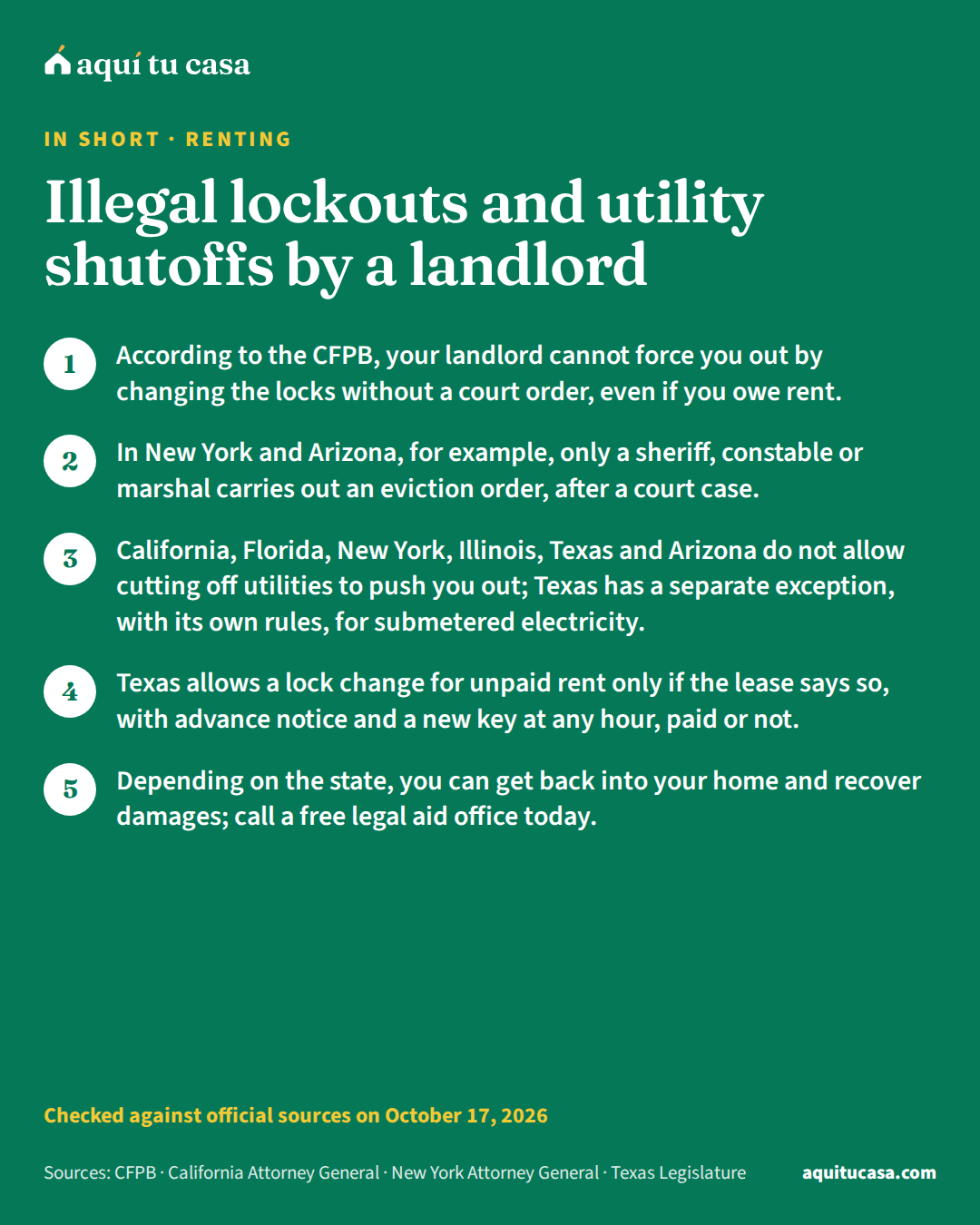
- Renting Illegal lockouts and utility shutoffs by a landlord If your landlord changed the locks, removed your things or cut off water or power to make you leave: what several states' laws say and what to do today. 12 minute read
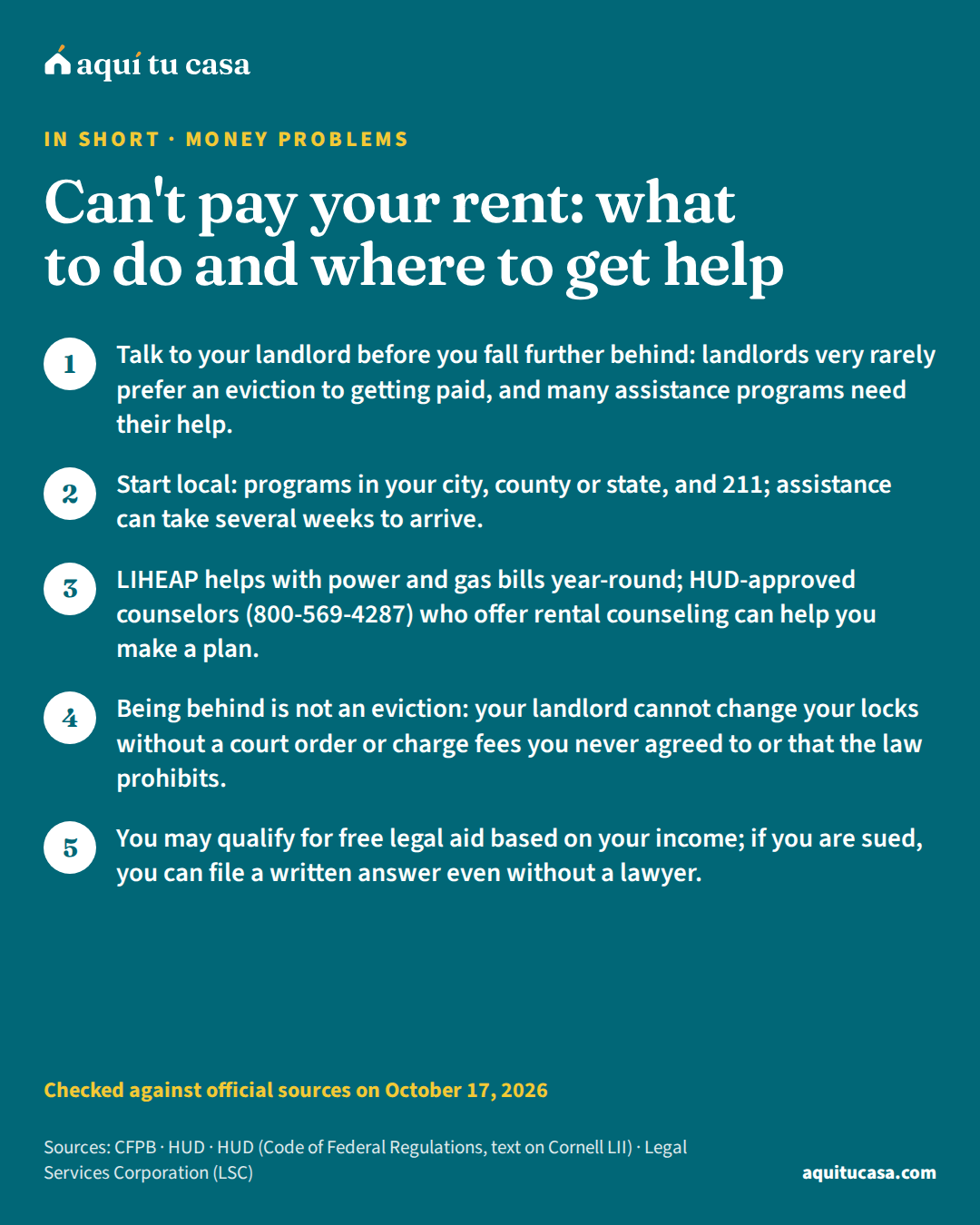
- Money problems Can't pay your rent: what to do and where to get help If you can't cover the rent: how to talk to your landlord, where to find rental assistance (211, local programs, HUD) and what an eviction requires. 13 minute read
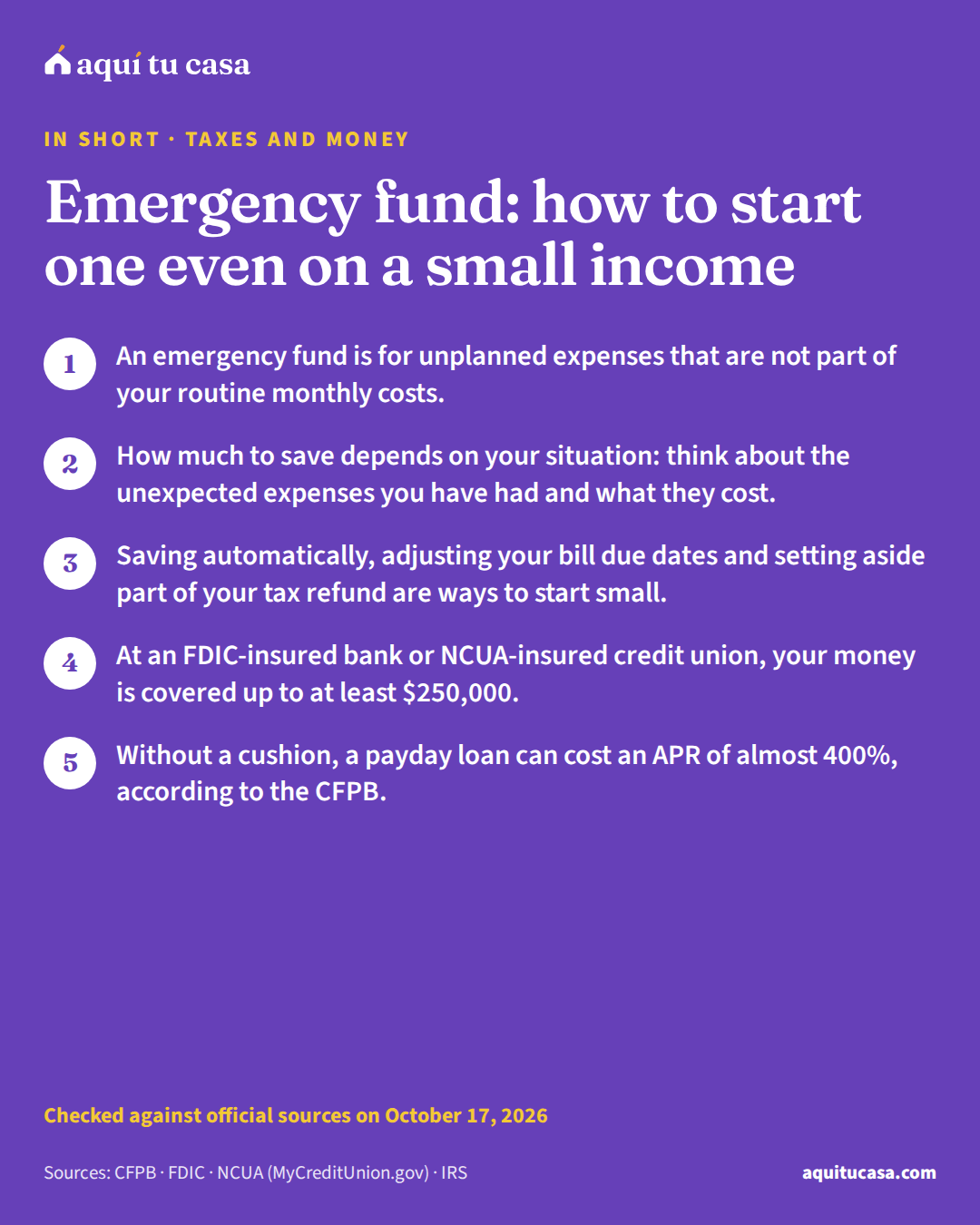
- Taxes and money Emergency fund: how to start one even on a small income What an emergency fund is, how much to save for your situation, how to start with little money, where to keep it safe and what it costs not to have one. 10 minute read
Tools for this topic
Was this guide useful?
Thank you. Your answer stays in your browser; nothing is sent.