Emergency fund: how to start one even on a small income
What an emergency fund is, how much to save for your situation, how to start with little money, where to keep it safe and what it costs not to have one.
Verified against official sources on October 17, 2026 8 official sources

Show contents
In short
What you need to know
Quick answer
An emergency fund is money set aside only for the unexpected, such as a car repair, a medical bill or a week without income. The CFPB does not set an amount: it depends on your situation, and even a little money gives you some security. Start with a goal, automatic transfers or part of your tax refund, which the IRS can deposit into up to three accounts. Keep it in an insured bank or credit union account where you are not tempted to spend it.
What matters most
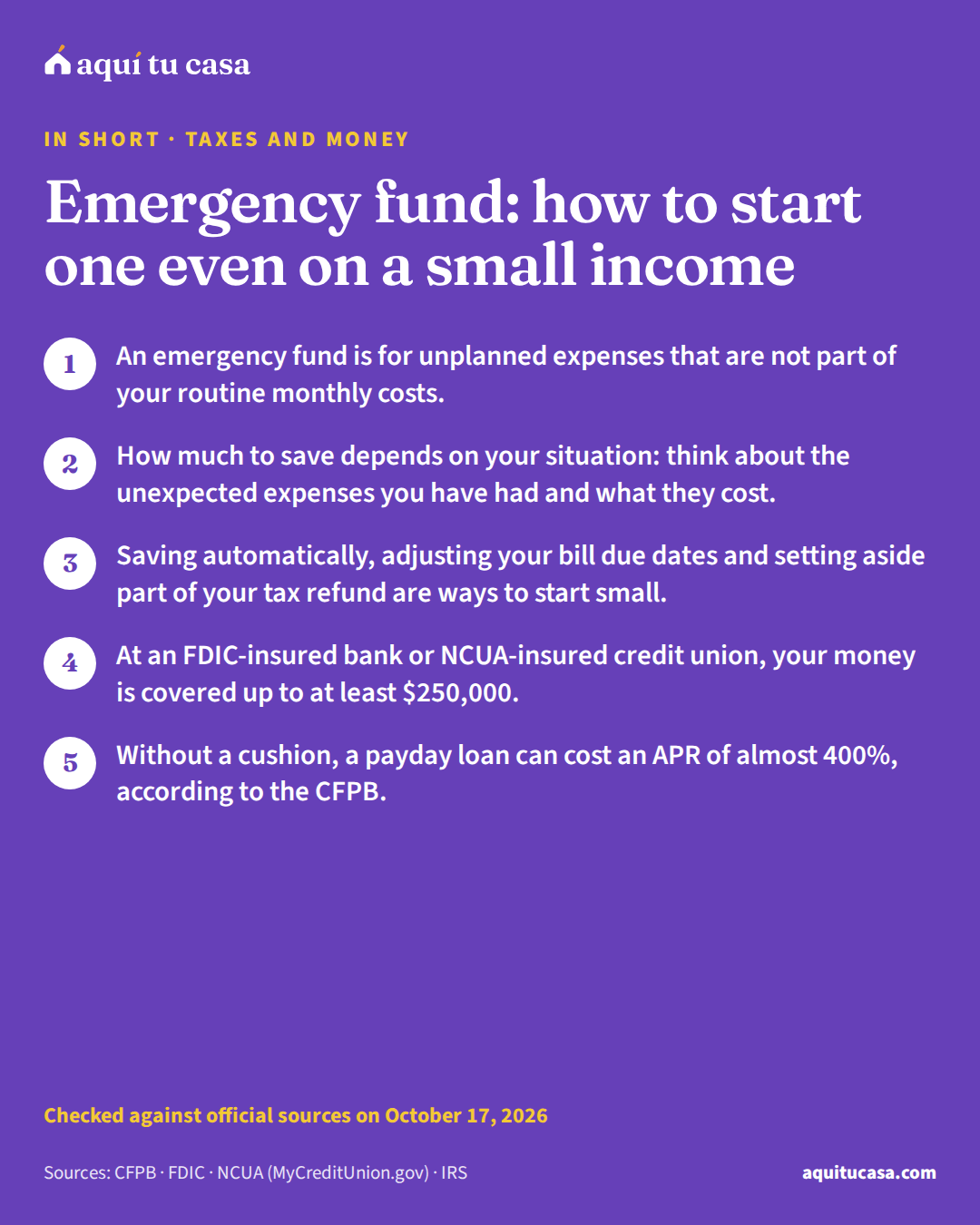
- An emergency fund is for unplanned expenses that are not part of your routine monthly costs.
- How much to save depends on your situation: think about the unexpected expenses you have had and what they cost.
- Saving automatically, adjusting your bill due dates and setting aside part of your tax refund are ways to start small.
- At an FDIC-insured bank or NCUA-insured credit union, your money is covered up to at least $250,000.
Is this for you?
This guide is for you if…
- You want a cushion for a car repair, a medical bill or a week without work.
- You are paid in cash or your income changes week to week, and you are not sure how to save that way.
- You are about to get your tax refund and want part of it to stay saved.
Get direct help first if…
- You are already behind on rent or your mortgage: start with the emergencies guide or talk to a housing counselor today.
- You are looking to invest for the long term: this guide is about money for the unexpected, which needs to be within reach.
A car that will not start, a medical bill, a broken appliance or a week without work can throw any family’s finances off track. This guide is for anyone who wants a cushion for those moments, even on a small income or with pay that changes every week. It explains what an emergency fundemergency fundAn emergency fund is cash you set aside only for unplanned expenses or emergencies, such as car or home repairs, medical bills or a loss of income. It is not for routine monthly spending. The CFPB explains that without savings, even a small financial shock can push you into debt that is hard to pay off. How much you need depends on your situation; the CFPB suggests thinking about the unexpected expenses you have had before. You can keep it in a bank or credit union account, on a prepaid card or in cash, and it grows more easily with automatic saving or part of a tax refund.See the full definition is, how to decide how much to save, how to start, where to keep it safe and what it costs not to have one.
What an emergency fund is
According to the CFPB, an emergency fund is a cash reserve set aside only for unplanned expenses or emergencies: car or home repairs, medical bills or a loss of income. It covers payments large or small that are not part of your routine monthly expenses. And setting aside even a little helps you recover more quickly.1
As the CFPB puts it, we have all had unexpected emergencies, from a fender bender or a damaged cell phone to a loss of income.1
Why does it matter? Without savings, a shock, even a small one, can set you back, and if it turns into debt it can last a long time. People without a cushion sometimes end up paying with credit cards or loans, which leave debts that are hard to pay off, or pulling money from their retirement savings.1
How much to save
The CFPB does not give one number for everyone: it says what you need depends on your situation. To set a goal, it suggests thinking about the most common unexpected expenses you have had and what they cost.1 For example, the last time the car broke down or a doctor’s bill arrived.
If you live paycheck to paycheck or are not paid the same amount each week or month, setting money aside can feel hard. But even a small amount gives you some security.1 A concrete goal helps you stay motivated, and starting your emergency fund can be that first reachable goal.1
To see how much fits in your month, use the family budget tool or our guide to a family budget with several incomes.
How to start, even when money is tight
The CFPB says that if you have little room to save, the easiest ways to start are managing your cash flow and saving part of your tax refund.1 These are its strategies:
Build the habit. Set a goal, pick a specific amount to set aside each time, check your progress regularly and celebrate when you succeed.1
Manage your cash flow. It is the timing of when your money comes in and goes out. If it does not line up, you come up short at the end of the week or month. You can ask creditors such as your landlord, the power company or your card issuer to change your due dates, and use the weeks with more money to move a little extra into savings.1
Use money that arrives all at once. For many people, the tax refund is one of the largest checks of the year, and money can also come as a birthday or holiday gift. Saving all or part of it helps you build the fund quickly, especially if your income is irregular.1
Make it automatic. Set up a transfer from checking to savings at your bank or credit unioncredit unionA credit union is a not-for-profit financial institution that, like a bank, accepts deposits, makes loans and offers other services, but is owned by its members. Members elect a volunteer board of directors, and profits go back to them as lower fees, higher savings rates and lower loan rates. To join you need a common bond, such as your employer, your family, where you live or a group you belong to. It is chartered by the NCUA, a federal agency, or by a state. If the credit union is federally insured, your deposits are protected by the NCUA's insurance fund.See the full definition. You decide how much and how often. Watch your balance so you do not pay overdraft fees, for example with alerts. If you are paid by direct deposit, ask your employer whether your paycheck can be split between two accounts. That way you pay yourself first: part of it goes to savings without you having to think about it.1
Your emergency fund, step by step
1. Decide what counts as an emergency
Before you start
Set rules and stay consistent: an unplanned expense is not the same as a monthly one.1
2. Set a goal
This week
Think about your past unexpected expenses and what they cost.1
Try it with your numbersFamily budget3. Open a place just for the fund
This week
A separate account at a bank or credit union, where you are not tempted to spend it.1
4. Set aside a fixed amount
Every payday
With an automatic transfer or by splitting your direct deposit; watch your balance to avoid overdrafts.1
6. Use it and refill it
When you need it
Do not be afraid to use it; if you spend it, start building it back up.1
Example with real numbers
Split your refund to start your fund
An example in words using the IRS direct deposit option.
- Your federal tax refund
- By direct deposit, free
- One part to your checking account
- For this month's expenses
- Another part to your savings account
- Your emergency fund
- Accounts you can split it into
- Up to three
You split it with your tax software or, on paper, with Form 8888; the accounts must be in your name, your spouse's name or both.5 IRS VITA sites prepare basic returns for free for people who qualify, and many serve limited English-speaking taxpayers.6
Run it with your numbersFamily budget
Where to keep it
The CFPB says the fund should be safe, within reach and somewhere you are not tempted to spend it on things that are not emergencies.1
Three places for your emergency fund
Generally among the safest
Bank or credit union account
You only spend what you load
Prepaid card
An insured account, separate from your spending account, meets all three things the CFPB asks for: safe, within reach and away from temptation.1
FDIC insurance protects your checking and savings accounts at an insured bank if the bank fails: it covers at least $250,000 per depositor and per ownership category, and since 1933 no one has lost a penny of insured funds. It does not cover investments that are not deposits.2 At a federally insured credit union, the NCUA provides similar coverage, automatically when you join. Careful: some state-chartered credit unions have private insurance without the backing of the U.S. government.3
If you do not have an account, the IRS points to the FDIC website or the NCUA Credit Union Locator to find a bank or credit union that opens accounts online. Some prepaid cards and mobile apps can also receive direct deposits if they have account and routing numbers.5 Our guide to low-fee accounts (Bank On) covers low-cost options, and the one on opening an account without a Social Security number explains what banks usually ask for.

When to use it and how to refill it
The CFPB suggests setting rules for what counts as an emergency and staying consistent. Not every surprise is a crisis: it may be a medical bill insurance did not cover.1
Having the fund helps you avoid relying on cards or loans. If you pay for an emergency with credit, the cost can grow a lot through interest and fees. And do not be afraid to use it when you need it: that is what it is for. If you spend it, build it back up little by little.1
To stay motivated, check your progress regularly: a balance alert or a sheet where you write down your running total. When you reach your goal, celebrate and set the next one.1
If this is you
You are paid in cash
Cash at home can be stolen, lost or destroyed; a bank or credit union account is generally considered among the safest places.1
Your income changes month to month
Use good months to move more into savings, and save part of any money that arrives all at once.1
You live paycheck to paycheck
Even a small amount gives you some security; changing your due dates can open up some room.1
Your family has several incomes
Look at when each person's money comes in and goes out, and set aside a fixed amount together.1 Our family budget guide helps.
What it costs not to have one: payday loans
Without a cushion, many people turn to a payday loan. According to the CFPB, it is usually a short-term, high-cost loan, generally for $500 or less, due on your next payday. Many state laws allow fees of $10 to $30 for every $100. A typical two-week loan with a $15 per $100 fee equals an APR (annual percentage rate)annual percentage rate (APR)The annual percentage rate (APR) is a broader measure of the cost of borrowing money than the interest rate. Besides the interest, it includes certain loan charges, such as discount points and some lender fees, spread over the life of the loan and expressed as a yearly percentage. That is why the APR is almost always a little higher than the interest rate. It is useful for comparing offers: if two loans have the same interest rate but a different APR, the one with the higher APR charges more in fees.See the full definition of almost 400%; credit card APRs range from about 12% to about 30%. And the lender generally does not check whether you can repay.7
Before taking one, the CFPB suggests looking at alternatives: some employers, nonprofit organizations and community groups offer advances or emergency credit; there is also help from family or friends, cheaper options at your bank or credit union, or negotiating with whoever you owe. And if you expect a refund or extra income, use it to start saving for the next emergency.8 If a collection agency is already after you, our debt collection guide explains your rights.

Costly mistakes
Mistake: Waiting until you have “enough” to start.
Instead: Even a small amount gives you some security; start with what you can.1
Mistake: Keeping the whole fund in cash at home.
Instead: Cash can be stolen, lost or destroyed; a bank or credit union account is generally considered among the safest places.1
Mistake: Setting up an automatic transfer without watching your balance.
Instead: Use alerts or reminders so you do not pay overdraft fees.1
Mistake: Spending the entire tax refund.
Instead: Send part of it straight to your savings account; the IRS can split it into up to three accounts.5
Mistake: Reaching for a payday loan first.
Instead: Check the alternatives first: advances, your bank or credit union, or negotiating with whoever you owe.8
Mistake: Not using the fund for fear of emptying it.
Instead: That is what it is for; if you spend it, build it back up.1
What to do this week
- List the unexpected expenses you had last year and what they cost, and set a goal.1
- Write down your rules for what counts as an emergency.1
- Open or choose a separate account at an FDIC-insured bank or NCUA-insured credit union.2
- Schedule an automatic transfer every payday and a balance alert.1 See how much fits with the family budget tool.
- If you are filing taxes, note your savings account numbers so you can split your refund; a VITAVITA (free tax preparation)VITA (Volunteer Income Tax Assistance) and TCE (Tax Counseling for the Elderly) are IRS programs that offer free basic tax return preparation by IRS-certified volunteers. They are meant for people with moderate income, people with disabilities and limited-English speakers; TCE focuses on people sixty and older. The IRS sets no program-wide income limit, but individual sites may set their own. Many sites serve in Spanish and help with ITIN applications and renewals. Filing taxes every year builds the record lenders ask for.See the full definition site can prepare your return for free if you qualify.6
Your household this month
Let's do the math
Left each month
Enter what at least one person takes home to see the result.
What helps
- Pay savings first: set the goal aside the day the money arrives, before flexible spending.
- Add up the bills that come every few months (car insurance, school) and divide by twelve.
- If income changes, plan on a low month and save the extra from good months.
- A HUD-approved housing counselor can go over the budget with you, often for free.
This is a planning tool with your numbers, not a credit evaluation or an approval. The split reference is only a guide.
Ready to see the numbers? Find your county here
See how this applies in your county: its loan limits, prices and rents, from the official data.
Printable checklist
Frequently asked questions
How much money should I have in my emergency fund?
The CFPB does not set an amount: it says it depends on your situation. It suggests thinking about the most common unexpected expenses you have had and what they cost, and using that to set a goal. If you live paycheck to paycheck, even a small amount gives you some security.
Where is the safest place to keep my emergency fund?
According to the CFPB, a bank or credit union account is generally considered one of the safest places, and a dedicated account may make sense. At an FDIC-insured bank or NCUA-insured credit union, your deposits are covered up to at least $250,000.
Is it OK to keep the money in cash at home?
The CFPB mentions it as an option, at home or with a trusted relative. But it warns that cash can be stolen, lost or destroyed, and it does not have the insurance of an insured account.
How do I save if my income changes every week?
The CFPB suggests managing your cash flow: use the weeks when more money comes in to move a little extra into savings, and ask your creditors to change due dates if they do not line up with your income. It also recommends saving part of any one-time money, such as a tax refund.
Can I send part of my tax refund to a savings account?
Yes. The IRS can deposit your refund into one, two or three accounts. You split it with your tax software or, on a paper return, with Form 8888. The accounts must be in your name, your spouse's name or both.
What counts as an emergency?
The CFPB suggests setting your own guidelines and staying consistent: for example, a car or home repair, a medical bill not covered by insurance or a loss of income. Routine monthly expenses are not emergencies.
If I have an emergency, should I get a payday loan?
The CFPB explains that they typically charge $10 to $30 for every $100, which on a typical two-week loan equals an APR of almost 400%. Before taking one, it suggests looking at alternatives: advances from your employer or community groups, help from family, options at your bank or credit union, or negotiating with whoever you owe.
Sources
Every figure in this guide comes from one of these official sources. The number next to a sentence leads to the source behind it.
Each source on one line: who publishes it, its title, its address and the date we read it.
- 1. CFPB · An essential guide to building an emergency fund · consumerfinance.gov · Accessed October 17, 2026
- 2. FDIC · Understanding Deposit Insurance · fdic.gov · Accessed October 17, 2026
- 3. NCUA (MyCreditUnion.gov) · Share Insurance · mycreditunion.gov · Accessed October 17, 2026
- 4. CFPB · Prepaid cards and other prepaid accounts · consumerfinance.gov · Accessed October 17, 2026
- 5. IRS · Get your refund faster: Tell IRS to direct deposit your refund to one, two, or three accounts · irs.gov · Accessed October 17, 2026
- 6. IRS · Free tax return preparation for eligible taxpayers · irs.gov · Accessed October 17, 2026
- 7. CFPB · What is a payday loan? · consumerfinance.gov · Accessed October 17, 2026
- 8. CFPB · Should I get a payday loan if I need money now? · consumerfinance.gov · Accessed October 17, 2026
Keep reading
Related guides
If this guide helped, these follow the same path.

Taxes and money 13 minute read
No-overdraft-fee bank accounts: what Bank On means
What a Bank On certified account is, why an account helps you save and buy a home, credit unions, FDIC/NCUA insurance, check cashing and remittances.
- An account can save you what you pay to cash checks and buy money orders, keeps your savings in a safe place and leaves the statements a lender reviews.
- The Bank On standard calls for an opening deposit of $25 or less, a monthly fee of $5 or less ($10 if it can be waived) and no overdraft fees.
- Credit unions are owned by their members; you join through your job, your family, your area or a group, and the NCUA says they tend to charge lower fees.
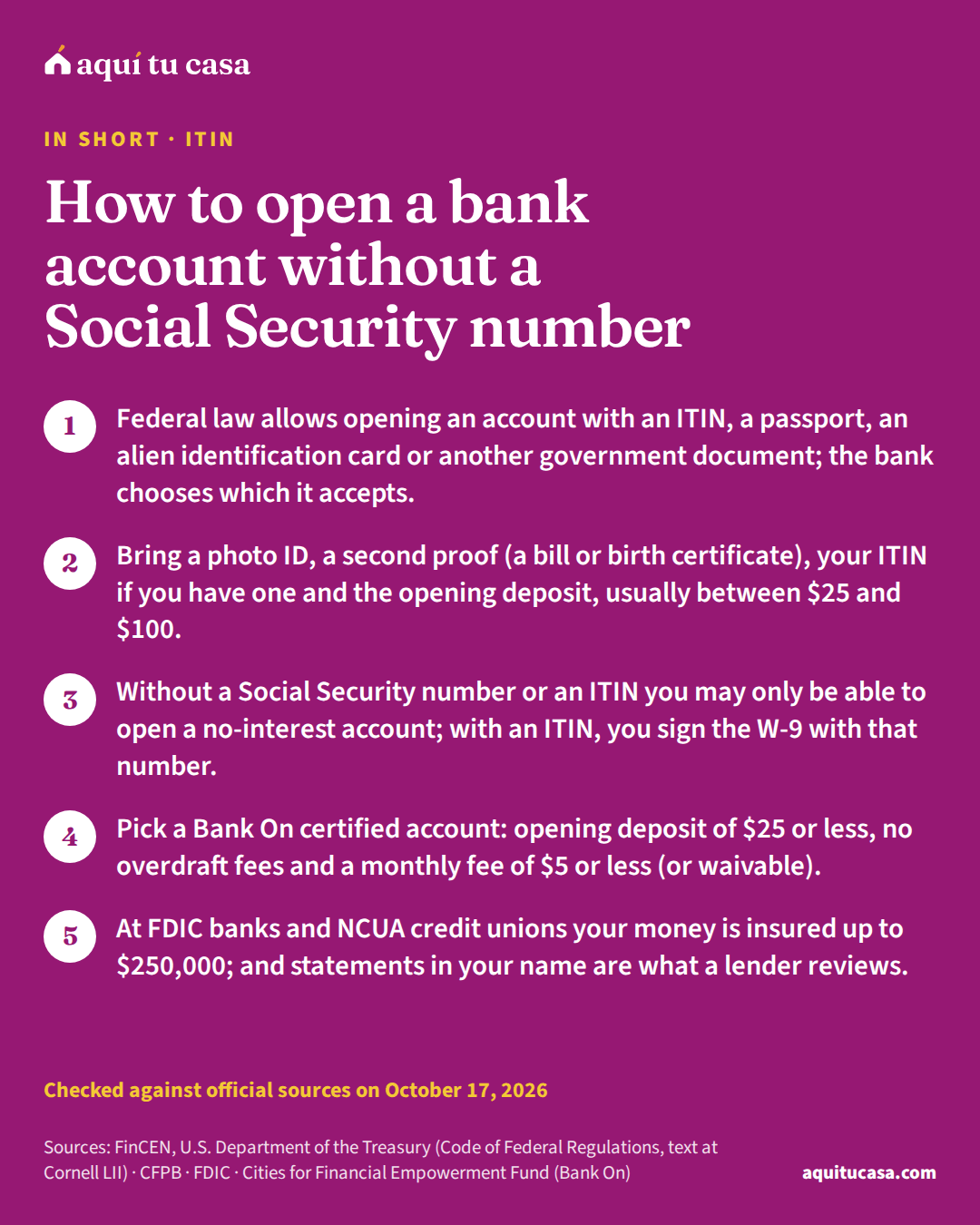
- ITIN How to open a bank account without a Social Security number What banks and credit unions ask for to open an account without a Social Security number (ITIN, passport or consular ID) and which account to pick. 11 minute read
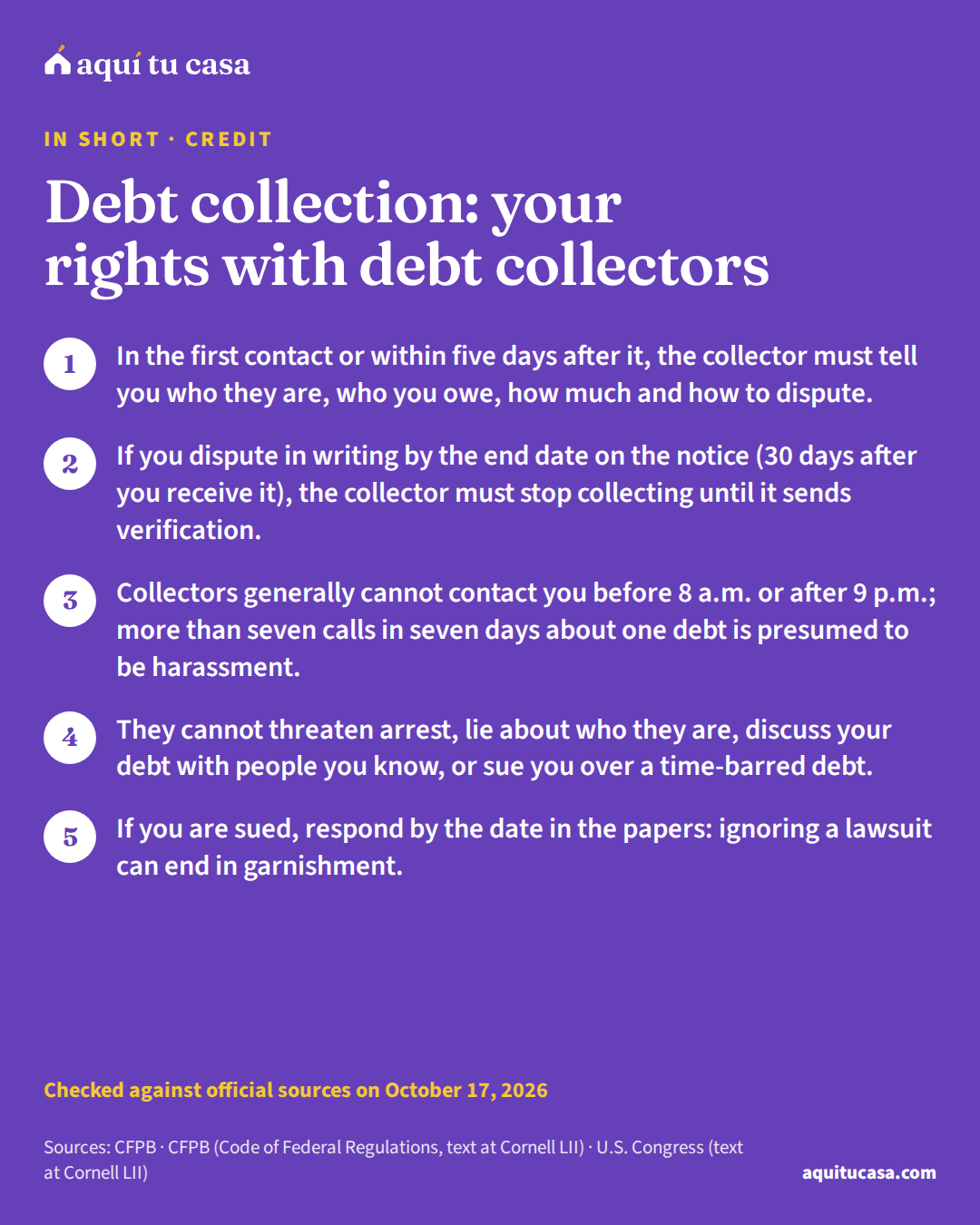
- Credit Debt collection: your rights with debt collectors What a debt collector must tell you, how to dispute in writing, when and how often they can call, old debts, and what to do if you are sued. 16 minute read
Tools for this topic
Was this guide useful?
Thank you. Your answer stays in your browser; nothing is sent.