Debt collection: your rights with debt collectors
What a debt collector must tell you, how to dispute in writing, when and how often they can call, old debts, and what to do if you are sued.
Verified against official sources on October 17, 2026 28 official sources

Show contents
In short
What you need to know
Quick answer
A debt collector must tell you who they are, who you owe and how much, and how to dispute the debt, in the first contact or within five days after it. You have 30 days from receiving that notice to dispute in writing, and in the meantime the collector must stop collecting until it sends you verification. The law limits when and how often they can call, bans threats and harassment, and does not let them sue you over a time-barred debt. If you are sued, respond by the date in the court papers.
What matters most
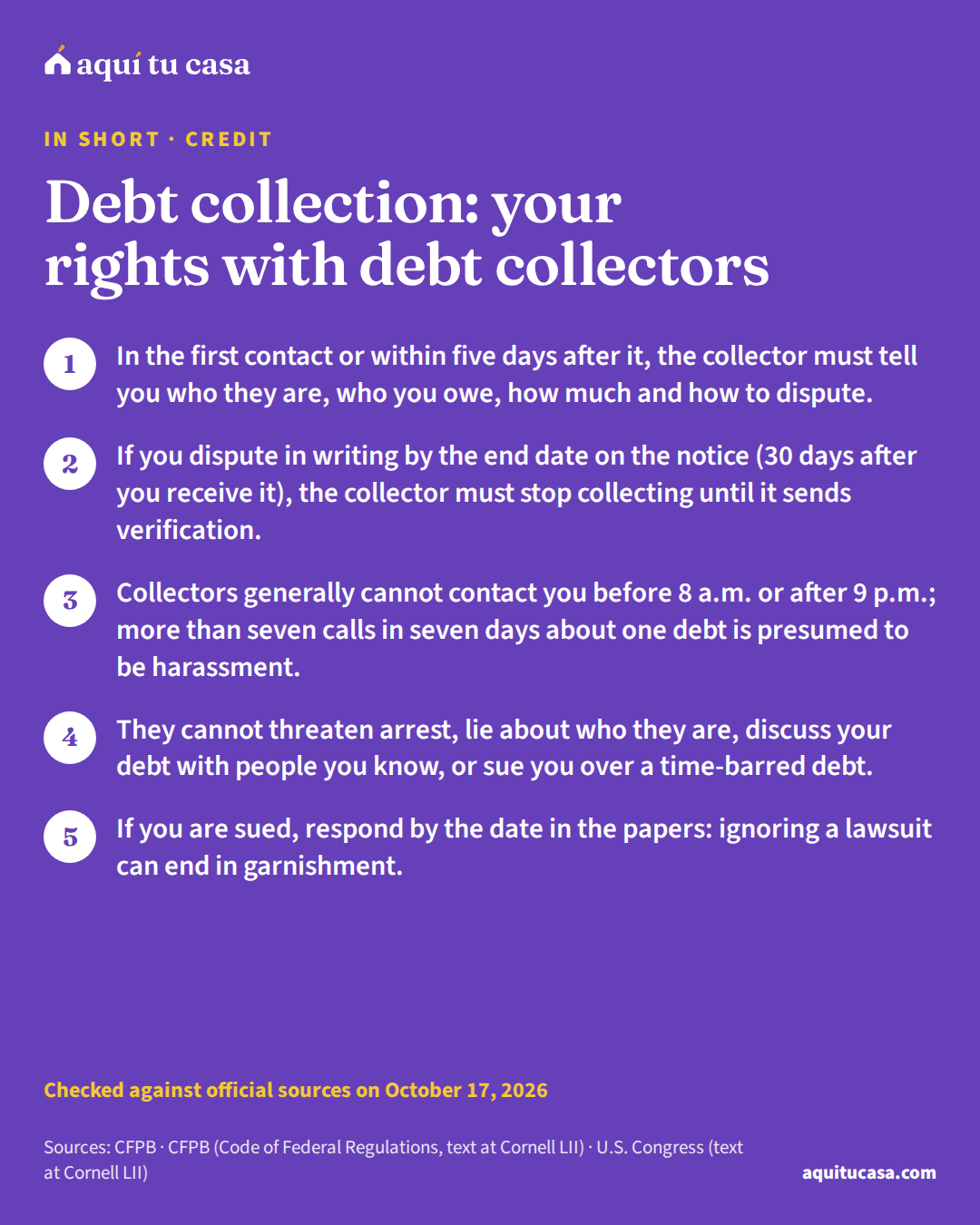
- In the first contact or within five days after it, the collector must tell you who they are, who you owe, how much and how to dispute.
- If you dispute in writing by the end date on the notice (30 days after you receive it), the collector must stop collecting until it sends verification.
- Collectors generally cannot contact you before 8 a.m. or after 9 p.m.; more than seven calls in seven days about one debt is presumed to be harassment.
- They cannot threaten arrest, lie about who they are, discuss your debt with people you know, or sue you over a time-barred debt.
Is this for you?
This guide is for you if…
- You got a letter, an email or a call from a collection agency and are not sure the debt is yours.
- A collector keeps calling you, your job or your relatives, and you want to know what they can and cannot do.
- You have an old debt and wonder whether you can still be sued over it.
Get direct help first if…
- You have already been served with a lawsuit or have a court date: look for legal help today; this guide only explains your rights in general.
- The debt belongs to your business: the federal debt collection law covers personal, family or household debts, not business debts.
- The bank or store that gave you the credit is collecting directly: the federal law generally does not cover the original creditor, although your state's law may.
Did you get a letter, an email or a call from a collection agency? This guide is for you, whether or not the debt is yours. Using what federal law and the Consumer Financial Protection Bureau (CFPB) say, it explains what collectors must tell you, how to dispute in writing, when they can call, what they cannot do, what happens with old debts and where to find free help. It is not advice about your case: it is what the official sources say.
Who is collecting and which laws protect you
A debt collector is generally a person or company that regularly collects debts owed to others, usually past due: a collection agency, a lawyer who collects debts as a business, or a company that buys past-due debts (a debt buyer). The original creditor is whoever gave you the loan or credit; it can collect on its own, hire a collector or sell your account to one.1
The main law is the Fair Debt Collection Practices Act (FDCPA), which bans abusive, unfair or deceptive practices. It covers personal, family or household debts; it does not cover business debts and generally does not cover the original creditor collecting its own debt. Most states have debt collection laws, many of them similar, and some do cover the original creditor: your state attorney general’s office can tell you more.2 Since November 30, 2021, the CFPB’s Debt Collection Rule has also applied; it clarifies and interprets the FDCPA1 and is known as Regulation F (12 CFR part 1006).3
A collector can report the debt to a credit reporting companycredit reporting agencyA credit reporting agency, also called a credit bureau or credit reporting company, is a company that gathers information about people and sells credit reports to other businesses. The three nationwide ones are Equifax, Experian and TransUnion. The businesses that buy those reports use them to decide whether to give you credit, a job, a rental home or insurance. There are also specialty agencies, for example for rental history or check writing. The federal Fair Credit Reporting Act (FCRA) gives you the right to request a copy of your report and to dispute information that is wrong.See the full definition, and it then shows up on your credit reportcredit reportA credit report is a statement that has information about your credit activity and current credit situation: your loans and cards, the balances, whether you have paid on time, accounts in collection and who has checked your credit. Credit reporting companies, also called credit bureaus, compile it from what banks and creditors report; your credit score is computed from it. When you apply for a mortgage, the lender pulls your report from the three bureaus. You have the right to see it for free and to dispute anything that is wrong.See the full definition as a collection accountcollection accountA collection account is a past-due debt that the original creditor (the company that gave you the loan or credit) handed to a debt collector or sold to another company. A debt collector is a person or company that regularly collects debts owed to others, such as a collection agency, a lawyer or a debt buyer. The account can show up on your credit report; once you pay it, it should generally show a zero balance as a paid collection. Most negative information can be reported for up to seven years. If you think you do not owe the debt or the amount is wrong, you can dispute it with the collector and with the credit reporting company.See the full definition.10 But first it has to talk with you, or send you a letter or message and wait a reasonable time in case it was not delivered.19 Our guide on how to read your credit report helps you find it.
The validation notice: what they must tell you
When a collector first communicates with you, it must give you the validation information: orally in that first communication, or in writing or electronically at that time or within five days after. That document is the validation notice.3 In its first written communication it must also say that it is trying to collect a debt and that any information it gets will be used for that purpose.17
Under Regulation F, the notice includes, among other things:3
- The collector’s name and the mailing address where it accepts disputes.
- The current creditor’s name and, for consumer financial product debts, the creditor on the “itemization date.”
- The account number, if any, in full or truncated.
- What was owed on the itemization date, what changed since then and the current amount.
- The end date for disputing, and a statement that unless you dispute by then the collector will assume the debt is valid.
Example with real numbers
How the amount they are collecting is built
The notice starts from what was owed on one date and shows, line by line, what changed since then.
- Amount on the itemization date
- What was owed that day
- Interest since that date
- Added
- Fees since that date
- Added
- Payments since that date
- Subtracted
- Credits since that date
- Subtracted
- Current amount of the debt
- What they are collecting today
The itemization date can be the last statement date, the charge-off date, the last payment date, the date of the transaction that created the debt or the date of a judgment.3 If a line does not add up, you can dispute the part of the amount that is wrong.5
Run it with your numbersCredit planAt the bottom, the notice has a response section headed “How do you want to respond?” There you can check that you dispute because “This is not my debt” or “The amount is wrong,” and ask for the original creditor’s name and address.3
How to dispute the debt in writing
From the first contact to verification
1. The collector contacts you
Day 0
It gives you the validation information orally or in writing, or sends you the notice afterwards.3
2. The collector sends the validation notice
No later than 5 days after the first contact
Look for the end date for disputing: the notice has to state it.3
3. You dispute in writing
Before the end date on the notice
Use the response section of the notice or a CFPB sample letter, and keep a copy.9
4. The collector stops collecting
From when it receives your dispute
Until it sends you a copy of verification or of a judgment, or the original creditor's details if you asked for them.5
5. It sends you verification
Before collecting again
After that it can keep collecting, but you can keep disputing with the collector and with the credit reporting companies.7
You have 30 days from receiving the validation information to dispute in writing; not doing it in writing or on time can affect your rights.4 To set the end date, the collector may assume you received the notice at least five business days after sending it; the period ends 30 days after that.3 If you dispute within that period, the collector must stop collecting the debt, or the disputed part, until it sends verification or a copy of a judgment, and it cannot do anything that overshadows your right to dispute.5
You can dispute if you think you already paid, you do not owe it, the amount is wrong or the debt is not yours. If you already paid, send copies of your proof, such as cancelled checks or card statements, and keep the originals.8
The CFPB publishes sample letters for five situations: you do not owe the debt, you need more information, you want them to stop contacting you, you want them to contact you only through your lawyer, or you want to specify how they can contact you. It recommends using them as soon as possible and keeping copies; even if more than 30 days have passed, it is still a good idea to ask for what you need. The letters are not legal advice.9
Send your letter by certified mail with a return receipt, or electronically, and keep a copy. Write down the date, time and what was said on every call, and be careful what you say: apologizing or admitting the debt could be used against you.10
Not disputing on time does not mean you accept the debt: no court can treat it as an admission.6 And if the debt shows up on your credit report, you can also dispute it with the credit reporting companies;7 our guide on how to dispute credit report errors explains how to file that credit disputecredit report disputeA credit report dispute is the complaint you make when your credit report has wrong or incomplete information. You have the right to dispute it, and the investigation is free. It is usually done in two places: with the credit reporting company and with the company that supplied the information, called a furnisher, such as your bank, your landlord or your credit card company. You explain in writing what is wrong and why, with copies of your documents. The credit reporting company must investigate, generally within thirty days, and delete or correct anything found to be inaccurate, incomplete or unverifiable.See the full definition.

When and how they can contact you
A collector cannot contact you at an unusual time or place, or one it knows is inconvenient for you. Absent other information, before 8:00 a.m. and after 9:00 p.m. where you are is inconvenient. It also cannot contact you at work if it knows your employer does not allow it, and if it knows a lawyer represents you on that debt, it must deal with your lawyer.11 If it calls at a bad time, you can say so and it must end the call.2
How many calls. A collector is presumed to break the law if it calls about the same debt more than seven times in seven consecutive days, or calls again within seven days after talking with you about that debt.12 Calls that go to voicemail count, and seven calls in a single day could also break the law. These rules cover phone calls only; texts, emails and social media have other protections.13
Messages and social media. Every email or text must give you a simple way to opt out of that channel. The collector cannot post anything about your debt on social media where others can see it.2 If you ask it not to use a channel, it can no longer use it.12
Your family and your job. It may contact other people generally only to find out where you live, your phone number or where you work, usually just once and without saying it is about a debt. It may generally discuss your debt only with you, your spouse, your parents (if you are a minor), your guardian or executor, or your lawyer. It may ask your employer for your address or phone number, but not tell them you owe a debt.14
Disputing the debt or asking them to stop contacting you
If it is not yours or the amount is wrong
Dispute the debt
If you want the calls to stop
Ask them to stop contacting you
You can do both, in that order: dispute first, then ask them to stop contacting you.10

What a debt collector cannot do
According to the CFPB, harassment includes repeated calls or messages meant to annoy you, obscene language, threats of violence, publishing lists of people who “refuse to pay” and calling without giving a name.15 A collector also cannot claim to be a lawyer or a government official when it is not, say you committed a crime, say you will be arrested, say it will garnish your wages or bank account, or call its papers legal documents when they are not. It cannot charge fees your contract or the law does not allow.16 The law also bans threatening action that cannot legally be taken or is not intended, and using a false business name.17
If a collector violates the FDCPA, you can sue: the court can award the damages you suffered, plus additional damages of up to $1,000, and if you win, costs and a reasonable fee for your lawyer.18 You must sue within one year of the violation. According to the CFPB, some lawyers specialize in these cases, you can also go to court without a lawyer, and you can submit a complaint to the CFPB and your state attorney general.15
Old debts: the statute of limitations
A debt generally does not disappear until it is paid. But in many states there is a time limit for collecting it through a lawsuit: the statute of limitations. In most states it is between three and six years, though it can be longer, and it varies by type of debt, your state and the state law named in your contract. Some debts, such as federal student loans, have no statute of limitations.21
Once that period has passed, the debt is time-barred and the collector cannot sue or threaten to sue you over it.22 Even so, in most states it can keep asking you to pay by letter or phone. A partial payment or acknowledging the debt may restart the clock. And if you are sued and do not show up to say the time limit has passed, the court can still enter a judgment against you: it is ordinarily up to you to raise it.21
If you are sued or face garnishment
If you are sued, the CFPB says to respond, yourself or through a lawyer, by the date in the court papers. Responding does not mean you accept the debt: it makes the collector prove the debt is valid. If you do not respond, the court can enter a default judgment, and with it, depending on your state, the creditor may garnish your wages, place a lienlienA lien is a legal right a creditor holds in your property to make sure you repay a debt. It usually prevents the property from being sold until the debt is paid, and if you do not pay, the creditor may be able to take the property. Your mortgage is a lien on your home: when you pay it off, the lien is released and that shows up in your county's property records. There are other kinds, such as a federal tax lien, which is the government's legal claim against all your property when you do not pay a tax debt.See the full definition on your property or freeze money in your bank account.23
Most creditors can garnish wages or benefits only after a judgment, and laws protect part of them so you have something left to live on. If you receive federal benefits by direct deposit, such as Social Security, SSI or veterans’ benefits, the bank must protect two months of those deposits. LawHelp.org explains how to claim exemptions. Some government agencies, such as the IRS, can garnish without a court order.24
There may be legal aidlegal aidLegal aid is the free civil legal help that nonprofit organizations and their lawyers provide to low-income people in civil, not criminal, matters. In housing, that includes representing families facing eviction or foreclosure, alongside matters such as custody, child support, protection from domestic violence and access to benefits. In the United States, the Legal Services Corporation, created by Congress, funds a nationwide network of these organizations; its finder points you to the one in your area. Each sets its own income limits.See the full definition offices or clinics in your area that help for free if you meet their criteria.23 Our free legal aid guide explains how to find them; it is an option, not an obligation.
If this is you
You want the notice in Spanish
If the notice has the box “Quiero este formulario en español” and you check it, the collector must send you a complete and accurate translation.3
The collector is calling your relatives
It can only ask them how to reach you, generally just once, and cannot tell them it is about a debt.14
You receive Social Security or other benefits
If they are deposited directly, the bank must protect two months of those deposits before freezing or garnishing your account.24
You were served with a lawsuit
Respond by the date in the papers; responding does not mean you accept the debt.23 Free legal aid is an option.
Real collector or scam?
A real collector can tell you its company name, mailing address and details about the debt. Red flags of a scam include threats of criminal charges, calls late at night or at work, refusing to give an address, a phone number or information about the debt, and asking for your financial information. Ask for the collector’s name, company, address, phone number and license number if your state licenses collectors, and check them with your state attorney general or regulator.25
To confirm it is talking to the right person, a collector may ask for your date of birth, the last four digits of your Social Security number or your address; if you do not want to give your Social Security number, it will generally ask for something else, such as the account number of the debt. Whether to answer is your choice. Never give your bank account, card or full Social Security number unless you know it is a real collector; if in doubt, ask your creditor who it authorized to collect.26
If the debt is yours: how to negotiate
You can talk with a collector even if you cannot pay today: it can help you see your options, and ignoring it usually will not make it go away.9 If the debt is yours, the CFPB suggests writing down your monthly take-home pay and expenses, leaving room for emergencies and not paying more than you can afford. If you have several debts with one collector, you can tell it which debt your payment goes to. Get the plan and the collector’s promises in writing before you pay, and avoid companies that charge upfront to “settle” your debts. A non-profit credit counselor can help you build a budget.27 Our family budget guide and the family budget tool help you see what fits each month.
A HUD-approved housing counselorHUD-approved housing counselorA HUD-approved housing counselor works at an agency HUD has approved to provide housing counseling: independent, expert advice customized to your situation about buying a home, renting, a missed mortgage payment, a foreclosure or credit problems. The agencies usually charge little or nothing; many serve in Spanish and offer the homebuyer education course several assistance programs require. They are not lenders or real estate agents and sell you nothing. Your county page lists the official agencies with phone numbers.See the full definition also gives advice on credit issues, often at little or no cost.28

Costly mistakes
Mistake: Ignoring the letters and calls.
Instead: Use the notice to find out whether the debt is yours; ignoring it will not make them go away, and they can sue.9
Mistake: Disputing only by phone.
Instead: Dispute in writing before the end date on the notice; that is what makes the collector pause.4
Mistake: Giving your bank account or full Social Security number to a caller.
Instead: First confirm it is a real collector; never give financial information to someone you have not verified.26
Mistake: Making a small payment on a very old debt without checking its dates.
Instead: A partial payment or acknowledging the debt may restart the statute of limitations.21
Mistake: Paying on a verbal deal.
Instead: Get the plan and the collector's promises in writing before you pay.27
Mistake: Not responding to a lawsuit.
Instead: Respond by the date in the papers; otherwise the court can enter a judgment against you.23
What to do this week
- Put the collector’s letters and messages in one folder, and write down the date, time and what was said on each call.10
- Find the dispute end date on your validation notice and mark it on your calendar.3
- If the debt is not yours or the amount is wrong, dispute in writing before that date, using the notice’s response section or a CFPB sample letter.9
- Send the letter by certified mail with a return receipt and keep a copy.8
- Check your credit report; if the debt appears and is wrong, dispute it with the credit reporting companies too.7 Organize the steps with the credit plan.
- If you were sued, respond by the date in the papers; free legal aid is an option.23
- If the collector harasses or threatens you, submit a complaint to the CFPB and your state attorney general.15
Your situation
If you have never had a card or a loan in the U.S., choose "None".
Your credit plan
12 steps
You have done 0 of 12.
This week
Get your three credit reports for free
At AnnualCreditReport.com you can get the Equifax, Experian and TransUnion reports for free once a week. Checking your own report does not lower your score. If it comes up empty, that is not an error: you simply have no history yet.
Source: CFPB: How do I get a free copy of my credit reports? ↗ · CFPB: Does requesting my credit report hurt my credit score? ↗
Dispute any error in writing
Write to the credit bureau and to the company that reported the item, with copies of your proof, by certified mail. By law, the bureau must investigate again for free and resolve it within 30 days of receiving your notice.
Source: CFPB: How do I dispute an error on my credit report? ↗ · Congreso de EE. UU. (texto en Cornell LII): Fair Credit Reporting Act, 15 U.S.C. §1681i, Procedure in case of disputed accuracy ↗
Talk to a HUD-approved housing counselor
They give independent advice on buying, renting, defaults and credit, often free or at low cost. You can go over your report and your plan with them.
Source: CFPB: Find a Housing Counselor ↗
This month
Open a secured card
You deposit an amount (for example, $500) and can spend up to that amount. With on-time payments, the limit can go up, and the deposit comes back. Before signing, ask whether they report to all three bureaus and compare the annual fee and the rate: they can be high.
Source: CFPB: What are some ways to start or rebuild a good credit history? ↗ · CFPB: How to rebuild your credit ↗
Or a credit builder loan
The bank or credit union holds the money as savings while you make small payments, usually for six to 24 months; when you finish, you get it. You build history and savings at the same time.
Source: CFPB: What are some ways to start or rebuild a good credit history? ↗
Ask for your rent to be reported
On-time rent payments can help build your credit. Ask your landlord whether they take part in a rent reporting program (often through a payment app) and check its fees.
Set up automatic payments
An automatic payment or a reminder before the statement date prevents the costliest kind of slip: payment history is the main factor in most models.
What does not build credit
Paying with a debit card or cash, prepaid cards and payday loans do not build history, according to the CFPB. They are ways to pay, not accounts that get reported.
From here on
Do not close your first account
A long history of on-time payments helps your score. When a better card comes along, keep the first one open and current.
Only apply for the credit you need
Opening several accounts in a short time is a risk signal for lenders, and each application leaves a hard inquiry that does affect your score.
Source: CFPB: How do I get and keep a good credit score? ↗ · CFPB: What is a credit inquiry? ↗
Watch your debt-to-income ratio
Lenders divide your monthly debt payments by your gross monthly income to see whether you can handle a new loan. While you prepare, avoid new payments, such as a car.
Watch out for "credit repair"
It is a scam if they charge before doing anything, promise to remove accurate negative information, tell you not to contact the bureaus or to dispute everything. Disputing errors is free by law, and if you already signed up for something like this, you can cancel within three business days.
Source: CFPB: How can I tell a credit repair scam from a reputable credit counselor? ↗
An educational plan built on what the CFPB, the NCUA and the federal credit reporting law publish; not individual advice. We recommend no brands and are paid for no product.
Ready to see the numbers? Find your county here
See how this applies in your county: its loan limits, prices and rents, from the official data.
Printable checklist
Frequently asked questions
How long do I have to dispute a debt with a collector?
You have 30 days from receiving the validation information to dispute in writing. The notice gives the exact end date of that period. If you dispute in writing by that date, the collector must pause collecting the disputed amount until it sends you verification. You can still dispute after that, but the collector no longer has to pause.
What time can a debt collector call me?
Generally not before 8 a.m. or after 9 p.m. where you are, or at any time they know is inconvenient for you. If they call at a bad time, you can tell them and they must end the call. They also have to follow your instructions about when and where you do not want to be contacted.
How many times can a debt collector call me?
Regulation F presumes a violation if a collector calls about the same debt more than seven times in seven consecutive days, or calls again within seven days after talking with you about that debt. Calls that go to voicemail count. Even fewer calls can break the law, for example seven calls in a single day.
Can I go to jail for not paying a debt?
A debt collector cannot threaten to have you arrested, or have you arrested, for an unpaid debt; the CFPB calls that harassment. But if you are sued and do not follow a court order, such as appearing or providing information, a judge may issue a warrant for your arrest. That is why you should never ignore a court order.
Can a debt collector talk to my family or my boss about my debt?
Generally no. They may contact other people only to find out where you live, your phone number or where you work, and they cannot say it is about a debt. They can ask your employer for your address or phone number, but they cannot tell your employer you owe a debt.
What happens if the debt is very old?
The debt does not disappear until it is paid, but once your state's statute of limitations has passed, the collector cannot sue you or threaten to sue. According to the CFPB, most states have limits between three and six years. Careful: a partial payment or acknowledging the debt may restart the clock.
How do I get a debt collector to stop calling me?
Send a letter telling them to stop contacting you; the CFPB has sample letters. After that they can only write to say there will be no further contact or that they may take other action, such as a lawsuit. The debt does not go away: if you plan to dispute it, do that before asking them to stop.
Can I get the debt notice in Spanish?
A collector may include on the notice an option to request it in Spanish. If it does and you ask, it must send you a notice completely and accurately translated into Spanish. If it does not include that option, Regulation F allows, but does not require, a translation.
Can they take money from my paycheck or my bank account?
Most creditors can garnish your wages or benefits only after a court issues a judgment. Federal and state laws protect part of it so you have something left to live on, and if you receive federal benefits such as Social Security by direct deposit, the bank must protect two months of those deposits. Some government agencies, such as the IRS, can garnish without a court order.
Sources
Every figure in this guide comes from one of these official sources. The number next to a sentence leads to the source behind it.
Each source on one line: who publishes it, its title, its address and the date we read it.
- 1. CFPB · Debt collection key terms · consumerfinance.gov · Accessed October 17, 2026
- 2. CFPB · What laws limit what debt collectors can say or do? · consumerfinance.gov · Accessed October 17, 2026
- 3. CFPB (Code of Federal Regulations, text at Cornell LII) · Regulation F, 12 CFR §1006.34, Notice for validation of debts · law.cornell.edu · Accessed October 17, 2026
- 4. CFPB · What information does a debt collector have to give me about a debt they’re trying to collect from me? · consumerfinance.gov · Accessed October 17, 2026
- 5. CFPB (Code of Federal Regulations, text at Cornell LII) · Regulation F, 12 CFR §1006.38, Disputes and requests for original-creditor information · law.cornell.edu · Accessed October 17, 2026
- 6. U.S. Congress (text at Cornell LII) · 15 U.S.C. §1692g, Validation of debts (Fair Debt Collection Practices Act) · law.cornell.edu · Accessed October 17, 2026
- 7. CFPB · Can a debt collector still collect a debt after I’ve disputed it? · consumerfinance.gov · Accessed October 17, 2026
- 8. CFPB · What can I do if a debt collector contacts me about a debt I already paid or don't think I owe? · consumerfinance.gov · Accessed October 17, 2026
See the other 20 sources
- 9. CFPB · What should I do when a debt collector contacts me? · consumerfinance.gov · Accessed October 17, 2026
- 10. CFPB · How do I get a debt collector to stop calling or contacting me? · consumerfinance.gov · Accessed October 17, 2026
- 11. CFPB (Code of Federal Regulations, text at Cornell LII) · Regulation F, 12 CFR §1006.6, Communications in connection with debt collection · law.cornell.edu · Accessed October 17, 2026
- 12. CFPB (Code of Federal Regulations, text at Cornell LII) · Regulation F, 12 CFR §1006.14, Harassing, oppressive, or abusive conduct · law.cornell.edu · Accessed October 17, 2026
- 13. CFPB · When and how often can a debt collector call me on the phone? · consumerfinance.gov · Accessed October 17, 2026
- 14. CFPB · Can debt collectors tell other people, like family, friends, or my employer, about my debt? · consumerfinance.gov · Accessed October 17, 2026
- 15. CFPB · What is harassment by a debt collector? · consumerfinance.gov · Accessed October 17, 2026
- 16. CFPB · What is an unfair, deceptive or abusive practice by a debt collector? · consumerfinance.gov · Accessed October 17, 2026
- 17. U.S. Congress (text at Cornell LII) · 15 U.S.C. §1692e, False or misleading representations (Fair Debt Collection Practices Act) · law.cornell.edu · Accessed October 17, 2026
- 18. U.S. Congress (text at Cornell LII) · 15 U.S.C. §1692k, Civil liability (Fair Debt Collection Practices Act) · law.cornell.edu · Accessed October 17, 2026
- 19. CFPB (Code of Federal Regulations, text at Cornell LII) · Regulation F, 12 CFR §1006.30, Other prohibited practices · law.cornell.edu · Accessed October 17, 2026
- 20. CFPB · Can I be arrested for an unpaid debt? · consumerfinance.gov · Accessed October 17, 2026
- 21. CFPB · Can debt collectors collect a debt that’s several years old? · consumerfinance.gov · Accessed October 17, 2026
- 22. CFPB (Code of Federal Regulations, text at Cornell LII) · Regulation F, 12 CFR §1006.26, Collection of time-barred debts · law.cornell.edu · Accessed October 17, 2026
- 23. CFPB · What should I do if I’m sued by a debt collector or creditor? · consumerfinance.gov · Accessed October 17, 2026
- 24. CFPB · Can a debt collector take or garnish my wages or benefits? · consumerfinance.gov · Accessed October 17, 2026
- 25. CFPB · How do I tell if a debt collector is legitimate or a scam? · consumerfinance.gov · Accessed October 17, 2026
- 26. CFPB · Should I share personal information with a debt collector? · consumerfinance.gov · Accessed October 17, 2026
- 27. CFPB · How do I negotiate a settlement with a debt collector? · consumerfinance.gov · Accessed October 17, 2026
- 28. CFPB · Find a Housing Counselor · consumerfinance.gov · Accessed October 17, 2026
Keep reading
Related guides
If this guide helped, these follow the same path.

Credit 14 minute read
How to dispute errors on your credit report
How to fix credit report errors for free: what to send each bureau and the company that reported it, legal deadlines, and credit repair scams.
- Disputing is free and you can do it yourself: write to the credit bureau and also to the company that reported the item.
- Explain what is wrong and why, with copies (never originals) of your proof, and keep a copy of everything you send.
- The bureau must reinvestigate and generally finish in 30 days; if the item is wrong or cannot be verified, it must delete or correct it.
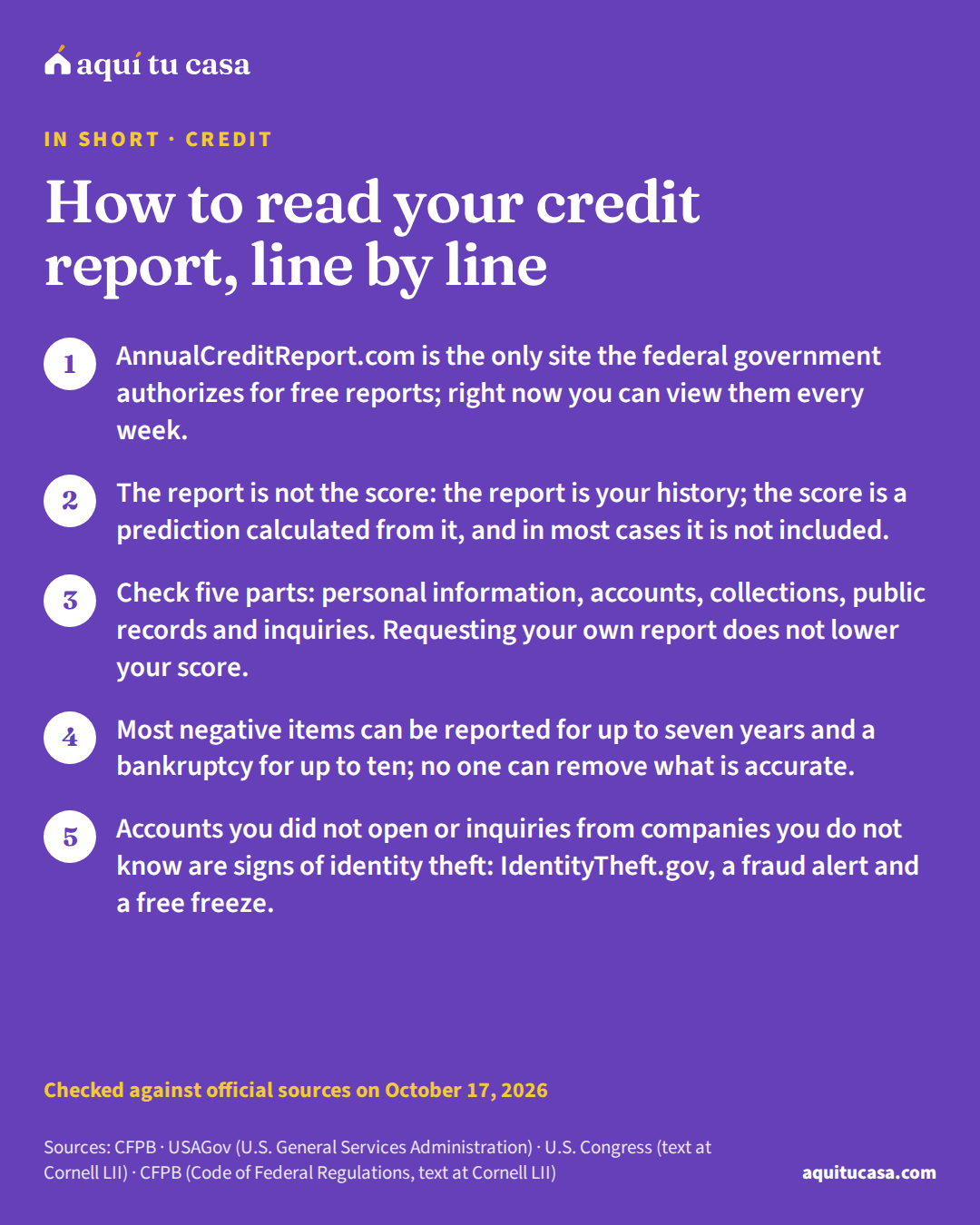
- Credit How to read your credit report, line by line Where to get your free credit reports, what each part says, how long negative items can stay and how to spot errors or identity theft. 13 minute read
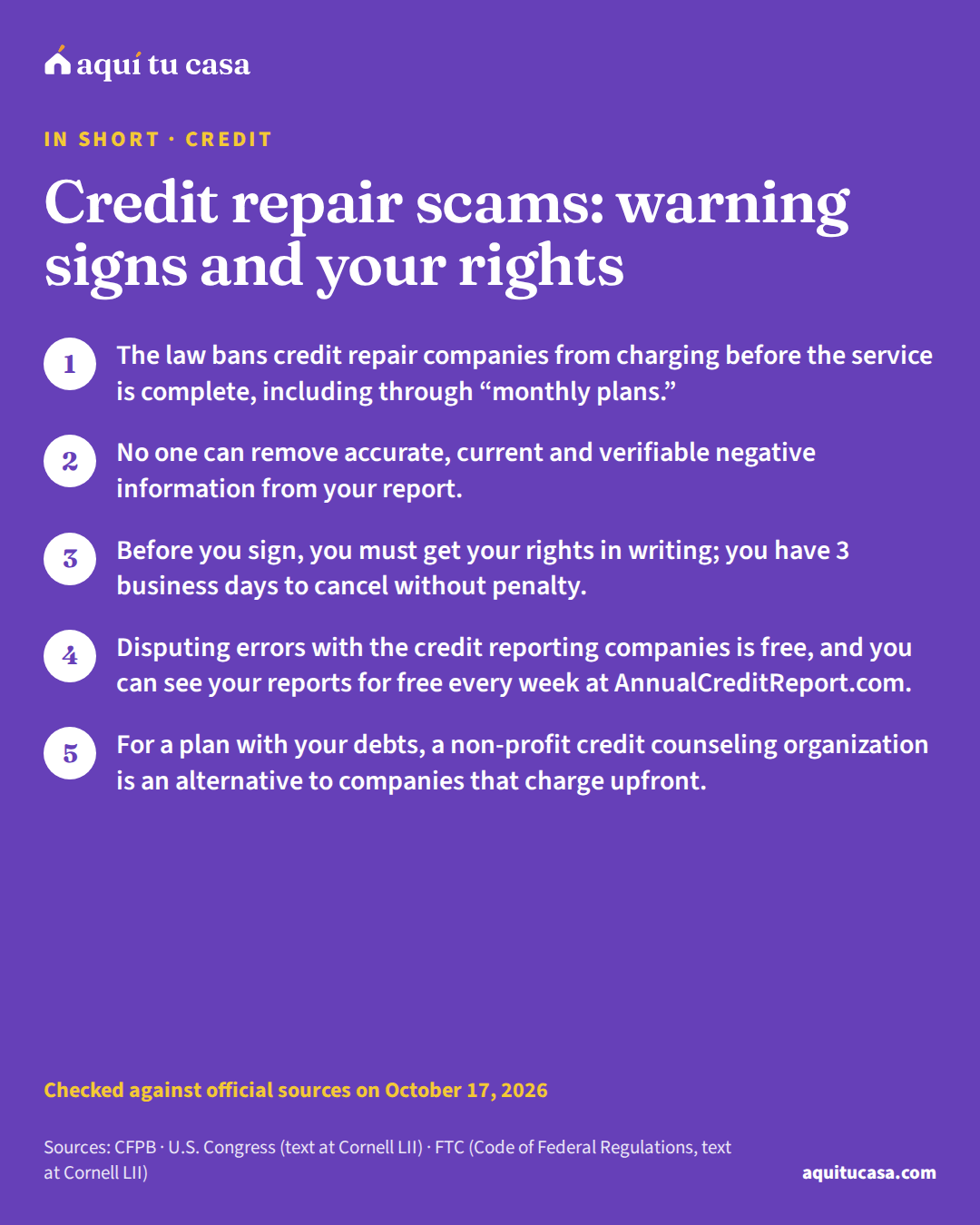
- Credit Credit repair scams: warning signs and your rights What credit repair companies cannot do, what the law requires (no upfront fees, a written contract, 3 days to cancel) and what you can do for free. 12 minute read
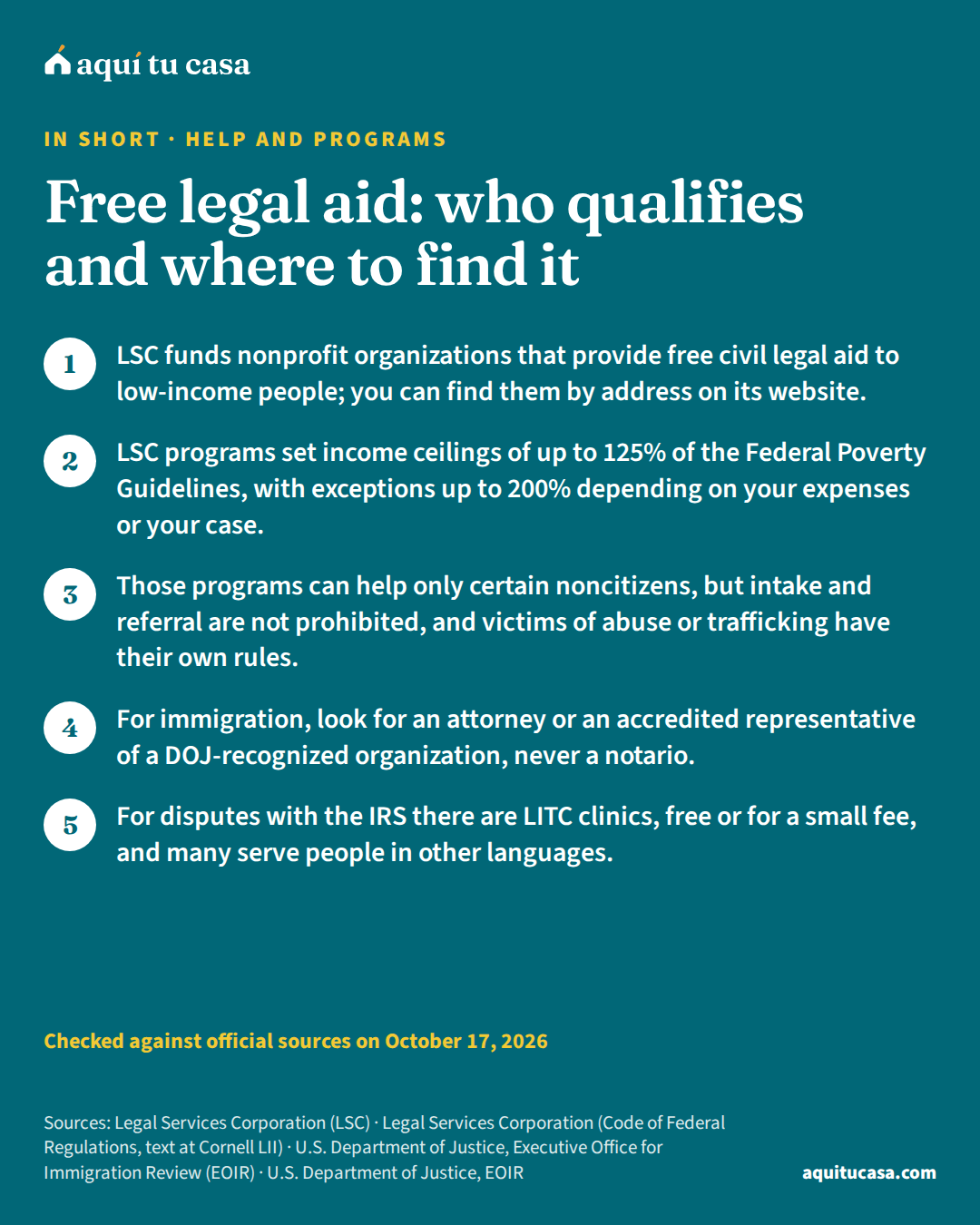
- Help and programs Free legal aid: who qualifies and where to find it What free legal aid is, who qualifies, which rules apply if you are not a citizen, and where to get help with immigration and tax problems. 11 minute read
Tools for this topic
Was this guide useful?
Thank you. Your answer stays in your browser; nothing is sent.