Credit repair scams: warning signs and your rights
What credit repair companies cannot do, what the law requires (no upfront fees, a written contract, 3 days to cancel) and what you can do for free.
Verified against official sources on October 17, 2026 15 official sources

Show contents
In short
What you need to know
Quick answer
A credit repair company cannot charge you before it finishes the work, and no one can remove accurate negative information from your credit report. The law requires the company to give you your rights in writing and a dated contract before it starts, and gives you 3 business days to cancel without penalty. Demands for upfront payment, promises to erase real debts or advice not to talk to the credit reporting companies are scam warning signs. You can dispute errors yourself, for free.
What matters most
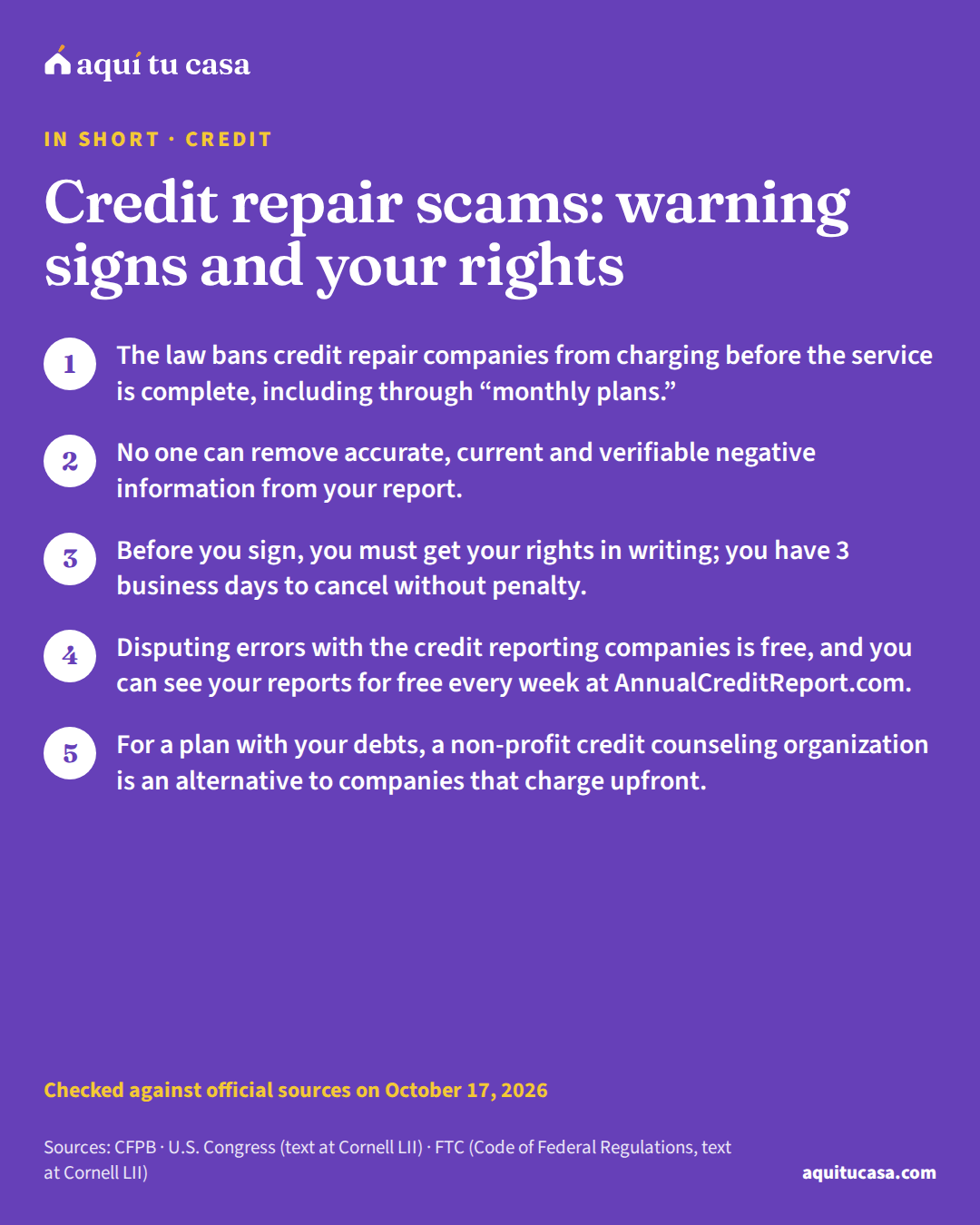
- The law bans credit repair companies from charging before the service is complete, including through “monthly plans.”
- No one can remove accurate, current and verifiable negative information from your report.
- Before you sign, you must get your rights in writing; you have 3 business days to cancel without penalty.
- Disputing errors with the credit reporting companies is free, and you can see your reports for free every week at AnnualCreditReport.com.
Is this for you?
This guide is for you if…
- You saw an ad promising to raise your credit score or erase debts from your report, and you want to know whether it is real.
- You already signed with a credit repair company or are being charged a monthly fee, and you want to know your rights.
- You have debts and someone is offering a program to settle or consolidate them.
Get direct help first if…
- You found an error on your report and want to fix it: go straight to the guide on disputing errors, step by step.
- A debt collector is calling you: the debt collection guide explains your rights with collectors.
- Your identity was stolen: besides this guide, report the theft and block the fraudulent accounts with the credit reporting companies.
Did you see an ad promising to raise your credit scorecredit scoreA credit score is a number that predicts how likely you are to pay back a loan on time. It is computed from the information in your credit report: whether you pay on time, how much you owe relative to your limits, how long you have used credit and how many new accounts you opened. FICO is one brand of score; VantageScore is another, and each lender decides which one it uses. A higher score usually brings a lower interest rate and more loan options; each program publishes the minimum it accepts. You can check your report for free and dispute errors.See the full definition in days or “erase” debts from your report? This guide is for you, and for anyone who already signed up or paid. It explains what credit repair companies can and cannot do, what the law requires before they charge you, how to cancel, what you can do yourself for free and where to find help at no cost.
What “credit repair” companies do
According to the CFPB, these companies promise to fix your credit or raise your scores, typically by doing things you can do yourself for free. They advertise heavily on social media. The usual approach is to look for negative items on your credit reportcredit reportA credit report is a statement that has information about your credit activity and current credit situation: your loans and cards, the balances, whether you have paid on time, accounts in collection and who has checked your credit. Credit reporting companies, also called credit bureaus, compile it from what banks and creditors report; your credit score is computed from it. When you apply for a mortgage, the lender pulls your report from the three bureaus. You have the right to see it for free and to dispute anything that is wrong.See the full definition and send disputes to the credit reporting companiescredit reporting agencyA credit reporting agency, also called a credit bureau or credit reporting company, is a company that gathers information about people and sells credit reports to other businesses. The three nationwide ones are Equifax, Experian and TransUnion. The businesses that buy those reports use them to decide whether to give you credit, a job, a rental home or insurance. There are also specialty agencies, for example for rental history or check writing. The federal Fair Credit Reporting Act (FCRA) gives you the right to request a copy of your report and to dispute information that is wrong.See the full definition (Equifax, Experian and TransUnion).1
Here is the catch. If a reporting company decides a dispute is “frivolous,” for example because it gets many identical or formulaic ones, it does not have to investigate. And if the company disputes items that are accurate, they may disappear while being verified, but they come back: your scores can rise and then fall back. Many companies charge a monthly fee that they justify by disputing the same items over and over.1
Under the law, a credit repair organization is anyone who charges you to improve your credit historycredit historyYour credit history is the record of your credit accounts and of whether you paid them on time, as shown in your credit report. Credit reporting companies collect and update this information and provide it to other businesses, which use it to make decisions about you. A good history helps you get housing, bank accounts, cards and loans, and lowers the interest you pay. If you have no history, or very little (a thin file), there may not be enough information to produce a score. Paying with a debit card, cash or a prepaid card usually does not build it.See the full definition or to advise you about it. The definition excludes nonprofits exempt under section 501(c)(3), a creditor helping you restructure what you owe it, and banks and credit unions.5
What no one can do: remove what is accurate
The law is clear: neither you nor any “credit repair” company has the right to have accurate, current and verifiable information removed from your report.7 According to the CFPB, no one can do it.3 Accurate negative information, such as a collection accountcollection accountA collection account is a past-due debt that the original creditor (the company that gave you the loan or credit) handed to a debt collector or sold to another company. A debt collector is a person or company that regularly collects debts owed to others, such as a collection agency, a lawyer or a debt buyer. The account can show up on your credit report; once you pay it, it should generally show a zero balance as a paid collection. Most negative information can be reported for up to seven years. If you think you do not owe the debt or the amount is wrong, you can dispute it with the collector and with the credit reporting company.See the full definition, a charge-off, a judgment or a late payment, stays on your report for seven years from the last activity or first delinquency.1
What does get fixed is errors. Reporting companies remove inaccurate, incomplete or unverifiable items, whether you or a company sends the dispute.1 So it only makes sense to dispute what is wrong. Our guide on how to dispute credit report errors walks you through filing that disputecredit report disputeA credit report dispute is the complaint you make when your credit report has wrong or incomplete information. You have the right to dispute it, and the investigation is free. It is usually done in two places: with the credit reporting company and with the company that supplied the information, called a furnisher, such as your bank, your landlord or your credit card company. You explain in writing what is wrong and why, with copies of your documents. The credit reporting company must investigate, generally within thirty days, and delete or correct anything found to be inaccurate, incomplete or unverifiable.See the full definition yourself.
The warning signs of a scam
According to the CFPB, be wary if the company:3
- Pressures you to pay before doing the work. The simple rule: do not pay upfront.
- Guarantees your score will go up by a specific amount.
- Promises to remove negative information from your report even if it is accurate and current.
- Asks you to dispute your whole report, even if it is correct.
- Does not explain your rights or what you can do for free.
- Tells you not to contact the credit reporting companies.
The CFPB adds that some companies set up monthly payment plans to get around the ban on upfront fees, and that every form of payment before the service is completed is illegal.3 If the company sold to you by phone, the rule is even stricter: it cannot charge you until the time frame it promised has passed and it gives you a credit report showing the results, issued more than six months after they were achieved.13 That is why some call their charge a “subscription fee.”1

What the law requires before they charge you
The Credit Repair Organizations Act (CROA) sets clear rules, in this order:
If you hire a credit repair company
1. You get your rights in writing
Before you sign
A statement titled “Consumer Credit File Rights Under State and Federal Law,” which says you can dispute on your own and that no one can remove accurate information.7
2. You sign a written, dated contract
Before any service
It must state the total of all payments, the services with their guarantees, how long they will take, and the company's name and address.8
3. You get copies and the cancellation notice
When you sign
A copy of the contract and of your rights, and the “Notice of Cancellation” form in duplicate.9
4. You can cancel without penalty
Until midnight of the third business day
Until those 3 business days are over, the company cannot start providing services.8
6. If they sold to you by phone
More than 6 months after the results
They can charge only after the promised time frame has passed and they give you a credit report showing the results.13
On top of that, any waiver of your rights under this law that you sign is void, trying to get you to waive them is a violation, and a contract that does not comply with the law is void and cannot be enforced.10
What you can do yourself, for free
Disputing errors on your report is a free right, and you do not need to pay anyone to do it.3 You can notify the credit bureau in writing that you dispute an item, and it must reinvestigate without charging you.7 To start, see your three reports for free every week at AnnualCreditReport.com or by calling (877) 322-8228. Be wary of other sites claiming to offer “free” reports: some bill you later for services you have to cancel.14
Example with real numbers
What it costs to fix your credit on your own
Compared with what a company may charge, this is what it costs to do it yourself.
- Seeing your three reports at AnnualCreditReport.com
- Free, every week
- Disputing an error with the credit reporting company
- Free
- Paying a credit repair company upfront
- Banned by law
- Canceling a contract within 3 business days
- No penalty
- What you need to pay to fix an error
- Nothing
Free weekly reports.14 Disputes at no cost.7 Upfront charges banned.6 Cancellation without penalty.9 Only inaccurate items get fixed; accurate ones stay.1
Run it with your numbersCredit planIf you have no credit history or are rebuilding it, the CFPB reminds you there are no shortcuts to a strong history or high scores.1 Our credit from zero guide explains how to start, and how to read your credit report helps you spot errors.
Three paths with your credit and your debts
Usually for-profit
Credit repair company
Usually nonprofit
Credit counseling
An error you can fix yourself for free; what is accurate, no one can remove.7

If you have debts: counseling, settlement and consolidation
A credit counseling organization is usually a nonprofit. It advises you on your money and debts, and it can set up a debt management plan: you make one payment to the organization and it pays your creditors. It may charge fees, works to lower your monthly payment and never advises you to stop paying.1
To find one, the CFPB points to the Financial Counseling Association of America, the National Foundation for Credit Counseling and the U.S. Department of Justice list of approved credit counselors. Check with your state attorney general that it is reputable. A reputable organization sends you free information without asking for details about your situation. Get the fee quote in writing, do not sign anything without reading it and, if you choose a plan, confirm with your creditors that they accepted it before sending payments.4 A HUD-approved housing counselorHUD-approved housing counselorA HUD-approved housing counselor works at an agency HUD has approved to provide housing counseling: independent, expert advice customized to your situation about buying a home, renting, a missed mortgage payment, a foreclosure or credit problems. The agencies usually charge little or nothing; many serve in Spanish and offer the homebuyer education course several assistance programs require. They are not lenders or real estate agents and sell you nothing. Your county page lists the official agencies with phone numbers.See the full definition also advises on credit issues, often at little or no cost.15
Debt settlement companies are something else. The CFPB warns that dealing with them can be risky: they often charge expensive fees, encourage you to stop paying your cards (which adds fees and can lead to lawsuits) and many cannot settle everything, so you can end up deeper in debt.2 They could be breaking the law if they charge you before settling at least one of your debts, before you agree to the settlement and before you make a payment under it. If part of a debt is forgiven, you could owe taxes on that amount.1
A debt consolidation loan combines your debts into one payment. But the low rate may be a teaser that rises later, and a lower payment may simply mean paying for longer: overall you might pay more.1
If this is you
You have no credit history and are offered “fast” credit
There are no shortcuts to a strong history.1 Start with our credit from zero guide.
You want to raise your score before applying for a mortgage
Disputing accurate items can make them disappear for a while and come back, and your score can rise and fall back.1
You have many debts and cannot keep up
A non-profit credit counseling service can help with a budget and a debt management plan.2
If you already signed or paid
If you signed recently, you can cancel without penalty before midnight of the third business day after signing. Use the “Notice of Cancellation” form that came with the contract, signed and dated, or any other written notice, and keep a copy.9
If you already paid upfront or the company did not deliver, the law protects you. A contract that does not comply with the CROA is void.10 You can sue the company for the greater of your damages or what you paid it, plus any punitive damages the court allows and, if you win, costs and reasonable attorneys’ fees.11 You have 5 years from the violation to sue.12 You can also submit a complaint to the CFPB.3 If you want guidance at no cost, our free legal aid guide explains the options; it is an option, not an obligation.

Costly mistakes
Mistake: Paying upfront to “clean up” your credit.
Instead: The law bans charging before the service is complete, including through monthly plans.3
Mistake: Letting a company dispute your whole report, even if it is correct.
Instead: Dispute only what is wrong; accurate items come back and the dispute may be treated as frivolous.1
Mistake: Signing without reading or getting your rights in writing.
Instead: Ask for the rights statement and the dated contract before you sign, and keep your copies.9
Mistake: Letting the 3 business days pass without deciding.
Instead: If you have doubts, cancel in writing before midnight of the third business day.9
Mistake: Stopping payments on your cards because a debt company told you to.
Instead: Fees and interest pile up and you can be sued; look for a non-profit credit counseling service.2
Mistake: Using “free” report websites that ask for your card.
Instead: The reports that are free by law are at AnnualCreditReport.com or (877) 322-8228.14
What to do this week
- Get your three free reports at AnnualCreditReport.com and mark anything that is wrong.14
- Dispute each error yourself with the credit bureau, in writing; it is free.7 Organize the steps with the credit plan.
- If you signed with a company in the last 3 business days and want out, send the cancellation notice today.9
- If you already paid upfront, gather the contract and receipts, and submit a complaint to the CFPB.3
- If your debts are overwhelming, look for a non-profit credit counseling service and check its reputation with your state attorney general.4 The family budget tool helps you see how much you can pay each month.
Your situation
If you have never had a card or a loan in the U.S., choose "None".
Your credit plan
12 steps
You have done 0 of 12.
This week
Get your three credit reports for free
At AnnualCreditReport.com you can get the Equifax, Experian and TransUnion reports for free once a week. Checking your own report does not lower your score. If it comes up empty, that is not an error: you simply have no history yet.
Source: CFPB: How do I get a free copy of my credit reports? ↗ · CFPB: Does requesting my credit report hurt my credit score? ↗
Dispute any error in writing
Write to the credit bureau and to the company that reported the item, with copies of your proof, by certified mail. By law, the bureau must investigate again for free and resolve it within 30 days of receiving your notice.
Source: CFPB: How do I dispute an error on my credit report? ↗ · Congreso de EE. UU. (texto en Cornell LII): Fair Credit Reporting Act, 15 U.S.C. §1681i, Procedure in case of disputed accuracy ↗
Talk to a HUD-approved housing counselor
They give independent advice on buying, renting, defaults and credit, often free or at low cost. You can go over your report and your plan with them.
Source: CFPB: Find a Housing Counselor ↗
This month
Open a secured card
You deposit an amount (for example, $500) and can spend up to that amount. With on-time payments, the limit can go up, and the deposit comes back. Before signing, ask whether they report to all three bureaus and compare the annual fee and the rate: they can be high.
Source: CFPB: What are some ways to start or rebuild a good credit history? ↗ · CFPB: How to rebuild your credit ↗
Or a credit builder loan
The bank or credit union holds the money as savings while you make small payments, usually for six to 24 months; when you finish, you get it. You build history and savings at the same time.
Source: CFPB: What are some ways to start or rebuild a good credit history? ↗
Ask for your rent to be reported
On-time rent payments can help build your credit. Ask your landlord whether they take part in a rent reporting program (often through a payment app) and check its fees.
Set up automatic payments
An automatic payment or a reminder before the statement date prevents the costliest kind of slip: payment history is the main factor in most models.
What does not build credit
Paying with a debit card or cash, prepaid cards and payday loans do not build history, according to the CFPB. They are ways to pay, not accounts that get reported.
From here on
Do not close your first account
A long history of on-time payments helps your score. When a better card comes along, keep the first one open and current.
Only apply for the credit you need
Opening several accounts in a short time is a risk signal for lenders, and each application leaves a hard inquiry that does affect your score.
Source: CFPB: How do I get and keep a good credit score? ↗ · CFPB: What is a credit inquiry? ↗
Watch your debt-to-income ratio
Lenders divide your monthly debt payments by your gross monthly income to see whether you can handle a new loan. While you prepare, avoid new payments, such as a car.
Watch out for "credit repair"
It is a scam if they charge before doing anything, promise to remove accurate negative information, tell you not to contact the bureaus or to dispute everything. Disputing errors is free by law, and if you already signed up for something like this, you can cancel within three business days.
Source: CFPB: How can I tell a credit repair scam from a reputable credit counselor? ↗
An educational plan built on what the CFPB, the NCUA and the federal credit reporting law publish; not individual advice. We recommend no brands and are paid for no product.
Ready to see the numbers? Find your county here
See how this applies in your county: its loan limits, prices and rents, from the official data.
Printable checklist
Frequently asked questions
Is it legal to pay a company to fix my credit?
Hiring one is legal, but the law bans it from charging you before it finishes the service. Before you sign, it must give you your rights in writing and a dated contract, and you have 3 business days to cancel without penalty. What it does with errors on your report, you can do yourself for free.
Can they remove a debt I really owe from my report?
No. Neither you nor any company has the right to have accurate, current and verifiable information removed. According to the CFPB, accurate negative information, such as a collection account, stays for seven years from the last activity or first delinquency.
How much does it cost to dispute an error on my credit report?
Nothing. Disputing errors is a free right, and the credit bureau cannot charge you to reinvestigate. You do not need to pay anyone to do it.
How do I cancel a credit repair contract?
Before midnight of the third business day after signing, mail or deliver the “Notice of Cancellation” form that comes with the contract, signed and dated, or any other written notice. You do not have to give a reason or pay a penalty. Keep a copy of what you send.
Is a monthly “subscription” for credit repair legal?
According to the CFPB, every form of upfront payment before the service is completed is illegal, and some companies set up monthly payments to get around that rule. If you were signed up by phone, they also cannot charge you until the promised time frame has passed and they give you a report showing the results, issued more than six months after they were achieved.
What do I do if I already paid a credit repair company?
A contract that does not comply with the law is void. You can sue the company for what you paid it or for your damages, whichever is greater, within 5 years of the violation. You can also submit a complaint to the CFPB.
What is the difference between a credit repair company and a credit counselor?
According to the CFPB, credit counseling organizations are usually nonprofits that offer free materials and can set up a debt management plan; they do not erase debts and never advise you to stop paying. Credit repair companies are usually for-profit and charge for things you can do yourself for free.
Should I use a debt settlement company?
The CFPB warns it can be risky: these companies often charge expensive fees, ask you to stop paying your cards and cannot always settle everything, so you may end up deeper in debt. They could be breaking the law if they charge you before settling at least one debt, before you agree to the settlement and before you make a payment under it. A non-profit credit counseling service is an alternative.
Sources
Every figure in this guide comes from one of these official sources. The number next to a sentence leads to the source behind it.
Each source on one line: who publishes it, its title, its address and the date we read it.
- 1. CFPB · What is the difference between credit counseling and debt settlement, debt consolidation, or credit repair? · consumerfinance.gov · Accessed October 17, 2026
- 2. CFPB · What is a debt relief program and how do I know if I should use one? · consumerfinance.gov · Accessed October 17, 2026
- 3. CFPB · How can I tell a credit repair scam from a reputable credit counselor? · consumerfinance.gov · Accessed October 17, 2026
- 4. CFPB · What is credit counseling? · consumerfinance.gov · Accessed October 17, 2026
- 5. U.S. Congress (text at Cornell LII) · 15 U.S.C. §1679a, Definitions (Credit Repair Organizations Act) · law.cornell.edu · Accessed October 17, 2026
- 6. U.S. Congress (text at Cornell LII) · 15 U.S.C. §1679b, Prohibited practices (Credit Repair Organizations Act) · law.cornell.edu · Accessed October 17, 2026
- 7. U.S. Congress (text at Cornell LII) · 15 U.S.C. §1679c, Disclosures (Credit Repair Organizations Act) · law.cornell.edu · Accessed October 17, 2026
- 8. U.S. Congress (text at Cornell LII) · 15 U.S.C. §1679d, Credit repair organizations contracts · law.cornell.edu · Accessed October 17, 2026
See the other 7 sources
- 9. U.S. Congress (text at Cornell LII) · 15 U.S.C. §1679e, Right to cancel contract (Credit Repair Organizations Act) · law.cornell.edu · Accessed October 17, 2026
- 10. U.S. Congress (text at Cornell LII) · 15 U.S.C. §1679f, Noncompliance with this subchapter (Credit Repair Organizations Act) · law.cornell.edu · Accessed October 17, 2026
- 11. U.S. Congress (text at Cornell LII) · 15 U.S.C. §1679g, Civil liability (Credit Repair Organizations Act) · law.cornell.edu · Accessed October 17, 2026
- 12. U.S. Congress (text at Cornell LII) · 15 U.S.C. §1679i, Statute of limitations (Credit Repair Organizations Act) · law.cornell.edu · Accessed October 17, 2026
- 13. FTC (Code of Federal Regulations, text at Cornell LII) · Telemarketing Sales Rule, 16 CFR §310.4, Abusive telemarketing acts or practices · law.cornell.edu · Accessed October 17, 2026
- 14. CFPB · How do I get a free copy of my credit reports? · consumerfinance.gov · Accessed October 17, 2026
- 15. CFPB · Find a Housing Counselor · consumerfinance.gov · Accessed October 17, 2026
Keep reading
Related guides
If this guide helped, these follow the same path.

Credit 13 minute read
How to read your credit report, line by line
Where to get your free credit reports, what each part says, how long negative items can stay and how to spot errors or identity theft.
- AnnualCreditReport.com is the only site the federal government authorizes for free reports; right now you can view them every week.
- The report is not the score: the report is your history; the score is a prediction calculated from it, and in most cases it is not included.
- Check five parts: personal information, accounts, collections, public records and inquiries. Requesting your own report does not lower your score.
- Credit Credit from zero: how to start your history in the U.S. What credit reports and scores are, how to get them for free, and how to start a history from nothing with a secured card or a credit-builder loan. 16 minute read
- Credit Debt collection: your rights with debt collectors What a debt collector must tell you, how to dispute in writing, when and how often they can call, old debts, and what to do if you are sued. 16 minute read
Tools for this topic
Was this guide useful?
Thank you. Your answer stays in your browser; nothing is sent.