Free legal aid: who qualifies and where to find it
What free legal aid is, who qualifies, which rules apply if you are not a citizen, and where to get help with immigration and tax problems.
Verified against official sources on October 17, 2026 19 official sources

Show contents
In short
What you need to know
Quick answer
Free legal aid means nonprofit organizations that help low-income people with civil legal problems at no cost, such as an eviction, a foreclosure, custody or benefits. Programs funded by the Legal Services Corporation set income ceilings of up to 125% of the Federal Poverty Guidelines, with exceptions up to 200%, and can help only certain noncitizens, although they can still take your call and refer you. For an immigration case, only an attorney or a representative accredited by the Department of Justice can give you legal advice. Asking for help is an option, not an obligation.
What matters most
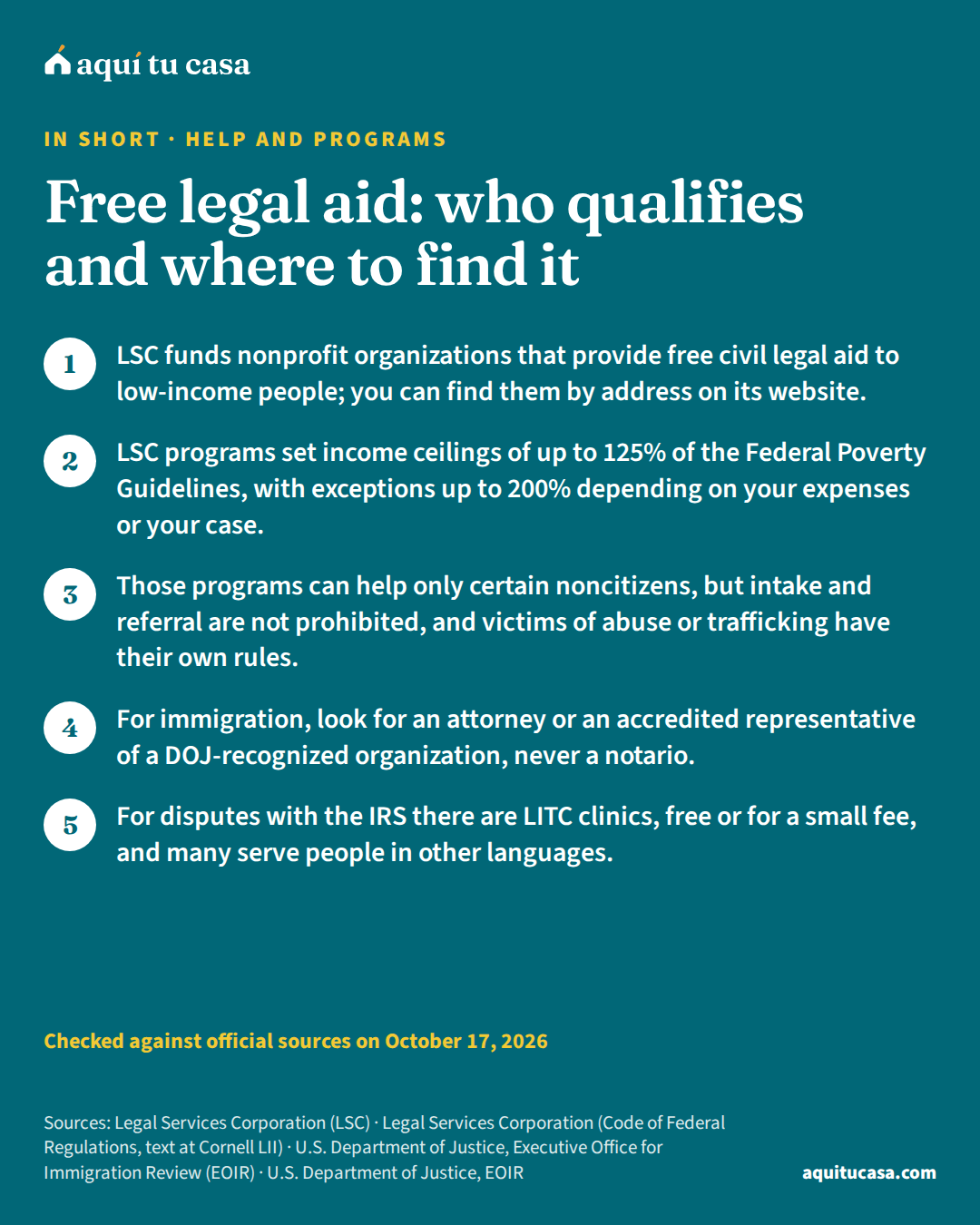
- LSC funds nonprofit organizations that provide free civil legal aid to low-income people; you can find them by address on its website.
- LSC programs set income ceilings of up to 125% of the Federal Poverty Guidelines, with exceptions up to 200% depending on your expenses or your case.
- Those programs can help only certain noncitizens, but intake and referral are not prohibited, and victims of abuse or trafficking have their own rules.
- For immigration, look for an attorney or an accredited representative of a DOJ-recognized organization, never a notario.
Is this for you?
This guide is for you if…
- You have a civil legal problem, such as an eviction, a debt lawsuit, child custody or denied benefits, and cannot afford a lawyer.
- You have an immigration question and want to know who can legally help you at low cost.
- You have a problem with the IRS and find it hard to understand your rights in English.
Get direct help first if…
- You are accused of a crime: in a criminal case you have a right to an attorney; this guide is about civil legal problems.
- You have a hearing in a few days: besides reading this guide, call a legal aid program today; court dates do not wait.
An eviction, a debt lawsuit, custody of your children or denied benefits can change a family’s life, and a private lawyer is expensive. This guide is for you if you have a legal problem and little money: it explains what free legal aidlegal aidLegal aid is the free civil legal help that nonprofit organizations and their lawyers provide to low-income people in civil, not criminal, matters. In housing, that includes representing families facing eviction or foreclosure, alongside matters such as custody, child support, protection from domestic violence and access to benefits. In the United States, the Legal Services Corporation, created by Congress, funds a nationwide network of these organizations; its finder points you to the one in your area. Each sets its own income limits.See the full definition is, who qualifies, which rules apply to noncitizens, where to get help with immigration and taxes, and what to ask if you look for a lawyer. Asking for help is an option, never an obligation.
What free legal aid is
The Legal Services Corporation (LSC) puts it this way: in the United States you have a right to an attorney when you are accused of a crime, but you can lose your income, your home or your children in a civil case without that right. That is where civil legal services come in.1
LSC is the largest funder of civil legal services in the country. It distributes federal grants to nonprofit organizations that provide free legal assistance to low-income individuals and families.1 It was established by Congress in 1974 and funds organizations in every state, the District of Columbia and the territories.2
According to LSC, these organizations help with matters such as:1
- Family: custody, child support and protection from domestic violence.
- Housing: representing people and families facing evictionevictionEviction is the legal process a landlord uses to get back a rented home when the tenant does not want to leave. The most common reasons are unpaid rent, serious lease violations or a lease that has ended. First the landlord must give you written notice. If it is not resolved, the landlord needs a court order, and a law enforcement officer must carry out the removal. If you are sued, you have the right to file a written answer explaining to the court why you should not be evicted. The rules change by state and city.See the full definition or foreclosureforeclosureForeclosure is the process by which the lender or servicer takes back the property after the homeowner fails to make mortgage payments. The rules and timelines depend on each state; all of them include advance notices and, in general, time to catch up or ask for an alternative, such as a repayment plan or a loan modification. If you fall behind, call your servicer and a HUD-approved housing counseling agency early: foreclosure counseling is free and exists for exactly this.See the full definition.
- Benefits: helping seniors with benefits such as Medicare and Social Security, and veterans with theirs.
- Work: for example, helping people with criminal records get back to work.
How to find a program near you
On the LSC website you enter your address or city and it shows you the nearest LSC-funded organization. LSC also points to LawHelp.org for information about your legal question and free legal forms.2
From the first call to getting help
2. You do the intake interview
On the first call or visit
They ask about your income, what you expect to earn and your assets, using simple forms.6
3. They check whether you qualify
During the interview
They compare your income and assets with the program's ceilings and exceptions.3
4. If you say you are a citizen, you sign for it
Before they represent you
A written attestation, unless you only get brief advice by phone.10
5. They help you or refer you
At the end of the interview
If they cannot take your case, intake and referral to another service are still allowed.7
Once one program has found you eligible, it can ask another program to help you in the same case without reassessing you.6
Who qualifies: income and assets
Each program that receives LSC funds sets its own rules, within what the federal regulation allows:3
- Income. The annual ceiling cannot exceed 125% of the current Federal Poverty Guidelines.
- Assets. Programs set a reasonable limit, and may not count your home, the car you use to get around or the tools you use to earn a living.
- Benefits. They may find you eligible if you receive benefits from a government program for low-income people.
- Domestic violence. If you are a victim, only your income and assets and those of your household count, not the alleged abuser’s or anything you hold jointly with them.
There are exceptions. A program may accept you even if your income is above the ceiling if you are trying to keep government benefits for low-income people, if most of your income goes to medical or nursing home expenses, or if your income does not exceed 200% of the Guidelines and you are seeking low-income or disability benefits. It may also consider seasonal income, unreimbursed medical expenses, fixed debts, dependent care, the costs of being able to work, or taxes.5
And something few people know: a program may help someone without applying those ceilings if the help is paid for entirely with non-LSC funds and the law allows it.4 So even if you think you do not qualify, it is worth asking.
Example with real numbers
How they check whether you qualify
An example in words of what an LSC-funded program looks at.
- Your household income
- Compared with the program's ceiling
- The general ceiling
- Up to 125% of the Federal Poverty Guidelines
- With an exception
- Up to 200%, depending on your expenses or your case
- Your assets
- Reviewed separately; your home and car may not count
- Who decides
- Each program, under its own rules
Each program sets its ceiling and asset limits within the regulation.3 Exceptions depend on your expenses and the type of case.5 With non-LSC funds, a program may help you without those ceilings.4

If you are not a citizen: what the LSC rules say
This part matters, so we explain it calmly. Programs that receive LSC funds may provide legal assistance only to U.S. citizens and certain noncitizens. They cannot represent a noncitizen who is not eligible, but intake and referral to other services do not count as legal assistance: they can listen and tell you where to go.7
Among the noncitizens who can get help, if they are in the United States, the regulation lists lawful permanent residents; the spouse, parent or unmarried child under 21 of a citizen who has applied to adjust to permanent resident status, if the application has not been rejected; refugees and people granted asylum; and people granted withholding of deportation or removal.8
There is also a rule for victims. A program may provide related legal assistance to a noncitizen who has been battered or subjected to extreme cruelty, is a victim of sexual assault or trafficking in the United States, or qualifies for a U visa, and also to someone whose child is in those situations. That help can include protective orders, divorce, custody, support, housing, benefits, employment and related immigration matters.9
For an immigration case: attorneys and accredited representatives
According to EOIR, the Department of Justice office in charge of the immigration courts, only certain people can represent you: validly licensed attorneys and accredited representatives. Notarios, document preparers, immigration consultants and travel agents cannot give you legal advice, tell you which benefit to apply for or represent you in court; if they do, they are breaking the law.11 Our guide notario is not a lawyer explains how to recognize who can actually help.
An accredited representativeDOJ-accredited representativeAn accredited representative is a non-attorney whom the U.S. Department of Justice, through its Recognition and Accreditation Program, authorizes to represent people in immigration matters before DHS and, with full accreditation, before the immigration courts. They may only do so through a recognized organization, which must be a non-profit, federally tax-exempt entity. It is the safe way to get low-cost immigration help: the Department of Justice publishes the official roster by state. Anyone who is not on that roster and is not a lawyer is not authorized to represent you.See the full definition is not a lawyer, but the Department of Justice authorizes them to represent people before DHS and EOIR. The program aims to give more low-income people competent representation. Accredited representatives work only through recognized organizations, which must be nonprofit and federally tax-exempt, and accreditation lasts three years.12 Only fully accredited representatives can appear in immigration court; partially accredited ones appear only before USCIS.11
Recognized organizations serve mainly low-income people, and if they charge fees they must have a written policy for helping people who cannot pay.13 EOIR publishes the lists of recognized organizations and accredited representatives, also by state.14 And if you are in immigration court proceedings, EOIR provides a list of organizations and attorneys who have committed to free (pro bono) services, though it does not endorse them.15
Who can help you with immigration
Validly licensed
Attorney
Of a recognized organization
Accredited representative
For your immigration case, look for an attorney or an accredited representative on the EOIR rosters.14

Taxes, housing and debts: other help at no cost
Problems with the IRS. Low Income Taxpayer Clinics (LITCs) can represent you before the IRS or in court on audits, appeals and collection matters, for free or for a small fee. Generally your income must be below a certain threshold, and the amount in dispute is usually less than $50,000. They also help people who speak English as a second language, and IRS Publication 4134 lists them with the languages they offer. They receive partial IRS funding but are independent.16 To prepare your return, VITAVITA (free tax preparation)VITA (Volunteer Income Tax Assistance) and TCE (Tax Counseling for the Elderly) are IRS programs that offer free basic tax return preparation by IRS-certified volunteers. They are meant for people with moderate income, people with disabilities and limited-English speakers; TCE focuses on people sixty and older. The IRS sets no program-wide income limit, but individual sites may set their own. Many sites serve in Spanish and help with ITIN applications and renewals. Filing taxes every year builds the record lenders ask for.See the full definition sites do it for free for people who qualify, and many serve limited English speakers.17
Housing. If you got an eviction notice, our guide on what to do if you get an eviction notice explains the steps, and the eviction timeline tool shows your state’s timing. A HUD-approved housing counselorHUD-approved housing counselorA HUD-approved housing counselor works at an agency HUD has approved to provide housing counseling: independent, expert advice customized to your situation about buying a home, renting, a missed mortgage payment, a foreclosure or credit problems. The agencies usually charge little or nothing; many serve in Spanish and offer the homebuyer education course several assistance programs require. They are not lenders or real estate agents and sell you nothing. Your county page lists the official agencies with phone numbers.See the full definition advises on renting, falling behind and credit, often at little or no cost.19
Debts. If a collector sues you, our debt collection guide explains what to do before the court date.
If this is you
You are facing eviction
LSC-funded programs represent people and families facing eviction or foreclosure.1
You are experiencing violence at home
The abuser's income does not count when assessing yours,3 and a noncitizen victim can receive related legal assistance.9
You have an immigration question
Look for an attorney or an accredited representative of a recognized organization on the EOIR rosters, not a notario.14
You were denied a benefit
If you are trying to get or keep government benefits for low-income people, a program may accept you even if your income is above the general ceiling.5
If you do not qualify: how to look for a lawyer
If a program cannot take your case, the CFPB suggests these routes: a lawyer referral service in your area, referrals from the American Bar Association or your state bar, and state legal aid programs for low-income people.18
Before hiring, ask whether there is an up-front fee, whether you will have to pay even if you lose and, if you cannot afford it, whether they can refer you to a lawyer who does not charge up front. Check with your state’s mandatory bar that the lawyer is in good standing. And bring copies of your papers: never leave your originals with anyone.18

Costly mistakes
Mistake: Paying a notario or consultant for your immigration case.
Instead: Look for an attorney or an accredited representative; a notario cannot give you legal advice.11
Mistake: Assuming you do not qualify without asking.
Instead: There are exceptions up to 200% of the Guidelines, and some programs use other funds without those ceilings.4
Mistake: Not calling because you are not a citizen.
Instead: Intake and referral to other services are allowed, and victims of abuse or trafficking have their own rules.7
Mistake: Leaving your original documents at an office.
Instead: Bring copies and keep the originals.18
Mistake: Hiring a lawyer without checking their standing.
Instead: Look them up with your state's mandatory bar.18
What to do this week
- Find the legal aid program for your area on the LSC website, with your address or city.2
- Gather your papers and make copies; write down your household income and fixed expenses for the intake interview.6
- If your question is about immigration, check the recognized organization or accredited representative on the EOIR rosters.14
- If you have a problem with the IRS, find an LITC in Publication 4134.16
- If you do not qualify, ask your state bar for referrals and ask about fees before you sign.18
Ready to see the numbers? Find your county here
See how this applies in your county: its loan limits, prices and rents, from the official data.
Printable checklist
Frequently asked questions
Who qualifies for free legal aid?
Each LSC-funded program sets its own rules. The income ceiling cannot exceed 125% of the Federal Poverty Guidelines, but there are exceptions up to 200% if, for example, you are seeking government benefits or have medical expenses or fixed debts. Programs also look at your assets, and may not count your home or the car you use to get around.
Will free legal aid help with my immigration case?
LSC-funded programs can help only certain noncitizens. For an immigration case, EOIR says only an attorney or an accredited representative of a DOJ-recognized organization can represent you. EOIR also publishes a list of free legal service providers for people in immigration proceedings.
Will they ask whether I am a citizen?
At an LSC-funded program, if you say you are a citizen you will be asked to attest to it in writing, except for brief advice by phone. The regulation bars them from doubting your citizenship because of your accent, limited English, appearance, race or national origin. Also, intake and referral to other services do not count as legal assistance.
Can a domestic violence victim get help even if they are not a citizen?
LSC regulations allow related legal assistance for noncitizens who were battered or subjected to extreme cruelty, victims of sexual assault or trafficking, or people who qualify for a U visa. That help can include protective orders, custody, support, housing and related immigration matters. When assessing income, the abuser's income is not counted.
How much does an accredited representative charge?
Accredited representatives work through nonprofit organizations recognized by the Department of Justice, which serve mainly low-income people. If the organization charges fees, it must have a written policy for helping people who cannot pay.
Is there free help if I have a problem with the IRS?
Yes: Low Income Taxpayer Clinics (LITCs) can represent you in audits, appeals and collection matters, for free or for a small fee, if your income is below a certain threshold. IRS Publication 4134 lists them with the languages they offer. To prepare your return, VITA sites do it for free for people who qualify.
What if I do not qualify for free legal aid?
The CFPB suggests using a lawyer referral service or your state bar, and asking whether there is an up-front fee and whether you pay even if you lose. Before hiring, check with the state bar that the lawyer is in good standing. Some programs also use non-LSC funds and can help without applying the same income ceilings.
Sources
Every figure in this guide comes from one of these official sources. The number next to a sentence leads to the source behind it.
Each source on one line: who publishes it, its title, its address and the date we read it.
- 1. Legal Services Corporation (LSC) · What are Legal Services? · lsc.gov · Accessed October 17, 2026
- 2. Legal Services Corporation (LSC) · I Need Legal Help · lsc.gov · Accessed October 17, 2026
- 3. Legal Services Corporation (Code of Federal Regulations, text at Cornell LII) · 45 CFR §1611.3, Financial eligibility policies · law.cornell.edu · Accessed October 17, 2026
- 4. Legal Services Corporation (Code of Federal Regulations, text at Cornell LII) · 45 CFR §1611.4, Financial eligibility for legal assistance · law.cornell.edu · Accessed October 17, 2026
- 5. Legal Services Corporation (Code of Federal Regulations, text at Cornell LII) · 45 CFR §1611.5, Authorized exceptions to the annual income ceiling · law.cornell.edu · Accessed October 17, 2026
- 6. Legal Services Corporation (Code of Federal Regulations, text at Cornell LII) · 45 CFR §1611.7, Manner of determining financial eligibility · law.cornell.edu · Accessed October 17, 2026
- 7. Legal Services Corporation (Code of Federal Regulations, text at Cornell LII) · 45 CFR §1626.3, Prohibition (Restrictions on legal assistance to aliens) · law.cornell.edu · Accessed October 17, 2026
- 8. Legal Services Corporation (Code of Federal Regulations, text at Cornell LII) · 45 CFR §1626.5, Aliens eligible for assistance based on immigration status · law.cornell.edu · Accessed October 17, 2026
See the other 11 sources
- 9. Legal Services Corporation (Code of Federal Regulations, text at Cornell LII) · 45 CFR §1626.4, Aliens eligible for assistance under anti-abuse laws · law.cornell.edu · Accessed October 17, 2026
- 10. Legal Services Corporation (Code of Federal Regulations, text at Cornell LII) · 45 CFR §1626.6, Verification of citizenship · law.cornell.edu · Accessed October 17, 2026
- 11. U.S. Department of Justice, Executive Office for Immigration Review (EOIR) · Can Someone Represent You Before EOIR? · justice.gov · Accessed October 17, 2026
- 12. U.S. Department of Justice, EOIR · Recognition & Accreditation (R&A) Program · justice.gov · Accessed October 17, 2026
- 13. U.S. Department of Justice (Code of Federal Regulations, text at Cornell LII) · 8 CFR §1292.11, Recognition of an organization · law.cornell.edu · Accessed October 17, 2026
- 14. U.S. Department of Justice, EOIR · Recognition & Accreditation (R&A) Roster Reports · justice.gov · Accessed October 17, 2026
- 15. U.S. Department of Justice, EOIR · List of Pro Bono Legal Service Providers · justice.gov · Accessed October 17, 2026
- 16. IRS (Taxpayer Advocate Service) · Low Income Taxpayer Clinics · irs.gov · Accessed October 17, 2026
- 17. IRS · Free tax return preparation for eligible taxpayers · irs.gov · Accessed October 17, 2026
- 18. CFPB · How do I find a lawyer to help me with a creditor or collector trying to collect a debt from me? · consumerfinance.gov · Accessed October 17, 2026
- 19. CFPB · Find a Housing Counselor · consumerfinance.gov · Accessed October 17, 2026
Keep reading
Related guides
If this guide helped, these follow the same path.

Protect yourself from scams 12 minute read
A notario is not a lawyer: who can give you legal advice
Outside Puerto Rico, a notary public is not a lawyer. What a notary can do, who can advise you for free or at low cost, warning signs and how to report it.
- Outside Puerto Rico, a notary public witnesses signatures: they cannot give you legal advice, tell you what to apply for or represent you in immigration matters.
- Only a licensed attorney or an accredited representative of a recognized organization can advise you on immigration, and both can be checked on official lists.
- In Puerto Rico a notario is a lawyer, but when acting as a notary they represent neither party.
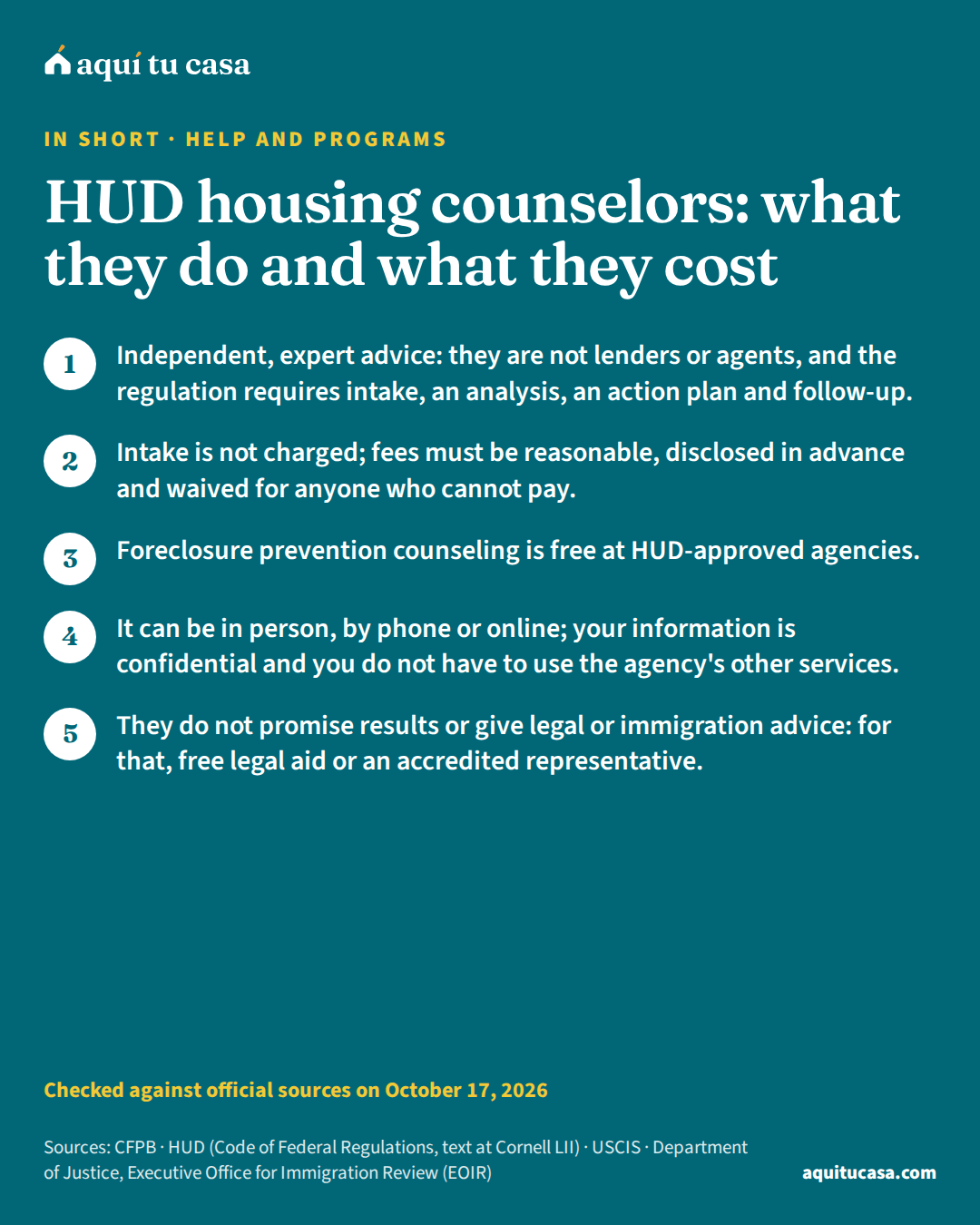
- Help and programs HUD housing counselors: what they do and what they cost What a HUD-approved housing counselor does, what they help with (buying, renting, missed payments, credit), what they may charge and how to find one. 11 minute read
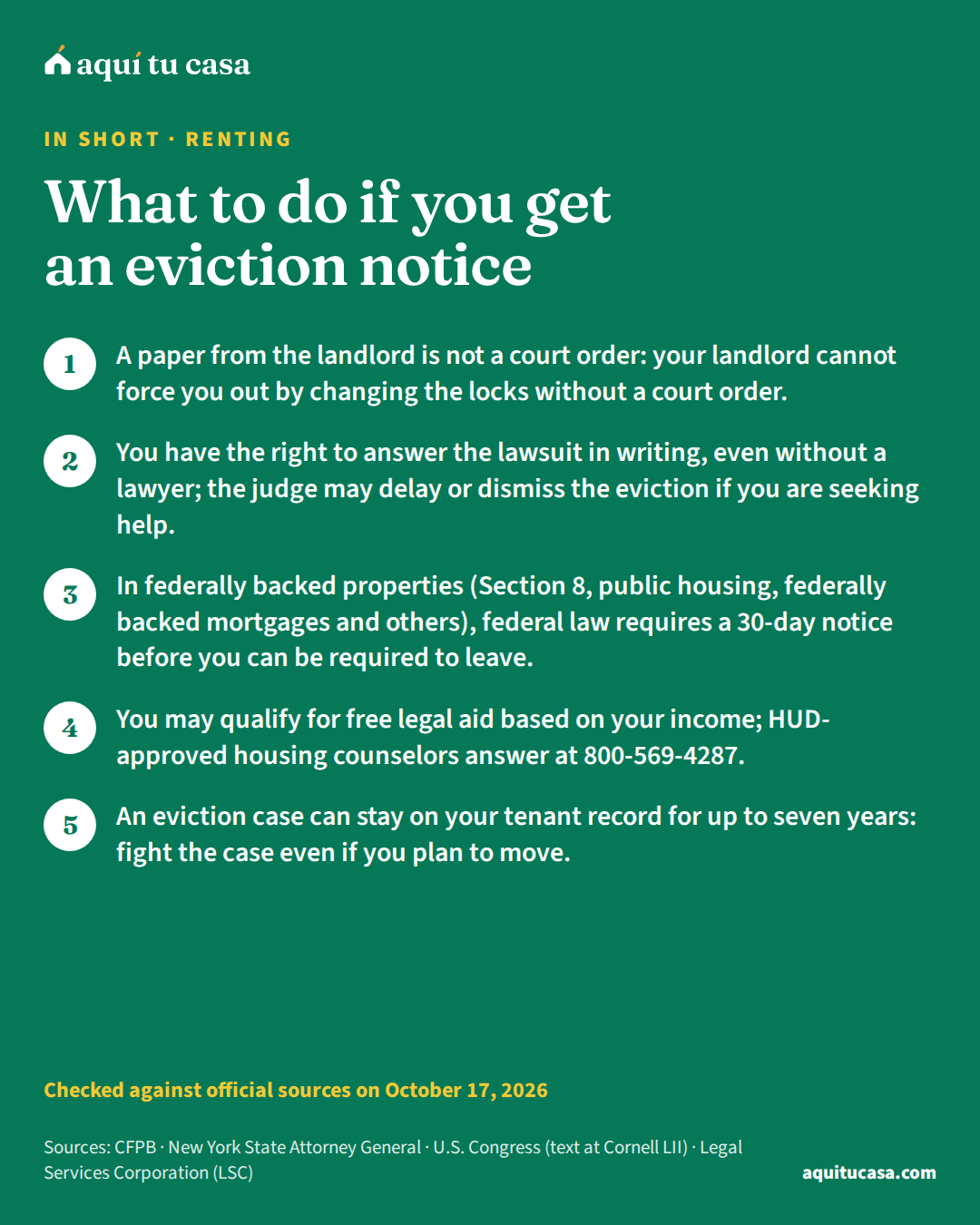
- Renting What to do if you get an eviction notice Notice, lawsuit and the judge's order: what you can do at each moment, where free legal help is and what federal law says about the 30-day notice. 14 minute read
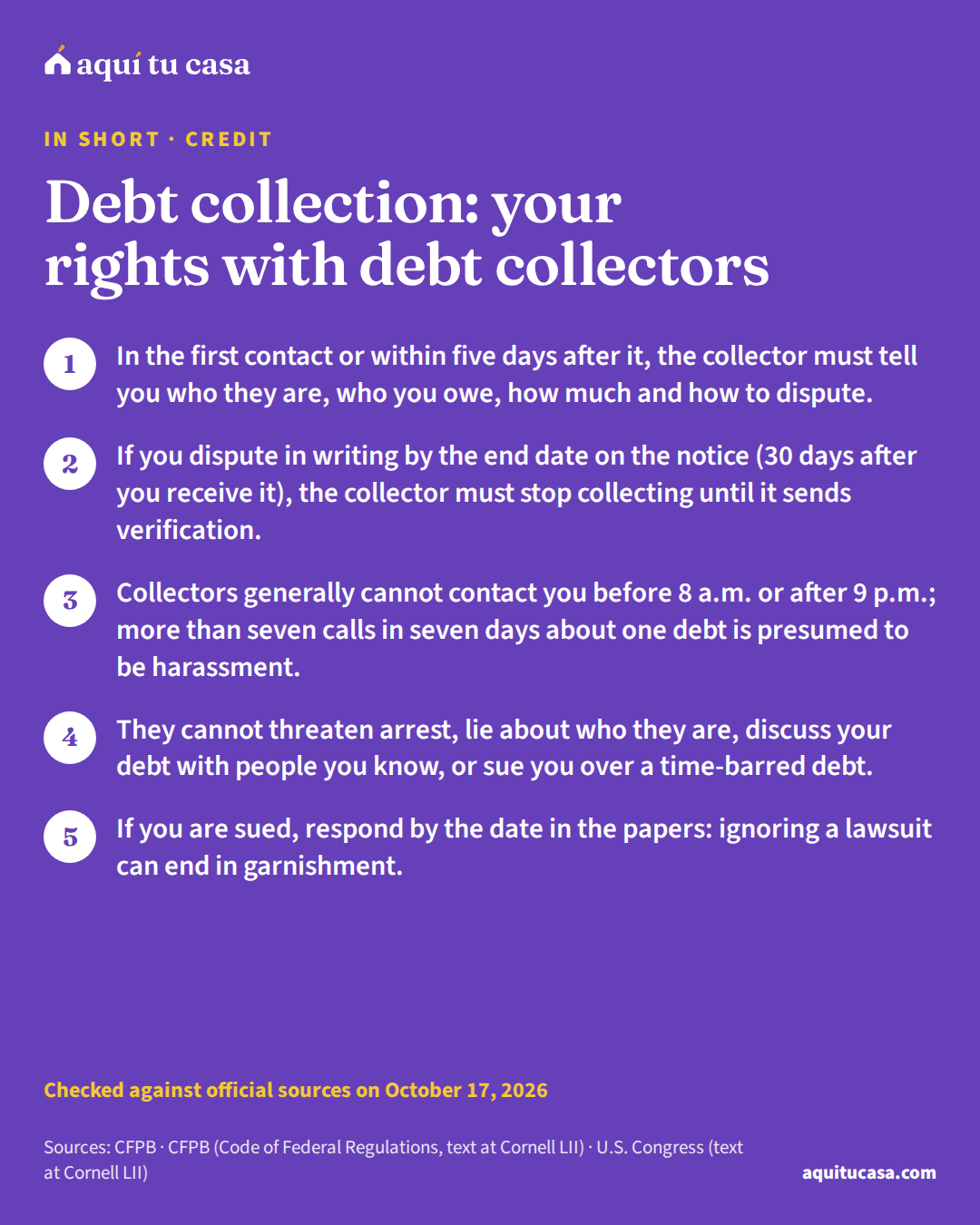
- Credit Debt collection: your rights with debt collectors What a debt collector must tell you, how to dispute in writing, when and how often they can call, old debts, and what to do if you are sued. 16 minute read
Tools for this topic
Was this guide useful?
Thank you. Your answer stays in your browser; nothing is sent.