
Which programs might I qualify for?
Assistance programs that might fit you.
What you get → possible programs
Someone shared this page with you.
Questions and answers
Every question our 13 guides about help and programs answer, grouped by guide. Each answer is the guide's own and leads to it, with its sources.
Open a question to read its answer. Each group ends with the full guide, its sources and, when it has one, its calculator.
We found no questions with those words. Try another word or open a topic.
From the guide
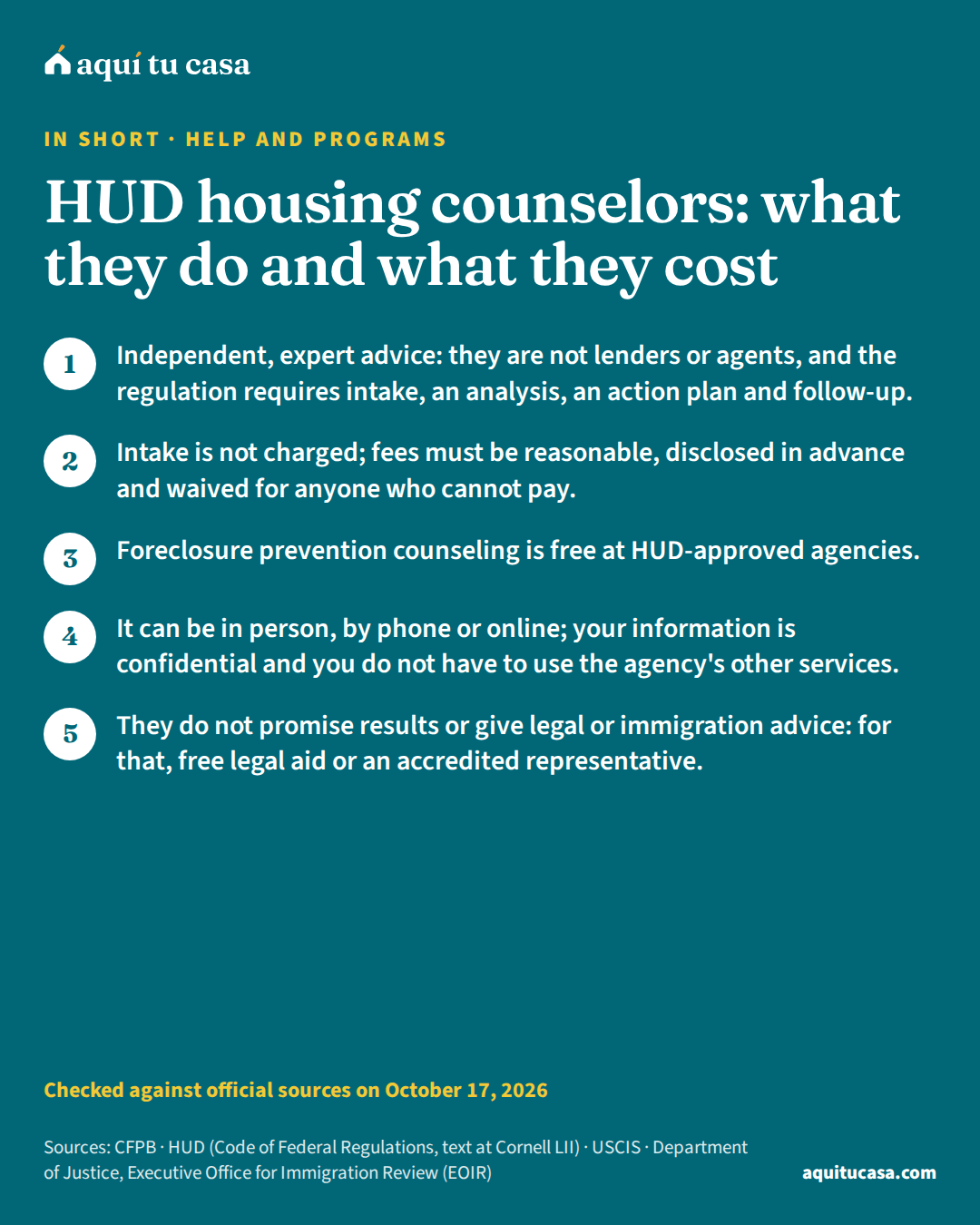
What a HUD-approved housing counselor does, what they help with (buying, renting, missed payments, credit), what they may charge and how to find one.
Verified on October 17, 2026 11 official sources
Read the full guide Do the math: Which programs might I qualify for?
No. The counselor does not sell you a home or a loan: they give independent, HUD-certified advice so that you decide. The regulation bars them from having an interest in you as a lender, broker or landlord, and from taking a fee for sending you to a lender or agent. If a lender pays the agency for the counseling, the agency has to tell you.
Read the full guideThe intake interview is not charged. If the agency charges fees for other services, they must be reasonable, disclosed in advance and waived for anyone who cannot pay them. Foreclosure prevention counseling is free.
Read the full guideMany agencies do. On your state's page on this site you will see the HUD-approved agencies with the languages they declare; the CFPB's tool also lets you search by ZIP code. Since not all of them offer every service, check each one's list of services.
Read the full guideA housing counselor does not give immigration advice; their job is your housing and your money. If you have immigration questions, only an attorney or an accredited representative can advise you; according to the Department of Justice, notarios and immigration consultants cannot give legal advice.
Read the full guideYes. Under HUD's regulation, counseling can take place at the agency's office, at another location, by phone or online. If you prefer in person and your agency does not offer it, it must refer you to one that does.
Read the full guideIf you are going because of a mortgage problem, the CFPB says you will be asked how much you owe and the date of your last payment (both on your last statement), and possibly for pay stubs, tax returns, bank statements and your other monthly bills. To buy or rent, bring your income, your expenses and your debts.
Read the full guideYes. Under HUD's regulation, the agency keeps a confidential file with your action plan and must protect your personal and financial information, including your credit reports.
Read the full guideNo. The agency must tell you in writing what services it offers and what financial relationships it has, and state clearly that you are not obligated to receive any other services from it or its partners. It must also tell you about other options.
Read the full guideThe data behind these guides
The guides on Help and programs cite these figures. They update when their sources publish new ones; what you see here is current.
See all the dataSources: U.S. Census Bureau (Average 2020–2024) · HUD (2026 data)
From the guide
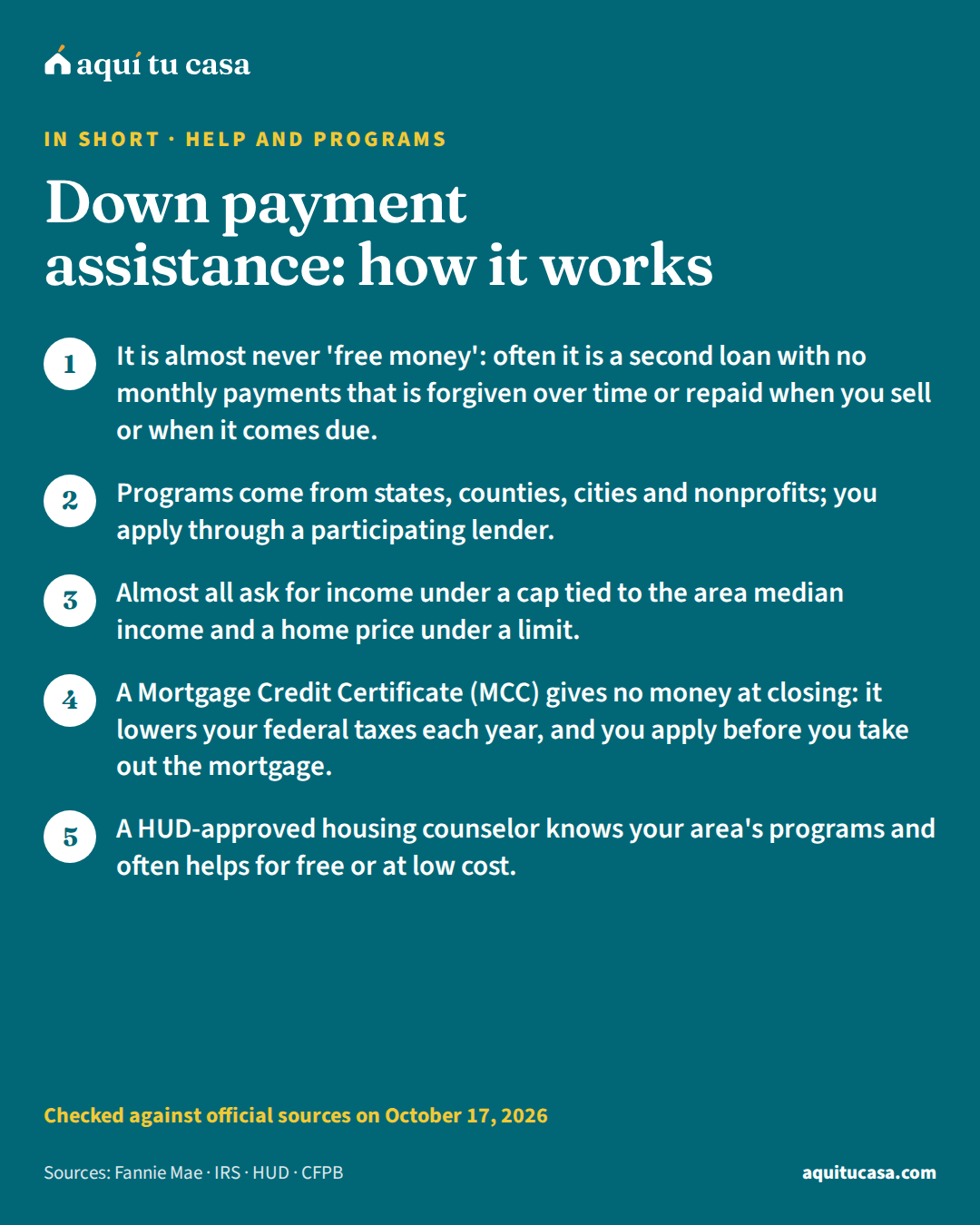
What down payment assistance is, the types that exist (grant, forgivable or deferred second loan, tax credit), who qualifies and where to find it.
Verified on October 17, 2026 12 official sources
Read the full guide Do the math: Which programs might I qualify for?
It depends on the type. A grant is not repaid. A forgivable second loan is forgiven over time if you meet the program's conditions, such as living in the home for a set time. A deferred one has no monthly payments but is repaid when it comes due, or earlier if you sell the home or pay off the loan. A repayable one has monthly payments. Each program publishes its conditions, and our records quote its text.
Read the full guideMost programs say nothing about the ITIN on their page (110 of the 134 we have read). Ask the program or a participating lender directly. Remember that the first-mortgage type matters too: FHA stopped accepting non-permanent residents for case numbers assigned on or after May 25, 2025.
Read the full guideA second loan adds debt against the home. For loans Fannie Mae buys, a program's second loan (Community Seconds) must be fixed-rate, no more than 2 points above your first mortgage's initial rate, and if its payments are deferred five years or more the lender does not have to count them in your debt-to-income ratio. Compare the total cost with and without assistance before you decide.
Read the full guideIt depends on the loan and the program. On a conventional loan Fannie Mae buys, with a Community Seconds loan on a one-unit principal residence, no minimum contribution of your own funds is required; on a two- to four-unit home financed above 80%, you must put in at least 5%. Other loans and programs have their own rules, listed on their record.
Read the full guideOn this site's assistance programs page, organized by state, and with the Which programs do I qualify for? tool. The CFPB also suggests looking up a HUD-approved housing counseling agency in your area or calling the HOPE Hotline, (888) 995-4673, 24 hours a day.
Read the full guideA Mortgage Credit Certificate turns part of the interest you pay into a credit on your federal taxes, figured each year on Form 8396. If the certificate credit rate is higher than 20%, the credit can't be more than $2,000. You apply before taking out the mortgage, and if you sell the home within 9 years you may have to repay part of the benefit.
Read the full guideMany programs require it, but each publishes its own definition, and it does not always mean 'never owned a home'. Some programs do not require it. Read the definition on the program's record before ruling yourself out.
Read the full guideBe wary of anyone who asks for money up front to 'get' or 'guarantee' you assistance. USA.gov warns that promises of 'grants' or 'free money' from the government are often scams and asks people to report them to the FTC. Each program's record and HUD-approved counselors can guide you, often for free or at low cost.
Read the full guide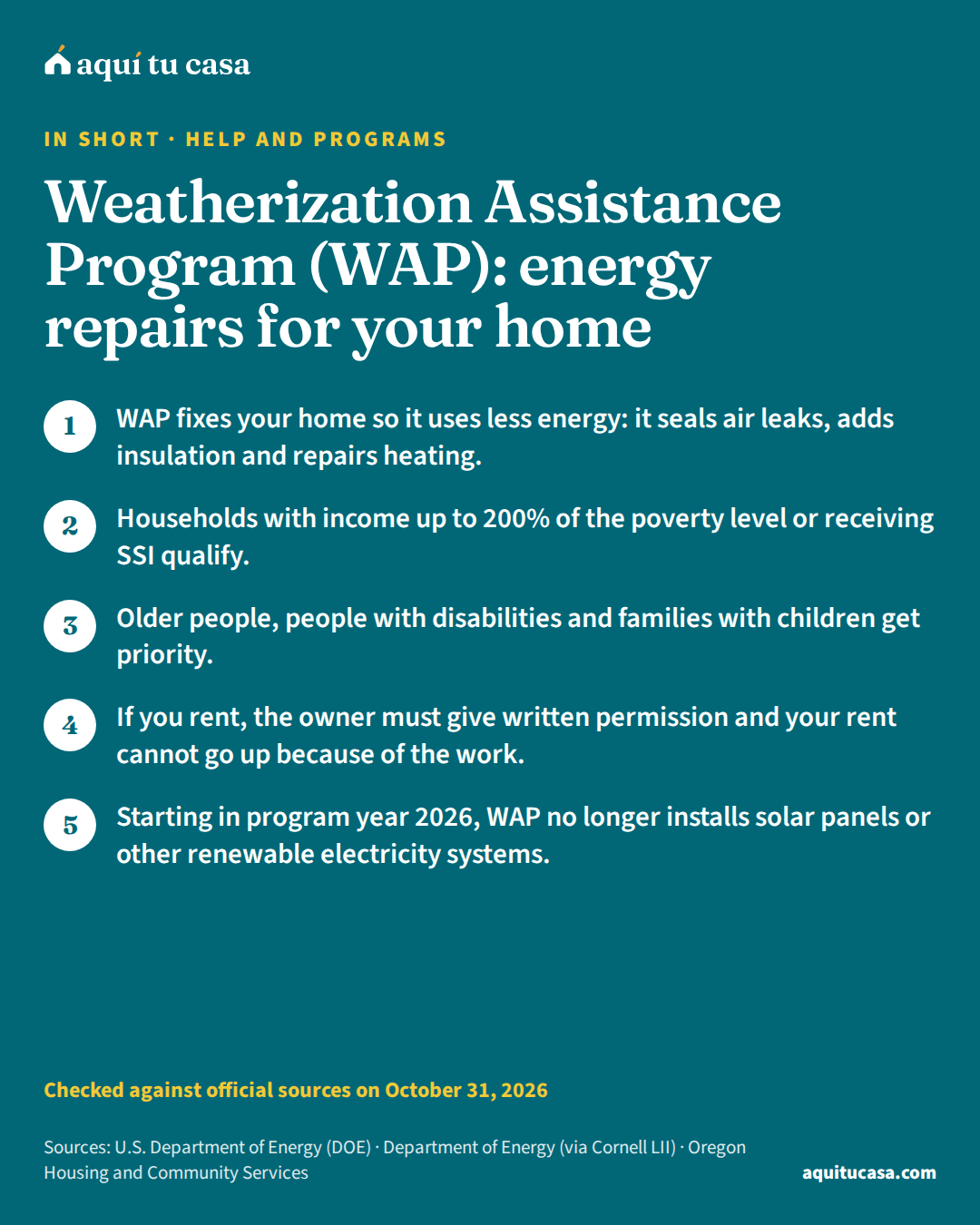
From the guide
How DOE's Weatherization Assistance Program (WAP) works: who qualifies, what gets fixed in your home, how to apply and what protects renters.
Verified on October 31, 2026 6 official sources
WAP is paid for with federal and state funds that go to local agencies. In Oregon, for example, the state agency says it provides services at no cost to eligible households. Ask your local provider whether you will be asked to pay anything.
Read the full guideUnder DOE's rules, households with income up to 200% of the poverty level, or with someone receiving SSI, and in some states those eligible for LIHEAP. Older people, people with disabilities, families with children and households that spend a lot on energy get priority.
Read the full guideYes. Owners and renters can apply. If you rent, the provider needs the owner's written permission, and DOE's rules say that for a reasonable period after the work your rent cannot be raised because of the weatherization.
Read the full guideAn energy audit of your home decides. The most common measures are air sealing, insulation and heating or cooling upgrades. In Oregon, for example, they include insulation, minor repairs, furnace repair or replacement and duct improvements.
Read the full guideNot through WAP right now. DOE said that starting in program year 2026, renewable electricity-generation technologies not on the program's official list are no longer permitted, and it is not approving new ones.
Read the full guideIt depends on your county. If you are income eligible, you go on a waiting list. When your turn comes, an auditor visits your home, the work is done and an inspector checks it at the end.
Read the full guideAsk for LIHEAP help with the bill and ask your power or gas company about payment plans. DOE also mentions Community Action Agencies and, if you live in a rural area, USDA repair loans and grants.
Read the full guide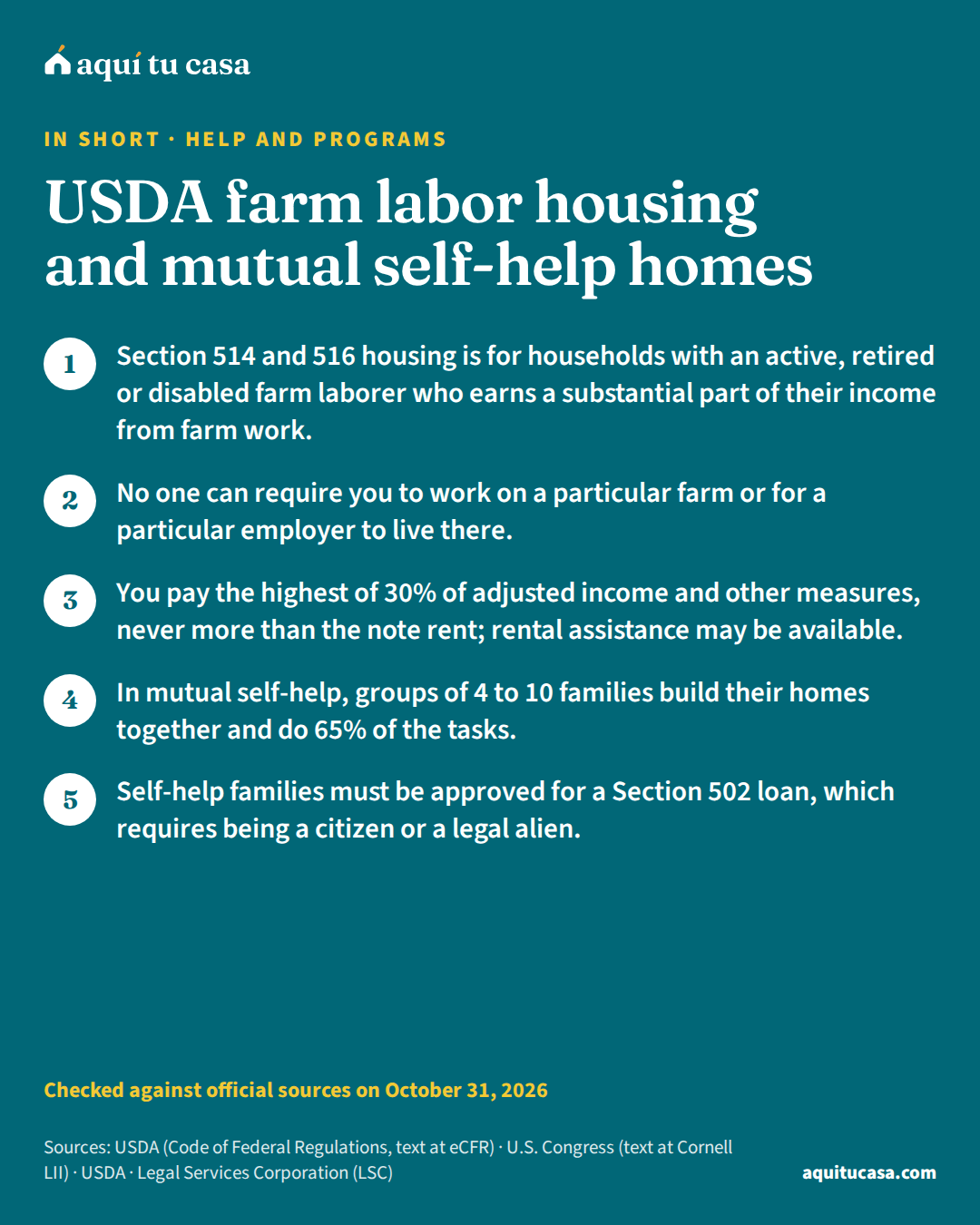
From the guide
How USDA farm labor housing (Sections 514 and 516) and mutual self-help housing (Section 523), where families build their homes together, work.
Verified on October 31, 2026 18 official sources
Read the full guide Do the math: How much rent can I afford?
A household that includes a domestic farm laborer who is working now, a retired one or a disabled one, and that is income eligible. The tenant must earn a substantial part of their income from farm work, for example at least 65% of the region's income limit, or have worked at least 110 whole days in farm work in the past year.
Read the full guideThe regulation defines it as a person who earns a substantial part of their income from farm work, not self-employment, in the United States, Puerto Rico or the Virgin Islands, and who is a citizen, a lawful permanent resident, or a person legally admitted to the United States and authorized to work in agriculture. It can include the immediate family members who live with them.
Read the full guideIn off-farm labor housing, no. The regulation bars requiring a tenant to work on a particular farm or for a particular employer as a condition of living there, and bars discrimination based on race, color, religion, sex, age, disability, familial status or national origin.
Read the full guideThe highest of 30% of your monthly adjusted income, 10% of your gross monthly income, the housing part of a public assistance payment, or the basic rent unless you get rental assistance; and never more than the note rent. Eligible tenants may get rental assistance.
Read the full guideIt is a method in which groups of generally 4 to 10 low-income families build their homes by exchanging labor, guided by an organization that receives a Section 523 grant. Each family helps on the others' homes until 65% of the tasks are done, and must be approved for a Section 502 loan before starting.
Read the full guideNot necessarily. The organization recruits families, explains the program, helps find land, house plans and cost estimates, prepares loan applications, and supervises and trains families during construction. What you do need is enough time to work and a desire to work with other families.
Read the full guideThe Section 502 loan the families need requires being a U.S. citizen or a noncitizen who qualifies as a 'legal alien' under section 214 of the federal housing law, which includes permanent residents, refugees, asylees and other categories. Which category you fit is an immigration question: an attorney or an accredited representative can advise you.
Read the full guide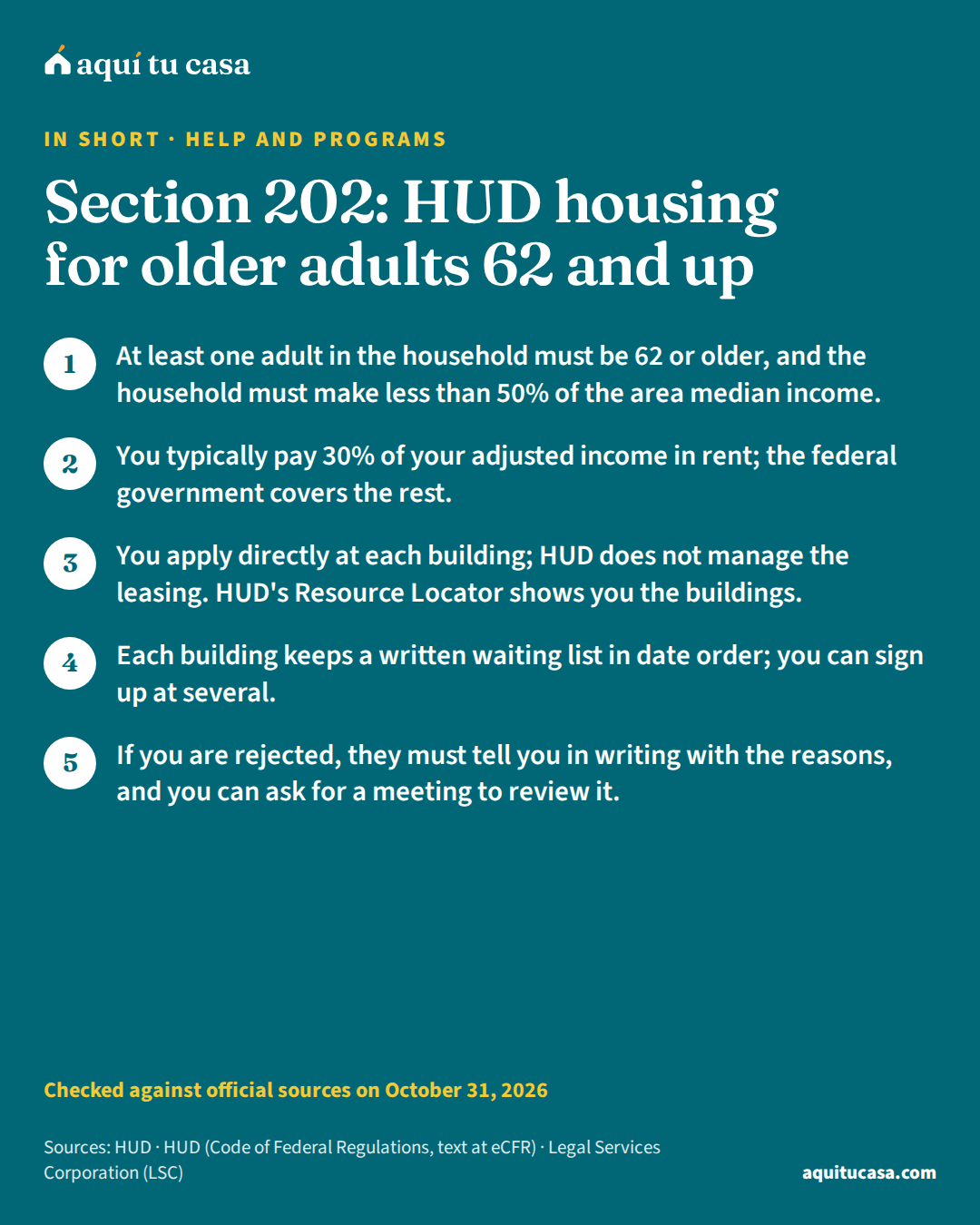
From the guide
How HUD's Section 202 housing for low-income older adults works: the age and income rules, the rent, how to apply and what to expect on the waiting list.
Verified on October 31, 2026 11 official sources
Read the full guide Do the math: How much rent can I afford?
At least one adult in the applying household must be 62 or older. The regulation counts age at the time you move in. Other household members can live with you even if they are younger.
Read the full guideAccording to HUD, residents typically pay 30% of their adjusted income, and the federal government covers the rest. If you receive a support service the program does not cover, you may be asked for a co-payment, but it is not added to your rent.
Read the full guideThe household must make less than 50% of the area median income where the building is. That limit depends on the area, and HUD publishes what 50% of the median is in each one. The building manager does the final calculation with your household income.
Read the full guideDirectly with the owner or manager of each building, because HUD does not manage the leasing. To find Section 202 buildings near you, use HUD's Resource Locator and choose the option for affordable elderly and special needs housing.
Read the full guideIt depends on each building. The owner must keep a written list in date order and let you know when a unit opens. If the list is so long that you are not likely to get in within 12 months, it can tell you it is not taking more applications. That is why it helps to sign up at several buildings.
Read the full guideNo. The regulation bars infirmaries, nursing stations and spaces for overnight care. What there usually is, is a service coordinator who connects you with community supports such as cleaning, meals and transportation.
Read the full guideNo. The regulation bars living in a Section 202 unit or receiving that assistance while living in another federally assisted unit or getting help from another federal housing program, including Section 8.
Read the full guide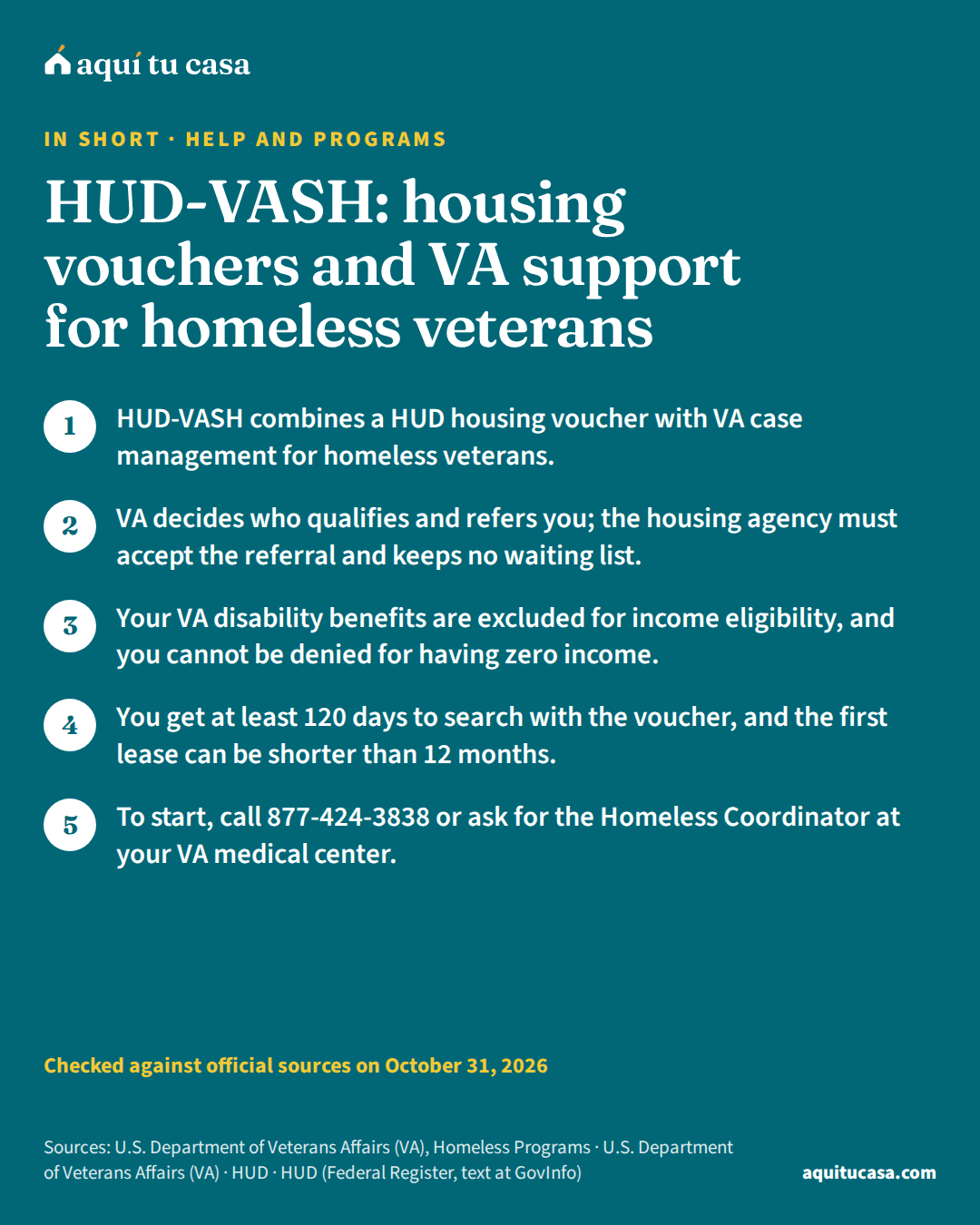
From the guide
How HUD-VASH works for homeless veterans: a HUD housing voucher with VA case management, who refers you, the income rules and how to get started today.
Verified on October 31, 2026 6 official sources
Read the full guide Do the math: How much rent can I afford?
You do not ask the housing agency. Call the National Call Center for Homeless Veterans, 877-424-3838, free and any time, or go to your VA medical center and ask for the Homeless Coordinator. HUD says to mention your interest in HUD-VASH. VA decides whether you qualify and refers you to the housing agency.
Read the full guideUnder HUD's rules, housing agencies may not keep a waiting list or apply local preferences for HUD-VASH. VA selects veterans and refers them, and the agency must accept those referrals.
Read the full guideWhen administering HUD-VASH, the housing agency may not deny assistance on the usual criminal-record grounds, except one: if anyone in the household must register for life as a sex offender in a state registry. If that person is not the veteran, the rest of the family can be served if they remove that person from the household.
Read the full guideTo decide whether you qualify by income, no: all your VA service-connected disability benefits are excluded. They are counted later to calculate how much rent you pay. The agency must serve veterans with incomes up to 80% of the area median income.
Read the full guideWhile you need case management, you can live only where VA can provide it, and the agency must consult with VA before approving the move, unless you are a victim of violence. If VA decides you no longer need case management, the regular rules for moving apply.
Read the full guideIf VA determines you are not taking part in required case management without good cause, the agency must remove you from HUD-VASH, although it can offer you a regular voucher. A VA decision that you no longer need case management is never a reason to take away your assistance.
Read the full guide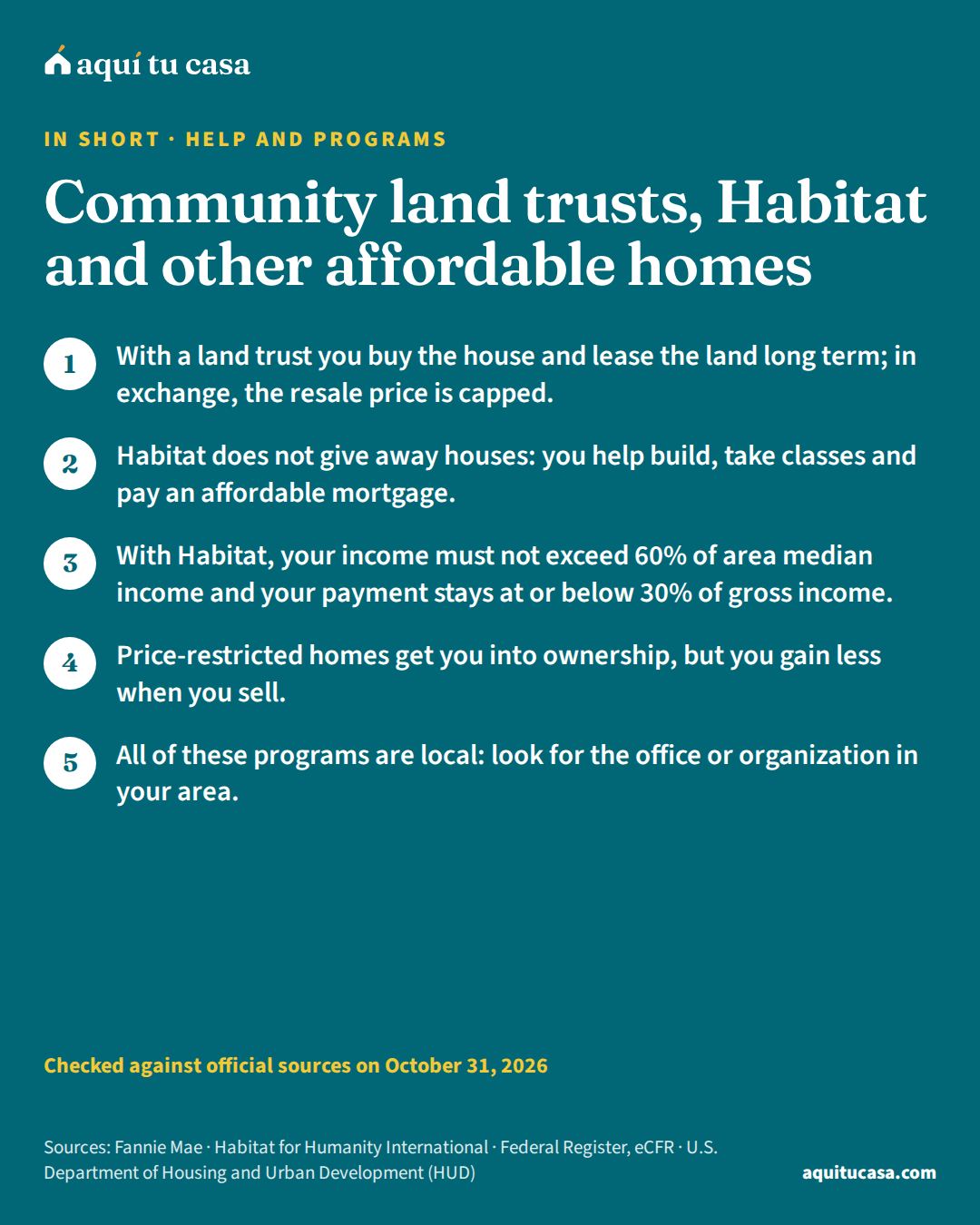
From the guide
How community land trusts, Habitat for Humanity and price-restricted homes work: who qualifies, what you gain and which limits you accept.
Verified on October 31, 2026 7 official sources
It is an organization that buys homes, sells them to income-eligible families and keeps the land. You own the house and lease the land with a long-term ground lease, at affordable monthly rents. In exchange, you accept limits on the future sales price.
Read the full guideYou own the house and have the right to use the land under the lease. But you accept rules: the price you can sell for and the income of whoever buys from you are limited. Read the ground lease with a housing counselor before you sign.
Read the full guideNo. Habitat says future owners partner with the local affiliate and volunteers to build or rehabilitate the home and pay an affordable mortgage. Habitat makes sure that payment does not exceed 30% of your gross monthly income at closing.
Read the full guideIn the U.S., household income must not exceed 60% of area median income. You must also need affordable housing, be willing to partner with Habitat (sweat equity and classes) and be able to pay an affordable mortgage. Each local affiliate runs its own application.
Read the full guideIt is your work instead of money: helping build your home or other families' homes, taking homeowner classes or volunteering at a Habitat ReStore. Habitat buyers invest hundreds of hours.
Read the full guideYes, in many cases. Fannie Mae buys community land trust loans if the ground lease meets its requirements, such as being based on an approved model and lasting at least five years past the loan. Ask the land trust which lenders it works with.
Read the full guideWith a price-restricted home, you sell using the program's formula or maximum price, usually to another income-eligible family. You gain less than in a market sale. Get the formula in writing and run the numbers before you buy.
Read the full guideTools
The calculators these guides use. Each one leaves you with a result you can use today.
Assistance programs that might fit you.
What you get → possible programs
The price your income can carry.
What you get → maximum price
The rent that fits your budget.
What you get → rent that fits
Your monthly payment with taxes and insurance.
What you get → monthly payment
From the guide
How to use your Section 8 voucher to buy a home: who qualifies, the required counseling, the inspections, what the housing authority pays and for how long.
Verified on October 31, 2026 2 official sources
Read the full guide Do the math: How much house can I afford?
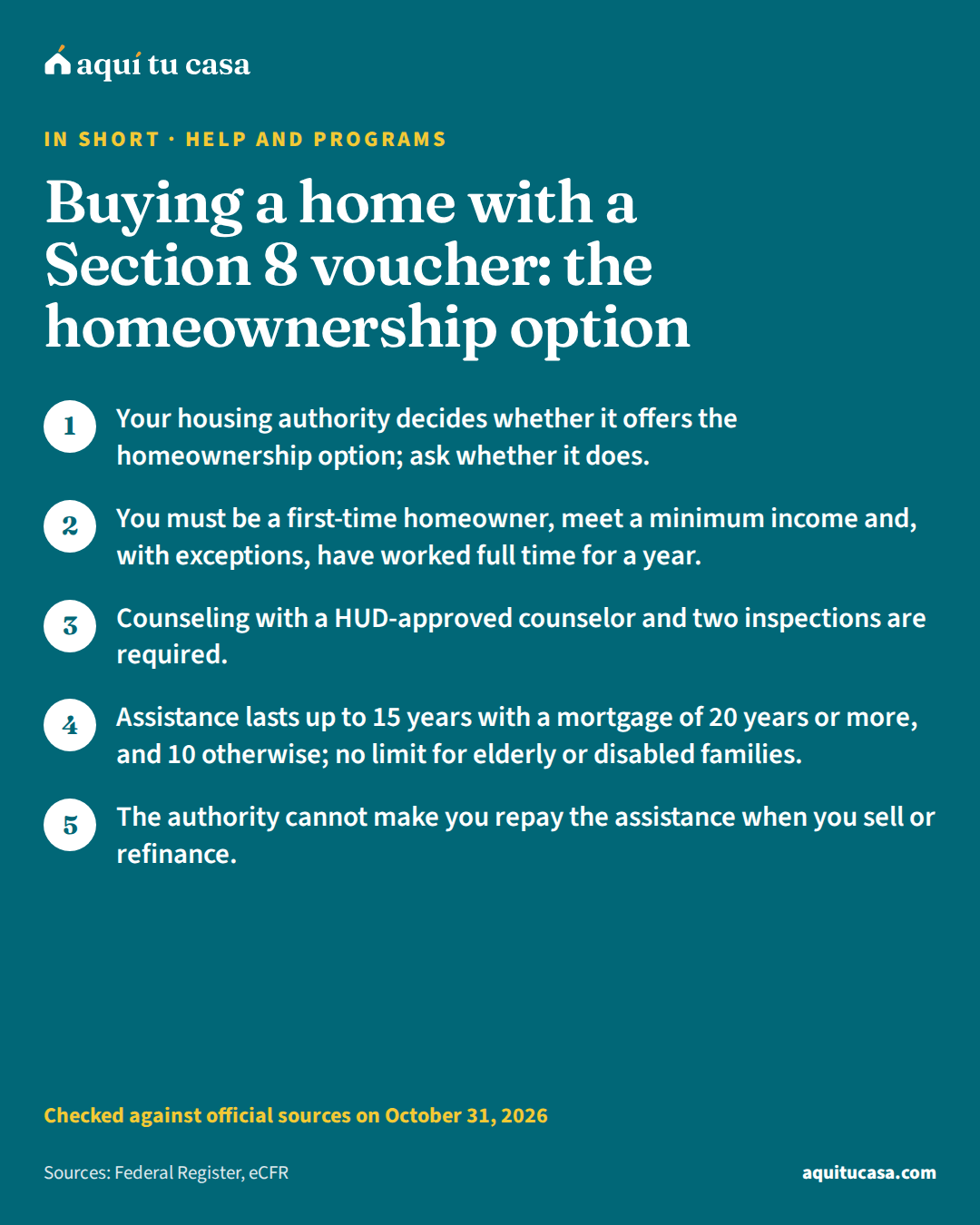
Generally yes: no one in your family can have owned a home in the three years before assistance starts. Single parents and displaced homemakers also count. There are exceptions for cooperative members and for reasonable accommodation because of a disability.
Read the full guideThe adults who will own the home must earn at least the federal minimum wage times 2,000 hours a year. For a disabled family, the minimum is 12 times the monthly SSI benefit for one person. Welfare assistance does not count, except for elderly or disabled families. Your authority may set a higher minimum.
Read the full guideYes, with exceptions: one or more adults who will own the home must work full time (an average of at least 30 hours a week) and have done so during the past year. It does not apply to elderly or disabled families. The authority may count self-employment.
Read the full guideUp to 15 years if your initial mortgage is 20 years or longer, and up to 10 in other cases. For elderly or disabled families there is no time limit.
Read the full guideYes. And the authority may not require you to repay the assistance when you sell or refinance. While you are assisted, you must live in the home, keep up with the mortgage and tell the authority before you move out.
Read the full guide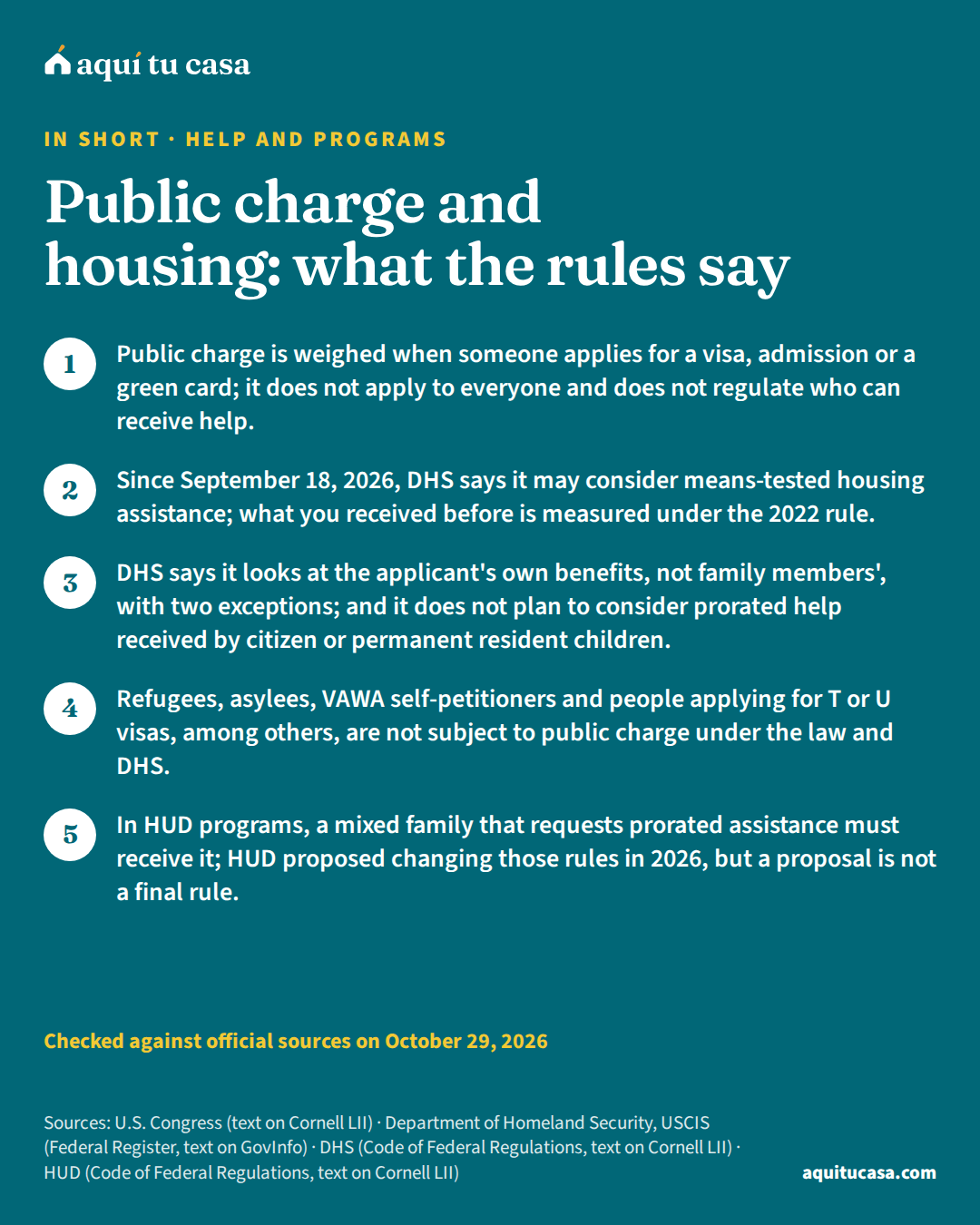
From the guide
Public charge: which housing help DHS may consider, who is exempt, how HUD prorates assistance for mixed-status families and where to get free advice.
Verified on October 29, 2026 17 official sources
Read the full guide Do the math: Which programs might I qualify for?
It is a rule in immigration law. When someone applies for a visa, admission or adjustment of status, the government weighs whether the person is likely to become dependent on the government. The law requires officials to consider at a minimum their age, health, family status, assets and resources, and education and skills.
Read the full guideDHS says it considers all housing assistance the government provides, pays for or subsidizes, as long as it is means-tested: it does not exclude public housing or housing subsidies. It also says benefits given to everyone regardless of income are not considered, and that its officers decide case by case, taking into account the type of program, the amount, the duration and how recent the help was.
Read the full guideDHS says it only considers benefits received by the person themselves, not by family members, and that it does not plan to consider prorated housing assistance received by citizen or permanent resident children. There are two exceptions: if you are legally obligated to support them and they receive the help because your income is below a threshold, DHS considers that low income as part of your financial status; and if you live off the family member's benefits.
Read the full guideDHS says it does not consider benefits the 2022 rule excluded, including housing benefits, if they were received before that date. But if the help was approved for a period that extends past that date and you kept receiving it, DHS says it does consider it, unless you withdrew the application or told the agency you no longer wanted it.
Read the full guideNo. The law says it does not apply to people admitted or adjusting status as refugees or asylees, to VAWA self-petitioners or to people applying for or holding a U visa. DHS also names people seeking a T visa, special immigrant juveniles, people applying for or re-registering for TPS and people adjusting under the Cuban Adjustment Act. If you don't know whether it applies to you, ask an accredited representative.
Read the full guideThe housing agency calculates the full assistance using the income of every member, including anyone who does not claim eligible status, and multiplies it by the number of members with eligible status divided by the total number of members. The family pays the rest of the rent. A mixed family that requests it must receive it.
Read the full guideDHS says its rule does not regulate eligibility or prohibit participation in programs, and does not prevent a person subject to public charge from receiving benefits they qualify for. Each program has its own eligibility rules; the housing agency explains them.
Read the full guideFrom a Justice Department-accredited representative, who works at a recognized non-profit organization; EOIR publishes the list by state. Free legal aid is another option; LSC has a search tool. A notario or consultant cannot give you immigration legal advice.
Read the full guide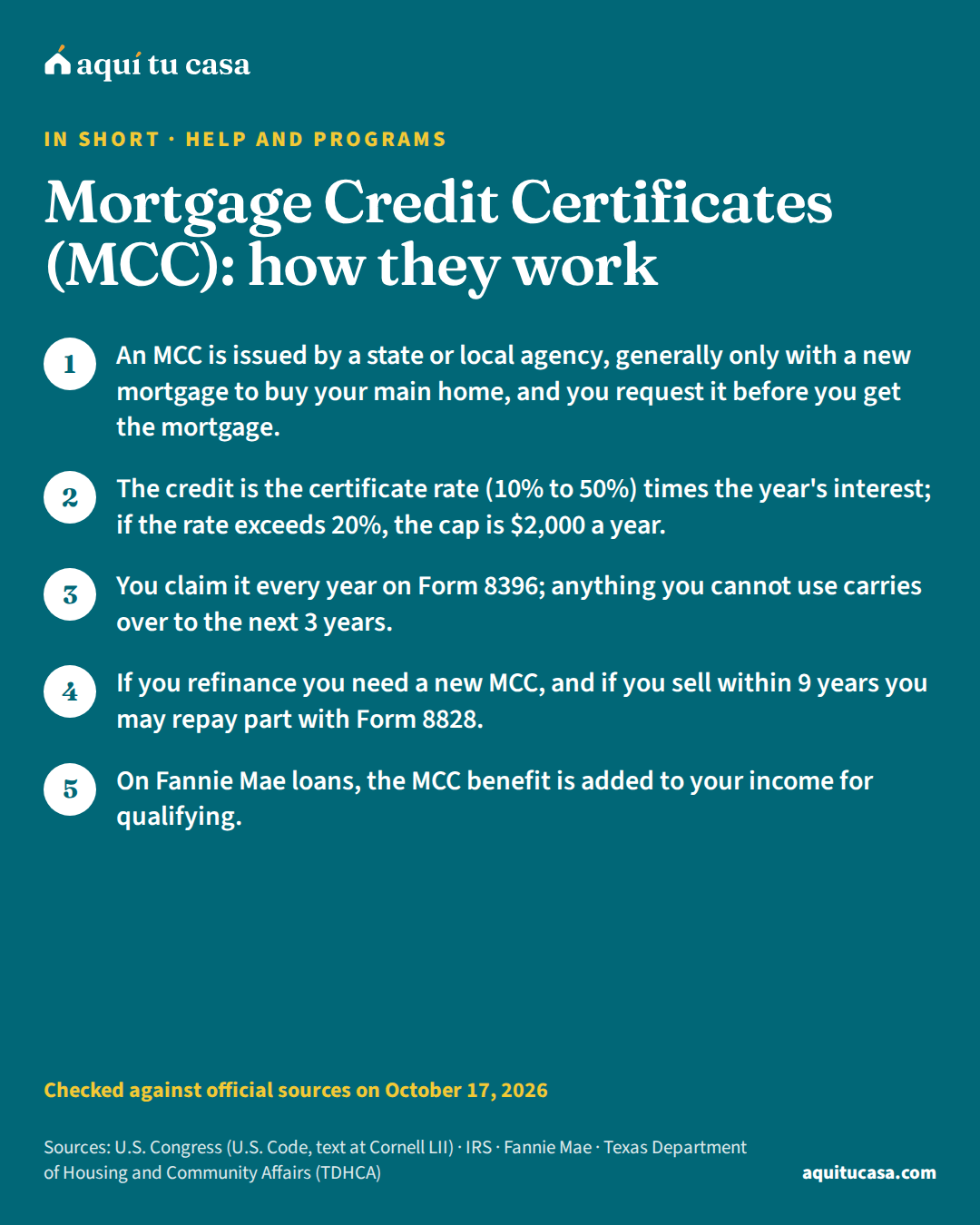
From the guide
What an MCC is, how much it can cut your federal tax, who issues it, how to claim it on Form 8396 and when you might repay part of it if you sell.
Verified on October 17, 2026 12 official sources
It is a certificate issued by a state or a political subdivision, such as a city or county, under a qualified program. Each year it lets you claim on your federal return a credit equal to the certificate rate times the mortgage interest you paid on the certified debt.
Read the full guideIt depends on your certificate rate, how much interest you pay and your tax. The law sets the rate between 10% and 50%; if it exceeds 20%, the credit cannot exceed $2,000 a year. The credit also generally cannot exceed your tax for the year; the rest carries over to the next 3 years.
Read the full guideAt your state or local housing finance agency. The IRS says you must contact the agency before you get the mortgage and buy the home. A HUD-approved housing counselor can also help you find programs.
Read the full guideThe law generally requires that buyers have not owned their home in the 3 years before signing the mortgage, with exceptions such as targeted-area homes and certain veterans. Each program publishes its own income and price requirements.
Read the full guideYou need a new (reissued) MCC to keep claiming the credit on the new loan, and the credit may change. Ask the agency that issued your certificate before you refinance.
Read the full guideIf you bought with an MCC and sell within 9 years, you may have to repay part of the benefit on Form 8828. If you sold at a loss you repay nothing, and if your income does not exceed a limit on the form, you do not either. Even so, you must file Form 8828 with your return.
Read the full guideOn loans Fannie Mae buys, it can: the maximum MCC benefit is added to your monthly income with the formula loan × note rate × MCC percentage ÷ 12. Other lenders may have different rules.
Read the full guideIt depends on the program: ask your state agency directly. In 110 of the 134 programs in our database, the official source does not say whether they accept an ITIN.
Read the full guide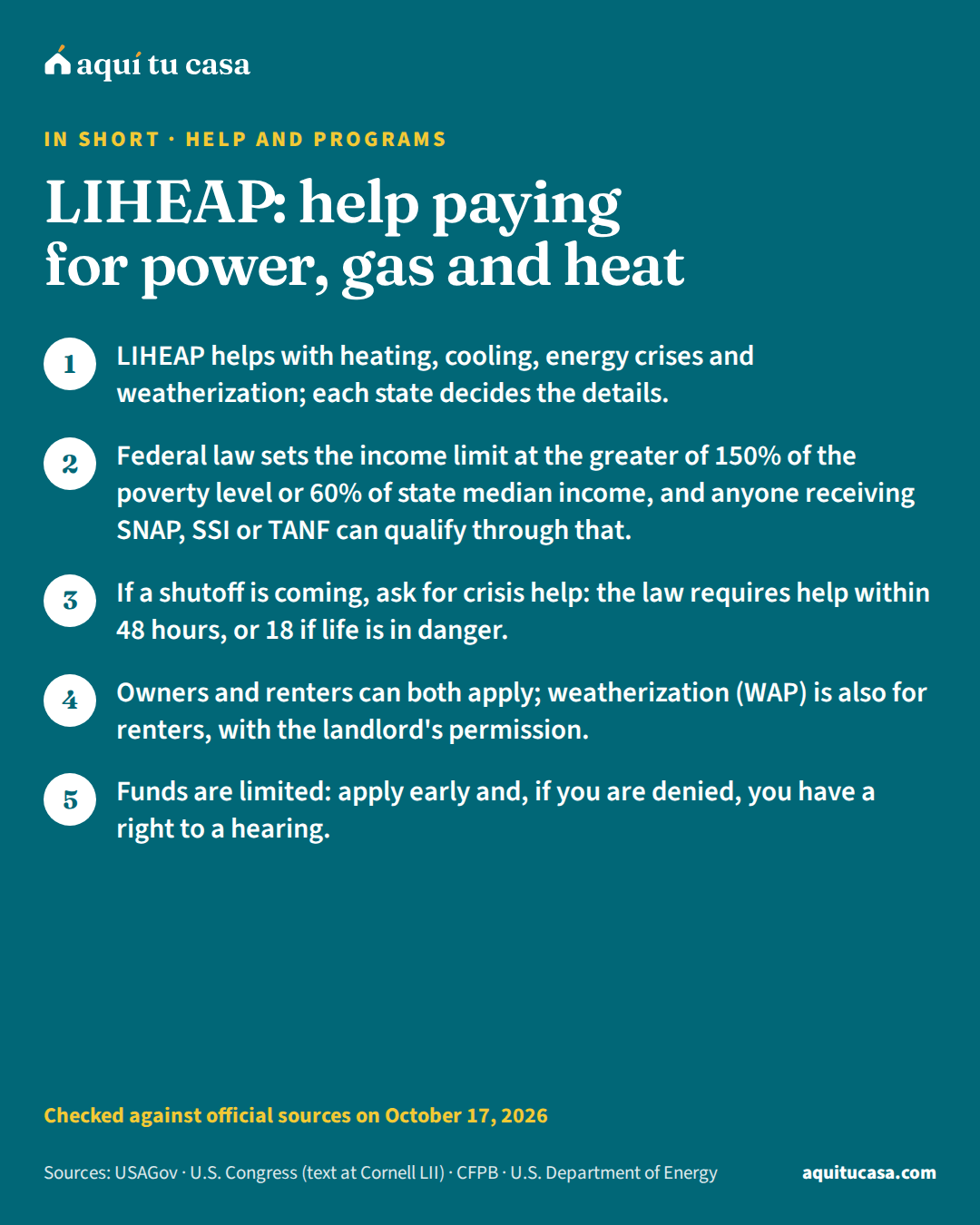
From the guide
What LIHEAP is, who qualifies, how to apply in your state, crisis help when a shutoff is coming and free weatherization (WAP) to lower your bills.
Verified on October 17, 2026 11 official sources
It is the Low Income Home Energy Assistance Program. With federal funds, each state helps pay heating or cooling bills, provides emergency services in an energy crisis and, depending on where you live, helps with electric bills. It can also pay for improvements so your home uses less energy.
Read the full guideIt depends on the state, but within federal law: households in which someone receives TANF, SSI, SNAP or certain veterans' payments, or households with incomes no higher than the greater of 150% of the poverty level or 60% of state median income. A state cannot exclude you solely on income if you earn less than 110% of the poverty level.
Read the full guideAt your state or county LIHEAP office. Some places let you apply online and others require you to apply in person. If you do not know your office, call the National Energy Assistance Referral Hotline at (866) 674-6327 or 211.
Read the full guideYes: ask for LIHEAP crisis help. Federal law requires the crisis program to provide some form of assistance that resolves the problem within 48 hours after an eligible household applies, or 18 hours if life is in danger. Bring the shutoff notice when you apply.
Read the full guideYes. The law requires states to treat owners and renters equitably. If you live in federally assisted housing and pay part of your heating, you cannot be automatically denied LIHEAP because you receive a utility allowance. For weatherization, the provider asks your landlord for permission.
Read the full guideIt is a Department of Energy program that makes your home more efficient so you spend less, while protecting your health and safety. Under its guidelines, households with incomes up to 200% of the poverty guidelines or receiving SSI qualify, with priority for older adults, people with disabilities and families with children. There may be a waitlist.
Read the full guideYes, because funds are limited. California says some eligible households may not get a benefit so that those with the greatest need come first, and in Texas providers may be out of funds. If you are denied or get no timely answer, the law gives you the right to a fair hearing.
Read the full guide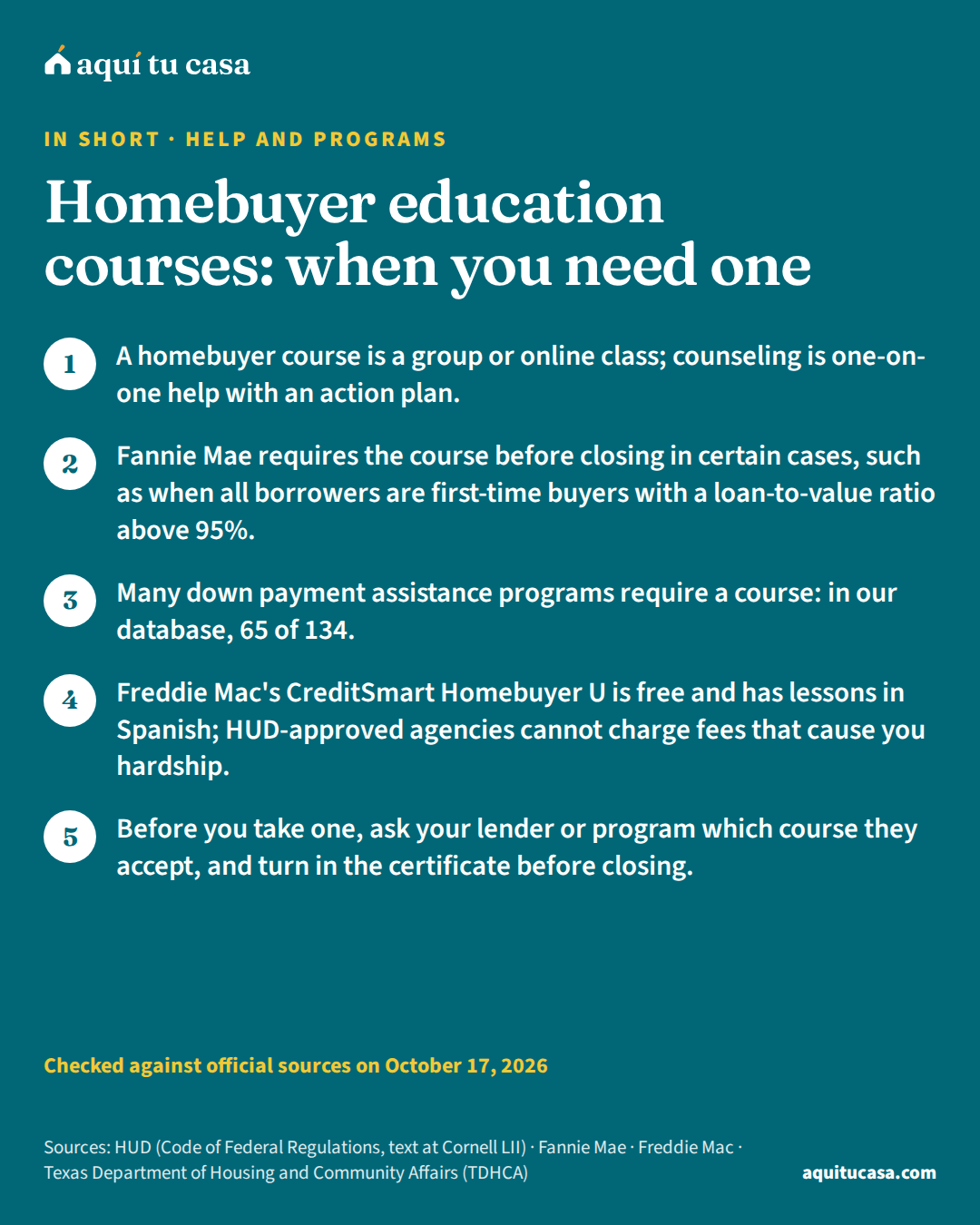
From the guide
What a homebuyer education course is, when Fannie Mae, Freddie Mac and assistance programs require one, and where to take it for free or in Spanish.
Verified on October 17, 2026 10 official sources
Read the full guide Do the math: Which programs might I qualify for?
Not always: it depends on the loan and the program. Fannie Mae requires it before closing in certain cases, for example if all borrowers are first-time buyers with a loan-to-value ratio above 95%, or if none of them has a credit history. Many assistance programs also require one: in our database, 65 of 134 programs.
Read the full guideThere are free options: Freddie Mac's CreditSmart is completely free, and some state agencies, such as Connecticut's, offer free workshops. HUD-approved agencies may charge reasonable fees, but they must tell you first, cannot charge for intake and must provide counseling without charge to people who cannot afford it.
Read the full guideYes. Freddie Mac's CreditSmart Homebuyer U has lessons in English and Spanish, although the printable certificate is in English. Some counseling agencies give workshops in Spanish; for example, the Connecticut agency says some of them do.
Read the full guideFor Fannie Mae, the course can be in person, online, by phone or hybrid, as long as the content is aligned with national or HUD standards. CreditSmart Homebuyer U is online and self-paced.
Read the full guideA course is a class with a curriculum, in a group or online. Counseling is one-on-one help for your situation, with a budget and a written action plan. For Fannie Mae, counseling from a HUD-approved agency also meets the course requirement.
Read the full guideFor Fannie Mae loans, the course is given by a qualified third-party provider independent of the lender. Ask your lender which courses it accepts before you enroll.
Read the full guideBefore closing. Fannie Mae asks that at least one borrower complete it before closing when the requirement applies, and some programs require it to qualify. Taking it early leaves time to get and turn in the certificate.
Read the full guideNo. Freddie Mac says CreditSmart Essentials is not a homeownership education course. The one that gives the certificate for buying is CreditSmart Homebuyer U.
Read the full guide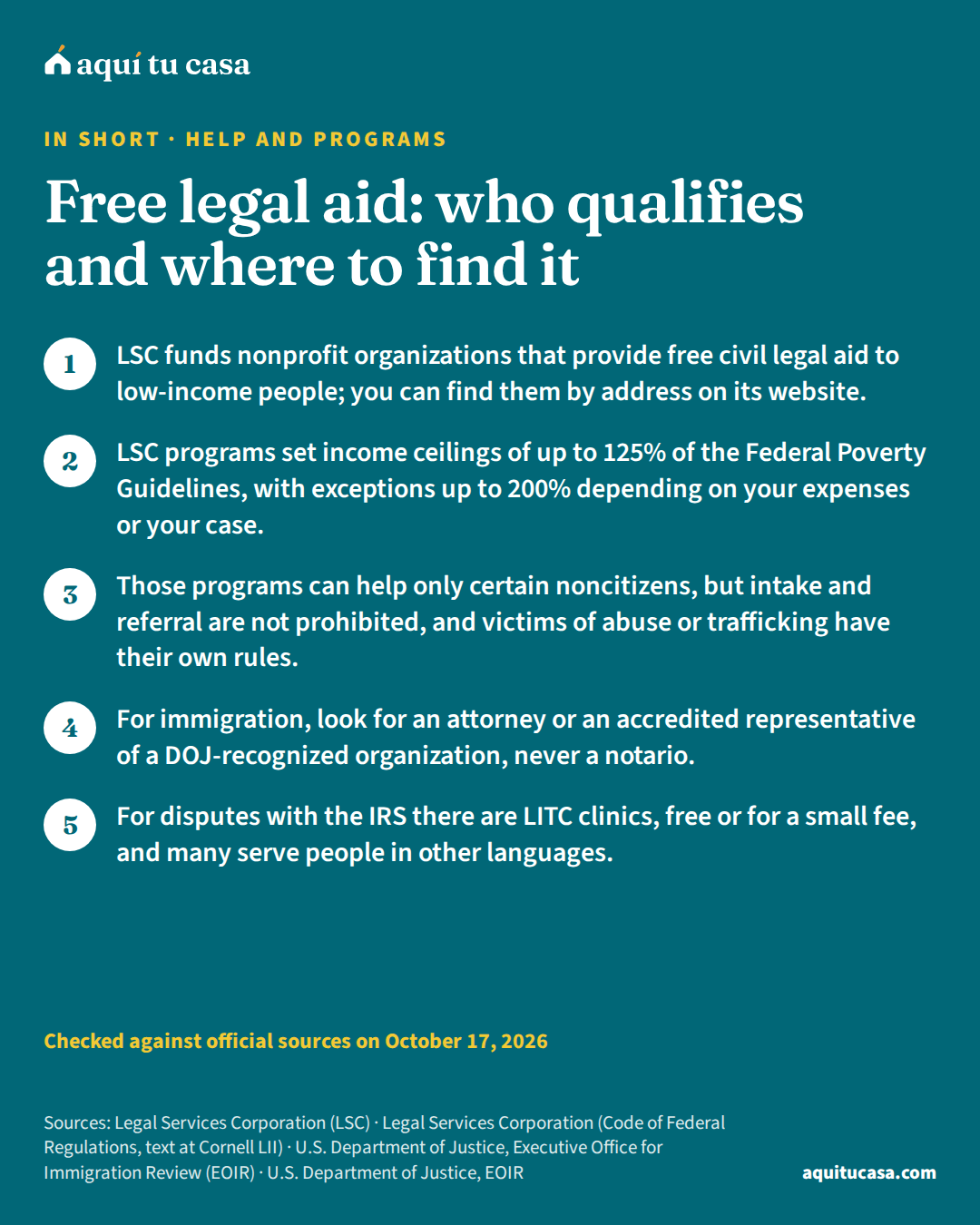
From the guide
What free legal aid is, who qualifies, which rules apply if you are not a citizen, and where to get help with immigration and tax problems.
Verified on October 17, 2026 19 official sources
Read the full guide Do the math: Eviction timelines by state
Each LSC-funded program sets its own rules. The income ceiling cannot exceed 125% of the Federal Poverty Guidelines, but there are exceptions up to 200% if, for example, you are seeking government benefits or have medical expenses or fixed debts. Programs also look at your assets, and may not count your home or the car you use to get around.
Read the full guideLSC-funded programs can help only certain noncitizens. For an immigration case, EOIR says only an attorney or an accredited representative of a DOJ-recognized organization can represent you. EOIR also publishes a list of free legal service providers for people in immigration proceedings.
Read the full guideAt an LSC-funded program, if you say you are a citizen you will be asked to attest to it in writing, except for brief advice by phone. The regulation bars them from doubting your citizenship because of your accent, limited English, appearance, race or national origin. Also, intake and referral to other services do not count as legal assistance.
Read the full guideLSC regulations allow related legal assistance for noncitizens who were battered or subjected to extreme cruelty, victims of sexual assault or trafficking, or people who qualify for a U visa. That help can include protective orders, custody, support, housing and related immigration matters. When assessing income, the abuser's income is not counted.
Read the full guideAccredited representatives work through nonprofit organizations recognized by the Department of Justice, which serve mainly low-income people. If the organization charges fees, it must have a written policy for helping people who cannot pay.
Read the full guideYes: Low Income Taxpayer Clinics (LITCs) can represent you in audits, appeals and collection matters, for free or for a small fee, if your income is below a certain threshold. IRS Publication 4134 lists them with the languages they offer. To prepare your return, VITA sites do it for free for people who qualify.
Read the full guideThe CFPB suggests using a lawyer referral service or your state bar, and asking whether there is an up-front fee and whether you pay even if you lose. Before hiring, check with the state bar that the lawyer is in good standing. Some programs also use non-LSC funds and can help without applying the same income ceilings.
Read the full guideChange topic without leaving the questions.

These answers explain the rules but do not know your situation. These organizations go over it with you, free.