HUD-VASH: housing vouchers and VA support for homeless veterans
How HUD-VASH works for homeless veterans: a HUD housing voucher with VA case management, who refers you, the income rules and how to get started today.
Verified against official sources on October 31, 2026 6 official sources

Show contents
In short
What you need to know
Quick answer
HUD-VASH pairs a HUD housing voucher, which helps pay rent for a private apartment or house, with a VA case manager who supports you with your health, your budget and your relationship with the landlord. It is for homeless veterans who need that ongoing support. You do not sign up on a waiting list: VA decides whether you qualify and refers you to the housing agency, which must accept the referral. To get started, call 877-424-3838, free and any time, or ask for the Homeless Coordinator at your VA medical center.
What matters most
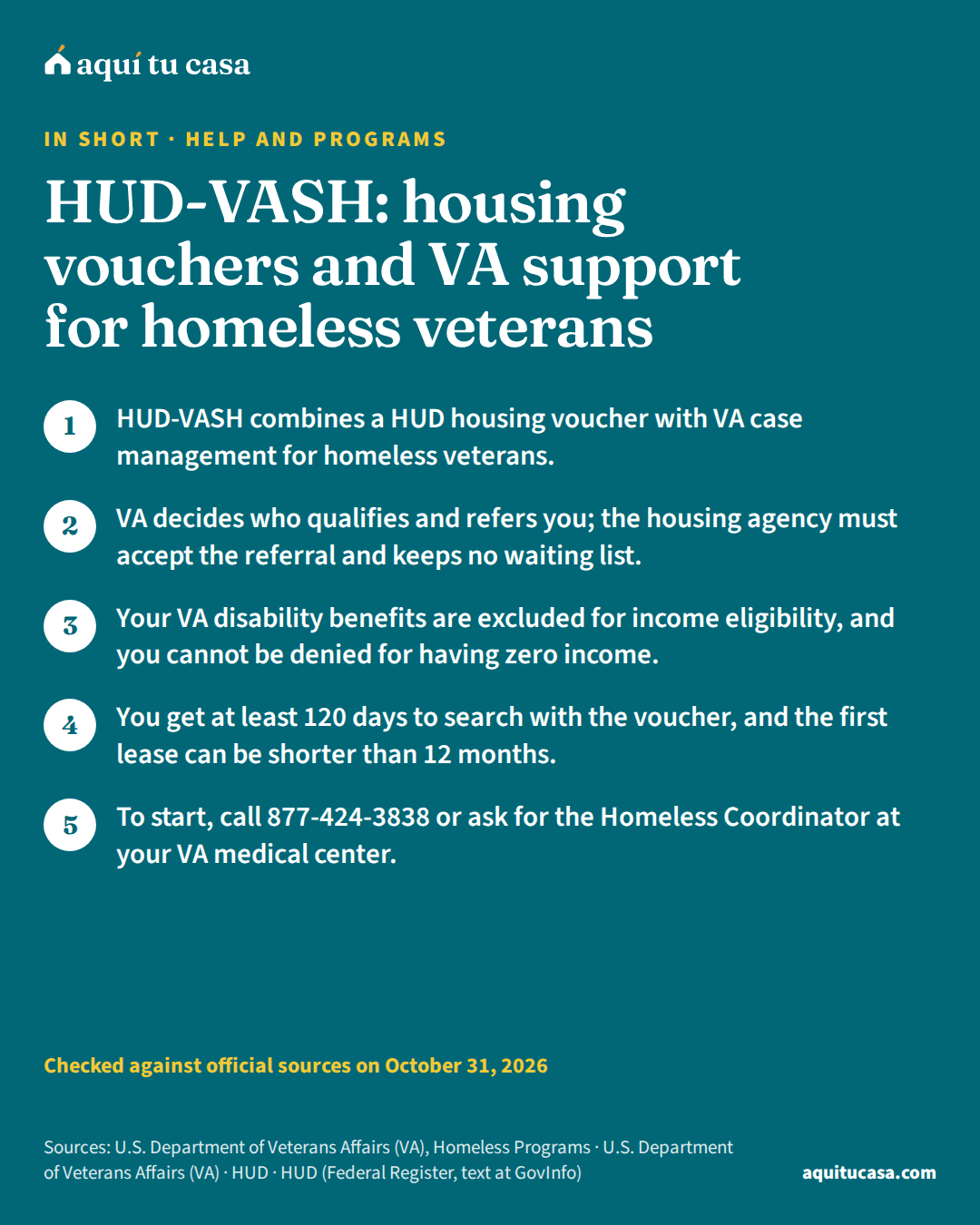
- HUD-VASH combines a HUD housing voucher with VA case management for homeless veterans.
- VA decides who qualifies and refers you; the housing agency must accept the referral and keeps no waiting list.
- Your VA disability benefits are excluded for income eligibility, and you cannot be denied for having zero income.
- You get at least 120 days to search with the voucher, and the first lease can be shorter than 12 months.
Is this for you?
This guide is for you if…
- You are a veteran without stable housing, or about to lose it.
- You have a family member who is a homeless veteran and want to know how to ask for help for them.
- You already have a HUD-VASH voucher and want to understand the program's rules.
Get direct help first if…
- You want to buy a home with your veteran benefit: our VA home loan guide explains that program.
- You are thinking of hurting yourself: call or text 988 and press 1 for the Veterans Crisis Line.
Losing your home after serving the country is hard, and asking for help is not always easy. This guide is for you if you are a veteran without a home, or want to help a family member who is. It explains what HUD-VASH is, who refers you, how the housing voucherHousing Choice Voucher (Section 8)The Housing Choice Voucher, the program almost everyone calls Section 8, is the country's largest federal rental assistance. HUD pays rental subsidies so eligible families can afford decent, safe and sanitary housing. Local public housing agencies administer it with HUD funds. The family finds its own home on the private market; if the agency approves the unit and the tenancy, it contracts with the owner to pay part of the rent, and the family pays the rest. Waiting lists are usually long and open for limited periods.See the full definition works, which rules change for veterans and what to do today to get started.
What HUD-VASH is
HUD-VASH is a partnership between HUDDepartment of Housing and Urban Development (HUD)HUD (the U.S. Department of Housing and Urban Development) is the federal department that runs housing and community development assistance programs and works to ensure fair and equal housing opportunity. The Federal Housing Administration (FHA), which insures mortgages made by private lenders, is part of HUD. HUD funds local public housing agencies (PHAs) that run public housing and Section 8 vouchers. It also approves housing counseling agencies across the country, and you can file a housing discrimination complaint with its Office of Fair Housing and Equal Opportunity (FHEO).See the full definition and the Department of Veterans Affairs (VA). It brings together two things: a HUD Housing Choice Voucher, which helps pay the rent, and VA case management and supportive services, so you can keep your home. That support can include health care, mental health care, substance use treatment and help finding work.1
Once you are approved, you get a voucher to rent a private apartment or house from a landlord who accepts vouchers. After you move in, the support continues. Every participant has a VA case manager who connects you with health care and helps you budget for rent, understand your leaseleaseA lease, or rental agreement, is the contract in which the owner or landlord gives you the right to live in and use a property for a set period of time in exchange for payment, usually rent. While the lease lasts you have possession, but the landlord still owns the property. The lease says how much you pay and when, who handles maintenance and how the agreement can end. Your rights as a tenant are usually spelled out in the lease and in your state and local laws. Before complaining to the landlord, it helps to read the lease and make sure you are also following the rules you agreed to.See the full definition and get along with the landlord, for as long as needed.1
According to VA, the program is designed for homeless veterans who need that ongoing, intensive support because of more complex challenges, such as chronic health conditions.1 It operates in all 50 states, Puerto Rico, Guam and the Virgin Islands, and there is a Tribal HUD-VASH for American Indian and Alaska Native veterans.1
Who refers you: VA
Here is the big difference from a regular Section 8 voucher. You do not sign up on a housing agency’s waiting list. VA decides whether you are eligible and selects veterans, then refers your family to the public housing agencypublic housing agency (PHA)A public housing agency (PHA) is a state, county, municipal or other governmental entity or public body authorized to operate public housing or rental assistance programs. These are the agencies that locally administer the Housing Choice Vouchers (Section 8) and public housing with HUD funds: they open and manage the waiting lists, review eligibility and income, inspect units and pay the owner its share of the rent. Each county usually has one or several; your page shows the ones serving your area with their phone numbers.See the full definition it works with. The agency must accept that referral, and it may not keep a waiting listwaiting list (public housing and Section 8)The waiting list is where a public housing agency (PHA) places families who qualify for public housing or a Section 8 voucher when it cannot help them right away. When your name comes up, the PHA contacts you. Because more families need help than there are resources, long waits are common and a PHA may close its list. Each PHA can give preference to certain groups under its written policies. In the voucher program, a PHA may remove you if you do not answer its requests for information, but if that was because of a family member's disability, it must put you back in your place.See the full definition or apply local preferences for HUD-VASH. The VA medical center also decides whether you count as a veteran for this voucher.4
That is why the first step is VA. HUD says to contact a VA medical center near you and mention your interest in HUD-VASH. VA provides case management at its medical centers, community clinics or through organizations it designates.3 You can also go to your VA medical center and ask for the Homeless Coordinator, or chat online with a VA counselor any time. Your family or friends can use that chat to help you too.2
From first contact to the keys
2. VA reviews your case
In the following days
VA decides whether you are eligible and whether you count as a veteran for the voucher.4
3. VA refers you to the housing agency
If you qualify
The agency must accept the referral; there is no waiting list for HUD-VASH.4
4. You give your information to the agency
When you apply for the voucher
Your income, assets and Social Security number; they can accept your self-certification.4
5. You search for housing with the voucher
At least 120 days
With a landlord who accepts vouchers; your case manager helps you search.4
6. You move in and the support continues
As long as you need it
Your VA case manager helps with your health, your budget and your lease.1
The rules that change for veterans
HUD-VASH generally follows regular voucher rules, but HUD changed several to help veterans. Those changes are in the HUD-VASH Operating Requirements, whose current version was published August 13, 2024.3 Our Section 8 guide explains how a regular voucher works.
No diagnosis requirement. HUD removed the rule that required a chronic mental illness or chronic substance use disorder, with required treatment, to receive the assistance.4
Fewer reasons to deny you. The housing agency stops applying its usual rules for deciding who qualifies, except income and one exception: it must deny admission if anyone in the household must register for life in a state sex offender registry. If that person is not the veteran, the rest of the family can be served if they remove that person from the household.4
Your income. The agency must serve all income-eligible veterans, including low-income veterans, up to 80% of the area median incomearea median income (AMI)The area median income (AMI) is the median family income of an area, which HUD computes every year for each metropolitan area and county. Housing programs use it as the yardstick: under the federal rule, a family is low-income when it earns no more than 80% of its area's median income and very low-income when it earns no more than 50%, adjusted for family size. State down payment assistance programs and Section 8 vouchers publish their limits as a percentage of AMI, so the same salary can qualify in one county and not in the next.See the full definition. To decide whether you qualify, all your VA service-connected disability benefits are excluded; they are counted later to calculate what you pay. You cannot be denied for having zero income, and the agency must accept your self-certification without a notary.4
Your assets. At admission, the agency must accept your self-certification that your assets are no more than $50,000, an amount adjusted each year for inflation, and that you own no real estate. And it must not enforce that limit at later reviews.4
Example with real numbers
A veteran with VA disability benefits
An example in words of how their benefits are counted.
- VA service-connected disability benefits
- Receives a monthly payment
- To decide whether they qualify by income
- Those benefits are not counted
- To calculate how much rent they pay
- Those benefits are counted
- If they have no other income
- They cannot be denied for zero income
- Who decides
- The housing agency, under the HUD-VASH rules
The example's rules come from the HUD-VASH Operating Requirements.4 Use the calculator to see how much rent you can afford on your income.
Run it with your numbersHow much rent can I afford?
Your papers: Social Security number and ID
Many homeless veterans have lost their papers. The HUD-VASH rules take that into account. To verify your Social Security number, the agency must accept your self-certification plus at least one third-party document with your name, such as a bank statement, a utility or cell phone bill or a benefit letter; for the veteran, it can be the VA photo ID. If you have your DD 214 or your application for health benefits (10-10EZ), the agency must accept them, but they are not required. And it must accept the VA photo ID in place of other government ID.4
Searching for housing and moving with the voucher
You get at least 120 days to search for housing with the voucher, when you first receive it and each time you move with the assistance. The agency can grant extensions, and a person with a disability can ask for them as a reasonable accommodation. The first lease can be shorter than 12 months.4 HUD even allows the voucher to be used for units on the grounds of a VA facility.4
You can choose housing on the private market, as long as the landlord accepts the voucher, the home meets HUD requirements and the rent falls within program guidelines. Your case manager helps you search.1 Watch out for fake listings; our guide on how to avoid rental scams helps you spot them.
While you need case management, you can live only where VA can provide it. If you move to another agency’s area, that agency cannot rescreen you, and the agency must consult with VA before approving the move, unless you are a victim of domestic violence, dating violence, sexual assault or stalking.4

How to keep your voucher
Case management is part of the program. If VA determines you are not taking part in required case management without good cause, the agency must remove you from HUD-VASH, although it can offer you one of its regular vouchers. But a VA decision that you no longer need case management is never a reason to take away your assistance. And you cannot be removed for something that happened before you entered the program and that the agency already knew about.4
Civil rights rules do not change in HUD-VASH. If you or someone in your family has a disability, the agency must make reasonable accommodations, for example in the search term, the lease or hearings.4 Our guide on reasonable accommodations explains how to ask.
If there is violence in the family, the agency cannot take away the assistance of the person who is the victim. In a break-up, the assistance generally stays with the veteran; but if the veteran committed the violence, the victim must continue to be assisted.4 If the veteran is removed from the lease because of the violence, the family can keep the assistance; but if the veteran was the only one with established eligible citizenship or immigration status, the others have 30 calendar days to show they qualify or find other housing.5 Our VAWA guide explains more.
If this is you
You sleep in your car or a shelter
Call 877-424-3838; they connect you with the nearest VA, free and any time.1
You want to help your brother, who is a veteran
You can chat with a VA counselor yourself to help him get started.2
You have no income right now
You cannot be denied for zero income, and they accept your self-certification without a notary.4
You receive VA disability benefits
They do not count when deciding whether you qualify by income, though they do count for your rent.4
Your family has mixed immigration status
If the veteran is removed from the lease and was the only one with eligible status, the others get 30 days.5
Costly mistakes
Mistake: Going first to the housing agency to ask for the voucher.
Instead: Start with VA: VA decides and refers you; there is no waiting list for HUD-VASH.4
Mistake: Not applying because you lost your papers.
Instead: They can accept your self-certification with a document showing your name, such as your VA ID.4
Mistake: Assuming your VA disability benefits rule you out.
Instead: They are excluded when deciding income eligibility.4
Mistake: Letting the search term run out without asking for more time.
Instead: You get at least 120 days and can ask for an extension.4
Mistake: Stopping visits with your case manager without telling anyone.
Instead: If you do not take part without good cause, you can be removed from HUD-VASH.4
Mistake: Moving to another city without talking to VA.
Instead: While you need case management, the move is coordinated with VA.4

What to do this week
- Call 877-424-3838 or go to your VA medical center and ask for the Homeless Coordinator.2
- Say that you are interested in HUD-VASH.3
- Gather your VA ID and any letter or bill with your name on it.4
- When you get the voucher, write down the date: you have at least 120 days to search.4
- If you have a problem with the housing agency or the landlord, look for free legal aid; LSC has a search tool.6
Your income
Let's do the math
Rent that fits your budget (30% of income)
$2,018
With an income of $6,728 a month. Up to $3,364 would already be a severe burden (50% of income).
Compared with HUD’s Fair Market Rent in the United States
- 2 bedrooms$1,750Fits · 26%Needs $33.65 an hour
The wage needed pays that rent without going over 30% of income, working 40 hours a week all year.
The typical rent households actually pay in the United States is $1,413 a month (Census).
A reference to give you an idea. Each landlord and each program sets its own requirements.
Ready to see the numbers? Find your county here
See how this applies in your county: its loan limits, prices and rents, from the official data.
Printable checklist
Frequently asked questions
How do I ask for a HUD-VASH voucher?
You do not ask the housing agency. Call the National Call Center for Homeless Veterans, 877-424-3838, free and any time, or go to your VA medical center and ask for the Homeless Coordinator. HUD says to mention your interest in HUD-VASH. VA decides whether you qualify and refers you to the housing agency.
Is there a waiting list for HUD-VASH?
Under HUD's rules, housing agencies may not keep a waiting list or apply local preferences for HUD-VASH. VA selects veterans and refers them, and the agency must accept those referrals.
Can I be denied the voucher because of my criminal record?
When administering HUD-VASH, the housing agency may not deny assistance on the usual criminal-record grounds, except one: if anyone in the household must register for life as a sex offender in a state registry. If that person is not the veteran, the rest of the family can be served if they remove that person from the household.
Do my VA disability benefits count as income?
To decide whether you qualify by income, no: all your VA service-connected disability benefits are excluded. They are counted later to calculate how much rent you pay. The agency must serve veterans with incomes up to 80% of the area median income.
I do not have my Social Security card or papers. Can I apply?
Yes. Under HUD's rules, the agency must accept your self-certification of your Social Security number with a third-party document that has your name, such as your VA photo ID. If you have your DD 214 or your 10-10EZ, it must accept them too, but they are not required.
Can I move to another city with my HUD-VASH voucher?
While you need case management, you can live only where VA can provide it, and the agency must consult with VA before approving the move, unless you are a victim of violence. If VA decides you no longer need case management, the regular rules for moving apply.
Do I lose the voucher if I stop seeing my case manager?
If VA determines you are not taking part in required case management without good cause, the agency must remove you from HUD-VASH, although it can offer you a regular voucher. A VA decision that you no longer need case management is never a reason to take away your assistance.
Sources
Every figure in this guide comes from one of these official sources. The number next to a sentence leads to the source behind it.
Each source on one line: who publishes it, its title, its address and the date we read it.
- 1. U.S. Department of Veterans Affairs (VA), Homeless Programs · HUD-VASH · department.va.gov · Accessed October 31, 2026
- 2. U.S. Department of Veterans Affairs (VA) · National Call Center for Homeless Veterans · va.gov · Accessed October 31, 2026
- 3. HUD · HUD-Veterans Affairs Supportive Housing (HUD-VASH) · hud.gov · Accessed October 31, 2026
- 4. HUD (Federal Register, text at GovInfo) · Section 8 Housing Choice Vouchers: Revised Implementation of the HUD-Veterans Affairs Supportive Housing Program (89 FR 65769) · govinfo.gov · Accessed October 31, 2026
- 5. HUD · Notice of Occupancy Rights under the Violence Against Women Act (Form HUD-5380) · hud.gov · Accessed October 31, 2026
- 6. Legal Services Corporation (LSC) · I Need Legal Help · lsc.gov · Accessed October 31, 2026
Keep reading
Related guides
If this guide helped, these follow the same path.

Renting 12 minute read
Section 8 and mixed-status families: how it works
How the Section 8 voucher works, how aid is prorated in a mixed-status family, how to apply through your housing agency and what HUD proposed.
- A mixed family can receive Section 8: assistance is prorated by how many members have citizenship or eligible status.
- A member without eligible status can elect not to contend it, in writing; never misstate your status.
- Everyone's income counts toward the calculation, including the income of a member who does not contend status.
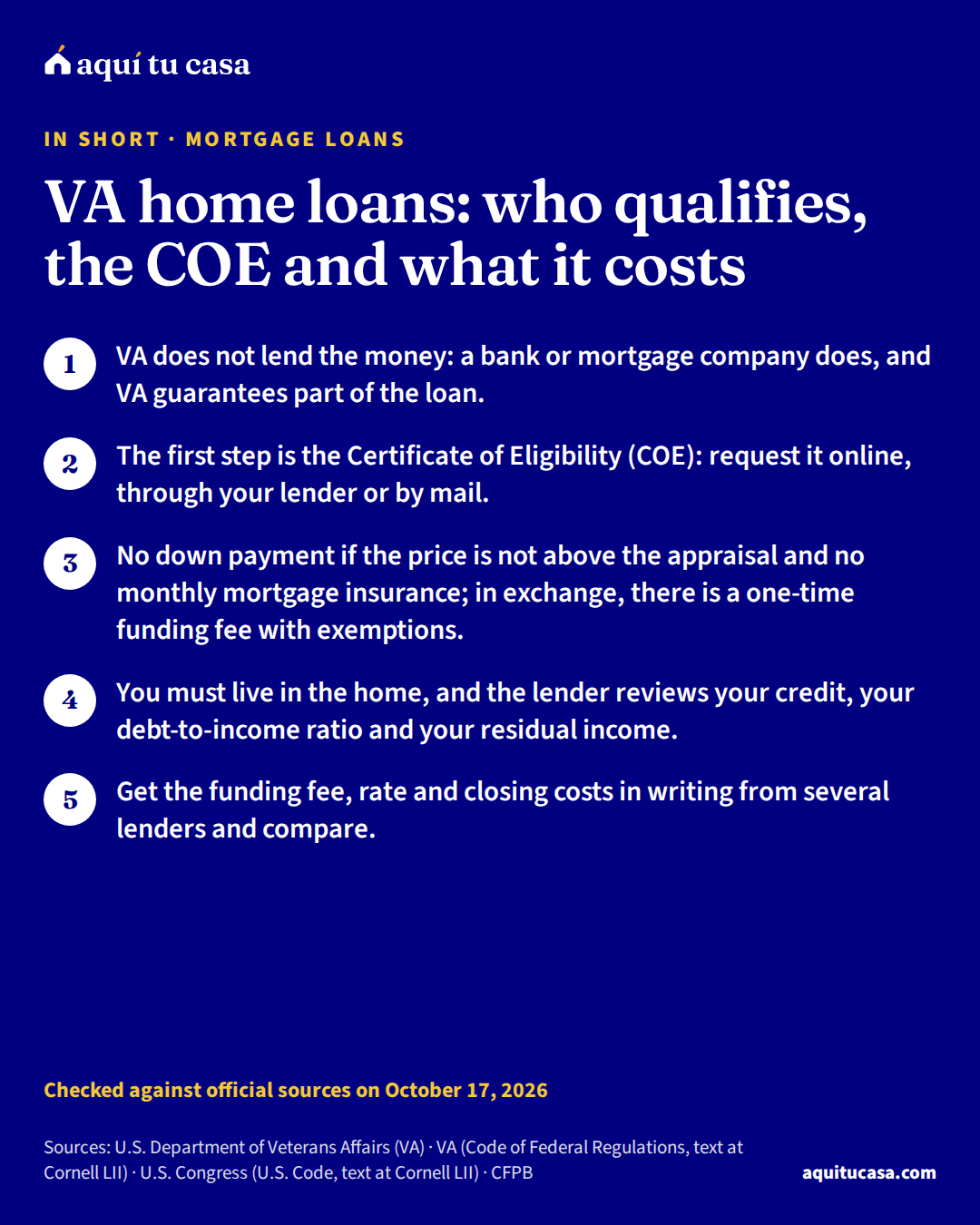
- Mortgage loans VA home loans: who qualifies, the COE and what it costs How a VA home loan works: who qualifies, getting your Certificate of Eligibility (COE), the funding fee and the rule that you must live in the home. 14 minute read
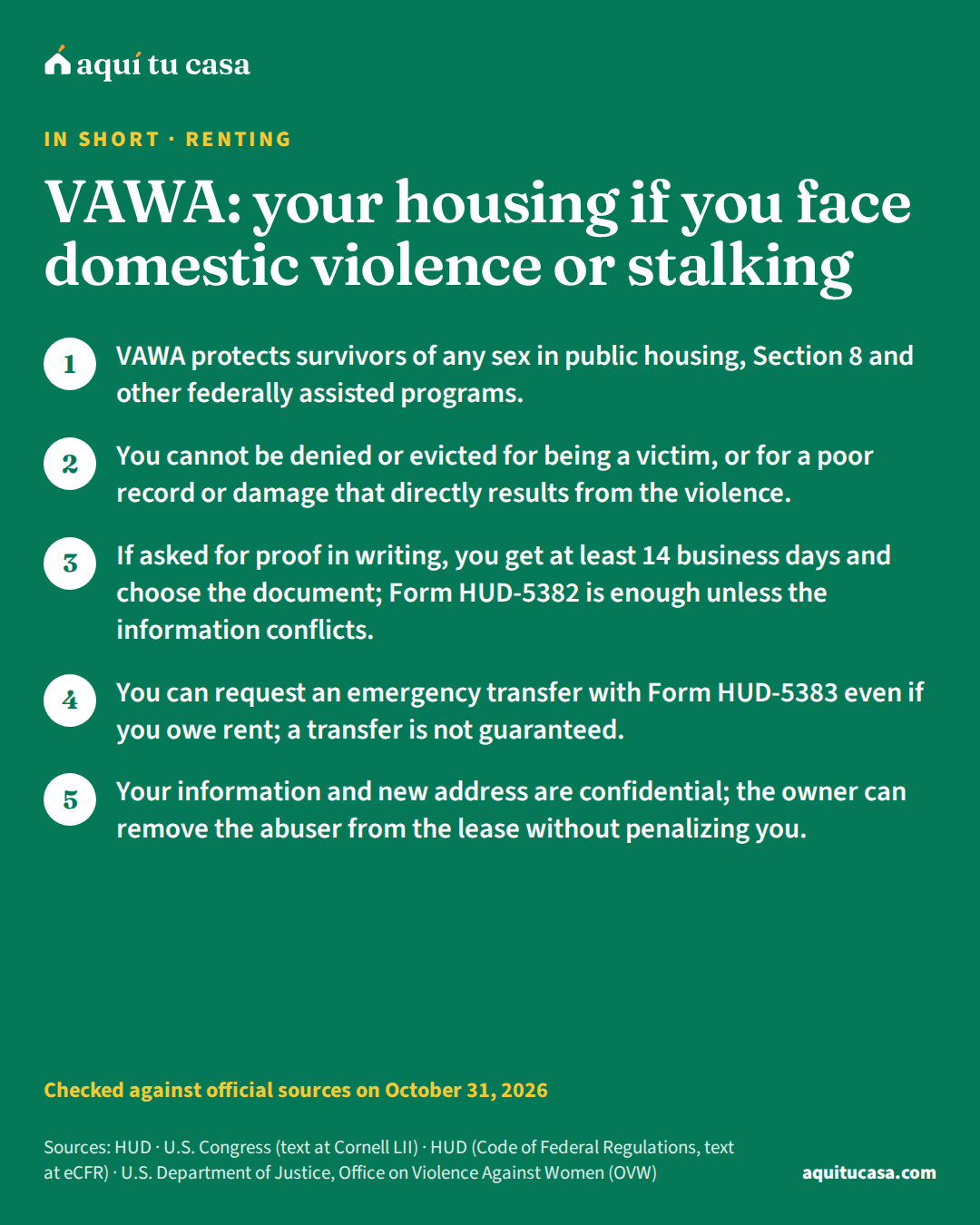
- Renting VAWA: your housing if you face domestic violence or stalking How VAWA protects you in federally assisted housing: no denial or eviction for being a victim, Form HUD-5382 and emergency transfers to a safe home. 14 minute read
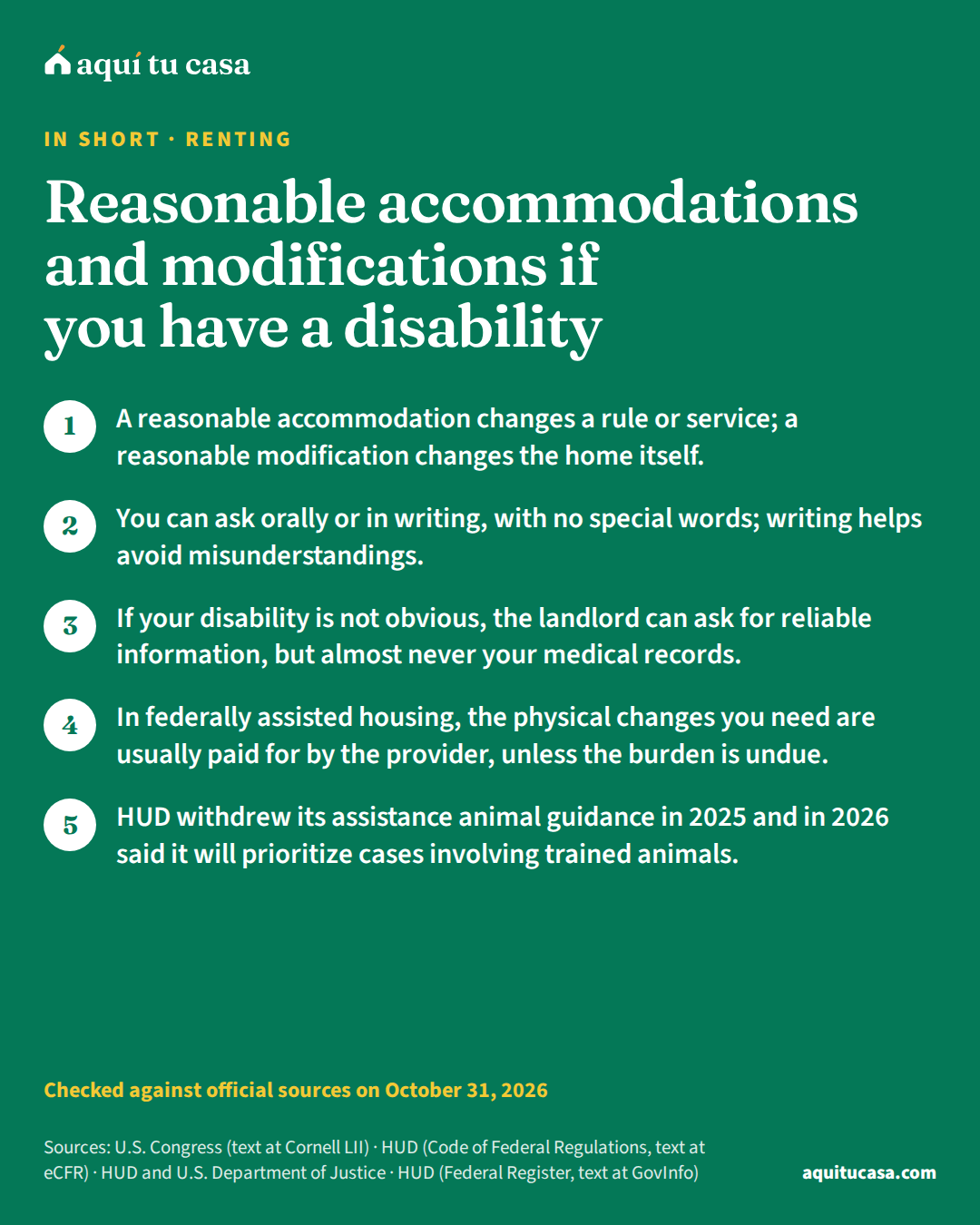
- Renting Reasonable accommodations and modifications if you have a disability What you can ask a landlord for because of a disability under the Fair Housing Act: rule changes, physical changes, assistance animals and complaints. 13 minute read
Tools for this topic
Was this guide useful?
Thank you. Your answer stays in your browser; nothing is sent.