VA home loans: who qualifies, the COE and what it costs
How a VA home loan works: who qualifies, getting your Certificate of Eligibility (COE), the funding fee and the rule that you must live in the home.
Verified against official sources on October 17, 2026 15 official sources

Show contents
In short
What you need to know
Quick answer
A VA home loan comes from a bank or mortgage company, and VA (the Department of Veterans Affairs) guarantees part of it. It is for Veterans, service members and National Guard and Reserve members who meet a minimum service requirement, and for some surviving spouses. It often needs no down payment if the price is not above the appraisal and has no monthly mortgage insurance, but it carries a one-time funding fee unless you are exempt. You need a Certificate of Eligibility (COE), must meet credit and income standards and must live in the home.
What matters most
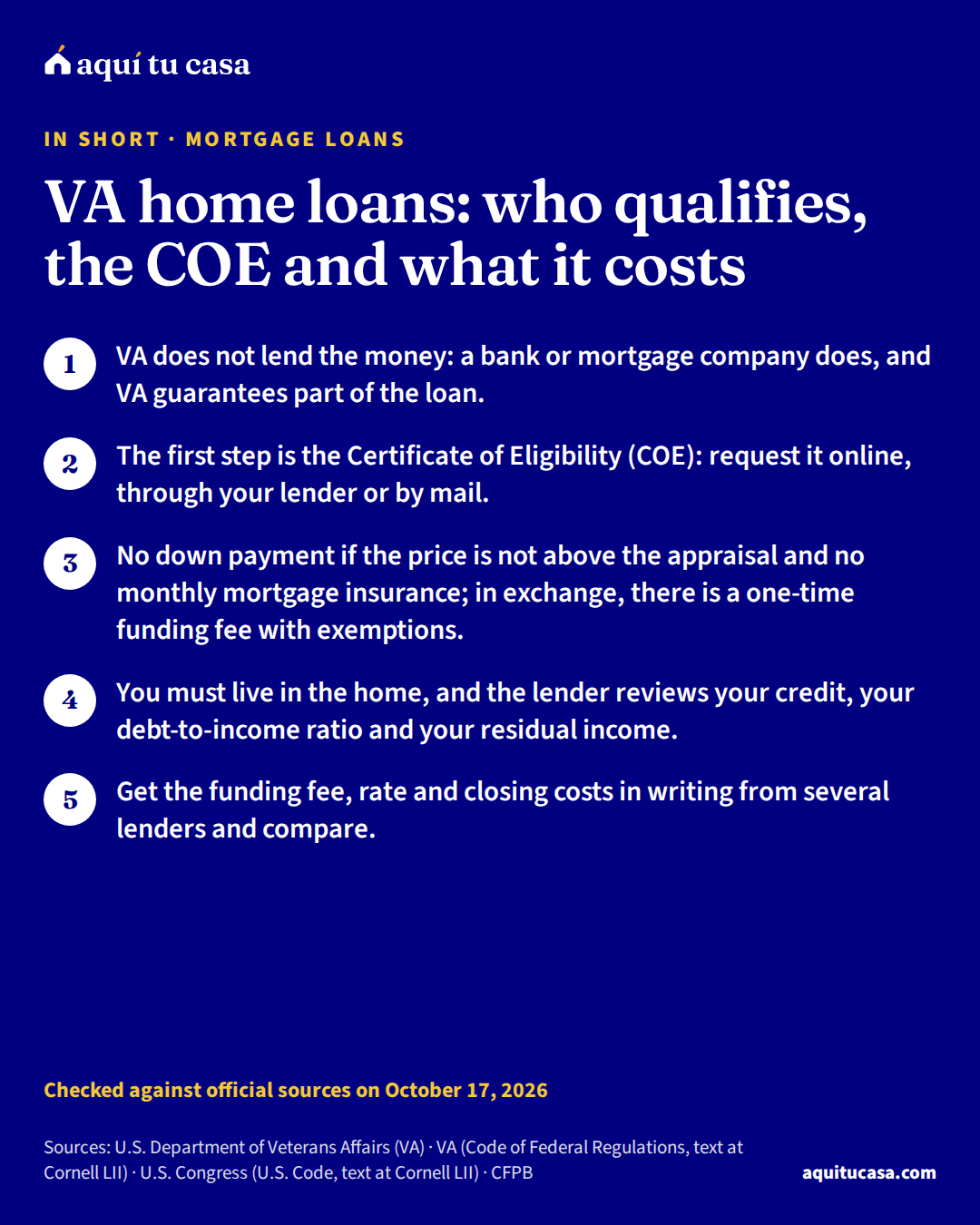
- VA does not lend the money: a bank or mortgage company does, and VA guarantees part of the loan.
- The first step is the Certificate of Eligibility (COE): request it online, through your lender or by mail.
- No down payment if the price is not above the appraisal and no monthly mortgage insurance; in exchange, there is a one-time funding fee with exemptions.
- You must live in the home, and the lender reviews your credit, your debt-to-income ratio and your residual income.
Is this for you?
This guide is for you if…
- You are a Veteran, an active-duty service member, or a member of the National Guard or Reserve, and you want to buy a home.
- You are the surviving spouse of a Veteran and want to know whether you can use this benefit.
- You already have a VA loan offer and want to understand the funding fee and the closing costs.
Get direct help first if…
- You want to refinance a loan you already have: the refinancing guide covers the options, including VA's.
- You want to buy a home to rent out without living in it: a VA loan requires that you live in the home.
- You have already fallen behind on your mortgage: start with the guide on what to do if you can't pay it.
This guide is for Veterans, active-duty service members, National Guard and Reserve members, and surviving spouses who want to buy a home with a VA loanVA loanA VA loan is a mortgage program offered by the U.S. Department of Veterans Affairs (VA) to help servicemembers, veterans and some surviving spouses buy a home. The VA does not lend the money: it guarantees part of a loan made by a private lender, and with that guarantee the lender can offer terms other loans do not have, such as buying with no down payment. Only people who meet the VA's service requirements can use it; the lender will ask for your certificate of eligibility.See the full definition. It explains who qualifies, how to request the Certificate of Eligibility (COE), what the funding fee is, what the lender reviews and which rules you have to follow after closing.
What a VA loan is and what it offers
VA (the Department of Veterans Affairs) does not lend you the money. A private lenderlenderThe lender is the financial institution that lends you the money for your mortgage. The mortgage is the agreement that gives the lender the right to take your home if you do not repay what it lent you. After closing, it is common for another company, the loan servicer, to collect your payments and keep track of the loan; it may be the same company that lent you the money or a different one. On the Loan Estimate, the lender's name appears on the first page, and the last page lists it as "Lender" with its NMLS or license number.See the full definition, such as a bank or mortgage company, makes the loan, and VA guarantees part of it against loss. That guaranty is what lets the lender offer better terms, such as no down payment.1 If you stop paying, VA pays the lender back a percentage of the loan.2
For a VA purchase loan, three things must be true: you qualify for a Certificate of Eligibility (COE); you meet VA’s and your lender’s credit, income and other standards; and you will live in the home.3
According to VA, this loan often offers:3
- No down paymentdown paymentThe down payment is the part of the home's price you pay out of your own pocket when you buy; the loan covers the rest. In U.S. Spanish it is also called enganche, cuota inicial or entrada. Each loan type has its own minimum: FHA requires at least 3.5% of the value, VA and USDA loans may require none, and conventional loans ask for more if you want to avoid private mortgage insurance. A larger down payment lowers the loan, the monthly payment and the total interest; many state programs help families put it together.See the full definition, as long as the sales price is not higher than the appraised valuehome appraisalAn appraisal is a written document that gives a professional appraiser's opinion of how much a property is worth. The lender orders it before approving the mortgage, because the home is the loan's collateral and the lender does not want to lend more than it is worth. If the appraisal comes in below the price you agreed, the bank bases the loan on the lower value and you will have to cover the difference, renegotiate the price or walk away if your contract allows it. An appraisal is not an inspection: it measures value, not the home's condition.See the full definition.
- No monthly mortgage insurancemortgage insuranceMortgage insurance protects the lender, not you, if you fall behind on your loan payments. You pay for it, as part of the monthly payment and sometimes also as an upfront charge. It exists because it lets the lender accept a lower down payment. On an FHA loan it is called the mortgage insurance premium (MIP) and is charged by the FHA; on a conventional loan with a small down payment it is called private mortgage insurance (PMI) and comes from a private insurer. The rules for when you can stop paying it differ in each case.See the full definition: no PMI and no MIP.
- Fewer closing costs and no penalty if you pay the loan off early.
- Several uses: buying a home of up to 4 units, a condo in a VA-approved project or a manufactured home, building, or improving a home. And the benefit can be used again.
Example with real numbers
The down payment on a typical home, with VA and with FHA
Using the typical US home value and each loan's minimum down payment.
- Home price (typical US value)
- $332,700
- FHA minimum down payment (3.5%)
- $11,645
- VA down payment, if the price is not above the appraisal (0%)
- 0% of the price
This is an example with national numbers.133 With VA there is no down payment, but there are closing costs and, unless you are exempt, the funding fee.8 Work out your monthly payment with your own numbers.
Run it with your numbersMortgage calculator
Who qualifies
The COE shows that you meet the minimum service. If you are on active duty now, you need at least 90 continuous days. If you are a Veteran, it depends on when you served. For service from August 2, 1990, to the present, for example, the minimum is 24 continuous months, or the full period you were called up for (at least 90 days), or less than 90 days if you were discharged for a service-connected disability. In the National Guard or Reserve, the minimum can be 90 days of non-training active-duty service, or 6 creditable years.4 VA’s eligibility page has the full table by service period.
If you fall short of the minimum, you may still get a COE if you were discharged under certain exceptions: hardship, an involuntary reduction in force, certain medical conditions or a service-connected disability. With an other than honorable discharge you may not be eligible, but you can still apply and VA reviews your records; you can also apply for a discharge upgrade.4
Surviving spouses. You may get your own COE if the Veteran died in service or from a service-connected disability and you did not remarry (special rules apply if you remarried at 57 or older), if the Veteran is missing in action or a prisoner of war, or, in certain situations, if the Veteran had been totally disabled and then died.5
In every case, the COE is only one piece: you also have to meet VA’s and your lender’s credit, income and occupancy requirements.4
The Certificate of Eligibility (COE), step by step
From COE to keys
1. Check that you meet the minimum service
Before you start
On active duty, at least 90 continuous days; as a Veteran, it depends on when you served.4
2. Gather your papers
Before requesting the COE
Veterans: your DD214. Active duty: a statement of service signed by your commander, adjutant or personnel officer.6
3. Request the COE
Online, through your lender or by mail
Your lender may be able to request it online for you; by mail, with Form 26-1880, it can take longer.6
4. Compare lenders
Before you choose
Rates and fees vary from lender to lender, and some fees are negotiable.1
Try it with your numbersCompare loans5. Sign the contract with the VA clause
When you find the home
The VA escape clause lets you void the contract if the home does not appraise for the price.1
6. VA appraisal and inspection
Before closing
The VA appraiser checks the minimum property requirements; the inspection is yours to order.1
7. You receive the Closing Disclosure
At least 3 business days before
Check the rate, fees, closing costs and monthly payment.1
The COE confirms for your lender that you qualify for the benefit. Veterans need a copy of their discharge or separation papers (DD214). Active-duty service members need a statement of service signed by their commander, adjutant or personnel officer. There are three ways to request it: online; through your lender, which may be able to use an online system called Web LGY; or by mail, with VA Form 26-1880, which can take longer. VA reviews your request and tells you its decision.6 Surviving spouses who receive DIC use a different form, VA Form 26-1817.5
The funding fee
The funding fee is a one-time payment the Veteran, service member or survivor makes on a VA loan. It exists because the program does not require a down payment or monthly mortgage insurance, and it helps lower the program’s cost to taxpayers. You pay it at closing: you can add it to the loan and pay it over time, or pay it in full that day.8
VA calculates it as a percentage of the total loan amount, not the price of the home. The percentage depends on the type of loan and, for some loans, on whether this is your first use of the benefit and on your down payment. VA publishes the full rate chart on its funding fee page.8 On a purchase loan, today’s chart asks for 2.15% of the loan amount the first time you use the benefit with less than 5% down, 1.5% with 5% or more and 1.25% with 10% or more. After first use, with less than 5% down, it is 3.3%.8 If you add it to the loan, you pay it off over time along with the rest of the debt. VA recommends talking to your lender about any cost added to the loan amount.8
You do not pay it if any of these is true:8
- You receive VA compensation for a service-connected disability, or you are eligible for it but receive retirement or active-duty pay instead.
- You receive DIC as the surviving spouse of a Veteran.
- You are a service member who, before closing, received a proposed or memorandum rating saying you are eligible for compensation based on a pre-discharge claim.
- You are on active duty and, on or before closing day, provide evidence that you received a Purple Heart.
If you are later awarded disability compensation effective before your closing date, you may get the fee refunded.8

Closing costs and what the seller can pay
No down payment does not mean no costs. Your lender sets the interest rateinterest rateThe interest rate on a mortgage is what you pay each year to borrow the money, expressed as a percentage of the loan balance. It does not include fees or other charges; that is what the annual percentage rate (APR) is for. On a fixed-rate loan the rate never changes over the life of the loan; on an adjustable-rate loan it can go up or down after an initial period. The rate you are offered depends on your credit score, your down payment, the loan type and the market, and you see it on the first page of the Loan Estimate.See the full definition, discount pointsdiscount pointsDiscount points are a payment you make to the lender at closing in exchange for a lower interest rate over the life of the loan. Each point costs a percentage of the loan amount. The opposite is lender credits: the bank lowers your closing costs today in exchange for a higher rate. Buying points only pays off if you keep the loan long enough for the monthly savings to exceed what you paid. Points appear on the Loan Estimate, in section A of the closing costs.See the full definition and other closing costsclosing costsClosing costs are all of the costs you pay on closing day on top of the down payment: lender fees, the appraisal, the credit report, title insurance, the closing agent's fees, any transfer taxes your state or county charges and the first deposits into the escrow account. The lender must itemize them on the Loan Estimate within days of your application and confirm them on the Closing Disclosure before you sign. Some can be paid by the seller, and several state programs help cover them.See the full definition, and all of that varies from lender to lender.8 VA’s regulation has a list of allowed charges: you may pay reasonable amounts for the VA appraisal, recording, the credit report, insurance and title, and the lender may charge a flat fee of no more than 1 percent of the loan in place of other origination charges. Nothing outside that list can be charged to you.9 VA says many lenders charge that 1% origination feeorigination chargesThe origination fee is what the lender charges you for making the mortgage loan. It can cover processing your application, underwriting, funding the loan and other administrative services. On the Loan Estimate it appears under "Origination Charges," which adds up everything you pay each lender and loan originator for giving you the loan, whatever the charge is called; points paid to lower the rate go on their own line in that section. On the Closing Disclosure it is in section A on page 2. In general, these charges cannot go up at closing, except in certain circumstances.See the full definition, may add other fees, and that some fees are negotiable.1
You and the seller can negotiate who pays costs such as the agent’s commission, the origination fee, points, the VA appraisal, title insurance and recording. VA lets the seller or builder offer credits toward your closing costs, but it limits seller’s concessions to no more than 4% of the home’s reasonable value, the figure on the VA Notice of Value. And on a purchase loan, the only cost you can add to the loan is the funding fee: everything else is paid at closing.8 The closing costs guide explains how to read them on the Loan Estimate, and the closing cost calculator gives you a ballpark with your own numbers.
Credit, income and residual income
Even with full entitlement, the lender decides how much to lend based on your credit history, income, debts and assets. VA does not require a minimum credit scorecredit scoreA credit score is a number that predicts how likely you are to pay back a loan on time. It is computed from the information in your credit report: whether you pay on time, how much you owe relative to your limits, how long you have used credit and how many new accounts you opened. FICO is one brand of score; VantageScore is another, and each lender decides which one it uses. A higher score usually brings a lower interest rate and more loan options; each program publishes the minimum it accepts. You can check your report for free and dispute errors.See the full definition, but some lenders do, so VA recommends contacting more than one to compare.2
VA’s regulation uses two standards to judge whether your income is enough.10
- The debt-to-income ratiodebt-to-income ratio (DTI)Your debt-to-income ratio (DTI) is all your monthly debt payments divided by your gross monthly income, that is, income before taxes. If you pay a certain amount each month across a car, cards, student loans and the mortgage you are asking for, and you earn three times that, your DTI is one third. Lenders use it to measure whether you can manage the payment; each loan type and lender sets its own limit, and assistance programs usually publish theirs. Paying down debt before applying improves your DTI.See the full definition (DTI). It compares your housing payment and other debts with your income. The standard is 41 percent or less.
- Residual income. It measures whether, after paying for housing and your other debts, you have enough left each month for everyday living expenses. Every member of the household counts, and the tables vary by region of the country, family size and loan amount. Puerto Rico is in the South region.
Ordinarily you have to meet both. But failing one does not automatically disqualify you, and meeting both does not mean the loan is approved: the lender looks at your whole case.10 The how much house can I afford tool helps you find a comfortable payment before you talk to a lender.
You have to live in the home
A VA loan is for your home, not an investment. The law requires you to certify that you intend to live in the home: that you already live there or will move in personally within a reasonable time after closing.11 VA also lists it among the purchase loan requirements.3
If you are on active duty and cannot live in the home because of your service, the requirement is met if your spouse lives or intends to live there and makes the certification, or if a dependent child lives there and your attorney-in-fact or the child’s legal guardian makes it.11
The appraisal and how much you can borrow
VA sets no loan limit if you have full entitlement, as long as you can afford the loan and the appraisal supports the price. The maximum loan is the appraised value or the purchase price, whichever is lower. If you have already used part of your entitlement, most lenders require your entitlement, down payment or both to cover at least 25% of the loan.2
The VA appraisal is not a home inspectionhome inspectionA home inspection is a review of the property's physical condition by an inspector before you finish buying: roof, foundation, plumbing, electrical, heating and cooling, signs of moisture or pests. It is often part of the home buying process and you pay for it, not the lender; unlike the appraisal, it does not say what the home is worth but what problems it has. With the report you can ask for repairs, negotiate the price or walk away if your contract includes an inspection contingency. Some assistance programs require one.See the full definition or a guarantee of value.7 The appraiser checks that the home meets minimum property requirements (MPRs) and gives an opinion of value, and VA strongly recommends getting an inspection as well. If the appraisal comes in below the price, you have three paths: request a Reconsideration of Value (ROV) with sales data, renegotiate the price with the seller or pay the difference at closing. That is why your contract should include the VA escape clause.1

VA or FHA: how they compare
VA loan and FHA loan, side by side
For those who qualify through service
VA loan
The CFPB notes that a VA loan may cost more than a conventional one if you have a significant down payment and good credit: get offers for both and compare.12
According to the CFPB, VA loans also offer additional protections if you later have trouble paying.12 The mortgage loan types guide compares VA, FHA, USDA and conventional loans in more detail.
If this is you
You receive disability compensation
You do not pay the funding fee if you receive VA compensation for a service-connected disability.8 Keep your compensation letter handy.
You are a surviving spouse
You may have your own COE in certain cases, and if you receive DIC you do not pay the funding fee either.58
You have used the benefit before
You can restore your entitlement if you sold and paid off the loan, or you may have entitlement left for another purchase.4
You have fallen behind on payments
When a VA loan is 61 days past due, VA assigns you a loan technician.14 The can't pay my mortgage guide explains your options.
If you fall behind on payments later
If you are a Veteran or a surviving spouse, VA provides counseling to avoid foreclosureforeclosureForeclosure is the process by which the lender or servicer takes back the property after the homeowner fails to make mortgage payments. The rules and timelines depend on each state; all of them include advance notices and, in general, time to catch up or ask for an alternative, such as a repayment plan or a loan modification. If you fall behind, call your servicer and a HUD-approved housing counseling agency early: foreclosure counseling is free and exists for exactly this.See the full definition, even if your loan is not a VA loan. If your VA loan is 61 days past due, VA automatically assigns a loan technician. If you are struggling to pay, contact your loan servicerloan servicerThe loan servicer is the company that sends you your mortgage statements and handles the day-to-day tasks of the loan: it processes your payments, answers your questions, keeps track of principal and interest paid and manages your escrow account, if you have one. It can also offer options if you fall behind and, in certain cases, start a foreclosure. It may be the same company that lent you the money or a different one, and it is common for another company to take over the loan after closing.See the full definition right away. VA also warns about scams: work only with trusted organizations.14 The loan modification scams guide explains the warning signs.
A HUD-approved housing counselorHUD-approved housing counselorA HUD-approved housing counselor works at an agency HUD has approved to provide housing counseling: independent, expert advice customized to your situation about buying a home, renting, a missed mortgage payment, a foreclosure or credit problems. The agencies usually charge little or nothing; many serve in Spanish and offer the homebuyer education course several assistance programs require. They are not lenders or real estate agents and sell you nothing. Your county page lists the official agencies with phone numbers.See the full definition can also give independent advice on buying, falling behind and credit, often for free or at low cost.15 Find one through the HUD-approved housing counselors guide.

Costly mistakes
Mistake: Thinking VA lends you the money and taking the first offer.
Instead: A private lender makes the loan: compare rates and fees from several.1
Mistake: Signing a purchase contract without the VA escape clause.
Instead: Ask for it: it lets you void the contract if the home does not appraise for the price.1
Mistake: Treating the VA appraisal as if it were an inspection.
Instead: The appraisal is not an inspection; VA strongly recommends getting one.1
Mistake: Paying the funding fee without checking whether you are exempt.
Instead: Review the exemptions, such as disability compensation or DIC.8
Mistake: Using a VA loan on a home you do not plan to live in.
Instead: The law requires you to live in the home as your own.11
Mistake: Giving up because one lender asks for a higher score.
Instead: VA does not require a minimum score; talk to more than one lender.2
What to do this week
- Check VA’s eligibility page to see whether you meet the minimum service for your service period.4
- Find your DD214 or ask for your statement of service, and request the COE online or through your lender.6
- If you receive disability compensation or DIC, gather the letter that shows it so you are not charged the funding fee.8
- Ask several VA lenders for a Loan Estimate and compare the rate, the origination fee and the other costs.8
- Work out a comfortable monthly payment with the mortgage calculator before you start house hunting.
- If you want to go over your numbers with someone, a HUD-approved housing counselor gives independent advice, often free or at low cost.15
Your numbers
Starts at the typical home value in the United States. Change it to the price you have in mind.
That is $11,645 (3.5% of the price). The usual minimum for this loan is 3.5%.
This week's average ± a quarter or half point.
National average as of November 5, 2026 (Freddie Mac); your rate may be different.
Adjust advanced details
Let's do the math
Estimated monthly payment
National figure$2,759
at 7.18% · 30 years
- Loan amount
- $326,673
- Total interest
- $470,006
- Paid off in
- November 2056
Includes $5,618 FHA upfront mortgage insurance premium.
Does it fit the income?
Comfortable
up to $1,884 a month
Tight
$1,884 to $2,422 a month
Hard
more than $2,422 a month
Your payment · 41%
Compared with the typical household income in the United States ($80,734 a year). Reference: HUD calls paying more than 30% of income for housing a cost burden.
| Principal & interest | $2,213 |
|---|---|
| Property tax | $261 |
| Home insurance | $139 |
| FHA mortgage insurance (MIP) | $147 |
How does it compare with incomes?
For this payment to be 28% of your income, you'd need to earn about $118,260 a year. With your other debts, to stay under 36%: about $91,980 a year.
You need at least $11,645 for the down payment, plus closing costs.
This is an estimate to give you an idea, not a loan offer. Your real payment depends on your rate, your credit, and the insurance and taxes on the home you buy.
Total monthly payment $2,759; principal and interest $2,213.
Ready to see the numbers? Find your county here
See how this applies in your county: its loan limits, prices and rents, from the official data.
Printable checklist
Frequently asked questions
Do I need a down payment for a VA loan?
According to VA, a VA purchase loan often needs no down payment (0%) as long as the sales price is not higher than the appraised value. If you do not have full entitlement, most lenders require your entitlement, down payment or both to cover at least 25% of the loan.
How much is the VA funding fee?
VA calculates it as a percentage of the loan amount, not the price. The percentage depends on the type of loan and, for a purchase, on whether you have used the benefit before and on your down payment; VA publishes the chart on its website. You can add it to the loan or pay it at closing, and you do not pay it if, for example, you receive VA compensation for a service-connected disability.
Is there a minimum credit score for a VA loan?
VA says it does not require a minimum credit score, but some lenders do, so it recommends contacting more than one lender to compare. The lender also looks at your debt-to-income ratio and your residual income.
Can a surviving spouse use a VA loan?
Yes, in certain cases: for example, if the Veteran died in service or from a service-connected disability and you did not remarry, or if the Veteran is missing in action or a prisoner of war. You need your own COE and must meet the lender's credit and income requirements.
Can I use a VA loan more than once?
Yes. VA says you can restore the entitlement you used if you sold the home and paid off the loan, if another qualified Veteran assumes your loan with their entitlement, or if you paid off the loan without selling (only once). Even without restoring it, you may have entitlement left for another purchase.
Can I buy a rental property with a VA loan?
Not as an investment you do not live in. The law requires you to certify that you intend to live in the home as your own and move in within a reasonable time. If you are on active duty and cannot live there, the requirement is met if your spouse, or a dependent child, lives there and the certification is made.
Can I request the COE and ask questions in Spanish?
VA has a Spanish-language page explaining how to request the COE. That page says that if you call with questions about the loan, you can ask the agent to add a Spanish-speaking interpreter to the call.
Sources
Every figure in this guide comes from one of these official sources. The number next to a sentence leads to the source behind it.
Each source on one line: who publishes it, its title, its address and the date we read it.
- 1. U.S. Department of Veterans Affairs (VA) · Buying a home with a VA-backed loan · va.gov · Accessed October 17, 2026
- 2. U.S. Department of Veterans Affairs (VA) · VA home loan entitlement and limits · va.gov · Accessed October 17, 2026
- 3. U.S. Department of Veterans Affairs (VA) · Purchase loan · va.gov · Accessed October 17, 2026
- 4. U.S. Department of Veterans Affairs (VA) · Eligibility for VA home loan programs · va.gov · Accessed October 17, 2026
- 5. U.S. Department of Veterans Affairs (VA) · Home loans for surviving spouses · va.gov · Accessed October 17, 2026
- 6. U.S. Department of Veterans Affairs (VA) · How to request a VA home loan Certificate of Eligibility (COE) · va.gov · Accessed October 17, 2026
- 7. U.S. Department of Veterans Affairs (VA) · Solicitud de un Certificado de elegibilidad (COE) para recibir un préstamo hipotecario de VA · va.gov · Accessed October 17, 2026
- 8. U.S. Department of Veterans Affairs (VA) · VA funding fee and loan closing costs · va.gov · Accessed October 17, 2026
See the other 7 sources
- 9. VA (Code of Federal Regulations, text at Cornell LII) · 38 CFR §36.4313, Charges and fees · law.cornell.edu · Accessed October 17, 2026
- 10. VA (Code of Federal Regulations, text at Cornell LII) · 38 CFR §36.4340, Underwriting standards, processing procedures, lender responsibility, and lender certification · law.cornell.edu · Accessed October 17, 2026
- 11. U.S. Congress (U.S. Code, text at Cornell LII) · 38 U.S.C. §3704, Restrictions on loans · law.cornell.edu · Accessed October 17, 2026
- 12. CFPB · Special loan programs · consumerfinance.gov · Accessed October 17, 2026
- 13. CFPB · FHA loans · consumerfinance.gov · Accessed October 17, 2026
- 14. U.S. Department of Veterans Affairs (VA) · VA help to avoid foreclosure · va.gov · Accessed October 17, 2026
- 15. CFPB · Find a Housing Counselor · consumerfinance.gov · Accessed October 17, 2026
Keep reading
Related guides
If this guide helped, these follow the same path.

Mortgage loans 14 minute read
Mortgage loan types: FHA, conventional, VA and USDA
What each mortgage type asks for, what its insurance costs, fixed or adjustable rate, points and APR. A neutral comparison with official sources.
- No loan type is best for everyone: according to the CFPB, each is designed for different situations; if several fit, get several quotes.
- FHA insurance lasts the life of the loan if you put down less than 10%; a conventional loan's PMI ends by law at 78% of the original value, if you are current.
- VA and USDA require no down payment if you qualify; VA charges no monthly insurance and USDA charges guarantee fees.
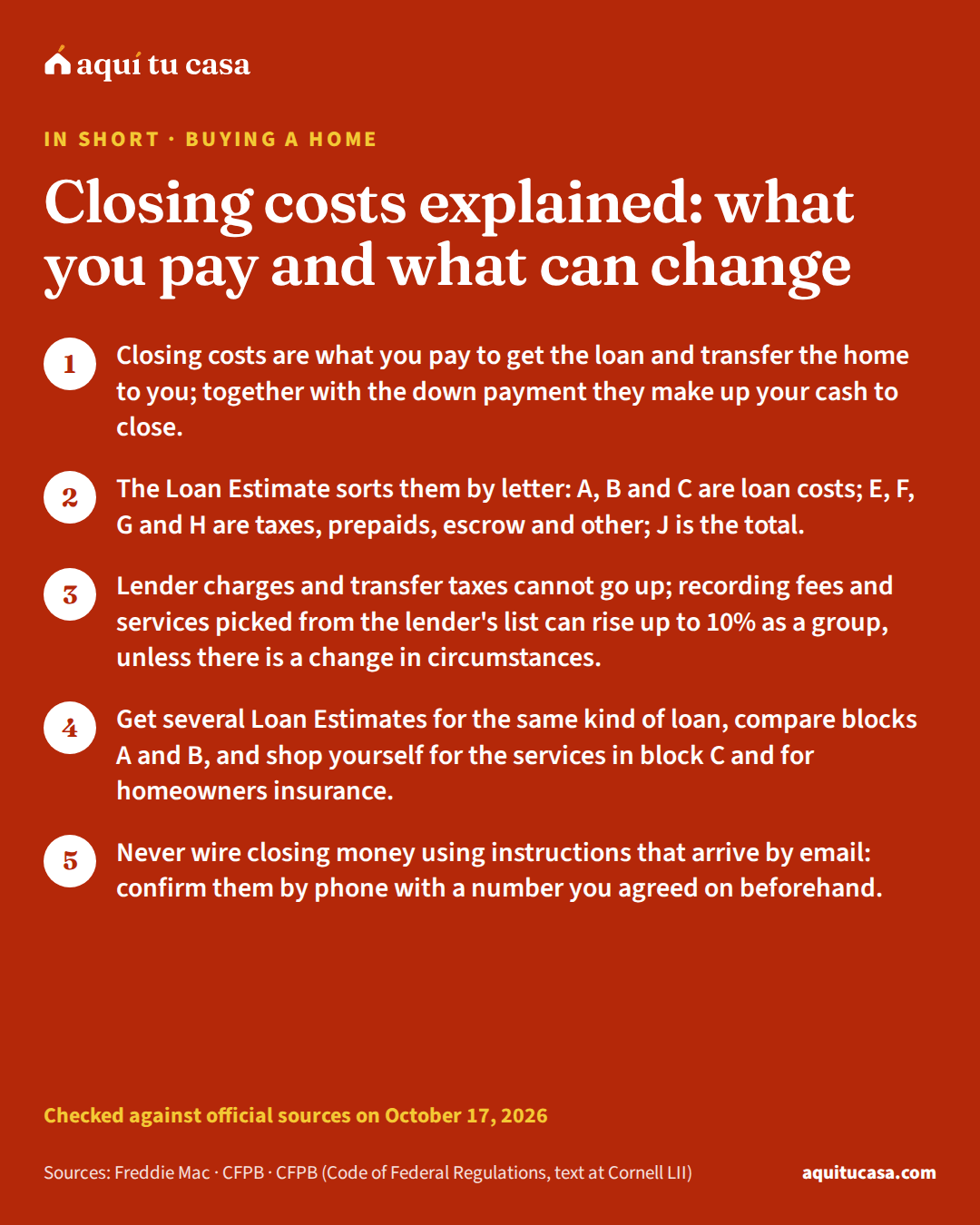
- Buying a home Closing costs explained: what you pay and what can change What closing costs are, how to read them on your Loan Estimate, which charges cannot go up before closing and how to compare offers to pay less. 14 minute read
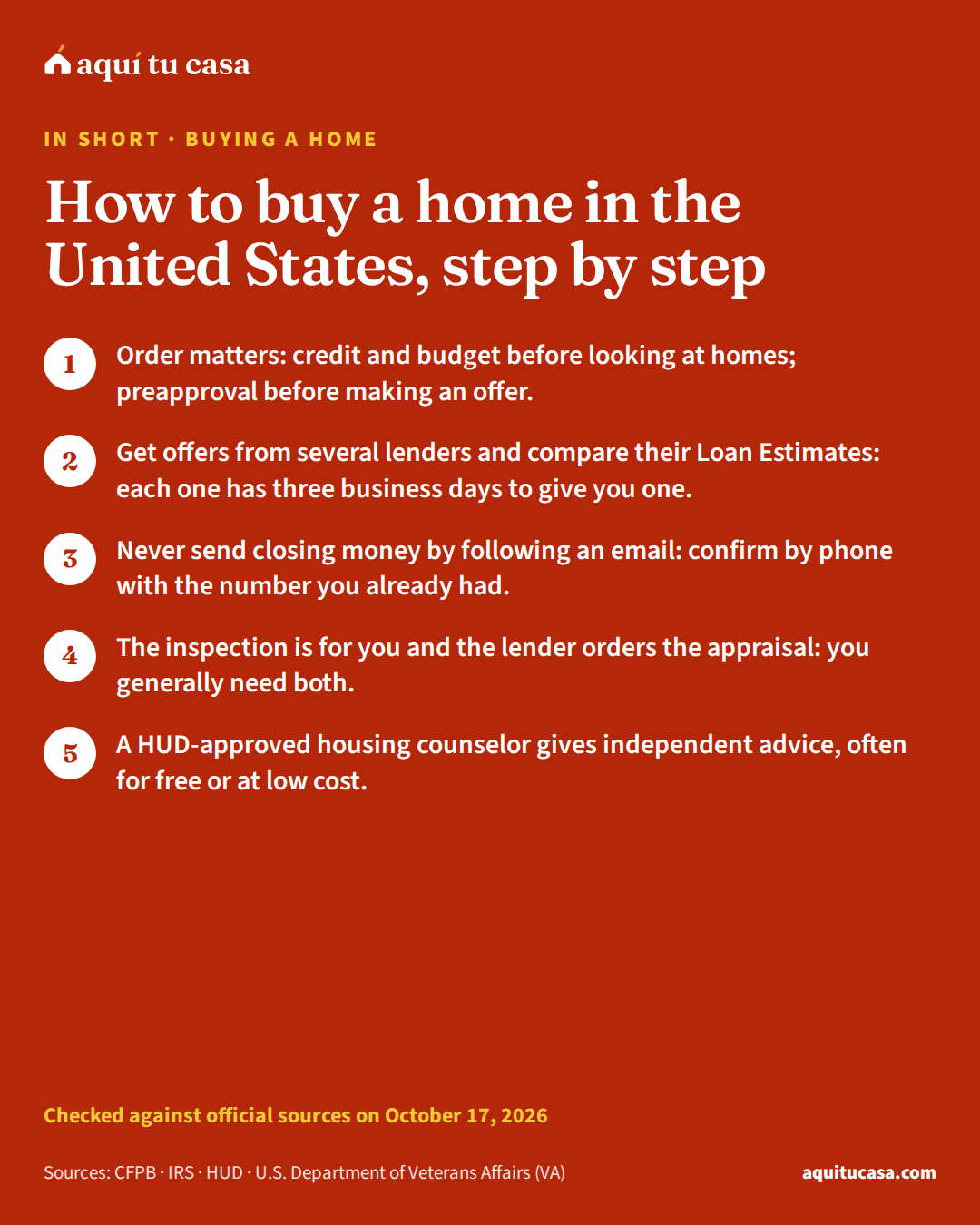
- Buying a home How to buy a home in the United States, step by step The nine steps to buying a home: paperwork, credit, budget, assistance, preapproval, offer, inspection, closing and the first year, with official sources. 15 minute read
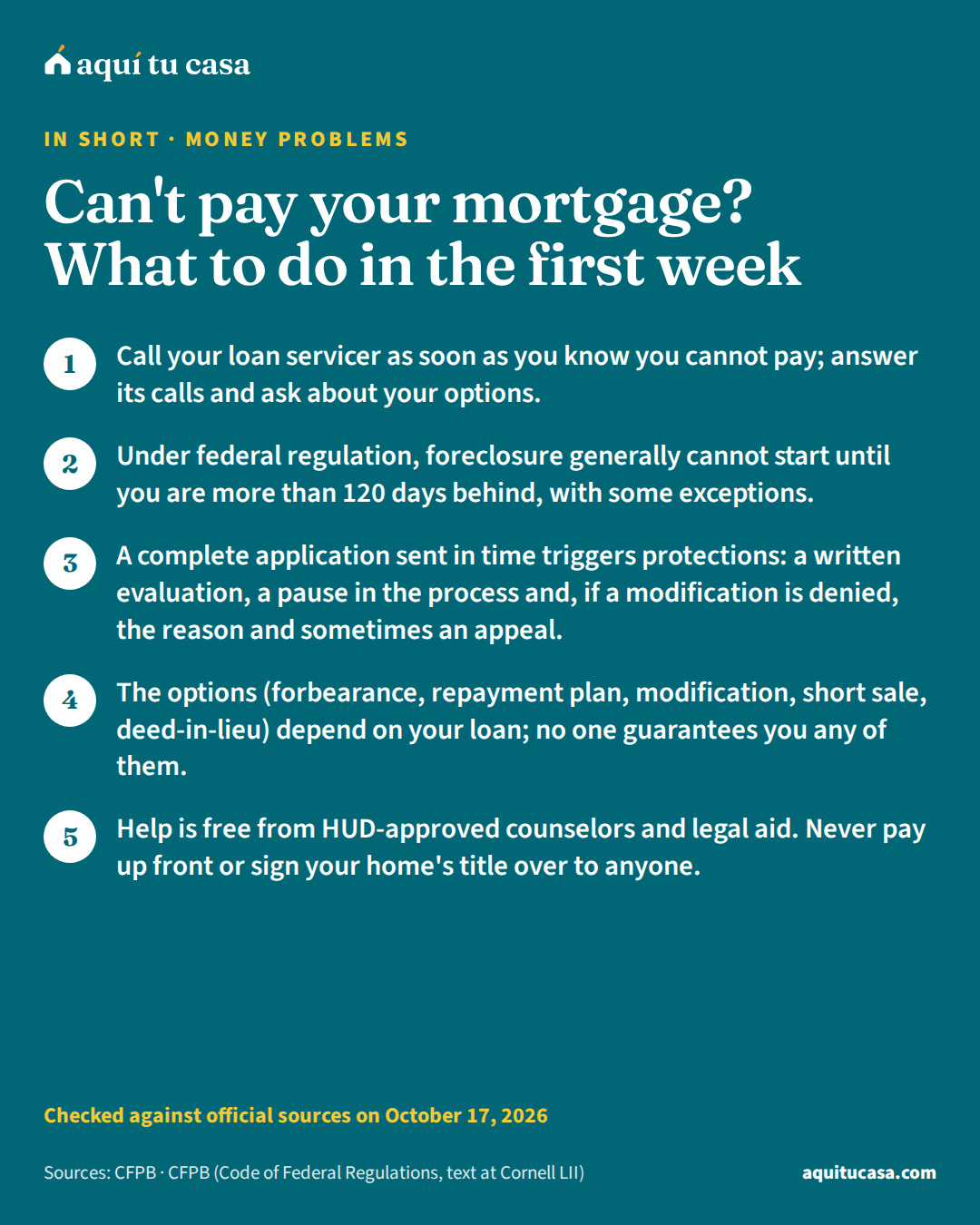
- Money problems Can't pay your mortgage? What to do in the first week Can't pay your mortgage? Call your servicer, learn the options that exist, the federal rules that protect you and the rescue scams to avoid. 14 minute read
Tools for this topic
Was this guide useful?
Thank you. Your answer stays in your browser; nothing is sent.