
How much house can I afford?
The price your income can carry.
What you get → maximum price
Someone shared this page with you.
Questions and answers
Every question our 25 guides about mortgage loans answer, grouped by guide. Each answer is the guide's own and leads to it, with its sources.
Open a question to read its answer. Each group ends with the full guide, its sources and, when it has one, its calculator.
We found no questions with those words. Try another word or open a topic.
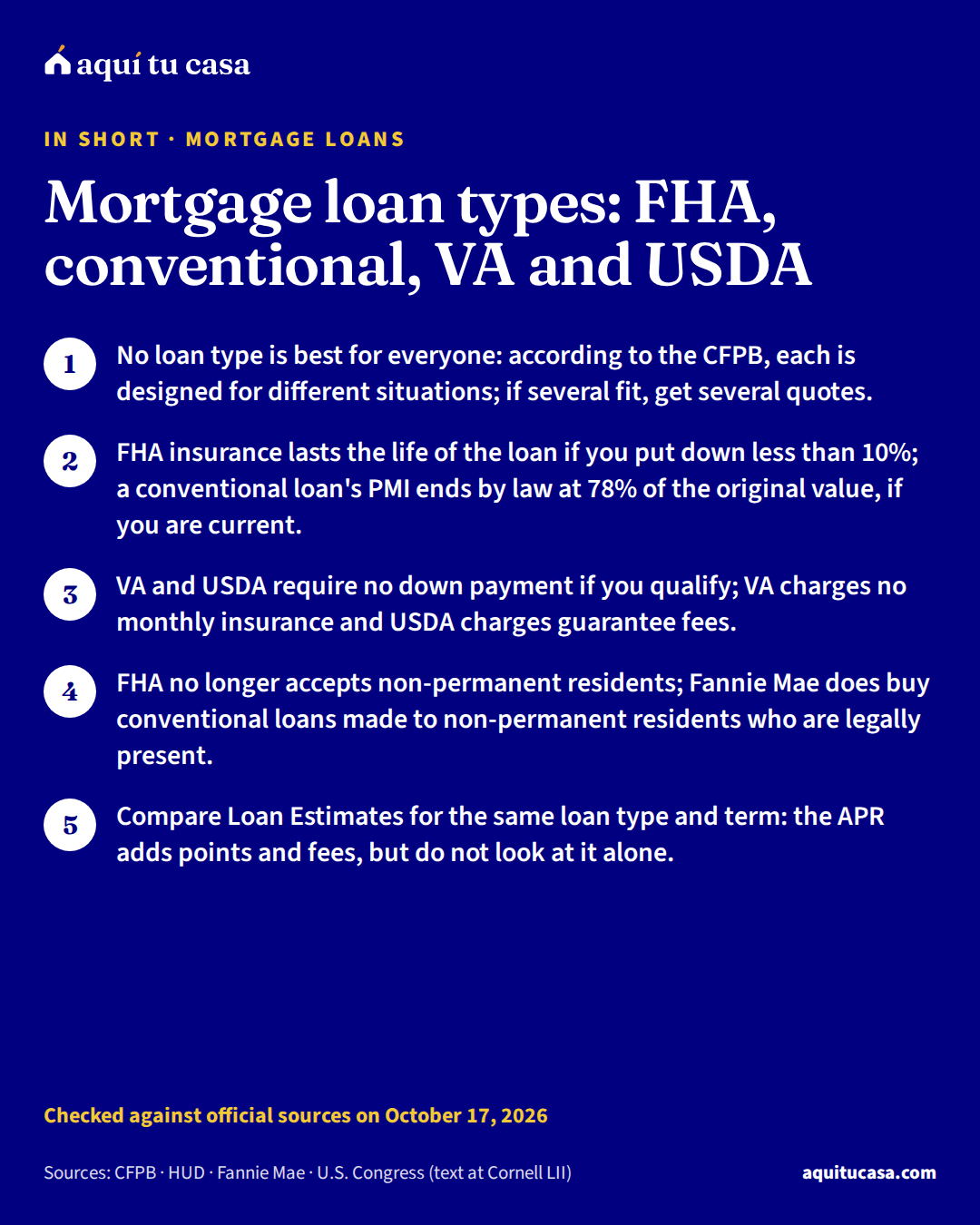
From the guide
What each mortgage type asks for, what its insurance costs, fixed or adjustable rate, points and APR. A neutral comparison with official sources.
Verified on October 17, 2026 26 official sources
It depends on your credit and your down payment. The CFPB says that with good credit and a medium down payment (10% to 15%), FHA tends to cost more than conventional, and that with a lower score or a small down payment FHA is often the cheapest. VA and USDA can cost less if you qualify. There is no hard-and-fast rule: get quotes and compare total costs.
Read the full guideAccording to HUD's Handbook, with 580 or higher you are eligible for maximum financing, which means the minimum 3.5% down payment. From 500 to 579, the loan cannot exceed 90% of the value, so you put down at least 10%. Below 500 you are not eligible for FHA.
Read the full guideBy law, it ends automatically when your balance, based on your original payment schedule, reaches 78% of the home's original value, if you are current. You can ask in writing to cancel it once the balance reaches 80%, if you have a good payment history, are current and meet the holder's requirements, such as showing the home has not lost value.
Read the full guideIt depends on your down payment. According to HUD, on loans longer than 15 years, if the loan is 90% of the value or less (you put down 10% or more), the annual premium lasts 11 years; if it is above 90%, it lasts the life of the loan.
Read the full guideSince May 25, 2025, FHA accepts, besides citizens, only lawful permanent residents and citizens of Micronesia, the Marshall Islands and Palau. USDA requires being a citizen, non-citizen national or qualified alien. Fannie Mae buys conventional loans made to non-permanent residents who are legally present. The ITIN mortgage guide explains the other options.
Read the full guideYou need a Certificate of Eligibility (COE) based on your service: for example, a service member who has served at least 90 continuous days. Some surviving spouses can get one too. You also have to meet VA's and the lender's credit, income and occupancy requirements. You request the COE online or through your lender.
Read the full guideUSDA has an Income and Property Eligibility Site where you can check whether an address is in an eligible rural area and whether your household income might qualify. To apply, USDA refers you to its approved lenders.
Read the full guideIt depends on your situation, and no one can decide it for you. The CFPB describes a fixed rate as lower risk with no surprises, and an adjustable rate as cheaper at the start but with the risk that the payment rises a lot. It warns against counting on selling or refinancing before the rate changes.
Read the full guideThe data behind these guides
The guides on Mortgage loans cite these figures. They update when their sources publish new ones; what you see here is current.
See all the dataSources: Freddie Mac (As of November 5, 2026) · HUD (2026 data) · FHFA (2026 data)
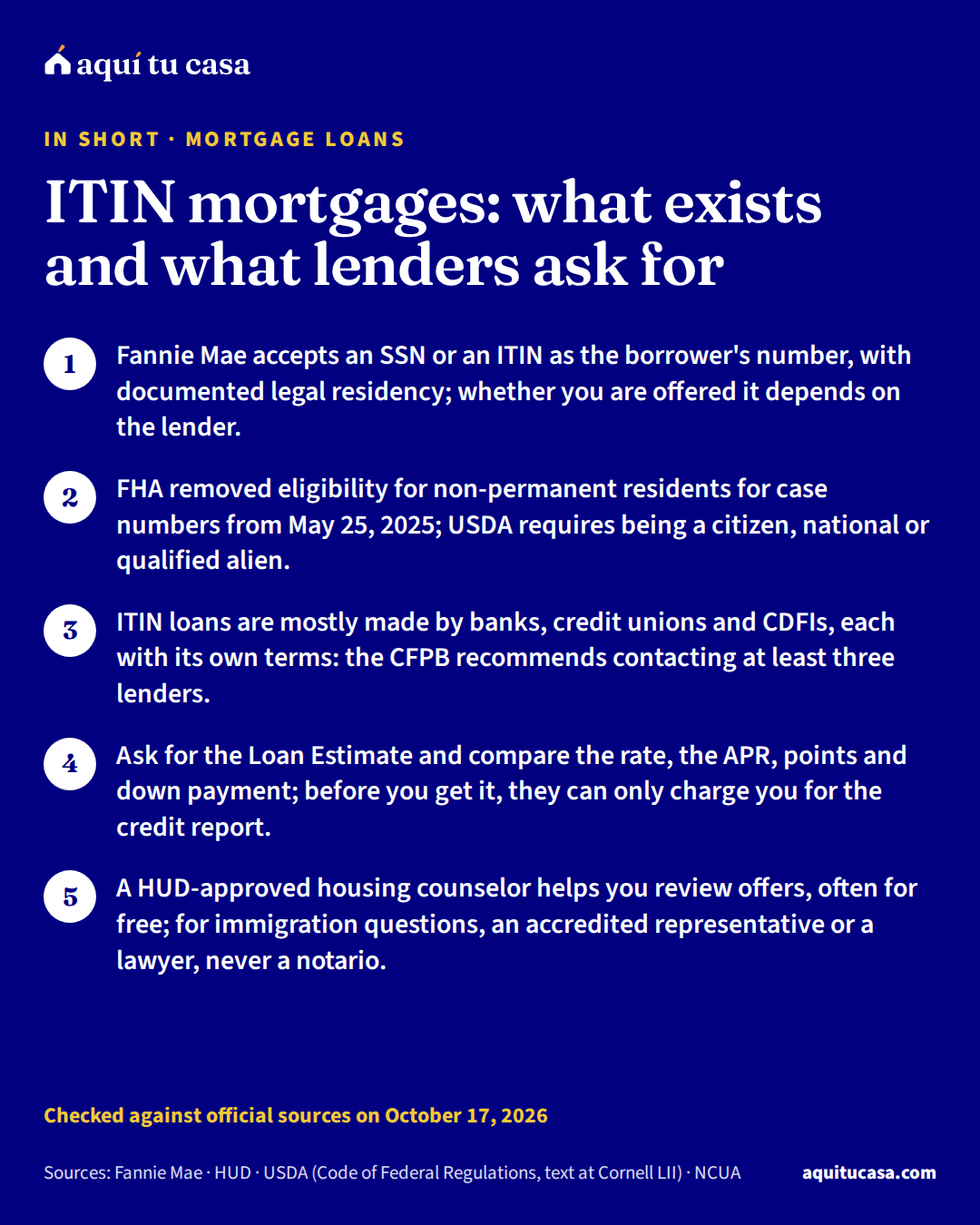
From the guide
Which home loans accept an ITIN and which do not: Fannie Mae's rule, what FHA and USDA say, who lends and how to compare offers.
Verified on October 17, 2026 17 official sources
It depends on the program and the lender. Fannie Mae accepts the ITIN as the borrower's number if you meet legal residency; FHA no longer accepts non-permanent residents. On top of that, some banks, credit unions and CDFIs offer ITIN loans under their own rules. If one lender says no, ask another: each one offers different kinds of loans.
Read the full guideEach lender sets its own down payment, rate and documents for its ITIN loans; that is why there is no single figure. Compare several offers using the Loan Estimate and look at the APR, not just the rate.
Read the full guideEach person who signs the loan is a borrower and each program decides what it asks of each one; with Fannie Mae, every borrower needs an SSN or an ITIN and must meet legal residency. Ask the lender, before you apply, how it treats your income and your ITIN in that combination.
Read the full guideFor case numbers assigned on or after May 25, 2025, FHA only accepts citizens, lawful permanent residents and citizens of Micronesia, the Marshall Islands and Palau. A Social Security card is not enough to prove status. If you are a permanent resident, FHA is open to you on the same terms as citizens.
Read the full guideStart with your local bank or credit union and the CDFI Fund's list of certified CDFIs, which exist in every state. The FDIC's public Community Reinvestment Act evaluations also document which banks have ITIN programs. A HUD-approved housing counselor can help you identify lenders.
Read the full guideClosing costs. Freddie Mac says to be prepared to pay between 2% and 5% of the price; on a $332,700 home, the typical U.S. value, that is between $6,654 and $16,635. Your real figure is on the Loan Estimate.
Read the full guideBefore you receive the Loan Estimate and say you want to proceed, Regulation Z only allows a bona fide and reasonable fee for your credit report. Be wary of anyone who asks for an upfront 'processing' fee.
Read the full guideThat is an immigration question that neither a lender nor this site can answer. You can ask a representative accredited by the Department of Justice or an immigration lawyer; never a notario.
Read the full guide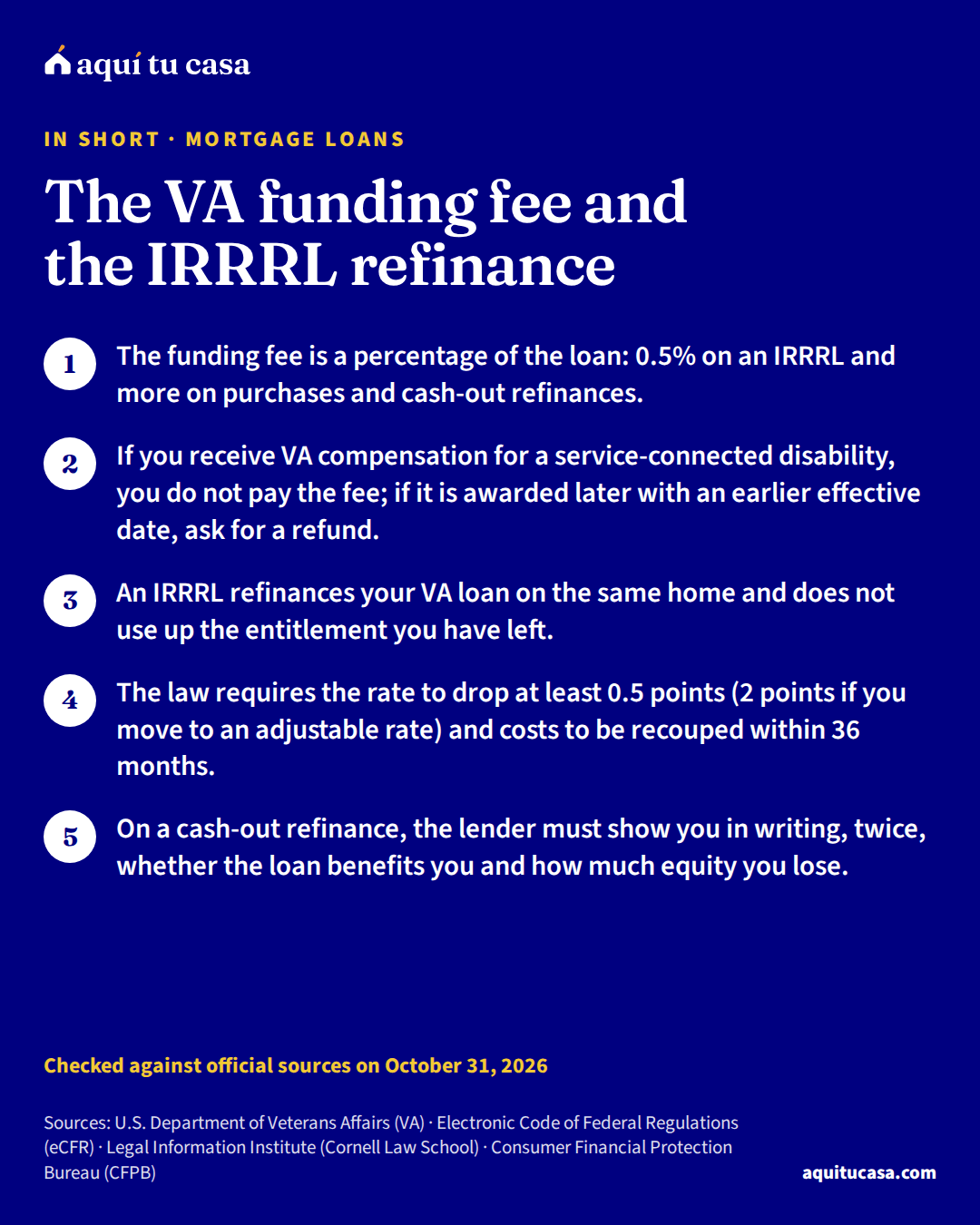
From the guide
How much the VA funding fee is on each loan type, who does not pay it, how to ask for a refund and the IRRRL rules for lowering your interest rate.
Verified on October 31, 2026 6 official sources
According to VA's chart effective April 7, 2023, it is 0.5% of the loan amount, whether or not you have used the benefit before. You can add it to the new loan or pay it at closing.
Read the full guideIf you receive VA compensation for a service-connected disability, you do not pay it. Nor if you are eligible for that compensation but receive retirement or active-duty pay instead, or in other cases VA lists, such as DIC for surviving spouses.
Read the full guideYou may. VA says you may be eligible for a refund if the effective date of your compensation is before your closing date. Call your VA regional loan center to ask.
Read the full guideNo. Under VA's regulation, an IRRRL is guaranteed regardless of how much entitlement you have left and is not charged against your available entitlement.
Read the full guideYes, if you lived there before and certify it. If you could not live there because of active duty, it is enough that your spouse lives or lived in the home and certifies it.
Read the full guideNo. The IRRRL may not exceed the old loan balance plus allowed closing costs and a discount of up to 2% of the loan, plus energy improvements if any. For cash there is the cash-out refinance, with a different fee and different rules.
Read the full guideThe law requires at least 0.5 percentage points if both loans are fixed-rate, and at least 2 points if you move from fixed to adjustable. Costs must also be recouped through lower payments within 36 months.
Read the full guide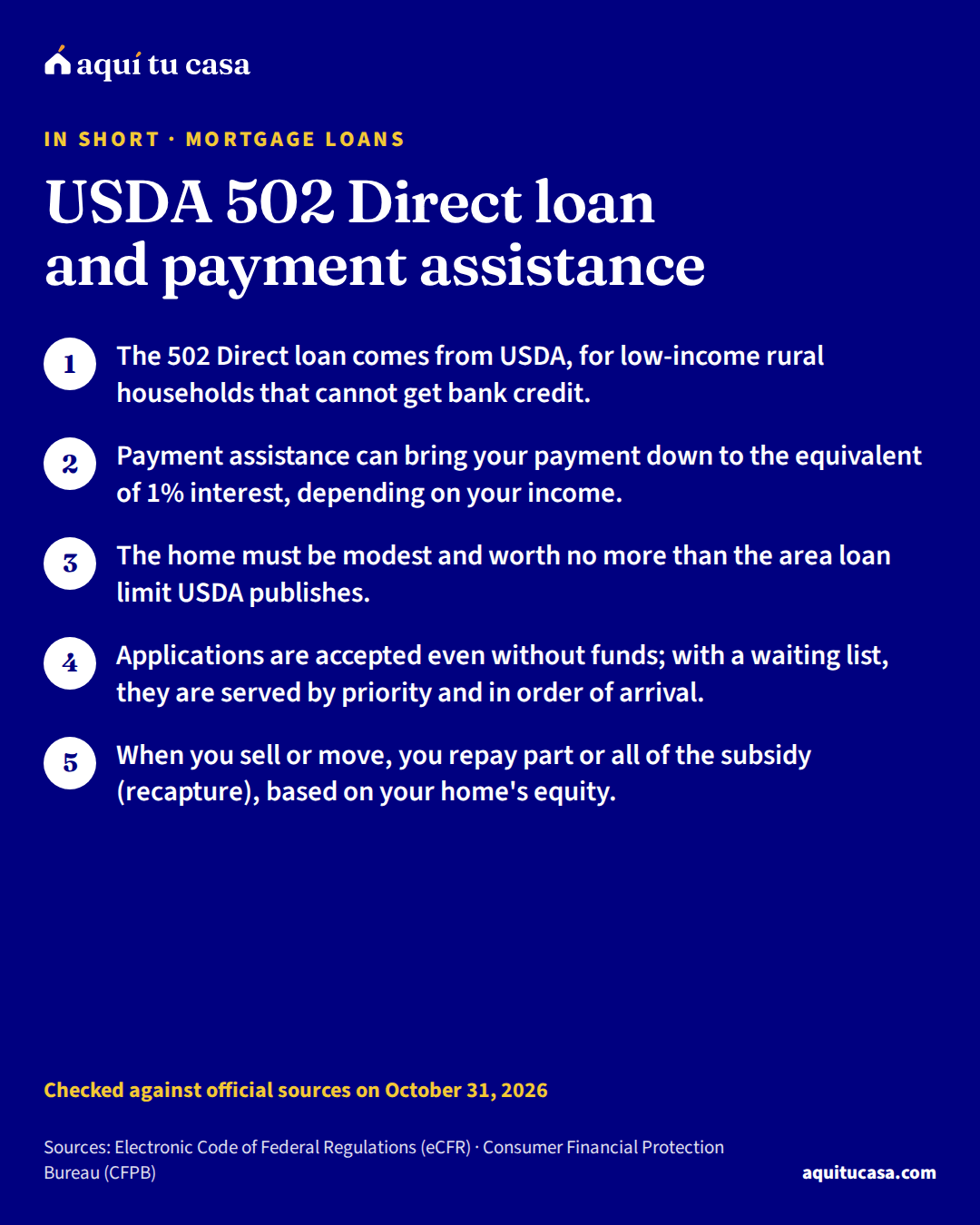
From the guide
USDA's Section 502 Direct loan: who qualifies, how payment assistance is figured, the modest home rule, the waiting list and paying back the subsidy.
Verified on October 31, 2026 3 official sources
Read the full guide Do the math: How much house can I afford?
With the guaranteed loan, a bank lends and USDA guarantees it. With the 502 Direct loan, USDA lends, only to low-income households that cannot get credit elsewhere, and it can give you payment assistance. The USDA loan guide covers the other program.
Read the full guideIt depends on your income. If you never had a subsidy, you get method 2: your share of the payment moves toward 24% of your adjusted income, but the assistance never lowers the payment more than a 1% interest rate would.
Read the full guideAs a rule no, unless you have savings. Non-elderly families must use net assets above $15,000, and elderly families assets above $20,000.
Read the full guideIt is paying back the payment assistance you received. It comes due when you sell or stop living in the home, and it is based on your home's equity: it is the lesser of the subsidy you received and a portion of how much the value rose.
Read the full guideYes. USDA accepts applications even when funds are not available. If you are eligible, you go on the waiting list, where certain priority cases are served first and then in order of arrival.
Read the full guideYou must be a U.S. citizen or a noncitizen who qualifies as a legal alien under USDA's regulation. If you are not sure about your case, talk to a lawyer or a Justice Department-accredited representative before you hand over documents.
Read the full guideUSDA reviews your income every year. You must report it if your income rises at least 10%, if an adult in the household starts or changes jobs or if the people living with you change. The assistance may go down.
Read the full guide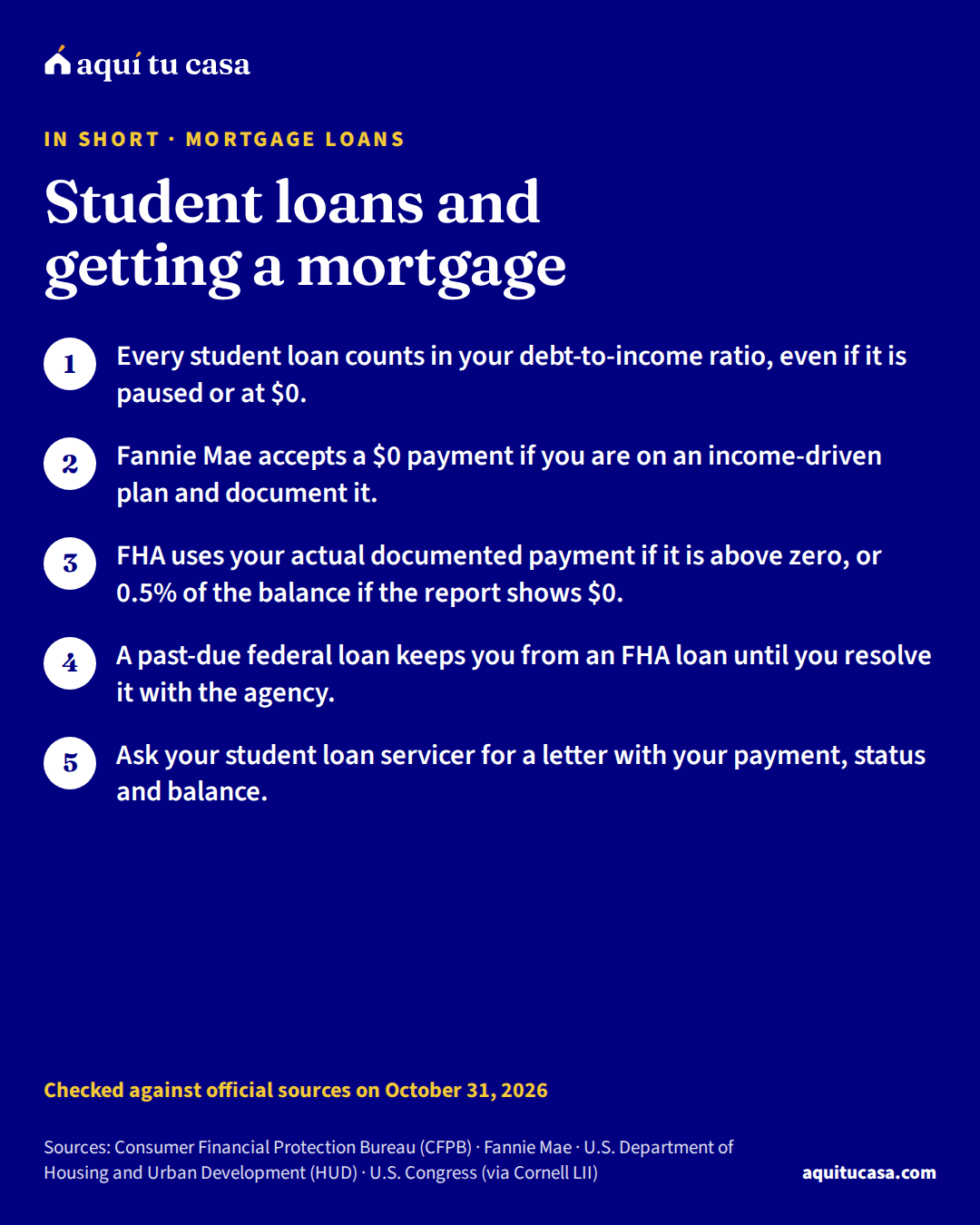
From the guide
How FHA and Fannie Mae count your student loan: income-driven payments, $0 payments, deferment, past-due federal debt and which papers to ask for.
Verified on October 31, 2026 5 official sources
Read the full guide Do the math: How much house can I afford?
Yes. FHA includes every student loan, whether or not you are paying. Fannie Mae, for a deferred or paused loan, uses 1% of the balance or the full payment under the terms.
Read the full guideWith Fannie Mae, it can be, if the lender verifies with documents that your actual payment is $0. With FHA, when the report shows $0, 0.5% of the balance is used.
Read the full guideThe law created the Repayment Assistance Plan starting July 1, 2026. In that plan the minimum payment is $10, so it does not reach $0. The lender uses your actual documented payment.
Read the full guideYour most recent statement or a letter from your student loan servicer with your monthly payment, account status, balance and terms. FHA requires that document in writing if the payment used is lower than the one on the report.
Read the full guideWith Fannie Mae, the lender can leave it out if someone else actually pays it and provides 12 months of checks or bank statements with no late payments. It does not apply if the payer is the seller or the agent.
Read the full guideNot until you resolve it. According to HUD's Handbook, if the agency confirms the federal debt is valid and delinquent, you are not eligible for FHA until you resolve it with that agency.
Read the full guideWith FHA, the lender can leave the payment out if you have written documentation that the balance was forgiven, canceled, discharged or paid in full. Keep that letter.
Read the full guide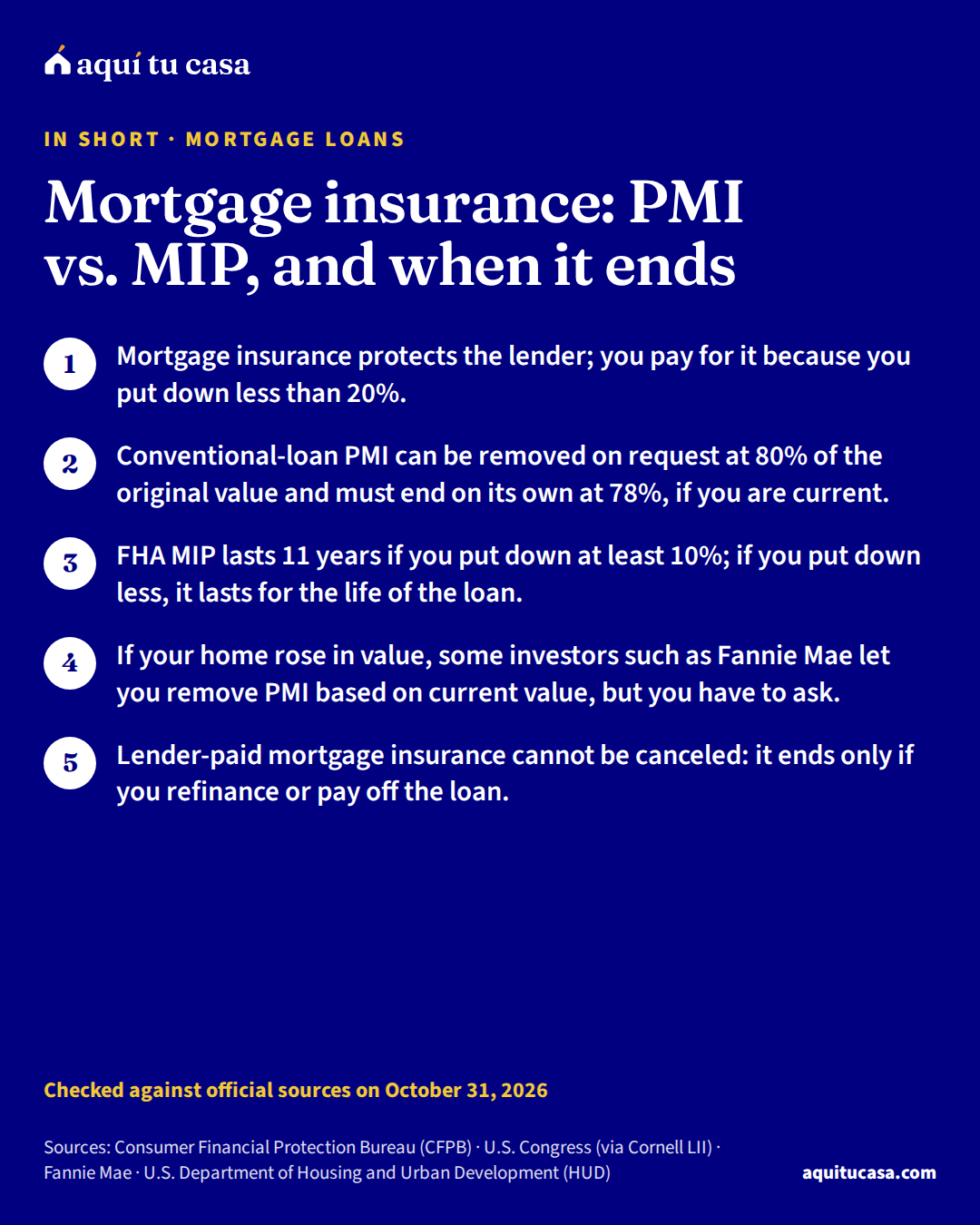
From the guide
What mortgage insurance is, how conventional-loan PMI differs from FHA MIP, when each one ends and how to ask your servicer to remove it.
Verified on October 31, 2026 11 official sources
No. The CFPB explains that mortgage insurance protects the lender, not you. If you fall behind, you can lose the home even though you pay for it. If you cannot pay, call your servicer and a HUD-approved housing counselor.
Read the full guideWhen your balance is scheduled to reach 80% of your home's original value, or earlier if you made extra payments. The first date appears on the PMI disclosure you got with the loan. You ask in writing, and you must be current with a good payment history.
Read the full guideYes. By law, PMI must end on the date your balance is scheduled to reach 78% of the original value, if you are current. And it cannot continue past the midpoint of the loan term, if you are current.
Read the full guideIt depends on who owns your loan. Fannie Mae, for example, lets you ask based on current value: on a one-unit home, with a balance of 75% or less of current value if the loan is two to five years old, or 80% or less if it is older than five years. Ask your servicer which rules apply.
Read the full guideIt depends on your down payment. Under HUD's chart, if your loan-to-value was 90% or less, the annual premium lasts 11 years; if it was more than 90%, it lasts for the mortgage term. Older FHA loans may follow other rules: ask your servicer.
Read the full guideFor PMI, yes: the servicer must return unearned premiums no later than 45 days after it is canceled or terminated. FHA's upfront premium is not refunded, except as a credit if you refinance into another FHA loan within 3 years.
Read the full guideAsk for the answer and the reasons in writing. If you believe the servicer broke the law, you can file a complaint with the CFPB, and a HUD-approved housing counselor can help you review your case for free.
Read the full guide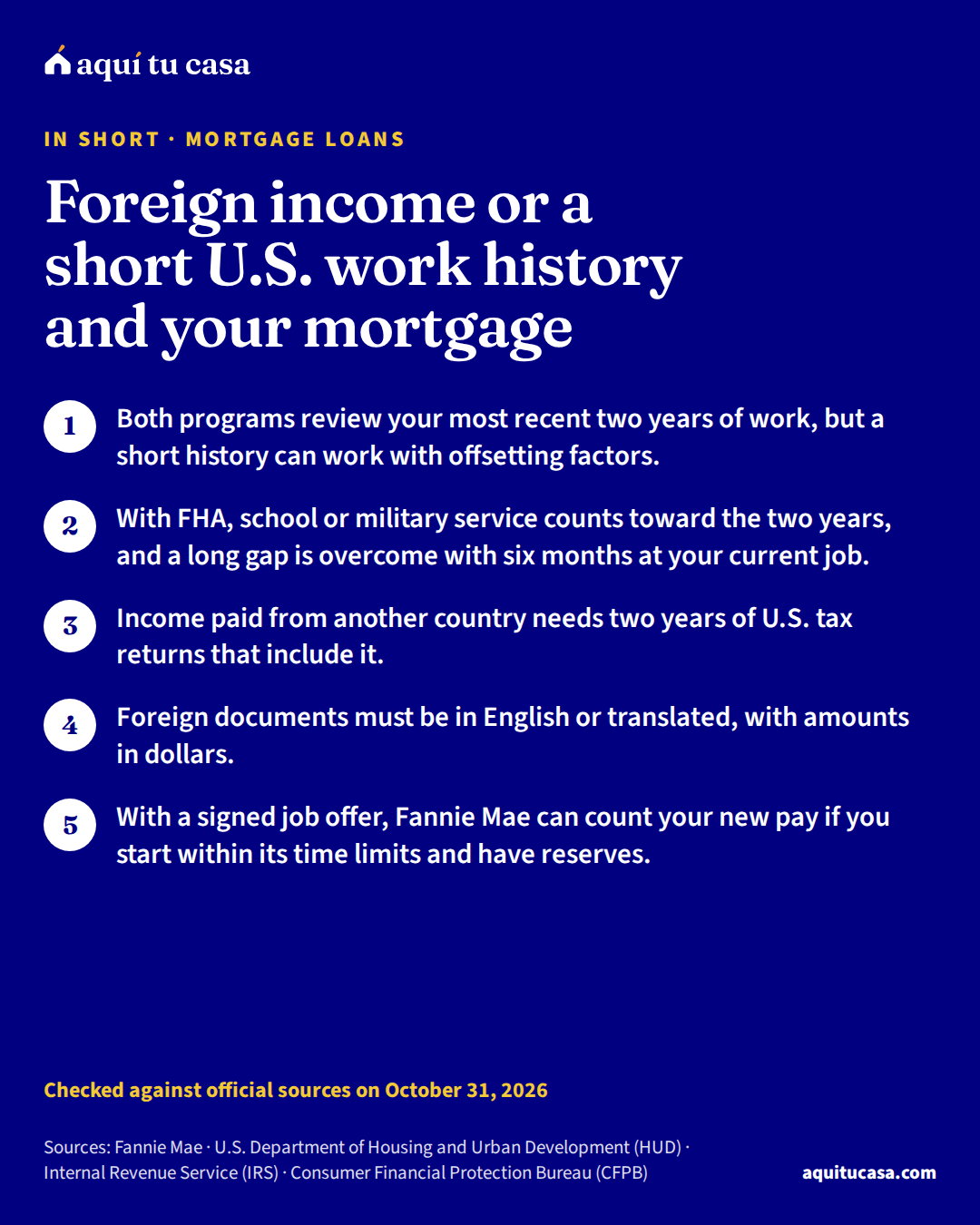
From the guide
How FHA and Fannie Mae count income paid from another country, a short work history, school, gaps in employment and a new job offer.
Verified on October 31, 2026 7 official sources
Not necessarily the same one. FHA verifies your most recent two years of employment, and if you changed employers it uses your W-2s or verifications. Fannie Mae looks for a reliable pattern over two years, and someone who changes jobs but earns consistent income is considered to have reliable income.
Read the full guideWith FHA, evidence that you were enrolled in school or the military during the most recent two full years can be used to verify your history.
Read the full guideIt can. FHA and Fannie Mae call income paid by a foreign corporation or government in another currency foreign income. You need two years of U.S. tax returns that include it, with English translations and amounts converted to dollars.
Read the full guideTo use it, FHA and Fannie Mae ask for your tax returns for the most recent two years showing that income. If it is not on your returns, you likely cannot use it to qualify. A VITA site can help you with your return.
Read the full guideNot necessarily with FHA. If the gap was six months or more, the lender can count your current income if you have been at your current job at least six months and had two years of work before the gap.
Read the full guideWith Fannie Mae, yes, with conditions. The offer must be signed and non-contingent, and under one option your start date must fall between 30 days before and 90 days after the note signing, with extra reserves for the months without pay.
Read the full guideFannie Mae says non-citizen borrowers must meet the same employment and income verification requirements as citizens. Rules about immigration status are separate; see the guides for green card holders and for TPS, parole and work permits.
Read the full guideTools
The calculators these guides use. Each one leaves you with a result you can use today.
The price your income can carry.
What you get → maximum price
Your monthly payment with taxes and insurance.
What you get → monthly payment
What each loan costs per month and over five years.
What you get → payment per loan
The cash you need on closing day.
What you get → cash to close
From the guide
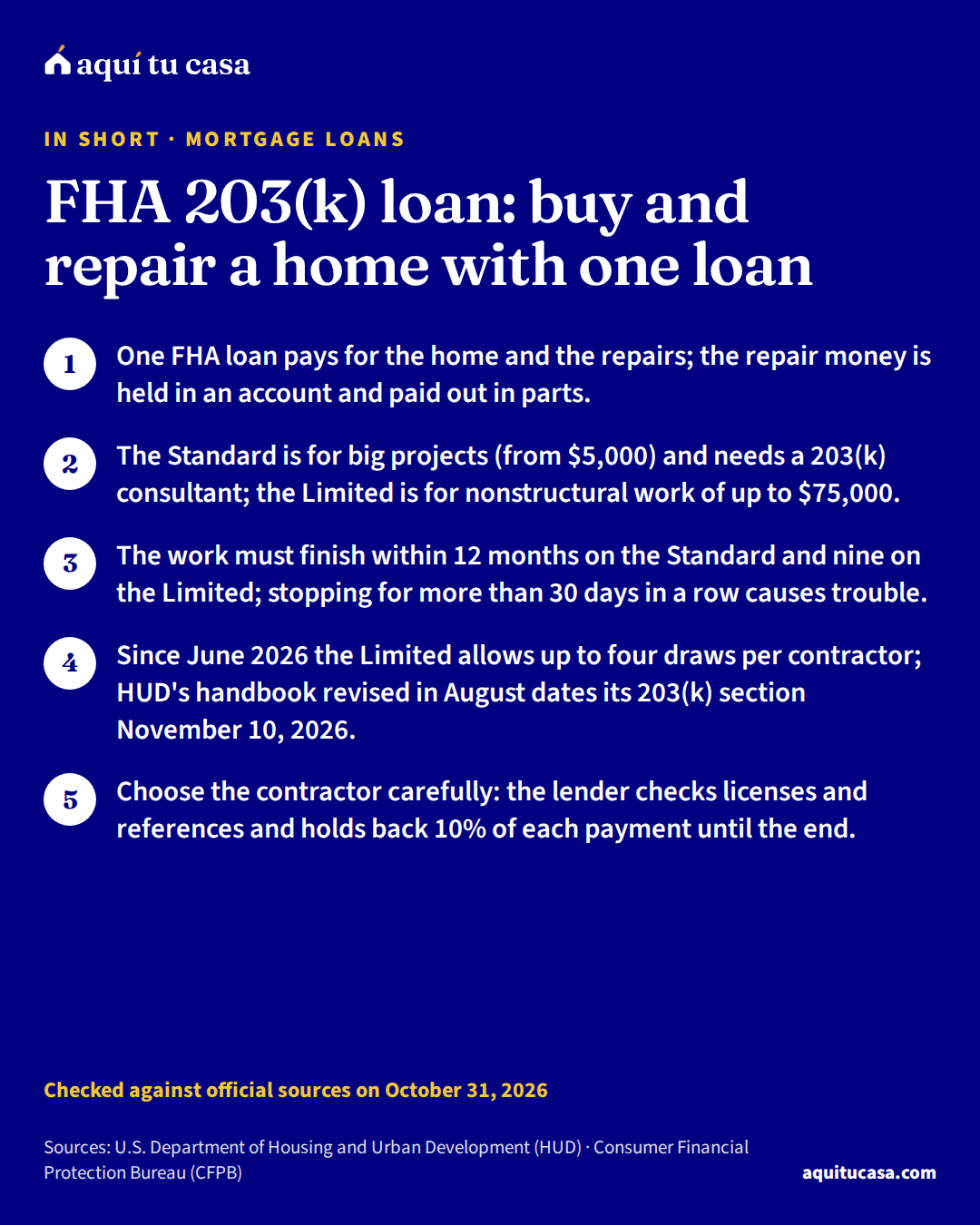
How FHA's Standard and Limited 203(k) loans work: which repairs they pay for, the consultant, the draws, the deadlines and the dates on HUD's rules.
Verified on October 31, 2026 3 official sources
The Standard is for big projects, even structural ones, and requires at least $5,000 in repairs and an FHA-approved 203(k) consultant. The Limited is for minor, nonstructural work, up to $75,000 in total, and does not require a consultant.
Read the full guideYes, under a self-help agreement. But according to HUD you cannot be reimbursed for your own labor: the loan pays only for the materials of the work you do.
Read the full guideUp to 12 months on the Standard and up to nine on the Limited, counted from when the loan is funded. If you fall behind schedule you can ask for an extension, which the lender grants only if your payments are current.
Read the full guideNot a new one. HUD does not allow paying for luxury items such as new pools, exterior hot tubs or saunas, tennis courts or gazebos. You can repair or remove a pool that already exists.
Read the full guideYes. You always need an appraisal by an FHA roster appraiser that says what the home will be worth after the improvements. The maximum loan depends on that value and on the home's as-is value.
Read the full guideYes. HUD Mortgagee Letter 2026-06, dated June 23, 2026 and effective immediately, raised Limited draws to four per contractor. The FHA handbook revised August 12, 2026 dates its 203(k) section November 10, 2026. Ask your lender which version applies to your loan.
Read the full guideYes, if the HUD home is identified as 203(k)-eligible in the contract. Investors cannot use a 203(k) to buy HUD homes.
Read the full guide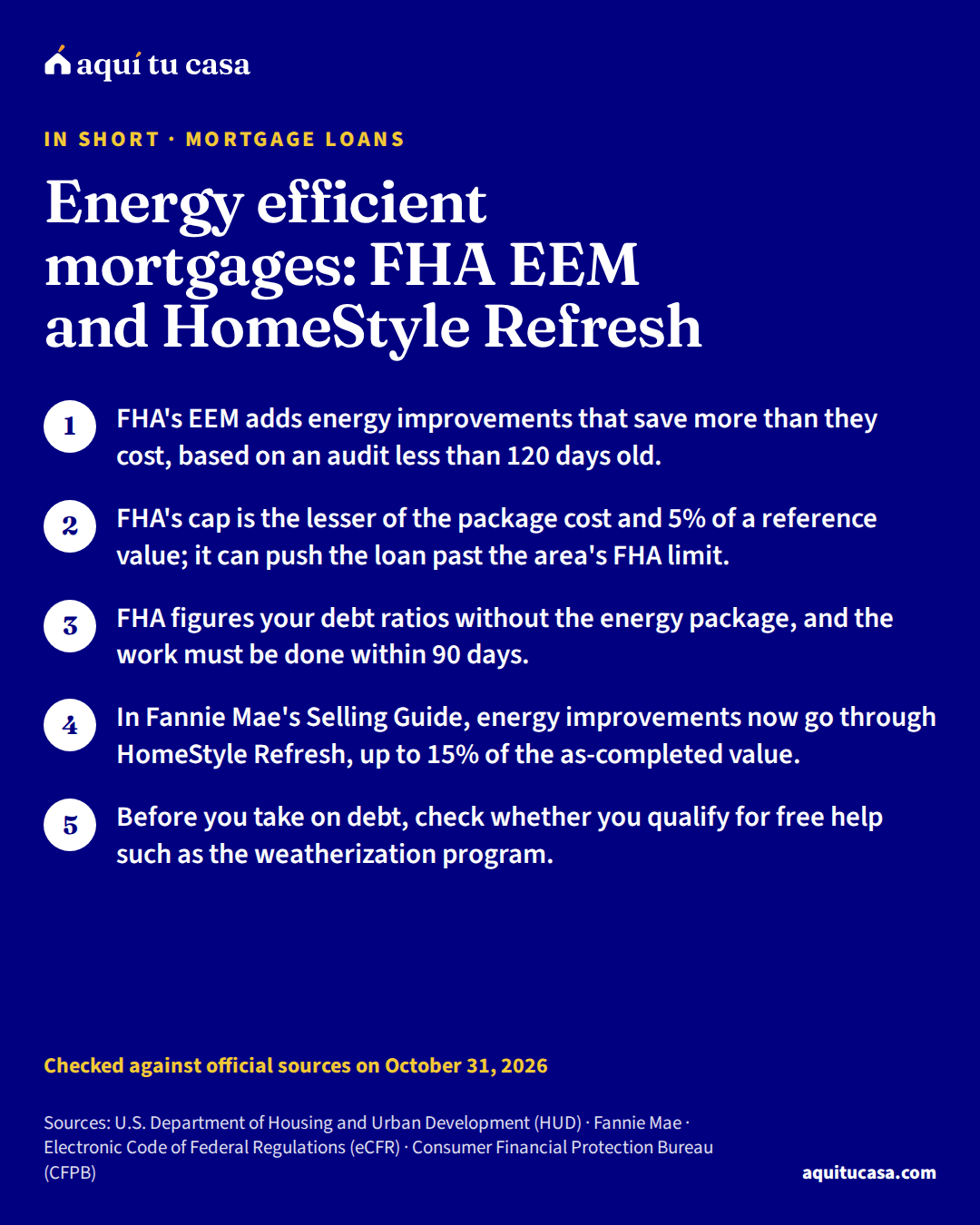
From the guide
How to add energy-saving improvements to your loan: FHA's EEM, Fannie Mae's HomeStyle Refresh, the energy audit and what happened to HomeStyle Energy.
Verified on October 31, 2026 4 official sources
It is an FHA mortgage that adds the cost of cost-effective energy efficiency improvements, on a purchase or a no cash-out refinance. It can be used with 203(b), 203(h) and 203(k) loans.
Read the full guideYes. FHA requires a whole-home assessment by a qualified rater (for example, BPI or RESNET, or one who meets your state's rules). The report cannot be more than 120 days old.
Read the full guideThe lesser of the cost of the cost-effective package and 5% of the lowest of three values: the home's adjusted value, 115% of the area median price or 150% of the national conforming loan limit.
Read the full guideNot because of the package. FHA figures your debt ratios with the loan without the energy package and accepts the payment increase without re-underwriting.
Read the full guideIn the Selling Guide published October 7, 2026, the section where it used to be is called HomeStyle Refresh. Energy or water efficiency improvements go there now, up to 15% of the as-completed value.
Read the full guideAccording to Fannie Mae, a limited cash-out refinance can pay off a PACE loan or other debt that financed energy improvements. If it combines new improvements and that debt, the total cannot exceed 15%.
Read the full guideYes. VA's regulation allows the IRRRL payment to go up if the increase comes from including energy efficiency improvements.
Read the full guide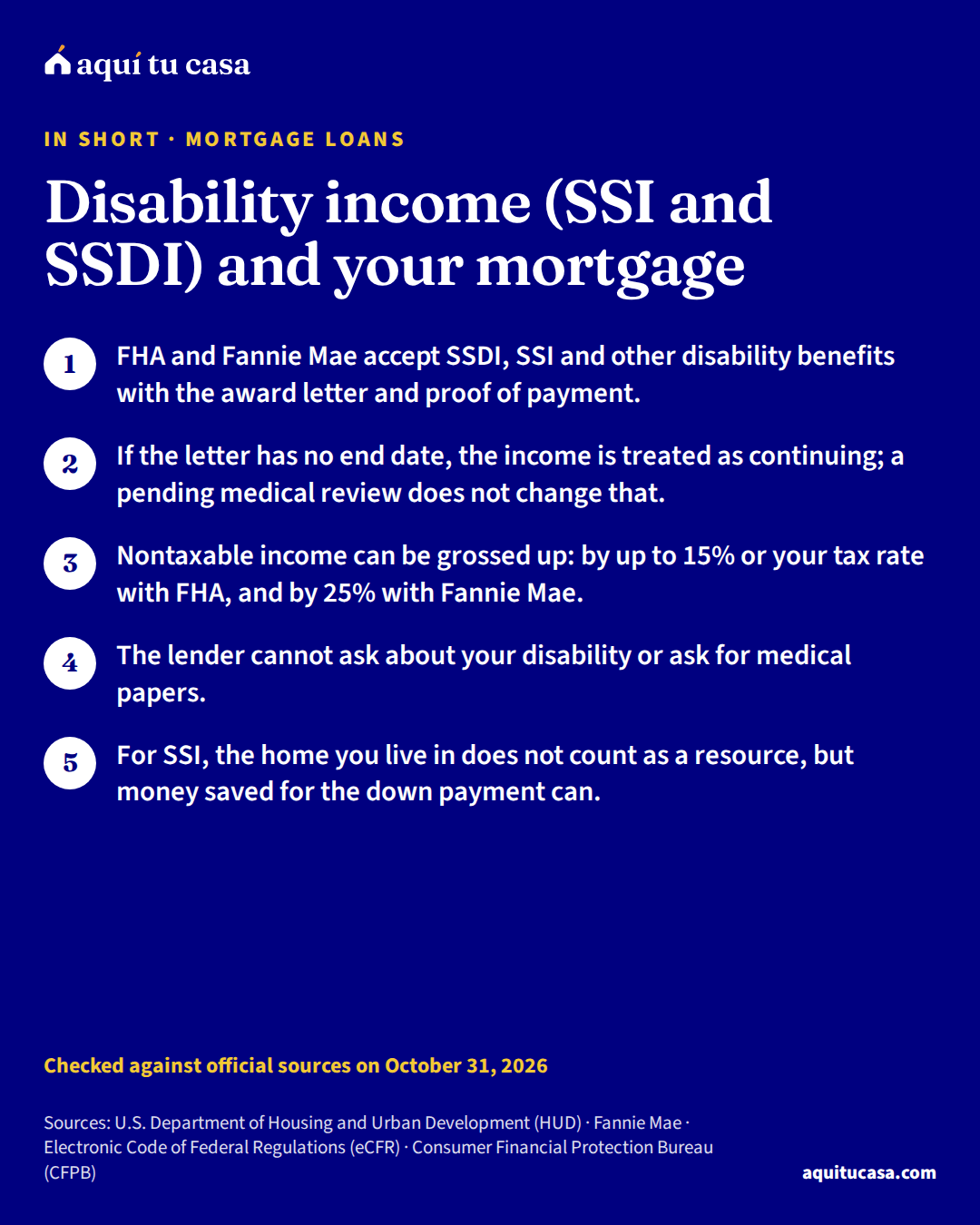
From the guide
How FHA and Fannie Mae count SSDI, SSI and other disability benefits, which papers they ask for, the tax gross-up and what a lender cannot ask you.
Verified on October 31, 2026 8 official sources
Read the full guide Do the math: How much house can I afford?
Yes. FHA and Fannie Mae accept it. With FHA you need the last Notice of Award and one more document, such as the SSA-1099, a bank statement showing the deposit or an SSA proof of income letter.
Read the full guideIt counts too. FHA includes it with Social Security disability income, and Fannie Mae asks for the award letter and proof that you receive it now.
Read the full guideAccording to FHA, the lender may not treat a pending or current medical review as evidence that the benefit will not continue. Fannie Mae says something similar for long-term disability: a review of benefits is not a reason to think the income will end.
Read the full guideNo. FHA's handbook says that under no circumstance may the lender ask about or request documents on the nature of the disability or your medical condition.
Read the full guideIt means adding the tax you do not pay to your income, so it compares fairly with someone who pays taxes. FHA allows up to the greater of 15% or your tax rate; Fannie Mae, 25% or more if a similar earner's taxes would be higher.
Read the full guideThe home you live in does not count as a resource for SSI, whatever its value. But the money you save before you buy can count, and the limit is $2,000 for an individual and $3,000 for a couple. Ask SSA before you save a large amount.
Read the full guideWith Fannie Mae, Social Security income a dependent receives can count if it is documented to continue at least three years.
Read the full guide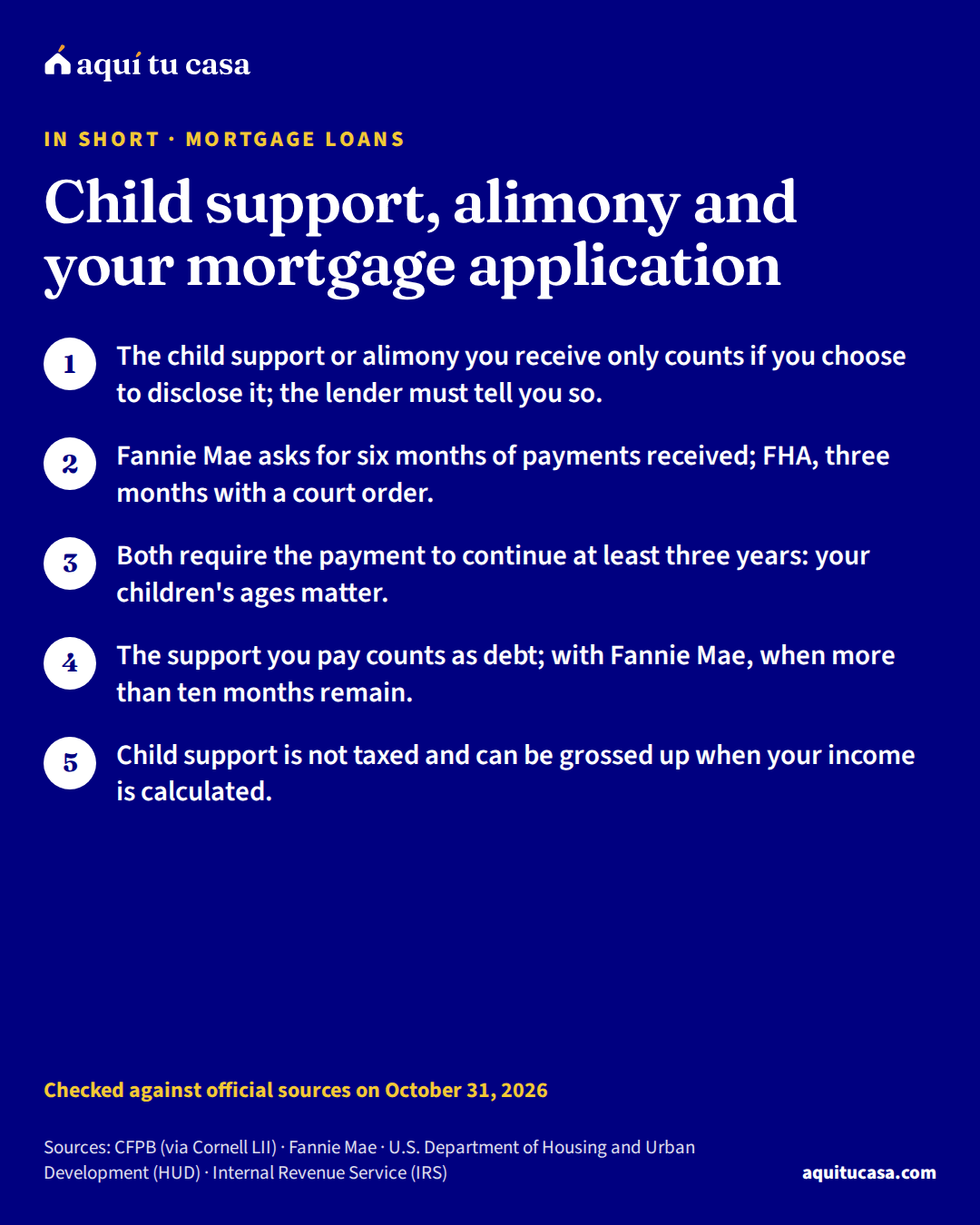
From the guide
When the child support or alimony you receive counts as income, and when what you pay counts as debt, under FHA, Fannie Mae and federal law.
Verified on October 31, 2026 9 official sources
Read the full guide Do the math: How much house can I afford?
No, if you do not want it counted. Under Regulation B, the lender cannot ask whether part of your income is child support or alimony unless it tells you that you do not have to reveal it. If you want it to count, you do have to disclose and document it.
Read the full guideIt depends on the program. FHA accepts a voluntary payment agreement with 12 months of canceled checks, deposit slips or tax returns. Fannie Mae does not count voluntary payments if you are separated without an agreement that sets them.
Read the full guideProbably not. Fannie Mae and FHA require the income to continue at least three years, and Fannie Mae says to check limits such as the children's ages.
Read the full guideOn an FHA loan, to see whether you have a wage garnishment for child support or alimony. It asks for stubs covering at least 28 consecutive days and uses the greater of the order or the garnishment.
Read the full guideYes, but there is an option. With Fannie Mae, the lender can subtract alimony from your income instead of adding it to your debts. With FHA, it counts as debt if it was not subtracted from your income.
Read the full guideNo. According to the IRS, child support is not considered income and the payer cannot deduct it. That is why FHA and Fannie Mae let the lender gross it up a little when figuring your income.
Read the full guideWith Fannie Mae, the history must show full, regular and timely payments. With FHA, if payments were not consistent, the average you received over the previous two years is used.
Read the full guide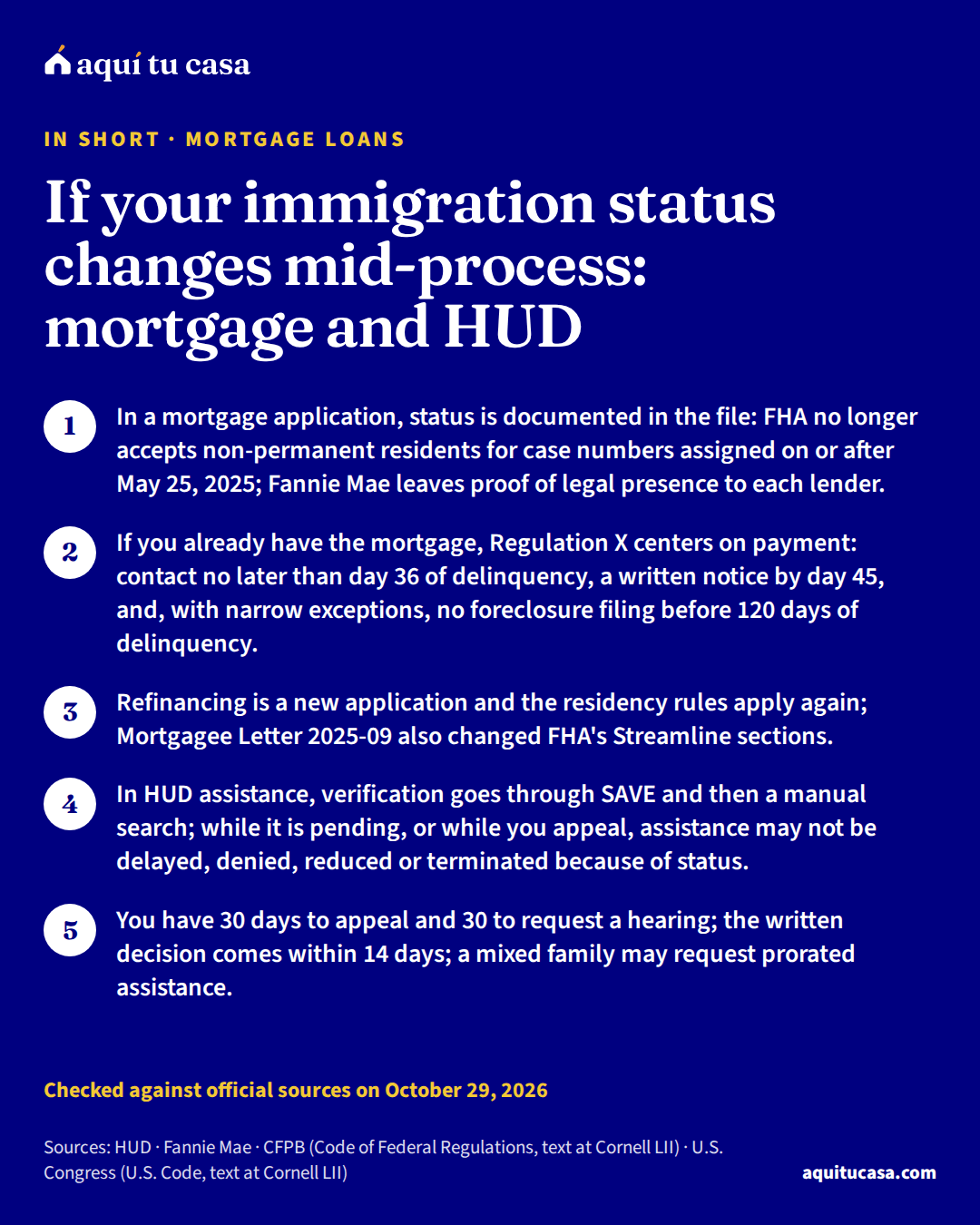
From the guide
What FHA, Fannie Mae and HUD say if your immigration status changes while you apply for or pay a mortgage or get HUD help, and your rights when you appeal.
Verified on October 29, 2026 24 official sources
Mortgagee Letter 2025-09 says it must be implemented for case numbers assigned on or after May 25, 2025, and the Handbook requires the file to include evidence of lawful permanent residence. Bring your new document to the lender right away and ask in writing how it goes into the file. A HUD-approved housing counselor can review it with you.
Read the full guideFannie Mae accepts lawful non-permanent residents, but it does not set which documents prove legal presence: each lender decides, case by case. It also requires that income be reasonably expected to continue, and Regulation B lets the lender consider your status. Ask in writing, before closing, how it treats your permit's date, and compare with other lenders.
Read the full guideThis guide can only tell you what the cited sources say. The FHA and Fannie Mae residency rules we cite speak of the application and of delivering the loan when it is originated. The servicing rules (Regulation X) revolve around payment: the servicer must contact you if you fall behind and may not make the first foreclosure filing unless the loan is more than 120 days delinquent. If your case is specific, you can review your loan documents with free legal aid.
Read the full guideYou have 30 days from the date of the notice to request the appeal in writing directly to the immigration service, with a copy and proof of mailing for the housing authority. The immigration service must decide within 30 days or explain the delay. While the appeal is pending, assistance may not be delayed, denied, reduced or terminated because of status.
Read the full guideThe regulation says prorated assistance must be provided if the family requests it: it is divided by the number of members with established eligible status. If the family does not accept it, or no one has eligible status, it may request a temporary deferral of termination, in periods of up to six months and up to eighteen in total. The Section 8 and mixed-status families guide explains the calculation.
Read the full guideNo. It is a proposed rule published February 20, 2026; the comment period closed April 21, 2026. It proposes verifying everyone regardless of age, making prorated assistance temporary and removing the appeal to the immigration service. To change the regulation, HUD would have to publish a final rule. This guide is reviewed every month.
Read the full guideNo. According to the Department of Justice, notarios, document preparers and immigration consultants cannot give you legal advice or tell you whether you qualify for immigration relief. An accredited representative or a lawyer can; EOIR publishes the lists by state.
Read the full guide
From the guide
How a VA home loan works: who qualifies, getting your Certificate of Eligibility (COE), the funding fee and the rule that you must live in the home.
Verified on October 17, 2026 15 official sources
According to VA, a VA purchase loan often needs no down payment (0%) as long as the sales price is not higher than the appraised value. If you do not have full entitlement, most lenders require your entitlement, down payment or both to cover at least 25% of the loan.
Read the full guideVA calculates it as a percentage of the loan amount, not the price. The percentage depends on the type of loan and, for a purchase, on whether you have used the benefit before and on your down payment; VA publishes the chart on its website. You can add it to the loan or pay it at closing, and you do not pay it if, for example, you receive VA compensation for a service-connected disability.
Read the full guideVA says it does not require a minimum credit score, but some lenders do, so it recommends contacting more than one lender to compare. The lender also looks at your debt-to-income ratio and your residual income.
Read the full guideYes, in certain cases: for example, if the Veteran died in service or from a service-connected disability and you did not remarry, or if the Veteran is missing in action or a prisoner of war. You need your own COE and must meet the lender's credit and income requirements.
Read the full guideYes. VA says you can restore the entitlement you used if you sold the home and paid off the loan, if another qualified Veteran assumes your loan with their entitlement, or if you paid off the loan without selling (only once). Even without restoring it, you may have entitlement left for another purchase.
Read the full guideNot as an investment you do not live in. The law requires you to certify that you intend to live in the home as your own and move in within a reasonable time. If you are on active duty and cannot live there, the requirement is met if your spouse, or a dependent child, lives there and the certification is made.
Read the full guideVA has a Spanish-language page explaining how to request the COE. That page says that if you call with questions about the loan, you can ask the agent to add a Spanish-speaking interpreter to the call.
Read the full guideChange topic without leaving the questions.

These answers explain the rules but do not know your situation. These organizations go over it with you, free.