Foreign income or a short U.S. work history and your mortgage
How FHA and Fannie Mae count income paid from another country, a short work history, school, gaps in employment and a new job offer.
Verified against official sources on October 31, 2026 7 official sources

Show contents
In short
What you need to know
Quick answer
FHA and Fannie Mae look at your most recent two years of work, but a short history does not always rule you out. With FHA, time in school or the military counts toward those two years, and a long gap can be overcome with six months at your current job. With Fannie Mae, a shorter history can work if positive factors offset it. Income a foreign company or government pays you in another currency can count, but you need two years of U.S. tax returns that show it, with translations and amounts in dollars.
What matters most
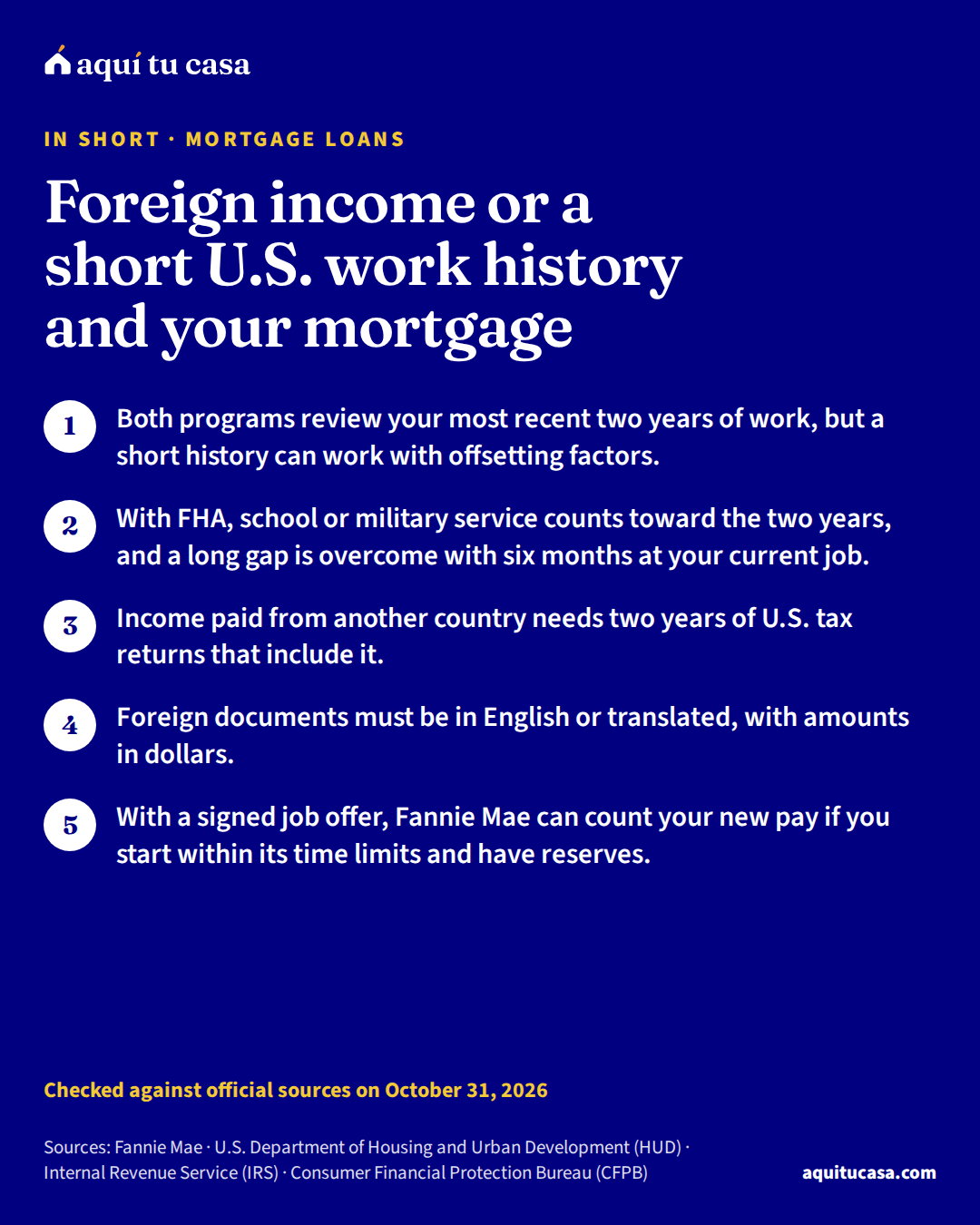
- Both programs review your most recent two years of work, but a short history can work with offsetting factors.
- With FHA, school or military service counts toward the two years, and a long gap is overcome with six months at your current job.
- Income paid from another country needs two years of U.S. tax returns that include it.
- Foreign documents must be in English or translated, with amounts in dollars.
Is this for you?
This guide is for you if…
- You work for a company or government in another country and are paid in another currency.
- You arrived recently, have less than two years of work in the United States and want to buy a home.
- You just finished school, changed jobs or had a gap in employment and worry about qualifying.
Get direct help first if…
- Your question is about your immigration status, not your job: read «Green card holders and mortgages» or «TPS, parole, work permits and mortgages».
- You are self-employed: read «Buying a home when self-employed».
If you arrived in the United States recently, work for a company in another country or just finished school, it can seem you will never qualify for a mortgage because you do not have “two years of work.” The rules have exceptions for several of those cases, but they ask for very specific papers. This guide explains how FHA and Fannie Mae look at your work history, what happens with gaps and job changes, and how income paid to you from another country is counted.15
The two years: what counts and what does not
With FHA. The lender verifies your most recent two years of employment and income and your current job. If you were not with the same employer for those two years, it uses your W-2 formsForm W-2Form W-2 (Wage and Tax Statement) is the document your employer must prepare for each employee. It shows the wages you were paid and the taxes withheld from your pay, such as income tax and Social Security and Medicare taxes. The employer files it with the government and sends you a copy, on paper or electronically, in January or February so you can file your tax return. If it does not arrive or has errors, you first ask your employer to fix it; if you still do not get it, the IRS can help you obtain it.See the full definition, written or electronic verifications of employmentverification of employment (VOE)Verification of employment (VOE) is when the lender confirms that you work where your mortgage application says and that you still do. It can use documents you provide, such as pay stubs and W-2 forms, or, with your authorization, check directly with your employer or with an employment verification company. On loans Fannie Mae buys, the lender does a final check (called a verbal VOE) as late in the process as possible, by phone, in writing or through such a company. If you are self-employed, it must confirm that your business exists and is still operating.See the full definition, or evidence that you were enrolled in school or the military during the most recent two full years.5 That helps a lot if you just graduated.
With Fannie Mae. The lender evaluates whether your history shows a reliable pattern of employment over the most recent two years. A shorter history can work if your profile has positive factors that offset it. And if you change jobs often but earn consistent and predictable income, you are considered to have reliable income.1
Several jobs at once. Fannie Mae recommends a two-year history for each, but can accept one held for less time, with a minimum of 12 months, if there are positive factors. If your history includes different employers, you cannot have a gap of more than one month in the last 12 months, unless the work is seasonal.1 The guide on seasonal, tip and cash income explains that case.
A short history: what each program looks at
Two verified years
FHA
- School or military service counts toward the two years
- After a gap of six months or more, six months at your current job
- More than three employer changes in 12 months need more proof
- Foreign income needs two years of receipt
A reliable pattern
Fannie Mae
- A shorter history can work with offsetting factors
- Changing jobs is fine if income is consistent
- With several employers, no gaps over one month in 12 months
- A signed job offer can count
Ask your lender which program it is using to evaluate you and which papers it needs.
Gaps and job changes
A long gap with FHA. If you were out of work six months or more, the lender can count your current income if it verifies two things: that you have been in your current line of work at least six months and that you had two years of work before the gap.5
Many changes with FHA. If you changed employers more than three times in the last 12 months, or changed lines of work, the lender must document more carefully that your income is stable. It may ask for proof of your training or education for the new position, or that your income or benefits have gone up. That does not apply to fields where working for several employers is normal, such as temp agencies or union trades.5
Gaps with Fannie Mae. A gap in the last 12 months can make your employment look unstable, so the lender carefully analyzes whether your current job is likely to continue.1 Bring a letter explaining the gap and proof of your current job.
Income paid to you from another country
FHA and Fannie Mae define foreign income in similar ways: income paid to you by a foreign corporation or government, in foreign currency.51 It can count toward qualifying, on these conditions:
- Two years of U.S. tax returns that include it. FHA asks for your complete tax returnstax returnA tax return is the yearly form you use to report your income to the IRS and figure the tax you owe, so you can pay what is due or get a refund. The federal return for individuals is Form 1040. In general you must file if your gross income is above the minimum the IRS sets for your filing status, or if you had a certain amount of net earnings from self-employment; even when you do not have to, filing can pay off. You need your SSN or ITIN, and those of everyone else on the return, plus documents such as your W-2s and 1099s.See the full definition for the most recent two years, with all schedules; Fannie Mae, your signed federal returns for the most recent two years with that income.51
- Two years of receipt and likely to continue. With FHA, you must have received it for the previous two years and it must be reasonably likely to continue.5
- In English and in dollars. Documents not in English need a complete and accurate translation, and amounts must be converted to dollars.51
- An average. With FHA, the lender averages that income over the previous two years.5
If you did not report it. Because both programs ask for U.S. tax returns showing that income, if it does not appear on your returns you likely cannot use it to qualify.51 A VITA site can help with your return, and the guide Filing taxes with an ITIN explains why it matters for buying.
Example with real numbers
A designer who works remotely for a company abroad
An example in words, not a real case, of how the application comes together.
- Her income
- Paid by a foreign company, in another currency
- Her taxes
- She included it on her U.S. returns for the last two years
- Her papers
- Pay records translated into English and converted to dollars
- The FHA calculation
- The lender averages the income over the two years
- What she gets
- To use that income to qualify, like any other documented pay
The rules come from FHA and Fannie Mae.51 See how much house you can afford with your income in dollars.
Run it with your numbersHow much house can I afford?
If you have a new job offer
Fannie Mae can count pay from a job you have not started yet, if you have an offer or contract that is signed and non-contingent and says who the employer is, the position, the type and rate of pay, and the start date. You cannot be employed by a relative or by someone with an interest in the sale.4
Under the option where the loan is delivered before your first paystubpay stubA pay stub is the statement that comes with your pay and shows how much you earned before deductions (gross pay), what was taken out and what you keep (net pay). Deductions include taxes, such as federal income tax, Social Security and Medicare, and sometimes health insurance or retirement savings. It also shows year-to-date totals. The federal wage law (FLSA) does not require employers to give you pay stubs, but it does require them to keep records of your hours and wages. For a mortgage, the lender may ask for your most recent one.See the full definition:4
- The purchase must be a one-unit home you will live in.
- You qualify only with your fixed base pay.
- Your start date must fall between 30 days before and 90 days after the note signing.
- Beyond normal reservesreservesReserves are the cash and other easy-to-cash assets you still have available after the mortgage closes. They are measured in months: how many full monthly house payments (principal, interest, taxes, insurance and association dues) you could cover with them. Under Fannie Mae's rules, they include money in checking or savings accounts, investments, the vested part of a retirement account and the cash value of a life insurance policy; personal loans and the money you use to close do not count. An eligible gift can also be used. How many months are required depends on the loan and the property.See the full definition, you need six months of house payments, or resources to cover your debts and the house payment until you start, plus one month.
How to prepare your application
1. Gather your two years of history
Before you look for a home
W-2s, paystubs, verifications or proof that you were in school.5
2. Check your tax returns
Before you apply
Foreign income must appear on your returns for the most recent two years.1
3. Translate and convert
Before you apply
Documents in English or fully translated, and amounts in dollars.5
4. Write a letter about gaps or changes
With your application
Explain why there was a gap or several job changes, and attach proof.5
5. If you have an offer, check the timing
Before you sign the purchase contract
The start date must fall near the note signing, with extra reserves.4
If this is you
You work remotely for a company in another country
It counts if it is on two years of U.S. returns, translated and in dollars.1
You just finished college
With FHA, proof that you were in school counts toward the two-year history.5
You stopped working for a while to care for your children
With FHA, six months at your current job and two years before the gap can be enough.5
You recently left the military
FHA accepts proof of military service to verify your two-year history.5
You hold several jobs at once
Fannie Mae can accept one with 12 months or more if there are positive factors.1
During the process: do not change jobs without telling the lender
Your history is not checked only once. With Fannie Mae, your most recent paystub can be no more than 30 days old when you apply, and it must show what you have earned so far that year.2 With FHA, the lender reverifies your employment within the 10 days before you sign the note.5
So if you plan to change jobs, tell your lender before you do. A change in the middle of the process can mean your application has to be reviewed again.
Questions for your lender:
- Which program will you use to evaluate me: FHA, Fannie Mae or another?
- Which papers do you need for my two years of history?
- If I am paid from another country, who does the translation and what exchange rate do you use for the dollars?
- If I had a gap, what letter or proof should I provide?
- When will you reverify my employment before closing?

Costly mistakes
Mistake: Not reporting on your U.S. taxes the income you are paid from another country.
Instead: To use it, FHA and Fannie Mae ask for two years of returns that show it.51
Mistake: Handing over pay records in another language and currency.
Instead: They must be translated into English with the amounts in dollars.5
Mistake: Believing a gap in employment rules you out for good.
Instead: With FHA, six months at your current job and two years before the gap can be enough.5
Mistake: Leaving gaps of more than a month between jobs if you hold several.
Instead: Fannie Mae does not accept gaps over one month in the last 12 months, except for seasonal work.1
Mistake: Counting on a new job without a signed, non-contingent offer.
Instead: Fannie Mae asks for the signed offer with the position, pay and start date.4
Free help and other options
A HUD-approved housing counselorHUD-approved housing counselorA HUD-approved housing counselor works at an agency HUD has approved to provide housing counseling: independent, expert advice customized to your situation about buying a home, renting, a missed mortgage payment, a foreclosure or credit problems. The agencies usually charge little or nothing; many serve in Spanish and offer the homebuyer education course several assistance programs require. They are not lenders or real estate agents and sell you nothing. Your county page lists the official agencies with phone numbers.See the full definition can review your history with you and which papers to gather, often for free or at low cost.7 The guide to HUD-approved housing counselors explains how to find one. For your taxes, the IRS VITA and TCE programs prepare basic returns for free for people who qualify.6 If your history does not yet meet FHA or Fannie Mae rules, the guide on non-QM loans explains other options and their costs. And use the document checklist to organize your papers.

What to do this week
- List your jobs for the last two years, with start and end dates.5
- Find your U.S. tax returns for the most recent two years.1
- If you are paid from another country, request pay records and prepare English translations.5
- If you had a gap, write a short letter explaining it.5
- Ask two lenders which program they would use to evaluate you.1
Your numbers
The minimum for this loan is 3.5%. More down lowers the monthly payment.
Adjust advanced details
First number: share of income for housing. Second: housing plus debts. Lender references, not fixed rules.
Let's do the math
Estimated top price
National figure$227,000
Limited by the housing payment: at that price it would be about $1,883 a month, 28% of your income.
- By the housing payment (28% of income)Limits you$227,000
- By your total debts (36% of income)$292,000
- By your cash (down payment + closing)$330,500
- Typical home in the United States
- $332,700
- Your cap is 68% of the typical home.
What changes if…?
- …you save $10,000 more$227,000
- …you cut $200 a month in debts$227,000
Your maximum price with four loans
Same income, debts and savings; only the down payment and the loan type change. ITIN uses an example down payment and rate.
| FHA 3.5% | Conventional 5% | Conventional 20% | ITIN 15% (example) | |
|---|---|---|---|---|
| Maximum price | $227,000 | $232,000 | $93,000 | $119,000 |
| Payment per month | $1,883 | $1,882 | $616 | $898 |
Educational estimate, not a pre-approval. Uses example insurance (0.5% of value per year) and example closing costs (3% of price); the tax is the place’s typical rate.
Ready to see the numbers? Find your county here
See how this applies in your county: its loan limits, prices and rents, from the official data.
Printable checklist
Frequently asked questions
Do I need two years at the same job?
Not necessarily the same one. FHA verifies your most recent two years of employment, and if you changed employers it uses your W-2s or verifications. Fannie Mae looks for a reliable pattern over two years, and someone who changes jobs but earns consistent income is considered to have reliable income.
I just finished school. Can I qualify?
With FHA, evidence that you were enrolled in school or the military during the most recent two full years can be used to verify your history.
I am paid from Mexico in pesos. Does that income count?
It can. FHA and Fannie Mae call income paid by a foreign corporation or government in another currency foreign income. You need two years of U.S. tax returns that include it, with English translations and amounts converted to dollars.
What if I did not report that income on my U.S. taxes?
To use it, FHA and Fannie Mae ask for your tax returns for the most recent two years showing that income. If it is not on your returns, you likely cannot use it to qualify. A VITA site can help you with your return.
I was out of work for almost a year. Does that disqualify me?
Not necessarily with FHA. If the gap was six months or more, the lender can count your current income if you have been at your current job at least six months and had two years of work before the gap.
I have a new job offer. Can I use it?
With Fannie Mae, yes, with conditions. The offer must be signed and non-contingent, and under one option your start date must fall between 30 days before and 90 days after the note signing, with extra reserves for the months without pay.
Am I treated differently because I am not a citizen?
Fannie Mae says non-citizen borrowers must meet the same employment and income verification requirements as citizens. Rules about immigration status are separate; see the guides for green card holders and for TPS, parole and work permits.
Sources
Every figure in this guide comes from one of these official sources. The number next to a sentence leads to the source behind it.
Each source on one line: who publishes it, its title, its address and the date we read it.
- 1. Fannie Mae · Selling Guide B3-3.2-02, Standards for Employment-Related Income · selling-guide.fanniemae.com · Accessed October 31, 2026
- 2. Fannie Mae · Selling Guide B3-3.2-01, Standards for Employment and Income Documentation · selling-guide.fanniemae.com · Accessed October 31, 2026
- 3. Fannie Mae · Selling Guide B3-3.1-01, General Income Information · selling-guide.fanniemae.com · Accessed October 31, 2026
- 4. Fannie Mae · Selling Guide B3-3.3-03, Employment Offers or Contracts · selling-guide.fanniemae.com · Accessed October 31, 2026
- 5. U.S. Department of Housing and Urban Development (HUD) · Handbook 4000.1, FHA Single Family Housing Policy Handbook · hud.gov · Accessed October 31, 2026
- 6. Internal Revenue Service (IRS) · Free tax return preparation for qualifying taxpayers · irs.gov · Accessed October 31, 2026
- 7. Consumer Financial Protection Bureau (CFPB) · Find a housing counselor · consumerfinance.gov · Accessed October 31, 2026
Keep reading
Related guides
If this guide helped, these follow the same path.

Mortgage loans 11 minute read
DACA and mortgages: what FHA, Fannie Mae and USDA say today
If you have DACA and want to buy a home: what FHA, Fannie Mae and USDA rules say today, what a lender may ask you and how to compare offers.
- Since case numbers assigned May 25, 2025, FHA only accepts citizens, permanent residents and citizens of Micronesia, the Marshall Islands and Palau: DACA was left out.
- Fannie Mae buys loans from lawful non-permanent residents on the same terms as citizens, but each lender decides which documents it accepts.
- USDA requires being a citizen, a national or a 'qualified alien' under 8 U.S.C. §1641; check the list before assuming anything.
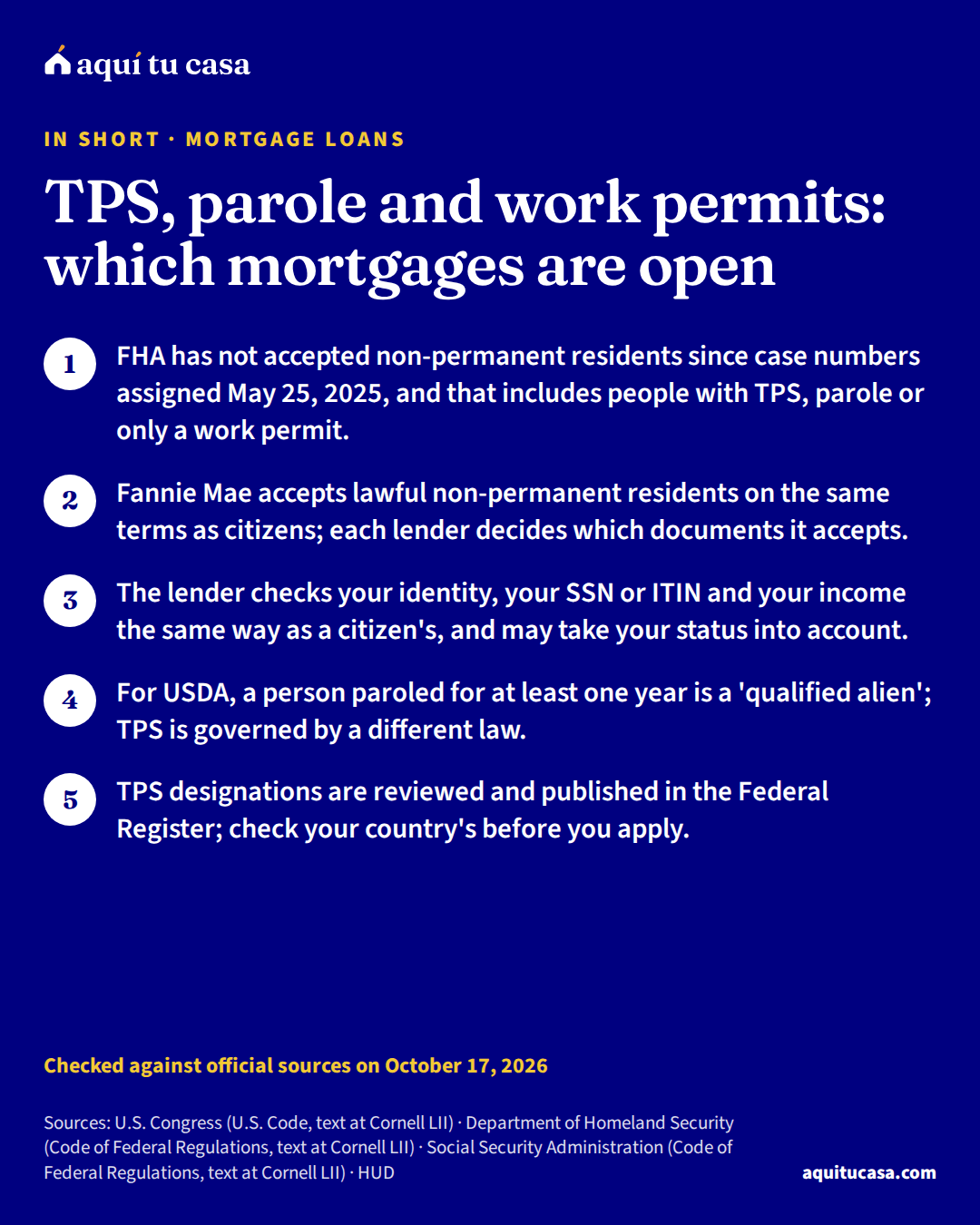
- Mortgage loans TPS, parole and work permits: which mortgages are open If you have TPS, parole or a work permit (EAD): what FHA, Fannie Mae and USDA say today, what documents a lender checks and how to compare offers. 10 minute read
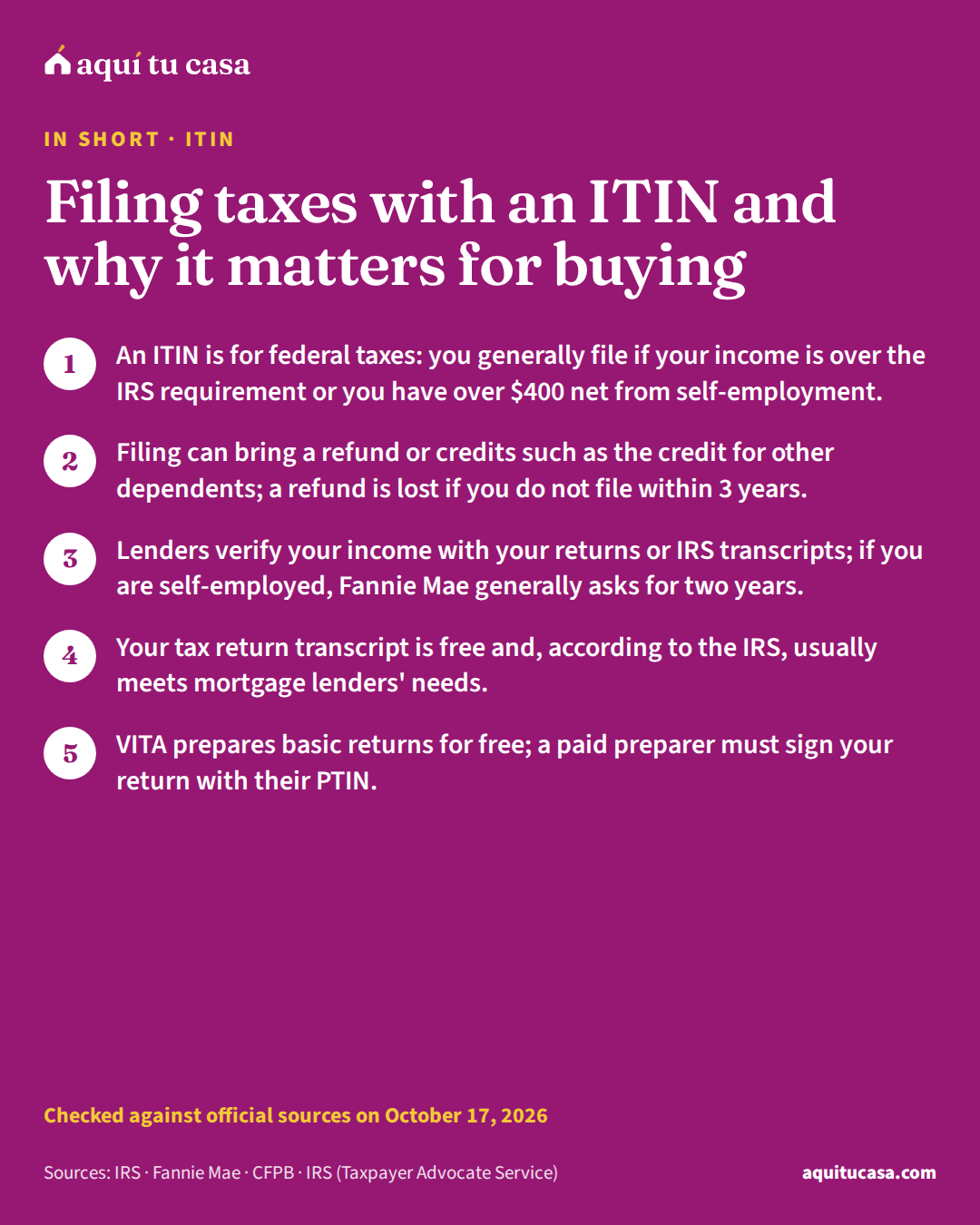
- ITIN Filing taxes with an ITIN and why it matters for buying Who has to file with an ITIN, what you gain by filing, how to get your IRS transcripts and why a lender will ask for your tax returns. 12 minute read
Tools for this topic
Was this guide useful?
Thank you. Your answer stays in your browser; nothing is sent.