Non-QM and bank statement loans: what they are
What a qualified mortgage (QM) is, what changes with a non-QM or bank statement loan, and what to check before you accept one.
Verified against official sources on October 17, 2026 12 official sources

Show contents
In short
What you need to know
Quick answer
A qualified mortgage (QM) is a loan that meets federal rules: no interest-only period, no growing balance, no balloon payment, a term of up to 30 years, limits on price and on points and fees, and your income and debts verified. A non-QM loan is one that does not meet those rules; some lenders, for example, offer to qualify you with bank statements. These loans are allowed, but the lender still has to determine that you can repay, and the CFPB notes that outside QMs there is no cap on points and fees. Compare each offer using its Loan Estimate.
What matters most
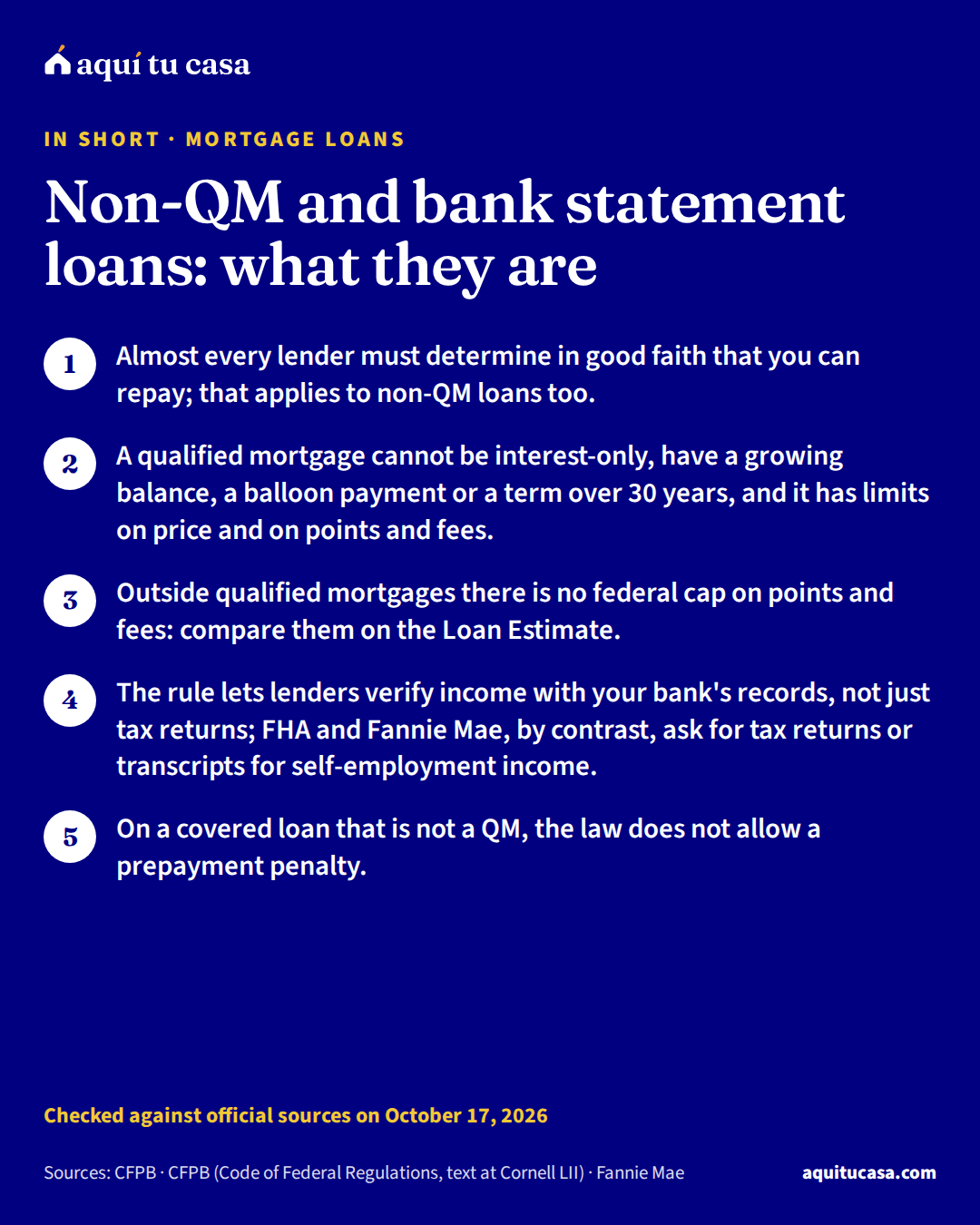
- Almost every lender must determine in good faith that you can repay; that applies to non-QM loans too.
- A qualified mortgage cannot be interest-only, have a growing balance, a balloon payment or a term over 30 years, and it has limits on price and on points and fees.
- Outside qualified mortgages there is no federal cap on points and fees: compare them on the Loan Estimate.
- The rule lets lenders verify income with your bank's records, not just tax returns; FHA and Fannie Mae, by contrast, ask for tax returns or transcripts for self-employment income.
Is this for you?
This guide is for you if…
- You are self-employed and a lender offered to qualify you with your bank statements instead of your tax returns.
- You were told your loan is "non-QM" and want to know what that means and what protections you have.
- You want to compare a non-QM offer with an FHA, VA, USDA or conventional loan.
Get direct help first if…
- You want to know how self-employment income counts on an FHA or conventional loan: the guide to buying a home when self-employed covers it.
- You are buying a property to rent out or for a business: the ability-to-repay rule in this guide is for consumer credit secured by a dwelling.
- You are looking at a home equity line of credit (HELOC) or a reverse mortgage: those follow other rules.
If you are self-employed, earn irregularly or do not have tax returns that show everything you make, you may be offered a “non-QM” or “bank statement” loan. This guide explains what a qualified mortgage (QM) is, what changes when a loan is not one, how qualifying with bank statements works and what to check before you accept an offer.
The ability-to-repay rule applies to almost everyone
Before getting into QM and non-QM, there is one rule that covers almost every loan for your home: the ability-to-repay rule. According to the CFPB, it prohibits most lenders from giving you a mortgage unless they have made a reasonable and good faith determination that you can pay it back. To do that, they must find out, consider and document your income, assets, employment, credit history and monthly expenses. They also cannot rely only on a low introductory rate: if the rate goes up later, they have to consider whether you can pay the higher rate.1
Regulation Z lists what the lender must consider: your income or assets (not counting the home’s value), your employment if it relies on it, the monthly payment on the loan and on any simultaneous loan, mortgage-related obligations, your current debts, alimony and child support, your debt-to-income ratiodebt-to-income ratio (DTI)Your debt-to-income ratio (DTI) is all your monthly debt payments divided by your gross monthly income, that is, income before taxes. If you pay a certain amount each month across a car, cards, student loans and the mortgage you are asking for, and you earn three times that, your DTI is one third. Lenders use it to measure whether you can manage the payment; each loan type and lender sets its own limit, and assistance programs usually publish theirs. Paying down debt before applying improves your DTI.See the full definition or residual income, and your credit history.2
The rule applies to any consumer credit secured by a dwelling, with few exceptions, such as a home equity line of credit (HELOC). The repayment-ability requirements also do not apply to a reverse mortgage or to a bridge loan of 12 months or less.2
What a qualified mortgage (QM) is
According to the CFPB, a qualified mortgagequalified mortgage (QM)A qualified mortgage (QM) is, according to the CFPB, a loan with less risky features and protections that make it more likely you can afford it. Under the ability-to-repay rule, the lender must make a good-faith effort to determine whether you can repay; if the loan is a QM, the lender is presumed to have followed that rule. In general, a QM cannot have an interest-only period, negative amortization or, with some exceptions, a balloon payment; it cannot exceed the rule's maximum term; it has limits on upfront points and fees; and the lender must verify your income and debts. FHA, VA and USDA loans are qualified loans.See the full definition (QM) is a loan with less risky features and protections that make it more likely you can afford it. If your loan is a QM, it is assumed that the lender followed the ability-to-repay rule.3
All government-backed loans (FHA, USDA and VA) are qualified mortgages. All others, including conventional loans backed by Fannie Mae and Freddie Mac and jumbo loans, must meet special requirements to qualify.3 In general, a qualified mortgage:
- Has no interest-onlyinterest-only mortgageAn interest-only mortgage has scheduled payments that, for a set period, cover only the interest. During that period what you owe does not go down with each payment. According to the CFPB, when the period ends you may pay off the balance all at once, refinance if that is available, or start paying principal with higher monthly payments. The CFPB warns not to assume you will be able to sell or refinance, because the home's value or your finances could change. A Qualified Mortgage (QM) cannot have an interest-only period, and the Loan Estimate labels the feature "Interest Only."See the full definition period, where you pay interest without paying down principalprincipalThe principal is the amount of money you borrowed and have to pay back, not counting the interest. In Spanish it is also called "capital". When you start, the principal is the loan amount; with every payment a part goes toward reducing it, and what remains is called the balance. Interest is computed on that balance, so the less principal you owe, the less interest you pay. On your monthly payment you will see P&I: principal and interest, the part of the payment that goes to the loan, separate from taxes and insurance.See the full definition.
- Has no negative amortization, meaning a balance that grows even though you pay.
- Has no balloon paymentballoon paymentA balloon payment is a large, one-time payment at the end of the loan term, higher than the payments before it and sometimes much higher. On the Loan Estimate, "Balloon Payment" means any payment that is more than two times a regular payment. Loans with a balloon payment usually have shorter terms and lower monthly payments that do not pay off the whole debt. If you cannot make the final payment, you may have to refinance or sell the home, or face foreclosure. With limited exceptions, a Qualified Mortgage (QM) cannot have a balloon payment.See the full definition at the end, except for certain loans from small lenders.
- Lasts no more than 30 years.
- Has limits on the APRannual percentage rate (APR)The annual percentage rate (APR) is a broader measure of the cost of borrowing money than the interest rate. Besides the interest, it includes certain loan charges, such as discount points and some lender fees, spread over the life of the loan and expressed as a yearly percentage. That is why the APR is almost always a little higher than the interest rate. It is useful for comparing offers: if two loans have the same interest rate but a different APR, the one with the higher APR charges more in fees.See the full definition and on upfront points and fees.
- Requires the lender to verify your income or assets and debts and to consider your debt-to-income ratio or residual income.3
Regulation Z sets the numbers. On a general QM, the APR may not exceed the average prime offer rate for a comparable loan (APOR) by 2.25 or more percentage points on a first-lien loan at or above a set amount, with higher margins for smaller loans. And points and fees may not exceed 3% of the loan when the amount is $100,000 or more; those amounts are adjusted every year for inflation.2
What a non-QM loan is
A non-QM loannon-QM loanA non-QM loan is a mortgage that does not meet the requirements of a Qualified Mortgage (QM). According to the CFPB, a Qualified Mortgage cannot have risky features such as an interest-only period, a balance that grows (negative amortization), balloon payments or a term longer than 30 years, and it has limits on upfront points and fees. Lenders are not required to make only Qualified Mortgages, but most lenders must still make a good-faith determination that you can repay the loan (the ability-to-repay rule). Federal banking regulators have said a bank may make both QM and non-QM loans.See the full definition is simply a mortgage that does not meet the requirements of a qualified mortgage. It is allowed. The CFPB says the mortgage rules only stop a lender from making a loan when the borrower cannot repay, and that lenders are not required to make qualified mortgages.4
What changes, according to official sources:
- No federal cap on points and fees. Only qualified mortgages have one; outside them, a lender can charge more if it chooses.4
- No assumption that the lender followed the rule. That assumption is for QMs.3 On a non-QM, the lender still has to determine in good faith that you can repay.2
- The QM rules do not apply. A loan that is interest-only, has a balloon payment or a term over 30 years cannot be a general QM,2 so read the terms of a non-QM carefully.6
- No prepayment penalty, if it is a loan covered by the rule: the law only allows one on a QM with an APR that cannot go up and that is not higher-priced, and even then with limits on time and amount.2
Qualified mortgage and non-QM loan, side by side
FHA, VA, USDA and those that meet the requirements
Qualified mortgage (QM)
Neither is "good" or "bad" because of its label: what matters are the terms, and those are on your Loan Estimate.6

Bank statement loans: qualifying with bank statements
A “bank statement” loan is one where the lender calculates your income from your bank statementsbank statementA bank statement is the summary your bank or credit union gives you of the activity in your account over a period: deposits, withdrawals, payments and the ending balance. Most send one every month, on paper or online; the law only requires a monthly statement when there was at least one electronic transfer that month, and otherwise it may come quarterly. When you apply for a mortgage, the lender can use your statements to verify you have money for the down payment, closing and reserves. Under Fannie Mae's rules, they must show the bank's name, your name, part of the account number, the period, all transactions and the ending balance.See the full definition instead of your tax returns. The federal rule allows it: Regulation Z says the lender must verify your income with reasonably reliable third-party records, and the examples include financial institution records, along with IRS tax transcriptsIRS tax transcriptAn IRS tax transcript is a free official summary of the information on your tax returns and tax account. It is not a photocopy of your return. There are several types: the tax return transcript shows most line items from your Form 1040 as filed and usually meets the needs of mortgage lenders; the tax account transcript shows changes made after you filed; the wage and income transcript shows what your W-2s and 1099s reported. You can get one through your IRS online account, by mail, by phone or with Form 4506-T.See the full definition and the returns you filed.2
Why do these loans exist? Because the most widely used rules for self-employment income rely on taxes. Fannie Mae, for example, verifies the income of someone self-employedself-employedFor the IRS, you are self-employed if you run a business as a sole proprietor or work as an independent contractor, if you are a member of a partnership that runs a business, or if you are otherwise in business for yourself, including part-time or as a gig worker. Because no employer withholds taxes for you, you generally pay estimated taxes every quarter and file a yearly return. Besides income tax, you pay self-employment tax, which covers Social Security and Medicare. Your profit or loss is figured by subtracting your business expenses from your business income, usually on Schedule C.See the full definition with signed federal tax returns for the past two years, with all schedules, or with IRS transcripts.9 If your returns show little income, that path may not be enough. The guide to buying a home when self-employed explains how your taxes count on FHA and conventional loans.
If you are offered a bank statement loan, ask whether it is a qualified mortgage and compare its points and fees: outside QMs there is no cap.4 The CFPB notes that if you are self-employed or your income is not from wages you may need more documents, and that requirements vary from lender to lender.10
The CFPB does not use the word “non-QM” on its conventional loans page, but it describes a similar group: “non-conforming” loans that do not fall into another category. Some are intended for borrowers with poor credit, tend to have high rates and may contain risky features, such as minimal documentation of your income, paying only the interest or letting the balance grow. Others are niche programs for people with unusual circumstances, such as self-employed borrowers. Its advice: consult multiple lenders, ask whether you could qualify for a conforming or FHA loan instead, and do not decide before you have your official Loan Estimates.11
Can you afford it? The example of a typical home
The rule requires the lender to consider your debt-to-income ratio or residual income.2 Here is how it looks with typical US numbers.
Example with real numbers
How much of income goes to the home
With the typical US household income and the payment on a typical home with an FHA loan and the minimum down payment, at the average rate of 7.18% as of November 5, 2026.
- Typical US household monthly income
- $6,728
- Monthly payment on a typical home with FHA (with taxes and insurance)
- $2,759
- Share of income that goes to housing
- 41%
This is an example with national numbers. The lender also adds your other debts to calculate your debt-to-income ratio.2 Try your own numbers.
Run it with your numbersHow much house can I afford?
The debt-to-income ratio guide explains how it is calculated and how to lower it, and the how much house can I afford tool runs the numbers with your income.
Before you accept a non-QM offer
How to review an offer, step by step
1. Get the Loan Estimate
Within 3 business days of applying
Every lender uses the same form, so you can compare.7
2. Check the "Loan Terms" table
Page 1
It says whether there is a prepayment penalty or a balloon payment and whether the amount, rate or payment can go up.6
3. Ask whether it is a qualified mortgage
Before you decide
Outside QMs there is no federal cap on points and fees.4
4. Compare with an FHA, VA, USDA or conventional loan
Before you decide
All government-backed loans are QMs; get their Loan Estimate too.3
Try it with your numbersCompare loans5. Get at least three offers in writing
Before you decide
That is the CFPB's recommendation for comparing.8
A Loan EstimateLoan EstimateThe Loan Estimate is a three-page form you receive from the lender within days of applying for a mortgage. In the same format at every bank, it sums up the terms of the loan being offered: amount, interest rate, whether the payment can change, the estimated monthly payment with taxes and insurance, the itemized closing costs and how much cash you need at closing. Because every lender uses the same form, it lets you compare offers side by side. It commits you to nothing: requesting one is not accepting the loan.See the full definition tells you a lot about a non-QM loan. Its “Loan Terms” table says whether there is a prepayment penalty, whether there is a balloon payment, meaning a payment more than twice a regular payment, and whether the amount, the rate or the payment can increase after closing.6 The closing costs guide shows where to find points and fees, and the guide on how to choose a mortgage lender helps you compare.

Lenders that do not follow the rule
Some lenders may not have to follow the ability-to-repay rule. The CFPB lists Community Development Financial Institutions (CDFIsCommunity Development Financial Institution (CDFI)A CDFI (Community Development Financial Institution) is an organization whose primary mission is community development. It provides loans, investments and other financial services in low-income communities and to people who lack access to financing. It can be a community development bank or credit union, or a loan fund that is not a bank. The law requires that it not be a government agency, that it be accountable to the community it serves and that it offer services such as financial and credit counseling along with its loans. The Treasury Department's CDFI Fund certifies them.See the full definition) certified by the Treasury Department, certain housing organizations and down payment assistance providers that receive HUD funding, nonprofits that lend fewer than 200 times a year and only to low- or moderate-income borrowers, and state housing finance agenciesstate housing finance agency (HFA)A state housing finance agency (HFA) is a public body created by an act of a state legislature, or by a local government, with the power to finance housing. In that federal definition, "state" includes Puerto Rico and the District of Columbia. Its mission is to increase affordable housing for renters and homebuyers with low to moderate incomes, especially first-time homebuyers. HFAs usually do not lend directly: they work with participating lenders that offer their loans and down payment assistance. Programs vary by state.See the full definition (HFAs).5 The nonprofits in that group must follow their own written procedures to determine that you can repay.5
If you are buying with an ITIN, the ITIN mortgage guide explains who lends and how, and the mortgage loan types guide compares FHA, VA, USDA and conventional loans.
If this is you
You are self-employed
Fannie Mae verifies your income with two years of tax returns or IRS transcripts.9 If you are offered a bank statement loan, ask whether it is a QM.4
You are paid in cash
The rule accepts financial institution records and receipts from check cashing and money transfer services as proof.2 Depositing your income creates that record.
You are buying with an ITIN
If a lender says it is exempt from the ability-to-repay rule, that may be true: the CFPB lists CDFIs, for example.5 The ITIN mortgage guide explains your options.

Costly mistakes
Mistake: Accepting a bank statement loan without asking whether it is a qualified mortgage.
Instead: Ask in writing: outside QMs there is no federal cap on points and fees.4
Mistake: Looking only at the monthly payment.
Instead: Check in the "Loan Terms" table whether the amount, rate or payment can go up and whether there is a balloon payment.6
Mistake: Thinking a non-QM lender does not have to check whether you can repay.
Instead: Most lenders must determine it in good faith, on non-QM loans too.2
Mistake: Comparing just one offer.
Instead: Get at least three in writing, including one for FHA, VA, USDA or conventional.83
Mistake: Not bringing complete bank statements.
Instead: Bring every page: requirements vary from lender to lender.10
What to do this week
- Gather your complete bank statements and, if you have them, your last two years of tax returns or IRS transcripts.92
- Get the Loan Estimate for the non-QM offer and for at least one other option, such as FHA or conventional.78
- Ask in writing whether each offer is a qualified mortgage.4
- Check the “Loan Terms” table on each one: penalty, balloon payment and payments that can go up.6
- Try your numbers in the compare loans tool.7
- If you want a second opinion, a HUD-approved housing counselorHUD-approved housing counselorA HUD-approved housing counselor works at an agency HUD has approved to provide housing counseling: independent, expert advice customized to your situation about buying a home, renting, a missed mortgage payment, a foreclosure or credit problems. The agencies usually charge little or nothing; many serve in Spanish and offer the homebuyer education course several assistance programs require. They are not lenders or real estate agents and sell you nothing. Your county page lists the official agencies with phone numbers.See the full definition gives independent advice, often for free or at low cost.12
Your numbers
We start with the typical home value in the United States. Enter the price you are looking at.
Adjust advanced details
FHA
Estimated monthly payment
$2,759
Principal and interest, tax, homeowners insurance and mortgage insurance.
- Down payment
- $11,645 (3.5%)
- Mortgage insurance
- $147 a monthFHA annual premium · whole term
- Upfront premium or fee
- $5,618FHA upfront mortgage insurance · added to the loan
- Paid in 5 years
- $141,609
- Balance after 5 years
- $308,088
- County limit
- Find your county to see the limit
Rules and notes
- Minimum down payment of 3.5% with a score of 580 or more; between 500 and 580 at least 10% is required.In effect since September 14, 2016 · Source ↗
- Mortgage insurance: 1.75% upfront plus an annual premium; with less than 10% down it lasts the whole term.In effect since March 20, 2023 · Source ↗
- Only citizens, lawful permanent residents and citizens of the Freely Associated States; non-permanent residents are no longer eligible.In effect since May 25, 2025 · Source ↗
Conventional, 3% down
Estimated monthly payment
$2,747
Principal and interest, tax, homeowners insurance and mortgage insurance.
- Down payment
- $9,981 (3%)
- Mortgage insurance
- $161 a monthPMI (example) · ends around year 13
- Upfront premium or fee
- None
- Paid in 5 years
- $140,854
- Balance after 5 years
- $304,358
- County limit
- Find your county to see the limit
Rules and notes
- Fannie Mae requires a minimum score of 620 on manually underwritten fixed-rate loans; its automated system (DU) sets no fixed minimum.In effect since April 22, 2026 · Source ↗
- Private mortgage insurance (PMI) with less than 20% down; it cancels on its own at 78% of the original value.In effect since January 1, 2024 · Source ↗
- Fannie Mae buys loans to lawful permanent and non-permanent residents on the same terms as citizens; the lender verifies the status.In effect since July 28, 2015 · Source ↗
Conventional, 5% down
Estimated monthly payment
$2,698
Principal and interest, tax, homeowners insurance and mortgage insurance.
- Down payment
- $16,635 (5%)
- Mortgage insurance
- $158 a monthPMI (example) · ends around year 12
- Upfront premium or fee
- None
- Paid in 5 years
- $137,950
- Balance after 5 years
- $298,082
- County limit
- Find your county to see the limit
Rules and notes
- Fannie Mae requires a minimum score of 620 on manually underwritten fixed-rate loans; its automated system (DU) sets no fixed minimum.In effect since April 22, 2026 · Source ↗
- Private mortgage insurance (PMI) with less than 20% down; it cancels on its own at 78% of the original value.In effect since January 1, 2024 · Source ↗
- Fannie Mae buys loans to lawful permanent and non-permanent residents on the same terms as citizens; the lender verifies the status.In effect since July 28, 2015 · Source ↗
Conventional, 20% down
Lowest paymentEstimated monthly payment
$2,202
Principal and interest, tax, homeowners insurance and mortgage insurance.
- Down payment
- $66,540 (20%)
- Mortgage insurance
- None
- Upfront premium or fee
- None
- Paid in 5 years
- $108,184
- Balance after 5 years
- $251,017
- County limit
- Find your county to see the limit
Rules and notes
- Fannie Mae requires a minimum score of 620 on manually underwritten fixed-rate loans; its automated system (DU) sets no fixed minimum.In effect since April 22, 2026 · Source ↗
- Private mortgage insurance (PMI) with less than 20% down; it cancels on its own at 78% of the original value.In effect since January 1, 2024 · Source ↗
- Fannie Mae buys loans to lawful permanent and non-permanent residents on the same terms as citizens; the lender verifies the status.In effect since July 28, 2015 · Source ↗
VA
Estimated monthly payment
$2,702
Principal and interest, tax, homeowners insurance and mortgage insurance.
- Down payment
- $0 (0%)
- Mortgage insurance
- None
- Upfront premium or fee
- $7,153VA funding fee · added to the loan
- Paid in 5 years
- $138,137
- Balance after 5 years
- $320,517
- County limit
- Find your county to see the limit
Rules and notes
- Military service requirements by period of service; you must meet VA's and your lender's credit standards.In effect since September 22, 2026 · Source ↗
- No down payment as long as the price is not above the appraisal; funding fee of 2.15% on first use with no down payment (exempt: zero). No monthly mortgage insurance.In effect since April 7, 2023 · Source ↗
- Up to the conforming limit with no down payment in most areas; more with a down payment.In effect since January 7, 2026 · Source ↗
USDA
Estimated monthly payment
$2,773
Principal and interest, tax, homeowners insurance and mortgage insurance.
- Down payment
- $0 (0%)
- Mortgage insurance
- $97 a monthUSDA annual fee · whole term
- Upfront premium or fee
- $3,327USDA upfront fee · added to the loan
- Paid in 5 years
- $142,404
- Balance after 5 years
- $316,909
- County limit
- No county limit
Rules and notes
- Home in an eligible rural area and income within the area limit; finances the full price for those who qualify.In effect since December 9, 2013 · Source ↗
- Upfront fee of 1% and annual fee of 0.35% of the balance.In effect since October 1, 2026 · Source ↗
- Each lender sets the score.
- Applicants must show they are U.S. citizens, U.S. non-citizen nationals or qualified aliens, as the federal rule defines them.In effect since November 29, 2022 · Source ↗
ITIN loan (example)
ExampleEstimated monthly payment
$2,315
Principal and interest, tax, homeowners insurance and mortgage insurance.
- Down payment
- $49,905 (15%)
- Mortgage insurance
- None
- Upfront premium or fee
- None
- Paid in 5 years
- $114,945
- Balance after 5 years
- $266,705
- County limit
- No county limit
Rules and notes
- Not a federal program: each lender sets the down payment, rate and documents. The 15% is only an example; rates are usually higher.
- They usually ask for ITIN tax returns for the last two years and more reserves; compare several lenders.
An educational estimate, not a loan offer. The same rate for every program (the real one differs); homeowners insurance is an example (0.5% of the value a year) and so is PMI (0.6% a year). The rules quoted are dated; check with your lender.
Ready to see the numbers? Find your county here
See how this applies in your county: its loan limits, prices and rents, from the official data.
Printable checklist
Frequently asked questions
What is a qualified mortgage (QM)?
It is a loan that meets federal requirements that make it less risky: no interest-only period, no growing balance, no balloon payment (with exceptions for small lenders), a term of up to 30 years, limits on the APR and on points and fees, and your income and debts verified. If your loan is a QM, it is assumed that the lender followed the ability-to-repay rule.
What is a non-QM loan?
It is a mortgage that does not meet the requirements of a qualified mortgage. It is allowed: the CFPB says lenders are not required to make only qualified mortgages. But most lenders still have to determine in good faith that you can repay the loan.
What is a bank statement loan?
It is a loan where the lender calculates your income from your bank statements instead of your tax returns. Regulation Z allows verifying income with financial institution records. Fannie Mae's rules for self-employment income, by contrast, are based on your signed tax returns or IRS transcripts. Always ask whether the offer is a qualified mortgage.
Are FHA, VA and USDA loans QMs?
Yes. According to the CFPB, all government-backed loans (FHA, USDA and VA) are qualified mortgages. Conventional and jumbo loans must meet special requirements to be QMs.
Can I be charged a penalty for paying the loan off early?
On a loan covered by the rule, only if it is a qualified mortgage with an APR that cannot go up, it is not higher-priced, and the law otherwise allows it. Even then, the penalty cannot apply after three years or exceed 2% of the balance prepaid in the first two years or 1% in the third. Check the "Prepayment Penalty" line on your Loan Estimate.
How much can I be charged in points and fees?
On a qualified mortgage of $100,000 or more (an amount adjusted for inflation), points and fees cannot exceed 3% of the loan. Outside qualified mortgages there is no such cap: the CFPB says lenders can charge more if they choose. Compare section A of each Loan Estimate.
Are there lenders that do not have to follow the ability-to-repay rule?
Yes, a few. The CFPB lists Community Development Financial Institutions (CDFIs), state housing finance agencies, certain down payment assistance providers and nonprofits that lend rarely and only to low- or moderate-income borrowers, which must follow their own written procedures.
How do I compare a non-QM offer with an FHA or conventional loan?
Get a Loan Estimate for each one: every lender uses the same form and must give it to you within three business days of your application. Compare the rate, the APR, the points and fees, and the "Loan Terms" table, which says whether there is a prepayment penalty, a balloon payment or payments that can go up. The CFPB recommends getting at least three offers in writing.
Sources
Every figure in this guide comes from one of these official sources. The number next to a sentence leads to the source behind it.
Each source on one line: who publishes it, its title, its address and the date we read it.
- 1. CFPB · What is the ability-to-repay rule? Why is it important to me? · consumerfinance.gov · Accessed October 17, 2026
- 2. CFPB (Code of Federal Regulations, text at Cornell LII) · Regulation Z, 12 CFR §1026.43, Minimum standards for transactions secured by a dwelling · law.cornell.edu · Accessed October 17, 2026
- 3. CFPB · What is a Qualified Mortgage? · consumerfinance.gov · Accessed October 17, 2026
- 4. CFPB · My lender says it can't lend to me because of a limit on points and fees on loans. Is this true? · consumerfinance.gov · Accessed October 17, 2026
- 5. CFPB · My mortgage lender told me it was exempt from the ability-to-repay mortgage rule. Is this true? · consumerfinance.gov · Accessed October 17, 2026
- 6. CFPB (Code of Federal Regulations, text at Cornell LII) · Regulation Z, 12 CFR §1026.37, Content of disclosures for certain mortgage transactions (Loan Estimate) · law.cornell.edu · Accessed October 17, 2026
- 7. CFPB · What is a Loan Estimate? · consumerfinance.gov · Accessed October 17, 2026
- 8. CFPB · Your home loan toolkit: A step-by-step guide · files.consumerfinance.gov · Accessed October 17, 2026
See the other 4 sources
- 9. Fannie Mae · Fannie Mae Selling Guide B3-3.5-01, Underwriting Factors and Documentation for a Self-Employed Borrower · selling-guide.fanniemae.com · Accessed October 17, 2026
- 10. CFPB · Create a loan application packet · consumerfinance.gov · Accessed October 17, 2026
- 11. CFPB · Conventional loans · consumerfinance.gov · Accessed October 17, 2026
- 12. CFPB · Find a Housing Counselor · consumerfinance.gov · Accessed October 17, 2026
Keep reading
Related guides
If this guide helped, these follow the same path.

Buying a home 13 minute read
Buying a home when you're self-employed: what lenders ask
How lenders check your income if you are self-employed or paid on a 1099: tax returns, Schedule C, IRS transcripts, profit and loss and bank statements.
- Lenders treat you as self-employed if you own 25% or more of a business; the IRS also includes independent contractors and gig workers.
- Expect to be asked for two years of signed tax returns with every schedule, or IRS transcripts, and to sign Form 4506-C.
- The income that counts comes from the net profit on your returns, with some adjustments; FHA uses the lesser of the two-year and the one-year average.
- Mortgage loans Mortgage loan types: FHA, conventional, VA and USDA What each mortgage type asks for, what its insurance costs, fixed or adjustable rate, points and APR. A neutral comparison with official sources. 14 minute read
- Mortgage loans Jumbo loans and FHA and conforming loan limits What conforming and FHA loan limits are, how they are set county by county, what a jumbo loan is and how to find the limit where you live. 9 minute read
- Buying a home Debt-to-income ratio (DTI): what it is and how to lower it What the debt-to-income ratio (DTI) is, how to calculate it, which payments count, the caps FHA, Fannie Mae, VA and USDA publish and how to lower it. 14 minute read
Tools for this topic
Was this guide useful?
Thank you. Your answer stays in your browser; nothing is sent.