Jumbo loans and FHA and conforming loan limits
What conforming and FHA loan limits are, how they are set county by county, what a jumbo loan is and how to find the limit where you live.
Verified against official sources on October 17, 2026 10 official sources

Show contents
In short
What you need to know
Quick answer
A loan limit is the largest amount a loan can be and still follow a program's rules. Fannie Mae and Freddie Mac can only buy loans up to the conforming limit, which is $832,750 in most counties for a one-unit home and higher in expensive areas; a loan above it is called a jumbo. FHA loans have their own limit by county, ranging from $541,287 to $1,299,500. Both change every year: look up your county's limits on our data pages.
What matters most
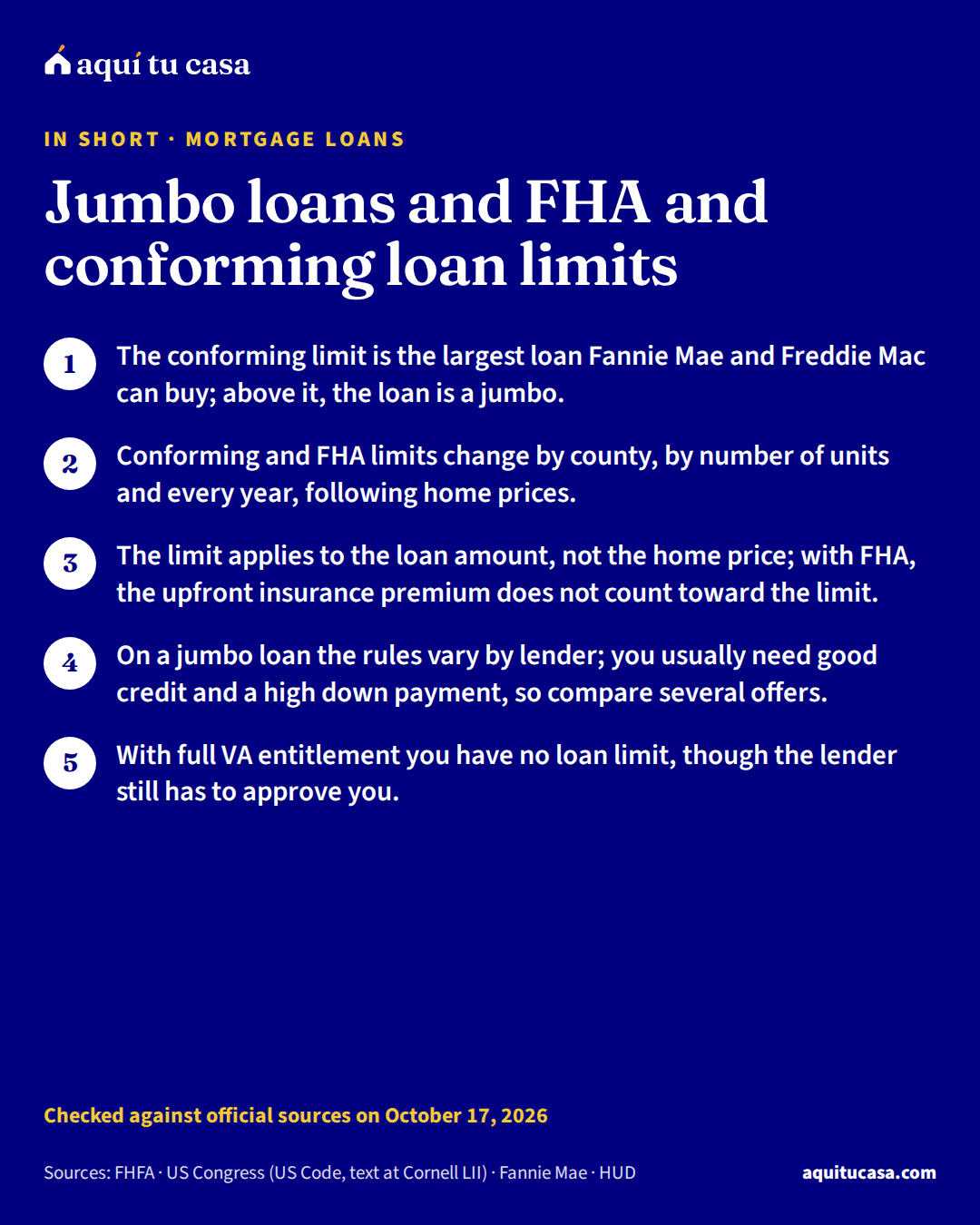
- The conforming limit is the largest loan Fannie Mae and Freddie Mac can buy; above it, the loan is a jumbo.
- Conforming and FHA limits change by county, by number of units and every year, following home prices.
- The limit applies to the loan amount, not the home price; with FHA, the upfront insurance premium does not count toward the limit.
- On a jumbo loan the rules vary by lender; you usually need good credit and a high down payment, so compare several offers.
Is this for you?
This guide is for you if…
- You are buying in an expensive area and want to know whether your loan fits under your county's FHA limit or conforming limit.
- You were told your loan would be a "jumbo" and want to know what that means.
- You are comparing an FHA loan with a conventional one and want to understand why the maximum changes from county to county.
Get direct help first if…
- You do not yet know which kind of loan fits you: start with the mortgage loan types guide.
- You want to know how much you need for a down payment: the down payment guide covers it.
- You are being offered a loan that does not meet the qualified mortgage rules: the non-QM loans guide explains it.
If you are buying in an expensive area, or the home has several units, the size of your loan can decide which kind of loan you get. This guide explains what conforming and FHA loan limits are, how they are set county by county, what a jumbo loan is and how to find your area’s limit on our data pages.
What a loan limit is
A loan limit is the largest amount a loan can be and still follow a program’s rules. Two of them matter most when you buy:
- The conforming limit. According to FHFA, Fannie Mae and Freddie Mac are restricted by law from buying mortgages with an origination balance above a certain amount, called the conforming loan limitconforming loan limitThe conforming loan limit is the maximum mortgage amount Fannie Mae and Freddie Mac may buy from lenders. Those two companies back most conventional loans, so a loan within the limit ("conforming") usually gets better terms than a larger one ("jumbo"). The Federal Housing Finance Agency (FHFA) sets it every year using the formula in the HERA law, and high-cost areas have a higher limit. Each county's FHA loan limit is computed from this number.See the full definition. Loans above that limit are called jumbo loansjumbo loanA jumbo loan is a mortgage whose amount is above the conforming loan limit. That limit is the most that Fannie Mae and Freddie Mac (the two companies that buy mortgages from lenders) are allowed by law to purchase. It is set every year with their regulator, the Federal Housing Finance Agency (FHFA), and it is higher in high-cost counties. A loan may go over the limit, but then it is called a jumbo loan. The CFPB notes that a jumbo loan may cost more to get than a conforming loan, and it must meet special requirements to count as a Qualified Mortgage (QM).See the full definition.1
- The FHA limit. An FHA loanFHA loanAn FHA loan is a mortgage made by a private lender and insured by the Federal Housing Administration (FHA), an agency of the U.S. government. That insurance protects the lender if you stop paying, which is why the lender can accept a lower down payment and a less-than-perfect credit history than on a conventional loan. Federal law sets the minimum cash investment at 3.5% of the property's value and caps the loan amount at the FHA limit, which changes by county. In exchange for the insurance you pay a mortgage insurance premium.See the full definition cannot exceed the FHA limitFHA loan limitThe FHA loan limit is the maximum mortgage amount the Federal Housing Administration can insure in a county or metropolitan area. The law computes it from the area's median home price: in general it is 115% of that price, but never less than a national floor (65% of the conforming loan limit) nor more than a national ceiling (150% of that limit). That is why expensive counties have higher limits. There is a separate limit for one-, two-, three- and four-unit homes. HUD publishes the limits every year and we show them for every county.See the full definition for its area. According to HUD Handbook 4000.1, under most programs the maximum loan is the lesser of the area’s limit or a percentage of the home’s value.5
Both are set by county. The CFPB puts it plainly: FHA loans have a maximum loan amount that varies by county,6 and conforming loans have one limit in most counties and a higher one in high-cost counties.7
Notice one thing: the limit applies to the loan amount, not the home price. Fannie Mae applies its limits to the original loan amount.3 If your loan is over the limit, a larger down paymentdown paymentThe down payment is the part of the home's price you pay out of your own pocket when you buy; the loan covers the rest. In U.S. Spanish it is also called enganche, cuota inicial or entrada. Each loan type has its own minimum: FHA requires at least 3.5% of the value, VA and USDA loans may require none, and conventional loans ask for more if you want to avoid private mortgage insurance. A larger down payment lowers the loan, the monthly payment and the total interest; many state programs help families put it together.See the full definition brings it down.
The conforming limit: how it is set
Federal law ties the conforming limit to home prices. It is adjusted on January 1 each year by the change in FHFA’s house price index; if the index falls, there is no adjustment that year and declines are accumulated.2 Today it is set under the permanent formula created by the HERA law of 2008.1
In expensive areas the limit goes up. When 115% of an area’s medianmedian (typical value)The median is the value in the middle when you sort all the data from smallest to largest: half of the cases fall below it and half above. If the number of data points is even, it is the average of the two middle values. On aquitucasa, when we say "typical value", "typical rent" or "typical income" we mean the median published by the Census Bureau, not the average: the average is pulled up by a few very expensive homes or very high salaries, while the median better describes what an ordinary family experiences. Every figure carries its source and date.See the full definition home price exceeds the limit, the limit rises to the lesser of 150% of the limit or 115% of the median price. The law also allows limits up to 50% higher in Alaska, Guam, Hawaii and the Virgin Islands.2
Fannie Mae calls the limits that apply to most of its loans “baseline” (or general) limits, and the limits its regulator sets for certain areas “high-cost area” limits; high-balance loans are subject to the latter. Limits vary with the number of units in the property and its location.3 The law sets higher limits for 2-, 3- and 4-family homes than for a single-family home.2
In our data, the conforming limit for a one-unit home is $832,750 in most counties and reaches $1,299,500 at the highest. The conforming loan limits page shows each county’s limit.
The FHA limit: one number per county
FHA’s law (12 U.S.C. §1709) sets the limit for a single-family home at the lesser of 115% of the area’s median home price or 150% of the Freddie Mac limit. It has a floor: it cannot be lower than 65% of that limit. The “area” is a metropolitan area, and its median price is that of the county in the area with the highest median.4
HUD calculates the limits from those median prices, sets them by metropolitan area and county, and publishes new limits for each calendar year. All of them fall between the low-cost and the high-cost area limits.5 In our data, the FHA limit for a one-unit home ranges from $541,287 to $1,299,500.
FHA limits by state (one-unit home)
| State | FHA limit (1 unit) |
|---|---|
| Alabama | $541,287 |
| Alaska | $541,287 – $596,850 |
| Arizona | $541,287 – $609,500 |
| Arkansas | $541,287 |
| California | $541,287 – $1,249,125 |
| Colorado | $541,287 – $1,249,125 |
| Connecticut | $541,287 – $977,500 |
| Delaware | $541,287 – $630,200 |
| District of Columbia | $1,249,125 |
| Florida | $541,287 – $990,150 |
| Georgia | $541,287 – $718,750 |
| Hawaii | $586,500 – $1,299,500 |
| Idaho | $541,287 – $1,249,125 |
| Illinois | $541,287 |
| Indiana | $541,287 |
| Iowa | $541,287 |
| Kansas | $541,287 |
| Kentucky | $541,287 |
| Louisiana | $541,287 |
| Maine | $541,287 – $615,250 |
| Maryland | $541,287 – $1,249,125 |
| Massachusetts | $541,287 – $1,249,125 |
| Michigan | $541,287 |
| Minnesota | $541,287 – $552,000 |
| Mississippi | $541,287 |
| Missouri | $541,287 |
| Montana | $541,287 – $754,400 |
| Nebraska | $541,287 – $603,750 |
| Nevada | $541,287 – $736,000 |
| New Hampshire | $541,287 – $962,550 |
| New Jersey | $541,287 – $1,249,125 |
| New Mexico | $541,287 – $692,300 |
| New York | $541,287 – $1,249,125 |
| North Carolina | $541,287 – $805,000 |
| North Dakota | $541,287 |
| Ohio | $541,287 – $591,100 |
| Oklahoma | $541,287 |
| Oregon | $541,287 – $762,450 |
| Pennsylvania | $541,287 – $630,200 |
| Puerto Rico | $541,287 – $690,000 |
| Rhode Island | $787,750 |
| South Carolina | $541,287 – $690,000 |
| South Dakota | $541,287 – $541,650 |
| Tennessee | $541,287 – $1,029,250 |
| Texas | $541,287 – $813,050 |
| Utah | $541,287 – $1,163,800 |
| Vermont | $541,287 – $575,000 |
| Virginia | $541,287 – $1,249,125 |
| Washington | $541,287 – $1,063,750 |
| West Virginia | $541,287 – $1,249,125 |
| Wisconsin | $541,287 – $552,000 |
| Wyoming | $541,287 – $1,249,125 |
Each state shows its lowest and highest limit among its counties. Your county's limit is on your state's page. Source: HUD

The formula has a practical consequence. Where homes are cheaper, the FHA limit can sit at the legal floor, which is 65% of the Freddie Mac limit, and so be lower than the conforming limit. In expensive areas, by contrast, both can rise up to 150% of the limit.42 So in your county, an FHA loan and a conforming loan can have different caps: check both before you choose.
One detail that matters: with FHA, the upfront mortgage insurance premium (upfront MIPFHA mortgage insurance premium (MIP)The FHA mortgage insurance premium (MIP) is what you pay for the insurance the FHA requires on all of its loans. That insurance protects the lender, not you, if you fall behind. It has two parts: an upfront premium (upfront MIP or UFMIP), paid with your closing costs or added to the loan, and an annual premium collected in your monthly payment. Federal law authorizes HUD to charge both and caps them. According to the CFPB, it costs the same no matter your credit score. If you add the upfront premium to the loan, the loan amount and the total cost go up.See the full definition, or UFMIP) is not counted when your loan is compared with the limit.5 Look up your county’s limit on the FHA loan limits page or on your county’s page, starting from places.

What a jumbo loan is
First, a note on names. According to the CFPB, a conventional loanconventional loanA conventional loan is any mortgage that is not insured or guaranteed by the federal government: it is not FHA, VA or USDA. The lender, or the companies that buy the loans (Fannie Mae and Freddie Mac), carry the risk. When the amount is within the conforming loan limit the loan is called "conforming"; above it, it is a "jumbo" loan. It usually asks for a higher credit score than an FHA loan and, if your down payment is less than 20% of the price, you are normally required to buy private mortgage insurance (PMI) until you build enough equity in the home.See the full definition simply means one that is not part of a government program, and there are two main groups: conforming loans, which follow Fannie Mae’s and Freddie Mac’s rules and limits, and non-conforming loans.7 A jumbo loan is one above the conforming limit.1 The CFPB separates two cases:
- Conforming jumbo (high-balance). A conforming loan above the general limit, available only in certain high-cost counties; its maximum varies by county.7
- Jumbo (non-conforming). A loan above your county’s limit. Rules vary by lender, but you usually need good credit and a high down payment.7
Non-conforming loans are less standardized: their eligibility, pricing and features can vary widely by lender. That is why the CFPB says it is especially important to compare several offers, to ask whether you could qualify for a conforming or FHA loan instead, and not to decide before you have your official Loan Estimates.7
A jumbo loan can be a qualified mortgagequalified mortgage (QM)A qualified mortgage (QM) is, according to the CFPB, a loan with less risky features and protections that make it more likely you can afford it. Under the ability-to-repay rule, the lender must make a good-faith effort to determine whether you can repay; if the loan is a QM, the lender is presumed to have followed that rule. In general, a QM cannot have an interest-only period, negative amortization or, with some exceptions, a balloon payment; it cannot exceed the rule's maximum term; it has limits on upfront points and fees; and the lender must verify your income and debts. FHA, VA and USDA loans are qualified loans.See the full definition, but it has to meet special requirements; government loans such as FHA and VA always are.8 The non-QM loans guide explains what changes when a loan is not one.
Three sizes of conventional loan
Up to the baseline limit
Conforming
Only in expensive areas
Conforming high-balance
If your loan is close to the limit, compare all three options and an FHA loan too.7
If you are a veteran: VA loans
VA loansVA loanA VA loan is a mortgage program offered by the U.S. Department of Veterans Affairs (VA) to help servicemembers, veterans and some surviving spouses buy a home. The VA does not lend the money: it guarantees part of a loan made by a private lender, and with that guarantee the lender can offer terms other loans do not have, such as buying with no down payment. Only people who meet the VA's service requirements can use it; the lender will ask for your certificate of eligibility.See the full definition work differently. According to VA, if you have full entitlement you do not have a loan limit, as long as you can afford the loan and the appraisalhome appraisalAn appraisal is a written document that gives a professional appraiser's opinion of how much a property is worth. The lender orders it before approving the mortgage, because the home is the loan's collateral and the lender does not want to lend more than it is worth. If the appraisal comes in below the price you agreed, the bank bases the loan on the lower value and you will have to cover the difference, renegotiate the price or walk away if your contract allows it. An appraisal is not an inspection: it measures value, not the home's condition.See the full definition supports the price; the lender still has to approve you. The maximum VA loan on a property is the appraised value or the price, whichever is lower.9
If you have already used part of your entitlement, what remains is based on the county limit, which for VA is the same as FHFA’s limit.9 Your Certificate of EligibilityVA Certificate of Eligibility (COE)The Certificate of Eligibility (COE) is the VA document that confirms to your lender that you can use the VA home loan benefit. According to the VA, requesting it is the first step toward a VA-backed loan. You can request it online, through your lender, which can process it in a VA system, or by mail with VA Form 26-1880. The documents you need depend on your situation: a Veteran uses discharge papers (DD214); an active-duty service member, a statement of service; and a surviving spouse, other forms. The COE does not approve the loan: the lender also reviews your credit, income and the appraisal.See the full definition (COE) shows how much you have used. The VA home loan guide covers the rest.
How to tell whether your loan fits under the limit
Step by step, with your county
1. Look up your county's limit
Before you house hunt
FHA limits are set by metropolitan area and county, and they change every year.5
2. Check the number of units
Before you house hunt
Limits vary with the number of units in the property.3
3. Work out the loan amount, not the price
When you make an offer
The limit applies to the loan; with FHA, the upfront premium does not count toward the limit.5
Try it with your numbersHow much house can I afford?4. If you are over the limit, compare options
Before you decide
Ask whether you qualify for a conforming or FHA loan and get several offers.7
Try it with your numbersCompare loans
Example with real numbers
The loan on a typical home and the limits
With the typical US home value and an FHA loan with the minimum 3.5% down payment.
- Price of a typical US home
- $332,700
- FHA loan, without the upfront premium (what is compared with the limit)
- $321,056
- Lowest FHA limit in the country (one unit)
- $541,287
- Conforming limit in most counties (one unit)
- $832,750
This is an example with national numbers.57 Compare your own loan with your county's limit.
Run it with your numbersMortgage calculator
If this is you
Costly mistakes
Mistake: Comparing the home price with the limit.
Instead: The limit applies to the loan amount; with FHA, without counting the upfront premium.35
Mistake: Using another year's or another county's limit.
Instead: Limits change every year and by county: check your county's limit for this year.25
Mistake: Forgetting that the home has more than one unit.
Instead: Limits vary with the number of units.3
Mistake: Taking the first jumbo offer.
Instead: Rules and pricing vary widely by lender: compare several offers.7
Mistake: Assuming a VA loan has the same limit as an FHA loan.
Instead: With full VA entitlement you have no loan limit.9

What to do this week
- Look up your county’s FHA limit and conforming limit on our FHA loan limits and conforming loan limits pages.53
- Confirm the number of units in the home you want to buy.3
- Work out your loan amount with the mortgage calculator and compare it with the limit.5
- If you are over the limit, get offers from several lenders, including an FHA or conforming one if you qualify.7
- If you are a veteran, get your Certificate of Eligibility to see how much entitlement you have left.9
- If you want help comparing, a HUD-approved housing counselorHUD-approved housing counselorA HUD-approved housing counselor works at an agency HUD has approved to provide housing counseling: independent, expert advice customized to your situation about buying a home, renting, a missed mortgage payment, a foreclosure or credit problems. The agencies usually charge little or nothing; many serve in Spanish and offer the homebuyer education course several assistance programs require. They are not lenders or real estate agents and sell you nothing. Your county page lists the official agencies with phone numbers.See the full definition gives independent advice, often for free or at low cost.10
Your numbers
The minimum for this loan is 3.5%. More down lowers the monthly payment.
Adjust advanced details
First number: share of income for housing. Second: housing plus debts. Lender references, not fixed rules.
Let's do the math
Estimated top price
National figure$227,000
Limited by the housing payment: at that price it would be about $1,883 a month, 28% of your income.
- By the housing payment (28% of income)Limits you$227,000
- By your total debts (36% of income)$292,000
- By your cash (down payment + closing)$330,500
- Typical home in the United States
- $332,700
- Your cap is 68% of the typical home.
What changes if…?
- …you save $10,000 more$227,000
- …you cut $200 a month in debts$227,000
Your maximum price with four loans
Same income, debts and savings; only the down payment and the loan type change. ITIN uses an example down payment and rate.
| FHA 3.5% | Conventional 5% | Conventional 20% | ITIN 15% (example) | |
|---|---|---|---|---|
| Maximum price | $227,000 | $232,000 | $93,000 | $119,000 |
| Payment per month | $1,883 | $1,882 | $616 | $898 |
Educational estimate, not a pre-approval. Uses example insurance (0.5% of value per year) and example closing costs (3% of price); the tax is the place’s typical rate.
Ready to see the numbers? Find your county here
See how this applies in your county: its loan limits, prices and rents, from the official data.
Printable checklist
Frequently asked questions
What is a jumbo loan?
It is a loan larger than the conforming loan limit, that is, larger than what Fannie Mae and Freddie Mac can buy by law. According to the CFPB, rules for a jumbo vary by lender, but you usually need good credit and a high down payment.
What is the conforming loan limit?
For a one-unit home it is $832,750 in most counties, and in high-cost areas it can go up to $1,299,500. The law sets higher limits for two- to four-unit homes, and all of them change every year. Find your county's limit on the conforming loan limits page.
What is the FHA limit in my county?
It depends on the county: in our data it ranges from $541,287 to $1,299,500 for a one-unit home. The law sets it from the area's median home price, with a national floor and ceiling. Look it up on the FHA loan limits page or your county's page.
Does the limit apply to the home price or to the loan?
To the loan. FHFA refers to the loan's origination balance and Fannie Mae to the original loan amount. With FHA, the upfront mortgage insurance premium is not counted against the limit, and the maximum loan is the lesser of the limit or a percentage of the home's value.
Why does the limit change every year?
Because the law ties it to home prices. The conforming limit is adjusted on January 1 each year based on FHFA's house price index (if prices fall, there is no adjustment), and FHA publishes new limits for each calendar year.
Can a jumbo loan be a qualified mortgage?
Yes, if it meets the requirements. The CFPB explains that government loans are always qualified mortgages, while conventional and jumbo loans must meet special requirements to qualify. Ask the lender, and see the non-QM loans guide.
Do VA loans have a limit?
If you have full entitlement, VA says you have no loan limit, as long as you can afford the loan and the appraisal supports the price; the lender still has to approve you. If you have used part of your entitlement, what remains is based on the county limit, which is the same as FHFA's.
What if the home has two to four units?
The law sets higher conforming limits for 2-, 3- and 4-family homes, and Fannie Mae says its limits vary with the number of units. FHA law also sets different limits for 2-, 3- and 4-family homes. Check your county's limit for the number of units you are buying.
Sources
Every figure in this guide comes from one of these official sources. The number next to a sentence leads to the source behind it.
Each source on one line: who publishes it, its title, its address and the date we read it.
- 1. FHFA · FHFA Conforming Loan Limits · fhfa.gov · Accessed October 17, 2026
- 2. US Congress (US Code, text at Cornell LII) · 12 U.S.C. §1717, Federal National Mortgage Association (loan limits, subsection (b)(2)) · law.cornell.edu · Accessed October 17, 2026
- 3. Fannie Mae · Fannie Mae Selling Guide B2-1.5-01, Loan Limits · selling-guide.fanniemae.com · Accessed October 17, 2026
- 4. US Congress (US Code, text at Cornell LII) · 12 U.S.C. §1709, Insurance of mortgages (FHA mortgage limits, subsection (b)(2)) · law.cornell.edu · Accessed October 17, 2026
- 5. HUD · FHA Single Family Housing Policy Handbook 4000.1 · hud.gov · Accessed October 17, 2026
- 6. CFPB · FHA loans · consumerfinance.gov · Accessed October 17, 2026
- 7. CFPB · Conventional loans · consumerfinance.gov · Accessed October 17, 2026
- 8. CFPB · What is a Qualified Mortgage? · consumerfinance.gov · Accessed October 17, 2026
See the other 2 sources
- 9. U.S. Department of Veterans Affairs (VA) · VA home loan entitlement and limits · va.gov · Accessed October 17, 2026
- 10. CFPB · Find a Housing Counselor · consumerfinance.gov · Accessed October 17, 2026
Keep reading
Related guides
If this guide helped, these follow the same path.

Buying a home 11 minute read
How much do you need for a down payment?
20% is not required: what each loan asks for (FHA, conventional, VA, USDA), what changes with less than 20% down, and where the money can come from.
- 20% is not a rule: FHA asks for 3.5% and a conventional HomeReady loan for 3%.
- VA (veterans and service members) and USDA (rural areas, with an income limit) may require no down payment.
- With less than 20% down there is mortgage insurance: PMI on conventional loans, which can be removed; MIP on FHA, with an upfront premium.
- Mortgage loans Non-QM and bank statement loans: what they are What a qualified mortgage (QM) is, what changes with a non-QM or bank statement loan, and what to check before you accept one. 11 minute read
- Mortgage loans VA home loans: who qualifies, the COE and what it costs How a VA home loan works: who qualifies, getting your Certificate of Eligibility (COE), the funding fee and the rule that you must live in the home. 14 minute read
Tools for this topic
Was this guide useful?
Thank you. Your answer stays in your browser; nothing is sent.