Mortgage loans Essential guide
Mortgage loan types: FHA, conventional, VA and USDA
What each mortgage type asks for, what its insurance costs, fixed or adjustable rate, points and APR. A neutral comparison with official sources.
Verified against official sources on October 17, 2026 26 official sources

Show contents
In short
What you need to know
Quick answer
There are four main types. FHA: insured by the government, from 3.5% down with a score of 580 or higher, with upfront and annual mortgage insurance. Conventional: not part of a government program, can start at 3% down in programs such as HomeReady, and its private mortgage insurance (PMI) ends by law as the balance falls. VA: no down payment and no monthly mortgage insurance for veterans, servicemembers and some surviving spouses, with a one-time fee. USDA: no down payment in eligible rural areas, with an income limit. Separately you choose a fixed or adjustable rate, the term and whether to pay points.
What matters most
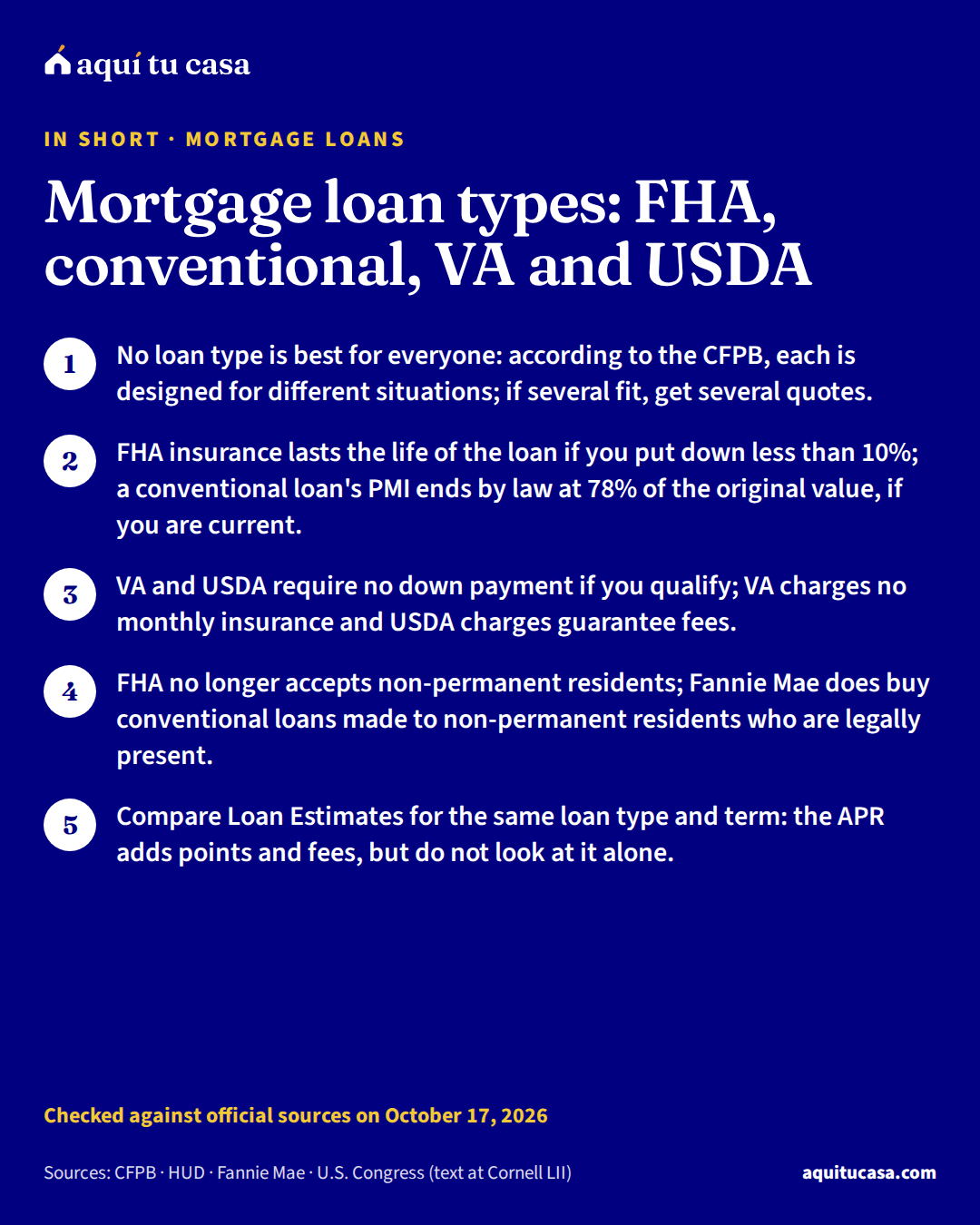
- No loan type is best for everyone: according to the CFPB, each is designed for different situations; if several fit, get several quotes.
- FHA insurance lasts the life of the loan if you put down less than 10%; a conventional loan's PMI ends by law at 78% of the original value, if you are current.
- VA and USDA require no down payment if you qualify; VA charges no monthly insurance and USDA charges guarantee fees.
- FHA no longer accepts non-permanent residents; Fannie Mae does buy conventional loans made to non-permanent residents who are legally present.
Is this for you?
This guide is for you if…
- You are about to apply for your first mortgage and do not know what FHA, conventional, VA or USDA mean.
- A lender offered you one loan type and you want to know what the others ask for.
- You want to understand the words on the Loan Estimate: rate, APR, points, mortgage insurance.
Get direct help first if…
- You already have a Loan Estimate and a question about one figure: ask your lender and, if the answer does not convince you, a HUD-approved housing counselor.
- Your immigration status changed recently or is not permanent: residency rules differ by program; a housing counselor can explain which ones accept you today.
A mortgagemortgageA mortgage is an agreement between you and a lender (a bank, a credit union or a mortgage company) that gives the lender the right to take your property if you do not repay the money it lent you, plus interest. Mortgage loans are used to buy a home or to borrow money against the value of a home you already own. You repay it in monthly payments that cover the principal (the money borrowed) and the interest, and often the property taxes and insurance as well. In Spanish, "hipoteca" and "préstamo hipotecario" mean the same thing.See the full definition is a loan with the home as collateral. What changes from one “type” to another is who backs the loan, how much it asks for up front, how much insurance it charges and whom it accepts. This guide compares the four main types using the rules their own agencies publish, without recommending one: the decision depends on your credit, your savings, the home and your area.
The four types in one table
The CFPB explains that each loan type is designed for different situations. Conventional loans are the majority of loans and typically cost less than FHA loans, though they can be harder to get; FHA loans have a low down payment and accept lower scores; VA loans are for veterans, servicemembers and surviving spouses; and USDA loans are for low- to middle-income borrowers in rural areas.1
| Type | Who backs it | Minimum down payment | Insurance or fee | Who it is for |
|---|---|---|---|---|
| FHAFHA loanAn FHA loan is a mortgage made by a private lender and insured by the Federal Housing Administration (FHA), an agency of the U.S. government. That insurance protects the lender if you stop paying, which is why the lender can accept a lower down payment and a less-than-perfect credit history than on a conventional loan. Federal law sets the minimum cash investment at 3.5% of the property's value and caps the loan amount at the FHA limit, which changes by county. In exchange for the insurance you pay a mortgage insurance premium.See the full definition | A private lender makes it and FHA insures it2 | 3.5% with a score of 580 or higher5 | Upfront premium of 1.75% of the loan plus an annual premium6 | Citizens, permanent residents and a few other cases7 |
| Conventionalconventional loanA conventional loan is any mortgage that is not insured or guaranteed by the federal government: it is not FHA, VA or USDA. The lender, or the companies that buy the loans (Fannie Mae and Freddie Mac), carry the risk. When the amount is within the conforming loan limit the loan is called "conforming"; above it, it is a "jumbo" loan. It usually asks for a higher credit score than an FHA loan and, if your down payment is less than 20% of the price, you are normally required to buy private mortgage insurance (PMI) until you build enough equity in the home.See the full definition | No government program; many follow Fannie Mae or Freddie Mac rules3 | From 3% in programs such as HomeReady8 | PMI if the loan is above 80% of the value; it ends by law1112 | Score from 620 if underwritten by hand9 |
| VAVA loanA VA loan is a mortgage program offered by the U.S. Department of Veterans Affairs (VA) to help servicemembers, veterans and some surviving spouses buy a home. The VA does not lend the money: it guarantees part of a loan made by a private lender, and with that guarantee the lender can offer terms other loans do not have, such as buying with no down payment. Only people who meet the VA's service requirements can use it; the lender will ask for your certificate of eligibility.See the full definition | A private lender makes it and VA guarantees it4 | 0% if the price does not exceed the appraisal15 | No monthly insurance; one-time funding fee with exemptions16 | Veterans, servicemembers and some surviving spouses17 |
| USDAUSDA loanA USDA loan is a mortgage from the Rural Housing Service, part of the U.S. Department of Agriculture (USDA). It is meant for low- and moderate-income families buying a home in an area the USDA considers rural, and it can be offered with no down payment. There are two paths: the USDA guarantees a loan made by a private lender, or it lends directly to very-low-income families. To qualify, your income must be within the limit for your area and the home must be in an eligible area, which you can check on the USDA's map.See the full definition | A Department of Agriculture program similar to FHA and VA4 | 0%4 | Upfront guarantee fee and annual fee22 | Eligible rural areas and households under the income limit18 |

The table sums up what each agency publishes; every program has more income, property and credit requirements that the lender reviews in your case. If several types fit, the CFPB suggests asking lenders for several quotes to see which comes out best overall.1
FHA: low down payment, insurance that lasts
According to the CFPB, an FHA loan comes from a private lender, and the Federal Housing Administration (FHA) regulates and insures it: it does not lend the money directly. It accepts lower scores than most conventional loans, has a maximum loan amount that varies by county and always carries mortgage insurance.2 Each county’s FHA limit is on our data pages.
HUD’s rules say how much you have to put in. The minimum investment is 3.5% of the home’s value when your score is 580 or higher. With a score of 500 to 579, the loan cannot exceed 90% of the value, so you put down at least 10%. Below 500 you are not eligible. If you have no traditional credit history, you can still get maximum financing, but your loan is underwritten by hand.5
The price of that flexibility is FHA’s mortgage insurancemortgage insuranceMortgage insurance protects the lender, not you, if you fall behind on your loan payments. You pay for it, as part of the monthly payment and sometimes also as an upfront charge. It exists because it lets the lender accept a lower down payment. On an FHA loan it is called the mortgage insurance premium (MIP) and is charged by the FHA; on a conventional loan with a small down payment it is called private mortgage insurance (PMI) and comes from a private insurer. The rules for when you can stop paying it differ in each case.See the full definition, called MIPFHA mortgage insurance premium (MIP)The FHA mortgage insurance premium (MIP) is what you pay for the insurance the FHA requires on all of its loans. That insurance protects the lender, not you, if you fall behind. It has two parts: an upfront premium (upfront MIP or UFMIP), paid with your closing costs or added to the loan, and an annual premium collected in your monthly payment. Federal law authorizes HUD to charge both and caps them. According to the CFPB, it costs the same no matter your credit score. If you add the upfront premium to the loan, the loan amount and the total cost go up.See the full definition. It has two parts: an upfront premium of 1.75% of the base loan amount, which can be added to the loan,5 and an annual premium collected in your monthly payment. On a loan longer than 15 years, if you borrow 90% of the value or less, the annual premium lasts 11 years; if you borrow more than 90%, it lasts the life of the loan.6
Example with real numbers
FHA insurance on a typical home
With the typical US home value, the FHA minimum down payment and the average 30-year rate of 7.18% (November 5, 2026).
- Home price (typical US value)
- $332,700
- Minimum down payment (3.5%)5
- $11,645
- Base loan
- $321,056
- Upfront premium (1.75% of the base loan), added to the loan6
- $5,618
- Monthly share of the annual premium, in your payment
- $147
- Loan including the upfront premium
- $326,674
This is an example with national numbers. With less than 10% down, the annual premium lasts the life of the loan.6 The calculator runs it with your price and your rate.
Run it with your numbersMortgage calculatorConventional: no government program
“Conventional” just means the loan is not part of a government program. According to the CFPB, conventional loans typically cost less than FHA loans but can be harder to get. “Conforming” loans have maximum amounts set by the government, and their other rules come from Fannie Mae or Freddie Mac.3
Down payment from 3%. Fannie Mae’s HomeReady is a conventional loan for people who meet certain income limits. On a purchase it can finance up to 97% of the value, with a fixed rate for up to 30 years, on a one-unit home you will live in. Your income cannot exceed 80% of the area median incomearea median income (AMI)The area median income (AMI) is the median family income of an area, which HUD computes every year for each metropolitan area and county. Housing programs use it as the yardstick: under the federal rule, a family is low-income when it earns no more than 80% of its area's median income and very low-income when it earns no more than 50%, adjusted for family size. State down payment assistance programs and Section 8 vouchers publish their limits as a percentage of AMI, so the same salary can qualify in one county and not in the next.See the full definition. If everyone who will live in the home is a first-time buyer, a homebuyer education coursehomebuyer education courseA homebuyer education course is a class with a set curriculum that covers the homebuying process, how to maintain a home, budgeting and why good credit matters. It can be in a group, in person, online or by phone. It is not the same as housing counseling, which is one-on-one help with an action plan for your situation. Some loans and some down payment assistance programs require you to finish a course before closing, especially first-time homebuyers. When you finish, you get a certificate.See the full definition is required.8
Credit score. If the loan is underwritten by hand, Fannie Mae requires at least 620 with a fixed rate and 640 with an adjustable rate. With its automated system (DU) there is no fixed minimum: the system assesses your risk.9
Private mortgage insurance (PMI). If the loan is above 80% of the value, that is, if you put down less than 20%, it carries private mortgage insurance (PMI)private mortgage insurance (PMI)Private mortgage insurance (PMI) is a type of mortgage insurance you might be required to buy on a conventional loan when your down payment is less than 20% of the purchase price. It protects the lender, not you, if you stop making payments. It is normally paid monthly as part of your payment, and the cost depends on your credit score and how much you put down. Unlike FHA insurance, PMI can be canceled once your balance falls far enough relative to the home's value; the lender must explain the rules to you.See the full definition. For a purchase, the value is the lower of the price and the appraisal.11 The difference from FHA is that PMI ends by law. It ends automatically when your balance, based on the original payment schedule, reaches 78% of the original value, if you are current.12 And you can ask in writing to cancel it once the balance reaches 80%, if you have a good payment history and the home has not lost value.13
Conforming limit. By law, Fannie Mae and Freddie Mac only buy loans below a certain amount, the conforming loan limitconforming loan limitThe conforming loan limit is the maximum mortgage amount Fannie Mae and Freddie Mac may buy from lenders. Those two companies back most conventional loans, so a loan within the limit ("conforming") usually gets better terms than a larger one ("jumbo"). The Federal Housing Finance Agency (FHFA) sets it every year using the formula in the HERA law, and high-cost areas have a higher limit. Each county's FHA loan limit is computed from this number.See the full definition. Above it, the loan is a jumbojumbo loanA jumbo loan is a mortgage whose amount is above the conforming loan limit. That limit is the most that Fannie Mae and Freddie Mac (the two companies that buy mortgages from lenders) are allowed by law to purchase. It is set every year with their regulator, the Federal Housing Finance Agency (FHFA), and it is higher in high-cost counties. A loan may go over the limit, but then it is called a jumbo loan. The CFPB notes that a jumbo loan may cost more to get than a conforming loan, and it must meet special requirements to count as a Qualified Mortgage (QM).See the full definition.14 With jumbo loans each lender sets its own rules, and they usually require good credit and a high down payment.3 Each county’s conforming limit is on our data pages.
Residency. Fannie Mae buys loans made to non-citizens who are lawful permanent or non-permanent residents, under the same terms as citizens. The lender decides which documents to ask for.10
FHA and conventional, side by side
Insured by FHA
FHA
- From 3.5% down with a score of 580 or higher; from 500 to 579, at least 10%.5
- Upfront premium of 1.75% plus an annual premium; with less than 10% down, the annual one lasts the life of the loan.6
- Does not accept non-permanent residents.7
- With a lower score or a small down payment, it is often the cheapest option.2
No government program
Conventional
- From 3% down with HomeReady, with an income limit.8
- Score from 620 with a fixed rate if underwritten by hand; with DU, the system assesses risk.9
- PMI if you put down less than 20%; it ends by law at 78% of the original value.1112
- With good credit and a medium down payment, it usually costs less than FHA.2
There is no hard-and-fast rule: get quotes for both options and compare total costs.2
VA: no down payment for those who served
The VA loan is for eligible veterans, current servicemembers and surviving spouses. A private lender makes it and the Department of Veterans Affairs (VA) guarantees it. It charges no monthly mortgage insurance premiums, but usually an upfront fee at closing. The CFPB warns that if you have significant down payment funds and good credit, it may cost more than a conventional loan.4
According to VA, the loan often lets you put no money down as long as the price does not exceed the appraised value, and borrow up to the conforming limit with no down payment in most areas. It also charges no PMI or MIP, and no penalty if you pay the loan off early. You have to live in the home and meet VA’s and your lender’s credit and income requirements.15
The funding fee is a one-time payment. You can add it to the loan or pay it in full at closing, and the amount depends on the loan, your down payment and whether you have used the benefit before. Among others, it is not paid by those receiving VA compensation for a service-connected disability and by surviving spouses receiving Dependency and Indemnity Compensation (DIC).16
To start you need your Certificate of Eligibility (COE), which shows the lender you qualify based on your service. A service member who has served at least 90 continuous days meets the minimum; for veterans, the minimum depends on when they served. You request it online, or your lender can request it for you.17
USDA: no down payment in rural areas
The guaranteed program of USDA, the Department of Agriculture, is similar to FHA and VA, but for low- and moderate-income families in rural areas. According to the CFPB, it requires no down payment and is usually cheaper than FHA; in exchange, you pay an upfront fee and ongoing premiums to USDA.4 For fiscal year 2027, those fees are 1% up front and 0.35% a year.22
The regulation sets several conditions. Your household’s adjusted income cannot exceed the moderate income limit. You have to show you are a citizen, a non-citizen national or a qualified alien. The home has to be your principal residence, and it must be modest, decent, safe and sanitary.18 The moderate income limit is the highest of 115% of the US median family income and two other figures that depend on your state and your area. And the definition of “rural area” is in a federal law, the Housing Act of 1949.19
A USDA loan always has a fixed rate, with a term of up to 30 years; there are no adjustable-rate versions.20 If you are not sure whether your area counts as rural, USDA has an eligibility site where you check whether an address is in an eligible area and whether your income might qualify. To apply, USDA refers you to its approved lenders.21
VA and USDA, side by side
For your service
VA
If you qualify, these programs can cost less than a conventional or FHA loan; compare the Loan Estimates.4
Fixed or adjustable rate, and the term
Separately from the loan type, you choose how the rate behaves. With a fixed-ratefixed-rate mortgageA fixed-rate mortgage is a home loan whose interest rate is set when you take out the loan and does not change over its whole life. The part of your payment that covers principal and interest is therefore the same every month, from the first payment to the last; what can change is what you pay for taxes and insurance if they ride in the same payment. It is the most common choice in the United States and the one almost every state assistance program uses. The most common terms are thirty and fifteen years.See the full definition mortgage, the rate is set when you take out the loan and does not change. With an adjustable-rate mortgage (ARM)adjustable-rate mortgage (ARM)An adjustable-rate mortgage (ARM) is a loan whose interest rate can change, usually in step with a market index. It often starts with a fixed rate for an initial period (for example, the first few years) and then adjusts at set intervals, so your payment can go up or down. The contract sets caps on how much the rate can rise at each adjustment and in total. Before accepting one, check on the Loan Estimate how high your payment could reach and whether you could afford it.See the full definition, it can go up or down: many start lower than fixed rates, but when the introductory period ends the rate changes at regular intervals and the payment is likely to go up.23
The CFPB describes a fixed rate as lower risk with no surprises, although your total payment can still change if taxes or insurance go up. With an adjustable rate, the principal and interest payment could go up a lot, even double. It might make sense if you plan to move before the initial fixed period ends, but if you stay longer you could pay a lot more.1
The term is the other decision. Shorter terms save money overall, because you pay interest for less time and the rate is usually lower, but the monthly payment is higher; 30-year terms have lower payments and, typically, higher rates.1

Rate, APR and points: how to compare offers
Two numbers that look alike and are not. The interest rateinterest rateThe interest rate on a mortgage is what you pay each year to borrow the money, expressed as a percentage of the loan balance. It does not include fees or other charges; that is what the annual percentage rate (APR) is for. On a fixed-rate loan the rate never changes over the life of the loan; on an adjustable-rate loan it can go up or down after an initial period. The rate you are offered depends on your credit score, your down payment, the loan type and the market, and you see it on the first page of the Loan Estimate.See the full definition is what you pay each year to borrow, as a percentage, without fees. The APRannual percentage rate (APR)The annual percentage rate (APR) is a broader measure of the cost of borrowing money than the interest rate. Besides the interest, it includes certain loan charges, such as discount points and some lender fees, spread over the life of the loan and expressed as a yearly percentage. That is why the APR is almost always a little higher than the interest rate. It is useful for comparing offers: if two loans have the same interest rate but a different APR, the one with the higher APR charges more in fees.See the full definition is a broader measure: it adds the rate, points, broker fees and other charges, so it is usually higher. On the Loan Estimate, the rate is on page 1 and the APR on page 3. But with an adjustable rate the APR does not reflect the maximum rate, and the CFPB advises not to look at the APR alone.24
Discount pointsdiscount pointsDiscount points are a payment you make to the lender at closing in exchange for a lower interest rate over the life of the loan. Each point costs a percentage of the loan amount. The opposite is lender credits: the bank lowers your closing costs today in exchange for a higher rate. Buying points only pays off if you keep the loan long enough for the monthly savings to exceed what you paid. Points appear on the Loan Estimate, in section A of the closing costs.See the full definition lower the rate in exchange for paying more at closing; lender credits do the opposite: they lower closing costs in exchange for a higher rate.25 Neither is free.

Which one fits you
No loan type is best for everyone. These are the rules that matter most depending on your situation; for your own case, a HUD-approved housing counselorHUD-approved housing counselorA HUD-approved housing counselor works at an agency HUD has approved to provide housing counseling: independent, expert advice customized to your situation about buying a home, renting, a missed mortgage payment, a foreclosure or credit problems. The agencies usually charge little or nothing; many serve in Spanish and offer the homebuyer education course several assistance programs require. They are not lenders or real estate agents and sell you nothing. Your county page lists the official agencies with phone numbers.See the full definition gives independent advice, often free or at low cost.26
If this is you
You are a veteran, servicemember or surviving spouse
Request your COE online or through your lender.17 If you receive compensation for a service-connected disability, you do not pay the funding fee.16
You are buying for the first time
Many state and local programs help with the down payment and can be used with an FHA or conventional loan.4 See the down payment assistance guide.
You have an ITIN or are not a permanent resident
FHA does not accept non-permanent residents,7 and USDA requires being a citizen, non-citizen national or qualified alien.18 The ITIN mortgage guide explains the options.
Your income is low or moderate
USDA and HomeReady have income limits.188 Also check the debt-to-income ratio guide: each program measures your debts its own way.
Common mistakes
Mistake: Comparing offers by interest rate alone.
Instead: Also look at the APR, which adds points and fees, though not on its own.24
Mistake: Comparing an adjustable-rate APR as if it were fixed.
Instead: With an adjustable rate, the APR does not reflect the maximum rate it can reach.24
Mistake: Assuming FHA insurance comes off like PMI.
Instead: With less than 10% down, the FHA annual premium lasts the life of the loan.6
Mistake: Assuming your area is not rural for USDA.
Instead: Check the address on USDA's eligibility site.21
Mistake: Choosing an adjustable rate counting on selling or refinancing before it rises.
Instead: The CFPB warns that your home's value can fall or your situation can change.23
Mistake: Deciding before you have the Loan Estimates.
Instead: Compare the official offers from several lenders before you choose.1

What to do this week
- Mark in the table the types that could fit you: military service, rural area, score, savings and status.1
- Look up your county’s FHA limit and conforming limit.14
- If you are a veteran, request your COE; if you are looking outside the city, check the address on USDA’s site.1721
- Run the mortgage calculator with two loan types and compare the payment and the total cost.
- Ask several lenders for Loan Estimates and compare them side by side.1
- If something does not add up, take it to a HUD-approved housing counselor before you sign.26
Your numbers
Starts at the typical home value in the United States. Change it to the price you have in mind.
That is $11,645 (3.5% of the price). The usual minimum for this loan is 3.5%.
This week's average ± a quarter or half point.
National average as of November 5, 2026 (Freddie Mac); your rate may be different.
Adjust advanced details
Let's do the math
Estimated monthly payment
National figure$2,759
at 7.18% · 30 years
- Loan amount
- $326,673
- Total interest
- $470,006
- Paid off in
- November 2056
Includes $5,618 FHA upfront mortgage insurance premium.
Does it fit the income?
Comfortable
up to $1,884 a month
Tight
$1,884 to $2,422 a month
Hard
more than $2,422 a month
Your payment · 41%
Compared with the typical household income in the United States ($80,734 a year). Reference: HUD calls paying more than 30% of income for housing a cost burden.
| Principal & interest | $2,213 |
|---|---|
| Property tax | $261 |
| Home insurance | $139 |
| FHA mortgage insurance (MIP) | $147 |
How does it compare with incomes?
For this payment to be 28% of your income, you'd need to earn about $118,260 a year. With your other debts, to stay under 36%: about $91,980 a year.
You need at least $11,645 for the down payment, plus closing costs.
This is an estimate to give you an idea, not a loan offer. Your real payment depends on your rate, your credit, and the insurance and taxes on the home you buy.
Total monthly payment $2,759; principal and interest $2,213.
Ready to see the numbers? Find your county here
See how this applies in your county: its loan limits, prices and rents, from the official data.
Frequently asked questions
Which loan is the cheapest?
It depends on your credit and your down payment. The CFPB says that with good credit and a medium down payment (10% to 15%), FHA tends to cost more than conventional, and that with a lower score or a small down payment FHA is often the cheapest. VA and USDA can cost less if you qualify. There is no hard-and-fast rule: get quotes and compare total costs.
What is the minimum credit score for an FHA loan?
According to HUD's Handbook, with 580 or higher you are eligible for maximum financing, which means the minimum 3.5% down payment. From 500 to 579, the loan cannot exceed 90% of the value, so you put down at least 10%. Below 500 you are not eligible for FHA.
When does PMI come off a conventional loan?
By law, it ends automatically when your balance, based on your original payment schedule, reaches 78% of the home's original value, if you are current. You can ask in writing to cancel it once the balance reaches 80%, if you have a good payment history, are current and meet the holder's requirements, such as showing the home has not lost value.
Can I get rid of FHA mortgage insurance?
It depends on your down payment. According to HUD, on loans longer than 15 years, if the loan is 90% of the value or less (you put down 10% or more), the annual premium lasts 11 years; if it is above 90%, it lasts the life of the loan.
What if I have an ITIN or am not a permanent resident?
Since May 25, 2025, FHA accepts, besides citizens, only lawful permanent residents and citizens of Micronesia, the Marshall Islands and Palau. USDA requires being a citizen, non-citizen national or qualified alien. Fannie Mae buys conventional loans made to non-permanent residents who are legally present. The ITIN mortgage guide explains the other options.
Who can get a VA loan?
You need a Certificate of Eligibility (COE) based on your service: for example, a service member who has served at least 90 continuous days. Some surviving spouses can get one too. You also have to meet VA's and the lender's credit, income and occupancy requirements. You request the COE online or through your lender.
How do I know whether a home qualifies for USDA?
USDA has an Income and Property Eligibility Site where you can check whether an address is in an eligible rural area and whether your household income might qualify. To apply, USDA refers you to its approved lenders.
Should I choose a fixed or an adjustable rate?
It depends on your situation, and no one can decide it for you. The CFPB describes a fixed rate as lower risk with no surprises, and an adjustable rate as cheaper at the start but with the risk that the payment rises a lot. It warns against counting on selling or refinancing before the rate changes.
Sources
Every figure in this guide comes from one of these official sources. The number next to a sentence leads to the source behind it.
Each source on one line: who publishes it, its title, its address and the date we read it.
- 1. CFPB · Understand the different kinds of loans available · consumerfinance.gov · Accessed October 17, 2026
- 2. CFPB · FHA loans · consumerfinance.gov · Accessed October 17, 2026
- 3. CFPB · Conventional loans · consumerfinance.gov · Accessed October 17, 2026
- 4. CFPB · Special loan programs · consumerfinance.gov · Accessed October 17, 2026
- 5. HUD · HUD Handbook 4000.1, FHA Single Family Housing Policy Handbook (Update 18) · hud.gov · Accessed October 17, 2026
- 6. HUD · HUD Mortgagee Letter 2023-05, Reduction of FHA Annual MIP Rates · hud.gov · Accessed October 17, 2026
- 7. HUD · HUD Mortgagee Letter 2025-09, Revisions to Residency Requirements · hud.gov · Accessed October 17, 2026
- 8. Fannie Mae · Fannie Mae Selling Guide B5-6-01, HomeReady Mortgage Loan and Borrower Eligibility · selling-guide.fanniemae.com · Accessed October 17, 2026
See the other 18 sources
- 9. Fannie Mae · Fannie Mae Selling Guide B3-5.1-01, General Requirements for Credit Scores · selling-guide.fanniemae.com · Accessed October 17, 2026
- 10. Fannie Mae · Fannie Mae Selling Guide B2-2-02, Non–U.S. Citizen Borrower Eligibility Requirements · selling-guide.fanniemae.com · Accessed October 17, 2026
- 11. Fannie Mae · Fannie Mae Selling Guide B7-1-01, Provision of Mortgage Insurance · selling-guide.fanniemae.com · Accessed October 17, 2026
- 12. U.S. Congress (text at Cornell LII) · Homeowners Protection Act, 12 U.S.C. §4901 (Definitions) · law.cornell.edu · Accessed October 17, 2026
- 13. U.S. Congress (text at Cornell LII) · Homeowners Protection Act, 12 U.S.C. §4902 · law.cornell.edu · Accessed October 17, 2026
- 14. FHFA · FHFA Conforming Loan Limits · fhfa.gov · Accessed October 17, 2026
- 15. U.S. Department of Veterans Affairs (VA) · VA: Purchase loan · va.gov · Accessed October 17, 2026
- 16. U.S. Department of Veterans Affairs (VA) · VA funding fee and loan closing costs · va.gov · Accessed October 17, 2026
- 17. U.S. Department of Veterans Affairs (VA) · Eligibility for VA home loan programs · va.gov · Accessed October 17, 2026
- 18. USDA (Code of Federal Regulations, text at Cornell LII) · 7 CFR §3555.151, Eligibility requirements (Guaranteed Rural Housing Program) · law.cornell.edu · Accessed October 17, 2026
- 19. USDA (Code of Federal Regulations, text at Cornell LII) · 7 CFR §3555.10, Definitions and abbreviations (Guaranteed Rural Housing Program) · law.cornell.edu · Accessed October 17, 2026
- 20. USDA (Code of Federal Regulations, text at Cornell LII) · 7 CFR §3555.104, Loan terms (Guaranteed Rural Housing Program) · law.cornell.edu · Accessed October 17, 2026
- 21. USDA · USDA Income and Property Eligibility Site · eligibility.sc.egov.usda.gov · Accessed October 17, 2026
- 22. USDA · USDA Rural Development: Fiscal Year 2027 Conditional Commitment Notice (SFH Guaranteed) · content.govdelivery.com · Accessed October 17, 2026
- 23. CFPB · What is the difference between a fixed-rate and adjustable-rate mortgage (ARM) loan? · consumerfinance.gov · Accessed October 17, 2026
- 24. CFPB · What is the difference between a mortgage interest rate and an APR? · consumerfinance.gov · Accessed October 17, 2026
- 25. CFPB · How should I use lender credits and points (also called discount points)? · consumerfinance.gov · Accessed October 17, 2026
- 26. CFPB · Find a Housing Counselor · consumerfinance.gov · Accessed October 17, 2026
Keep reading
Related guides
If this guide helped, these follow the same path.

Buying a home 11 minute read
How much do you need for a down payment?
20% is not required: what each loan asks for (FHA, conventional, VA, USDA), what changes with less than 20% down, and where the money can come from.
- 20% is not a rule: FHA asks for 3.5% and a conventional HomeReady loan for 3%.
- VA (veterans and service members) and USDA (rural areas, with an income limit) may require no down payment.
- With less than 20% down there is mortgage insurance: PMI on conventional loans, which can be removed; MIP on FHA, with an upfront premium.
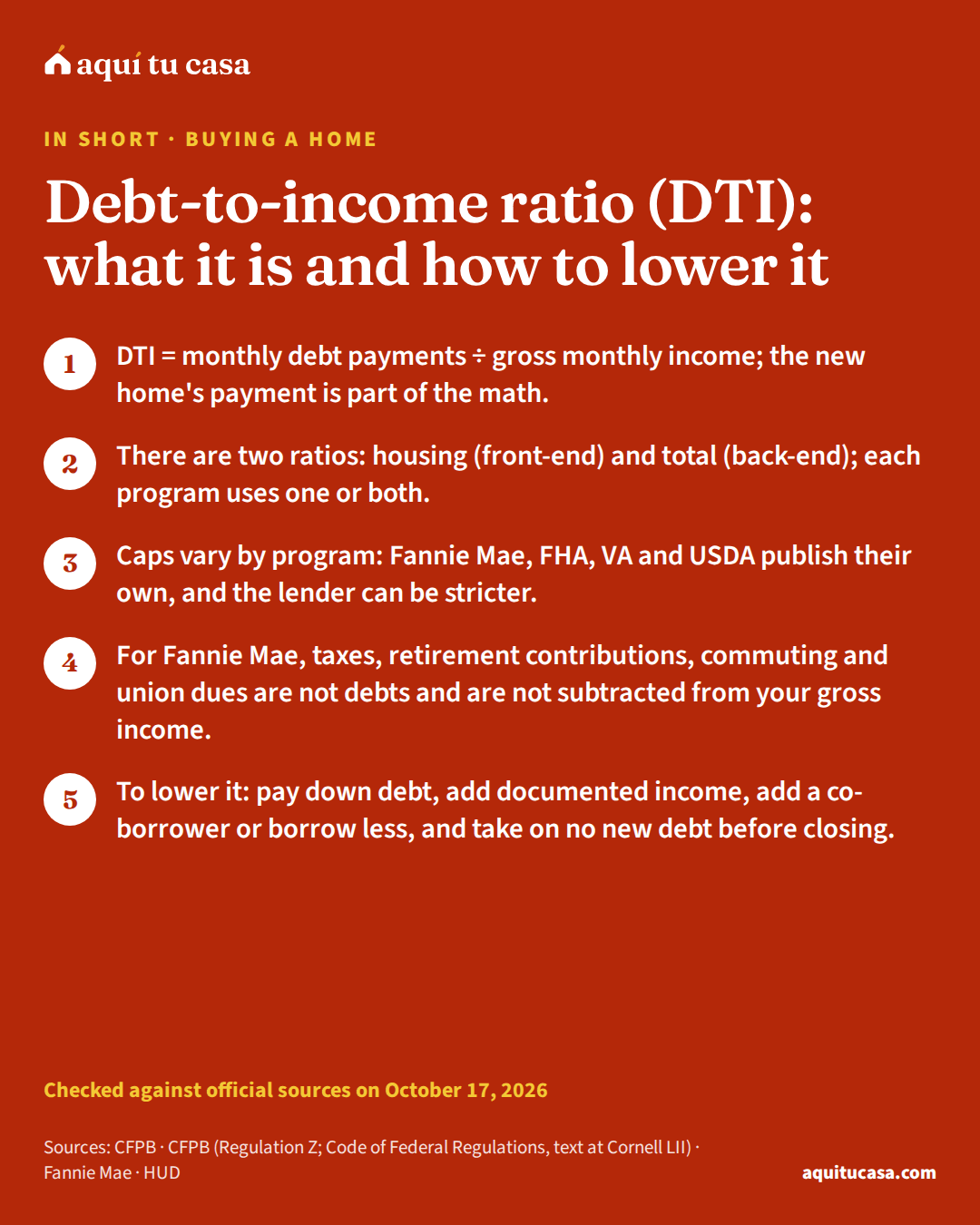
- Buying a home Debt-to-income ratio (DTI): what it is and how to lower it What the debt-to-income ratio (DTI) is, how to calculate it, which payments count, the caps FHA, Fannie Mae, VA and USDA publish and how to lower it. 14 minute read
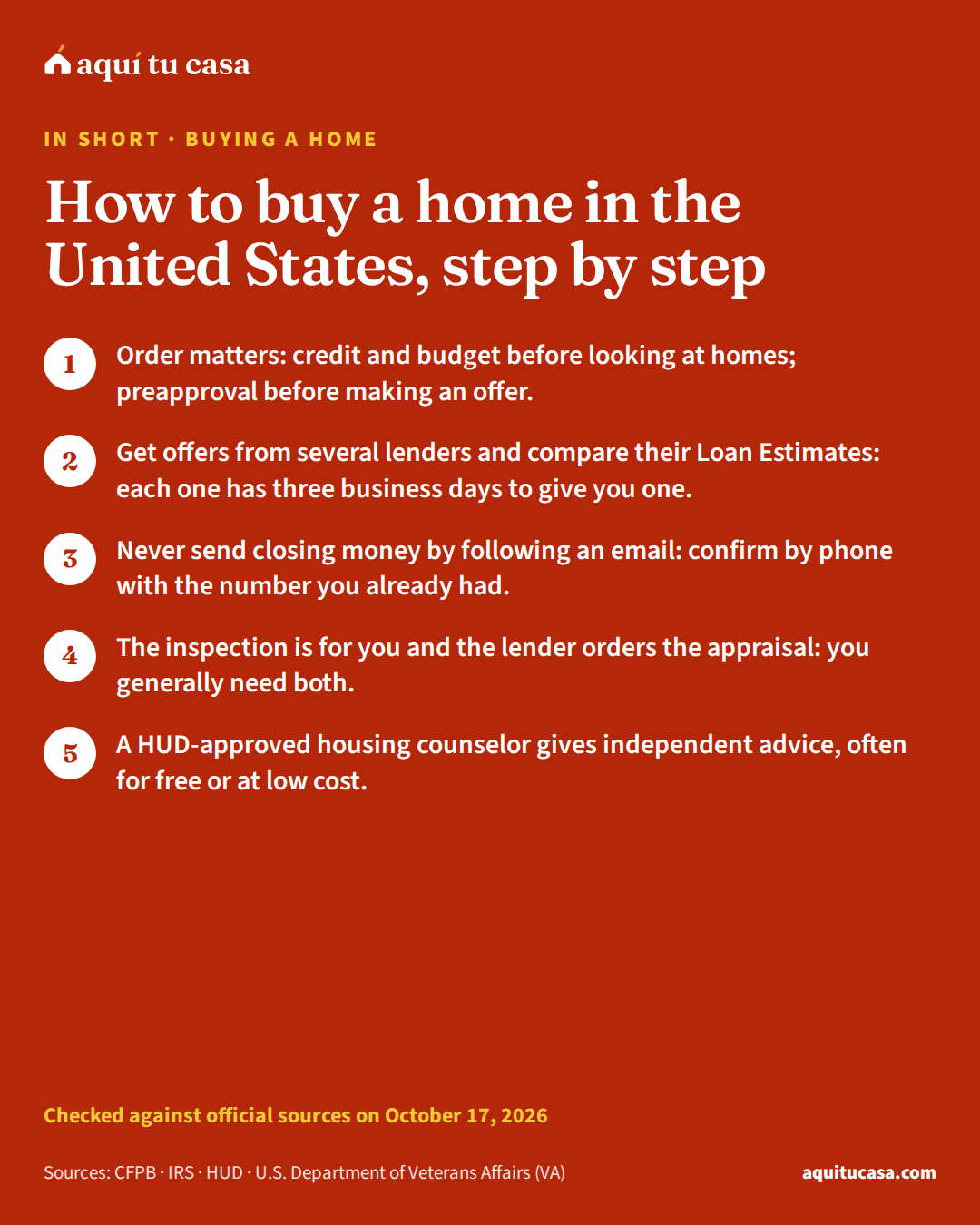
- Buying a home How to buy a home in the United States, step by step The nine steps to buying a home: paperwork, credit, budget, assistance, preapproval, offer, inspection, closing and the first year, with official sources. 15 minute read
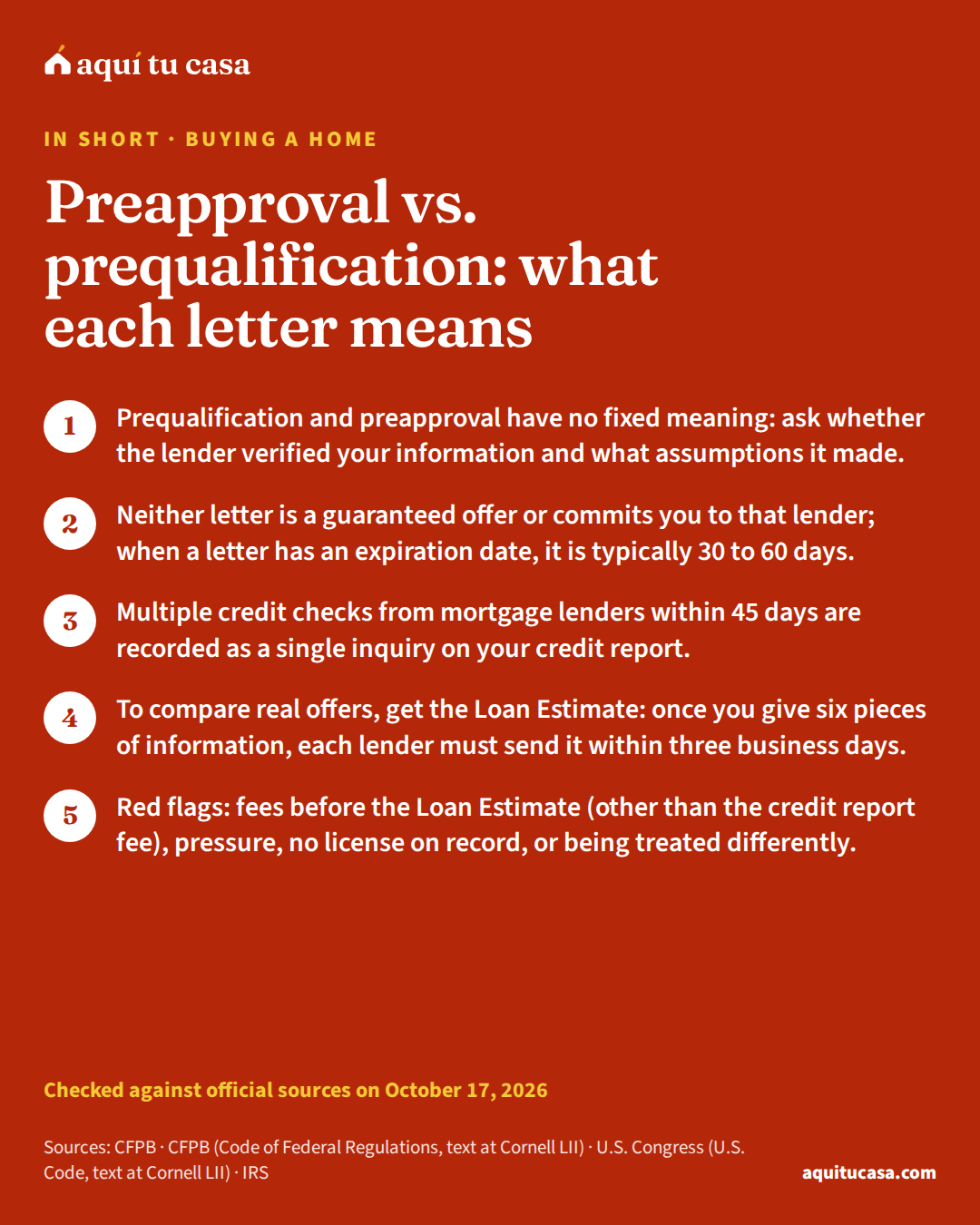
- Buying a home Preapproval vs. prequalification: what each letter means What prequalification and preapproval letters are, what lenders check, why neither one is a loan, and how to compare lenders without hurting your credit. 14 minute read
Tools for this topic
Was this guide useful?
Thank you. Your answer stays in your browser; nothing is sent.