Buying a home when you're self-employed: what lenders ask
How lenders check your income if you are self-employed or paid on a 1099: tax returns, Schedule C, IRS transcripts, profit and loss and bank statements.
Verified against official sources on October 17, 2026 18 official sources

Show contents
In short
What you need to know
Quick answer
Yes, you can buy a home if you are self-employed, but the lender has to document your income with third-party records, mainly your tax returns. It usually asks for two years of signed returns with every schedule, such as Schedule C, or IRS transcripts, and it figures your income from your net profit, not from what you bill. FHA and Fannie Mae accept less than two years in some cases. If you are offered a loan that uses bank statements instead of tax returns, ask whether it is a Qualified Mortgage, because outside those there is no limit on points and fees.
What matters most
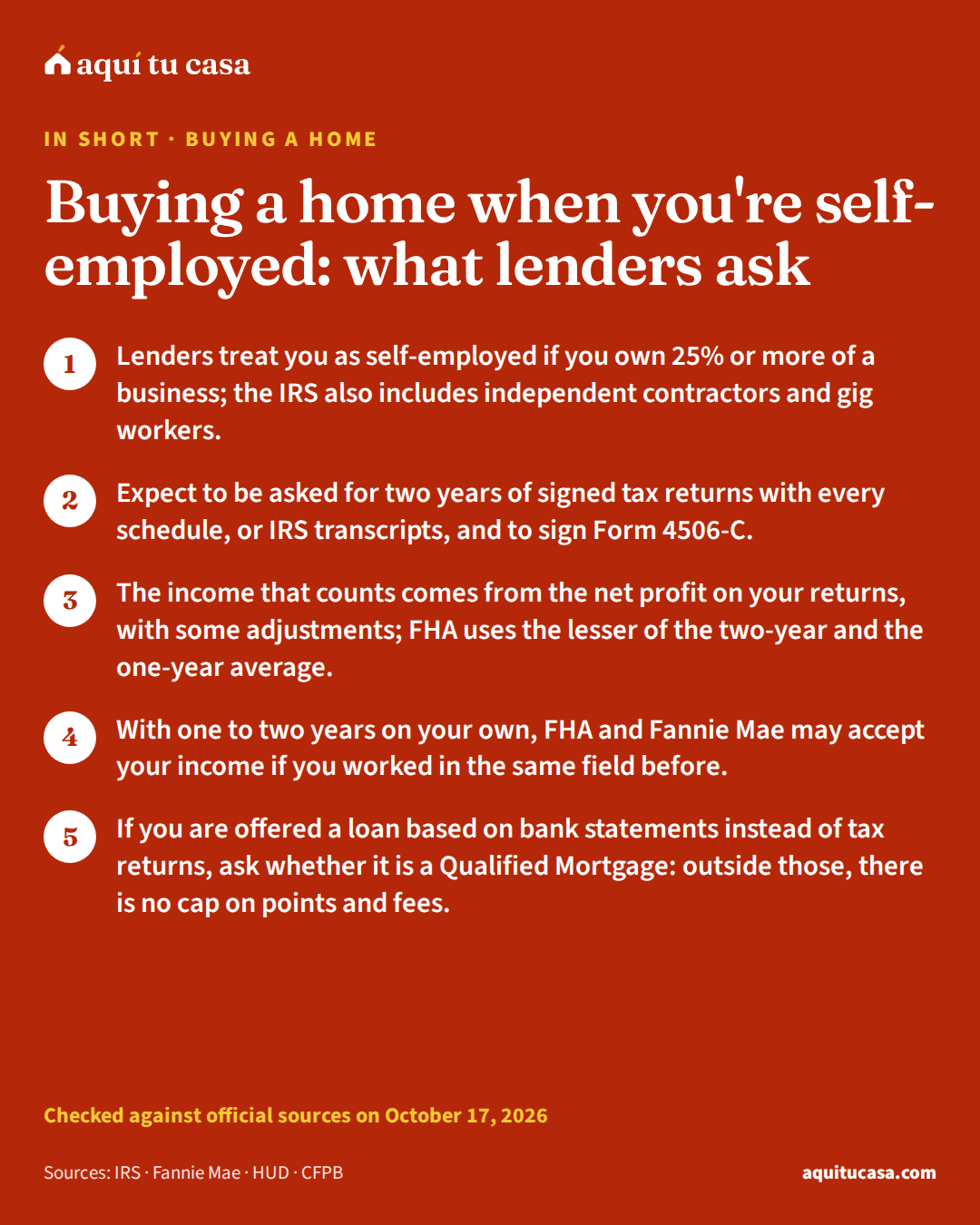
- Lenders treat you as self-employed if you own 25% or more of a business; the IRS also includes independent contractors and gig workers.
- Expect to be asked for two years of signed tax returns with every schedule, or IRS transcripts, and to sign Form 4506-C.
- The income that counts comes from the net profit on your returns, with some adjustments; FHA uses the lesser of the two-year and the one-year average.
- With one to two years on your own, FHA and Fannie Mae may accept your income if you worked in the same field before.
Is this for you?
This guide is for you if…
- You run your own business, work as an independent contractor or get paid on 1099 forms, and you want to buy a home with a loan.
- A lender asked for your tax returns, a profit and loss statement or a Form 4506-C and you want to know why.
- You were offered a loan that uses bank statements instead of tax returns and want to know what the rules say.
Get direct help first if…
- You earn a W-2 salary and only have a small side job: many rules here do not apply if that extra income is not used to qualify.
- You need help preparing or fixing your tax return: this guide gives no tax advice; IRS VITA sites prepare basic returns for free for people who qualify.
- Your question is about a business with partners, an S corporation or a partnership: this guide mostly covers a business of your own reported on Schedule C.
This guide is for you if you run your own business, work as a contractor or get paid on 1099 forms and want to buy a home with a mortgagemortgageA mortgage is an agreement between you and a lender (a bank, a credit union or a mortgage company) that gives the lender the right to take your property if you do not repay the money it lent you, plus interest. Mortgage loans are used to buy a home or to borrow money against the value of a home you already own. You repay it in monthly payments that cover the principal (the money borrowed) and the interest, and often the property taxes and insurance as well. In Spanish, "hipoteca" and "préstamo hipotecario" mean the same thing.See the full definition. You will see what counts as self-employment, which documents lenders ask for, how they figure the income that counts, and what changes between FHA, a conventional loan and a loan based on bank statements.
- Of income history, what Fannie Mae generally requires
- 2 years4
- Ownership of a business, the point where the lender treats you as self-employed
- 25%4
- From the current business on your latest return, if you have less than two years
- 12 months4
- A drop in business income this size sends an FHA loan to manual underwriting
- Over 20%9
What counts as self-employment
According to the IRS, you are generally self-employedself-employedFor the IRS, you are self-employed if you run a business as a sole proprietor or work as an independent contractor, if you are a member of a partnership that runs a business, or if you are otherwise in business for yourself, including part-time or as a gig worker. Because no employer withholds taxes for you, you generally pay estimated taxes every quarter and file a yearly return. Besides income tax, you pay self-employment tax, which covers Social Security and Medicare. Your profit or loss is figured by subtracting your business expenses from your business income, usually on Schedule C.See the full definition if you run a business as a sole proprietor or an independent contractor, or otherwise work for yourself, even part-time or through an app. Your net profit is what is left after you subtract business expenses from what you billed, and that profit becomes part of your income on Form 1040. If your net earnings from self-employment were $400 or more, you have to file a return.1
That profit is figured on Schedule CSchedule C (Form 1040)Schedule C is the form attached to Form 1040 to report the profit or loss from a business you operated or a profession you practiced as a sole proprietor, including gig work. An activity counts as a business if your main purpose is income or profit and you do it with continuity and regularity. On the schedule you subtract your business expenses from your income: if expenses are lower, the difference is your net profit, which becomes part of your income on Form 1040. That figure is also used to calculate self-employment tax on Schedule SE.See the full definition, the form where you report income or loss from a business you run as a sole proprietor.2 If you are paid on a 1099 formForm 1099Form 1099 is a family of IRS information returns that report income other than employee wages. Anyone who paid you in the course of their business must file it with the IRS and send you a copy, on paper or electronically, early in the year. There are several types: 1099-NEC for freelance or contract work, 1099-K for payments by card or through online platforms, 1099-INT for bank interest, 1099-G for government payments such as unemployment, and 1099-MISC for other income. You use that information on your tax return.See the full definition, that money also goes on your return. The IRS says gig and side-job income must be reported even if it is part-time, even if no 1099 arrives and even if you are paid in cash.3
Lenders use their own definition. For Fannie Mae, anyone who owns 25% or more of a business is self-employed. Before approving the loan, the lender has to look at how stable your income is, what kind of business you have, whether there is demand for what you sell and whether the business can keep producing enough income.4 FHA uses the same cutoff: self-employment income comes from a business you own 25 percent or more of.9
Why all the paperwork? Because the law requires it. The ability-to-repay rule prohibits most lenders from giving you a mortgage without a good faith determination that you can pay it back. To make it, they must find out and document your income, assets, employment, credit and expenses.10 And they must verify income with third-party records, such as an IRS transcript or copies of your returns.11 With a salary, a pay stub helps. When you work for yourself, the main record is usually your tax return.4
The documents you will be asked for
The CFPB suggests gathering your papers before you talk to lenders: your signed federal tax returnstax returnA tax return is the yearly form you use to report your income to the IRS and figure the tax you owe, so you can pay what is due or get a refund. The federal return for individuals is Form 1040. In general you must file if your gross income is above the minimum the IRS sets for your filing status, or if you had a certain amount of net earnings from self-employment; even when you do not have to, filing can pay off. You need your SSN or ITIN, and those of everyone else on the return, plus documents such as your W-2s and 1099s.See the full definition for the last two years, documentation of other income and your two most recent bank statementsbank statementA bank statement is the summary your bank or credit union gives you of the activity in your account over a period: deposits, withdrawals, payments and the ending balance. Most send one every month, on paper or online; the law only requires a monthly statement when there was at least one electronic transfer that month, and otherwise it may come quarterly. When you apply for a mortgage, the lender can use your statements to verify you have money for the down payment, closing and reserves. Under Fannie Mae's rules, they must show the bank's name, your name, part of the account number, the period, all transactions and the ending balance.See the full definition. If you are self-employed, it adds, you may need more documents, and requirements vary from lender to lender. Share your situation with the loan officer or a housing counselor and ask what you will need.14
How the lender checks your self-employment income
1. You gather your tax returns
Before you apply
Usually your complete individual returns for the last two years, with all schedules, and sometimes your business returns.9
Try it with your numbersDocument checklist2. You sign Form 4506-C
At or before closing
It lets the lender request your transcripts from the IRS and compare them with your copies.8
3. The lender analyzes your income in writing
During underwriting
It starts from the net profit on your returns to figure how much stable, continuing income you will have.4
4. It may ask for a profit and loss statement
If time has passed since your last tax year
FHA asks for one if more than a calendar quarter has passed since your last tax year ended.9
5. It figures your monthly income and your DTI
Before approval
With that income it measures how much would go to debts and the new payment.16
Try it with your numbersHow much house can I afford?
Fannie Mae accepts copies of your signed federal returns for the past two years, individual and in some cases business, with all schedules. It also accepts IRS-issued transcripts. If your business has existed for five years and you have owned 25% or more of it all that time, one year of returns may be enough.4
On an FHA loan, the lender must get your complete individual returns for the two most recent years, with all schedules. It also asks for your business returns, unless your self-employment income went up over those two years, the money to close is not coming from business accounts and the loan is not a cash-out refinance. Instead of your signed copies, it can get transcripts straight from the IRS with your signature on a form such as the 4506-C.9
You can pull your own tax transcriptsIRS tax transcriptAn IRS tax transcript is a free official summary of the information on your tax returns and tax account. It is not a photocopy of your return. There are several types: the tax return transcript shows most line items from your Form 1040 as filed and usually meets the needs of mortgage lenders; the tax account transcript shows changes made after you filed; the wage and income transcript shows what your W-2s and 1099s reported. You can get one through your IRS online account, by mail, by phone or with Form 4506-T.See the full definition too. The IRS provides them online, in your account, or by mail; by mail they take 5 to 10 calendar days to reach the address it has on file.15 Fannie Mae says a lender can use, for example, the Wage and Income Transcript, which shows your W-2 and 1099 forms.8

How the lender figures the income that counts
This is the biggest difference from an employee. The lender does not look at what you bill, but at what your tax returns show. For Fannie Mae, the income or loss from your business is figured on Schedule C and carried to Form 1040. Then the lender adjusts it: it subtracts income that will not recur and adds back certain items Schedule C subtracted, such as depreciation, business use of your home and amortization.6 That analysis is written down, and its purpose is to know how much stable, continuing income you will have.4
FHA figures your income with the lower of two numbers: the average over the previous two years or the average over the last year. If your business is growing, the two-year average counts. If it shrank, the last year’s average counts, because it is the lower one.9 And if income fell more than 20 percent over the period reviewed, the loan goes to manual underwriting.9
One more rule matters if part of your pay is cash. For FHA, qualifying income must be likely to continue for at least the first three years of the loan. On top of that, the lender may only consider income that is legally earned and, when required, reported on your tax returns. On an FHA loan, income that should have been on your return and is not does not help you qualify.9
Example with real numbers
A typical payment against a typical income
With the typical US home value, an FHA loan with the minimum down payment and this week's rate, against a typical household's gross income.
- Home price (typical US value)
- $332,700
- Estimated monthly payment (principal, interest, taxes, insurance and MIP)
- $2,759
- Gross monthly income of a typical household
- $6,728
- Share of income that would go to the home
- 41%
This is an example with national numbers. If you are self-employed, the income that counts comes from the net profit on your returns, with the lender's adjustments, not from what you bill.6 Lenders measure your ability to pay with your debt-to-income ratio.16
Run it with your numbersHow much house can I afford?
With that income, the lender figures your debt-to-income ratio (DTI)debt-to-income ratio (DTI)Your debt-to-income ratio (DTI) is all your monthly debt payments divided by your gross monthly income, that is, income before taxes. If you pay a certain amount each month across a car, cards, student loans and the mortgage you are asking for, and you earn three times that, your DTI is one third. Lenders use it to measure whether you can manage the payment; each loan type and lender sets its own limit, and assistance programs usually publish theirs. Paying down debt before applying improves your DTI.See the full definition: your monthly debt payments divided by your grossgross incomeGross income is the total you earn before taxes and other deductions are taken out. On your pay stub it shows up as gross pay, not as what lands in your account. Lenders use it to figure your debt-to-income ratio (DTI): they add up your monthly debt payments and divide them by your gross monthly income. When you apply for a mortgage, your annual pre-tax income can include full-time or part-time work, self-employment, tips, commissions, overtime and bonuses; the lender looks at whether you can reasonably expect that income to continue.See the full definition monthly income. Each product and each lender has its own limits.16 The DTI guide explains how it is calculated and how to lower it.
If you have been on your own less than two years
Two years is the general rule, not the only one. FHA can count your income if you have been self-employed for one to two years, as long as you previously worked at least two years in the same line of work or a related occupation.9 For example, someone who worked for years as an employee of a roofing company and then opened their own.
Fannie Mae wants your latest return to show a full year (12 months) of income from the current business. It also wants documentation that you earned the same or more before, in a field with the same products or services or in a job with similar responsibilities.4 With FHA and Fannie Mae, less than a full year of business income on your return is not enough for these exceptions.94
FHA, conventional or a bank-statement loan
Three paths when you are self-employed
Government-insured
FHA loan
Backed by Fannie Mae
Conventional loan (Fannie Mae)
All three must verify your income with third-party records; what changes is the paperwork and the cost.11
What if a lender offers to qualify you with your bank statements instead of your tax returns? Regulation Z requires income to be verified with third-party records that are reasonably reliable. The examples it gives include IRS transcripts, copies of your returns, financial institution records, and even receipts from check cashing or money transfer services.11
According to the CFPB, all FHA, VA and USDA loans are Qualified Mortgages, and conventional loans must meet special requirements to be one. A Qualified Mortgage requires the lender to verify your income or assets and your debts, and it limits upfront points and fees.12 Lenders are not required to make Qualified Mortgages, so outside them they can charge more in points and fees.13 A loan that is not a Qualified Mortgage is sometimes called a non-QM loannon-QM loanA non-QM loan is a mortgage that does not meet the requirements of a Qualified Mortgage (QM). According to the CFPB, a Qualified Mortgage cannot have risky features such as an interest-only period, a balance that grows (negative amortization), balloon payments or a term longer than 30 years, and it has limits on upfront points and fees. Lenders are not required to make only Qualified Mortgages, but most lenders must still make a good-faith determination that you can repay the loan (the ability-to-repay rule). Federal banking regulators have said a bank may make both QM and non-QM loans.See the full definition. If you are offered one, ask whether it is a Qualified Mortgage and compare its Loan Estimate with other lenders’; the mortgage loan types guide explains the options.
Your business money and business debts
Can you use business funds for the down paymentdown paymentThe down payment is the part of the home's price you pay out of your own pocket when you buy; the loan covers the rest. In U.S. Spanish it is also called enganche, cuota inicial or entrada. Each loan type has its own minimum: FHA requires at least 3.5% of the value, VA and USDA loans may require none, and conventional loans ask for more if you want to avoid private mortgage insurance. A larger down payment lowers the loan, the monthly payment and the total interest; many state programs help families put it together.See the full definition? For Fannie Mae, they can be an acceptable source for the down payment, closing costs and reservesreservesReserves are the cash and other easy-to-cash assets you still have available after the mortgage closes. They are measured in months: how many full monthly house payments (principal, interest, taxes, insurance and association dues) you could cover with them. Under Fannie Mae's rules, they include money in checking or savings accounts, investments, the vested part of a retirement account and the cash value of a life insurance policy; personal loans and the money you use to close do not count. An eligible gift can also be used. How many months are required depends on the loan and the property.See the full definition. You must be listed as an owner of the account.5 If you also qualify with that business’s income, the lender must analyze its cash flow to confirm that taking the money out will not hurt it. For that it may ask for several months of business statements or a current balance sheet.4
Debts count too. Fannie Mae includes in your monthly obligations any business debt you are personally responsible for.4 And on an FHA loan, if the money to close comes from business accounts, the lender also asks for your business returns.9

If this is you
You are paid on 1099 forms
For the IRS, as an independent contractor you are generally self-employed and report on Schedule C.1 The lender relies on your returns, not just the 1099s.4
Part of your pay is in cash
For FHA, income reported on your returns when required is what counts.9 Read the guide on cash and your mortgage.
You file taxes with an ITIN
The rule to document income is the same.11 The ITIN mortgage guide explains which loans exist.
You are a first-time buyer with a new business
With one to two years, FHA may count your income if you worked in the same field before.9
Mistakes that can cost you the loan
Mistake: Assuming the lender looks at what you bill.
Instead: It starts from the net profit on your returns, with some adjustments.6
Mistake: Showing up with incomplete returns or missing schedules.
Instead: Bring complete returns with every schedule, or get your transcripts.9
Mistake: Leaving cash or no-1099 income off your return.
Instead: The IRS requires reporting it,3 and FHA counts income reported when required.9
Mistake: Pulling business money for the down payment without saying so.
Instead: Say it from the start: the lender will check that it does not hurt the business.4
Mistake: Signing a bank-statement loan without comparing.
Instead: Outside a Qualified Mortgage there is no cap on points and fees: compare offers.13
For your taxes, the IRS offers free help: VITA sites prepare basic returns for people who qualify, including limited English-speaking taxpayers, and you can find one with the IRS locator or at 800-906-9887.17 For your home-buying numbers, a HUD-approved housing counselorHUD-approved housing counselorA HUD-approved housing counselor works at an agency HUD has approved to provide housing counseling: independent, expert advice customized to your situation about buying a home, renting, a missed mortgage payment, a foreclosure or credit problems. The agencies usually charge little or nothing; many serve in Spanish and offer the homebuyer education course several assistance programs require. They are not lenders or real estate agents and sell you nothing. Your county page lists the official agencies with phone numbers.See the full definition gives independent advice, often free or at low cost.18 The housing counselors guide explains how to find one.

What to do this week
- Gather your returns for the last two years, complete and signed, with every schedule.9
- Pull your IRS transcripts online or request them by mail; they take 5 to 10 calendar days.15
- If more than a quarter has passed since your tax year ended, prepare a year-to-date profit and loss statement.9
- List the business debts that are in your name.4
- Use the document checklist and the how much house can I afford calculator with your net income.
- Tell several lenders about your situation and ask what documents they need; requirements vary from one to another.14 The preapproval guide covers the next step.
Your numbers
The minimum for this loan is 3.5%. More down lowers the monthly payment.
Adjust advanced details
First number: share of income for housing. Second: housing plus debts. Lender references, not fixed rules.
Let's do the math
Estimated top price
National figure$227,000
Limited by the housing payment: at that price it would be about $1,883 a month, 28% of your income.
- By the housing payment (28% of income)Limits you$227,000
- By your total debts (36% of income)$292,000
- By your cash (down payment + closing)$330,500
- Typical home in the United States
- $332,700
- Your cap is 68% of the typical home.
What changes if…?
- …you save $10,000 more$227,000
- …you cut $200 a month in debts$227,000
Your maximum price with four loans
Same income, debts and savings; only the down payment and the loan type change. ITIN uses an example down payment and rate.
| FHA 3.5% | Conventional 5% | Conventional 20% | ITIN 15% (example) | |
|---|---|---|---|---|
| Maximum price | $227,000 | $232,000 | $93,000 | $119,000 |
| Payment per month | $1,883 | $1,882 | $616 | $898 |
Educational estimate, not a pre-approval. Uses example insurance (0.5% of value per year) and example closing costs (3% of price); the tax is the place’s typical rate.
Ready to see the numbers? Find your county here
See how this applies in your county: its loan limits, prices and rents, from the official data.
Printable checklist
Frequently asked questions
Can I buy a house if I'm self-employed?
Yes. The rules do not stop you, but the lender must document your income with third-party records, such as your tax returns or IRS transcripts. That is why it helps to have your returns filed and complete before you apply.
How many years of tax returns do I need?
Usually two. FHA asks for your complete individual returns for the two most recent years, with all schedules, and Fannie Mae generally requires a two-year history. Fannie Mae may accept a single year if the business has existed for five years and you have owned 25% or more of it that whole time.
Can I get a mortgage with less than two years of self-employment?
Sometimes. FHA may count your income with one to two years on your own if you worked at least two years before in the same line of work or a related one. Fannie Mae wants your latest returns to show a full year from the current business and proof that you earned the same or more doing similar work before.
I'm paid on 1099s. Does that count as self-employed?
According to the IRS, if you work as an independent contractor or run your own business you are generally self-employed, and that income goes on Schedule C. For a lender, that means your income is documented with your tax returns, not just the 1099 forms.
Can I be approved with bank statements instead of tax returns?
Regulation Z allows income to be verified with financial institution records, not only tax returns. The FHA and Fannie Mae rules for self-employment income are built on your tax returns or IRS transcripts. If a lender offers to qualify you with bank statements, ask whether it is a Qualified Mortgage: outside those there is no limit on points and fees.
Does the money I earn in cash count?
The IRS says income must be reported even if you are paid in cash and even if you get no 1099. On an FHA loan, the lender may only count income that, when required, is reported on your tax returns. The guide on cash and your mortgage explains how cash savings are documented.
Why do I have to sign Form 4506-C?
It lets the lender request your transcripts directly from the IRS and compare them with the copies you provided. Fannie Mae requires every borrower whose income is used to qualify to sign one at or before closing.
Can I use my business money for the down payment?
It can be an acceptable source if you are listed as an owner of the account. If you also qualify with that business's income, Fannie Mae requires the lender to check that taking the money out will not hurt the business, and it may ask for several months of business statements.
Sources
Every figure in this guide comes from one of these official sources. The number next to a sentence leads to the source behind it.
Each source on one line: who publishes it, its title, its address and the date we read it.
- 1. IRS · Self-employed individuals tax center · irs.gov · Accessed October 17, 2026
- 2. IRS · About Schedule C (Form 1040), Profit or Loss from Business (Sole Proprietorship) · irs.gov · Accessed October 17, 2026
- 3. IRS · Gig economy tax center · irs.gov · Accessed October 17, 2026
- 4. Fannie Mae · Fannie Mae Selling Guide B3-3.5-01, Underwriting Factors and Documentation for a Self-Employed Borrower · selling-guide.fanniemae.com · Accessed October 17, 2026
- 5. Fannie Mae · Fannie Mae Selling Guide B3-4.2-02, Depository Accounts · selling-guide.fanniemae.com · Accessed October 17, 2026
- 6. Fannie Mae · Fannie Mae Selling Guide B3-3.6-03, Income or Loss Reported on IRS Form 1040, Schedule C · selling-guide.fanniemae.com · Accessed October 17, 2026
- 7. Fannie Mae · Fannie Mae Selling Guide B3-3.7-04, Analyzing Profit and Loss Statements · selling-guide.fanniemae.com · Accessed October 17, 2026
- 8. Fannie Mae · Fannie Mae Selling Guide B3-3.1-02, Tax Return and Transcript Documentation Requirements · selling-guide.fanniemae.com · Accessed October 17, 2026
See the other 10 sources
- 9. HUD · FHA Single Family Housing Policy Handbook 4000.1 · hud.gov · Accessed October 17, 2026
- 10. CFPB · What is the ability-to-repay rule? Why is it important to me? · consumerfinance.gov · Accessed October 17, 2026
- 11. CFPB (Code of Federal Regulations, text at Cornell LII) · Regulation Z, 12 CFR §1026.43, Minimum standards for transactions secured by a dwelling · law.cornell.edu · Accessed October 17, 2026
- 12. CFPB · What is a Qualified Mortgage? · consumerfinance.gov · Accessed October 17, 2026
- 13. CFPB · My lender says it can't lend to me because of a limit on points and fees on loans. Is this true? · consumerfinance.gov · Accessed October 17, 2026
- 14. CFPB · Create a loan application packet · consumerfinance.gov · Accessed October 17, 2026
- 15. IRS · Get your tax records and transcripts · irs.gov · Accessed October 17, 2026
- 16. CFPB · What is a debt-to-income ratio? · consumerfinance.gov · Accessed October 17, 2026
- 17. IRS · Free tax return preparation for qualifying taxpayers · irs.gov · Accessed October 17, 2026
- 18. CFPB · Find a Housing Counselor · consumerfinance.gov · Accessed October 17, 2026
Keep reading
Related guides
If this guide helped, these follow the same path.

Buying a home 14 minute read
Debt-to-income ratio (DTI): what it is and how to lower it
What the debt-to-income ratio (DTI) is, how to calculate it, which payments count, the caps FHA, Fannie Mae, VA and USDA publish and how to lower it.
- DTI = monthly debt payments ÷ gross monthly income; the new home's payment is part of the math.
- There are two ratios: housing (front-end) and total (back-end); each program uses one or both.
- Caps vary by program: Fannie Mae, FHA, VA and USDA publish their own, and the lender can be stricter.
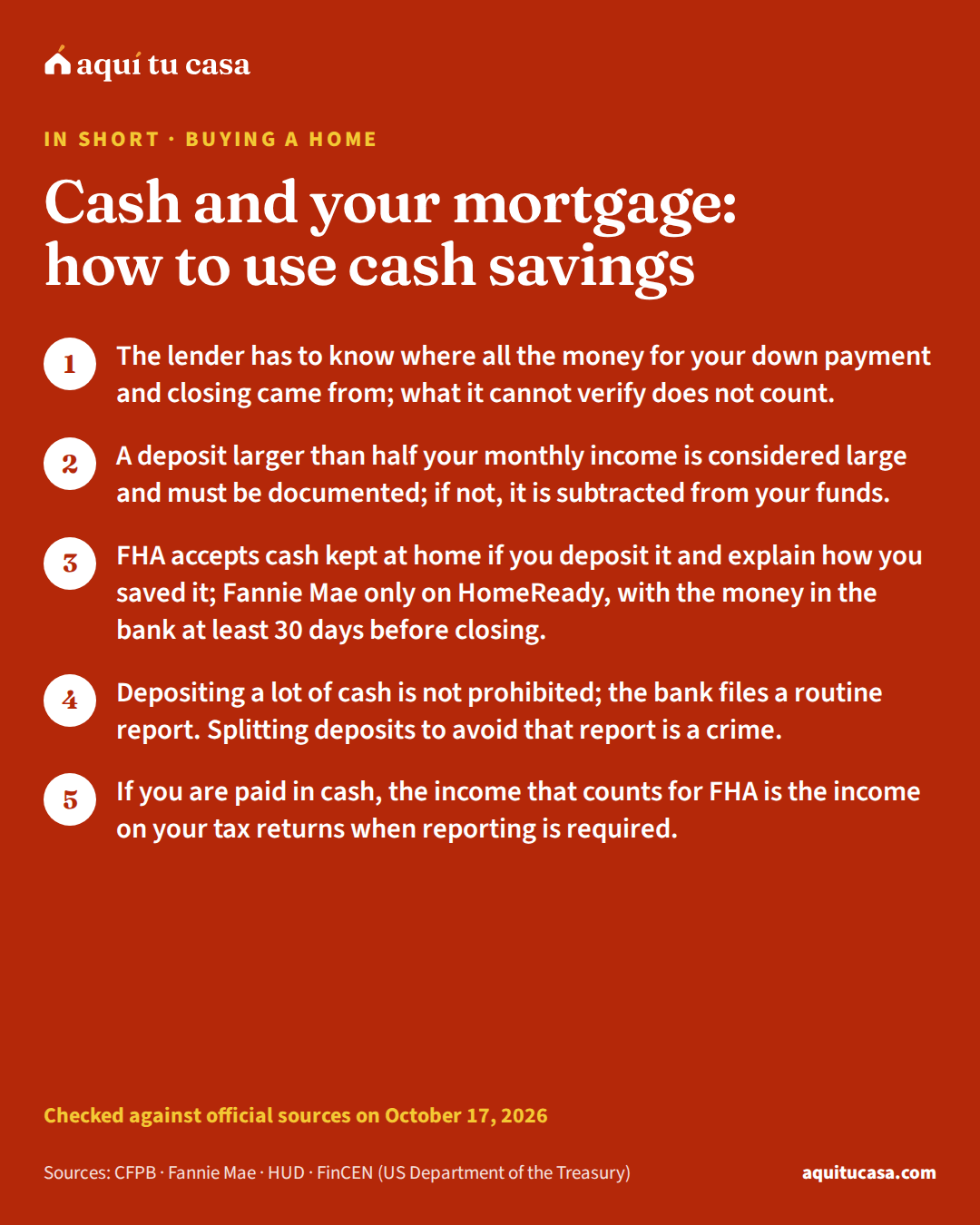
- Buying a home Cash and your mortgage: how to use cash savings If you save or get paid in cash: why the lender asks where your money came from, what a large deposit is and how to move your cash into the bank. 11 minute read
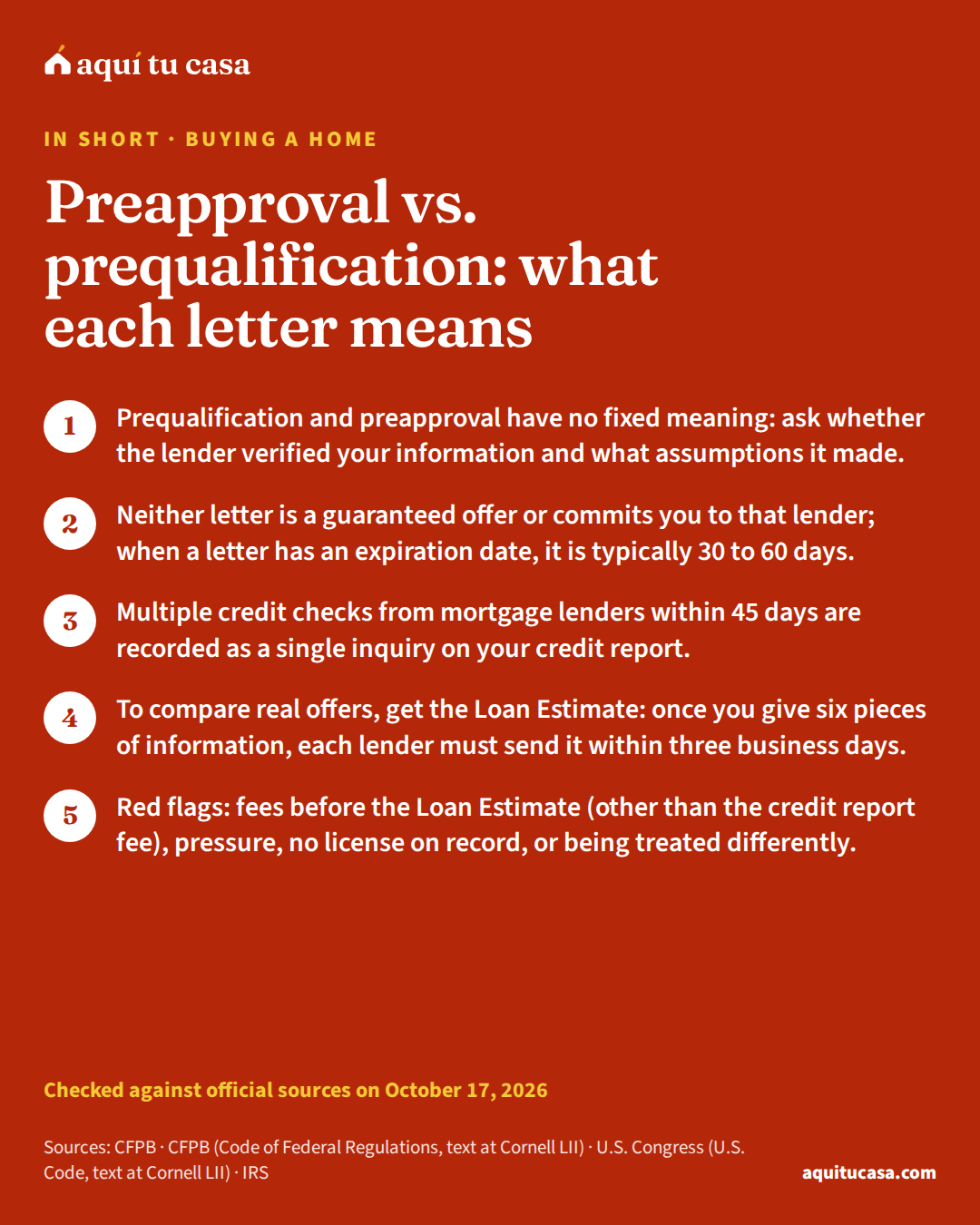
- Buying a home Preapproval vs. prequalification: what each letter means What prequalification and preapproval letters are, what lenders check, why neither one is a loan, and how to compare lenders without hurting your credit. 14 minute read
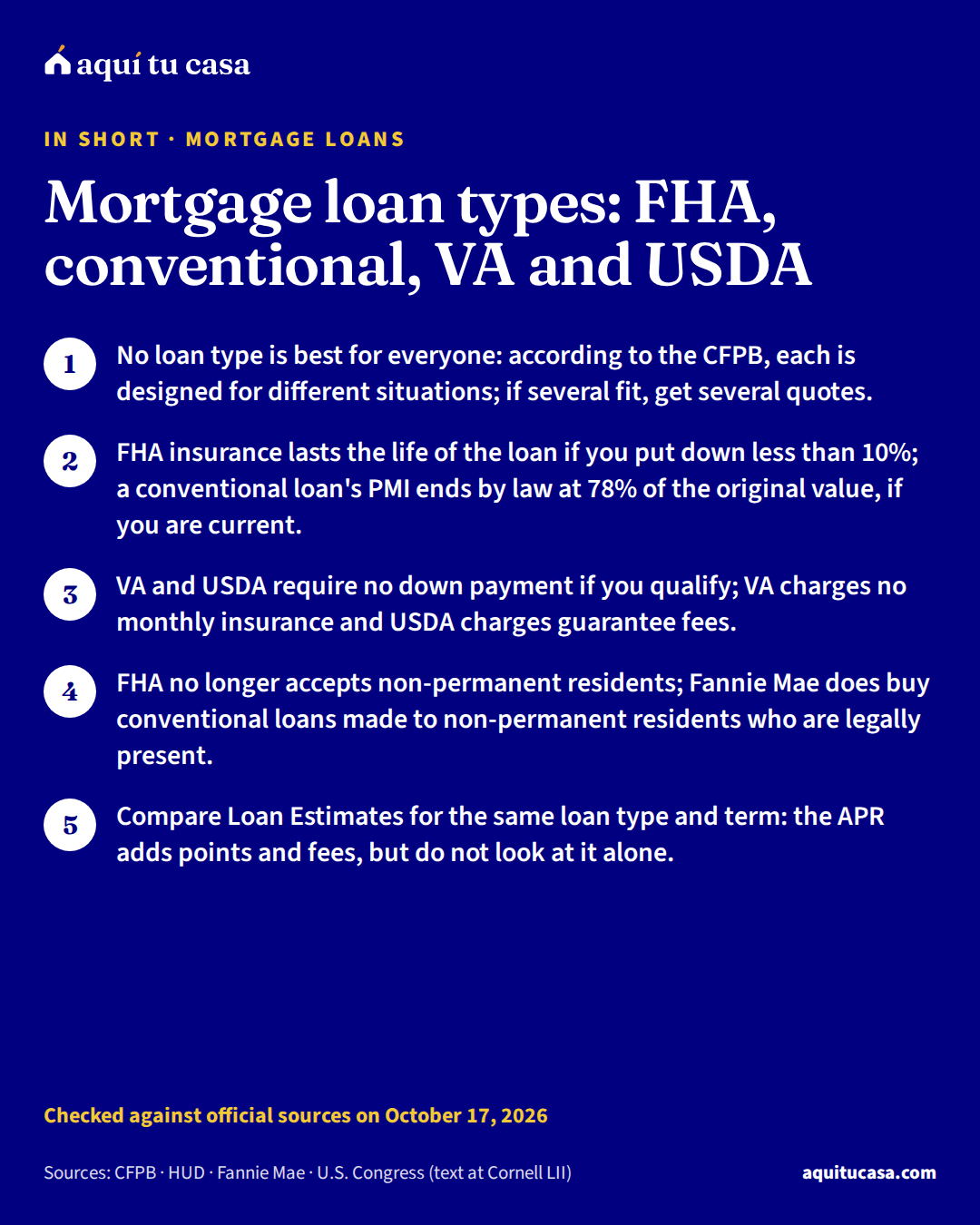
- Mortgage loans Mortgage loan types: FHA, conventional, VA and USDA What each mortgage type asks for, what its insurance costs, fixed or adjustable rate, points and APR. A neutral comparison with official sources. 14 minute read
Tools for this topic
Was this guide useful?
Thank you. Your answer stays in your browser; nothing is sent.