Homebuyer education courses: when you need one
What a homebuyer education course is, when Fannie Mae, Freddie Mac and assistance programs require one, and where to take it for free or in Spanish.
Verified against official sources on October 17, 2026 10 official sources

Show contents
In short
What you need to know
Quick answer
A homebuyer education course is a class with a curriculum on the homebuying process, budgeting, credit and maintaining a home. Your loan may require one (for example, Fannie Mae requires it before closing if all borrowers are first-time buyers with a very small down payment, or if no one has a credit history), or your down payment assistance program may. HUD-approved agencies offer them, often free or at low cost, and there are free online courses, such as Freddie Mac's CreditSmart Homebuyer U, with lessons in Spanish.
What matters most
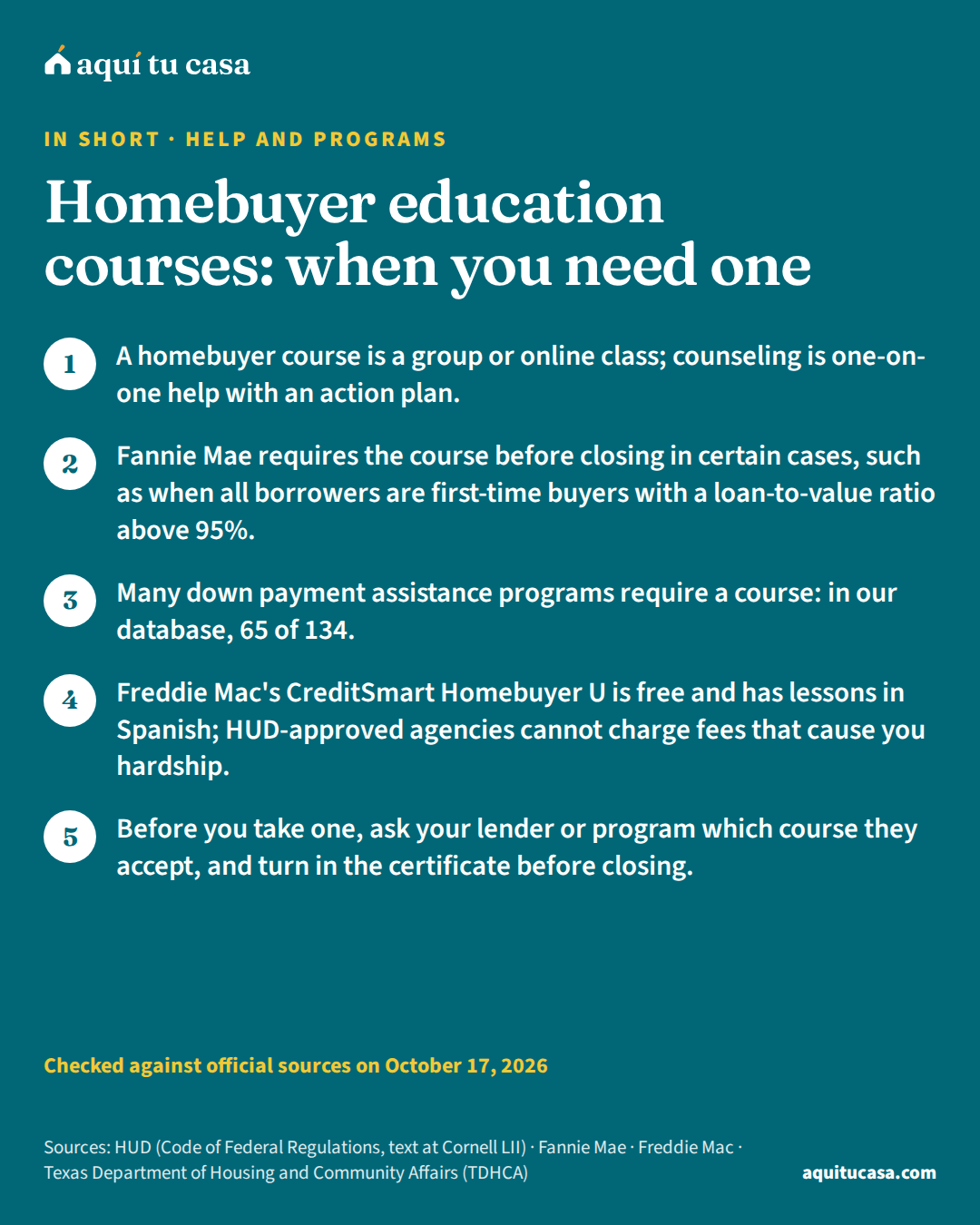
- A homebuyer course is a group or online class; counseling is one-on-one help with an action plan.
- Fannie Mae requires the course before closing in certain cases, such as when all borrowers are first-time buyers with a loan-to-value ratio above 95%.
- Many down payment assistance programs require a course: in our database, 65 of 134.
- Freddie Mac's CreditSmart Homebuyer U is free and has lessons in Spanish; HUD-approved agencies cannot charge fees that cause you hardship.
Is this for you?
This guide is for you if…
- You are about to buy your first home and were told you need a «homebuyer course» or a certificate.
- You want to use a down payment assistance program and the program requires a course.
- You want to prepare before you shop for a home and prefer to learn in Spanish.
Get direct help first if…
- You are already behind on your mortgage: what you need is foreclosure prevention counseling; start with the guide on what to do if you cannot pay your mortgage.
- You are looking for a counselor for your own situation: see the guide to HUD-approved housing counselors.
Many loans and assistance programs for buying a home require a “homebuyer education course” before closing. This guide is for you if you were asked to take one or want to prepare: it explains what it is, how it differs from counseling, when it is required, where to take it for free or in Spanish and what to do with the certificate. All of it based on what HUD, Fannie Mae, Freddie Mac and the programs themselves say.
What a homebuyer course is
A homebuyer education coursehomebuyer education courseA homebuyer education course is a class with a set curriculum that covers the homebuying process, how to maintain a home, budgeting and why good credit matters. It can be in a group, in person, online or by phone. It is not the same as housing counseling, which is one-on-one help with an action plan for your situation. Some loans and some down payment assistance programs require you to finish a course before closing, especially first-time homebuyers. When you finish, you get a certificate.See the full definition is a class, not a one-on-one appointment. HUD’s rule calls it “education”: formal classes with a curriculum and goals, in a group or classroom, on topics such as the homebuying process, how to maintain a home, budgeting, fair housing, how to recognize and report predatory lending and the importance of good credit.1 Fannie Mae defines it the same way and adds that it can also be given in other formats.4
Counseling is something else: help from a counselor for your particular situation, focused on specific obstacles such as repairing your credit or finding money for a down payment, and always with an action plan.1 For Fannie Mae, counseling includes a budget and a written action plan, plus an education component.4
Course or counseling
Education
Homebuyer course
If you are asked for a course and also want help with your numbers, counseling gives you both.410
When you are asked for one
It depends on your loan and your program. On loans Fannie Mae buys, at least one borrower must finish the education before closing in these cases: if no borrower has at least one credit or installment account on their report; if, in a manually underwritten loan, no one has a credit score; on a HomeReady purchase when everyone who will live in the home is a first-time buyer; or on a purchase with a loan-to-value ratioloan-to-value ratio (LTV)The loan-to-value ratio (LTV) compares the amount of your mortgage with the appraised value of the property. It is expressed as a percentage: a loan that covers almost the whole value has a high LTV; one with a large down payment, a low LTV. Lenders use it to measure risk: the higher the LTV, the stricter the requirements and the more likely you will be asked for mortgage insurance. Over time, as you pay down principal or the home gains value, your LTV falls, which can let you cancel PMI on a conventional loan.See the full definition above 95% when all borrowers are first-time buyers.4
Freddie Mac has an education requirement for its Home Possible and HomeOne mortgages, and says the certificate from its free CreditSmart Homebuyer U course meets it.5
Many down payment assistancedown payment assistance (DPA)Down payment assistance (DPA) is money a public or nonprofit program contributes toward your down payment and sometimes your closing costs. Many states, local governments and nonprofits offer programs to make homeownership more affordable; most focus on low- and moderate-income families buying their first home, and some target teachers, firefighters and other public service employees. The help can be a grant you never repay, a second loan with no payments that is forgiven over the years or repaid when you sell, and many can be used with a regular FHA or conventional loan.See the full definition programs also require one. Of the 134 programs in our database, 65 say in their official source that they require a course. Two examples: the Texas agency (TDHCA) says completing an approved course is required to qualify for its program’s assistance,7 and the Connecticut agency (CHFA) requires one of its workshops for anyone getting a CHFA loan.8 The which programs do I qualify for tool finds programs for you, and each program’s page under assistance programs says whether it requires a course.
If this is you
Everyone is a first-time buyer
With Fannie Mae, if the loan-to-value ratio is above 95% or the loan is HomeReady, someone must take the course before closing.4
No one has a credit history
Fannie Mae requires the course if no borrower has a credit account on their report.4 See also credit from zero.
You prefer to learn in Spanish
CreditSmart Homebuyer U has lessons in Spanish; the printable certificate is in English.6
Where to take it
You have three common routes, and all three can work; what matters is that your lender or program accepts the course.
A HUD-approved counseling agency. Some give homebuyer workshops. By rule, agencies that give group sessions must also offer individual counseling on the same topics.2 The CFPB says not every counselor offers every service, so check each agency’s list of services.10 The guide to HUD-approved housing counselors explains how to find one who speaks Spanish.
Your state housing agency’s course. Some agencies have their own. Connecticut’s, for example, says its workshops are free, that HUD-approved counselors give them on weekday evenings and Saturdays, that some agencies hold them virtually and some in Spanish, and that you get a certificate when you finish.8
An online course. Freddie Mac’s CreditSmart Homebuyer U is free, online and self-paced: you can pause and continue on several devices, lessons are in English and Spanish, and the certificate can be sent to your lender and your co-borrower. The printable certificate is in English.6
For Fannie Mae loans, any qualified third-party provider independent of the lender can give the course, in person, online, by phone or hybrid, with content aligned with national or HUD standards. The lender confirms the course and keeps a copy of your certificate.4
HUD-approved counseling agencies by state
| State | HUD-approved counselors |
|---|---|
| Alabama | 25 |
| Alaska | 1 |
| Arizona | 21 |
| Arkansas | 14 |
| California | 81 |
| Colorado | 26 |
| Connecticut | 13 |
| Delaware | 12 |
| District of Columbia | 17 |
| Florida | 98 |
| Georgia | 42 |
| Hawaii | 17 |
| Idaho | 10 |
| Illinois | 81 |
| Indiana | 21 |
| Iowa | 11 |
| Kansas | 3 |
| Kentucky | 19 |
| Louisiana | 26 |
| Maine | 7 |
| Maryland | 41 |
| Massachusetts | 37 |
| Michigan | 59 |
| Minnesota | 33 |
| Mississippi | 16 |
| Missouri | 18 |
| Montana | 11 |
| Nebraska | 8 |
| Nevada | 8 |
| New Hampshire | 5 |
| New Jersey | 34 |
| New Mexico | 7 |
| New York | 93 |
| North Carolina | 52 |
| North Dakota | 3 |
| Ohio | 54 |
| Oklahoma | 6 |
| Oregon | 25 |
| Pennsylvania | 75 |
| Puerto Rico | 9 |
| Rhode Island | 5 |
| South Carolina | 13 |
| South Dakota | 13 |
| Tennessee | 32 |
| Texas | 51 |
| Utah | 7 |
| Vermont | 7 |
| Virginia | 49 |
| Washington | 15 |
| West Virginia | 8 |
| Wisconsin | 26 |
| Wyoming | 1 |
Some give homebuyer workshops; check each agency's services.10 Source: HUD

What it costs
There are no-cost options. Freddie Mac says CreditSmart resources are completely free,5 and the Connecticut agency offers its workshops for free.8
HUD-approved agencies may charge reasonable and customary fees for education and counseling, as long as the cost does not cause you financial hardship. They must post their fees, tell you before providing the service and cannot charge you for intake. If they charge, they must provide counseling at no cost to people who cannot afford it.3 The CFPB sums it up: these agencies give independent advice, often at little or no cost.10

What you learn
These are the topics the sources describe. According to HUD, education covers the homebuying process, maintaining a home, budgeting, fair housing, identifying predatory lending and the importance of credit.1 CreditSmart Homebuyer U, for example, goes from an introduction to the homebuying process to managing money, credit, getting a mortgage, finding a home and closing, and keeping your home.6
Homeownership counseling, when you ask for it, covers the whole process: the decision to buy, choosing and buying a home, the inspection and what comes after.2 If you want the numbers side, the guide on how to buy a home step by step follows the same order.
From the course to closing, step by step
From the course to your certificate in the loan file
1. Ask which course they accept
Before you enroll
Your lender confirms the course is aligned with the standards; your program may require its own.4
2. Pick the format
In person, online or by phone
For Fannie Mae, in person, online, by phone or hybrid all count.4
3. Take the course at your pace
Well before closing
With CreditSmart you can pause and pick up where you left off.6
4. Keep the certificate
When you finish
The certificate of completion is what meets the requirement.8
Try it with your numbersDocument checklist6. If you want more help, ask for counseling
Any time
A HUD-approved agency helps you with your budget and an action plan.4

The certificate: your proof that you finished
What meets the requirement is not having attended the class, but the certificate of completion. On Fannie Mae loans, the lender keeps a copy in your file.4 CreditSmart Homebuyer U can send the certificate to your lender, your housing professional and your co-borrower, and the printable certificate is in English.6 In Connecticut, those who finish the workshop receive a certificate that meets the requirement of their CHFA loan.8 There, one of the workshops is not needed if you took the other within the past 12 months, and the pre-purchase workshop is free for anyone who lives in the state.8
Keep the certificate on paper and digitally, with the date you finished. If your purchase is delayed, ask your lender or program whether the certificate is still good or whether you need to repeat the course.
Questions to ask before you enroll
Before you pay or spend hours on a course, it helps to have these answers. HUD-approved agencies must tell you their fees before providing the service.3
- Do my lender and my assistance program accept this course?
- How much does it cost and what does that price include?
- Is it in person, online or by phone? Are there classes or materials in Spanish?
- How long does it take and can I do it at my own pace?
- How and when do I get the certificate? Do you send it straight to my lender?
- How long is the certificate valid?
- Do you also offer one-on-one counseling if I need it later?

Common mistakes
Mistake: Taking any course without asking whether it is accepted.
Instead: Ask your lender or program; the content must be aligned with the standards.4
Mistake: Taking CreditSmart Essentials thinking it is the homebuyer course.
Instead: The one that gives the certificate for buying is CreditSmart Homebuyer U.5
Mistake: Leaving the course for the last week.
Instead: When it is required, it must be finished before closing.4
Mistake: Paying without asking the price.
Instead: HUD-approved agencies must tell you their fees before the service.3
Mistake: Losing the certificate.
Instead: Keep it on paper and digitally; the lender needs a copy.4
The CFPB notes that many states and local organizations help first-time buyers, and that a HUD-approved counseling agency or the HOPE Hotline, (888) 995-4673, can help you find those programs.9 If you will use a Mortgage Credit Certificate or down payment assistance, ask whether they require a course from the start.
What to do this week
- Ask your lender or assistance program whether they require a course and which one they accept.4
- Find programs with the which programs do I qualify for tool and check on each program’s page whether it requires a course.7
- If you prefer online and in Spanish, look at CreditSmart Homebuyer U, which is free.6
- If you prefer in person, look for a HUD-approved agency and ask about its workshops and fees.3
- Keep your certificate and give it to your lender before closing.4
Your numbers
The minimum for this loan is 3.5%. More down lowers the monthly payment.
Adjust advanced details
First number: share of income for housing. Second: housing plus debts. Lender references, not fixed rules.
Let's do the math
Estimated top price
National figure$227,000
Limited by the housing payment: at that price it would be about $1,883 a month, 28% of your income.
- By the housing payment (28% of income)Limits you$227,000
- By your total debts (36% of income)$292,000
- By your cash (down payment + closing)$330,500
- Typical home in the United States
- $332,700
- Your cap is 68% of the typical home.
What changes if…?
- …you save $10,000 more$227,000
- …you cut $200 a month in debts$227,000
Your maximum price with four loans
Same income, debts and savings; only the down payment and the loan type change. ITIN uses an example down payment and rate.
| FHA 3.5% | Conventional 5% | Conventional 20% | ITIN 15% (example) | |
|---|---|---|---|---|
| Maximum price | $227,000 | $232,000 | $93,000 | $119,000 |
| Payment per month | $1,883 | $1,882 | $616 | $898 |
Educational estimate, not a pre-approval. Uses example insurance (0.5% of value per year) and example closing costs (3% of price); the tax is the place’s typical rate.
Ready to see the numbers? Find your county here
See how this applies in your county: its loan limits, prices and rents, from the official data.
Printable checklist
Frequently asked questions
Do I have to take a course to buy a home?
Not always: it depends on the loan and the program. Fannie Mae requires it before closing in certain cases, for example if all borrowers are first-time buyers with a loan-to-value ratio above 95%, or if none of them has a credit history. Many assistance programs also require one: in our database, 65 of 134 programs.
How much does a homebuyer course cost?
There are free options: Freddie Mac's CreditSmart is completely free, and some state agencies, such as Connecticut's, offer free workshops. HUD-approved agencies may charge reasonable fees, but they must tell you first, cannot charge for intake and must provide counseling without charge to people who cannot afford it.
Are there homebuyer courses in Spanish?
Yes. Freddie Mac's CreditSmart Homebuyer U has lessons in English and Spanish, although the printable certificate is in English. Some counseling agencies give workshops in Spanish; for example, the Connecticut agency says some of them do.
Can I take the course online?
For Fannie Mae, the course can be in person, online, by phone or hybrid, as long as the content is aligned with national or HUD standards. CreditSmart Homebuyer U is online and self-paced.
What is the difference between a course and housing counseling?
A course is a class with a curriculum, in a group or online. Counseling is one-on-one help for your situation, with a budget and a written action plan. For Fannie Mae, counseling from a HUD-approved agency also meets the course requirement.
Can my lender give me the course?
For Fannie Mae loans, the course is given by a qualified third-party provider independent of the lender. Ask your lender which courses it accepts before you enroll.
When should I take the course?
Before closing. Fannie Mae asks that at least one borrower complete it before closing when the requirement applies, and some programs require it to qualify. Taking it early leaves time to get and turn in the certificate.
Does CreditSmart Essentials count as a homebuyer course?
No. Freddie Mac says CreditSmart Essentials is not a homeownership education course. The one that gives the certificate for buying is CreditSmart Homebuyer U.
Sources
Every figure in this guide comes from one of these official sources. The number next to a sentence leads to the source behind it.
Each source on one line: who publishes it, its title, its address and the date we read it.
- 1. HUD (Code of Federal Regulations, text at Cornell LII) · 24 CFR §214.3, Definitions (Housing Counseling Program) · law.cornell.edu · Accessed October 17, 2026
- 2. HUD (Code of Federal Regulations, text at Cornell LII) · 24 CFR §214.300, Counseling services · law.cornell.edu · Accessed October 17, 2026
- 3. HUD (Code of Federal Regulations, text at Cornell LII) · 24 CFR §214.313, Housing counseling fees · law.cornell.edu · Accessed October 17, 2026
- 4. Fannie Mae · Selling Guide B2-2-06, Homeownership Education and Housing Counseling · selling-guide.fanniemae.com · Accessed October 17, 2026
- 5. Freddie Mac · CreditSmart: Frequently asked questions · creditsmart.freddiemac.com · Accessed October 17, 2026
- 6. Freddie Mac · CreditSmart Homebuyer U · creditsmart.freddiemac.com · Accessed October 17, 2026
- 7. Texas Department of Housing and Community Affairs (TDHCA) · TDHCA Homebuyer Programs · welcomehome.tdhca.texas.gov · Accessed October 17, 2026
- 8. Connecticut Housing Finance Authority (CHFA) · Homebuyer / Rental Education · chfa.org · Accessed October 17, 2026
See the other 2 sources
- 9. CFPB · Where can I find information on programs for first-time home buyers? · consumerfinance.gov · Accessed October 17, 2026
- 10. CFPB · Find a Housing Counselor · consumerfinance.gov · Accessed October 17, 2026
Keep reading
Related guides
If this guide helped, these follow the same path.

Help and programs 11 minute read
HUD housing counselors: what they do and what they cost
What a HUD-approved housing counselor does, what they help with (buying, renting, missed payments, credit), what they may charge and how to find one.
- Independent, expert advice: they are not lenders or agents, and the regulation requires intake, an analysis, an action plan and follow-up.
- Intake is not charged; fees must be reasonable, disclosed in advance and waived for anyone who cannot pay.
- Foreclosure prevention counseling is free at HUD-approved agencies.
- Help and programs Down payment assistance: how it works What down payment assistance is, the types that exist (grant, forgivable or deferred second loan, tax credit), who qualifies and where to find it. 12 minute read
- Help and programs Mortgage Credit Certificates (MCC): how they work What an MCC is, how much it can cut your federal tax, who issues it, how to claim it on Form 8396 and when you might repay part of it if you sell. 11 minute read
- Buying a home How to buy a home in the United States, step by step The nine steps to buying a home: paperwork, credit, budget, assistance, preapproval, offer, inspection, closing and the first year, with official sources. 15 minute read
Tools for this topic
Was this guide useful?
Thank you. Your answer stays in your browser; nothing is sent.