Gift money from family to buy a home
Who can give you money for the down payment, what the gift letter must say, how the transfer is documented and what happens with taxes.
Verified against official sources on October 17, 2026 12 official sources

Show contents
In short
What you need to know
Quick answer
Yes: your family can give you money for the down payment and closing costs, and on many loans all of that money can be a gift. The lender asks for a signed gift letter with the donor's name, address, phone number and relationship to you, the amount and a statement that it does not have to be repaid, plus proof of how the money moved from the donor's account to yours or to the closing agent. On an FHA loan, the gift cannot be cash kept at home. Generally, if there is gift tax, the giver pays it.
What matters most
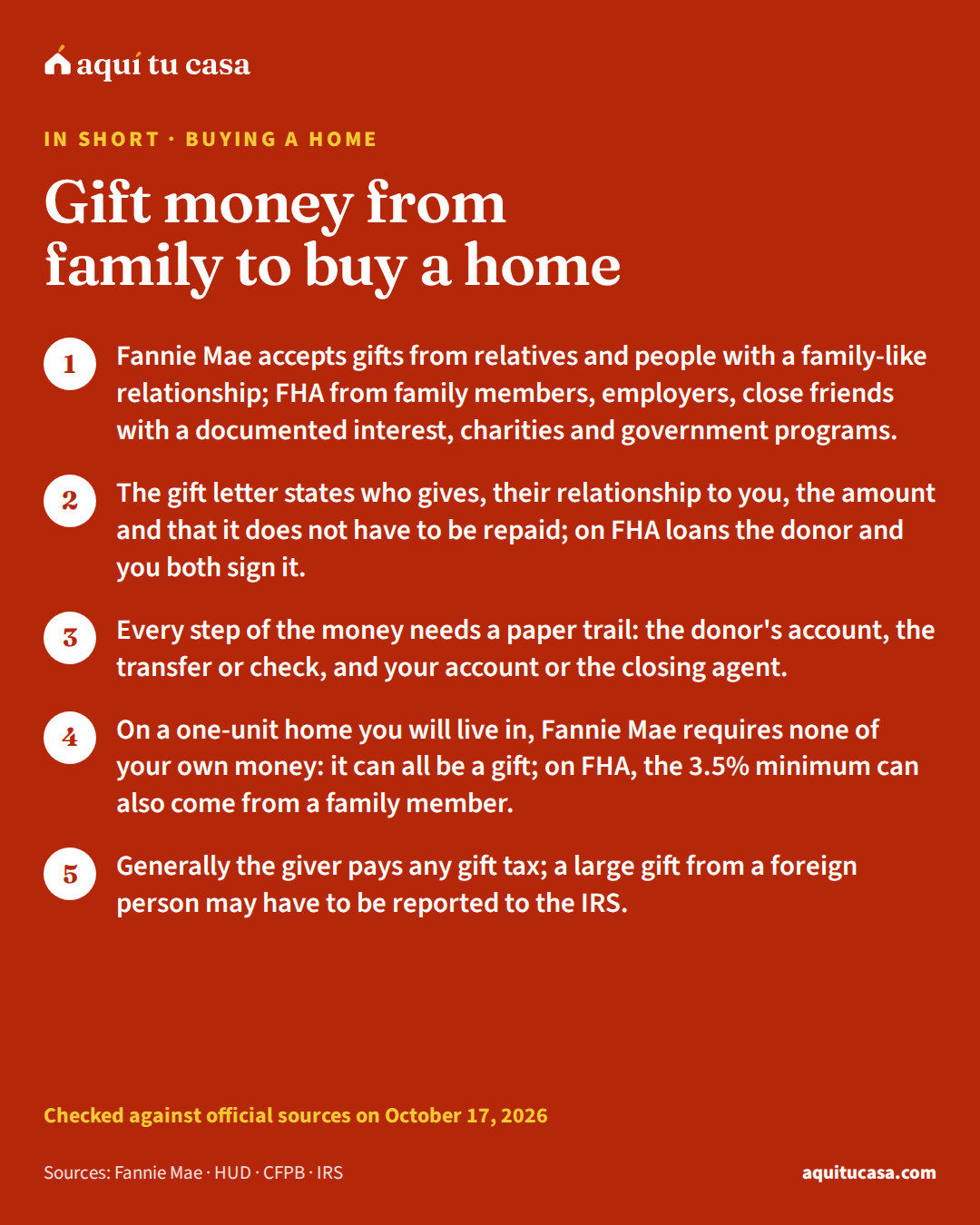
- Fannie Mae accepts gifts from relatives and people with a family-like relationship; FHA from family members, employers, close friends with a documented interest, charities and government programs.
- The gift letter states who gives, their relationship to you, the amount and that it does not have to be repaid; on FHA loans the donor and you both sign it.
- Every step of the money needs a paper trail: the donor's account, the transfer or check, and your account or the closing agent.
- On a one-unit home you will live in, Fannie Mae requires none of your own money: it can all be a gift; on FHA, the 3.5% minimum can also come from a family member.
Is this for you?
This guide is for you if…
- Your parents, grandparents or another relative want to help with the down payment or closing costs.
- The lender asked you for a gift letter and you do not know what it must say.
- You are buying a home from a relative who mentioned a «gift of equity».
Get direct help first if…
- The money is a loan you will pay back: for the lender, a gift is money you do not repay; a loan is treated differently.
- You are looking for help from a government program or an organization: start with the down payment assistance guide.
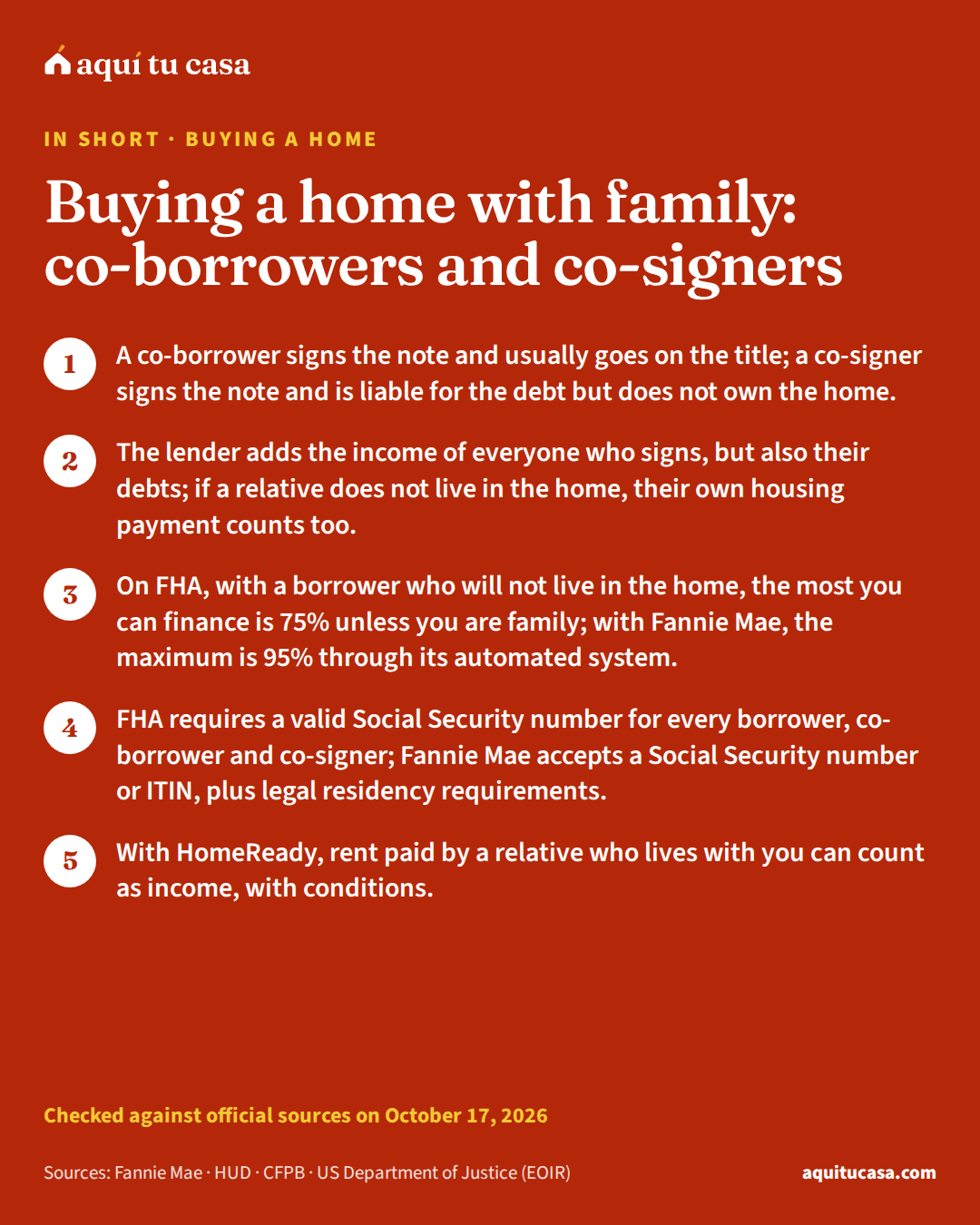
- Your relative will sign the loan with you: the guide on buying with family as co-borrowers covers that option.
Many families help each other buy a home. This guide is for you if your parents, grandparents or another relative want to give you money for the down paymentdown paymentThe down payment is the part of the home's price you pay out of your own pocket when you buy; the loan covers the rest. In U.S. Spanish it is also called enganche, cuota inicial or entrada. Each loan type has its own minimum: FHA requires at least 3.5% of the value, VA and USDA loans may require none, and conventional loans ask for more if you want to avoid private mortgage insurance. A larger down payment lowers the loan, the monthly payment and the total interest; many state programs help families put it together.See the full definition or closing costs. You will see who can give, what the gift lettergift letterA gift letter is a document signed by the person who gives you money to buy a home, stating that the money is a gift and not a loan. For some loans, a gift can pay the down payment, closing costs or reserves, as long as you can prove where the money came from. Under Fannie Mae's rules, the letter states the amount of the gift, says no repayment is expected, and gives the donor's name, address, phone number and relationship to you. The lender also verifies that the money moved from the donor's account to yours or to the closing agent.See the full definition must say, how the money has to move for the lender to accept it, and what happens with taxes.
- Of the home's value, your minimum investment on an FHA loan
- 3.5%5
- Of your own money on a one-unit home you live in with Fannie Mae, if the rest is a gift
- None1
- Of your own money with Fannie Mae on a 2- to 4-unit home with more than 80% financing
- 5%1
- In gifts from a nonresident alien in a year; above that, it is reported to the IRS
- $100,0008
Who can give you money
Not just anyone can give a gift toward your loan. Each program has its list.
For Fannie Mae, which backs many conventional loansconventional loanA conventional loan is any mortgage that is not insured or guaranteed by the federal government: it is not FHA, VA or USDA. The lender, or the companies that buy the loans (Fannie Mae and Freddie Mac), carry the risk. When the amount is within the conforming loan limit the loan is called "conforming"; above it, it is a "jumbo" loan. It usually asks for a higher credit score than an FHA loan and, if your down payment is less than 20% of the price, you are normally required to buy private mortgage insurance (PMI) until you build enough equity in the home.See the full definition, the gift can come from a relative: your spouse, your children or other dependents, or anyone related to you by blood, marriage, adoption or legal guardianship. It can also come from a non-relative with a family-like relationship: your domestic partner or one of their relatives, your fiancé or fiancée, a former relative, or someone with a long-standing family-like or mentorship relationship with you. The donor cannot be, or be tied to, the builder, the real estate agent or another party with an interest in the sale.1
On an FHA loanFHA loanAn FHA loan is a mortgage made by a private lender and insured by the Federal Housing Administration (FHA), an agency of the U.S. government. That insurance protects the lender if you stop paying, which is why the lender can accept a lower down payment and a less-than-perfect credit history than on a conventional loan. Federal law sets the minimum cash investment at 3.5% of the property's value and caps the loan amount at the FHA limit, which changes by county. In exchange for the insurance you pay a mortgage insurance premium.See the full definition, a gift is cash or equity you are not expected to repay. It can come from a family member, your employer or union, a close friend with a clearly defined and documented interest in you, a charity, or a government program that helps low- or moderate-income families or first-time buyers.5 FHA defines “family member” with a list: children, parents and grandparents (including step and foster), a spouse or domestic partner, adopted or foster children, brothers and stepbrothers, sisters and stepsisters, uncles and aunts, and in-laws.5
With Fannie Mae, gifts can be used to buy a principal residence or a second home, not an investment property.1
The gift letter: what it must say
The gift letter is the proof that the money is a gift and not a loan. The CFPB suggests asking whoever gives you the money for a signed statement saying it was a gift.6 Fannie Mae and FHA ask for almost the same things:
| Must include | Fannie Mae | FHA |
|---|---|---|
| Donor’s name, address and phone number | Yes | Yes |
| Donor’s relationship to you | Yes | Yes |
| Gift amount | The actual or maximum amount | The amount |
| That it does not have to be repaid | Yes | Yes |
| Who signs | The donor | The donor and you, dated |
Fannie Mae wants the letter to state the actual or maximum amount, the donor’s statement that no repayment is expected, and the donor’s name, address, phone number and relationship to you.1 On an FHA loan, the donor and you both sign and date the letter, with the same details and a statement that no repayment is required.5
How the money has to move to count
The letter alone is not enough. The lender also needs to see the money’s path: where it came from and where it landed.
From the donor to closing, step by step
1. Confirm the donor is acceptable
Before you apply
A relative or someone with a family-like relationship for Fannie Mae; a family member, employer or close friend for FHA.5
2. Sign the gift letter
When the lender asks
With the donor's details, the amount and the statement that it does not have to be repaid.1
Try it with your numbersDocument checklist3. The donor shows the money in their account
Before the transfer
The lender verifies the money is in the donor's account or has already moved to yours.1
4. The money moves to your account with proof
Before closing
With the donor's check and your deposit slip, or proof of the transfer.5
5. Or it goes straight to the closing agent
Closing day
By electronic transfer, certified check, cashier's check or other official check.1
6. Confirm the instructions by phone
Before any wire
Never follow wiring instructions that arrive by email.10
Fannie Mae accepts, for example, a copy of the donor’s check and your deposit slip, or proof of an electronic transfer from the donor’s account to yours or to the closing agentsettlement agentThe settlement agent (also called a closing agent) is the person or company that coordinates the closing so that everything the contract requires is accounted for. Depending on the location, it may be a title company, an escrow company (in most western states) or a closing attorney (in some eastern states). It collects the money from the lender and from you, pays the seller, distributes the closing costs and records the documents with the county. It works for all the parties; it is not your personal representative. Ask it how to pay the money you need to bring to closing.See the full definition. If the money does not move before closing, the lender documents that the donor gave it to the closing agent by wire, certified check or cashier’s check.1 FHA asks for similar proof: the donor’s statement showing the withdrawal and your deposit, the canceled check, or the transfer. And no matter when the money arrives, the lender must be able to conclude it did not come from an unacceptable source.5
If you deposit a large gift into your account, the lender will ask you to document it. Fannie Mae even mentions a wedding invitation as proof that you received gifts.3

How much can be a gift
It depends on the loan and the home. With Fannie Mae, on a one-unit principal residence you do not have to put in any of your own money: everything you need to close can come from a gift. On a two- to four-unit home or a second home, with a loan-to-value ratioloan-to-value ratio (LTV)The loan-to-value ratio (LTV) compares the amount of your mortgage with the appraised value of the property. It is expressed as a percentage: a loan that covers almost the whole value has a high LTV; one with a large down payment, a low LTV. Lenders use it to measure risk: the higher the LTV, the stricter the requirements and the more likely you will be asked for mortgage insurance. Over time, as you pay down principal or the home gains value, your LTV falls, which can let you cancel PMI on a conventional loan.See the full definition above 80%, you must put in 5% of your own money. If the donor has lived with you for the last 12 months and both of you will live in the new home, their gift counts as your own money.1
On an FHA loan, your minimum investment is at least 3.5% of the home’s value. That money can come from a family member as a gift, but not from the seller, anyone else who benefits from the sale, or anyone they reimburse.5
Example with real numbers
The cash to close a typical home with FHA
With the typical US home value, the FHA minimum down payment and the closing cost range Freddie Mac gives. A relative could give all or part of it.
- Home price (typical US value)
- $332,700
- FHA minimum down payment (3.5%)
- $11,645
- Closing costs (Freddie Mac range)
- $6,654 to $16,635
- Cash to close, before credits
- $18,299 to $28,280
This is an example with national numbers.9 On FHA, the minimum investment can come from a family member as a gift, with a gift letter and proof of the transfer.5
Run it with your numbersDown payment savings plan
If your family cannot cover everything, there are other options. According to the CFPB, many states and local organizations help first-time buyers with the down payment or closing costs; to find them it suggests a HUD-approved counseling agency or the HOPE Hotline, (888) 995-4673.11 The down payment assistance guide explains how they work, and the which programs do I qualify for tool searches for programs. The guide on how much down payment you need compares each loan’s minimums.
If you buy from a relative: the gift of equity
When you buy the home from your mother, your grandfather or another relative, the seller can give you a “gift of equity.” For Fannie Mae, it is part of the seller’s equity in the home passed to the buyer as a credit in the purchase. It can go toward the down payment and closing costs, but not reserves. The same donor and minimum contribution rules apply, and it is documented with a signed gift letter and the settlement statement showing it.2
On an FHA loan, only a family member can give equity as a gift when selling the home to another family member, with the same letter signed and dated by both of you.5

Taxes and gifts from abroad
Do you pay tax on a gift you receive? According to the IRS, if there is gift tax, the giver generally pays it, although under special arrangements the recipient may. Gifts that do not exceed the annual exclusion for the year are not taxable gifts, and the exclusion is counted per recipient. The gift tax return is Form 709.7 The IRS publishes the exclusion amount each year.
If the money comes from a relative who lives in another country, there are two things to check. First, the lender: Fannie Mae requires documenting the source of all the money, with foreign documents in English or translated, and funds from assets outside the US must be exchanged into dollars and held in a US financial institution, verified before closing.4 Second, the IRS: if you are a US person for tax purposes and in one year receive more than $100,000 from a nonresident alien (adding what people related to them give you), you must report it on Part IV of Form 3520, generally by April 15. Filing late or incomplete can bring penalties.8
If this is you
Your parents are helping with the down payment
Fannie Mae and FHA accept gifts from parents and grandparents with a letter and proof of the transfer.1
The money comes from another country
It must arrive in dollars at a US financial institution before closing, with documents in English or translated.4 If you receive remittances, keep the receipts.
You are a first-time buyer
Besides a gift, there are state and local programs for the down payment and closing costs.11
Your family cannot help
On FHA, a charity or a government program can also give the gift.5
Mistakes that can stall your loan
Mistake: Taking the gift as cash kept at home.
Instead: On FHA that cash does not count; have it come from the donor's account.5
Mistake: Depositing the gift with no letter and no proof of how the money moved.
Instead: Gather the letter, the check or transfer, and your deposit record.5
Mistake: Calling money you will pay back a gift.
Instead: The letter says it does not have to be repaid; if it is a loan, say so.1
Mistake: Taking help from the agent or builder as a «gift».
Instead: The donor cannot be tied to a party with an interest in the sale.1
Mistake: Wiring the money to closing with instructions that came by email.
Instead: Confirm the account by phone at a number you already knew.10
If you want to go over your numbers with someone, a HUD-approved housing counselorHUD-approved housing counselorA HUD-approved housing counselor works at an agency HUD has approved to provide housing counseling: independent, expert advice customized to your situation about buying a home, renting, a missed mortgage payment, a foreclosure or credit problems. The agencies usually charge little or nothing; many serve in Spanish and offer the homebuyer education course several assistance programs require. They are not lenders or real estate agents and sell you nothing. Your county page lists the official agencies with phone numbers.See the full definition gives independent advice, often free or at low cost.12
What to do this week
- Talk with your relative and confirm they can be a donor on the loan you want.1
- Ask the lender whether it has a gift letter form, and check together that it has every detail.5
- Decide whether the money will move to your account before closing or go straight to the closing agent, and keep every receipt.1
- If the money comes from another country, plan early for the exchange into dollars and the transfer to a US account.4
- Figure out how much you need with the down payment savings plan and the closing cost calculator.
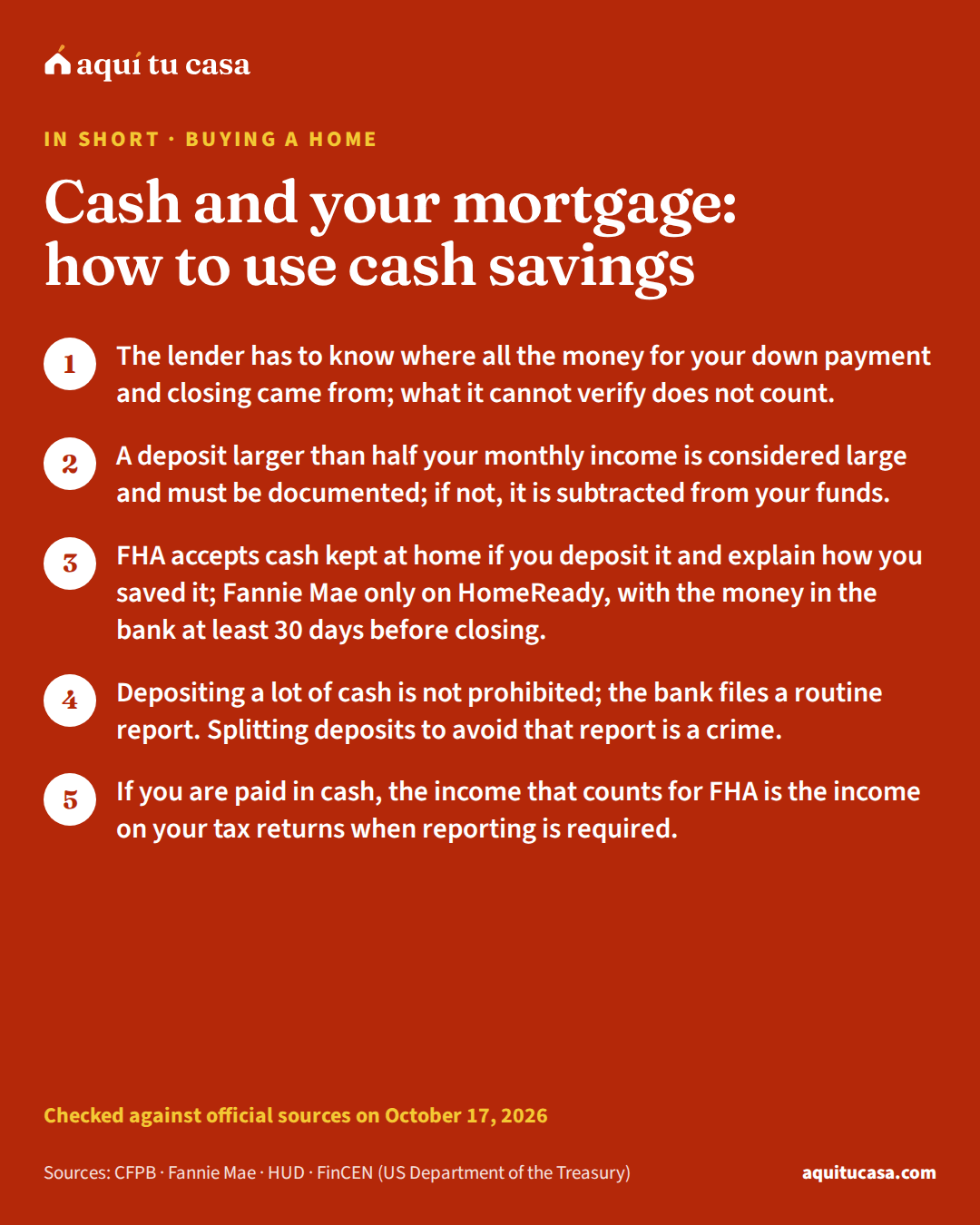
- Read the guide on cash and your mortgage if part of your savings is in cash.
Your numbers
We start with the typical home value in the United States ($332,700). Enter the price you are looking at.
Adjust advanced details
The minimum for this loan is 3.5%. A larger down payment lowers the monthly payment but takes longer to save.
As a share of the price. It is an example; your lender's Loan Estimate has the real figure.
Annual interest of the account where you keep the money. Leave it at zero if you do not know.
Let's do the math
Time to reach your goal
Enter how much you can save each month.
Your goal
- Down payment (3.5% of the price)
- $11,645
- Closing costs (3% of the price)
- $9,981
- Savings target
- $21,626
- You already have
- $0
- Still missing
- $21,626
What helps
- Set up an automatic transfer on payday into a separate account you do not use for spending.
- Ask about your state's and city's assistance programs before setting the goal: many cover part of the down payment or closing costs.
- If family gives you part of it, the lender usually asks for a gift letter and the transfer record; ask beforehand how they want it.
- Revisit the goal whenever the price you are looking at, the loan type or what you can save changes.
An educational estimate, not a loan offer. Closing costs are an example (3% of the price); the real figure comes in the Loan Estimate. We do not count the reserves some lenders require after closing.
Ready to see the numbers? Find your county here
See how this applies in your county: its loan limits, prices and rents, from the official data.
Printable checklist
Frequently asked questions
Can my parents give me the money for the down payment?
Yes. Fannie Mae accepts gifts from relatives by blood, marriage or adoption, and FHA accepts gifts from family members such as parents and grandparents. The lender will ask for a gift letter and proof of how the money reached your account or the closing agent.
What does a gift letter for a mortgage need to say?
For Fannie Mae and FHA: the giver's name, address and phone number, their relationship to you, the gift amount and a statement that it does not have to be repaid. On FHA loans the donor and you both sign and date it. Ask the lender whether it has a form for the letter.
Can my whole down payment be a gift?
In many cases, yes. Fannie Mae requires no contribution of your own on a one-unit principal residence, and all the money can come from a gift. On FHA, your 3.5% minimum investment can come from a family member, but not from the seller or someone who benefits from the sale. On a two- to four-unit home with Fannie Mae and more than 80% financing, you must put in 5% of your own.
Can a friend give me money for a house?
It depends on the loan. FHA accepts a close friend with a clearly defined and documented interest in you. Fannie Mae accepts someone with a long-standing family-like or mentorship relationship. In both cases the donor cannot be tied to the seller, builder or agent.
Do I have to pay taxes on a cash gift for a house?
According to the IRS, if there is gift tax, the giver generally pays it, and gifts that do not exceed the annual exclusion are not taxable gifts. The IRS publishes the exclusion amount for each year, and the gift tax return is Form 709.
My family lives in another country. Can they send me the money?
The lender has to document where all the money came from, and Fannie Mae requires funds from assets outside the US to be exchanged into dollars and held in a US financial institution before closing, with documents in English or translated. Also, if you are a US person for tax purposes and receive more than $100,000 in a year from a nonresident alien, you have to report it on Form 3520.
What is a gift of equity?
It is when the seller, say your mother, gives you part of her equity in the home as a credit in the purchase. Fannie Mae accepts it for the down payment and closing costs, not for reserves. On FHA loans, only a family member selling to another family member can give it.
Can the gift be given in cash?
On an FHA loan, cash the donor keeps at home is not an acceptable source for a gift. The safest route is for the money to leave the donor's account by check or transfer, so every step leaves proof.
Sources
Every figure in this guide comes from one of these official sources. The number next to a sentence leads to the source behind it.
Each source on one line: who publishes it, its title, its address and the date we read it.
- 1. Fannie Mae · Fannie Mae Selling Guide B3-4.3-04, Personal Gifts · selling-guide.fanniemae.com · Accessed October 17, 2026
- 2. Fannie Mae · Fannie Mae Selling Guide B3-4.3-05, Gifts of Equity · selling-guide.fanniemae.com · Accessed October 17, 2026
- 3. Fannie Mae · Fannie Mae Selling Guide B3-4.2-02, Depository Accounts · selling-guide.fanniemae.com · Accessed October 17, 2026
- 4. Fannie Mae · Fannie Mae Selling Guide B3-4.2-05, Foreign Assets · selling-guide.fanniemae.com · Accessed October 17, 2026
- 5. HUD · FHA Single Family Housing Policy Handbook 4000.1 · hud.gov · Accessed October 17, 2026
- 6. CFPB · Create a loan application packet · consumerfinance.gov · Accessed October 17, 2026
- 7. IRS · Frequently asked questions on gift taxes · irs.gov · Accessed October 17, 2026
- 8. IRS · Gifts from foreign person · irs.gov · Accessed October 17, 2026
See the other 4 sources
- 9. Freddie Mac · What Are Closing Costs and How Much Will I Pay? · myhome.freddiemac.com · Accessed October 17, 2026
- 10. CFPB · Mortgage closing scams: How to protect yourself and your closing funds · consumerfinance.gov · Accessed October 17, 2026
- 11. CFPB · Where can I find information on programs for first-time home buyers? · consumerfinance.gov · Accessed October 17, 2026
- 12. CFPB · Find a Housing Counselor · consumerfinance.gov · Accessed October 17, 2026
Keep reading
Related guides
If this guide helped, these follow the same path.
Help and programs 12 minute read
Down payment assistance: how it works
What down payment assistance is, the types that exist (grant, forgivable or deferred second loan, tax credit), who qualifies and where to find it.
- It is almost never 'free money': often it is a second loan with no monthly payments that is forgiven over time or repaid when you sell or when it comes due.
- Programs come from states, counties, cities and nonprofits; you apply through a participating lender.
- Almost all ask for income under a cap tied to the area median income and a home price under a limit.
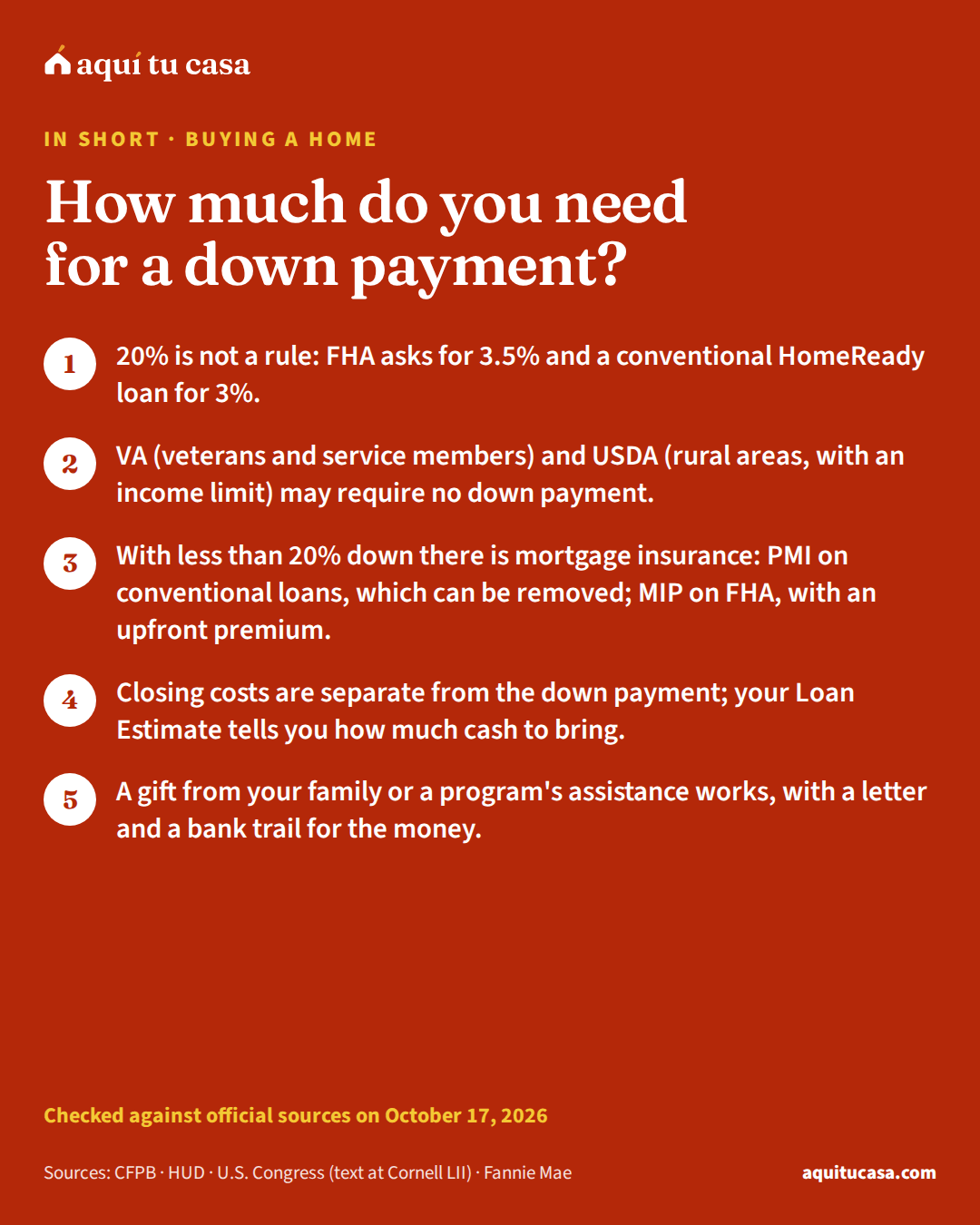
- Buying a home How much do you need for a down payment? 20% is not required: what each loan asks for (FHA, conventional, VA, USDA), what changes with less than 20% down, and where the money can come from. 11 minute read
- Buying a home Cash and your mortgage: how to use cash savings If you save or get paid in cash: why the lender asks where your money came from, what a large deposit is and how to move your cash into the bank. 11 minute read
- Buying a home Buying a home with family: co-borrowers and co-signers Who in your family can sign the loan with you, how incomes and debts add up, and what changes if your relative will not live in the home or has an ITIN. 11 minute read
Tools for this topic
Was this guide useful?
Thank you. Your answer stays in your browser; nothing is sent.