Buying a home with family: co-borrowers and co-signers
Who in your family can sign the loan with you, how incomes and debts add up, and what changes if your relative will not live in the home or has an ITIN.
Verified against official sources on October 17, 2026 13 official sources

Show contents
In short
What you need to know
Quick answer
Yes, you can buy a home with your family: relatives can sign the loan as co-borrowers, whether or not they live in the home, or as co-signers. The lender adds up the income of everyone who signs and also their debts, and all of them are responsible for the full loan. If a relative will not live in the home, extra rules apply: on FHA they must be a US citizen or live in the US, and Fannie Mae limits how much can be financed. FHA asks every person who signs for a valid Social Security number; Fannie Mae accepts a Social Security number or an ITIN, with legal residency requirements.
What matters most
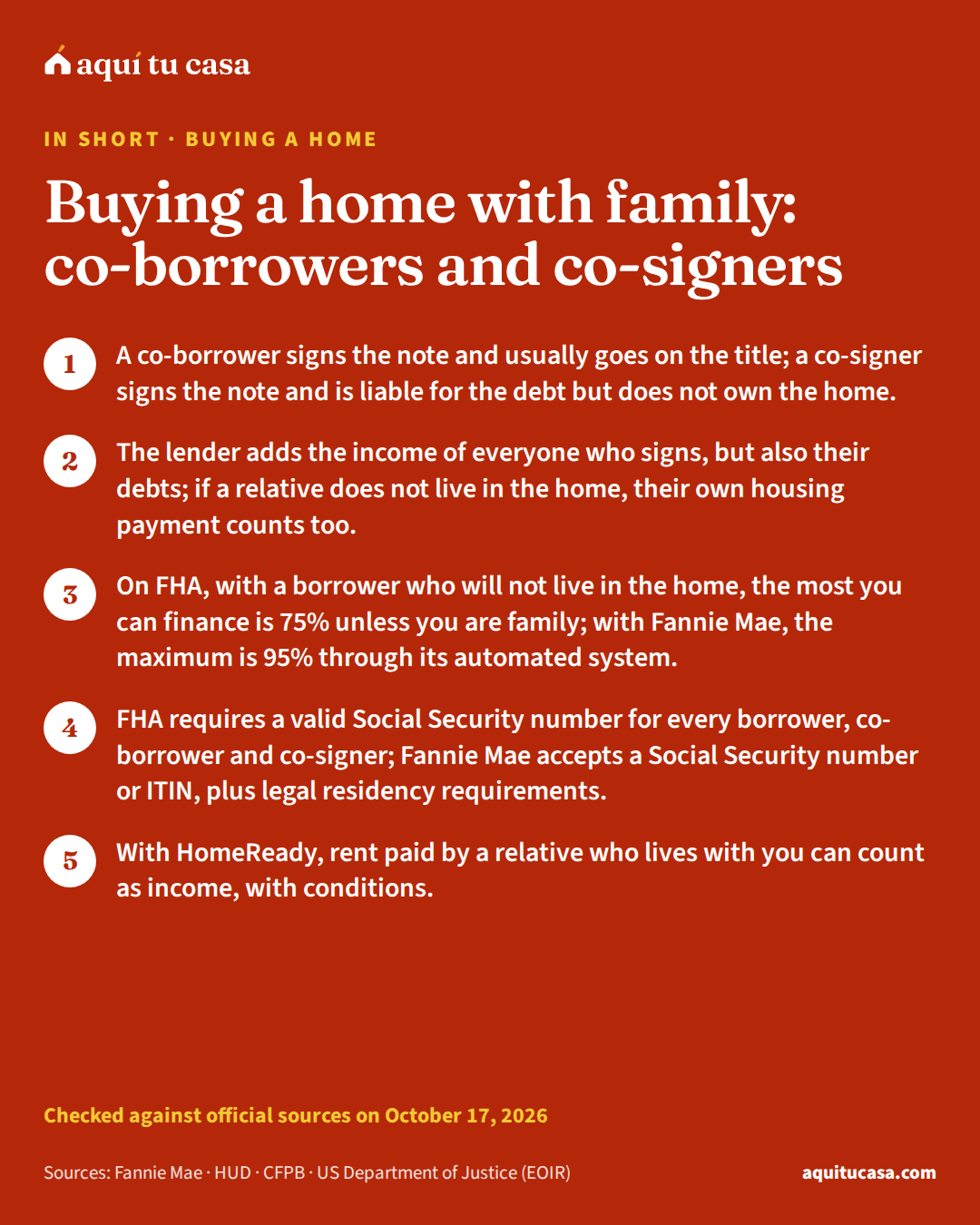
- A co-borrower signs the note and usually goes on the title; a co-signer signs the note and is liable for the debt but does not own the home.
- The lender adds the income of everyone who signs, but also their debts; if a relative does not live in the home, their own housing payment counts too.
- On FHA, with a borrower who will not live in the home, the most you can finance is 75% unless you are family; with Fannie Mae, the maximum is 95% through its automated system.
- FHA requires a valid Social Security number for every borrower, co-borrower and co-signer; Fannie Mae accepts a Social Security number or ITIN, plus legal residency requirements.
Is this for you?
This guide is for you if…
- You want to buy with your parents, adult children, siblings or another relative and combine incomes.
- A relative offered to sign the loan with you even though they will not live in the home.
- Some people in your family have Social Security numbers and others have ITINs, and you want to know what the rules say about who can sign.
Get direct help first if…
- Your question is whether signing a loan affects your immigration case: this guide does not answer that. If you want, you can ask a Justice Department accredited representative or an immigration attorney.
- Your relative only wants to give you money, without signing the loan: the guide on gift money from family covers that option.
- You already bought and want to know how the home is titled for each of you: start with the guide on how to hold title with family.
Buying with several relatives is one way to combine incomes. This guide is for you if you want to buy with your parents, adult children, siblings or another relative and add their income to qualify. You will see the three ways someone can sign with you, how incomes and debts add up, what changes if your relative will not live in the home, and what FHA and Fannie Mae require about Social Security numbers and ITINs.
- Most FHA will finance if a borrower will not live in the home and you are not family
- 75%9
- Most Fannie Mae will finance (automated system) if someone who signs will not live in the home
- 95%3
- Top debt-to-income on Fannie Mae manual underwriting, counting only the occupants' income
- 43%3
- Of qualifying income can come from rent paid by someone who lives with you, on HomeReady
- 30%7
Three ways to sign with your family
For Fannie Mae, a borrower is anyone who applies for the loan, alone or with others, whose credit is used to qualify. A “co-borrower” is any borrower who is not listed first on the notepromissory noteThe promissory note (or simply the note) is the document you sign at closing to promise you will repay the loan to the lender. It describes what you are agreeing to: how much you owe, the interest rate, the payment dates, the total you will pay, the length of the loan, whether the payments can change and where to send them. It is separate from the mortgage or deed of trust, the document that gives the lender the right to take the home if you do not pay. Some terms, such as a prepayment penalty, may be in an addendum to the note. You can ask for copies of the documents before closing to review them.See the full definition. To own the home and be liable for the debt, a borrower signs the mortgage or deed of trustdeed of trustThe deed of trust is, along with the "mortgage," one of the most common names for the security instrument you sign at closing. With it, the home becomes collateral for the loan: if you do not make the payments or break the agreement, the lender can take the home and sell it to pay off the loan. Your signature on this document must be notarized. It is separate from the promissory note, which is your promise to pay. In some states, the lender can foreclose without going to court by following the notices in a "power of sale" clause in this document.See the full definition, signs the note and takes titletitleTitle is your legal right to own and possess a property. The deed is the document showing that the seller transferred that right to you, and legal title is the title that can be documented in public records. As part of the purchase, a title search is done to see whether anyone else has a claim against the home; common claims come from a previous owner's unpaid taxes or from contractors who say they were not paid for work on the home. Title insurance protects you if such a claim shows up later.See the full definition in their own name.1
There are three ways your relative can sign with you:
Co-borrower, non-occupant co-borrower or co-signer
Owner and debtor
Co-borrower who lives in the home
Debtor, sometimes owner
Co-borrower who does not live in the home
All three are responsible for the loan; what changes is who lives in the home and who owns it.3
For Fannie Mae, co-signers and guarantors have no ownership interest as shown on the title, but they sign the note and share liability with you. Non-occupant borrowers sign the note and are equally liable, and may or may not be on the title. None of them can be the seller, builder or agent.3 On an FHA loan, all borrowers and co-borrowers, whether or not they live in the home, take title, are obligated on the note and sign the mortgage. A co-signerco-signerA co-signer is a person who signs another person's loan or credit account to back it up, and by doing so becomes responsible for the debt. If the borrower does not pay, the creditor can collect up to the full debt from the co-signer, plus late fees or collection costs, without first trying to collect from the borrower, and the default may become part of the co-signer's credit record. A federal FTC rule calls for the co-signer to get a written notice explaining these risks before signing. On a mortgage, according to Fannie Mae, a co-signer signs the note and shares liability for the debt with the borrower but has no ownership interest in the home on the title.See the full definition is liable for the debt and signs the note, but does not own the home or sign the mortgage.9
FHA defines who counts as “family”: children, parents and grandparents (including step and foster), a spouse or domestic partner, adopted or foster children, brothers and stepbrothers, sisters and stepsisters, uncles and aunts, and in-laws. Someone with an interest in the sale, like the seller or agent, cannot sign as a co-borrower or co-signer, although exceptions may be granted for a family member.9
How incomes and debts add up
The upside of buying together is that incomes add up. For Fannie Mae, the debt-to-income ratiodebt-to-income ratio (DTI)Your debt-to-income ratio (DTI) is all your monthly debt payments divided by your gross monthly income, that is, income before taxes. If you pay a certain amount each month across a car, cards, student loans and the mortgage you are asking for, and you earn three times that, your DTI is one third. Lenders use it to measure whether you can manage the payment; each loan type and lender sets its own limit, and assistance programs usually publish theirs. Paying down debt before applying improves your DTI.See the full definition compares debts with the total monthly income of all borrowers, to the extent that income is used to qualify.5 According to the CFPB, it is your monthly debt payments divided by your gross monthly income, and each product and lender has its own limits.11
But debts add up too. If your relative will not live in the home, their debts include the mortgage or rent payment where they live.5 If someone signed a debt that another person actually pays, such as a sibling’s car loan, Fannie Mae allows leaving that payment out if the person paying shows 12 months of checks or bank statements with no late payments.6
How a loan with your family comes together
1. Decide who signs and who will live in the home
Before you apply
Co-borrower, non-occupant co-borrower or co-signer: each role has different rules.3
2. Each person gathers their documents
Before you apply
The income of someone who will not live in the home must meet the same standards as everyone else's.4
Try it with your numbersDocument checklist3. The lender adds incomes and debts
During underwriting
Including the housing payment of anyone who will not live in the home.5
Try it with your numbersHow much house can I afford?4. Check the limits for a non-occupant
When choosing the loan
On FHA, the maximum financing is 75% if you are not family.9
5. Decide how the title will read
Before closing
On FHA, every borrower takes title; co-signers do not.9
6. Everyone signs at closing
Closing day
Each borrower signs the note; the owners also sign the mortgage.1
Example with real numbers
A typical payment against a typical income
With the typical US home value, an FHA loan with the minimum down payment and this week's rate, against one typical household's income.
- Home price (typical US value)
- $332,700
- Estimated monthly payment
- $2,759
- Gross monthly income of a typical household
- $6,728
- With a co-borrower
- Their income is added, and so are their debts
- Share of one typical income that would go to the home
- 41%
This is an example with national numbers. With more than one borrower, the debt-to-income ratio uses the income of everyone who qualifies and adds their debts.5
Run it with your numbersHow much house can I afford?
The debt-to-income guide explains the math, and the guide to a family budget with several incomes helps you split household costs.
If your relative will not live in the home
A relative can help even if they live elsewhere, but extra rules apply. On FHA, anyone who signs without living in the home must be a US citizen or have their principal residence in the US. When one or more borrowers will not live in the home, the maximum loan-to-value ratioloan-to-value ratio (LTV)The loan-to-value ratio (LTV) compares the amount of your mortgage with the appraised value of the property. It is expressed as a percentage: a loan that covers almost the whole value has a high LTV; one with a large down payment, a low LTV. Lenders use it to measure risk: the higher the LTV, the stricter the requirements and the more likely you will be asked for mortgage insurance. Over time, as you pay down principal or the home gains value, your LTV falls, which can let you cancel PMI on a conventional loan.See the full definition is 75%. It can go up to 96.5% if the borrowers are family members, unless a relative is selling to another relative who will be a non-occupying co-borrower, or the home has two to four units.9
With Fannie Mae, when the loan goes through its automated system, the income, assets, debts and credit of each borrower are considered whether or not they will live in the home, and the most it will finance is 95%.3 With manual underwriting, the people who will live in the home must make the first 5% of the down payment from their own money (with some exceptions), their debt-to-income on their own income cannot exceed 43%, and the most it will finance is 90%.3 The non-occupant’s income must meet the same standards, and on manual underwriting it can offset limited income or credit history, but not serious or recent credit problems.4
If your relative lives with you but does not sign
Sometimes a relative lives with you and chips in but does not want to, or cannot, sign. On a Fannie Mae HomeReady loan, rent paid to you by people who live with you, related or not, can count as income on a one-unit home. The cap is 30% of your qualifying income, and that person cannot be on the loan or the title. They must have lived with you for the last 12 months, with proof you share an address, and paid you rent for the last 12 months, or at least 9 of them, directly to you.7
HomeReady has income limits: the lender adds the income of everyone who signs the note, and that total cannot exceed 80% of the area median incomearea median income (AMI)The area median income (AMI) is the median family income of an area, which HUD computes every year for each metropolitan area and county. Housing programs use it as the yardstick: under the federal rule, a family is low-income when it earns no more than 80% of its area's median income and very low-income when it earns no more than 50%, adjusted for family size. State down payment assistance programs and Section 8 vouchers publish their limits as a percentage of AMI, so the same salary can qualify in one county and not in the next.See the full definition where the home is.8

Social Security, ITIN and status: what the rules say
Many families include people with different documents. This is what the rules say, without predicting what will happen in your case.
On FHA, each borrower must provide evidence of a valid Social Security number, with exceptions for certain employers, and the lender validates the Social Security number of every borrower, co-borrower and co-signer.9 US citizenship is not required. A Social Security card is not enough to prove immigration status, and lawful permanent residents are eligible on the same terms as citizens, as are citizens of Micronesia, the Marshall Islands and Palau.9
Fannie Mae requires each borrower to have a valid Social Security number or an ITINITIN (Individual Taxpayer Identification Number)An ITIN is a nine-digit number the IRS, the federal tax agency, issues to people who need a U.S. taxpayer identification number to file taxes and are not eligible for a Social Security number. It is for tax purposes only: it does not authorize you to work in the United States, does not qualify you for Social Security benefits or the Earned Income Tax Credit, and says nothing about your immigration status. You apply with Form W-7, and it expires if it goes unused for several years. Some lenders accept an ITIN for a mortgage.See the full definition, plus legal residency requirements.1 It buys loans from lawful permanent or non-permanent residents on the same terms as citizens, and the lender decides which documents to ask for in each case.2 The ITIN mortgage guide explains what other loans exist.

Your spouse and the title
Does your husband or wife have to sign? According to the CFPB, if you qualify on your own for the amount and terms you ask for, a lender generally cannot require their signature. If you apply together, it can. And on a mortgage it can ask your spouse or another person to sign if your state’s law requires it to use the home as collateral.10 In community property states, FHA does not require your spouse to be a borrower or co-signer, but the mortgage must be signed by whoever state law requires.9
Who goes on the title is a separate decision, with rules that vary by state. The guide on how to hold title with family explains the ways to own a home together.
If this is you
You are buying with adult children or parents
They can sign as co-borrowers; their incomes and their debts are added.5
Your parents sign but live in another home
Their own housing payment counts in the debts,5 and on FHA they must be US citizens or live in the US.9
Someone in your family has an ITIN
FHA requires a Social Security number from every signer; Fannie Mae accepts an ITIN with legal residency.1
A relative pays you rent but does not sign
On HomeReady, that rent can count for up to 30% of your qualifying income.7
Costly mistakes
Mistake: Co-signing because you think it is not really your debt.
Instead: A co-signer is liable for the debt and signs the note.9
Mistake: Adding a relative's income without counting their debts.
Instead: Their debts count too, including their housing payment if they live elsewhere.5
Mistake: Asking the seller or the agent to sign with you.
Instead: Someone with an interest in the sale cannot be a co-borrower or co-signer, with possible exceptions for family.9
Mistake: Assuming a relative with an ITIN can sign an FHA loan.
Instead: FHA validates a Social Security number for every signer; ask about other loans.9
Mistake: Counting a relative's rent without proof of payment.
Instead: HomeReady asks for 12 months of rent paid and proof you live together.7
Before you decide, you can go over your numbers and options with a HUD-approved housing counselorHUD-approved housing counselorA HUD-approved housing counselor works at an agency HUD has approved to provide housing counseling: independent, expert advice customized to your situation about buying a home, renting, a missed mortgage payment, a foreclosure or credit problems. The agencies usually charge little or nothing; many serve in Spanish and offer the homebuyer education course several assistance programs require. They are not lenders or real estate agents and sell you nothing. Your county page lists the official agencies with phone numbers.See the full definition, who gives independent advice on whether a set of loan terms fits your goals, often free or at low cost.13 The housing counselors guide explains how to find one.

What to do this week
- Talk as a family about who will sign, who will live in the home and who will own it.3
- List the income and debts of each person who would sign, including their housing payment.5
- Check which documents each person has: a Social Security number or an ITIN, depending on the loan.1
- If a relative pays you rent, gather proof of 12 months of payments and that you live together.7
- Figure out what you can afford together with the how much house can I afford calculator and check the document checklist.
- Read the guide on gift money from family if someone would rather give money than sign.
Your numbers
The minimum for this loan is 3.5%. More down lowers the monthly payment.
Adjust advanced details
First number: share of income for housing. Second: housing plus debts. Lender references, not fixed rules.
Let's do the math
Estimated top price
National figure$227,000
Limited by the housing payment: at that price it would be about $1,883 a month, 28% of your income.
- By the housing payment (28% of income)Limits you$227,000
- By your total debts (36% of income)$292,000
- By your cash (down payment + closing)$330,500
- Typical home in the United States
- $332,700
- Your cap is 68% of the typical home.
What changes if…?
- …you save $10,000 more$227,000
- …you cut $200 a month in debts$227,000
Your maximum price with four loans
Same income, debts and savings; only the down payment and the loan type change. ITIN uses an example down payment and rate.
| FHA 3.5% | Conventional 5% | Conventional 20% | ITIN 15% (example) | |
|---|---|---|---|---|
| Maximum price | $227,000 | $232,000 | $93,000 | $119,000 |
| Payment per month | $1,883 | $1,882 | $616 | $898 |
Educational estimate, not a pre-approval. Uses example insurance (0.5% of value per year) and example closing costs (3% of price); the tax is the place’s typical rate.
Ready to see the numbers? Find your county here
See how this applies in your county: its loan limits, prices and rents, from the official data.
Printable checklist
Frequently asked questions
Can I buy a house with my parents?
Yes. Your parents can sign the loan with you as co-borrowers, whether or not they live in the home, or as co-signers. The lender will add their income and their debts, and all of you will be responsible for the full loan.
What is the difference between a co-borrower and a co-signer?
Both sign the note and are liable for the debt. The difference is the home: on FHA loans the co-borrower takes title and signs the mortgage, while the co-signer does not own the home or sign the mortgage. For Fannie Mae, a co-signer has no ownership interest as shown on the title.
Does my relative have to live in the house to help me qualify?
No, but extra rules apply. On FHA, someone who will not live in the home must be a US citizen or have their principal residence in the US, and the maximum financing drops to 75% unless you are family. With Fannie Mae, the maximum is 95% through its automated system and 90% with manual underwriting.
Do lenders combine the incomes of everyone who signs?
Yes, to the extent they are used to qualify. Fannie Mae figures the debt-to-income ratio with the income of all borrowers and adds their debts, including the housing payment of anyone who will not live in the home. Each person's income must meet the same standards.
Does my spouse have to sign the mortgage?
Not always. According to the CFPB, if you qualify on your own, a lender generally cannot require your spouse's signature, but it can if your state's law requires it for the lien on the home to be valid. In community property states, FHA does not require your spouse to be a borrower.
Can a relative with an ITIN be a co-borrower?
It depends on the loan. FHA requires the lender to validate a Social Security number for every borrower, co-borrower and co-signer. Fannie Mae requires a Social Security number or an ITIN, plus legal residency requirements. The ITIN mortgage guide explains what other options exist.
What if my relative has a lot of debt?
Their debts go into the calculation too, and can raise everyone's debt-to-income ratio. If your relative signed a debt that someone else actually pays, Fannie Mae allows leaving it out with 12 months of documented on-time payments.
Can rent paid by a relative who lives with me count as income?
On a Fannie Mae HomeReady loan, yes, up to 30% of your qualifying income, if that person is not on the loan, has lived with you for the last 12 months and can show they paid you rent. Your total income has to fit HomeReady's limits.
Sources
Every figure in this guide comes from one of these official sources. The number next to a sentence leads to the source behind it.
Each source on one line: who publishes it, its title, its address and the date we read it.
- 1. Fannie Mae · Fannie Mae Selling Guide B2-2-01, General Borrower Eligibility Requirements · selling-guide.fanniemae.com · Accessed October 17, 2026
- 2. Fannie Mae · Fannie Mae Selling Guide B2-2-02, Non-U.S. Citizen Borrower Eligibility Requirements · selling-guide.fanniemae.com · Accessed October 17, 2026
- 3. Fannie Mae · Fannie Mae Selling Guide B2-2-04, Guarantors, Co-Signers, or Non-Occupant Borrowers on the Subject Transaction · selling-guide.fanniemae.com · Accessed October 17, 2026
- 4. Fannie Mae · Fannie Mae Selling Guide B3-3.1-01, General Income Information · selling-guide.fanniemae.com · Accessed October 17, 2026
- 5. Fannie Mae · Fannie Mae Selling Guide B3-6-02, Debt-to-Income Ratios · selling-guide.fanniemae.com · Accessed October 17, 2026
- 6. Fannie Mae · Fannie Mae Selling Guide B3-6-05, Monthly Debt Obligations · selling-guide.fanniemae.com · Accessed October 17, 2026
- 7. Fannie Mae · Fannie Mae Selling Guide B5-6-02, HomeReady Mortgage Underwriting Methods and Requirements · selling-guide.fanniemae.com · Accessed October 17, 2026
- 8. Fannie Mae · Fannie Mae Selling Guide B5-6-01, HomeReady Mortgage Loan and Borrower Eligibility · selling-guide.fanniemae.com · Accessed October 17, 2026
See the other 5 sources
- 9. HUD · FHA Single Family Housing Policy Handbook 4000.1 · hud.gov · Accessed October 17, 2026
- 10. CFPB · Does my spouse have to co-sign my mortgage loan? · consumerfinance.gov · Accessed October 17, 2026
- 11. CFPB · What is a debt-to-income ratio? · consumerfinance.gov · Accessed October 17, 2026
- 12. US Department of Justice (EOIR) · Can Someone Represent You Before EOIR? · justice.gov · Accessed October 17, 2026
- 13. CFPB · Find a Housing Counselor · consumerfinance.gov · Accessed October 17, 2026
Keep reading
Related guides
If this guide helped, these follow the same path.

Buying a home 11 minute read
Gift money from family to buy a home
Who can give you money for the down payment, what the gift letter must say, how the transfer is documented and what happens with taxes.
- Fannie Mae accepts gifts from relatives and people with a family-like relationship; FHA from family members, employers, close friends with a documented interest, charities and government programs.
- The gift letter states who gives, their relationship to you, the amount and that it does not have to be repaid; on FHA loans the donor and you both sign it.
- Every step of the money needs a paper trail: the donor's account, the transfer or check, and your account or the closing agent.
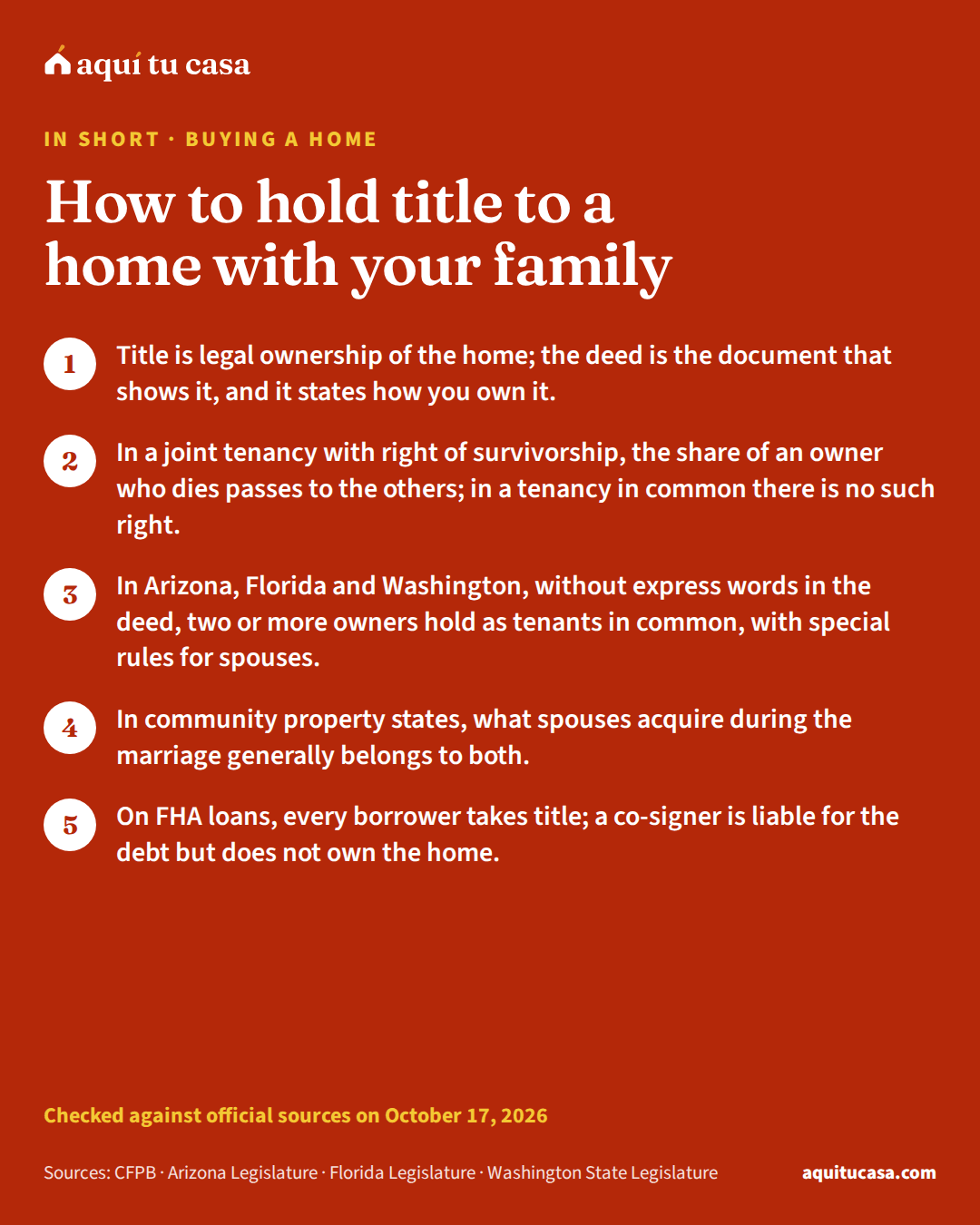
- Buying a home How to hold title to a home with your family Joint tenancy, tenancy in common and community property: what some state laws say, what loans require and where to find free legal help. 10 minute read
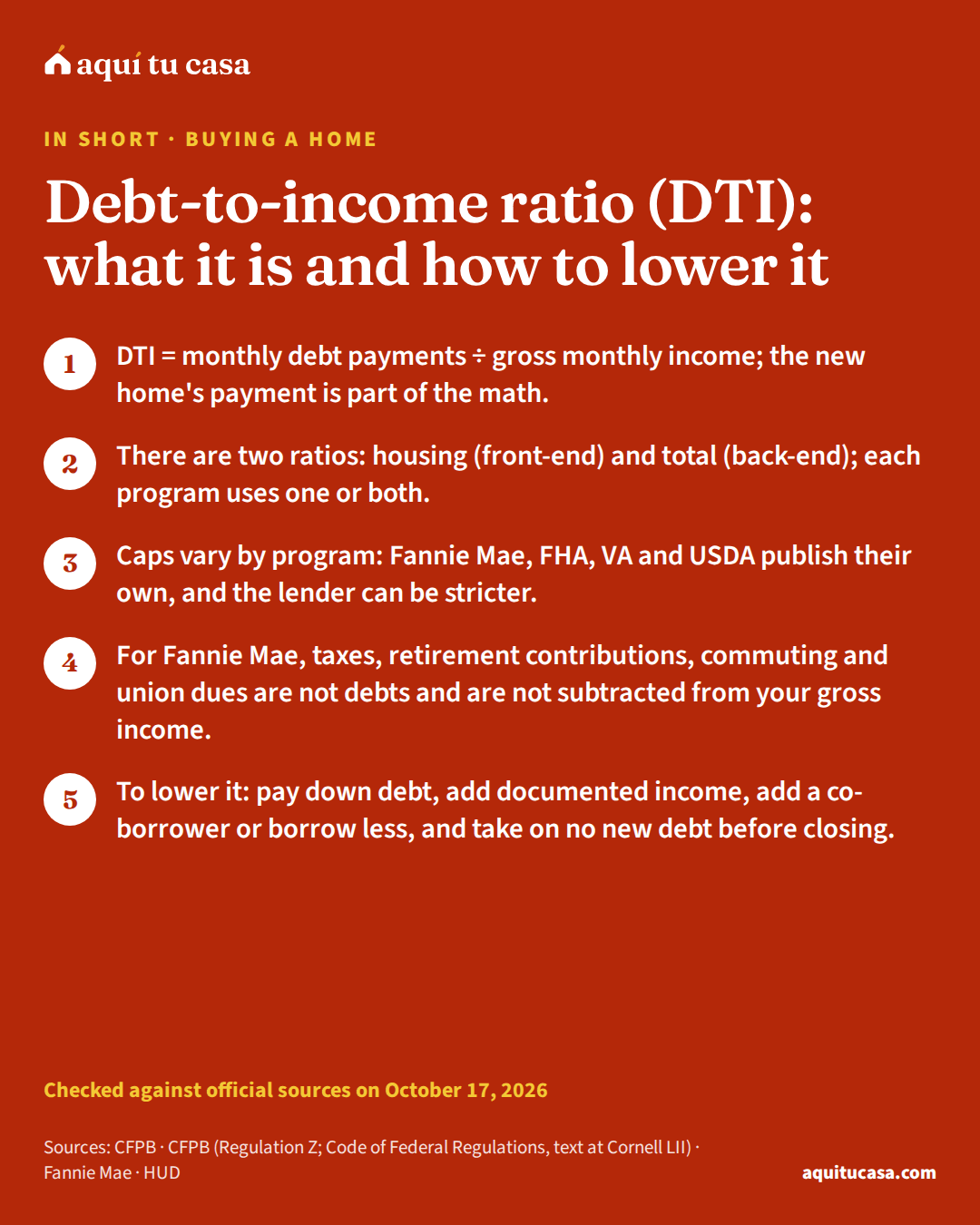
- Buying a home Debt-to-income ratio (DTI): what it is and how to lower it What the debt-to-income ratio (DTI) is, how to calculate it, which payments count, the caps FHA, Fannie Mae, VA and USDA publish and how to lower it. 14 minute read
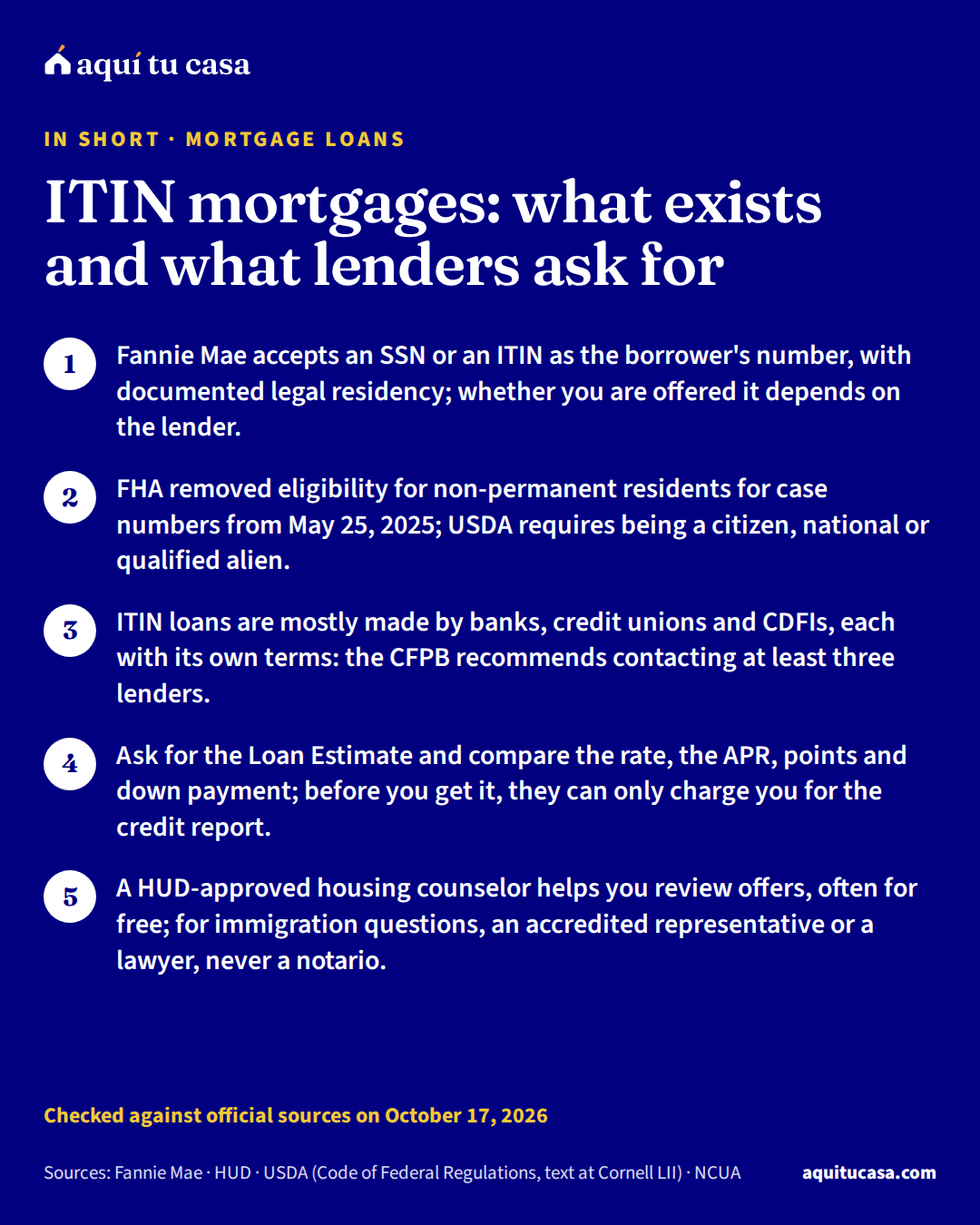
- Mortgage loans ITIN mortgages: what exists and what lenders ask for Which home loans accept an ITIN and which do not: Fannie Mae's rule, what FHA and USDA say, who lends and how to compare offers. 12 minute read
Tools for this topic
Was this guide useful?
Thank you. Your answer stays in your browser; nothing is sent.