How to hold title to a home with your family
Joint tenancy, tenancy in common and community property: what some state laws say, what loans require and where to find free legal help.
Verified against official sources on October 17, 2026 15 official sources

Show contents
In short
What you need to know
Quick answer
How a home is titled to a family is written in the deed and governed by each state's law. Three forms you will hear about are sole ownership, joint tenancy with right of survivorship (if one owner dies, their share passes to the others) and tenancy in common (each owns a share, without that right). In states such as Arizona, Florida and Washington, if the deed says nothing else, two or more owners hold as tenants in common, with special rules for spouses; and in community property states, what spouses buy during the marriage generally belongs to both. On an FHA loan, every borrower takes title. To decide for your case, you can get free legal help.
What matters most
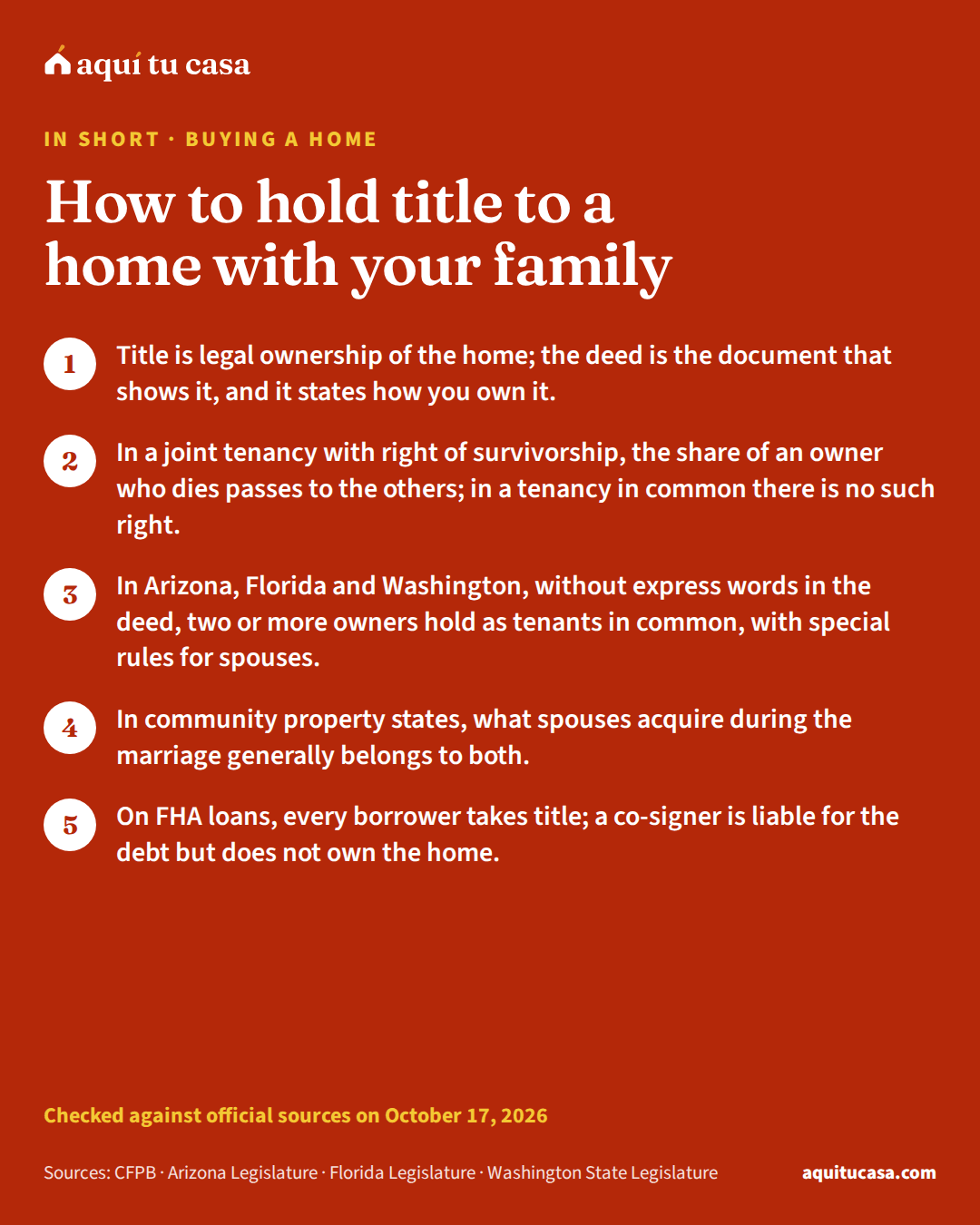
- Title is legal ownership of the home; the deed is the document that shows it, and it states how you own it.
- In a joint tenancy with right of survivorship, the share of an owner who dies passes to the others; in a tenancy in common there is no such right.
- In Arizona, Florida and Washington, without express words in the deed, two or more owners hold as tenants in common, with special rules for spouses.
- In community property states, what spouses acquire during the marriage generally belongs to both.
Is this for you?
This guide is for you if…
- You are buying with your partner, children, parents or siblings and want to understand the ways to own a home together.
- The closing agent or title company asked how you want the names to appear on the deed.
- You want to know what happens to the home if one of the owners dies.
Get direct help first if…
- You need someone to tell you which form of title is right for you: that is legal advice about your case; this guide explains what official sources say and where to find free legal help.
- Your relative will sign the loan with you and you want to know how incomes add up: start with the guide on buying with family as co-borrowers.
- You inherited a home or want to make a will: inheritance rules belong to each state and are worth reviewing with legal help.
When a family buys a home together, there is more to decide than the loan: whose name the home goes in, and in what form. This guide is for you if you are buying with your partner, children, parents or siblings. It explains what official sources and some state laws say; it is not legal advice, and at the end it tells you where to find free legal help.
What title and the deed are
According to the CFPB, when you buy your home you receive a document most often called a deeddeedA deed is the legal document the seller uses to transfer ownership of the home to you. The seller signs it at closing, it lists the names of all the buyers and you receive a copy. Afterward, the settlement agent records it with the county records office; that recording puts the public on notice that you are now the owner. There are several types: a warranty deed gives the most promises about the title, and a quitclaim deed promises nothing. Do not confuse it with a deed of trust, which is the mortgage document.See the full definition. It shows that the seller transferred legal ownership of the home to you, which is called titletitleTitle is your legal right to own and possess a property. The deed is the document showing that the seller transferred that right to you, and legal title is the title that can be documented in public records. As part of the purchase, a title search is done to see whether anyone else has a claim against the home; common claims come from a previous owner's unpaid taxes or from contractors who say they were not paid for work on the home. Title insurance protects you if such a claim shows up later.See the full definition. Title insurancetitle insuranceTitle is the legal right of ownership of the home, and title insurance protects you if, after closing, someone claims a right to it: an old debt, an heir, an error in the records. There are two policies. Most lenders require a lender's policy, which protects the amount they lent. The owner's policy is optional, paid once at closing, and protects you for as long as you own the home, including the legal costs of defending your right. You can shop for a title company; the price varies by state.See the full definition can protect you if someone later claims rights to the home. Most lenders require a lender’s policy; the owner’s policy is not required, but it protects your investment.1
The deed says who the owners are and in what form they own. That form decides, for example, what happens to each person’s share if someone dies. The rules come from each state’s law, so this guide uses examples from three states whose laws are published on their official sites: Arizona, Florida and Washington. If you live in another state, its rules may differ.
The ways to own a home together
On documents you will see the terms joint tenancy with right of survivorship and tenancy in common. Here is how they compare:
Three ways a home can be titled to a family
One person
Sole ownership
The share passes to the others
Joint tenancy with right of survivorship
What decides the form is what the deed says and your state's law.2
Arizona. By law, when property is granted to two or more people, it creates an estate in common and not a joint tenancy, with exceptions such as husband and wife. For one owner’s share to pass to the others at death, the deed must expressly declare a joint tenancy with right of survivorship. Spouses can also declare community property with right of survivorship.2
Florida. The law says the right of survivorship does not apply on its own. Except for property spouses hold by the entirety, a transfer to two or more people creates a tenancy in common unless the document expressly provides for survivorship. If the marriage is dissolved, the spouses become tenants in common.3
Washington. Joint tenancy lets property pass to the survivor without the cost or delay of probate. It is created only by a written document that expressly declares it, and each owner has the right to sever it on their own.4 If it is not declared, property owned by two or more people is held in common.5

Community property
In some states, what spouses buy during the marriage belongs to both. According to the IRS, the community property states are Arizona, California, Idaho, Louisiana, Nevada, New Mexico, Texas, Washington and Wisconsin. The laws of the state where you live decide whether you have community property. Generally, community property is what you, your spouse or both acquire during the marriage while living in one of those states. Separate property includes, for example, what each of you owned before marrying or received separately as a gift or inheritance. The IRS also notes that Alaska, Tennessee and South Dakota have laws with a community property election.7
Washington shows how a state law puts it: what one or both spouses acquire after marriage is, in general, community property.6 And if property in common is in both spouses’ names, it is presumed to be community property.5
Does your spouse have to sign? According to the CFPB, if you qualify on your own, a lender generally cannot require their signature for the credit. But on a mortgage it can ask for it if state law requires it to use the home as collateral, for example to create a valid lienlienA lien is a legal right a creditor holds in your property to make sure you repay a debt. It usually prevents the property from being sold until the debt is paid, and if you do not pay, the creditor may be able to take the property. Your mortgage is a lien on your home: when you pay it off, the lien is released and that shows up in your county's property records. There are other kinds, such as a federal tax lien, which is the government's legal claim against all your property when you do not pay a tax debt.See the full definition or clear title.12 In community property states, FHA does not require your spouse to be a borrower or co-signer, though the mortgage must be signed by whoever state law requires.9
What loans require
The loan also sets rules about who goes on the title. On FHA loans, all borrowers and co-borrowers, whether or not they live in the home, must take title in their own name or a living trust at closing. A co-signerco-signerA co-signer is a person who signs another person's loan or credit account to back it up, and by doing so becomes responsible for the debt. If the borrower does not pay, the creditor can collect up to the full debt from the co-signer, plus late fees or collection costs, without first trying to collect from the borrower, and the default may become part of the co-signer's credit record. A federal FTC rule calls for the co-signer to get a written notice explaining these risks before signing. On a mortgage, according to Fannie Mae, a co-signer signs the note and shares liability for the debt with the borrower but has no ownership interest in the home on the title.See the full definition signs the notepromissory noteThe promissory note (or simply the note) is the document you sign at closing to promise you will repay the loan to the lender. It describes what you are agreeing to: how much you owe, the interest rate, the payment dates, the total you will pay, the length of the loan, whether the payments can change and where to send them. It is separate from the mortgage or deed of trust, the document that gives the lender the right to take the home if you do not pay. Some terms, such as a prepayment penalty, may be in an addendum to the note. You can ask for copies of the documents before closing to review them.See the full definition and is liable for the debt, but does not own the home or sign the mortgage.9 Also, every purchaser on the sales contract must be a borrower, although a family member of a purchaser may be listed on the contract.9
For Fannie Mae, a borrower becomes an owner and is liable by signing the security instrument (the mortgage or deed of trustdeed of trustThe deed of trust is, along with the "mortgage," one of the most common names for the security instrument you sign at closing. With it, the home becomes collateral for the loan: if you do not make the payments or break the agreement, the lender can take the home and sell it to pay off the loan. Your signature on this document must be notarized. It is separate from the promissory note, which is your promise to pay. In some states, the lender can foreclose without going to court by following the notices in a "power of sale" clause in this document.See the full definition), signing the note and taking title in their own name.10 Borrowers who do not live in the home may or may not be on the title, and co-signers have no ownership interest as shown on the title.11
How to decide and put it in writing
1. Decide who will own the home
Before you make an offer
On FHA, every purchaser on the contract must be a borrower.9
3. Learn your state's rule
Before closing
In Arizona, Florida and Washington, without express words, property owned by several people is held in common.2
4. Ask whether your spouse must sign
Before closing
State law may require it for the lien to be valid.12
5. Read the deed before you sign
Closing day
Do not sign anything until the documents say what you expected.13
Try it with your numbersDocument checklist
What happens if one of the owners dies
This depends on how the title reads and on state law. In a joint tenancy with right of survivorship, the share of the owner who dies passes to the surviving owners.2 In Washington, the law says the property passes that way without the cost or delay of probate.4 In a tenancy in common there is no such right of survivorship.3
Example with real numbers
Two siblings buy a typical home
An example with the typical US home value and Washington law. Your state's rules may differ.
- Home price (typical US value)
- $332,700
- If the deed says nothing special
- They are tenants in common
- If the deed declares a joint tenancy
- The share of the one who dies passes to the other sibling
- To be a joint tenancy
- It must be declared in writing, expressly
This is an example. In Washington, without an express declaration, property owned by two or more people is held in common,5 and joint tenancy lets the property pass to the survivor without probate.4
Run it with your numbersHow much house can I afford?Some states also allow a deed that takes effect only when the owner dies. In Arizona it is called a beneficiary deed: it passes the property to the person the owner chose when the owner dies, along with any mortgages and liens. It can name several beneficiaries, who take title as joint tenants, tenants in common or another form valid in the state.8 Inheritance rules and this kind of deed vary from state to state; you can find more guides on the topic under owning a home.
If this is you
You are buying with siblings or children
Check whether the deed will say joint tenancy or tenancy in common; without express words, several states treat it as in common.3
Your parents want to leave you the home
Some states, such as Arizona, have a deed that passes the home to the person they choose at death.8
You are married in a community property state
What you acquire during the marriage generally belongs to both of you.7
You want legal guidance and cannot pay for it
LSC-funded legal aid offices serve low-income people.14

Mistakes that cause problems later
Mistake: Assuming co-owners automatically inherit from each other.
Instead: In Arizona, Florida and Washington that takes express words in the deed.234
Mistake: Signing the deed without reading how it says you own the home.
Instead: Take your time and do not sign until it says what you expected.13
Mistake: Thinking the co-signer owns the home.
Instead: They sign the debt, but do not own the home or sign the mortgage.9
Mistake: Forgetting a spouse's signature that state law requires.
Instead: Ask before closing whether your spouse must sign.12
Mistake: Listing someone on the contract who will not be on the FHA loan.
Instead: On FHA, purchasers on the contract must be borrowers, except a family member.9
Where to get free legal help
Choosing how your family holds title is a legal decision. If you want guidance, free legal aidlegal aidLegal aid is the free civil legal help that nonprofit organizations and their lawyers provide to low-income people in civil, not criminal, matters. In housing, that includes representing families facing eviction or foreclosure, alongside matters such as custody, child support, protection from domestic violence and access to benefits. In the United States, the Legal Services Corporation, created by Congress, funds a nationwide network of these organizations; its finder points you to the one in your area. Each sets its own income limits.See the full definition is an option, not a requirement. The Legal Services Corporation, established by Congress, funds civil legal aid for low-income people; on its site you find the nearest office by entering your address or city. LawHelp.org also has free legal information and forms.14
At closing, if anything about the sale is unclear, the CFPB recommends asking your real estate agent or settlement agentsettlement agentThe settlement agent (also called a closing agent) is the person or company that coordinates the closing so that everything the contract requires is accounted for. Depending on the location, it may be a title company, an escrow company (in most western states) or a closing attorney (in some eastern states). It collects the money from the lender and from you, pays the seller, distributes the closing costs and records the documents with the county. It works for all the parties; it is not your personal representative. Ask it how to pay the money you need to bring to closing.See the full definition: the title companytitle companyA title company is a company, or its authorized agent, that is qualified to issue title insurance. It searches public records for problems with the home's title (a title search), prepares the title commitment and issues the lender's and owner's policies. In most states, the fee for conducting your closing is also part of its charges. If title services are listed in section C of your Loan Estimate, you can shop for them yourself. Under the federal Real Estate Settlement Procedures Act (RESPA), a seller may not require you to buy title insurance from a particular company.See the full definition, escrow officer or attorney.13 For your home-buying numbers, a HUD-approved housing counselorHUD-approved housing counselorA HUD-approved housing counselor works at an agency HUD has approved to provide housing counseling: independent, expert advice customized to your situation about buying a home, renting, a missed mortgage payment, a foreclosure or credit problems. The agencies usually charge little or nothing; many serve in Spanish and offer the homebuyer education course several assistance programs require. They are not lenders or real estate agents and sell you nothing. Your county page lists the official agencies with phone numbers.See the full definition gives independent advice, often free or at low cost.15 The guides on buying with family as co-borrowers and the Closing Disclosure help with the next steps.

What to do this week
- List who will own the home and who will sign the loan.9
- Look up your state’s law on joint tenancy and tenancy in common on the legislature’s official site.2
- If you are married, check whether your state is a community property state.7
- Ask the title company how the deed will say you own the home, and read the draft before closing.13
- If you want guidance, find a free legal aid office on the LSC site or LawHelp.org.14
- Use the document checklist for what each person needs to bring to closing, and read the guide on how to buy a home step by step.
Your numbers
The minimum for this loan is 3.5%. More down lowers the monthly payment.
Adjust advanced details
First number: share of income for housing. Second: housing plus debts. Lender references, not fixed rules.
Let's do the math
Estimated top price
National figure$227,000
Limited by the housing payment: at that price it would be about $1,883 a month, 28% of your income.
- By the housing payment (28% of income)Limits you$227,000
- By your total debts (36% of income)$292,000
- By your cash (down payment + closing)$330,500
- Typical home in the United States
- $332,700
- Your cap is 68% of the typical home.
What changes if…?
- …you save $10,000 more$227,000
- …you cut $200 a month in debts$227,000
Your maximum price with four loans
Same income, debts and savings; only the down payment and the loan type change. ITIN uses an example down payment and rate.
| FHA 3.5% | Conventional 5% | Conventional 20% | ITIN 15% (example) | |
|---|---|---|---|---|
| Maximum price | $227,000 | $232,000 | $93,000 | $119,000 |
| Payment per month | $1,883 | $1,882 | $616 | $898 |
Educational estimate, not a pre-approval. Uses example insurance (0.5% of value per year) and example closing costs (3% of price); the tax is the place’s typical rate.
Ready to see the numbers? Find your county here
See how this applies in your county: its loan limits, prices and rents, from the official data.
Printable checklist
Frequently asked questions
Which is better, joint tenancy or tenancy in common?
It depends on your family and your state's law, and choosing is a legal decision about your case. What the laws of Arizona, Florida and Washington say is that in a joint tenancy with right of survivorship the share of an owner who dies passes to the others, and that without express words the owners hold as tenants in common. A legal aid office can guide you for free if you qualify.
What does joint tenancy with right of survivorship mean?
It is a way of owning together where, when one owner dies, their share passes to the other owners. In Washington, the law says it lets the home pass to the survivor without the cost or delay of probate, and that it must be declared expressly in writing.
What is community property?
According to the IRS, in community property states, what spouses acquire during the marriage while living there generally belongs to both; what each owned before or received as a gift or inheritance is separate property. Those states are Arizona, California, Idaho, Louisiana, Nevada, New Mexico, Texas, Washington and Wisconsin.
Can I put the house in my children's names if they do not sign the loan?
It depends on the loan and your state. On FHA loans, every borrower takes title, and every purchaser on the sales contract must be a borrower, although a family member of a purchaser may be listed on the contract. Ask the lender and the title company before you sign.
Does my spouse have to be on the deed?
It depends on your state's law. According to the CFPB, the lender may require your spouse's signature if state law requires it for the lien to be valid or the title to be clear. In community property states, FHA does not require your spouse to be a borrower, but the mortgage must be signed by whoever the law requires.
What happens to the house if one of the owners dies?
It depends on how the title reads and on state law. With joint tenancy with right of survivorship, the share of the owner who dies passes to the other owners. With tenancy in common there is no such right. Some states, such as Arizona, allow a beneficiary deed that passes the home to the person you choose when you die.
Is a co-signer an owner of the house?
No. On FHA loans, a co-signer signs the note and is liable for the debt, but does not own the home or sign the mortgage. For Fannie Mae, a co-signer has no ownership interest as shown on the title.
Where can I get free legal help with this?
The Legal Services Corporation funds civil legal aid offices for low-income people; on its site you find the nearest one with your address or city, and LawHelp.org has free information and forms. Getting help is an option, not a requirement for buying.
Sources
Every figure in this guide comes from one of these official sources. The number next to a sentence leads to the source behind it.
Each source on one line: who publishes it, its title, its address and the date we read it.
- 1. CFPB · Your home loan toolkit: A step-by-step guide · files.consumerfinance.gov · Accessed October 17, 2026
- 2. Arizona Legislature · Arizona Revised Statutes §33-431, Grants and devises to two or more persons · azleg.gov · Accessed October 17, 2026
- 3. Florida Legislature · Florida Statutes §689.15, Estates by survivorship · leg.state.fl.us · Accessed October 17, 2026
- 4. Washington State Legislature · Revised Code of Washington §64.28.010, Joint tenancies with right of survivorship · app.leg.wa.gov · Accessed October 17, 2026
- 5. Washington State Legislature · Revised Code of Washington §64.28.020, Interest in favor of two or more is interest in common · app.leg.wa.gov · Accessed October 17, 2026
- 6. Washington State Legislature · Revised Code of Washington §26.16.030, Community property defined · app.leg.wa.gov · Accessed October 17, 2026
- 7. IRS · Publication 555, Community Property · irs.gov · Accessed October 17, 2026
- 8. Arizona Legislature · Arizona Revised Statutes §33-405, Beneficiary deeds · azleg.gov · Accessed October 17, 2026
See the other 7 sources
- 9. HUD · FHA Single Family Housing Policy Handbook 4000.1 · hud.gov · Accessed October 17, 2026
- 10. Fannie Mae · Fannie Mae Selling Guide B2-2-01, General Borrower Eligibility Requirements · selling-guide.fanniemae.com · Accessed October 17, 2026
- 11. Fannie Mae · Fannie Mae Selling Guide B2-2-04, Guarantors, Co-Signers, or Non-Occupant Borrowers on the Subject Transaction · selling-guide.fanniemae.com · Accessed October 17, 2026
- 12. CFPB · Does my spouse have to co-sign my mortgage loan? · consumerfinance.gov · Accessed October 17, 2026
- 13. CFPB · Close the deal · consumerfinance.gov · Accessed October 17, 2026
- 14. Legal Services Corporation · I Need Legal Help · lsc.gov · Accessed October 17, 2026
- 15. CFPB · Find a Housing Counselor · consumerfinance.gov · Accessed October 17, 2026
Keep reading
Related guides
If this guide helped, these follow the same path.

Buying a home 11 minute read
Buying a home with family: co-borrowers and co-signers
Who in your family can sign the loan with you, how incomes and debts add up, and what changes if your relative will not live in the home or has an ITIN.
- A co-borrower signs the note and usually goes on the title; a co-signer signs the note and is liable for the debt but does not own the home.
- The lender adds the income of everyone who signs, but also their debts; if a relative does not live in the home, their own housing payment counts too.
- On FHA, with a borrower who will not live in the home, the most you can finance is 75% unless you are family; with Fannie Mae, the maximum is 95% through its automated system.
- Buying a home Gift money from family to buy a home Who can give you money for the down payment, what the gift letter must say, how the transfer is documented and what happens with taxes. 11 minute read
- Buying a home Closing Disclosure explained: what to check before signing What the Closing Disclosure is, when it must reach you, what to check on each of its five pages and which closing costs are not allowed to go up. 18 minute read
- Buying a home How to buy a home in the United States, step by step The nine steps to buying a home: paperwork, credit, budget, assistance, preapproval, offer, inspection, closing and the first year, with official sources. 15 minute read

Tools for this topic
Was this guide useful?
Thank you. Your answer stays in your browser; nothing is sent.