Emergency rental assistance: how it works and what to bring
How to get help with back rent or utility bills: who offers it today, what papers to bring, how long it takes and what to do if you have an eviction case.
Verified against official sources on November 6, 2026 7 official sources
Show contents
In short
What you need to know
Quick answer
Emergency rental assistance today comes from programs run by your state, county or city: the federal pandemic emergency fund has ended. Each program has its own rules, dates and funding; start with your state's and county's programs, or call 211. Bring ID, proof of income, your lease, the notice or lawsuit and what you owe. The money can take weeks, so if you have an eviction case, go to every hearing and look for free legal aid.
What matters most
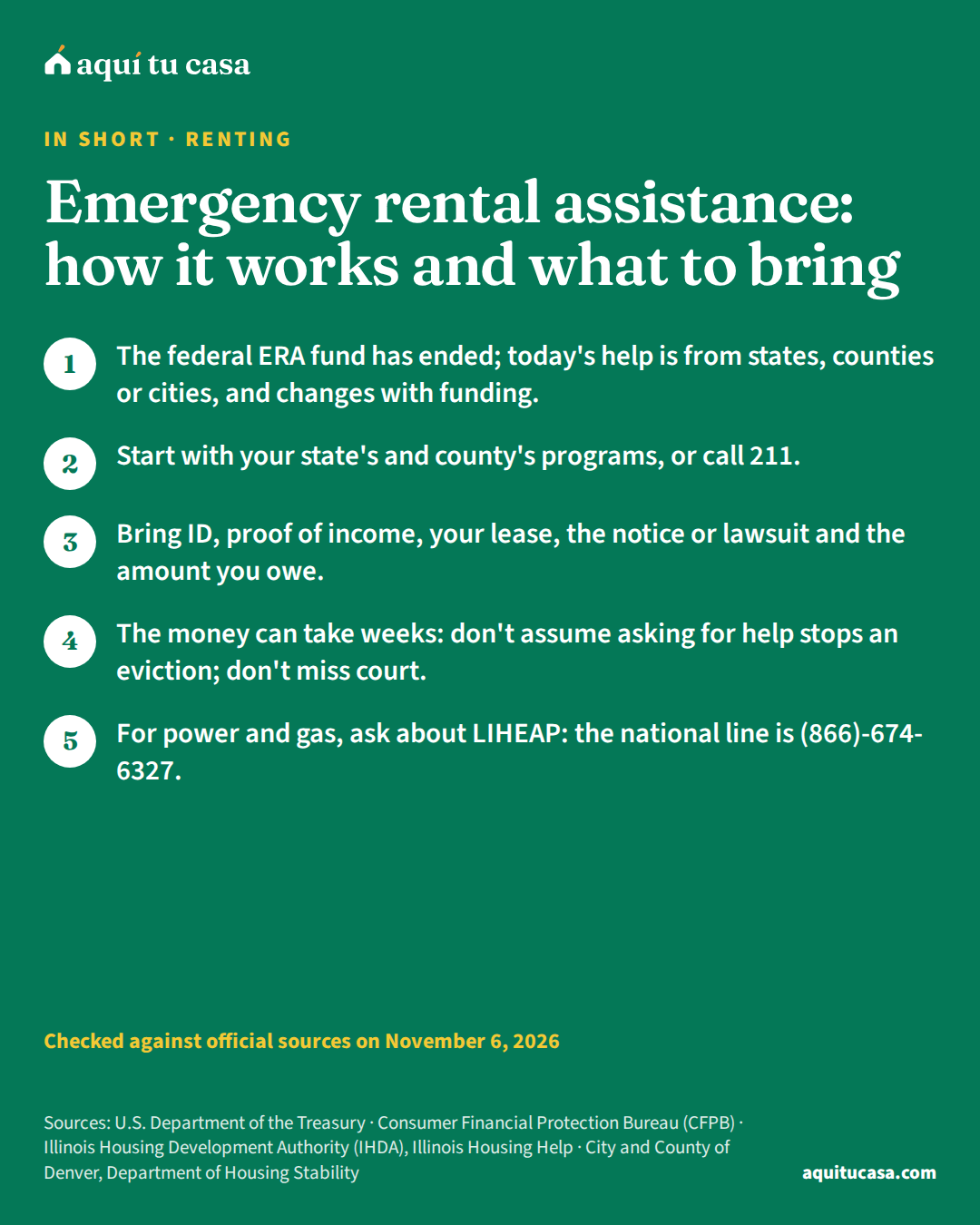
- The federal ERA fund has ended; today's help is from states, counties or cities, and changes with funding.
- Start with your state's and county's programs, or call 211.
- Bring ID, proof of income, your lease, the notice or lawsuit and the amount you owe.
- The money can take weeks: don't assume asking for help stops an eviction; don't miss court.
Is this for you?
This guide is for you if…
- You fell behind on rent or on your power bill and want to know what emergency help exists where you live.
- You got a demand for rent or an eviction lawsuit and want to know whether a program can pay what you owe.
- You want to know what papers to gather before calling an agency.
Get direct help first if…
- You want a subsidy that pays part of your rent every month for years: read the guide on how to apply for a Section 8 voucher.
- You are worried about whether asking for help affects an immigration case: read the guide on rental help and public charge, and talk to an accredited representative.
Emergency rental assistance today comes from programs run by your state, county or city: the federal pandemic fund has ended.1 Start with the programs in your area or call 211, and bring ID, proof of income, your leaseleaseA lease, or rental agreement, is the contract in which the owner or landlord gives you the right to live in and use a property for a set period of time in exchange for payment, usually rent. While the lease lasts you have possession, but the landlord still owns the property. The lease says how much you pay and when, who handles maintenance and how the agreement can end. Your rights as a tenant are usually spelled out in the lease and in your state and local laws. Before complaining to the landlord, it helps to read the lease and make sure you are also following the rules you agreed to.See the full definition and the notice or lawsuit.2 2 The money can take weeks, so if you already have an evictionevictionEviction is the legal process a landlord uses to get back a rented home when the tenant does not want to leave. The most common reasons are unpaid rent, serious lease violations or a lease that has ended. First the landlord must give you written notice. If it is not resolved, the landlord needs a court order, and a law enforcement officer must carry out the removal. If you are sued, you have the right to file a written answer explaining to the court why you should not be evicted. The rules change by state and city.See the full definition case, don’t miss court.2 This guide explains how to find the help that exists where you live, what programs ask for and how to protect yourself while you wait.
What emergency rental assistance is today
During the pandemic, the Treasury Department distributed federal Emergency Rental Assistance (ERA) funds. Treasury says the period for the second round of those funds has ended and they can no longer be used to help renters; it points to the CFPB’s housing portal.1
The CFPB says state, tribal and local organizations now distribute money to help with rent and other bills, and that they are the best place to start.2 Each program decides who qualifies, how much it gives, whether it is open year-round or in short windows and what papers it asks for. So two neighbors in different counties can have very different options.
Three ways programs give help
With an eviction case
Help in court
With a demand for rent
Monthly window or drawing
Ask each program whether it is open today, what papers it needs and whether anything must be paid back.
Where to find help in your area
The CFPB suggests searching for rental assistance in your city, county and state, and asking at local government offices and places like your library.2 211 can help you find options to pay rent or utilities: call from a cell phone or landline to talk to a local specialist.2
At aquitucasa we gather the programs we checked on their official pages, with what each page says about being open:
- On your state’s programs page, the “Rent help” section, for example in Texas, California, Florida, New York or Illinois.
- On your county’s rent page, the programs that serve your county or the whole state, for example Los Angeles County’s.
- On your city’s page, the help that belongs to your city or county.
For power and gas, the CFPB says your local LIHEAP office helps year-round, and the national referral line is (866)-674-6327.2 The LIHEAP guide explains how it works.

What papers to bring
Each program asks for its own papers, but they repeat. Illinois’s asks for a photo ID, proof of address and income, evidence of past-due rent and the complaint, summons and case number.3 New York City’s may ask for a birth certificate or Social Security number, proof of income, the landlord’s letters showing what you owe, court orders and the lease.5 Maricopa County’s asks for a photo ID, proof of household income for the 30 days before applying and papers showing the crisis you went through.6
From falling behind to getting help
2. Ask whether it is open and what it needs
Before you apply
Dates, requirements, papers and whether anything is paid back.5
While you wait: keep a record and keep talking
Applying is only the first step, and the wait can be the hardest part. Use it to protect yourself. Write down every call: the date, the program, the person you spoke with and what they told you. Keep the confirmation of each application, and answer quickly if a program asks for one more paper; a missing document is one of the easiest ways for an application to stall.
Tell your landlord, in writing, that you applied, with the program’s name and the date. Some programs pay the landlord directly, and in Illinois the tenant applies first and, if eligible, the landlord gets an email to complete its own section of the application,3 so ask the program how that works in your case and pass the information on to your landlord. Keep a copy of what you send. If you can pay part of the rent while you wait, pay it in a way that leaves a record, and keep the receipt.
If one program says no or is closed, don’t stop there. Ask the program whether it knows another one that could help, call 211 again and check your state’s and county’s pages for other options.2 Different programs cover different things: one may pay back rent, another the power bill, another a deposit for a new place. And if your budget no longer works with your rent, a housing counselor can help you look at the whole picture.2
If you already have a notice or an eviction lawsuit
A program’s money can take several weeks to arrive.2 Don’t assume that asking for help stops the lawsuit: go to every hearing, tell the judge you applied for help and bring the confirmation. The CFPB says that if your landlord is threatening to evict you, you should talk to a lawyer; you may qualify for free legal aidlegal aidLegal aid is the free civil legal help that nonprofit organizations and their lawyers provide to low-income people in civil, not criminal, matters. In housing, that includes representing families facing eviction or foreclosure, alongside matters such as custody, child support, protection from domestic violence and access to benefits. In the United States, the Legal Services Corporation, created by Congress, funds a nationwide network of these organizations; its finder points you to the one in your area. Each sets its own income limits.See the full definition based on your income.2 The guide on what to do if you get an eviction notice explains the deadlines, and the eviction timeline tool shows them for your state.
Some programs exist for exactly that moment: Illinois’s is for tenants with an eviction case for nonpayment, and it doesn’t require proof of citizenship.3
If your landlord’s lawyer or a collection agency is collecting back rent, the CFPB says it may be considered a debt collector under federal law, which bans unfair or deceptive practices; you can submit a complaint or call (855) 411-2372.2 And protect your record: an eviction filing or rent debt in collections on your report can make renting harder later.2
Immigration, paying it back and other questions
Each program has its own citizenship rule. Illinois says it doesn’t require proof of citizenship.3 Maricopa County warns its funding may require verifying citizenship or qualified-noncitizen status.6 New York City lists citizenship or immigration status among the factors it may consider.5 Ask before you apply. If your question is whether asking for help affects an immigration case, read the guide on rental help and public charge and talk to an accredited representativeDOJ-accredited representativeAn accredited representative is a non-attorney whom the U.S. Department of Justice, through its Recognition and Accreditation Program, authorizes to represent people in immigration matters before DHS and, with full accreditation, before the immigration courts. They may only do so through a recognized organization, which must be a non-profit, federally tax-exempt entity. It is the safe way to get low-cost immigration help: the Department of Justice publishes the official roster by state. Anyone who is not on that roster and is not a lawyer is not authorized to represent you.See the full definition.
Some programs must be paid back: New York City says you may be required to pay back some or all of its emergency assistance.5 And not all help is for emergencies: in Minnesota, the Renter’s Credit is a refundable credit on the state income tax return, which you can claim with a Social Security number or an ITIN.7
Mistake: Waiting until you owe several months to look for help.
Instead: Look as soon as you fall behind; the money can take weeks.2
Mistake: Skipping court because you already applied for help.
Instead: Go to every hearing and look for free legal aid.2
Mistake: Bringing an email from the landlord as your demand for rent.
Instead: Ask which notice they accept; in Denver, an email doesn't count.4
Mistake: Signing without knowing whether the help must be paid back.
Instead: Ask first; some programs must be paid back.5
Mistake: Letting a collector pressure you with threats.
Instead: A collector can't use unfair practices; you can complain to the CFPB.2

Where to get free help
The CFPB says some HUD-approved housing counseling agencies offer free or low-cost rental counseling; check that “rental” is on their list of services, or call 800-569-4287.2 The guide to HUD-approved housing counselors explains how to choose one, and the one on free legal aid how to find a lawyer at no cost.
If this is you
You are one month behind on rent
Look for your state's and county's programs, or call 211, before a lawsuit arrives.2
Your power or gas is about to be shut off
Ask about LIHEAP in your area or call the national line.2
You already have a court summons
Go to the hearing and look for legal aid; in Illinois there is help for cases in court.3
You file taxes with an ITIN in Minnesota
The Renter's Credit accepts a valid ITIN.7

What to do this week
Your income
Let's do the math
Rent that fits your budget (30% of income)
$2,018
With an income of $6,728 a month. Up to $3,364 would already be a severe burden (50% of income).
Compared with HUD’s Fair Market Rent in the United States
- 2 bedrooms$1,750Fits · 26%Needs $33.65 an hour
The wage needed pays that rent without going over 30% of income, working 40 hours a week all year.
The typical rent households actually pay in the United States is $1,413 a month (Census).
A reference to give you an idea. Each landlord and each program sets its own requirements.
Ready to see the numbers? Find your county here
See how this applies in your county: its loan limits, prices and rents, from the official data.
Printable checklist
Frequently asked questions
Does federal emergency rental assistance still exist?
Treasury says the period of performance for the second round of emergency rental assistance (ERA2) has ended and the funds can no longer be used to help renters. What exists today are programs from states, counties and cities, each with its own funding and rules.
Where do I find rent help in my city?
The CFPB says local programs are the best place to start: look for help in your city, county and state, ask at local government offices or call 211. On our page for your state's programs, the 'Rent help' section lists the ones we checked, with what each page says about being open.
What papers do I need to bring?
It depends on the program, but they usually ask for a photo ID, proof of household income, your lease, the notice or eviction lawsuit, the landlord's letters showing what you owe and, in some programs, papers showing the crisis you went through.
How long does the help take?
The CFPB says it may take several weeks to receive the money. If you have a court date, don't wait: go to the hearing, tell the judge you applied for help and look for legal aid.
Will they ask for immigration papers?
It depends on the program. Some say they don't require proof of citizenship, like Illinois's program for eviction cases; others say their funding may require verifying citizenship or status, like Maricopa County's. Ask before you apply, and if your question is about immigration, talk to an accredited representative.
Do I have to pay the help back?
It depends on the program. For example, New York City says you may be required to pay back some or all of its emergency assistance. Always ask before you sign.
Sources
Every figure in this guide comes from one of these official sources. The number next to a sentence leads to the source behind it.
Each source on one line: who publishes it, its title, its address and the date we read it.
- 1. U.S. Department of the Treasury · Emergency Rental Assistance Program · home.treasury.gov · Accessed November 6, 2026
- 2. Consumer Financial Protection Bureau (CFPB) · Get help paying rent and bills · consumerfinance.gov · Accessed November 6, 2026
- 3. Illinois Housing Development Authority (IHDA), Illinois Housing Help · Illinois Court-Based Rental Assistance Program (CBRAP) · illinoishousinghelp.org · Accessed November 6, 2026
- 4. City and County of Denver, Department of Housing Stability · Rent and Utility Help: Temporary Rental and Utility Assistance (TRUA) · denvergov.org · Accessed November 6, 2026
- 5. City of New York, Human Resources Administration (ACCESS NYC) · Emergency Assistance / One Shot Deal · access.nyc.gov · Accessed November 6, 2026
- 6. Maricopa County, Human Services Department · Rental Assistance · maricopa.gov · Accessed November 6, 2026
- 7. Minnesota Department of Revenue · Renter's Credit · revenue.state.mn.us · Accessed November 6, 2026
Keep reading
Related guides
If this guide helped, these follow the same path.

Renting 14 minute read
What to do if you get an eviction notice
Notice, lawsuit and the judge's order: what you can do at each moment, where free legal help is and what federal law says about the 30-day notice.
- A paper from the landlord is not a court order: your landlord cannot force you out by changing the locks without a court order.
- You have the right to answer the lawsuit in writing, even without a lawyer; the judge may delay or dismiss the eviction if you are seeking help.
- In federally backed properties (Section 8, public housing, federally backed mortgages and others), federal law requires a 30-day notice before you can be required to leave.
- Renting Rental help and public charge: what the rules say What public charge is, what changed in September 2026, whether housing help counts, and where to find rent help and free advice. 10 minute read
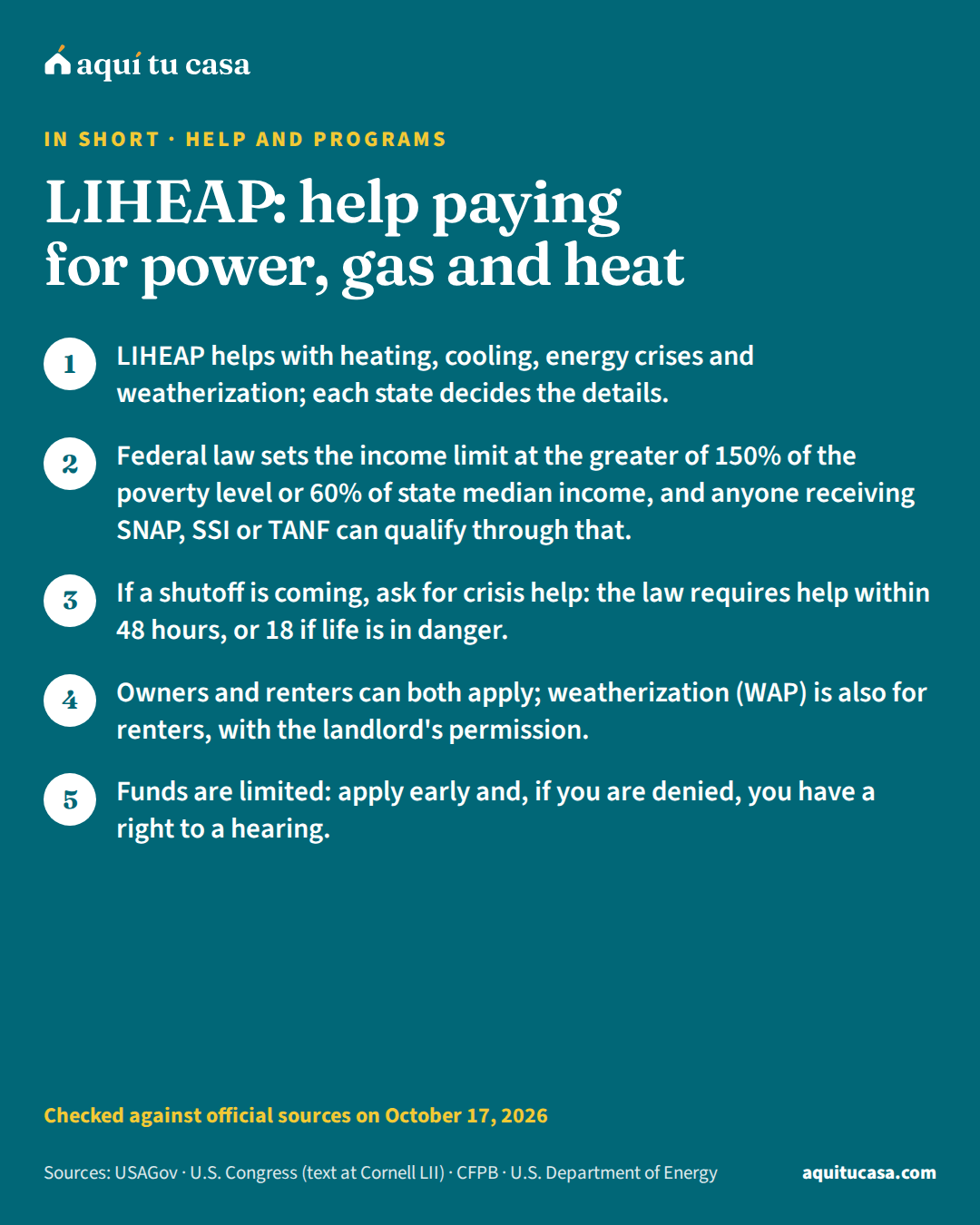
- Help and programs LIHEAP: help paying for power, gas and heat What LIHEAP is, who qualifies, how to apply in your state, crisis help when a shutoff is coming and free weatherization (WAP) to lower your bills. 10 minute read
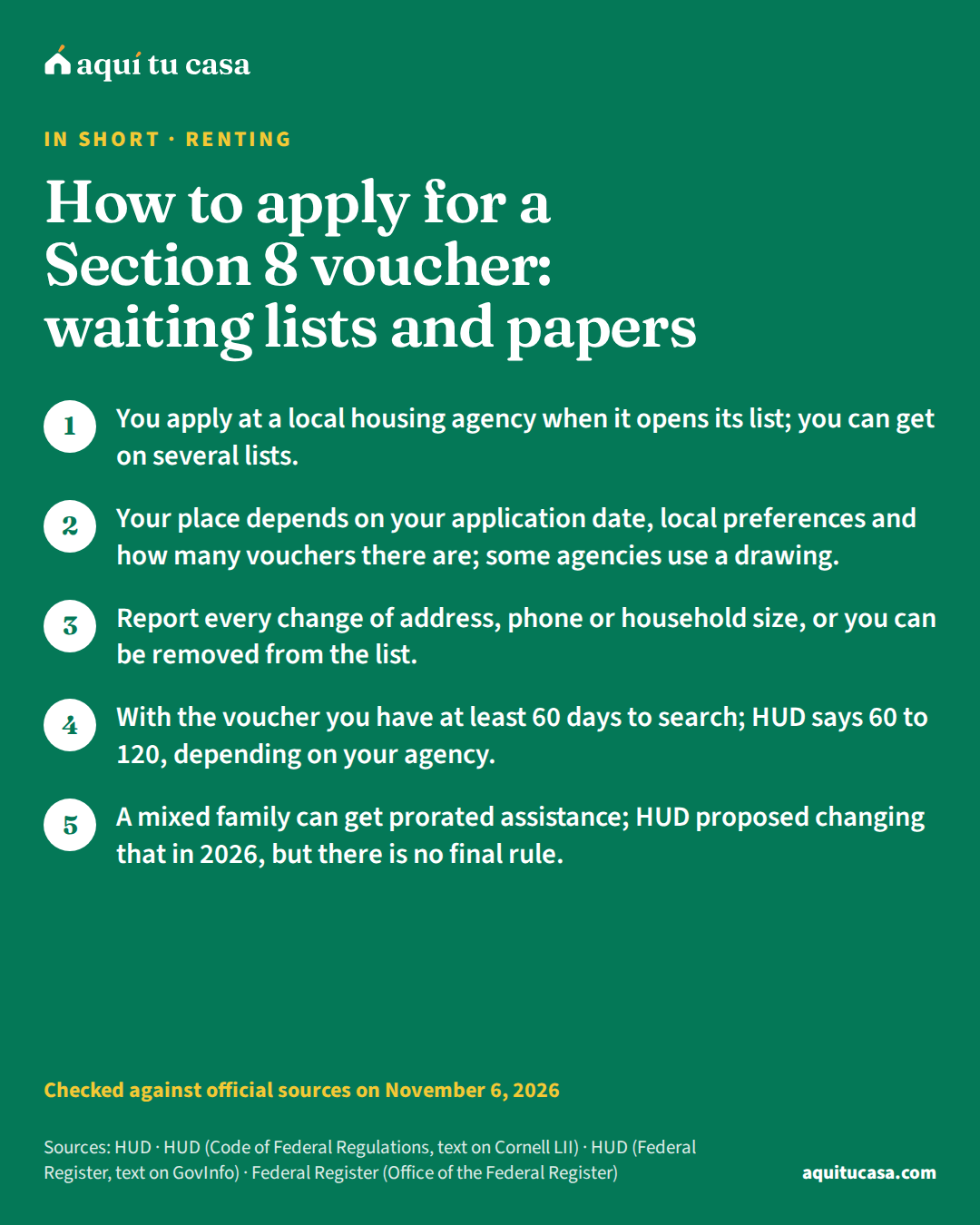
- Renting How to apply for a Section 8 voucher: waiting lists and papers How to apply for a Section 8 voucher: where to apply, how waiting lists and preferences work, the papers you need and what changes for a mixed family. 10 minute read
Tools for this topic
Was this guide useful?
Thank you. Your answer stays in your browser; nothing is sent.