The IRS and the privacy of your tax data
What the law says about the confidentiality of your tax return, when the IRS may share data, how to protect yours and where to get free help.
Verified against official sources on October 17, 2026 16 official sources

Show contents
In short
What you need to know
Quick answer
Federal law (26 U.S.C. §6103) says your tax returns and the information in them are confidential, except as the Internal Revenue Code itself authorizes. Those exceptions exist: for example, for tax agencies, child support agencies and investigations of federal crimes that are not tax crimes, with a judge's order or with a written request that meets legal requirements. Disclosing your data without authorization is a crime. The rules and how they are applied can change, and this guide cannot predict what will happen in any case.
What matters most
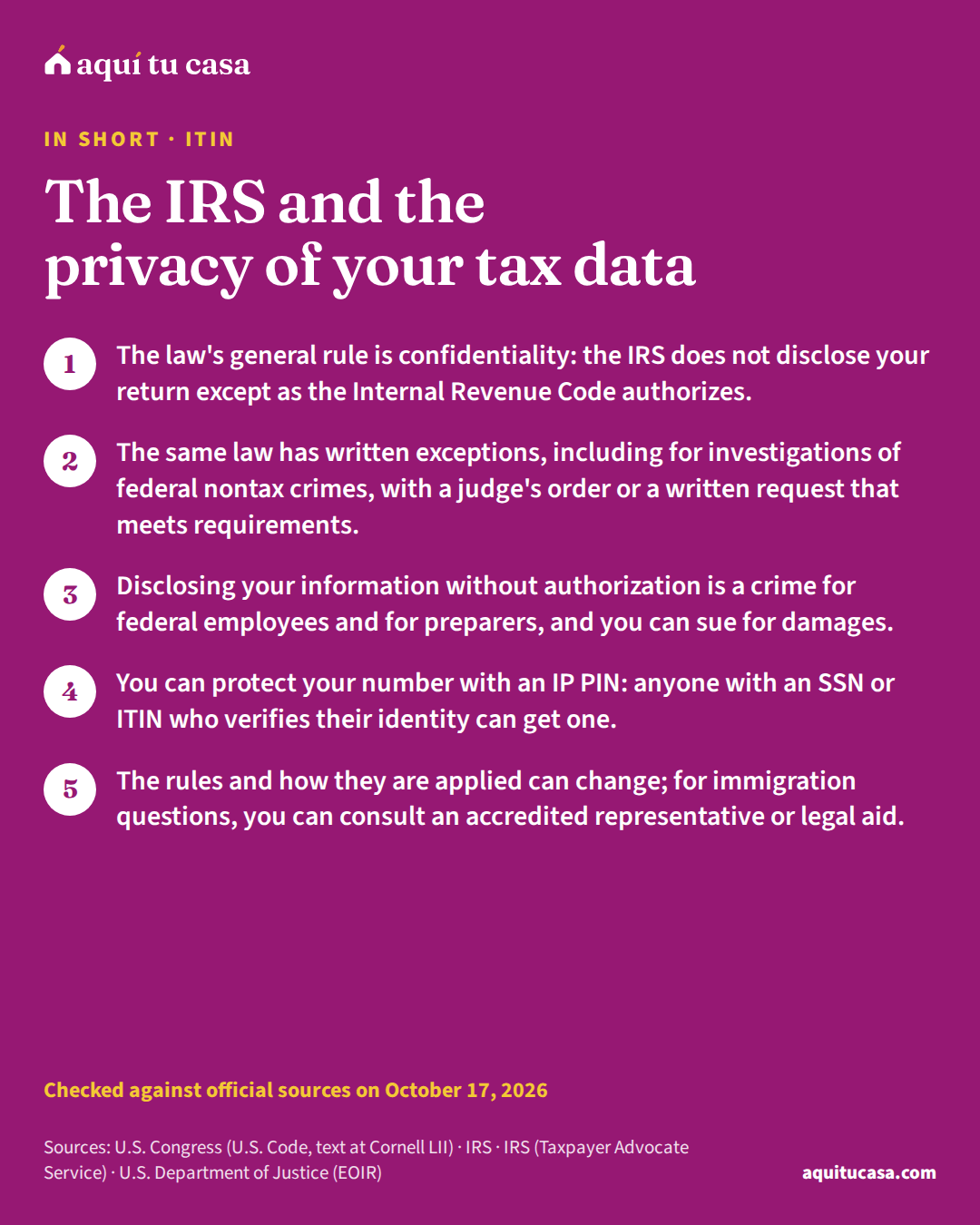
- The law's general rule is confidentiality: the IRS does not disclose your return except as the Internal Revenue Code authorizes.
- The same law has written exceptions, including for investigations of federal nontax crimes, with a judge's order or a written request that meets requirements.
- Disclosing your information without authorization is a crime for federal employees and for preparers, and you can sue for damages.
- You can protect your number with an IP PIN: anyone with an SSN or ITIN who verifies their identity can get one.
Is this for you?
This guide is for you if…
- You have an ITIN or are about to apply for one and worry about what the IRS does with your data.
- You want to know what the law says about who can and cannot see your tax return.
- You want to protect your number and your return from scams and identity theft.
Get direct help first if…
- You need to know what may happen in your immigration case: this guide cannot predict that. If you wish, you can consult a representative accredited by the Department of Justice or a legal aid organization.
- You already have a dispute with the IRS (an audit or a collection): a Low Income Taxpayer Clinic can represent you, free or for a small fee.
Many families do not file a tax returntax returnA tax return is the yearly form you use to report your income to the IRS and figure the tax you owe, so you can pay what is due or get a refund. The federal return for individuals is Form 1040. In general you must file if your gross income is above the minimum the IRS sets for your filing status, or if you had a certain amount of net earnings from self-employment; even when you do not have to, filing can pay off. You need your SSN or ITIN, and those of everyone else on the return, plus documents such as your W-2s and 1099s.See the full definition, or do not apply for an ITIN, because they fear what will happen to their data. This guide is for you if you share that worry. It explains what federal law and the IRS’s official pages say today: what is confidential, which exceptions the law itself writes, who else can see your information and how to protect yours. It is not an immigration guide and it cannot say what will happen in any case: the rules and the way agencies apply them can change, so always check the verification date.
The general rule: your return is confidential
The tax privacy law is section 6103 of the Internal Revenue Code. Its first sentence says that returns and return information are confidential. Except as the Code itself authorizes, no federal or state employee, and no other person with access under that law, may disclose them, and the rule still applies to former employees.1 The IRS repeats it in the instructions for Form W-7, the form used to apply for an ITIN.5
What does it protect? “Return information” includes your identity and the nature, source or amount of your income, payments, deductions, credits, assets and debts, among other data. And your “identity,” for this law, is your name, mailing address and taxpayer number, such as an ITINITIN (Individual Taxpayer Identification Number)An ITIN is a nine-digit number the IRS, the federal tax agency, issues to people who need a U.S. taxpayer identification number to file taxes and are not eligible for a Social Security number. It is for tax purposes only: it does not authorize you to work in the United States, does not qualify you for Social Security benefits or the Earned Income Tax Credit, and says nothing about your immigration status. You apply with Form W-7, and it expires if it goes unused for several years. Some lenders accept an ITIN for a mortgage.See the full definition or a Social Security number.1 For a refresher on what that number is for, see What is an ITIN?.
The IRS Taxpayer Bill of Rights puts it simply: you have the right to expect that what you give the IRS will not be disclosed unless you or the law authorize it, and that action will be taken against anyone who wrongfully uses or discloses your information.8
The exceptions the law itself writes
Confidentiality has exceptions, and the IRS explains them in the privacy notice in the Form 1040 instructions. It says section 6103 allows or requires it to give information on your return to others, for example: the Department of Justice to enforce the tax laws; cities and states for their own taxes; child support agencies; other federal agencies to decide benefits or loans; other countries under a tax treaty; federal and state agencies to enforce federal criminal laws that are not tax laws; and law enforcement and intelligence agencies to combat terrorism.6
For investigations of federal crimes that are not tax crimes, the law sets two routes with different rules.
Two routes in the law for nontax criminal investigations
§6103(i)(1)
With a judge's order
§6103(i)(2)
With a written request
- It covers information you did not provide, which the IRS gathers from other sources.11
- It is requested in writing by the head of the agency, its inspector general or certain Justice officials.1
- It must state the taxpayer's name and address, the years, the law involved and the specific reasons.1
- For this route, your name, address and number do not count as information you provided.11
Both are exceptions written into the law; outside what the Code authorizes, the rule is confidentiality.1
Put another way, on these two routes: what you provide on your return requires a judge’s order.1 Information the IRS has from other sources can be disclosed with a written request that meets the requirements, and for that route the law does not treat your identity (name, address and number) as information you provided.11 The law also has other exceptions: for example, the IRS may notify the right agency when information from other sources may be evidence of a federal nontax crime, and it may disclose information in an imminent danger of death or injury to a person.1
What this guide cannot tell you
This guide summarizes the text of the law and the IRS pages as they stand today. It cannot say how each agency uses these rules today, or what will happen in anyone’s case. Laws and the way agencies apply them can change.
If someone tells you the IRS “already shares everything” or “never shares anything,” be wary of both. The law has a rule and written exceptions; the rest depends on facts that change.16

Who else sees your data: preparer, VITA and lender
Your information does not only pass through the IRS. Whoever prepares your return also sees it, and the law limits them. If someone prepares returns as a business or for pay and knowingly or recklessly discloses the information you gave them, or uses it for anything other than preparing your return, they commit a misdemeanor, with a fine of up to $1,000 or up to 1 year in prison. The law has exceptions.4
At IRS VITAVITA (free tax preparation)VITA (Volunteer Income Tax Assistance) and TCE (Tax Counseling for the Elderly) are IRS programs that offer free basic tax return preparation by IRS-certified volunteers. They are meant for people with moderate income, people with disabilities and limited-English speakers; TCE focuses on people sixty and older. The IRS sets no program-wide income limit, but individual sites may set their own. Many sites serve in Spanish and help with ITIN applications and renewals. Filing taxes every year builds the record lenders ask for.See the full definition sites, volunteers who prepare returns must pass training that includes maintaining the privacy and confidentiality of all your information. They prepare basic returns for free for those who qualify; you find them with the IRS locator or at 800-906-9887.9
And the lender? The IRS says it only gives your tax records to a third party with your consent. When you apply for a mortgage, you authorize it from your account or by signing Form 4506-C.10 TranscriptsIRS tax transcriptAn IRS tax transcript is a free official summary of the information on your tax returns and tax account. It is not a photocopy of your return. There are several types: the tax return transcript shows most line items from your Form 1040 as filed and usually meets the needs of mortgage lenders; the tax account transcript shows changes made after you filed; the wage and income transcript shows what your W-2s and 1099s reported. You can get one through your IRS online account, by mail, by phone or with Form 4506-T.See the full definition partially mask your personal information and leave the financial data visible, which is what is used to verify income.11 The guide on filing taxes with an ITIN explains why lenders ask for them.
Example with real numbers
Who can see your return, according to the law
A summary in words of what the cited sources say. It does not describe anyone's case.
- You (and your spouse, on a joint return)
- You can request it in writing
- Anyone you authorize
- Only with your consent and for that purpose
- Your preparer
- Only to prepare your return, with exceptions
- Your lender
- Only with your consent (Form 4506-C)
- Federal agencies in nontax criminal cases
- With a judge's order or a written request that meets the law
- The general rule
- Confidential, except as the Code authorizes
Sources: 26 U.S.C. §§6103 and 7216 and the IRS.1410111 The rules can change; check this guide's verification date.
If someone discloses your data without permission
The law punishes improper disclosure. For a federal employee, or another person with access under the law, willfully disclosing a return or return information without authorization is a felony: a fine of up to $5,000, up to 5 years in prison or both, and a convicted federal employee is dismissed.2
In addition, if a federal employee knowingly or negligently inspects or discloses your information in violation of section 6103, you can sue the government for damages in federal court; if it was someone who is not a federal employee, you can sue that person.3
For guidance, Low Income Taxpayer Clinics (LITCs) help with disputes with the IRS, can represent you and explain your rights to people who speak English as a second language, free or for a small fee. They receive part of their funding from the IRS, but they are completely independent of it.14 The Taxpayer Bill of Rights also recognizes your right to be represented by someone you choose and to seek help from one of these clinics.8

How to protect your data yourself
Part of your privacy is in your hands. There are two risks you can reduce yourself: fake calls or messages that pretend to be the IRS, and someone else filing a return with your number, a kind of identity theftidentity theftIdentity theft happens when someone uses your personal information without your permission to commit fraud: for example, your name, your Social Security or Medicare number, or your credit card or bank account number. With that information, a thief can rent a home, get credit cards, receive government benefits or tax refunds, or open other accounts in your name. You often find out when your credit report or a statement shows accounts or charges you do not recognize, or when a debt collector calls. The federal site IdentityTheft.gov takes reports and gives you a recovery plan.See the full definition.1312
Five steps to protect your tax data
1. Be wary of calls and messages
Always
It is not the IRS if it rushes you, threatens you, asks for data or demands payment now.13
2. Do not answer by email, text or social media
Before you give any data
The IRS does not initiate contact that way to ask for personal or financial information.11
3. Get your IP PIN
Valid for one calendar year
It stops anyone else from filing a return with your ITIN or SSN.12
4. Choose your preparer carefully
Before you hand over your papers
By law they cannot use or disclose your data for anything else; VITA is free.4
5. Give consent only when needed
When you apply for a loan
The IRS only gives your records to a third party with your consent.10
An IP PIN is a six-digit number known only to you and the IRS. Anyone with a Social Security number or ITIN who can verify their identity can get one. The fastest way is your online account; if you cannot verify online, there are other options, such as an in-person appointment at a Taxpayer Assistance Center. It is valid for one calendar year.12
Remember too that the IRS normally contacts you first by U.S. mail, and that a social media direct message is never from the IRS.13 There are more scam warning signs in the housing scams guide.

Mistakes that expose your data
Mistake: Giving your ITIN or SSN to someone who calls claiming to be the IRS.
Instead: The IRS does not rush you or ask for data in a surprise call; hang up.13
Mistake: Answering a text or social media message that claims to be the IRS.
Instead: The IRS does not initiate contact that way to ask for data.1113
Mistake: Not filing out of fear, without getting informed.
Instead: Read what the law says and, if you are worried about your case, consult an accredited representative.115
Mistake: Asking a notario whether it is safe to file.
Instead: Notarios cannot give you legal advice; an accredited representative can.15
Mistake: Signing third-party authorizations without reading them.
Instead: Your consent decides who sees your information and for what.110
If this is you
You are about to apply for an ITIN
The IRS says you can apply regardless of your status.7 For immigration questions, consult an accredited representative.16
Your family has mixed status
This guide cannot predict any case; an organization with accredited representatives can guide you.16
You have a problem with the IRS
An LITC can represent you, free or for a small fee.14
You prefer help in Spanish
LITCs help people who speak English as a second language understand their rights.14
What to do this week
- Read the Taxpayer Bill of Rights; your right to confidentiality is there.8
- If someone calls or writes to you “from the IRS,” do not give any data and check the scam signs.13
- Consider getting your IP PIN in your online account or at an IRS appointment.12
- If you need help filing, find a VITA site at 800-906-9887.9
- If your question is about immigration, look for an organization with accredited representatives; see also a notario is not a lawyer.16
- Come back to this guide before you decide: the rules can change and you will see the date of the last verification here.
Ready to see the numbers? Find your county here
See how this applies in your county: its loan limits, prices and rents, from the official data.
Printable checklist
Frequently asked questions
Does applying for an ITIN or filing put me at risk?
The IRS says you can apply for an ITIN regardless of immigration status and that the number is for taxes only. The law protects the confidentiality of your data, with the exceptions it writes itself. We cannot tell you what will happen in your case: if you are worried, you can talk first with a representative accredited by the Department of Justice or with legal aid.
Can a lender see my tax returns without my permission?
The IRS says it only gives tax records to a third party with your consent. When you apply for a mortgage, you authorize the lender from your account or by signing Form 4506-C.
What is an IP PIN and can I get one with an ITIN?
It is a six-digit number that prevents someone else from filing a return with your ITIN or Social Security number. Anyone with an SSN or ITIN who verifies their identity can get one; it is valid for one calendar year.
How do I know whether a call or message is really from the IRS?
The IRS says it is not from them if it is unexpected, rushes you, threatens you, asks for personal or financial information or demands payment now. A social media direct message is never from the IRS, and it normally writes to you first by U.S. mail.
What if an IRS employee discloses my data without permission?
Willfully disclosing it without authorization is a felony, with a fine of up to $5,000, up to 5 years in prison or both, and a convicted employee is dismissed. You can also sue the government for damages in federal court. A Low Income Taxpayer Clinic can guide you.
Do VITA volunteers keep my data private?
The IRS requires volunteers who prepare returns to pass training that includes maintaining the privacy and confidentiality of all your information.
Sources
Every figure in this guide comes from one of these official sources. The number next to a sentence leads to the source behind it.
Each source on one line: who publishes it, its title, its address and the date we read it.
- 1. U.S. Congress (U.S. Code, text at Cornell LII) · 26 U.S.C. §6103, Confidentiality and disclosure of returns and return information · law.cornell.edu · Accessed October 17, 2026
- 2. U.S. Congress (U.S. Code, text at Cornell LII) · 26 U.S.C. §7213, Unauthorized disclosure of information · law.cornell.edu · Accessed October 17, 2026
- 3. U.S. Congress (U.S. Code, text at Cornell LII) · 26 U.S.C. §7431, Civil damages for unauthorized inspection or disclosure of returns and return information · law.cornell.edu · Accessed October 17, 2026
- 4. U.S. Congress (U.S. Code, text at Cornell LII) · 26 U.S.C. §7216, Disclosure or use of information by preparers of returns · law.cornell.edu · Accessed October 17, 2026
- 5. IRS · Instructions for Form W-7 (Rev. December 2024) · irs.gov · Accessed October 17, 2026
- 6. IRS · Instructions for Form 1040 (2025) · irs.gov · Accessed October 17, 2026
- 7. IRS · Individual taxpayer identification number (ITIN) · irs.gov · Accessed October 17, 2026
- 8. IRS · Taxpayer Bill of Rights · irs.gov · Accessed October 17, 2026
See the other 8 sources
- 9. IRS · Free tax return preparation for qualifying taxpayers (VITA and TCE) · irs.gov · Accessed October 17, 2026
- 10. IRS · Income Verification Express Service (IVES) · irs.gov · Accessed October 17, 2026
- 11. IRS · Get transcript · irs.gov · Accessed October 17, 2026
- 12. IRS · Get an identity protection PIN · irs.gov · Accessed October 17, 2026
- 13. IRS · How to know it's really the IRS calling or knocking on your door · irs.gov · Accessed October 17, 2026
- 14. IRS (Taxpayer Advocate Service) · Low Income Taxpayer Clinics · irs.gov · Accessed October 17, 2026
- 15. U.S. Department of Justice (EOIR) · Can Someone Represent You Before EOIR? · justice.gov · Accessed October 17, 2026
- 16. U.S. Department of Justice (EOIR) · Recognition & Accreditation (R&A) Program · justice.gov · Accessed October 17, 2026
Keep reading
Related guides
If this guide helped, these follow the same path.

ITIN 15 minute read
What an ITIN is and what it is for
The ITIN is the IRS number for filing taxes without a Social Security number: what it does and does not do, how to apply with Form W-7, timing and expiry.
- The ITIN is a tax number, nothing more: not a work permit, not a status and not an ID.
- You can apply regardless of immigration status, with the W-7 in the same package as your federal return; the passport is the only document that works on its own.
- It is free at an IRS center or a VITA site with ITIN services; an acceptance agent charges a fee.
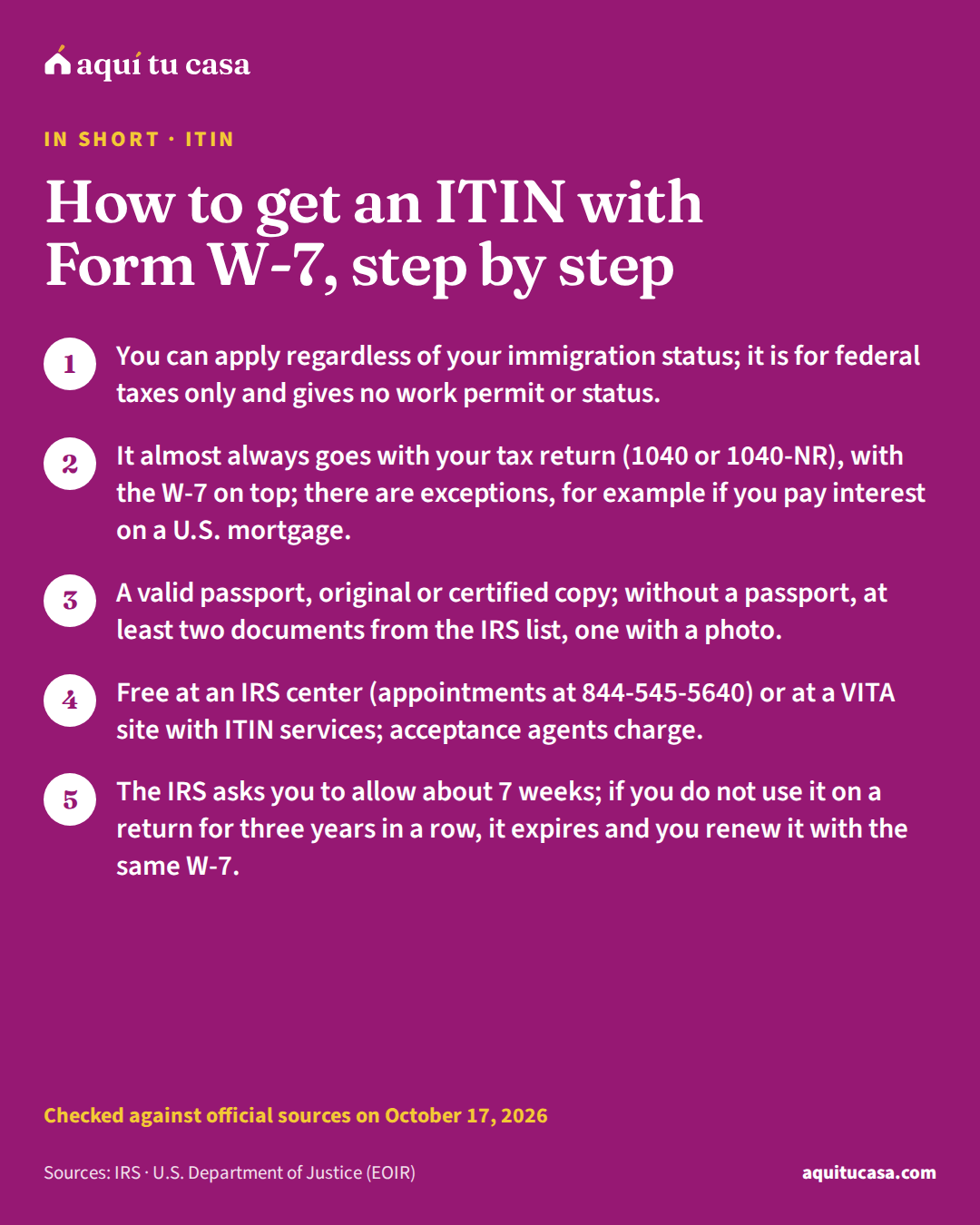
- ITIN How to get an ITIN with Form W-7, step by step Who can apply for an ITIN, which documents the IRS accepts, where to file Form W-7 for free, how long it takes and how to renew it. 15 minute read
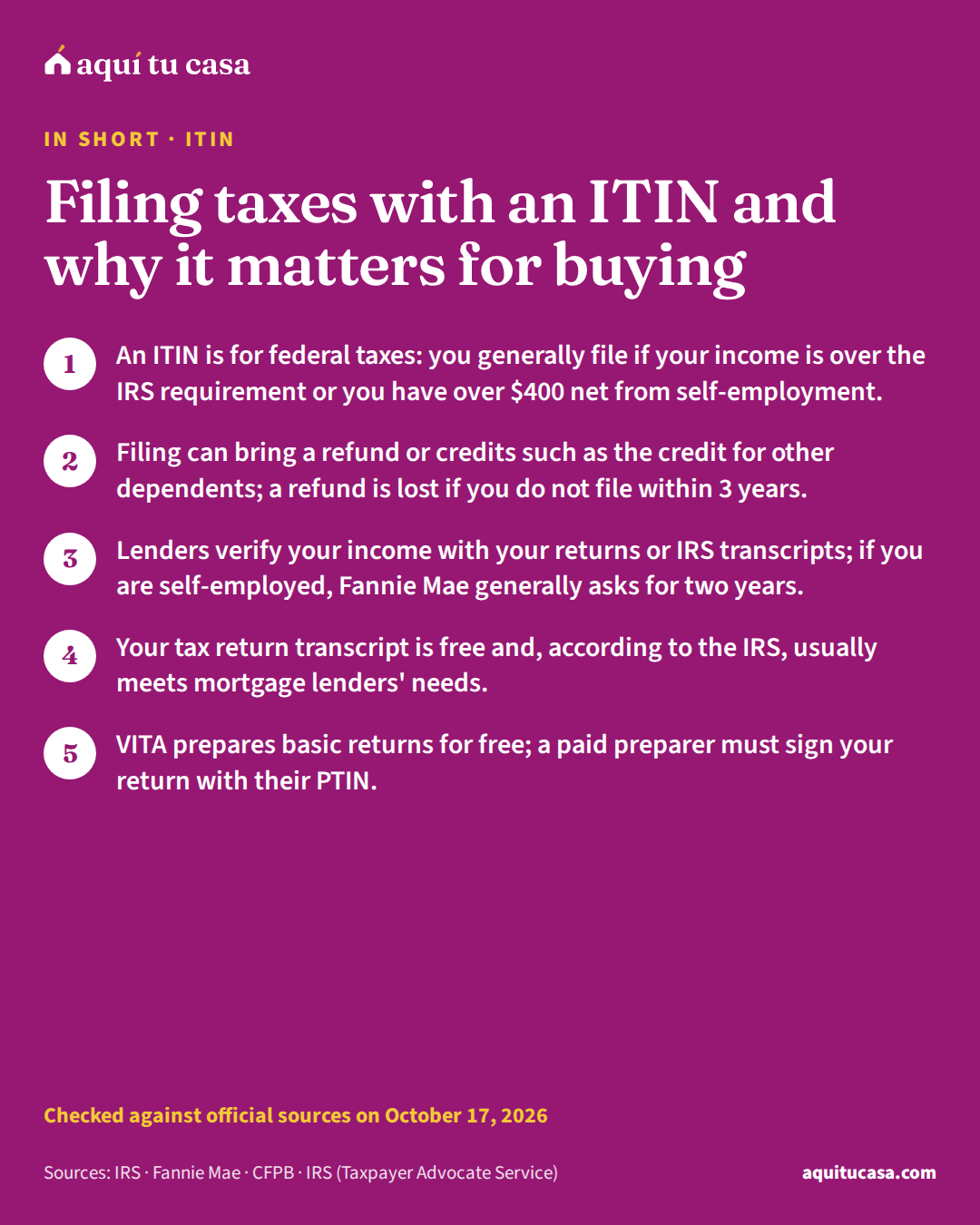
- ITIN Filing taxes with an ITIN and why it matters for buying Who has to file with an ITIN, what you gain by filing, how to get your IRS transcripts and why a lender will ask for your tax returns. 12 minute read
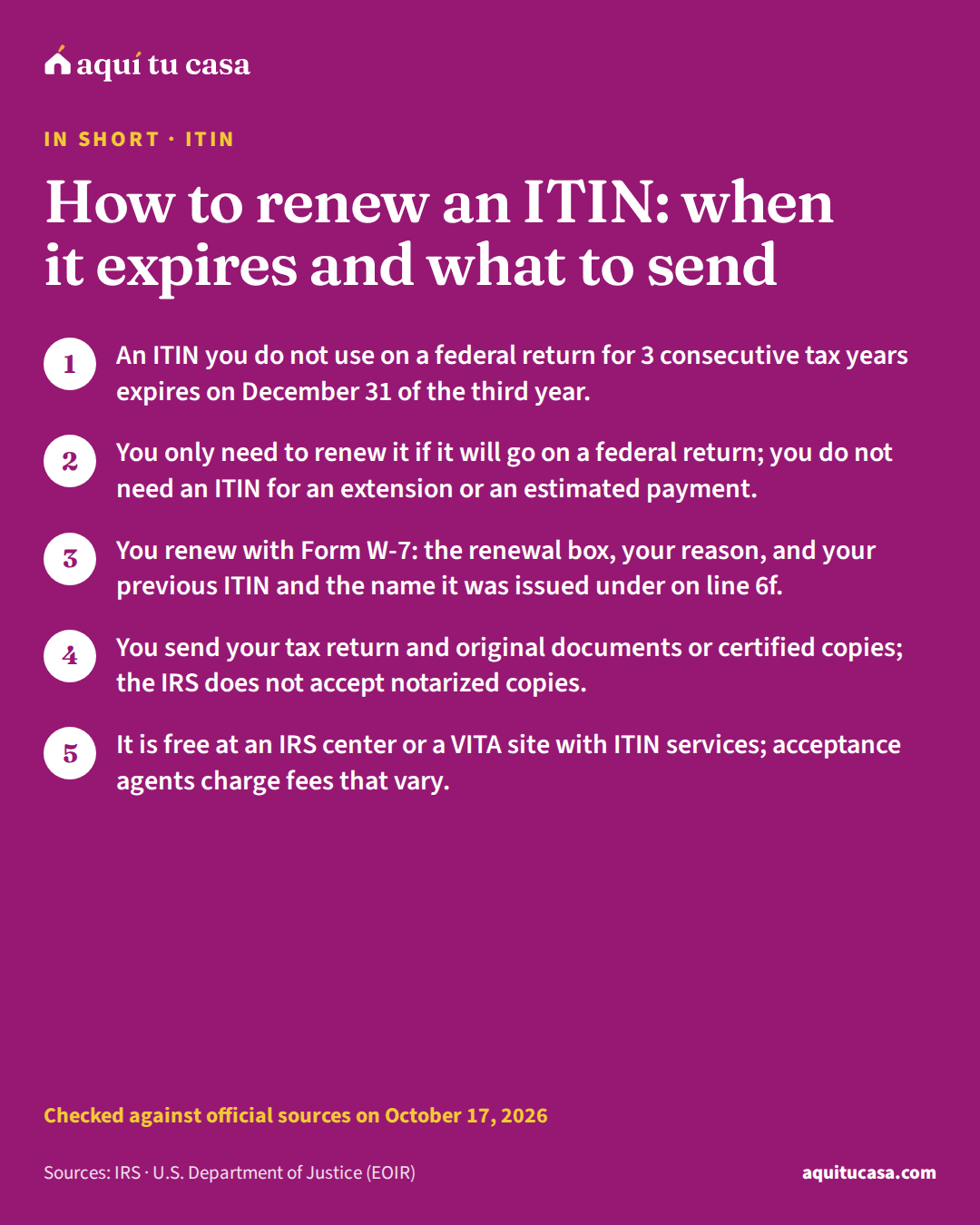
- ITIN How to renew an ITIN: when it expires and what to send When your ITIN expires, whether you really need to renew it, how to fill in a renewal Form W-7, which documents work and where to do it for free. 12 minute read
Was this guide useful?
Thank you. Your answer stays in your browser; nothing is sent.