How to read your credit report, line by line
Where to get your free credit reports, what each part says, how long negative items can stay and how to spot errors or identity theft.
Verified against official sources on October 17, 2026 16 official sources

Show contents
In short
What you need to know
Quick answer
Get your three free reports at AnnualCreditReport.com, the only site the federal government authorizes for them; right now you can view them every week, and checking your own report does not affect your score. Read them part by part (personal information, accounts and payments, collections, public records and inquiries) and confirm everything is yours and correct. Most negative information can be reported for up to seven years, and a bankruptcy for up to ten. If you see accounts you did not open or inquiries from companies you do not know, it may be identity theft or a file mixed with someone else's: disputing errors is free.
What matters most
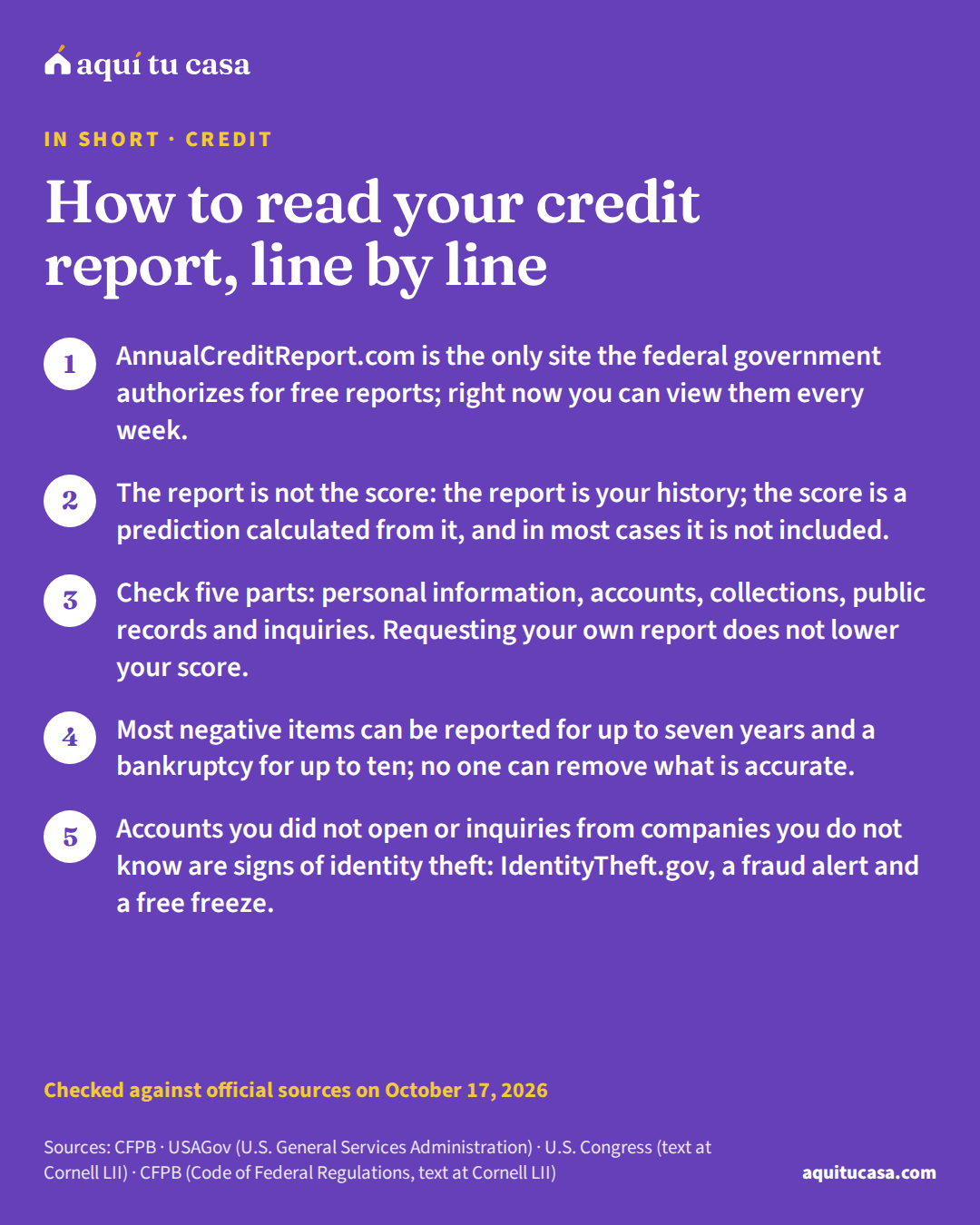
- AnnualCreditReport.com is the only site the federal government authorizes for free reports; right now you can view them every week.
- The report is not the score: the report is your history; the score is a prediction calculated from it, and in most cases it is not included.
- Check five parts: personal information, accounts, collections, public records and inquiries. Requesting your own report does not lower your score.
- Most negative items can be reported for up to seven years and a bankruptcy for up to ten; no one can remove what is accurate.
Is this for you?
This guide is for you if…
- You are about to request your credit report for the first time and do not know where or how.
- You have your reports in hand and do not understand what each part means.
- You want to buy or rent soon and would rather find the errors before the lender does.
- You got a bill or a collection call about a debt you do not recognize.
Get direct help first if…
- You already found an error and want the full dispute steps, with the letters: this is a summary; the steps are in our guide How to dispute credit report errors.
- You have been sued over a debt or were served court papers: look for free legal help today.
- You already know someone used your identity: start at IdentityTheft.gov, the federal site to report it and recover, and come back to this guide afterward.
Your credit report is the record of how you have handled debt, and lenders, landlords and insurers read it before they decide. This guide is for anyone requesting a report for the first time or puzzling over the one they have: where to get it for free, what each part says, how to check it step by step, how long negative items stay and how to spot an error or identity theft.
Report and score: two different things
Your credit reportcredit reportA credit report is a statement that has information about your credit activity and current credit situation: your loans and cards, the balances, whether you have paid on time, accounts in collection and who has checked your credit. Credit reporting companies, also called credit bureaus, compile it from what banks and creditors report; your credit score is computed from it. When you apply for a mortgage, the lender pulls your report from the three bureaus. You have the right to see it for free and to dispute anything that is wrong.See the full definition shows your credit activity and current situation: how you have paid your loans and the status of your accounts. Lenders use it to decide whether to lend to you and at what interest rateinterest rateThe interest rate on a mortgage is what you pay each year to borrow the money, expressed as a percentage of the loan balance. It does not include fees or other charges; that is what the annual percentage rate (APR) is for. On a fixed-rate loan the rate never changes over the life of the loan; on an adjustable-rate loan it can go up or down after an initial period. The rate you are offered depends on your credit score, your down payment, the loan type and the market, and you see it on the first page of the Loan Estimate.See the full definition; other businesses use it to decide whether to insure you, rent you a home or give you services such as internet, utilities or a cell phone. Most people have more than one report, because creditors are not required to report to every credit bureaucredit reporting agencyA credit reporting agency, also called a credit bureau or credit reporting company, is a company that gathers information about people and sells credit reports to other businesses. The three nationwide ones are Equifax, Experian and TransUnion. The businesses that buy those reports use them to decide whether to give you credit, a job, a rental home or insurance. There are also specialty agencies, for example for rental history or check writing. The federal Fair Credit Reporting Act (FCRA) gives you the right to request a copy of your report and to dispute information that is wrong.See the full definition.1
Your credit scorecredit scoreA credit score is a number that predicts how likely you are to pay back a loan on time. It is computed from the information in your credit report: whether you pay on time, how much you owe relative to your limits, how long you have used credit and how many new accounts you opened. FICO is one brand of score; VantageScore is another, and each lender decides which one it uses. A higher score usually brings a lower interest rate and more loan options; each program publishes the minimum it accepts. You can check your report for free and dispute errors.See the full definition is something else: a prediction of how you will repay, calculated by a scoring model from the data in your reports. You do not have just one score: it varies with the model, the source of the data and even the day it is calculated. Most scores range from 300 to 850.2 In most cases, your report does not include your score.3
How to get your reports for free
The only site the federal government authorizes for the free annual reports from the three nationwide bureaus is AnnualCreditReport.com. You can also request them at 1-877-322-8228 (TTY: 1-800-821-7232) or by mail, with the site’s request form.3
The law gives you the right to one free report from each bureau once during any 12-month period, and the bureau has up to 15 days from receiving your request to provide it.5 On top of that, according to the CFPB, the site lets you view your Equifax, Experian and TransUnion reports for free once a week; you can choose one, two or all three bureaus, and ask whether your report is available in your preferred language.6 Requesting your own report is a soft inquirysoft inquiryA soft inquiry is a review of your credit file that does not affect your score. It includes reviews of your existing accounts by your lenders or insurers, prescreened offers from prospective lenders, employment screening and your own requests for your credit report. Only you see it when you review your report; businesses that buy your report do not. That is why checking your own credit report, even often, does not lower your score.See the full definition: it does not affect your scores.8
There are extra free reports, too. If you were denied credit, insurance or a job because of a report, you have the right to another free one from the bureau named in the notice, if you ask within 60 days. The same goes if you believe your file is inaccurate because of fraud, if you place an initial fraud alert, if you are unemployed and plan to look for a job within 60 days, if you receive public assistance or if your state’s law provides one.6
The parts of the report
According to the CFPB, a report usually has five parts:1
| Part | What it shows |
|---|---|
| Personal information | Your name and other names you have used on credit accounts (nicknames included), current and former addresses, birth date, Social Security number and phone numbers |
| Credit accounts (tradelines) | Current and past accounts: type (mortgage, installment, revolving), credit limit or amount, balance, payment history, dates opened and closed, creditor name |
| Collections | Missed payments, loans sent to collections and overdue child support provided or verified by a government agency |
| Public records | Liens, foreclosures, bankruptcies, civil suits and judgments |
| Inquiries | The companies that have accessed your report |
Inquiries come in two kinds.8 Hard inquirieshard inquiryA hard inquiry happens when a lender checks your credit report because you applied for a loan or a card, to decide whether to approve you. It can affect your score, because most scoring models look at how often and how recently you apply for credit, and other businesses that buy your report can see it. A single inquiry has little impact. Scoring models also allow for comparison shopping: several inquiries for the same type of loan, such as a mortgage, within a short period usually count as one.See the full definition are usually made by lenders when you apply for credit: they affect your score, because most scoring models look at how recently and how often you apply, and companies that buy your report can see them. Soft inquiries (reviews of accounts you already have, prescreened offers, employment screening and your own requests) do not affect your scores and only you see them.
Check your report, step by step
The CFPB says to confirm that the report contains only items about you and to look for anything inaccurate or incomplete.9 Bureaus are required to follow reasonable procedures to make the information as accurate as possible,10 but errors happen. Keep your statements and a list of your previous addresses and names at hand, and go through the report in this order:
Go through your report in this order
1. Your personal information
Are your name, addresses and phone number right, and are they all yours? A name or address you do not recognize can be a sign of a mixed file.9
2. Your accounts
Did you open each one? Are you the owner or only an authorized user? Is a closed account showing as open?9
4. Balances and limits
Do they match your statements? Does the same debt show up twice, maybe under another name?9
6. Public records
Liens, foreclosures, bankruptcies, lawsuits and judgments. Compare their dates with the legal time limits in the next section.11
8. Mark what is wrong and keep a copy
The CFPB suggests sending, with your dispute, the part of the report with the errors circled or highlighted.14
Try it with your numbersCredit plan
If something does not add up, contact the bureau and the company that provided the information; the report includes directions on how to dispute.9

How long negative items stay
Positive information can stay longer, even after you pay off or close the account; negative information has time limits.10 The Fair Credit Reporting Act sets these maximums:11
| Negative item | Counted from | Maximum time |
|---|---|---|
| Bankruptcy | The order for relief or adjudication | 10 years |
| Civil suits, civil judgments and arrest records | The date of entry | 7 years, or until the statute of limitations expires if that is longer |
| Paid tax lien | The date of payment | 7 years |
| Account in collections or charged off | See below | 7 years |
| Any other negative item (except criminal convictions) | — | 7 years |
For an account in collectionscollection accountA collection account is a past-due debt that the original creditor (the company that gave you the loan or credit) handed to a debt collector or sold to another company. A debt collector is a person or company that regularly collects debts owed to others, such as a collection agency, a lawyer or a debt buyer. The account can show up on your credit report; once you pay it, it should generally show a zero balance as a paid collection. Most negative information can be reported for up to seven years. If you think you do not owe the debt or the amount is wrong, you can dispute it with the collector and with the credit reporting company.See the full definition or charged off, the seven years start once 180 days have passed from the start of the delinquency that led to it.11
These limits do not apply to reports used for credit or life insurance of $150,000 or more, or for a job paying $75,000 or more a year.11 A mortgage can be above that amount; in those cases, according to the CFPB, bureaus may report negative information outside the time limits.10

Signs of identity theft or a mixed file
A mixed file combines two people’s information, such as accounts belonging to someone with the same or a similar name.9 In identity theftidentity theftIdentity theft happens when someone uses your personal information without your permission to commit fraud: for example, your name, your Social Security or Medicare number, or your credit card or bank account number. With that information, a thief can rent a home, get credit cards, receive government benefits or tax refunds, or open other accounts in your name. You often find out when your credit report or a statement shows accounts or charges you do not recognize, or when a debt collector calls. The federal site IdentityTheft.gov takes reports and gives you a recovery plan.See the full definition, someone opens accounts in your name. The CFPB lists these warning signs: inquiries from companies you never contacted, accounts you did not open, wrong amounts, personal details that are not yours and debt collectors calling about debts that are not yours.12
If you think your identity was stolen, the CFPB lays out these steps:13
- Close the affected accounts and contact your bank’s fraud department.
- Report it to the FTC at IdentityTheft.gov: you get an Identity Theft Report and a recovery plan.
- Place a fraud alertfraud alertA fraud alert is a note in your credit file that requires creditors who check your report to verify your identity before opening a new account, issuing an additional card or raising your credit limit. You only need to ask one of the nationwide credit reporting companies, which must notify the others. An initial alert is for anyone who suspects they are, or are about to become, a victim of fraud or identity theft, and it lasts one year unless you ask to remove it sooner. An extended alert requires an identity theft report and lasts seven years. When you place one, you are entitled to free copies of your report.See the full definition with one bureau, which must notify the others: creditors will have to make sure it is you before opening a new account. An initial alert lasts one year; an extended alert, seven.
- Consider a security freezesecurity freezeA security freeze, also called a credit freeze, keeps new creditors from seeing your credit file, which helps stop an identity thief from opening new accounts in your name. By law it is free to place and to lift, and you must ask each of the three nationwide credit reporting companies separately. While it is on, only a few can see your file, such as creditors on accounts you already have, and you can still review your reports. It does not affect your score. Because creditors rarely lend without checking your file, it stops you too; you can lift it for free for a period of time when you need to.See the full definition: it is free under federal law, but you request it from each bureau separately.
- Ask the bureaus to block the fraudulent information, with your identity theft report, proof of identity and a letter. They must do it within four business days after receiving your request.
Tenant screening reports and other specialty bureaus
Not everything is in your Equifax, Experian and TransUnion reports. Specialty agencies collect information just for landlords, to help them decide whether to rent to you: your name, previous addresses, how long you lived at each one and your payment history with past landlords. Many give you a free copy of your report every 12 months; others charge.15 The CFPB publishes a list of specialty reporting companies, and you have to request each report separately.6
If a landlord turns down your rental application, fully or partly, because of what one of those reports says, that is an “adverse action”: the landlord must give you a notice with the agency’s name and contact information, and if you ask, the agency must give you a free copy of the report that was used.15 How tenant screeningtenant screening reportA tenant screening report is a report many landlords use to decide whether to rent to you and how much to charge for the security deposit. Specialty companies prepare it, and it can include your credit report, your rental history including eviction cases and lawsuits, employment verification, criminal history and a score or recommendation. It is not the same as a credit report. If a landlord denies you, or asks for a larger deposit or higher rent, because of the report, federal law requires the landlord to tell you, name the company and explain your right to a free copy and to dispute errors.See the full definition works when you have no history is covered in How to rent without a Social Security number or credit.
If you find an error
Disputing is your right, and you can do it yourself at no cost.10 According to the CFPB, write to the credit bureau saying what is wrong and why, with copies (not originals) of your proof; the bureau must investigate, forward your dispute to the company that provided the information and report the results to you. Also write, by certified mail, to the company that provided the information (your bank, your landlord, your card company); it generally must investigate and respond within 30 days of receiving your dispute.14
The full disputecredit report disputeA credit report dispute is the complaint you make when your credit report has wrong or incomplete information. You have the right to dispute it, and the investigation is free. It is usually done in two places: with the credit reporting company and with the company that supplied the information, called a furnisher, such as your bank, your landlord or your credit card company. You explain in writing what is wrong and why, with copies of your documents. The credit reporting company must investigate, generally within thirty days, and delete or correct anything found to be inaccurate, incomplete or unverifiable.See the full definition steps, with what each letter should include, where to send it and the legal timelines, are in our guide How to dispute credit report errors. If your report comes back nearly empty, Credit from zero explains how to start a history.
Free help near you
A HUD-approved housing counselor gives independent advice on credit issues, often at little or no cost, and you search for one by ZIP code; not every counselor offers every service, so check each agency’s list.16 Our credit plan helps you put the steps in order.
HUD-approved housing counselors by state
| State | HUD-approved counselors |
|---|---|
| Alabama | 25 |
| Alaska | 1 |
| Arizona | 21 |
| Arkansas | 14 |
| California | 81 |
| Colorado | 26 |
| Connecticut | 13 |
| Delaware | 12 |
| District of Columbia | 17 |
| Florida | 98 |
| Georgia | 42 |
| Hawaii | 17 |
| Idaho | 10 |
| Illinois | 81 |
| Indiana | 21 |
| Iowa | 11 |
| Kansas | 3 |
| Kentucky | 19 |
| Louisiana | 26 |
| Maine | 7 |
| Maryland | 41 |
| Massachusetts | 37 |
| Michigan | 59 |
| Minnesota | 33 |
| Mississippi | 16 |
| Missouri | 18 |
| Montana | 11 |
| Nebraska | 8 |
| Nevada | 8 |
| New Hampshire | 5 |
| New Jersey | 34 |
| New Mexico | 7 |
| New York | 93 |
| North Carolina | 52 |
| North Dakota | 3 |
| Ohio | 54 |
| Oklahoma | 6 |
| Oregon | 25 |
| Pennsylvania | 75 |
| Puerto Rico | 9 |
| Rhode Island | 5 |
| South Carolina | 13 |
| South Dakota | 13 |
| Tennessee | 32 |
| Texas | 51 |
| Utah | 7 |
| Vermont | 7 |
| Virginia | 49 |
| Washington | 15 |
| West Virginia | 8 |
| Wisconsin | 26 |
| Wyoming | 1 |
They advise on credit, among other topics, often at little or no cost.16 Source: HUD
If this is you
Your report comes back nearly empty
A report is built from what creditors report; if you have no accounts, there is little to read.1 Credit from zero explains how to start.
Someone in your family has your same name
If you see accounts belonging to someone with the same or a similar name, it may be a mixed file: it is a common error, and you can dispute it.9
You are about to rent
The landlord may use a tenant screening report. If you are turned down because of it, you must be told which agency made it, and you can ask for a free copy.15
You are applying for a mortgage
If the lender uses your score, the law requires it to give you the score, its range and the factors that pulled it down.4 Check your reports before you apply.

Costly mistakes
Mistake: Getting your report from a «free» site you saw in an ad.
Instead: Type AnnualCreditReport.com yourself: it is the only site the federal government authorizes.3
Mistake: Checking only one of your three reports.
Instead: Check all three: creditors are not required to report to every bureau.1
Mistake: Ignoring a collector's call about a debt that is not yours.
Instead: Do not ignore it: it may be a sign that someone opened an account in your name.12
Mistake: Paying someone to erase a late payment you really made.
Instead: No one has the right to remove accurate information; only errors get fixed, and that is free.10
Mistake: Sending your original documents with a dispute.
Instead: Send copies, plus the part of the report with the errors marked.14
Mistake: Giving your information to someone who calls «from the FTC».
Instead: The FTC never threatens you or asks you to move your money; contact the agency yourself at its official numbers.13
What to do this week
- Type AnnualCreditReport.com into your browser yourself and request your three reports.3
- Go through them with the steps above and your statements next to you.9
- Mark anything you do not recognize and keep a copy.14
- If you see signs of identity theft, go to IdentityTheft.gov and place a fraud alert.13
- If there is an error, follow How to dispute credit report errors and write to the bureau and to the company that provided the information.14
- Put your next check on your calendar: you can view your reports for free every week.6
Your situation
If you have never had a card or a loan in the U.S., choose "None".
Your credit plan
12 steps
You have done 0 of 12.
This week
Get your three credit reports for free
At AnnualCreditReport.com you can get the Equifax, Experian and TransUnion reports for free once a week. Checking your own report does not lower your score. If it comes up empty, that is not an error: you simply have no history yet.
Source: CFPB: How do I get a free copy of my credit reports? ↗ · CFPB: Does requesting my credit report hurt my credit score? ↗
Dispute any error in writing
Write to the credit bureau and to the company that reported the item, with copies of your proof, by certified mail. By law, the bureau must investigate again for free and resolve it within 30 days of receiving your notice.
Source: CFPB: How do I dispute an error on my credit report? ↗ · Congreso de EE. UU. (texto en Cornell LII): Fair Credit Reporting Act, 15 U.S.C. §1681i, Procedure in case of disputed accuracy ↗
Talk to a HUD-approved housing counselor
They give independent advice on buying, renting, defaults and credit, often free or at low cost. You can go over your report and your plan with them.
Source: CFPB: Find a Housing Counselor ↗
This month
Open a secured card
You deposit an amount (for example, $500) and can spend up to that amount. With on-time payments, the limit can go up, and the deposit comes back. Before signing, ask whether they report to all three bureaus and compare the annual fee and the rate: they can be high.
Source: CFPB: What are some ways to start or rebuild a good credit history? ↗ · CFPB: How to rebuild your credit ↗
Or a credit builder loan
The bank or credit union holds the money as savings while you make small payments, usually for six to 24 months; when you finish, you get it. You build history and savings at the same time.
Source: CFPB: What are some ways to start or rebuild a good credit history? ↗
Ask for your rent to be reported
On-time rent payments can help build your credit. Ask your landlord whether they take part in a rent reporting program (often through a payment app) and check its fees.
Set up automatic payments
An automatic payment or a reminder before the statement date prevents the costliest kind of slip: payment history is the main factor in most models.
What does not build credit
Paying with a debit card or cash, prepaid cards and payday loans do not build history, according to the CFPB. They are ways to pay, not accounts that get reported.
From here on
Do not close your first account
A long history of on-time payments helps your score. When a better card comes along, keep the first one open and current.
Only apply for the credit you need
Opening several accounts in a short time is a risk signal for lenders, and each application leaves a hard inquiry that does affect your score.
Source: CFPB: How do I get and keep a good credit score? ↗ · CFPB: What is a credit inquiry? ↗
Watch your debt-to-income ratio
Lenders divide your monthly debt payments by your gross monthly income to see whether you can handle a new loan. While you prepare, avoid new payments, such as a car.
Watch out for "credit repair"
It is a scam if they charge before doing anything, promise to remove accurate negative information, tell you not to contact the bureaus or to dispute everything. Disputing errors is free by law, and if you already signed up for something like this, you can cancel within three business days.
Source: CFPB: How can I tell a credit repair scam from a reputable credit counselor? ↗
An educational plan built on what the CFPB, the NCUA and the federal credit reporting law publish; not individual advice. We recommend no brands and are paid for no product.
Ready to see the numbers? Find your county here
See how this applies in your county: its loan limits, prices and rents, from the official data.
Printable checklist
Frequently asked questions
Does checking my report lower my score?
No. Requesting your own report is a soft inquiry: only you see it and it does not affect your scores. The ones that count are hard inquiries, made by a lender when you apply for credit.
Why are my three reports not the same?
Because creditors are not required to report to all three bureaus. An account can appear on one report and not on another, which is why it is worth checking all three.
Does my report include my score?
In most cases, no. The score is calculated from the data in the report and varies by model. If you apply for a mortgage and the lender uses your score, the law requires the lender to give you that information.
How long does a late payment stay on my report?
According to the CFPB, most negative information can be reported for seven years; a bankruptcy, for up to ten. If the item is accurate, no one has the right to remove it early, however much they charge.
Can I get my report if I have an ITIN?
The federal sources we reviewed do not explain how each bureau handles a file with an ITIN. If the official source cannot verify your identity, it must tell you what additional information or documents are needed and how to send them. If your request is denied, contact the bureau and, if that does not resolve it, the CFPB; a HUD-approved housing counselor can help you.
How often can I see my report for free?
According to the CFPB, you can view it for free every week at AnnualCreditReport.com, from each of the three bureaus. The law also gives you the right to one free report from each bureau every 12 months, and to more in certain cases, such as when you are denied credit because of your report.
What do I do if I see an account I did not open?
It may be identity theft or a file mixed with someone else's. If you think your identity was stolen, report it at IdentityTheft.gov, place a fraud alert and consider freezing your credit, which is free. If it is an error, dispute it with the bureau and with the company that reported the account.
What is a tenant screening report?
It is a report from a specialty agency that collects information for landlords, such as your previous addresses and your payment history with landlords. Many of those agencies give you a free copy every 12 months. If a landlord turns you down because of that report, it must give you a notice with the agency's details.
Sources
Every figure in this guide comes from one of these official sources. The number next to a sentence leads to the source behind it.
Each source on one line: who publishes it, its title, its address and the date we read it.
- 1. CFPB · What is a credit report? · consumerfinance.gov · Accessed October 17, 2026
- 2. CFPB · What is a credit score? · consumerfinance.gov · Accessed October 17, 2026
- 3. USAGov (U.S. General Services Administration) · Learn about your credit report and how to get a copy · usa.gov · Accessed October 17, 2026
- 4. U.S. Congress (text at Cornell LII) · Fair Credit Reporting Act, 15 U.S.C. §1681g, Disclosures to consumers · law.cornell.edu · Accessed October 17, 2026
- 5. U.S. Congress (text at Cornell LII) · Fair Credit Reporting Act, 15 U.S.C. §1681j, Charges for certain disclosures · law.cornell.edu · Accessed October 17, 2026
- 6. CFPB · How do I get a free copy of my credit reports? · consumerfinance.gov · Accessed October 17, 2026
- 7. CFPB (Code of Federal Regulations, text at Cornell LII) · 12 CFR §1022.136, Centralized source for requesting annual file disclosures from nationwide consumer reporting agencies · law.cornell.edu · Accessed October 17, 2026
- 8. CFPB · What is a credit inquiry? · consumerfinance.gov · Accessed October 17, 2026
See the other 8 sources
- 9. CFPB · What are common credit report errors that I should look for on my credit report? · consumerfinance.gov · Accessed October 17, 2026
- 10. CFPB · How long does information stay on my credit report? · consumerfinance.gov · Accessed October 17, 2026
- 11. U.S. Congress (text at Cornell LII) · Fair Credit Reporting Act, 15 U.S.C. §1681c, Requirements relating to information contained in consumer reports · law.cornell.edu · Accessed October 17, 2026
- 12. CFPB · How can I spot identity theft? · consumerfinance.gov · Accessed October 17, 2026
- 13. CFPB · What do I do if I am a victim of identity theft? · consumerfinance.gov · Accessed October 17, 2026
- 14. CFPB · How do I dispute an error on my credit report? · consumerfinance.gov · Accessed October 17, 2026
- 15. CFPB · Does late rent affect my credit score? · consumerfinance.gov · Accessed October 17, 2026
- 16. CFPB · Find a Housing Counselor · consumerfinance.gov · Accessed October 17, 2026
Keep reading
Related guides
If this guide helped, these follow the same path.

Credit 14 minute read
How to dispute errors on your credit report
How to fix credit report errors for free: what to send each bureau and the company that reported it, legal deadlines, and credit repair scams.
- Disputing is free and you can do it yourself: write to the credit bureau and also to the company that reported the item.
- Explain what is wrong and why, with copies (never originals) of your proof, and keep a copy of everything you send.
- The bureau must reinvestigate and generally finish in 30 days; if the item is wrong or cannot be verified, it must delete or correct it.
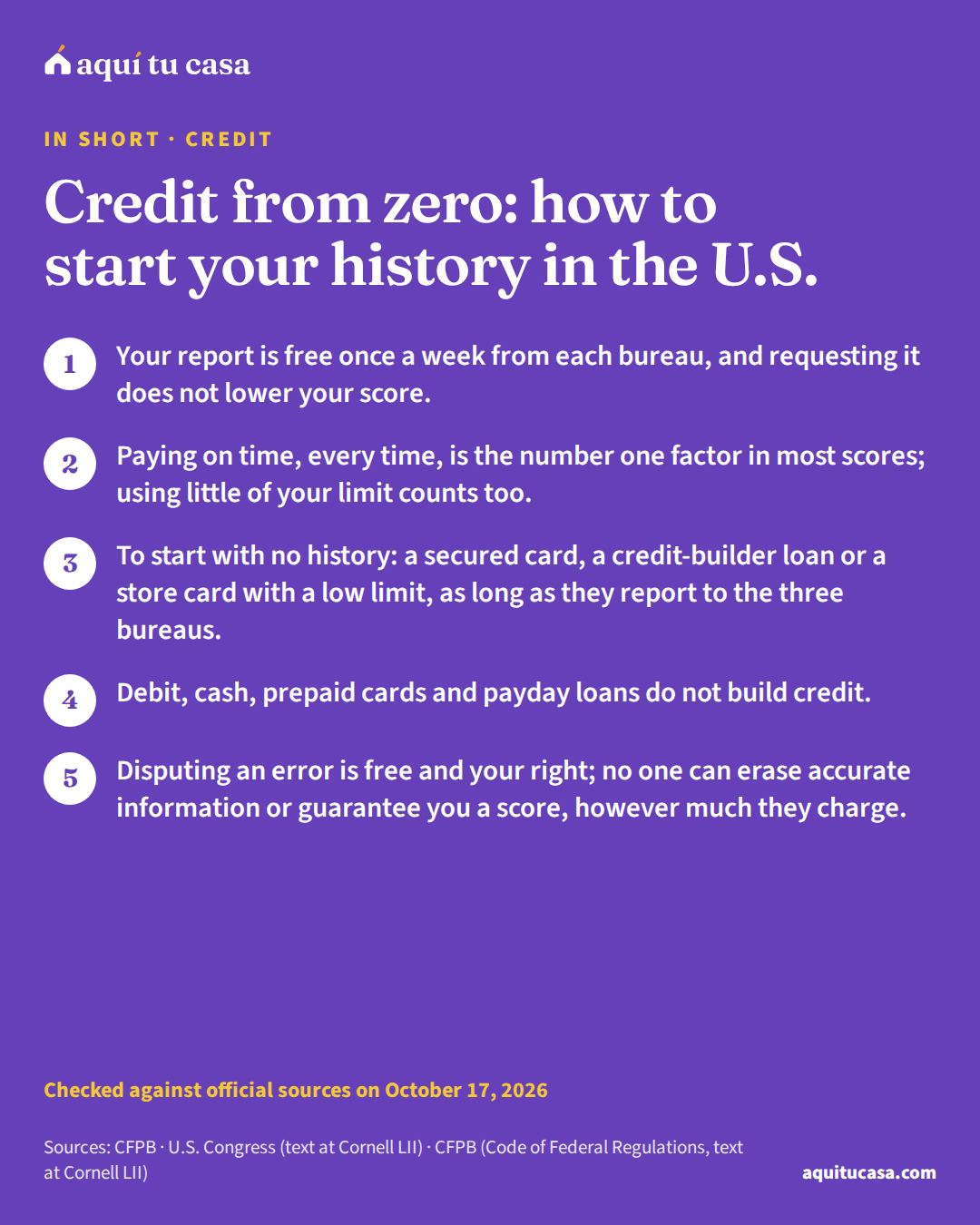
- Credit Credit from zero: how to start your history in the U.S. What credit reports and scores are, how to get them for free, and how to start a history from nothing with a secured card or a credit-builder loan. 16 minute read
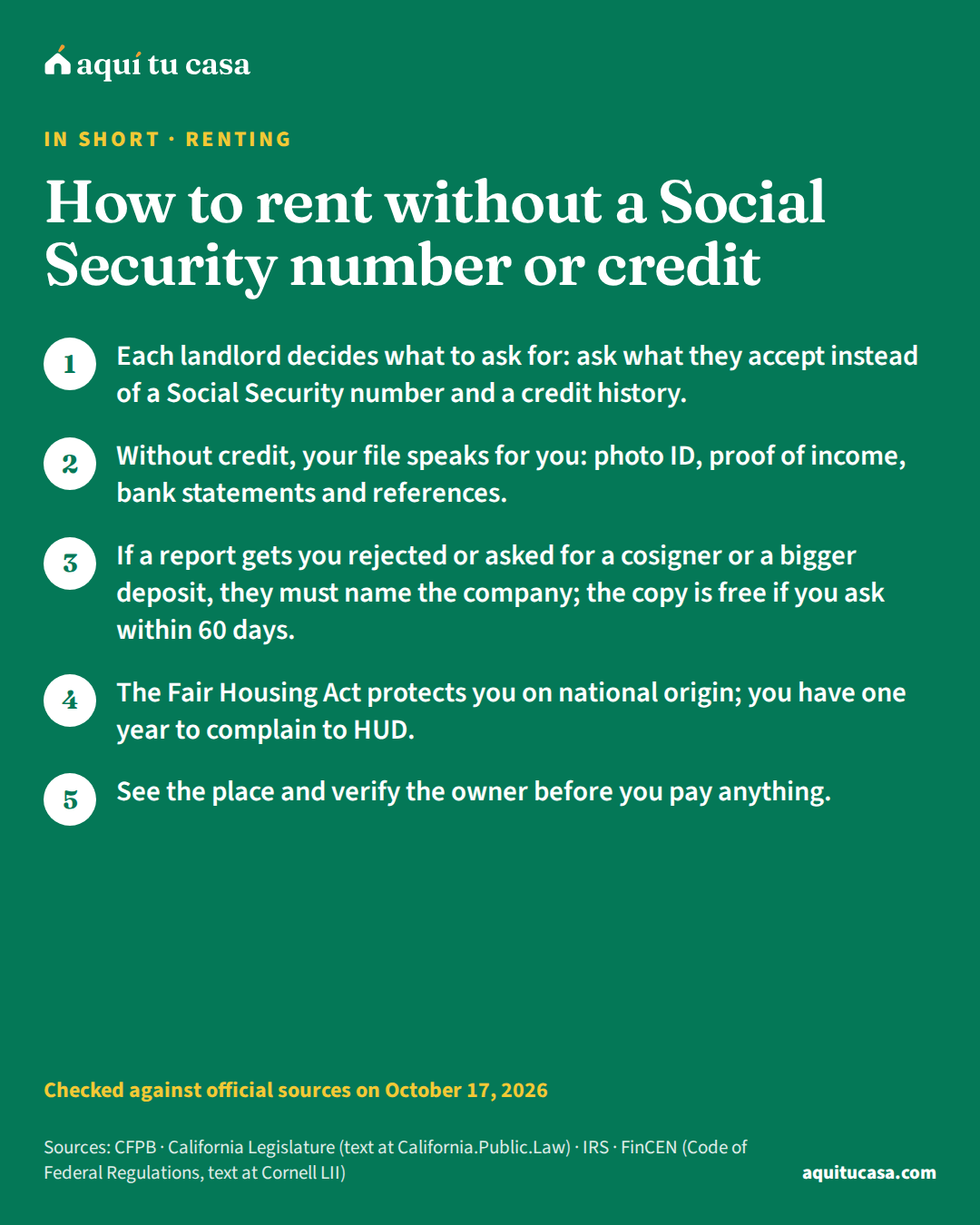
- Renting How to rent without a Social Security number or credit What a landlord can ask for, what to offer instead of an SSN and credit, how much rent fits your income and your rights if you are turned down. 11 minute read
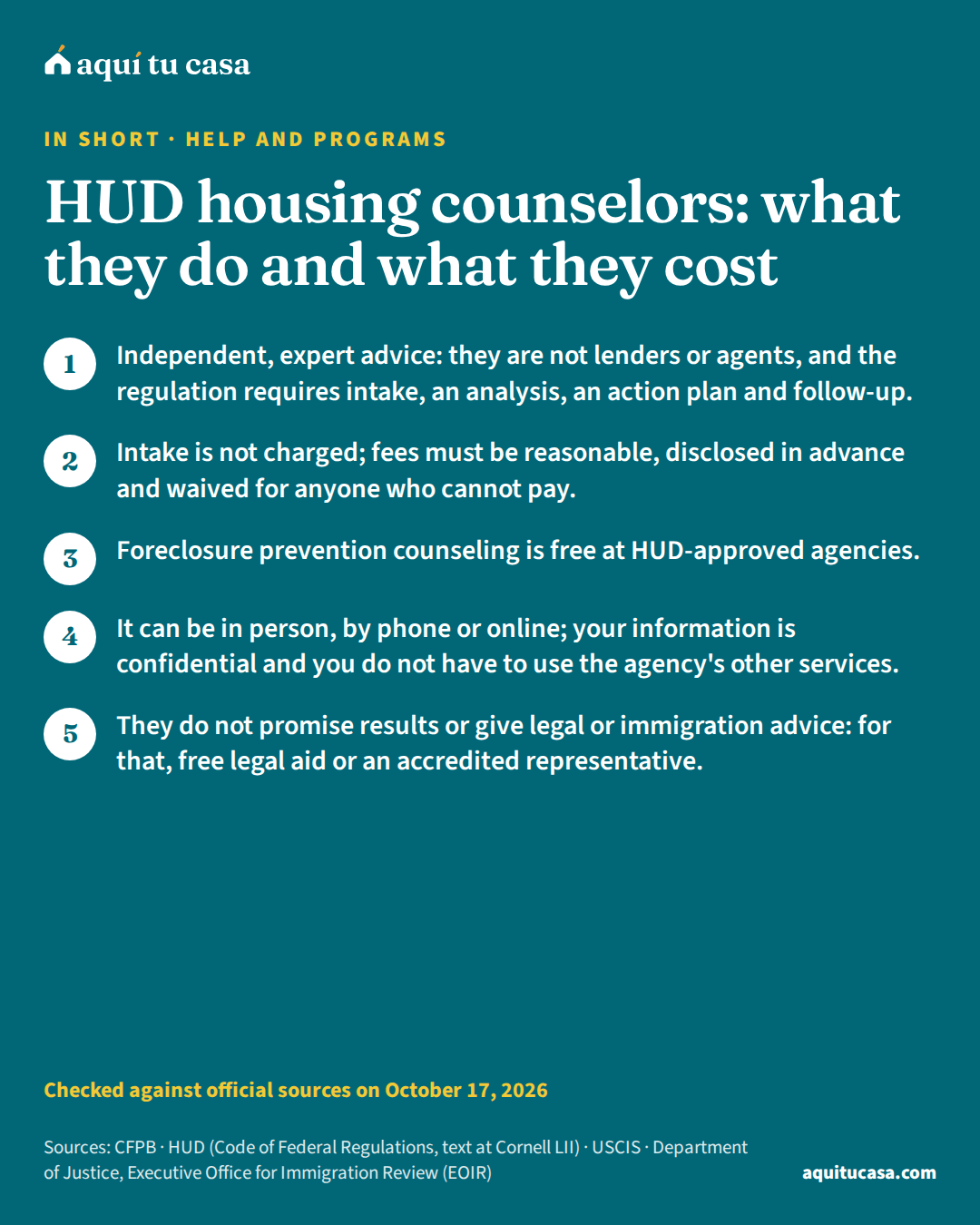
- Help and programs HUD housing counselors: what they do and what they cost What a HUD-approved housing counselor does, what they help with (buying, renting, missed payments, credit), what they may charge and how to find one. 11 minute read
Tools for this topic
Was this guide useful?
Thank you. Your answer stays in your browser; nothing is sent.