Buying a home Essential guide
How to buy a home in the United States, step by step
The nine steps to buying a home: paperwork, credit, budget, assistance, preapproval, offer, inspection, closing and the first year, with official sources.
Verified against official sources on October 17, 2026 28 official sources

Show contents
In short
What you need to know
Quick answer
Buying a home takes nine steps and most of them are free: gather your documents, check your credit, work out what you can pay, save the down payment and look for assistance, get a preapproval from several lenders, find a home and make an offer, choose your loan and inspect the home, review the Closing Disclosure and sign, and learn to look after the home in the first year. A HUD-approved housing counselor can walk the road with you, often for free or at low cost.
What matters most
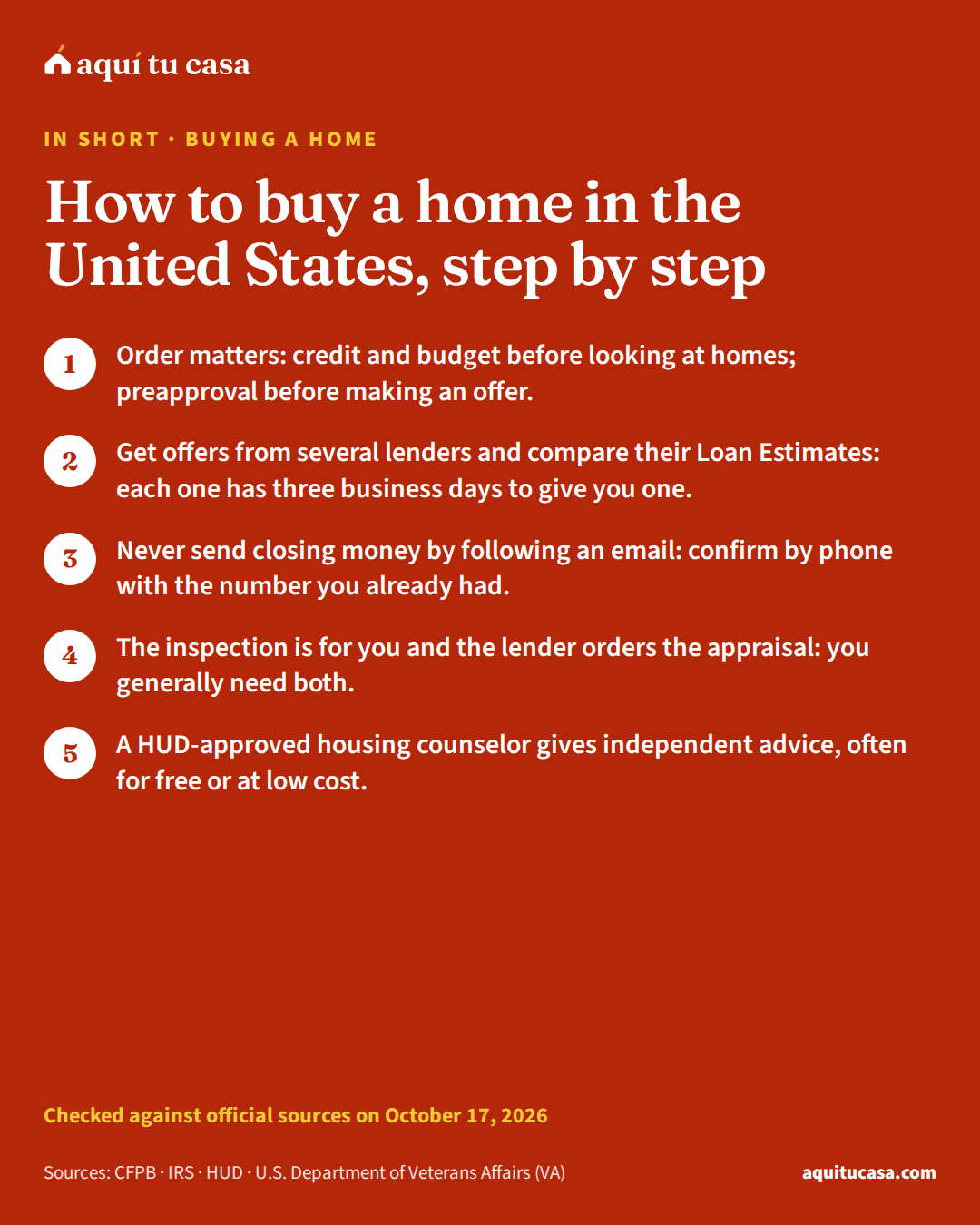
- Order matters: credit and budget before looking at homes; preapproval before making an offer.
- Get offers from several lenders and compare their Loan Estimates: each one has three business days to give you one.
- Never send closing money by following an email: confirm by phone with the number you already had.
- The inspection is for you and the lender orders the appraisal: you generally need both.
Is this for you?
This guide is for you if…
- It is your first home in the United States and you want to see the whole road before you start.
- You already started and do not know what comes next, or which document is which.
- You are buying with your family and want to split the tasks.
Get direct help first if…
- You are in the middle of a closing with a date on top of you: start with the Closing Disclosure guide and talk to your lender about your specific case.
- You fell behind on payments for a home you already own: look for a housing counselor first; that is another guide.
Buying a home in the United States is not one procedure; it is a line of them. The good news: almost all of them are free and they have an order. This guide is the map for first-time buyers: the nine steps in order, what each one asks of you and the guide that has the detail.
The CFPB, the federal consumer financial protection agency, splits the road into four phases: prepare, explore loans, choose a loan offer and get ready to close.1 We tell it in nine steps because families ask us about each one.
- According to the CFPB: prepare, explore loans, choose an offer and close
- 4 phases1
- Minimum down payment on an FHA loan, with a score of 580 or higher
- 3.5%10
- Window in which several mortgage credit checks count as one
- 45 days7
- Before closing, at the latest, the Closing Disclosure must reach you
- 3 business days25
The whole road at a glance
The nine steps to buying a home
1. Gather your documents
Phase 1 · Prepare
ID, proof of income, tax returns and bank statements. If you are self-employed, you may be asked for more.3
Try it with your numbersDocument checklist2. Check your credit
Phase 1 · Prepare
Get your reports free at AnnualCreditReport.com and dispute any errors. Guide: how to read your credit report.5
Try it with your numbersCredit plan3. Work out what you can pay
Phase 1 · Prepare
Lenders look at your debt-to-income ratio. Guide: what DTI is and how to lower it.8
Try it with your numbersHow much house can I afford?4. Save the down payment and look for assistance
Phase 1 · Prepare
FHA asks for 3.5% with a score of 580 or higher. Guides: how much down payment you need and down payment assistance.10
Try it with your numbersWhich programs might I qualify for?5. Get a preapproval
Phase 2 · Explore loans
Talk to several lenders; the letter does not commit you to any of them. Guide: preapproval vs. prequalification.15
6. Find a home and make an offer
Phase 2 · Explore loans
Search within your budget. The Fair Housing Act prohibits denying you housing because of your national origin, among other reasons.18
7. Choose your loan and inspect the home
Phase 3 · Choose a loan offer
Compare Loan Estimates and schedule the inspection as soon as you can. Guides: closing costs and home inspection.20
Try it with your numbersCompare loans8. Review the Closing Disclosure and sign
Phase 4 · Get ready to close
It arrives at least three business days before closing. Guide: the Closing Disclosure, page by page.25
Try it with your numbersClosing costs9. Your first year as an owner
After closing
Taxes, insurance and escrow: your payment can change each year. Guide: your first year as a homeowner.28
Each step has its own section below. If you or your family would rather read the official version in Spanish, the CFPB publishes its home loan toolkit as “Su conjunto de herramientas para préstamos hipotecarios: guía paso a paso”, with the steps to choose your mortgage, understand closing and own your home.2 You can download it from the CFPB’s site.
Step 1: Gather your documents
Before talking to anyone, put together what you will be asked for. The CFPB suggests building a packet: a pay stub for the last 30 days, W-2 forms and signed federal tax returns for the last two years, the two most recent bank statements, proof of where your down payment comes from with at least two months of history, ID and your Social Security number. If you are self-employed or your income is irregular, you may be asked for more documents, and each lender asks for different things.3 The printable list is at the end of this guide and in the document checklist tool.
If you are paid in cash, start earlier: deposit your income into a bank account regularly and keep your tax returns. That way you will have something to show what you earn when you are asked.
Step 2: Check your credit
Your credit reportcredit reportA credit report is a statement that has information about your credit activity and current credit situation: your loans and cards, the balances, whether you have paid on time, accounts in collection and who has checked your credit. Credit reporting companies, also called credit bureaus, compile it from what banks and creditors report; your credit score is computed from it. When you apply for a mortgage, the lender pulls your report from the three bureaus. You have the right to see it for free and to dispute anything that is wrong.See the full definition is the first thing the lender looks at. Get it free from each of the three companies (Equifax, Experian and TransUnion) once a week at AnnualCreditReport.com or by calling (877) 322-8228.5 Read it calmly and dispute any error: accounts that are not yours, payments marked late that you paid on time, debts already paid. The guide on how to read your credit report walks you through it line by line.
If you have no history, the credit from zero guide explains how to build it. FHA, for example, accepts borrowers without a traditional credit history, with manual underwriting.10
Step 3: Work out what you can pay
Two numbers rule: what you can pay each month without drowning, and what the lender believes you can pay. The second is measured, among other things, with the debt-to-income ratio (DTI)debt-to-income ratio (DTI)Your debt-to-income ratio (DTI) is all your monthly debt payments divided by your gross monthly income, that is, income before taxes. If you pay a certain amount each month across a car, cards, student loans and the mortgage you are asking for, and you earn three times that, your DTI is one third. Lenders use it to measure whether you can manage the payment; each loan type and lender sets its own limit, and assistance programs usually publish theirs. Paying down debt before applying improves your DTI.See the full definition: your monthly debt payments divided by your gross monthly income. Each loan type and each lender sets its own limit.8
An example with national numbers: the estimated monthly payment on a typical home with an FHA loan is $2,759. For a household with the country’s typical income ($6,728 a month before taxes), that payment would be 41% of its income, for housing alone. Use the how much house can I afford calculator with your real numbers. And remember that the monthly payment is not only the loan: it includes taxes, insurance and, with a small down paymentdown paymentThe down payment is the part of the home's price you pay out of your own pocket when you buy; the loan covers the rest. In U.S. Spanish it is also called enganche, cuota inicial or entrada. Each loan type has its own minimum: FHA requires at least 3.5% of the value, VA and USDA loans may require none, and conventional loans ask for more if you want to avoid private mortgage insurance. A larger down payment lowers the loan, the monthly payment and the total interest; many state programs help families put it together.See the full definition, mortgage insurance.

Step 4: Save the down payment and look for assistance
On how much to save: according to HUD’s handbook, an FHA loanFHA loanAn FHA loan is a mortgage made by a private lender and insured by the Federal Housing Administration (FHA), an agency of the U.S. government. That insurance protects the lender if you stop paying, which is why the lender can accept a lower down payment and a less-than-perfect credit history than on a conventional loan. Federal law sets the minimum cash investment at 3.5% of the property's value and caps the loan amount at the FHA limit, which changes by county. In exchange for the insurance you pay a mortgage insurance premium.See the full definition requires a down payment of at least 3.5% of the home’s value; with a credit score of 580 or higher you can get maximum financing, and with a score from 500 to 579 the loan only goes up to 90% of the value.10 Add closing costs on top: Freddie Mac says to be prepared to pay between 2% and 5% of the price.13
Example with real numbers
The money to buy a typical home
With the typical US home value, an FHA loan with the minimum down payment and the closing cost range Freddie Mac gives.
- Home price (typical US value)
- $332,700
- FHA minimum down payment (3.5%)
- $11,645
- Closing costs (2% to 5% of the price)
- $6,654 to $16,635
- Money to close, before assistance and credits
- $18,299 to $28,280
This is an example with national numbers.1013 Your real number is on your Loan Estimate. The savings plan tells you how much to set aside each month.
Run it with your numbersDown payment savings plan
You do not have to do it alone. There are two kinds of help:
- Down payment assistancedown payment assistance (DPA)Down payment assistance (DPA) is money a public or nonprofit program contributes toward your down payment and sometimes your closing costs. Many states, local governments and nonprofits offer programs to make homeownership more affordable; most focus on low- and moderate-income families buying their first home, and some target teachers, firefighters and other public service employees. The help can be a grant you never repay, a second loan with no payments that is forgiven over the years or repaid when you sell, and many can be used with a regular FHA or conventional loan.See the full definition. According to the CFPB, many states and local organizations have programs to help first-time buyers with the down payment or closing costs.12 Our list of assistance programs holds 134 verified programs in 52 states and territories, quoting what each one publishes; the which programs do I qualify for tool looks for the ones that might fit you.
- A HUD-approved housing counselorHUD-approved housing counselorA HUD-approved housing counselor works at an agency HUD has approved to provide housing counseling: independent, expert advice customized to your situation about buying a home, renting, a missed mortgage payment, a foreclosure or credit problems. The agencies usually charge little or nothing; many serve in Spanish and offer the homebuyer education course several assistance programs require. They are not lenders or real estate agents and sell you nothing. Your county page lists the official agencies with phone numbers.See the full definition. They give independent advice on buying, renting, defaults and credit, often at little or no cost.9 The CFPB also points to the HOPE Hotline, (888) 995-4673, open 24 hours a day.12
The guide on how much down payment you need explains what each loan type asks for and where the money can come from.
Step 5: Get a preapproval
A preapprovalpreapproval letterA preapproval or prequalification letter is a document from a lender saying it is generally willing to lend you up to a certain amount. It is not a guaranteed loan offer. Lenders use the two words differently: some issue a prequalification based on information you report, without verifying it, and only issue a preapproval after reviewing your documents; others use the words the other way around or interchangeably. That is why it pays to ask what the letter is based on. Sellers often ask for one before accepting an offer.See the full definition is a letter from a lender saying how much it would be willing to lend you. Mind the name: according to the CFPB, some lenders issue a prequalification letter based on unverified information you report and a preapproval letter only based on verified information; neither is a guaranteed offer.14
Talk to several lenders, not one. The preapproval letter shows the seller you are serious without committing you to that lender, and once the seller accepts your offer you may have as little as a couple of days to line up financing.15 Borrowers who shop around can save thousands of dollars; even if your agent has a preferred lender, you can and should compare.16
What about your credit? Each lender’s check lowers your score a little, but several checks from mortgage lenders within 45 days count as a single inquiry. The CFPB suggests not applying for cards or other loans right before or during the process.7 The preapproval vs. prequalification guide explains what the lender checks and what to ask.

Step 6: Find a home and make an offer
With the preapproval in hand, search within your number, not the bank’s number. Visit the neighborhood at different times, ask about property taxes and association dues, and check your county’s page under Places for typical prices and rents.
The purchase offerpurchase offerA purchase offer is the formal proposal you make to a seller to buy their home. Your real estate agent writes it up and sends it to the seller's agent. It includes the price you offer and the terms of the purchase: your target closing date, who pays certain fees, a deadline for the seller to respond and any contingencies, which are conditions that must be met before you buy. The seller can accept it or answer with a counteroffer, and you can accept, reject or counter again. Once both parties sign the written offer, it becomes a contract.See the full definition becomes a contract once the seller accepts it: price, closing date, what stays in the home and the conditions (contingenciescontingencyA contingency is a condition you add to your offer or purchase contract to protect yourself: if it is not met, you can change or end the contract and, in general, get your earnest money back. The most common are the inspection contingency, if the inspection finds problems; the appraisal contingency, if the appraisal comes in below the price; the financing or mortgage contingency, if you cannot get the loan within the agreed time; and the home sale contingency, tied to selling your current home. Contingencies are a normal part of buying, but too many can make your offer less attractive to the seller.See the full definition) that let you walk away from the purchase. For example, if your contract is contingent on a satisfactory inspection, you can cancel the sale without penalty if you are not satisfied with the results.20 Read every condition before you sign: if you drop one so your offer “wins,” understand what you give up, because you could lose your earnest moneyearnest moneyEarnest money is a deposit the buyer pays when signing the purchase contract to show good faith that the offer is serious. The seller does not keep it: a neutral third party (the title company or a closing agent) normally holds it, and at closing it is applied to your down payment or closing costs. If you back out for a reason the contract allows, such as an inspection or financing contingency, you get it back; if you back out without a valid reason, you can lose it.See the full definition.26
You have rights while you search. The Fair Housing ActFair Housing ActThe Fair Housing Act is the federal law that makes it illegal to refuse to sell or rent a dwelling, or to discriminate in its terms, because of race, color, religion, sex, familial status (having children), national origin or disability. It applies to landlords, real estate agents and managers, and also to banks and lenders when their practices make housing or credit unavailable for those reasons. National origin covers your language and the country you come from, regardless of immigration status. If you believe you were discriminated against, you can file a complaint with HUD at no cost; many states add protections.See the full definition makes it unlawful to refuse to sell or rent after a bona fide offer, or to make a dwelling unavailable, because of race, color, religion, sex, familial status or national origin, and also because of a disability.18 If a seller, agent or lender treats you differently for those reasons, keep the messages: you can file a complaint with HUD no later than one year after it happened,19 and your state’s free legal aid can help you.
Step 7: Choose your loan and inspect the home
With the offer accepted, ask each lender you want to compare for a Loan EstimateLoan EstimateThe Loan Estimate is a three-page form you receive from the lender within days of applying for a mortgage. In the same format at every bank, it sums up the terms of the loan being offered: amount, interest rate, whether the payment can change, the estimated monthly payment with taxes and insurance, the itemized closing costs and how much cash you need at closing. Because every lender uses the same form, it lets you compare offers side by side. It commits you to nothing: requesting one is not accepting the loan.See the full definition. Each one has three business days to give it to you; it is a three-page form, and getting one does not mean the loan is approved.17 Put them side by side with the compare loans tool, and read the closing costs guide to understand each block.
In this phase you also get the inspection and buy homeowners insurancehomeowners insuranceHomeowners insurance pays for losses and damage to your property if something unexpected happens, like a fire or a burglary, and usually includes liability coverage if someone is hurt at your home. Lenders require it as long as you have a mortgage, because the home is their collateral, and almost always collect it inside your monthly payment through the escrow account. The price depends on the location, the rebuilding cost, the deductible and your history. A standard policy does not cover floods or, in many states, earthquakes: those risks are insured separately.See the full definition and title insurancetitle insuranceTitle is the legal right of ownership of the home, and title insurance protects you if, after closing, someone claims a right to it: an old debt, an heir, an error in the records. There are two policies. Most lenders require a lender's policy, which protects the amount they lent. The owner's policy is optional, paid once at closing, and protects you for as long as you own the home, including the legal costs of defending your right. You can shop for a title company; the price varies by state.See the full definition, as the CFPB notes.21 Schedule the inspection as soon as possible, with an independent inspector who is accountable to you.20
Three checks before closing
You order it
Home inspection
The lender orders it
Appraisal
The CFPB says the inspection and the appraisal are different and that you generally need both.20
As for homeowners insurance: lenders generally require proof that you have it. A standard policy does not cover earthquakes or floods, though that coverage may be added, and you can choose the insurer yourself.24 Get several quotes. The home inspection guide explains what the inspector checks and what to ask.
Step 8: Review the Closing Disclosure and sign
Three business days before the scheduled closing, the lender must give you the Closing DisclosureClosing DisclosureThe Closing Disclosure is a required five-page form with the final details of the mortgage you selected: the loan terms, your monthly payment, every closing cost and how much cash you must bring on signing day. The lender must give it to you at least three business days before closing, so you can compare it with your Loan Estimate and ask about any change. If an important number changes, the three-day period starts again. Keep it: you will need it for your taxes.See the full definition.25 Compare it line by line with your latest Loan Estimate: rate, monthly payment, closing costsclosing costsClosing costs are all of the costs you pay on closing day on top of the down payment: lender fees, the appraisal, the credit report, title insurance, the closing agent's fees, any transfer taxes your state or county charges and the first deposits into the escrow account. The lender must itemize them on the Loan Estimate within days of your application and confirm them on the Closing Disclosure before you sign. Some can be paid by the seller, and several state programs help cover them.See the full definition and the cash you bring. If something changed without an explanation, ask before signing day. The Closing Disclosure guide takes you through it page by page.
Before you sign, do a final walk-through of the home. You have the right to take your time and review every document, and you are not committed until you sign.26 Signing is the final step: once you sign, you are responsible for the mortgage loan.21 Ask for any document you do not understand to be explained, in your language if possible.

Step 9: Your first year as an owner
The home brings three new bills besides the loan: property tax, homeowners insurance and, if it applies, the homeowners association. Many lenders require an escrowescrow accountAn escrow account is an account set up by your mortgage lender to pay certain property-related expenses on your behalf, mainly property taxes and homeowners insurance. The money comes from a portion of your monthly mortgage payment: each month you contribute a share and the loan servicer pays the bills when they come due. That is why your payment is higher than principal and interest alone, and why it can change when taxes or the insurance premium go up. In some states the word also names the period between the offer and the closing.See the full definition account to pay taxes and insurance: you pay a share every month with your mortgage and the loan servicer pays those bills for you. Because taxes and insurance can change from year to year, your total monthly payment can change too.28

Keep the whole closing folder. When you file taxes, when you sell or when you change insurers, you will need it. And if at any point paying gets hard, call a housing counselor before you fall behind. The guide to your first year as a homeowner explains what to check month by month.
If your situation is different
You have an ITIN instead of a Social Security number
The ITIN is for federal taxes only and does not change your immigration status.4 The steps are the same; the ITIN mortgage guide explains which loans exist.
You are self-employed
If your income is irregular or not from wages, you may be asked for more documents.3 Start gathering them early.
You have no credit history
FHA accepts borrowers without a traditional credit history, with manual underwriting.10 The credit from zero guide helps you start.
You are a veteran or servicemember
A VA loan often needs no down payment if the price is not higher than the appraised value, and carries no monthly mortgage insurance.11
If your situation is not here, a HUD-approved housing counselor can go over your case with you, often for free or at low cost.9
Costly mistakes
Mistake: Looking at homes before knowing your budget.
Instead: Work out your monthly ceiling first; DTI is only one of the lender's measures.8
Mistake: Talking to only one lender.
Instead: Get offers from several: borrowers who shop around can save thousands of dollars.16
Mistake: Applying for new cards or loans while your mortgage is in process.
Instead: The CFPB suggests avoiding it right before or during the process.7
Mistake: Paying a company to “erase” bad credit.
Instead: No one can remove accurate information; disputing errors is free.6
Mistake: Skipping the inspection so your offer “wins.”
Instead: The inspection is for your protection; understand what you give up if you drop that condition.20
Mistake: Wiring closing money with instructions that came by email.
Instead: Confirm them by phone at the number you already had.27
What to do this week
- Print the document list below and tick what you already have.3
- Get your free credit report at AnnualCreditReport.com and read it.5
- Work out your monthly ceiling with your family and write it down.
- Find your county under Places to see prices, limits and your state’s assistance.
- Book an appointment with a HUD-approved housing counselor; it is often free or low cost.9
Your numbers
The minimum for this loan is 3.5%. More down lowers the monthly payment.
Adjust advanced details
First number: share of income for housing. Second: housing plus debts. Lender references, not fixed rules.
Let's do the math
Estimated top price
National figure$227,000
Limited by the housing payment: at that price it would be about $1,883 a month, 28% of your income.
- By the housing payment (28% of income)Limits you$227,000
- By your total debts (36% of income)$292,000
- By your cash (down payment + closing)$330,500
- Typical home in the United States
- $332,700
- Your cap is 68% of the typical home.
What changes if…?
- …you save $10,000 more$227,000
- …you cut $200 a month in debts$227,000
Your maximum price with four loans
Same income, debts and savings; only the down payment and the loan type change. ITIN uses an example down payment and rate.
| FHA 3.5% | Conventional 5% | Conventional 20% | ITIN 15% (example) | |
|---|---|---|---|---|
| Maximum price | $227,000 | $232,000 | $93,000 | $119,000 |
| Payment per month | $1,883 | $1,882 | $616 | $898 |
Educational estimate, not a pre-approval. Uses example insurance (0.5% of value per year) and example closing costs (3% of price); the tax is the place’s typical rate.
Ready to see the numbers? Find your county here
See how this applies in your county: its loan limits, prices and rents, from the official data.
Printable checklist
Frequently asked questions
How long does buying a home take?
It depends on you and on the market. The part you control (credit, savings, paperwork, preapproval) can take months. The CFPB warns that once a seller accepts your offer you may have as little as a couple of days to line up financing, so it pays to shop for a lender first. The fixed deadlines are the Loan Estimate's and the Closing Disclosure's: three business days each.
Do I have to use the lender my agent recommends?
No. The CFPB says that even if your real estate agent or homebuilder has a preferred lender, you can and should shop around for the best deal. Borrowers who shop around can save thousands of dollars.
Can I buy with an ITIN?
The steps in this guide are the same; what changes is the type of loan and the documents each lender asks for. The IRS issues the ITIN for federal tax purposes only, and it does not change your immigration status. The ITIN mortgage guide explains which options exist, and a housing counselor can guide you for free or at low cost.
How much money do I need to buy a home?
You need the down payment plus closing costs. On a $332,700 home, the typical US value, the FHA minimum (3.5%) is $11,645, and Freddie Mac says to be prepared to pay between 2% and 5% of the price in closing costs. In total, between $18,299 and $28,280, before assistance or credits. Your real number is on your Loan Estimate.
What credit score do I need?
It depends on the loan and the lender. For FHA, HUD's handbook says that with 580 or higher you can get maximum financing (a 3.5% down payment); from 500 to 579 the loan goes up to 90% of the value; below 500 you do not qualify. If you have no traditional credit history, FHA can underwrite you manually.
Does getting preapproved by several lenders lower my score?
Each lender's check lowers your score a little, but according to the CFPB, multiple checks from mortgage lenders within 45 days count as a single inquiry. Checking your own credit does not affect it.
What happens if the inspection finds problems?
According to the CFPB, if your contract is contingent on a satisfactory inspection, you can cancel the sale without penalty if you are not satisfied with the results. You can also negotiate for the seller to make repairs or give you a credit for their cost.
Is there an official guide in Spanish?
Yes. The CFPB publishes its home loan toolkit in Spanish, 'Su conjunto de herramientas para préstamos hipotecarios: guía paso a paso', with the steps to choose your mortgage, understand closing and own your home.
Sources
Every figure in this guide comes from one of these official sources. The number next to a sentence leads to the source behind it.
Each source on one line: who publishes it, its title, its address and the date we read it.
- 1. CFPB · Buying a house · consumerfinance.gov · Accessed October 17, 2026
- 2. CFPB · Su conjunto de herramientas para préstamos hipotecarios: guía paso a paso (Your home loan toolkit, Spanish edition) · files.consumerfinance.gov · Accessed October 17, 2026
- 3. CFPB · Owning a Home: Create a loan application packet · consumerfinance.gov · Accessed October 17, 2026
- 4. IRS · Individual Taxpayer Identification Number (ITIN) · irs.gov · Accessed October 17, 2026
- 5. CFPB · How do I get a free copy of my credit reports? · consumerfinance.gov · Accessed October 17, 2026
- 6. CFPB · How can I tell a credit repair scam from a reputable credit counselor? · consumerfinance.gov · Accessed October 17, 2026
- 7. CFPB · What exactly happens when a mortgage lender checks my credit? · consumerfinance.gov · Accessed October 17, 2026
- 8. CFPB · What is a debt-to-income ratio? · consumerfinance.gov · Accessed October 17, 2026
See the other 20 sources
- 9. CFPB · Find a Housing Counselor · consumerfinance.gov · Accessed October 17, 2026
- 10. HUD · HUD Handbook 4000.1, FHA Single Family Housing Policy Handbook (update of August 12, 2026) · hud.gov · Accessed October 17, 2026
- 11. U.S. Department of Veterans Affairs (VA) · VA: Purchase loan · va.gov · Accessed October 17, 2026
- 12. CFPB · Where can I find information on programs for first-time home buyers? · consumerfinance.gov · Accessed October 17, 2026
- 13. Freddie Mac · What Are Closing Costs and How Much Will I Pay? · myhome.freddiemac.com · Accessed October 17, 2026
- 14. CFPB · What's the difference between a prequalification letter and a preapproval letter? · consumerfinance.gov · Accessed October 17, 2026
- 15. CFPB · Exploring your loan choices · consumerfinance.gov · Accessed October 17, 2026
- 16. CFPB · Owning a Home: Contact multiple lenders · consumerfinance.gov · Accessed October 17, 2026
- 17. CFPB · What is a Loan Estimate? · consumerfinance.gov · Accessed October 17, 2026
- 18. U.S. Congress (text at Cornell LII) · Fair Housing Act, 42 U.S.C. §3604, Discrimination in the sale or rental of housing · law.cornell.edu · Accessed October 17, 2026
- 19. U.S. Congress (text at Cornell LII) · Fair Housing Act, 42 U.S.C. §3610, Administrative enforcement; preliminary matters · law.cornell.edu · Accessed October 17, 2026
- 20. CFPB · Owning a Home: Schedule a home inspection · consumerfinance.gov · Accessed October 17, 2026
- 21. CFPB · Closing on your new home · consumerfinance.gov · Accessed October 17, 2026
- 22. CFPB · What are appraisals and why do I need to look at them? · consumerfinance.gov · Accessed October 17, 2026
- 23. CFPB · What is owner's title insurance? · consumerfinance.gov · Accessed October 17, 2026
- 24. CFPB · What is homeowner's insurance? Why is homeowner's insurance required? · consumerfinance.gov · Accessed October 17, 2026
- 25. CFPB · Closing Disclosure Explainer · consumerfinance.gov · Accessed October 17, 2026
- 26. CFPB · Owning a Home: Close the deal · consumerfinance.gov · Accessed October 17, 2026
- 27. CFPB · Mortgage Closing Scams: How to protect yourself and your closing funds · consumerfinance.gov · Accessed October 17, 2026
- 28. CFPB · What is an escrow or impound account? · consumerfinance.gov · Accessed October 17, 2026
Keep reading
Related guides
If this guide helped, these follow the same path.

Buying a home 14 minute read
Preapproval vs. prequalification: what each letter means
What prequalification and preapproval letters are, what lenders check, why neither one is a loan, and how to compare lenders without hurting your credit.
- Prequalification and preapproval have no fixed meaning: ask whether the lender verified your information and what assumptions it made.
- Neither letter is a guaranteed offer or commits you to that lender; when a letter has an expiration date, it is typically 30 to 60 days.
- Multiple credit checks from mortgage lenders within 45 days are recorded as a single inquiry on your credit report.
- Buying a home Closing costs explained: what you pay and what can change What closing costs are, how to read them on your Loan Estimate, which charges cannot go up before closing and how to compare offers to pay less. 14 minute read
- Buying a home Closing Disclosure explained: what to check before signing What the Closing Disclosure is, when it must reach you, what to check on each of its five pages and which closing costs are not allowed to go up. 18 minute read
Tools for this topic
Was this guide useful?
Thank you. Your answer stays in your browser; nothing is sent.