Home inspection: what it covers and when to get it
What a home inspection is, how it differs from the appraisal, when to get it under a contingency, radon and lead tests, and what to do with the report.
Verified against official sources on October 17, 2026 14 official sources

Show contents
In short
What you need to know
Quick answer
A home inspection is a check of the physical condition of the home that you arrange, with an inspector who works for you, before you are committed to buy. It is not the appraisal: the appraisal estimates the home's value for the lender and does not replace an inspection. Schedule it as soon as you can and, if possible, make your contract contingent on it. According to the CFPB, with the report you can negotiate repairs or a credit, and if your contract is contingent on the inspection, cancel the sale without penalty if you are not satisfied.
What matters most
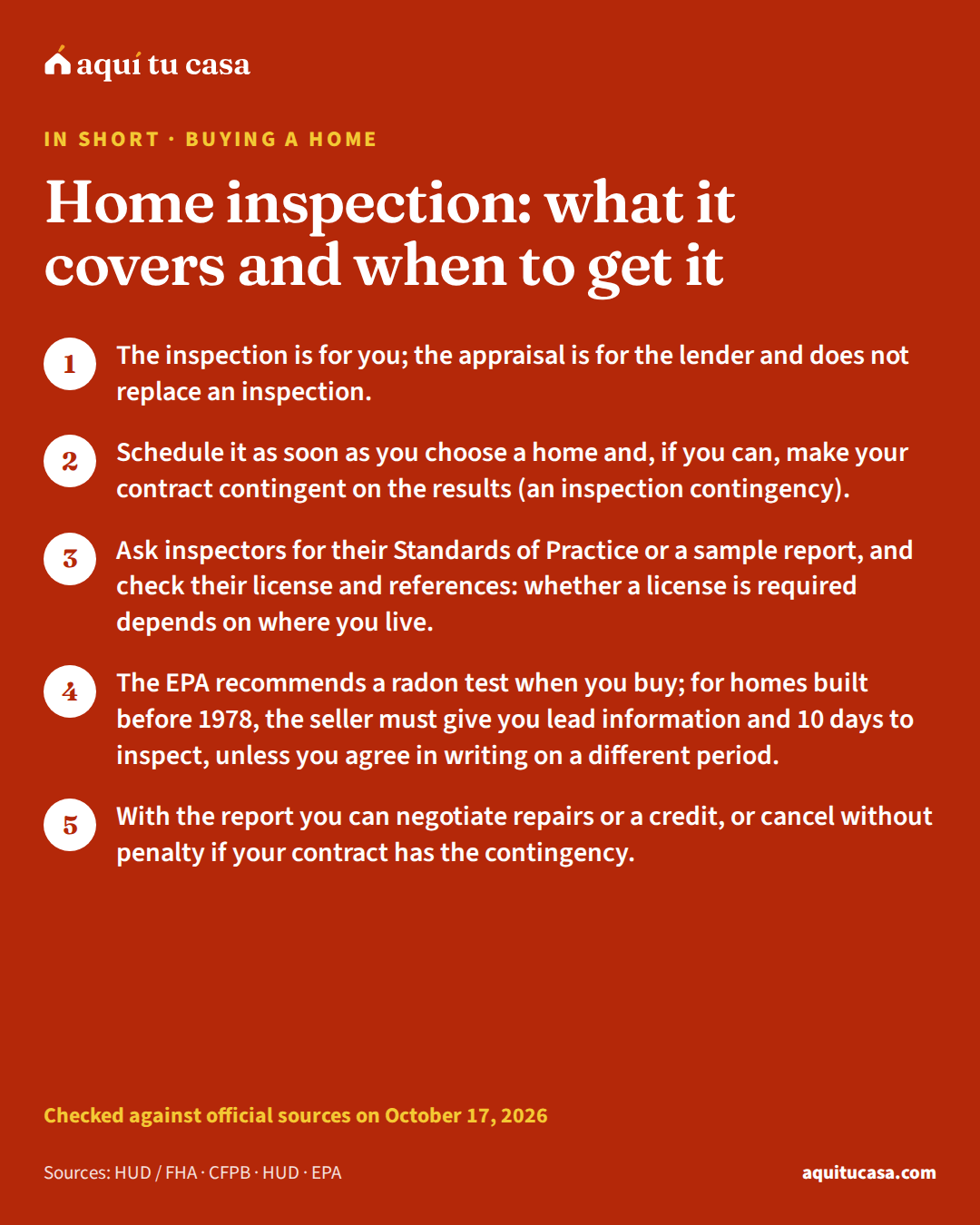
- The inspection is for you; the appraisal is for the lender and does not replace an inspection.
- Schedule it as soon as you choose a home and, if you can, make your contract contingent on the results (an inspection contingency).
- Ask inspectors for their Standards of Practice or a sample report, and check their license and references: whether a license is required depends on where you live.
- The EPA recommends a radon test when you buy; for homes built before 1978, the seller must give you lead information and 10 days to inspect, unless you agree in writing on a different period.
Is this for you?
This guide is for you if…
- You are about to make an offer on a home and want to know how the inspection protects you.
- Your offer was accepted and you need to schedule the inspection and choose an inspector.
- The home was built before 1978, or you are wondering whether to test for radon.
Get direct help first if…
- You already closed and found problems: this guide covers what happens before closing; for a claim against the seller or the inspector, look for free legal aid.
- You rent: this guide is for buyers; your rights as a tenant are in the renting guides.
- You are buying at a foreclosure sale: the federal lead disclosure rule does not apply to those sales, so the lead part of this guide will not help you.
This guide is for you if you are about to make an offer on a home or your offer was just accepted. It explains what an inspection is, how it differs from the appraisal, when to get it so your contract protects you, what to know about radon and lead, and what to do with the report.
- For a lead inspection in homes built before 1978, unless another period is agreed in writing
- 10 days11
- Radon level at which the EPA recommends fixing the home
- 4 pCi/L8
- Before closing, at the latest, you must get your copy of the appraisal
- 3 days7
- Homes covered by the federal lead disclosure rules
- Before 19789
What a home inspection is
A home inspectionhome inspectionA home inspection is a review of the property's physical condition by an inspector before you finish buying: roof, foundation, plumbing, electrical, heating and cooling, signs of moisture or pests. It is often part of the home buying process and you pay for it, not the lender; unlike the appraisal, it does not say what the home is worth but what problems it has. With the report you can ask for repairs, negotiate the price or walk away if your contract includes an inspection contingency. Some assistance programs require one.See the full definition is a check of the physical condition of the home you want to buy. According to FHA, its purpose is to inform you about the property before you make a financial commitment. For a fee, a qualified inspector takes an unbiased look at the home, estimates the remaining useful life of the major systems, equipment, structure and finishes, and identifies what needs to be repaired or replaced.1
It only happens if you arrange for one, because FHA does not perform home inspections.1 As the CFPB puts it, the inspector works for you and should tell you whether the home is in good condition or whether you are buying a “money pit” of expensive repairs.6
If you apply for an FHA loanFHA loanAn FHA loan is a mortgage made by a private lender and insured by the Federal Housing Administration (FHA), an agency of the U.S. government. That insurance protects the lender if you stop paying, which is why the lender can accept a lower down payment and a less-than-perfect credit history than on a conventional loan. Federal law sets the minimum cash investment at 3.5% of the property's value and caps the loan amount at the FHA limit, which changes by county. In exchange for the insurance you pay a mortgage insurance premium.See the full definition, you will see that explanation in writing: the lender has to give you the “For Your Protection: Get a Home Inspection” sheet (form HUD-92564-CN) at first contact, whether for prequalification, preapproval or the application.3 Read it calmly: it is short and covers the essentials.
An inspection is not an appraisal
FHA’s buyer sheet says it in capital letters: appraisals are NOT home inspections. The appraisalhome appraisalAn appraisal is a written document that gives a professional appraiser's opinion of how much a property is worth. The lender orders it before approving the mortgage, because the home is the loan's collateral and the lender does not want to lend more than it is worth. If the appraisal comes in below the price you agreed, the bank bases the loan on the lower value and you will have to cover the difference, renegotiate the price or walk away if your contract allows it. An appraisal is not an inspection: it measures value, not the home's condition.See the full definition is required to estimate the home’s value for your lenderlenderThe lender is the financial institution that lends you the money for your mortgage. The mortgage is the agreement that gives the lender the right to take your home if you do not repay what it lent you. After closing, it is common for another company, the loan servicer, to collect your payments and keep track of the loan; it may be the same company that lent you the money or a different one. On the Loan Estimate, the lender's name appears on the first page, and the last page lists it as "Lender" with its NMLS or license number.See the full definition and does not replace an inspection.1
Inspection and appraisal, side by side
For you
Home inspection
For the lender
Appraisal
They are different, but you generally need both.2
FHA does not guarantee the value or condition of your home. If you find problems after closingclosingClosing, also called settlement, is the last step in buying and financing a home: the moment when you and the other parties sign the necessary documents. Once you sign, you are responsible for repaying the mortgage. The lender sends the loan money to the settlement agent, who pays the seller and distributes the closing costs; the seller signs the deed that makes you the owner, and the documents are recorded with the county. Depending on the state, everyone signs together at a table or signatures are collected separately, sometimes online. Before you sign, read everything and ask about anything you do not understand.See the full definition, FHA cannot give or lend you money for repairs, and cannot buy the home back from you.1
If the appraisal comes in below the price. The CFPB says it is very risky to buy a home for more than its appraised value, and that lenders are not allowed to interfere with the appraiser’s judgment. First, get your copy. With a low appraisal, you can often negotiate a lower price with the seller. If the seller will not lower it, you may consider canceling the purchase, although depending on your contract there may be costs.4
When to get it: the inspection contingency
The CFPB places the inspection in the closing phase: after the seller has accepted your purchase offerpurchase offerA purchase offer is the formal proposal you make to a seller to buy their home. Your real estate agent writes it up and sends it to the seller's agent. It includes the price you offer and the terms of the purchase: your target closing date, who pays certain fees, a deadline for the seller to respond and any contingencies, which are conditions that must be met before you buy. The seller can accept it or answer with a counteroffer, and you can accept, reject or counter again. Once both parties sign the written offer, it becomes a contract.See the full definition and you have chosen a loan and a lender.5 Its advice is to schedule it as soon as you have chosen the home: to learn early whether there are major problems and decide whether you still want to buy, and to leave time for any additional inspections.2
This is where a contingencycontingencyA contingency is a condition you add to your offer or purchase contract to protect yourself: if it is not met, you can change or end the contract and, in general, get your earnest money back. The most common are the inspection contingency, if the inspection finds problems; the appraisal contingency, if the appraisal comes in below the price; the financing or mortgage contingency, if you cannot get the loan within the agreed time; and the home sale contingency, tied to selling your current home. Contingencies are a normal part of buying, but too many can make your offer less attractive to the seller.See the full definition comes in, a condition in your offer or contract. According to FHA, if you request the inspection early, you may be able to make your purchase contract contingent on its results.1 The CFPB explains why that matters: if your contract is contingent on a satisfactory inspection and you are not satisfied with the results, you have the right to cancel the sale without penalty.2
Where the inspection fits in your purchase
1. You talk with a lender
Prequalification, preapproval or application
If it is an FHA loan, you get the HUD sheet that explains what the inspection is for.3
2. You make your offer
Before you sign the contract
If you request the inspection early, you may be able to make the contract contingent on its results.1
3. You schedule the inspection
As soon as your offer is accepted
As early as possible, so you have time to resolve problems or get other inspections.2
4. You choose the inspector
Before the appointment
Ask prior customers for references and look the inspector up with the BBB and the licensing authority.2
5. You attend the inspection
On the day
Being there helps you understand the report and ask questions.2
6. Lead testing in homes built before 1978
10 days, unless another period is agreed in writing
The seller must give you that period for a lead inspection or risk assessment.11
7. You read the report and decide
Within your contingency period
Negotiate repairs or a credit, or cancel without penalty if your contract depends on the inspection.2
8. You get your copy of the appraisal
No later than 3 days before closing
You have a right to that copy, and you can't be charged for it.7

How to choose an inspector
To know what their inspection includes before you hire someone, FHA suggests asking the inspector for their Standards of Practice or a sample inspection report.1 To find one:
- Ask for references. FHA suggests asking friends, real estate professionals, local licensing authorities and organizations that qualify and test home inspectors.1 The CFPB adds: ask for references from prior customers.2
- Check their history. Depending on your area, home inspectors may not be required to be licensed, so the rule changes from place to place. Look the inspector up with your local Better Business Bureau (BBB) and your state or county licensing authority. The CFPB recommends one with a reputation for being honest and thorough.2
- Go to the inspection. If you can be there, it is easier to understand the report and the issues, and to ask questions.2

Radon and lead: separate tests
Beyond the general inspection, FHA suggests asking your inspector whether other health and safety tests make sense for your home: mold, air or water quality, asbestos, lead paint, urea formaldehyde insulation or pests. For radon questions, the same sheet lists the toll-free National Radon Information Line: 1-800-SOS-Radon (1-800-767-7236).1 Two of these have their own federal guidance or rules.
Radon. You cannot see, smell or taste it, but breathing it raises your risk of lung cancer. Any home can have it, and testing is the only way to know your home’s level: neighboring homes are not a guide. The EPA recommends testing if you are buying or selling a home, and fixing the home if the level is 4 picocuries per liter (pCi/L) or higher.8
If the home has not been tested, the EPA recommends testing as soon as possible and considering contract terms on how the test will be done, how results and costs are shared, and who pays if the level must be lowered. If the seller already has a test, you can accept it or ask for a new one. You can ask your state radon office for its approved list of testing companies; many states require a license, certification or registration.8
Lead in homes built before 1978. The federal lead-based paint rules cover most housing built before 1978.913 Before you are bound by the contract, the seller must:
- Give you an EPA-approved pamphlet, such as “Protect Your Family From Lead in Your Home.”10
- Tell you about any known lead-based paint or lead hazards in the home, and give you any records or reports they have.10
- Give you 10 days for a lead inspection or risk assessment, unless you agree in writing on a different period. You can waive those days, but only in writing.11
The contract must include an attachment, in the language of the contract, with a warning that recommends a lead assessment or inspection before purchase and your statement that you had the opportunity or waived it.12 This rule does not require the seller to test on their own.10 The rule does not apply to foreclosure sales, for example, and the EPA has a Lead-Based Paint Professional Locator for certified lead inspectors.13
What to do with the report
With the report in hand, the CFPB describes several paths: negotiating with the seller, asking for a credit or, if there are serious flaws, deciding not to buy.2 Here is how they look with example findings:
Example with real numbers
Report findings and what you can do
An example in words, using the paths the CFPB and the EPA describe.
- Damaged or worn-out parts
- Ask the seller to fix them before you move in, or to give you a credit for the cost2
- Repairs someone has to pay for
- Negotiate who makes or pays for them; depending on your contract and the local market, the seller may or may not agree2
- A serious flaw, such as a cracked foundation
- Decide not to buy; if your contract is contingent on a satisfactory inspection, cancel without penalty2
This is an example: what your inspector finds and what your contract says decide your options.
Run it with your numbersClosing costsDecide before closing: if you find problems afterward, FHA cannot give you money for repairs or buy the home back.1
A seller credit changes your numbers: the closing costs calculator estimates the cash you need to close, and the closing costs guide explains those credits. To sort out your options, a HUD-approved housing counselorHUD-approved housing counselorA HUD-approved housing counselor works at an agency HUD has approved to provide housing counseling: independent, expert advice customized to your situation about buying a home, renting, a missed mortgage payment, a foreclosure or credit problems. The agencies usually charge little or nothing; many serve in Spanish and offer the homebuyer education course several assistance programs require. They are not lenders or real estate agents and sell you nothing. Your county page lists the official agencies with phone numbers.See the full definition gives independent advice, often free or at low cost.14
If this is you
You are buying for the first time
The inspector works for you: get the inspection before you are finally committed to buy.6 The step-by-step home buying guide shows where it fits in the process.
You have young children and the home was built before 1978
You have 10 days for a lead inspection, unless another period is agreed in writing.11 The EPA has a locator for certified lead inspectors.13

Mistakes and red flags
Mistake: Skipping the inspection because the appraisal “already checked the house.”
Instead: The appraisal is for the lender and does not replace an inspection: arrange one yourself.1
Mistake: Assuming a home that looks fine does not need an inspection.
Instead: The CFPB says not to buy without a thorough inspection: it is for your protection.2
Mistake: Hiring the first inspector someone recommends.
Instead: Ask for references and look them up with the BBB and your state or county licensing authority.2
Mistake: Dropping the inspection contingency so your offer “wins.”
Instead: Without that condition you can lose the penalty-free exit if the report goes badly.2
Mistake: Accepting the seller's radon test without asking anything.
Instead: Ask who did it, where in the home and what has changed since, including the heating and air system (HVAC).8
Mistake: Leaving repairs until after closing.
Instead: Negotiate first: afterward, FHA cannot give you money for repairs or buy the home back.1
One more red flag: a pre-1978 home with no lead paperwork. The EPA says anyone who fails to give that information may be subject to penalties, and you can report it at epa.gov/lead/violation.13
What to do this week
- If you have not made an offer yet, ask how to include an inspection contingency and read the conditions it sets.1
- Ask several inspectors for their Standards of Practice or a sample report, and check their license (if your area requires one), references and the BBB.12
- Schedule the inspection as soon as your offer is accepted, and attend if you can.22
- Ask the seller for any radon results; if there are none, ask for a test and write into the contract who pays for it.8
- If the home was built before 1978, confirm you received the pamphlet, the lead disclosure and your 10 days to inspect.11
- With the report, decide whether to negotiate repairs or a credit, or to cancel under the contingency.2
Ready to see the numbers? Find your county here
See how this applies in your county: its loan limits, prices and rents, from the official data.
Printable checklist
Frequently asked questions
Is a home inspection required?
According to FHA, an inspection only happens if you arrange for one; FHA does not perform inspections. The CFPB says not to buy a home without having it thoroughly inspected, because inspections are for your protection.
Doesn't the appraisal already check the house?
Not for you. The appraisal estimates the home's value for the lender and does not replace an inspection. FHA does not guarantee the home's condition either, and cannot help with repairs after closing.
Who pays for the inspection?
You arrange it and the inspector charges a fee. The CFPB warns that if the inspector is paid by someone else, or not paid until closing, they might underemphasize problems. For a radon test, the EPA suggests writing into the contract how the costs will be shared.
Does the inspector need a license?
It depends on where you live: according to the CFPB, some areas do not require one. Before hiring, ask for references from prior customers and look the inspector up with your state or county licensing authority and the Better Business Bureau (BBB).
The house is old. What about lead?
If it was built before 1978, the seller must give you an EPA-approved pamphlet, tell you what they know about lead in the home and give you 10 days (or another period agreed in writing) for a lead inspection before you are bound by the contract. You can waive those days, but only in writing.
When should I get the inspection?
The CFPB recommends scheduling it as soon as possible once you have chosen the home, so you learn early about major problems and have time for other inspections. FHA adds that if you request it early in the process, you may be able to make your purchase contract contingent on its results.
Can I cancel the purchase if the inspection goes badly?
If your contract is contingent on a satisfactory inspection and you are not satisfied with the results, the CFPB says you have the right to cancel the sale without penalty. If you do not have that condition, check what your contract says; you can also negotiate repairs or a credit with the seller.
What if the appraisal comes in below the price?
The CFPB says it is very risky to buy a home for more than its appraised value. Get your copy of the appraisal and use that value to negotiate a lower price with the seller. If the seller will not agree, you may consider canceling, although depending on your contract there may be costs.
Where can I ask about radon?
FHA's sheet lists the toll-free National Radon Information Line, 1-800-SOS-Radon (1-800-767-7236). The EPA recommends testing when you buy a home, and your state radon office can give you its approved list of testing companies.
Sources
Every figure in this guide comes from one of these official sources. The number next to a sentence leads to the source behind it.
Each source on one line: who publishes it, its title, its address and the date we read it.
- 1. HUD / FHA · For Your Protection: Get a Home Inspection (form HUD-92564-CN) · hud.gov · Accessed October 17, 2026
- 2. CFPB · Schedule a home inspection · consumerfinance.gov · Accessed October 17, 2026
- 3. HUD · HUD Handbook 4000.1, FHA Single Family Housing Policy Handbook (Update 18) · hud.gov · Accessed October 17, 2026
- 4. CFPB · My appraisal is less than the sale price. What does that mean for me? · consumerfinance.gov · Accessed October 17, 2026
- 5. CFPB · Closing on your new home · consumerfinance.gov · Accessed October 17, 2026
- 6. CFPB · Your home loan toolkit · files.consumerfinance.gov · Accessed October 17, 2026
- 7. CFPB · What are appraisals and why do I need to look at them? · consumerfinance.gov · Accessed October 17, 2026
- 8. EPA · Home Buyer's and Seller's Guide to Radon (EPA 402/K-24/001) · epa.gov · Accessed October 17, 2026
See the other 6 sources
- 9. EPA (Code of Federal Regulations, text at Cornell LII) · 40 CFR §745.103, Definitions ('Target housing') · law.cornell.edu · Accessed October 17, 2026
- 10. EPA (Code of Federal Regulations, text at Cornell LII) · 40 CFR §745.107, Disclosure requirements for sellers and lessors · law.cornell.edu · Accessed October 17, 2026
- 11. EPA (Code of Federal Regulations, text at Cornell LII) · 40 CFR §745.110, Opportunity to conduct an evaluation · law.cornell.edu · Accessed October 17, 2026
- 12. EPA (Code of Federal Regulations, text at Cornell LII) · 40 CFR §745.113, Certification and acknowledgment of disclosure · law.cornell.edu · Accessed October 17, 2026
- 13. EPA · Real Estate Disclosures about Potential Lead Hazards · epa.gov · Accessed October 17, 2026
- 14. CFPB · Find a Housing Counselor · consumerfinance.gov · Accessed October 17, 2026
Keep reading
Related guides
If this guide helped, these follow the same path.

Buying a home 14 minute read
Closing costs explained: what you pay and what can change
What closing costs are, how to read them on your Loan Estimate, which charges cannot go up before closing and how to compare offers to pay less.
- Closing costs are what you pay to get the loan and transfer the home to you; together with the down payment they make up your cash to close.
- The Loan Estimate sorts them by letter: A, B and C are loan costs; E, F, G and H are taxes, prepaids, escrow and other; J is the total.
- Lender charges and transfer taxes cannot go up; recording fees and services picked from the lender's list can rise up to 10% as a group, unless there is a change in circumstances.
- Buying a home Closing Disclosure explained: what to check before signing What the Closing Disclosure is, when it must reach you, what to check on each of its five pages and which closing costs are not allowed to go up. 18 minute read
- Owning a home Home insurance explained: what it covers, how much to buy What home insurance covers, why the lender requires it, how to choose the amount and the deductible, why flood is separate and what happens if it lapses. 13 minute read
Tools for this topic
Was this guide useful?
Thank you. Your answer stays in your browser; nothing is sent.