Closing costs explained: what you pay and what can change
What closing costs are, how to read them on your Loan Estimate, which charges cannot go up before closing and how to compare offers to pay less.
Verified against official sources on October 17, 2026 17 official sources

Show contents
In short
What you need to know
Quick answer
Closing costs are what you pay to get your mortgage and put the home in your name: lender charges, services such as the appraisal and title, taxes and recording fees, prepaids and the initial deposit into your escrow account. You see them on page 2 of the Loan Estimate, which the lender must give you within three business days of your application. Some cannot go up before closing, some can go up by up to 10% as a group and some have no limit; if you are overcharged without a change in circumstances, you are owed the difference.
What matters most
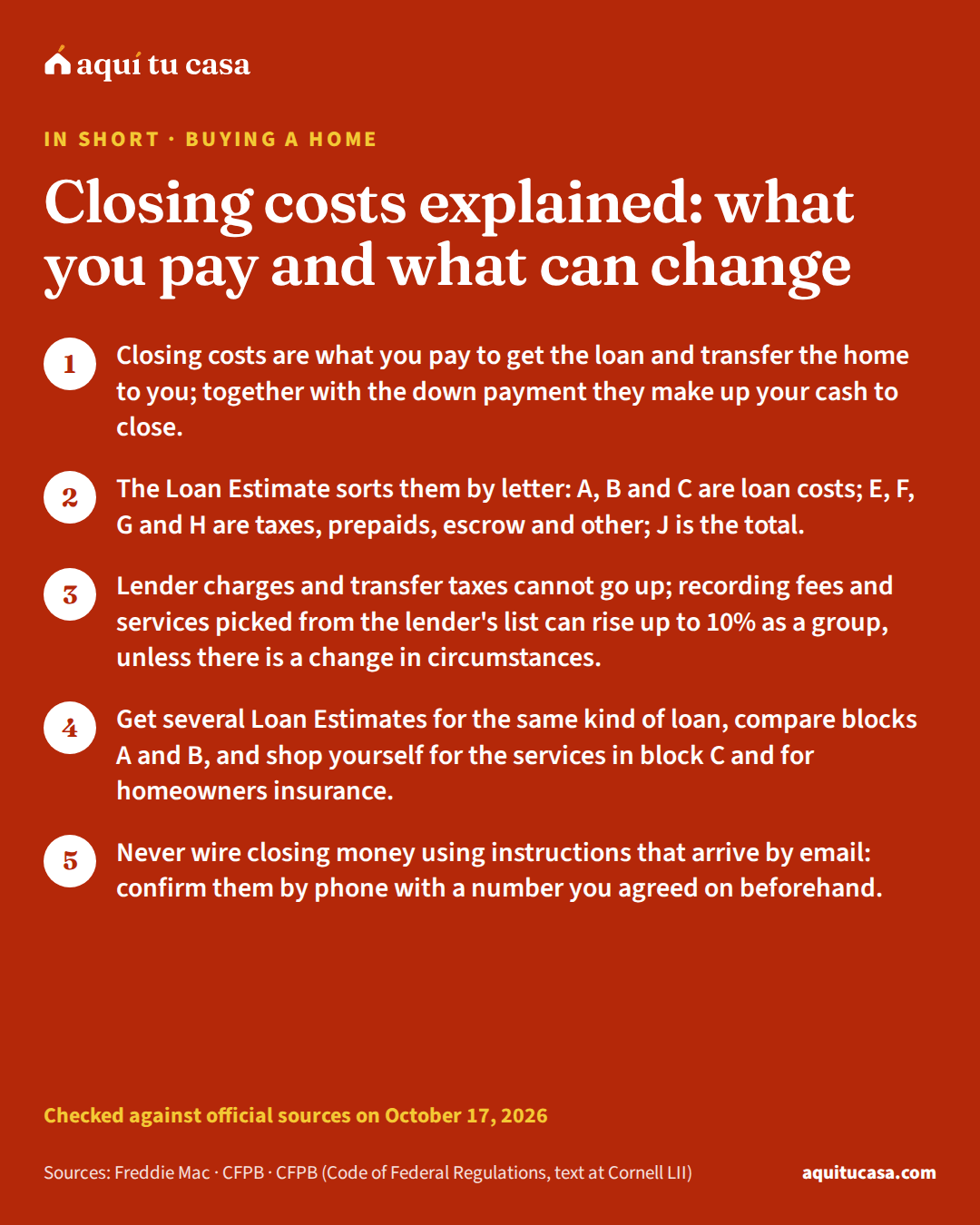
- Closing costs are what you pay to get the loan and transfer the home to you; together with the down payment they make up your cash to close.
- The Loan Estimate sorts them by letter: A, B and C are loan costs; E, F, G and H are taxes, prepaids, escrow and other; J is the total.
- Lender charges and transfer taxes cannot go up; recording fees and services picked from the lender's list can rise up to 10% as a group, unless there is a change in circumstances.
- Get several Loan Estimates for the same kind of loan, compare blocks A and B, and shop yourself for the services in block C and for homeowners insurance.
Is this for you?
This guide is for you if…
- You are buying a home with a loan and want to know how much money you need on top of the down payment.
- You already have one or more Loan Estimates and want to understand and compare them.
- Your lender sent a revised Loan Estimate with higher costs and you do not know whether that is allowed.
Get direct help first if…
- You already have the Closing Disclosure and close in a few days: start with the Closing Disclosure guide, page by page.
- You are getting a reverse mortgage, a home equity line of credit (HELOC) or a mobile home loan not secured by real estate: you do not get a Loan Estimate, but other forms.
- You are refinancing: many rules are similar, but this guide is about buying.
Besides the down paymentdown paymentThe down payment is the part of the home's price you pay out of your own pocket when you buy; the loan covers the rest. In U.S. Spanish it is also called enganche, cuota inicial or entrada. Each loan type has its own minimum: FHA requires at least 3.5% of the value, VA and USDA loans may require none, and conventional loans ask for more if you want to avoid private mortgage insurance. A larger down payment lowers the loan, the monthly payment and the total interest; many state programs help families put it together.See the full definition, buying a home with a mortgage comes with a second bill: closing costs. This guide is for anyone about to buy or who has already applied for a loan: it explains what those costs include, how to read them on the Loan Estimate, which ones can change before closing and where you can save.
What they are and who pays them
According to the CFPB, closing costsclosing costsClosing costs are all of the costs you pay on closing day on top of the down payment: lender fees, the appraisal, the credit report, title insurance, the closing agent's fees, any transfer taxes your state or county charges and the first deposits into the escrow account. The lender must itemize them on the Loan Estimate within days of your application and confirm them on the Closing Disclosure before you sign. Some can be paid by the seller, and several state programs help cover them.See the full definition, also called “settlement costs,” are the upfront costs you are charged to get your loan and transfer ownership of the property. You pay them at closing.2
They are not the same as your “Cash to Close”: that number adds your down payment and closing costs, then subtracts the deposit you already gave, seller credits and other adjustments. It is usually paid by cashier’s check or wire transfer, and the lender will ask you to prove where the money came from.2
Example with real numbers
Cash to close on a typical home
With the typical US home value, an FHA loan with the minimum down payment and the closing cost range Freddie Mac gives.
- Home price (typical US value)
- $332,700
- FHA minimum down payment (3.5%)
- $11,645
- Closing costs (2% to 5% of the price)
- $6,654 to $16,635
- Cash to close, before credits
- $18,299 to $28,280
This is an example with national numbers.1 Your real number is on your Loan Estimate; the deposit you already gave and seller credits lower it.2
Run it with your numbersClosing costs
Who pays? Generally the buyer pays all of the costs of the purchase, although depending on the contract or state law the seller may pay some. Among the common charges, the CFPB lists the appraisalhome appraisalAn appraisal is a written document that gives a professional appraiser's opinion of how much a property is worth. The lender orders it before approving the mortgage, because the home is the loan's collateral and the lender does not want to lend more than it is worth. If the appraisal comes in below the price you agreed, the bank bases the loan on the lower value and you will have to cover the difference, renegotiate the price or walk away if your contract allows it. An appraisal is not an inspection: it measures value, not the home's condition.See the full definition, title insurancetitle insuranceTitle is the legal right of ownership of the home, and title insurance protects you if, after closing, someone claims a right to it: an old debt, an heir, an error in the records. There are two policies. Most lenders require a lender's policy, which protects the amount they lent. The owner's policy is optional, paid once at closing, and protects you for as long as you own the home, including the legal costs of defending your right. You can shop for a title company; the price varies by state.See the full definition, government taxes and prepaids: property taxes, homeowners insurance and interest until your first payment.3
The cost groups on your Loan Estimate
The Loan EstimateLoan EstimateThe Loan Estimate is a three-page form you receive from the lender within days of applying for a mortgage. In the same format at every bank, it sums up the terms of the loan being offered: amount, interest rate, whether the payment can change, the estimated monthly payment with taxes and insurance, the itemized closing costs and how much cash you need at closing. Because every lender uses the same form, it lets you compare offers side by side. It commits you to nothing: requesting one is not accepting the loan.See the full definition lays out closing costs on page 2, always in the same blocks. The regulation sets the headings4 and the form gives them letters:5
| Block | What it includes |
|---|---|
| A. Origination Charges | What the lender charges to make your loan, including points to lower the rate |
| B. Services You Cannot Shop For | Third-party services you cannot shop for on your own, such as the appraisal or the credit report |
| C. Services You Can Shop For | Third-party services you can shop for yourself, such as title or a survey |
| E. Taxes and Other Government Fees | Recording fees and any transfer taxes you are paying |
| F. Prepaids | Homeowners insurance, mortgage insurance, interest and property taxes you pay in advance |
| G. Initial Escrow Payment at Closing | What goes into your escrow accountescrow accountAn escrow account is an account set up by your mortgage lender to pay certain property-related expenses on your behalf, mainly property taxes and homeowners insurance. The money comes from a portion of your monthly mortgage payment: each month you contribute a share and the loan servicer pays the bills when they come due. That is why your payment is higher than principal and interest alone, and why it can change when taxes or the insurance premium go up. In some states the word also names the period between the offer and the closing.See the full definition to pay insurance and taxes later |
| H. Other | Other closing payments; optional products say “(optional)” |
D adds A, B and C (loan costs). I adds E, F, G and H (other costs). J, total closing costs, is D + I minus lender credits.4
When the Loan Estimate arrives and what you can be charged before
From application to closing, step by step
1. You apply for the loan
Day 1
Before you receive the Loan Estimate and say you want to proceed, the only fee allowed is a bona fide and reasonable charge for your credit report.7
2. You receive the Loan Estimate
No later than 3 business days after
Every lender uses the same three-page form, so you can compare.6
Try it with your numbersClosing costs3. You compare and say you want to proceed
Before the estimated costs expire
Check the top of page 1 to see whether your rate is locked and until when.4
Try it with your numbersCompare loans4. If something changes, you get a revised Loan Estimate
No later than 4 business days before signing
Only for a change in circumstances, changes you ask for, or when the rate is locked.7
5. You receive the Closing Disclosure
No later than 3 business days before signing
Compare it line by line with your last Loan Estimate.7
6. You sign and pay your cash to close
Closing day
Confirm the account you are sending money to by phone or in person.16
7. If you were overcharged, you get the difference back
Up to 60 days after
The regulation gives the lender up to 60 days after closing to refund the excess.7
According to the CFPB, the lender must give you the Loan Estimate, a standard three-page form, within three business days of receiving your application. Because everyone uses the same form, you can compare. Getting one does not mean the loan is approved.6 The regulation adds that it must be delivered or mailed no later than seven business days before you sign.7
Asking for one is cheap. Under Regulation Z, no one can charge you for your application before you receive the Loan Estimate and say you want to proceed, except a bona fide and reasonable fee for your credit report. A written quote given to you before that must warn at the top: “Your actual rate, payment, and costs could be higher. Get an official Loan Estimate before choosing a loan.”7
The top of page 1 says whether your rate is locked (“Rate Lock”) and until when, and the date and time the estimated closing costs expire. If the rate is not locked, the rate, points and lender credits can change.4

What can and cannot go up before closing
It is illegal for a lender to deliberately underestimate the costs on your Loan Estimate. Regulation Z sets how much they can rise,7 and the CFPB sums it up in three groups:8
| Group | Examples | How much can it go up? |
|---|---|---|
| Cannot go up | Fees of the lender, the broker or their affiliates; required services you were not allowed to shop for; transfer taxes | Not at all |
| Up to 10% as a group | Recording fees; services from a provider you picked from the lender’s list (if it is a lender affiliate, not at all) | The group’s total, up to 10% |
| No limit | Prepaid interest, homeowners insurance, escrow deposit; providers you chose off the list; services the lender does not require | Any amount |
With a “change in circumstances,” those limits do not apply. For example: you switch loan type or down payment, the appraisal comes in different than expected, your credit changed because of a new loan or a missed payment, or the lender could not document your overtime or bonus.8 The same goes if you ask for changes, if locking the rate changes the points or credits, or if you say you want to proceed more than 10 business days after receiving the Loan Estimate (or any longer period the lender sets). You must receive a revised Loan Estimate no later than four business days before signing.7
Finally, you must receive the Closing DisclosureClosing DisclosureThe Closing Disclosure is a required five-page form with the final details of the mortgage you selected: the loan terms, your monthly payment, every closing cost and how much cash you must bring on signing day. The lender must give it to you at least three business days before closing, so you can compare it with your Loan Estimate and ask about any change. If an important number changes, the three-day period starts again. Keep it: you will need it for your taxes.See the full definition no later than three business days before signing.7 If a charge went over the limit without a change in circumstances, ask in writing for a correction before you sign: you are entitled to the difference back,8 and the regulation gives the lender up to 60 days after closing to refund it.7 The Closing Disclosure guide helps you check it line by line.
Loan Estimate and Closing Disclosure, side by side
At the start
Loan Estimate
Keep both: what can change from one to the other is exactly what the law limits.7
How to compare and pay less
The CFPB says closing costs can add up to thousands of dollars and vary widely among lenders.11

- Get several Loan Estimates. The CFPB recommends at least three offers in writing and focusing on blocks A and B, because you can shop for the block C services with any lender.9 Ask for the same kind of loan each time and compare totals, not the number of lines.2
- Shop for the block C services yourself. With the Loan Estimate, the lender must give you a written list of providers, and you can use one that is not on it if the lender agrees to work with them.10 The list itself must say that you may choose a different provider.7
- Compare title costs. Title is usually the biggest cost in block C: title insurance, the title search and, in most of the country, the closing agent’s fee. Most lenders require a lender’s policy; an owner’s policy protects your own investment. Recommended providers may be lender affiliates: get quotes and compare the bottom-line total.11 The seller cannot require you to use a particular title company.9
- Shop for homeowners insurance. You choose your homeowners insurancehomeowners insuranceHomeowners insurance pays for losses and damage to your property if something unexpected happens, like a fire or a burglary, and usually includes liability coverage if someone is hurt at your home. Lenders require it as long as you have a mortgage, because the home is their collateral, and almost always collect it inside your monthly payment through the escrow account. The price depends on the location, the rebuilding cost, the deductible and your history. A standard policy does not cover floods or, in many states, earthquakes: those risks are insured separately.See the full definition, and you usually pay the first 6 to 12 months at or before closing. Property taxesproperty taxProperty tax is the tax the county, city, school district and other local bodies charge real property owners every year to pay for schools, police, fire and other public services. It is computed on the value the assessor's office assigns to your home, at each body's rate, minus the exemptions you qualify for, such as the primary-residence exemption in many states. If you have a mortgage you normally pay it month by month inside your payment, through the escrow account. It is generally deductible on your federal return if you itemize.See the full definition are set by the local or state government: check that they are estimated correctly.2
- Understand points and credits. Discount pointsdiscount pointsDiscount points are a payment you make to the lender at closing in exchange for a lower interest rate over the life of the loan. Each point costs a percentage of the loan amount. The opposite is lender credits: the bank lowers your closing costs today in exchange for a higher rate. Buying points only pays off if you keep the loan long enough for the monthly savings to exceed what you paid. Points appear on the Loan Estimate, in section A of the closing costs.See the full definition lower your rate in exchange for paying more at closing; one point is 1% of the loan and sits in block A. Lender credits lower your closing costs in exchange for a higher rate, and sit in block J. Ask each lender for the same amount of points or credits.12 A loan advertised as “no closing costs” covers them with a higher rate or by adding them to the loan.13
Example with real numbers
What one point costs on a typical loan
- FHA loan on a typical home, without the upfront premium
- $321,056
- One point (1% of the loan)
- $3,211
One point is 1% of the loan amount and lowers your rate in exchange for paying more at closing.12 If you are offered points, ask each lender for the same number so you can compare.
Run it with your numbersCompare loansOur closing cost calculator uses these blocks to estimate your cash to close, and the compare loans tool shows what each offer costs per month and over five years. The real figure is the one on your Loan Estimate.
Seller credits and help with closing costs
You can negotiate a seller credit toward your closing costs. But the CFPB warns that the seller will usually ask for a higher price to cover it, and you still pay those costs through your loan. A lender credit also typically raises the loan amount or the rate.3
On the Loan Estimate, what the seller will pay goes on the “Seller Credits” line, and anything paid by someone else (not you, the seller or the lender) goes under “Adjustments and Other Credits.”4 The Closing Disclosure puts each cost in its column: “Borrower-Paid” (you), “Seller-Paid” (the seller) or “Paid by Others.”14
According to the CFPB, many states and local organizations help first-time buyers with the down payment or closing costs. To find those programs, it points to HUD-approved housing counseling agencies and the HOPE Hotline, (888) 995-4673, open 24 hours a day.15 The down payment assistance guide explains how they work, and the which programs do I qualify for tool looks for programs that might fit you.
If this is you
You are buying for the first time
Many states and local organizations help with the down payment or closing costs.15 Find your state's in assistance programs.
You are short on cash to close
A HUD-approved housing counselor reviews your numbers with you, often for free or at low cost.17
Your income changes month to month
If the lender could not document your overtime or bonuses, it can give you a revised Loan Estimate.8 Gather your proof of income from the start.
You are buying with an ITIN
You also get a Loan Estimate, on the same form: compare the same way.6 The ITIN mortgage guide covers the rest.
The closing scam: the email that changes the account
The CFPB warns that a victim can lose their life savings.16 The housing scams guide has more warning signs.

Costly mistakes
Mistake: Comparing Loan Estimates for different kinds of loans.
Instead: Ask for the Loan Estimate for the same kind of loan and compare totals.2
Mistake: Taking the recommended title company without asking.
Instead: Get quotes: title is usually the biggest cost in block C.11
Mistake: Choosing a “no closing cost” loan without looking at the rate.
Instead: Those costs are covered with a higher rate or added to the loan.13
Mistake: Signing without comparing the Closing Disclosure with the Loan Estimate.
Instead: Put them side by side and ask in writing for a correction of anything that went up too much.8
Mistake: Wiring closing money with instructions that came by email.
Instead: Confirm the account in person or at the phone number you already knew.16
What to do this week
- Ask several lenders for a Loan Estimate for the same kind of loan; before you receive it, they can only charge you for the credit report.7
- Compare blocks A and B on each one, and the J total after credits.9
- Using the list of providers, get quotes for the block C services, especially title.10
- Get homeowners insurance quotes and check the estimated property taxes.2
- Note whether your rate is locked and the date the estimated costs expire.4
- If you want help with your numbers or with programs, a HUD-approved housing counselorHUD-approved housing counselorA HUD-approved housing counselor works at an agency HUD has approved to provide housing counseling: independent, expert advice customized to your situation about buying a home, renting, a missed mortgage payment, a foreclosure or credit problems. The agencies usually charge little or nothing; many serve in Spanish and offer the homebuyer education course several assistance programs require. They are not lenders or real estate agents and sell you nothing. Your county page lists the official agencies with phone numbers.See the full definition gives independent advice, often free or at low cost.17
Your numbers
We start with the typical home value in the United States. Enter the price you are looking at.
Adjust advanced details
FHA
Estimated monthly payment
$2,759
Principal and interest, tax, homeowners insurance and mortgage insurance.
- Down payment
- $11,645 (3.5%)
- Mortgage insurance
- $147 a monthFHA annual premium · whole term
- Upfront premium or fee
- $5,618FHA upfront mortgage insurance · added to the loan
- Paid in 5 years
- $141,609
- Balance after 5 years
- $308,088
- County limit
- Find your county to see the limit
Rules and notes
- Minimum down payment of 3.5% with a score of 580 or more; between 500 and 580 at least 10% is required.In effect since September 14, 2016 · Source ↗
- Mortgage insurance: 1.75% upfront plus an annual premium; with less than 10% down it lasts the whole term.In effect since March 20, 2023 · Source ↗
- Only citizens, lawful permanent residents and citizens of the Freely Associated States; non-permanent residents are no longer eligible.In effect since May 25, 2025 · Source ↗
Conventional, 3% down
Estimated monthly payment
$2,747
Principal and interest, tax, homeowners insurance and mortgage insurance.
- Down payment
- $9,981 (3%)
- Mortgage insurance
- $161 a monthPMI (example) · ends around year 13
- Upfront premium or fee
- None
- Paid in 5 years
- $140,854
- Balance after 5 years
- $304,358
- County limit
- Find your county to see the limit
Rules and notes
- Fannie Mae requires a minimum score of 620 on manually underwritten fixed-rate loans; its automated system (DU) sets no fixed minimum.In effect since April 22, 2026 · Source ↗
- Private mortgage insurance (PMI) with less than 20% down; it cancels on its own at 78% of the original value.In effect since January 1, 2024 · Source ↗
- Fannie Mae buys loans to lawful permanent and non-permanent residents on the same terms as citizens; the lender verifies the status.In effect since July 28, 2015 · Source ↗
Conventional, 5% down
Estimated monthly payment
$2,698
Principal and interest, tax, homeowners insurance and mortgage insurance.
- Down payment
- $16,635 (5%)
- Mortgage insurance
- $158 a monthPMI (example) · ends around year 12
- Upfront premium or fee
- None
- Paid in 5 years
- $137,950
- Balance after 5 years
- $298,082
- County limit
- Find your county to see the limit
Rules and notes
- Fannie Mae requires a minimum score of 620 on manually underwritten fixed-rate loans; its automated system (DU) sets no fixed minimum.In effect since April 22, 2026 · Source ↗
- Private mortgage insurance (PMI) with less than 20% down; it cancels on its own at 78% of the original value.In effect since January 1, 2024 · Source ↗
- Fannie Mae buys loans to lawful permanent and non-permanent residents on the same terms as citizens; the lender verifies the status.In effect since July 28, 2015 · Source ↗
Conventional, 20% down
Lowest paymentEstimated monthly payment
$2,202
Principal and interest, tax, homeowners insurance and mortgage insurance.
- Down payment
- $66,540 (20%)
- Mortgage insurance
- None
- Upfront premium or fee
- None
- Paid in 5 years
- $108,184
- Balance after 5 years
- $251,017
- County limit
- Find your county to see the limit
Rules and notes
- Fannie Mae requires a minimum score of 620 on manually underwritten fixed-rate loans; its automated system (DU) sets no fixed minimum.In effect since April 22, 2026 · Source ↗
- Private mortgage insurance (PMI) with less than 20% down; it cancels on its own at 78% of the original value.In effect since January 1, 2024 · Source ↗
- Fannie Mae buys loans to lawful permanent and non-permanent residents on the same terms as citizens; the lender verifies the status.In effect since July 28, 2015 · Source ↗
VA
Estimated monthly payment
$2,702
Principal and interest, tax, homeowners insurance and mortgage insurance.
- Down payment
- $0 (0%)
- Mortgage insurance
- None
- Upfront premium or fee
- $7,153VA funding fee · added to the loan
- Paid in 5 years
- $138,137
- Balance after 5 years
- $320,517
- County limit
- Find your county to see the limit
Rules and notes
- Military service requirements by period of service; you must meet VA's and your lender's credit standards.In effect since September 22, 2026 · Source ↗
- No down payment as long as the price is not above the appraisal; funding fee of 2.15% on first use with no down payment (exempt: zero). No monthly mortgage insurance.In effect since April 7, 2023 · Source ↗
- Up to the conforming limit with no down payment in most areas; more with a down payment.In effect since January 7, 2026 · Source ↗
USDA
Estimated monthly payment
$2,773
Principal and interest, tax, homeowners insurance and mortgage insurance.
- Down payment
- $0 (0%)
- Mortgage insurance
- $97 a monthUSDA annual fee · whole term
- Upfront premium or fee
- $3,327USDA upfront fee · added to the loan
- Paid in 5 years
- $142,404
- Balance after 5 years
- $316,909
- County limit
- No county limit
Rules and notes
- Home in an eligible rural area and income within the area limit; finances the full price for those who qualify.In effect since December 9, 2013 · Source ↗
- Upfront fee of 1% and annual fee of 0.35% of the balance.In effect since October 1, 2026 · Source ↗
- Each lender sets the score.
- Applicants must show they are U.S. citizens, U.S. non-citizen nationals or qualified aliens, as the federal rule defines them.In effect since November 29, 2022 · Source ↗
ITIN loan (example)
ExampleEstimated monthly payment
$2,315
Principal and interest, tax, homeowners insurance and mortgage insurance.
- Down payment
- $49,905 (15%)
- Mortgage insurance
- None
- Upfront premium or fee
- None
- Paid in 5 years
- $114,945
- Balance after 5 years
- $266,705
- County limit
- No county limit
Rules and notes
- Not a federal program: each lender sets the down payment, rate and documents. The 15% is only an example; rates are usually higher.
- They usually ask for ITIN tax returns for the last two years and more reserves; compare several lenders.
An educational estimate, not a loan offer. The same rate for every program (the real one differs); homeowners insurance is an example (0.5% of the value a year) and so is PMI (0.6% a year). The rules quoted are dated; check with your lender.
Ready to see the numbers? Find your county here
See how this applies in your county: its loan limits, prices and rents, from the official data.
Printable checklist
Frequently asked questions
How much are closing costs?
It depends on the lender, the loan, the price and your state. The CFPB says they can add up to thousands of dollars and that estimates vary widely among lenders. Your real figure is on page 2 of your Loan Estimate; before you have one, our closing cost calculator gives you a ballpark with your own numbers.
Can the seller pay my closing costs?
You can negotiate a seller credit toward your closing costs, and depending on the contract or your state's law the seller may pay some of them. But the CFPB warns that the seller will usually ask for a higher price to cover that credit: you still pay those costs, through your loan.
Can a lender charge me for a Loan Estimate?
Before you receive the Loan Estimate and say you want to proceed, the regulation only allows a bona fide and reasonable fee for your credit report. Some lenders do not charge even that.
What do I do if a cost went up on my Closing Disclosure?
Compare it with your latest Loan Estimate and see which group it belongs to. If it is a charge that cannot go up, or the up-to-10% group went over, and there was no change in circumstances, ask in writing for a correction before you sign. If you find out afterwards, you are entitled to a refund of the excess; the regulation gives the lender up to 60 days after closing.
Is there such a thing as a no-closing-cost loan?
Some loans are advertised that way, but according to the CFPB every mortgage has costs. The lender covers them with a higher interest rate in exchange for a credit, or by adding them to the loan amount: you pay more over time or owe more.
How much money do I need on closing day?
Cash to close adds your down payment and closing costs, then subtracts the deposit you already gave, seller credits and other adjustments. Freddie Mac says to be prepared to pay between 2% and 5% of the price in closing costs. On a $332,700 home, the typical US value, with an FHA loan and the minimum down payment, that comes to between $18,299 and $28,280. Your real number is on your Loan Estimate.
What is a discount point and how much does it cost?
According to the CFPB, one point equals 1% of the loan amount and lowers your rate in exchange for paying more at closing. On an FHA loan of $321,056, one point would cost $3,211. Ask each lender for the same number of points so you can compare.
When must I receive the Closing Disclosure?
The lender must make sure you receive it no later than three business days before you sign. Use those days to compare it with your last Loan Estimate.
Sources
Every figure in this guide comes from one of these official sources. The number next to a sentence leads to the source behind it.
Each source on one line: who publishes it, its title, its address and the date we read it.
- 1. Freddie Mac · What Are Closing Costs and How Much Will I Pay? · myhome.freddiemac.com · Accessed October 17, 2026
- 2. CFPB · Loan Estimate Explainer · consumerfinance.gov · Accessed October 17, 2026
- 3. CFPB · What fees or charges are paid when closing on a mortgage and who pays them? · consumerfinance.gov · Accessed October 17, 2026
- 4. CFPB (Code of Federal Regulations, text at Cornell LII) · Regulation Z, 12 CFR §1026.37, Content of disclosures for certain mortgage transactions (Loan Estimate) · law.cornell.edu · Accessed October 17, 2026
- 5. CFPB · Sample Loan Estimate (adjustable-rate loan) · files.consumerfinance.gov · Accessed October 17, 2026
- 6. CFPB · What is a Loan Estimate? · consumerfinance.gov · Accessed October 17, 2026
- 7. CFPB (Code of Federal Regulations, text at Cornell LII) · Regulation Z, 12 CFR §1026.19, Certain mortgage and variable-rate transactions · law.cornell.edu · Accessed October 17, 2026
- 8. CFPB · Can my final mortgage costs increase from what was on my Loan Estimate? · consumerfinance.gov · Accessed October 17, 2026
See the other 9 sources
- 9. CFPB · Your home loan toolkit: A step-by-step guide · files.consumerfinance.gov · Accessed October 17, 2026
- 10. CFPB · What required mortgage closing services can I shop for? · consumerfinance.gov · Accessed October 17, 2026
- 11. CFPB · Shop for title insurance and other closing services · consumerfinance.gov · Accessed October 17, 2026
- 12. CFPB · How should I use lender credits and points (also called discount points)? · consumerfinance.gov · Accessed October 17, 2026
- 13. CFPB · Is there such a thing as a no-cost or no-closing cost loan or refinancing? · consumerfinance.gov · Accessed October 17, 2026
- 14. CFPB (Code of Federal Regulations, text at Cornell LII) · Regulation Z, 12 CFR §1026.38, Content of disclosures for certain mortgage transactions (Closing Disclosure) · law.cornell.edu · Accessed October 17, 2026
- 15. CFPB · Where can I find information on programs for first-time home buyers? · consumerfinance.gov · Accessed October 17, 2026
- 16. CFPB · Mortgage closing scams: How to protect yourself and your closing funds · consumerfinance.gov · Accessed October 17, 2026
- 17. CFPB · Find a Housing Counselor · consumerfinance.gov · Accessed October 17, 2026
Keep reading
Related guides
If this guide helped, these follow the same path.

Buying a home 18 minute read
Closing Disclosure explained: what to check before signing
What the Closing Disclosure is, when it must reach you, what to check on each of its five pages and which closing costs are not allowed to go up.
- Five pages, at least three business days before closing; Sundays and federal holidays do not count, Saturdays do.
- Compare it with your latest Loan Estimate: rate, APR, monthly payment, prepayment penalty, balloon payment and cash to close.
- The lender's charges cannot rise above the Loan Estimate; recording fees and services from the lender's list can rise up to 10 percent in total; any excess is refunded.
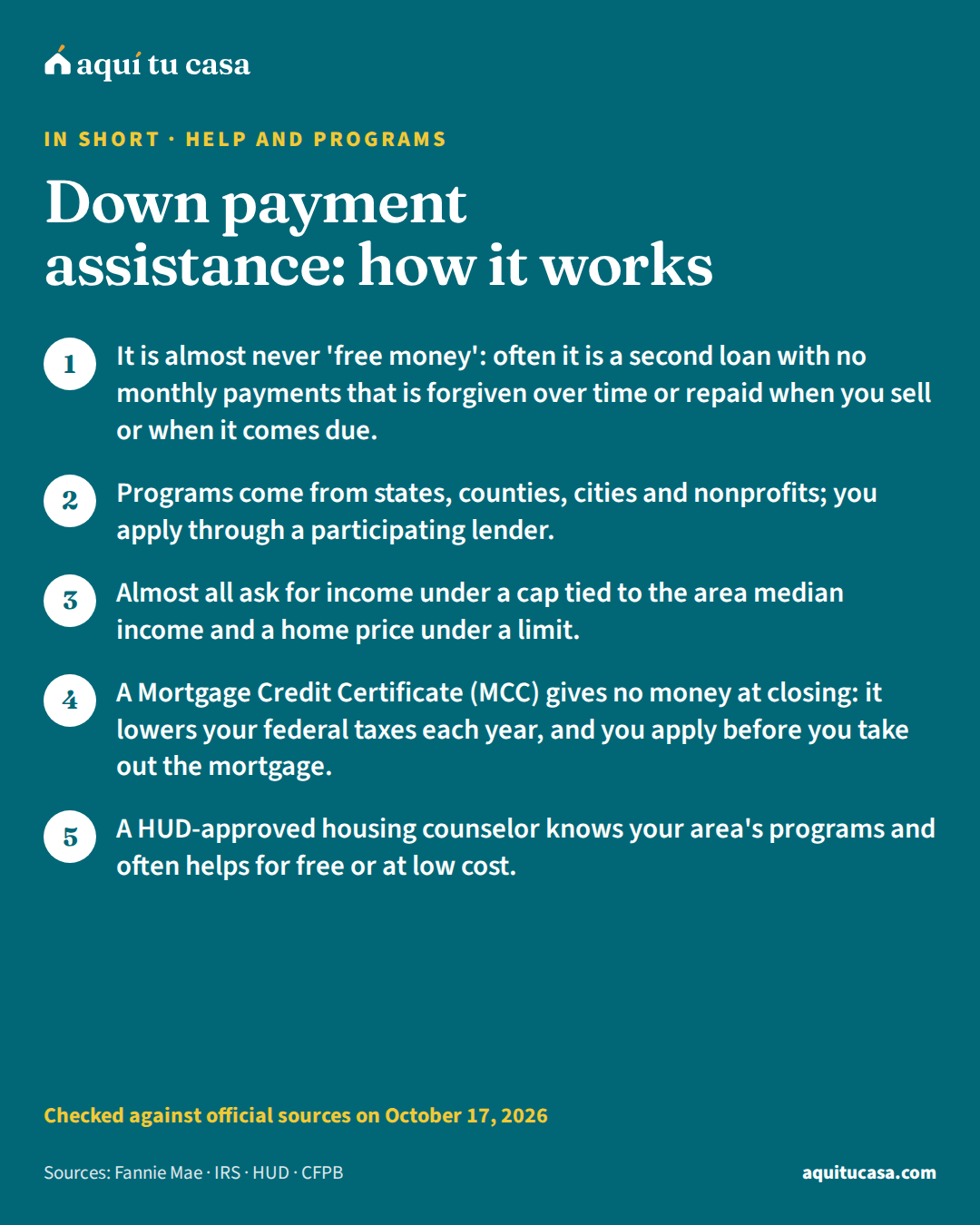
- Help and programs Down payment assistance: how it works What down payment assistance is, the types that exist (grant, forgivable or deferred second loan, tax credit), who qualifies and where to find it. 12 minute read
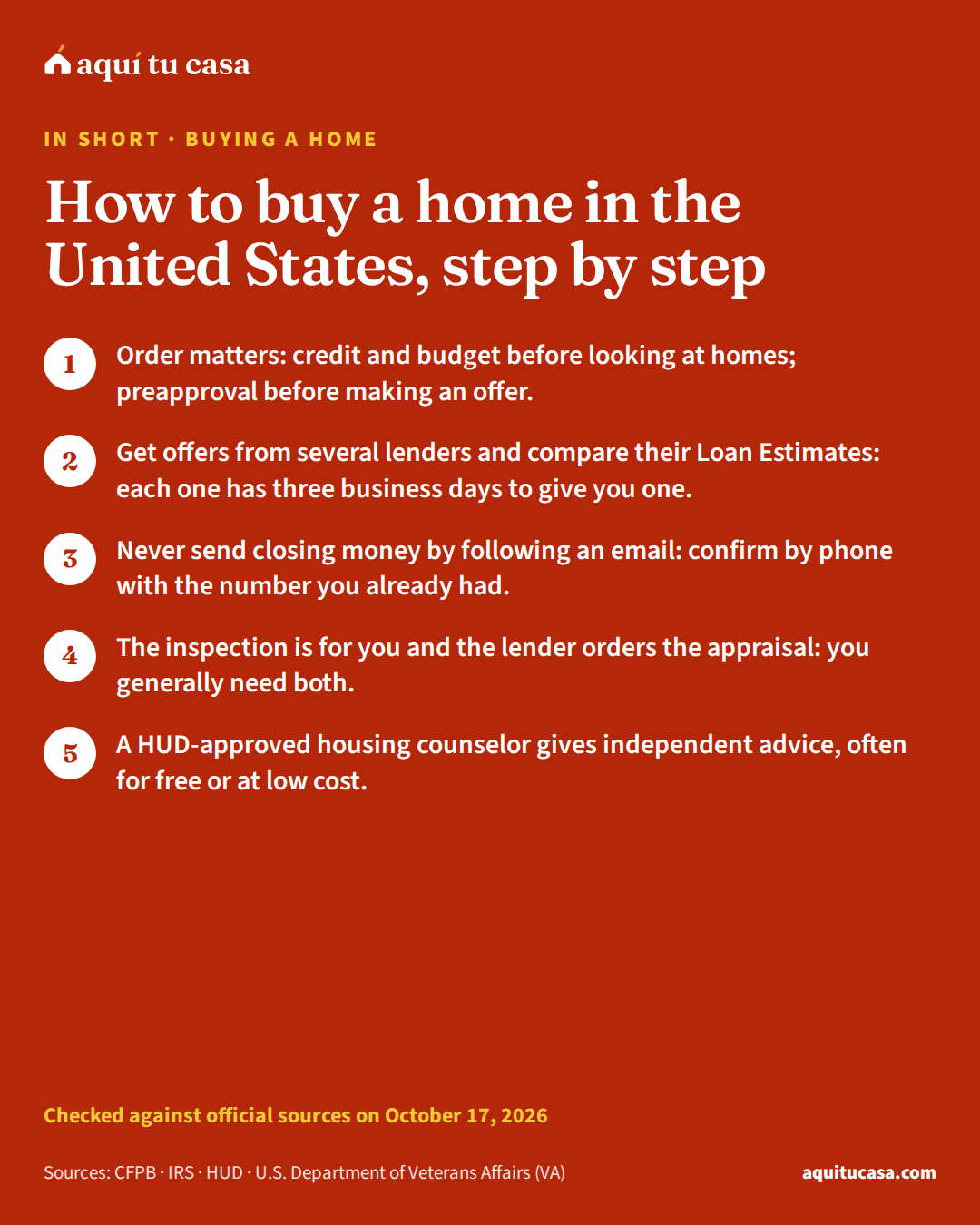
- Buying a home How to buy a home in the United States, step by step The nine steps to buying a home: paperwork, credit, budget, assistance, preapproval, offer, inspection, closing and the first year, with official sources. 15 minute read
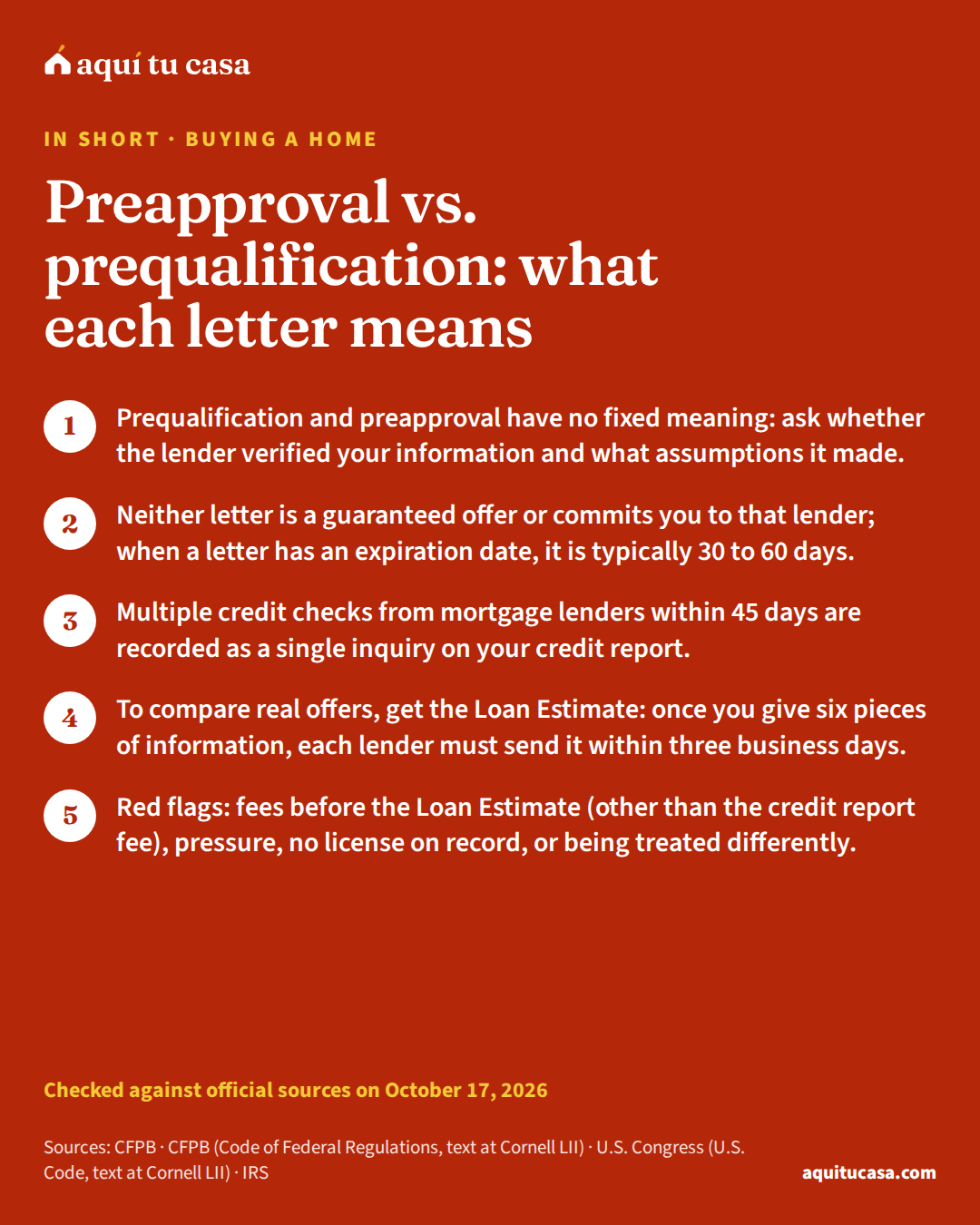
- Buying a home Preapproval vs. prequalification: what each letter means What prequalification and preapproval letters are, what lenders check, why neither one is a loan, and how to compare lenders without hurting your credit. 14 minute read
Tools for this topic
Was this guide useful?
Thank you. Your answer stays in your browser; nothing is sent.