How to open a bank account without a Social Security number
What banks and credit unions ask for to open an account without a Social Security number (ITIN, passport or consular ID) and which account to pick.
Verified against official sources on October 17, 2026 12 official sources

Show contents
In short
What you need to know
Quick answer
Yes, you can. The federal rule that requires banks to identify their customers accepts, for someone who is not a U.S. person, a taxpayer identification number (the ITIN), a passport number, an alien identification card or another government-issued document, such as a consular ID. Each bank or credit union decides which ones it accepts, so ask before you go. Bring your photo ID, a second proof (a bill with your address), your ITIN if you have one and the opening deposit. Look for a Bank On certified account: no overdraft fees and a low or waivable monthly fee. Without an SSN or ITIN you may only be offered an account that pays no interest.
What matters most
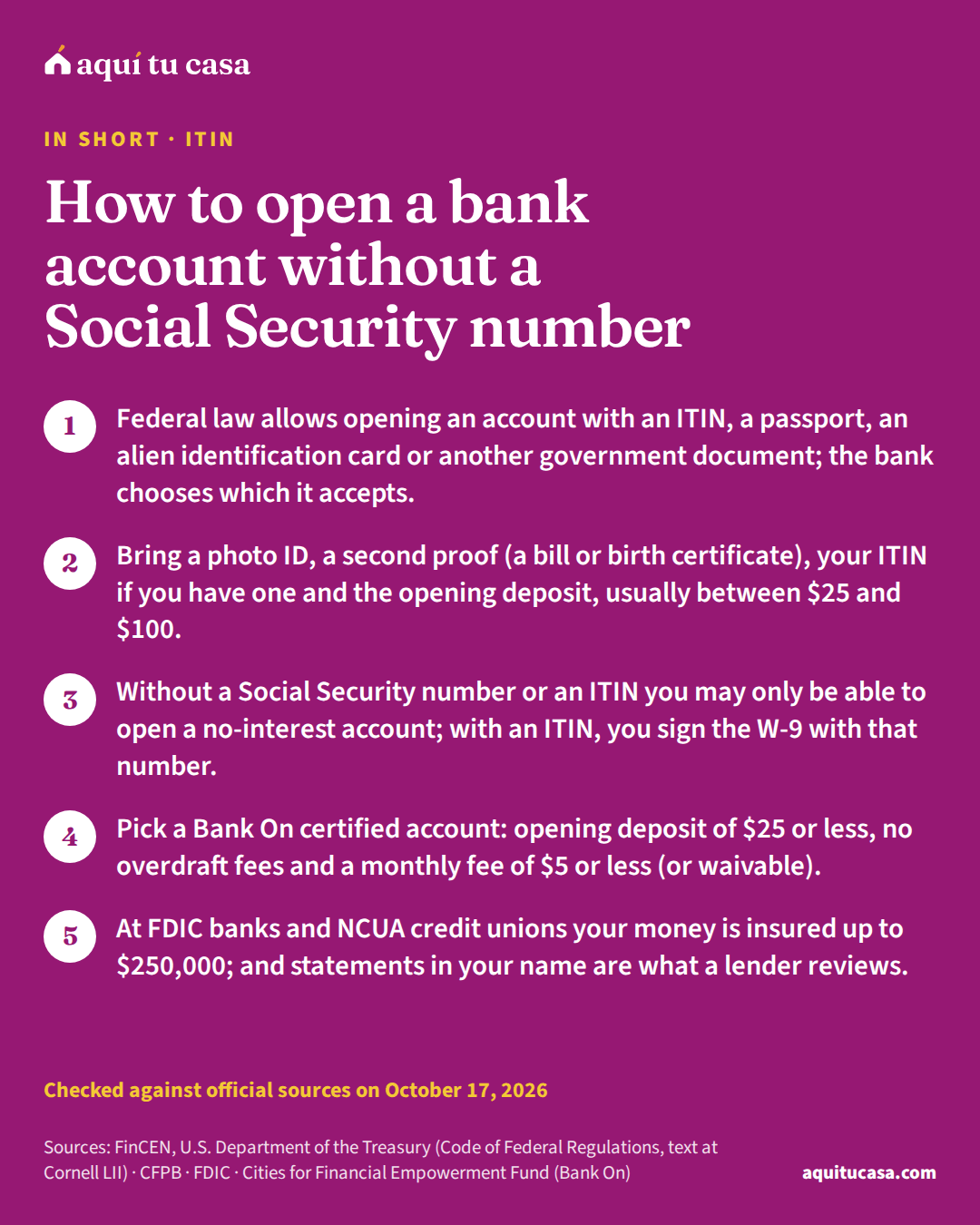
- Federal law allows opening an account with an ITIN, a passport, an alien identification card or another government document; the bank chooses which it accepts.
- Bring a photo ID, a second proof (a bill or birth certificate), your ITIN if you have one and the opening deposit, usually between $25 and $100.
- Without a Social Security number or an ITIN you may only be able to open a no-interest account; with an ITIN, you sign the W-9 with that number.
- Pick a Bank On certified account: opening deposit of $25 or less, no overdraft fees and a monthly fee of $5 or less (or waivable).
Is this for you?
This guide is for you if…
- You do not have a Social Security number and were told you cannot open an account without one.
- You have an ITIN, a passport or a consular ID and want to know which bank or credit union will accept you and what to bring.
- You are paid in cash and want your money on record for when you apply for a rental or a loan.
Get direct help first if…
- You already have an account and credit is what worries you: start with the credit-from-zero guide.
- You were denied an account over a checking account report and want to dispute it: this guide tells you how to request the report, but the dispute steps are in the credit-errors guide.
A bank account in your name is the foundation of almost everything else on this site: getting paid without paying to cash checks, proving income when you apply for a rental, saving for the down payment and, when the time comes, showing statements to a lender. Many people believe it cannot be done without a Social Security number. That is not so: federal law allows it with other documents, although each bank decides which ones it accepts. This guide tells you what the rule says, what to bring, which account to pick and what to do if they say no.
What federal law allows
The rule that requires banks to identify their customers is federal. Before opening an account, the bank must obtain at a minimum your name, date of birth, address and an identification number. For a U.S. person that number is the taxpayer identification number; for someone who is not, it may be one or more of these: a taxpayer identification number (the ITINITIN (Individual Taxpayer Identification Number)An ITIN is a nine-digit number the IRS, the federal tax agency, issues to people who need a U.S. taxpayer identification number to file taxes and are not eligible for a Social Security number. It is for tax purposes only: it does not authorize you to work in the United States, does not qualify you for Social Security benefits or the Earned Income Tax Credit, and says nothing about your immigration status. You apply with Form W-7, and it expires if it goes unused for several years. Some lenders accept an ITIN for a mortgage.See the full definition is one), a passport number and its country, an alien identification card number, or the number and country of any other government-issued document that proves nationality or residence. The same rule lets the bank open the account for someone who has already applied for a taxpayer number and has not yet received it, if it confirms the application was filed.1
That is what the law allows; what each bank accepts is its own decision. The CFPB explains that many banks ask for a U.S. or state photo ID, and that each bank or credit union has its own policy on foreign IDs. The Matrícula Consularconsular ID cardA Matricula Consular is an official Mexican government ID document issued by Mexico's consulates in the United States. Other countries offer similar IDs, sometimes called consular identification (CID) cards. According to the CFPB, many banks require a U.S. or state government-issued photo ID; if you do not have one, some banks and credit unions accept foreign passports and consular IDs such as the Matricula, but not all, and the CFPB suggests asking first. You usually also need another document, such as a bill with your name and address, and an interest-bearing account requires an SSN or ITIN.See the full definition is an official Mexican government identification document.2 The FDIC confirms that many banks open accounts for non-citizens, with a foreign passport, a consular ID or an ITIN.3 So the first step is to ask: “Which documents do you accept to open an account without a Social Security number?”
With an ITIN, or without one yet
IRS tax number
With an ITIN
Either way, each bank decides which ID it accepts: ask before you go.2
What to bring to the branch
According to the CFPB’s checklist and the FDIC’s #GetBanked page, this is what they usually ask for:
- A photo ID. A driver’s license or state ID if you have one; if not, your country’s passport or a consular ID, as the bank accepts.2
- A second proof. A bill with your name and address, your birth certificate or your Social Security card if you had one.2
- Your identification number. The Social Security number or the ITIN; the FDIC says to bring one of the two and adds that some banks accept other forms of ID.3
- The opening deposit. Usually between $25 and $100;2 the FDIC notes that some accounts open with as little as $25.3
Example with real numbers
What a person with a passport and an ITIN brings
An example in words; each bank says what it accepts, so call first.
- Photo ID
- Their country's passport, if the bank accepts it
- Second proof
- An electric bill with their name and address
- Identification number
- Their ITIN (with it they can have an account that pays interest)
- Money to open it
- The minimum deposit of the account they chose
- What they ask before signing
- Minimum balance, monthly fee, ATMs and overdraft, in writing
This is an example, not a bank rule.2 Use the document checklist to build your own.3
Run it with your numbersDocument checklistHow to open it, step by step
Opening the account, according to the FDIC
1. Get ready
Before you go
In most places you must be at least 18; if you are younger, a trusted adult may be able to help.3
2. Gather your IDs
The day you go
Your SSN or ITIN and a photo ID; some banks accept other forms.3
Try it with your numbersDocument checklist3. Fill out the application
In person, online or in an app
The bank confirms your name, date of birth, address and identification number.1
4. Make your first deposit
When you open it
At a Bank On certified account, the opening deposit is $25 or less.4
5. Sign the documents
At the end of the application
The signature card and the other papers, in person or electronically.3
6. Set up your tools
In the first days
Online or mobile banking and your debit card; ask for help if you are not sure how to use them.3

Which account to pick: look for the Bank On seal
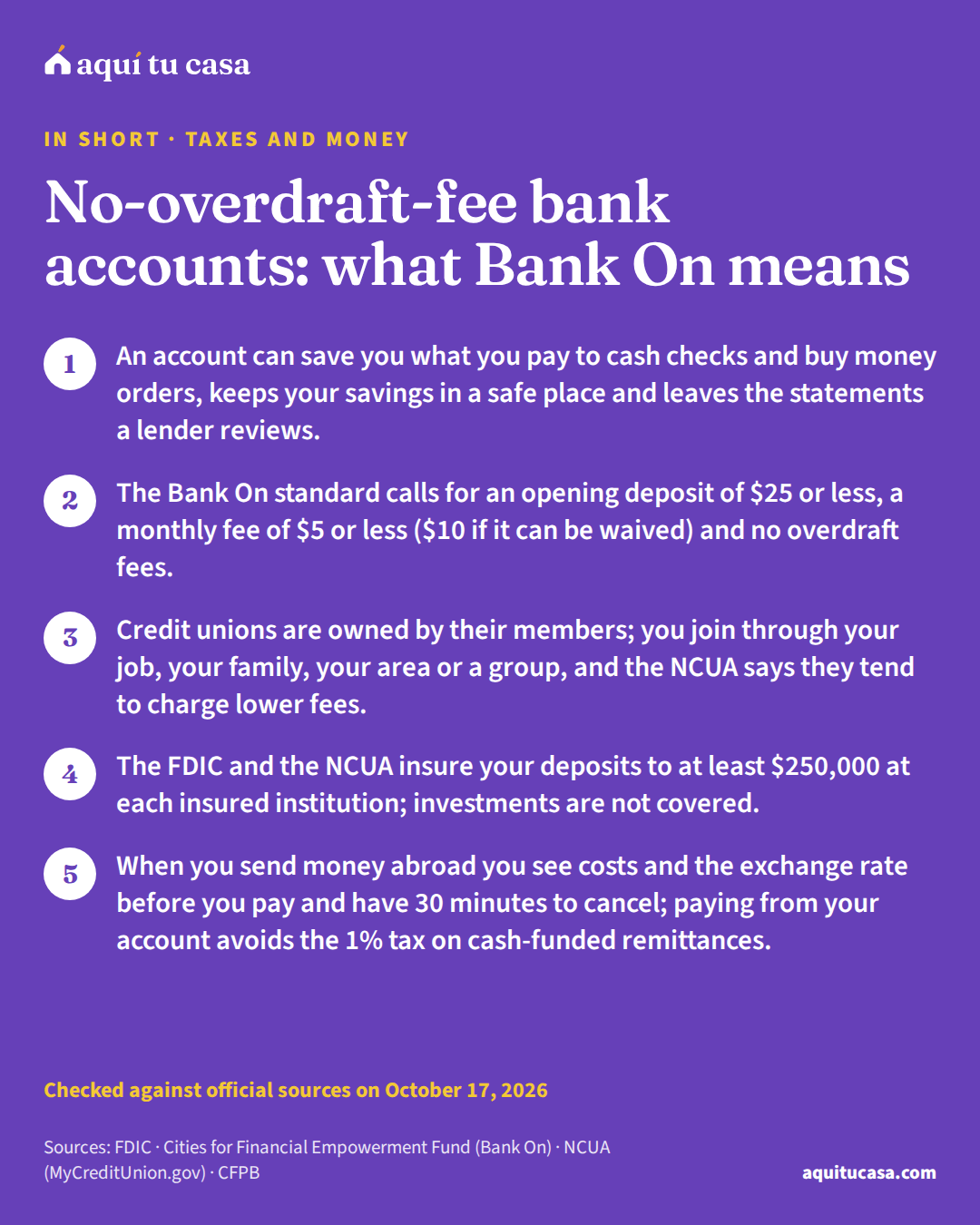
Not every account costs the same, and overdraft fees are the fastest way to lose the money you just deposited. Bank On is a national standard for basic accounts that the FDIC points to: certified accounts have low and transparent costs and do not allow overdraft or insufficient fund fees.3 The 2025–2026 standard requires an opening deposit of $25 or less; a monthly fee of $5 or less, or $10 or less if it can be waived with a single transaction (direct deposit, paying a bill or a debit card purchase); no overdraft, activation, closure, inactivity or low-balance fees; and insured deposits. Among what it “strongly recommends” to banks is accepting the ITIN and consular or municipal IDs as the primary document, and denying new customers only for actual fraud.4 The Bank On low-fee accounts guide explains how to find them.
Before signing, ask what the CFPB suggests: the minimum balance to avoid the monthly fee, how much that fee is, whether direct deposit eliminates it, what they charge at ATMs and how to avoid overdraft fees.2
Bank or credit union: both insure your money
It does not matter which you choose as long as it is insured. At an FDIC-insured bank your deposits are automatically protected to at least $250,000 per bank.3 At a federally insured credit unioncredit unionA credit union is a not-for-profit financial institution that, like a bank, accepts deposits, makes loans and offers other services, but is owned by its members. Members elect a volunteer board of directors, and profits go back to them as lower fees, higher savings rates and lower loan rates. To join you need a common bond, such as your employer, your family, where you live or a group you belong to. It is chartered by the NCUA, a federal agency, or by a state. If the credit union is federally insured, your deposits are protected by the NCUA's insurance fund.See the full definition, NCUA insurance is automatic when you join and covers individual accounts up to $250,000, backed by the United States government. Some credit unions have private insurance without that backing: confirm it with the NCUA locator.5 Credit unions often serve specific communities; the ITIN mortgages guide explains why it can help to join one before you apply for a loan.

If they say no
A bank denying you an account does not close the door. The CFPB explains that the denial may come from a checking account reporting company (such as Chex Systems or Early Warning Services) with negative information: an unpaid negative balance from an overdraft, suspected fraud or bad checks, even on a joint account with someone who had those problems. Some banks also look at your credit reportcredit reportA credit report is a statement that has information about your credit activity and current credit situation: your loans and cards, the balances, whether you have paid on time, accounts in collection and who has checked your credit. Credit reporting companies, also called credit bureaus, compile it from what banks and creditors report; your credit score is computed from it. When you apply for a mortgage, the lender pulls your report from the three bureaus. You have the right to see it for free and to dispute anything that is wrong.See the full definition. If it was because of a report, the bank must give you an adverse action notice with the company’s name and contact information; you can request a free copy from that company and dispute in writing anything that is wrong, and it is required to investigate. Also ask whether the bank has lower-risk accounts you may qualify for anyway; if not, try another institution.9 The FDIC also mentions “second chance” accounts, designed to help you rebuild your banking history.3 And if the denial was about documents, the Bank On standard recommends that banks accept the ITIN and consular IDs.4
Mistakes that cost you the account or your money
Mistake: Going to the branch without first asking which ID they accept.
Instead: Each bank has its own policy on foreign IDs: call first.2
Mistake: Opening the first account offered to you, even if it charges overdraft fees.
Instead: Look for a Bank On account: it does not allow overdraft or insufficient fund fees.4
Mistake: Giving up after one denial.
Instead: Ask for the adverse action notice and the free copy of the report, and ask about lower-risk accounts.9
Mistake: Keeping your savings at a credit union without checking its insurance.
Instead: Confirm it has federal NCUA insurance; private insurance does not have the government's backing.5
Mistake: Depositing all your saved cash at once right before you apply for a loan.
Instead: A large deposit has to be documented, and funds that cannot be verified do not count.11
If you do not have an ITIN yet
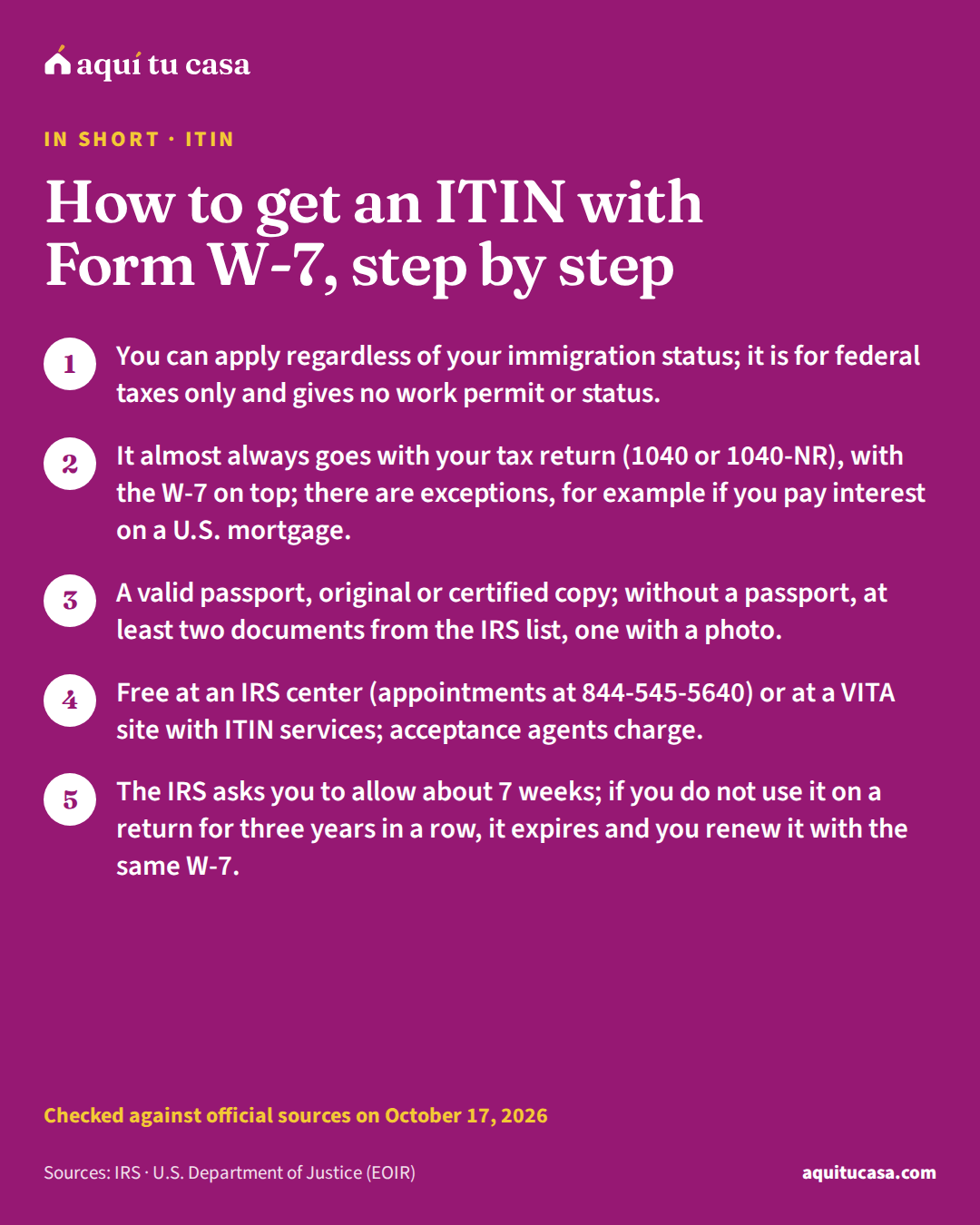
The ITIN is a 9-digit number the IRS issues for federal tax purposes; it does not authorize work, does not grant Social Security benefits, does not change your immigration status and is not ID outside the tax system.6 You apply with Form W-7Form W-7Form W-7 is the IRS's official application to get an ITIN, or to renew one that has expired or is about to. It is filed together with a federal tax return, with some exceptions, and with original documents or certified copies that prove your identity and foreign status, such as a passport. You can mail it, bring it to an IRS center or go to a Certifying Acceptance Agent, who reviews the documents and returns them on the spot. It is free; be wary of anyone who charges to "get" you a fast ITIN.See the full definition, by mail with your tax return or in person: free at an IRS Taxpayer Assistance Center or at a VITA site with ITIN services, or with an IRS-approved agent, who charges. The IRS asks you to allow 7 weeks to hear back.7 In the meantime, the federal rule lets the bank open the account for someone who has already filed the application, if it confirms that and receives the number later.1 The step by step is in how to get an ITIN with Form W-7.

Why it matters for renting and buying
An account in your name turns your effort into papers other people accept. When you apply for a mortgage, the lender will verify that you have the money for the down paymentdown paymentThe down payment is the part of the home's price you pay out of your own pocket when you buy; the loan covers the rest. In U.S. Spanish it is also called enganche, cuota inicial or entrada. Each loan type has its own minimum: FHA requires at least 3.5% of the value, VA and USDA loans may require none, and conventional loans ask for more if you want to avoid private mortgage insurance. A larger down payment lowers the loan, the monthly payment and the total interest; many state programs help families put it together.See the full definition, closing costs and reserves using your bank statementsbank statementA bank statement is the summary your bank or credit union gives you of the activity in your account over a period: deposits, withdrawals, payments and the ending balance. Most send one every month, on paper or online; the law only requires a monthly statement when there was at least one electronic transfer that month, and otherwise it may come quarterly. When you apply for a mortgage, the lender can use your statements to verify you have money for the down payment, closing and reserves. Under Fannie Mae's rules, they must show the bank's name, your name, part of the account number, the period, all transactions and the ending balance.See the full definition. For a purchase they must cover the most recent full two months, clearly identify the bank and you as the account holder, and show all deposits and withdrawals.10 And watch the deposits: a single deposit above 50% of the monthly income you qualify with counts as “large” and its source has to be documented; funds that cannot be verified do not count toward the down payment, closing costs or reserves.11 For renting, the guide on how to rent without a Social Security number or credit explains what else you can show.
If this is you
You are paid in cash
Deposit regularly: a large deposit all at once has to be documented for a lender.11
You applied for an ITIN and it has not arrived
The federal rule lets the bank open the account in the meantime, if it confirms your application.1
You want to buy a home later
Statements in your name will be the proof of your down payment and reserves.10
What to do this week
- Call two or three banks or credit unions in your area and ask which documents they accept without a Social Security number; also ask whether they have a Bank On certified account.4
- Gather your photo ID, a second proof and your ITIN, if you have one, with the document checklist.2
- Before signing, ask the fee questions and request the fee schedule in writing.2
- If they say no because of a report, ask for the adverse action notice and the free copy of the report.9
- From the first month on, deposit your income regularly and keep the statements.10
Your numbers
We start with the typical home value in the United States ($332,700). Enter the price you are looking at.
Adjust advanced details
The minimum for this loan is 3.5%. A larger down payment lowers the monthly payment but takes longer to save.
As a share of the price. It is an example; your lender's Loan Estimate has the real figure.
Annual interest of the account where you keep the money. Leave it at zero if you do not know.
Let's do the math
Time to reach your goal
Enter how much you can save each month.
Your goal
- Down payment (3.5% of the price)
- $11,645
- Closing costs (3% of the price)
- $9,981
- Savings target
- $21,626
- You already have
- $0
- Still missing
- $21,626
What helps
- Set up an automatic transfer on payday into a separate account you do not use for spending.
- Ask about your state's and city's assistance programs before setting the goal: many cover part of the down payment or closing costs.
- If family gives you part of it, the lender usually asks for a gift letter and the transfer record; ask beforehand how they want it.
- Revisit the goal whenever the price you are looking at, the loan type or what you can save changes.
An educational estimate, not a loan offer. Closing costs are an example (3% of the price); the real figure comes in the Loan Estimate. We do not count the reserves some lenders require after closing.
Ready to see the numbers? Find your county here
See how this applies in your county: its loan limits, prices and rents, from the official data.
Printable checklist
Frequently asked questions
Can they deny me an account for not having a Social Security number?
The federal rule does not require a Social Security number from someone who is not a U.S. person: it allows the ITIN, a passport or another government-issued document. But each bank decides which documents it accepts within that rule. If one says no, ask another, try a credit union or look for a Bank On certified account, whose standard recommends accepting the ITIN and consular IDs.
Does opening an account alert immigration?
This guide cannot answer what happens in your case. What the federal rule says is that the bank collects your name, date of birth, address and an identification number to identify its customers, and the IRS asks for the number for interest. If your situation worries you, you can first consult a free legal aid office or a representative accredited by the Department of Justice.
What about taxes on the account?
The interest an account pays is taxable income; that is why, for an interest-bearing account, the bank asks for a Social Security number or an ITIN and has you sign Form W-9 with that number. Without either, you may only be offered an account that pays no interest.
How much money do I need to open the account?
The CFPB says the opening deposit is usually between $25 and $100, and the FDIC that some accounts open with as little as $25. A Bank On certified account asks for $25 or less.
Can I open the account before my ITIN arrives?
The federal rule lets a bank's program open an account for someone who has applied for a taxpayer number and not yet received it, if it confirms the application was filed and gets the number later. Not every bank does this: ask first.
What is a second chance account?
According to the FDIC, some banks offer 'second chance' accounts for people who have had banking problems before, and they help you rebuild your banking history. The CFPB suggests asking whether the bank has lower-risk accounts that you may qualify for even after being denied another.
Is my money safe at a credit union?
At a federally insured credit union, NCUA insurance is automatic and covers individual accounts up to $250,000, backed by the U.S. government. Some credit unions have private insurance without that backing: check with the NCUA locator.
Is a prepaid account or an app as good as a bank?
Some prepaid accounts are Bank On certified and meet the same cost standards. What matters is that the account is in your name, that the deposits are insured (FDIC or NCUA) and that you can get monthly statements: that is what a landlord or a lender will ask for.
Sources
Every figure in this guide comes from one of these official sources. The number next to a sentence leads to the source behind it.
Each source on one line: who publishes it, its title, its address and the date we read it.
- 1. FinCEN, U.S. Department of the Treasury (Code of Federal Regulations, text at Cornell LII) · 31 CFR §1020.220, Customer identification program requirements for banks · law.cornell.edu · Accessed October 17, 2026
- 2. CFPB · Checklist for opening a bank or credit union account (A Newcomer's Guide to Managing Money) · files.consumerfinance.gov · Accessed October 17, 2026
- 3. FDIC · #GetBanked · fdic.gov · Accessed October 17, 2026
- 4. Cities for Financial Empowerment Fund (Bank On) · Bank On National Account Standards (2025–2026) · joinbankon.org · Accessed October 17, 2026
- 5. NCUA · Share Insurance Coverage · ncua.gov · Accessed October 17, 2026
- 6. IRS · Individual taxpayer identification number (ITIN) · irs.gov · Accessed October 17, 2026
- 7. IRS · How to apply for an ITIN · irs.gov · Accessed October 17, 2026
- 8. IRS · Instructions for the Requester of Form W-9 (Rev. March 2024) · irs.gov · Accessed October 17, 2026
See the other 4 sources
- 9. CFPB · Why was I denied a checking account? · consumerfinance.gov · Accessed October 17, 2026
- 10. Fannie Mae · Fannie Mae Selling Guide B3-4.2-01, Verification of Deposits and Assets · selling-guide.fanniemae.com · Accessed October 17, 2026
- 11. Fannie Mae · Fannie Mae Selling Guide B3-4.2-02, Depository Accounts · selling-guide.fanniemae.com · Accessed October 17, 2026
- 12. CFPB · Find a Housing Counselor · consumerfinance.gov · Accessed October 17, 2026
Keep reading
Related guides
If this guide helped, these follow the same path.

ITIN 15 minute read
What an ITIN is and what it is for
The ITIN is the IRS number for filing taxes without a Social Security number: what it does and does not do, how to apply with Form W-7, timing and expiry.
- The ITIN is a tax number, nothing more: not a work permit, not a status and not an ID.
- You can apply regardless of immigration status, with the W-7 in the same package as your federal return; the passport is the only document that works on its own.
- It is free at an IRS center or a VITA site with ITIN services; an acceptance agent charges a fee.
- ITIN How to get an ITIN with Form W-7, step by step Who can apply for an ITIN, which documents the IRS accepts, where to file Form W-7 for free, how long it takes and how to renew it. 15 minute read
- Taxes and money No-overdraft-fee bank accounts: what Bank On means What a Bank On certified account is, why an account helps you save and buy a home, credit unions, FDIC/NCUA insurance, check cashing and remittances. 13 minute read
- Credit Credit from zero: how to start your history in the U.S. What credit reports and scores are, how to get them for free, and how to start a history from nothing with a secured card or a credit-builder loan. 16 minute read
Tools for this topic
Was this guide useful?
Thank you. Your answer stays in your browser; nothing is sent.