Cash and your mortgage: how to use cash savings
If you save or get paid in cash: why the lender asks where your money came from, what a large deposit is and how to move your cash into the bank.
Verified against official sources on October 17, 2026 16 official sources

Show contents
In short
What you need to know
Quick answer
Saving in cash is not a problem, but to use that money for a mortgage it has to be in an account and come from a source you can explain. Lenders review your bank statements, usually for the last two months, and ask you to document any large deposit: for Fannie Mae and FHA, one bigger than half your monthly income. FHA accepts cash you kept at home if you deposit it and explain how you saved it; Fannie Mae accepts it only on its HomeReady loan. Deposit early, keep your receipts and never split deposits to avoid the bank's report.
What matters most
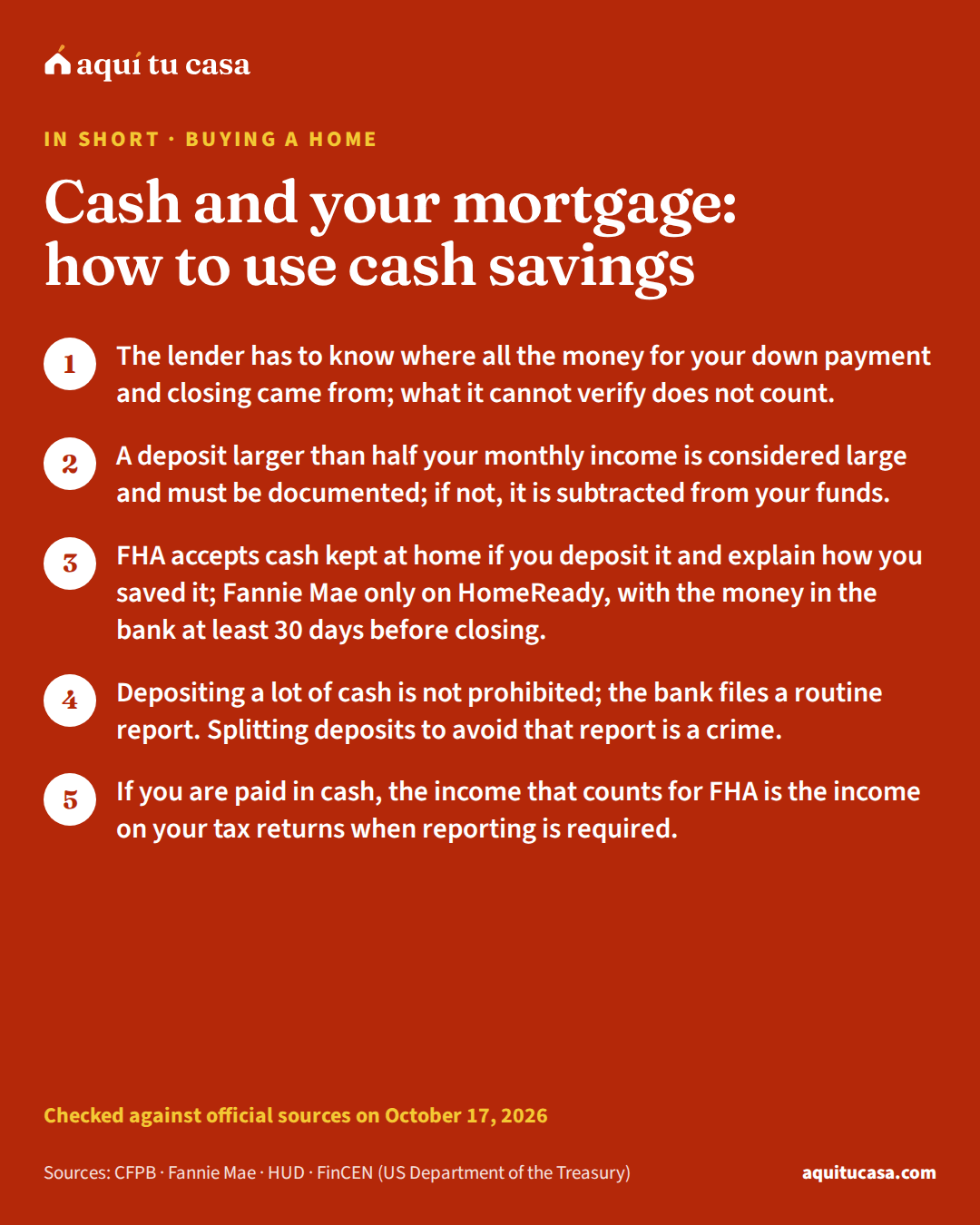
- The lender has to know where all the money for your down payment and closing came from; what it cannot verify does not count.
- A deposit larger than half your monthly income is considered large and must be documented; if not, it is subtracted from your funds.
- FHA accepts cash kept at home if you deposit it and explain how you saved it; Fannie Mae only on HomeReady, with the money in the bank at least 30 days before closing.
- Depositing a lot of cash is not prohibited; the bank files a routine report. Splitting deposits to avoid that report is a crime.
Is this for you?
This guide is for you if…
- You have cash savings at home and want to use them for the down payment or closing costs.
- You are paid all or part of your wages in cash and want to know how that works for a loan.
- You made a large deposit into your account and the lender asked you to explain it.
Get direct help first if…
- The money is a gift from a relative: start with the guide on gift money from family, which explains the gift letter.
- Your business handles a lot of cash and you want to know how your income is figured: the guide on buying when self-employed covers it.
- You need help with your taxes: this guide gives no tax advice; IRS VITA sites prepare basic returns for free for people who qualify.
Many people save in cash. This guide is for you if you keep money at home, get paid in cash or made a large deposit that the lender asked you to explain. You will see why the lender asks where your money came from, what FHA and Fannie Mae allow, and how to move your cash into the bank calmly and with a paper trail.
Why the lender asks where your money came from
It is not personal: the rules require the lender to verify every dollar you use to buy. The CFPB explains that cash to close is usually paid by cashier’s check or wire transfer, and that you will need to prove where it came from.1 On an FHA loan, the lender must document all the money you use to qualify or close, and confirm it comes from an acceptable source.10
For Fannie Mae, money in your accounts can go toward the down paymentdown paymentThe down payment is the part of the home's price you pay out of your own pocket when you buy; the loan covers the rest. In U.S. Spanish it is also called enganche, cuota inicial or entrada. Each loan type has its own minimum: FHA requires at least 3.5% of the value, VA and USDA loans may require none, and conventional loans ask for more if you want to avoid private mortgage insurance. A larger down payment lowers the loan, the monthly payment and the total interest; many state programs help families put it together.See the full definition, closing costsclosing costsClosing costs are all of the costs you pay on closing day on top of the down payment: lender fees, the appraisal, the credit report, title insurance, the closing agent's fees, any transfer taxes your state or county charges and the first deposits into the escrow account. The lender must itemize them on the Loan Estimate within days of your application and confirm them on the Closing Disclosure before you sign. Some can be paid by the seller, and several state programs help cover them.See the full definition and reservesreservesReserves are the cash and other easy-to-cash assets you still have available after the mortgage closes. They are measured in months: how many full monthly house payments (principal, interest, taxes, insurance and association dues) you could cover with them. Under Fannie Mae's rules, they include money in checking or savings accounts, investments, the vested part of a retirement account and the cash value of a life insurance policy; personal loans and the money you use to close do not count. An eligible gift can also be used. How many months are required depends on the loan and the property.See the full definition if it can be verified. Money that cannot be verified is not accepted, and the lender must investigate any sign that it was borrowed.4 So the lender does not just look at how much you have: it looks at how it got there.
The usual way to verify is with your bank statementsbank statementA bank statement is the summary your bank or credit union gives you of the activity in your account over a period: deposits, withdrawals, payments and the ending balance. Most send one every month, on paper or online; the law only requires a monthly statement when there was at least one electronic transfer that month, and otherwise it may come quarterly. When you apply for a mortgage, the lender can use your statements to verify you have money for the down payment, closing and reserves. Under Fannie Mae's rules, they must show the bank's name, your name, part of the account number, the period, all transactions and the ending balance.See the full definition. On a purchase, Fannie Mae asks for the most recent full two-month period, with every deposit and withdrawal and the ending balance.3 The CFPB suggests having your two most recent statements and documents showing where your down payment came from, with at least two months of history.2
What a large deposit is and how to explain it
For Fannie Mae, a large deposit is a single deposit that exceeds 50% of the monthly income you qualify with. If you need that money for a purchase, the lender must document that it comes from an acceptable source.4 FHA’s rule is similar: the lender must document each deposit of more than 50 percent of your monthly income, and verify you did not borrow to put together the down payment.10
What counts as proof? Fannie Mae gives examples: your written explanation, proof that you sold something of yours, like a car, or a wedding invitation if you received gifts. If a deposit cannot be documented, that money is subtracted from your funds, and the lender checks whether what is left is enough.4 Some deposits need no explanation because the statement already shows where they came from: your paycheck by direct deposit, Social Security, a tax refund or a transfer between your verified accounts.4
Example with real numbers
When a deposit counts as large
Using the typical US household income as an example. Your own threshold depends on the monthly income you qualify with.
- Monthly income of a typical household
- $6,728
- Deposit Fannie Mae and FHA consider large
- One of more than half that amount
- If you cannot document it
- It is subtracted from your available funds
This is an example with national numbers. Fannie Mae defines a large deposit using your monthly qualifying income,4 and FHA using your monthly effective income.10
Run it with your numbersDown payment savings planYour cash savings at home
Cash you keep outside a bank is called “cash on hand.” Each type of loan treats it differently:
Cash kept at home: what each loan accepts
Yes, with an explanation
FHA loan
No
Standard Fannie Mae
In all three cases, the cash has to reach an account before closing and come from a source you can explain.10
On an FHA loan, the lender must verify that the cash is deposited in a financial institution or held by the title or escrow company. It will ask you to explain how you saved it and how long it took. Then it decides whether that is reasonable given that time, your income, your spending habits, your documented expenses and your history with banks.10
Fannie Mae, by contrast, does not accept cash on hand for the down payment or closing costs, except on its HomeReady loan.5 On HomeReady, for a one-unit home, the lender must verify that you usually pay your expenses in cash and that what you saved fits how you pay. The money must be in an account at application or at least 30 days before closing. You sign a statement about where it came from and that it was not borrowed, and your history should show little use of credit and little banking relationship.6 To use HomeReady, the yearly income of all borrowers may not exceed 80% of the area median incomearea median income (AMI)The area median income (AMI) is the median family income of an area, which HUD computes every year for each metropolitan area and county. Housing programs use it as the yardstick: under the federal rule, a family is low-income when it earns no more than 80% of its area's median income and very low-income when it earns no more than 50%, adjusted for family size. State down payment assistance programs and Section 8 vouchers publish their limits as a percentage of AMI, so the same salary can qualify in one county and not in the next.See the full definition where the home is.7

How to move your cash into the bank
Depositing cash is normal. Do it early and keep a paper trail, so the lender can see the money on your statements.
From cash at home to money that counts
1. Open an account
As soon as you can
At an FDIC-insured bank, the money in your account has that protection; a safe deposit box does not.12
2. Deposit it the normal way, without splitting it
When you take it in
Over $10,000 in a day, the bank files a routine report; splitting deposits to avoid it is a crime.11
4. Write down how you saved the money
Before you apply
For FHA, explain how you saved it and over how long.10
Try it with your numbersDocument checklist5. Let it show up on your statements
Usually two months
The lender reviews the most recent full two-month period.3
6. Pay at closing from your account
Closing day
Usually by cashier's check or wire, with proof of where it came from.1
Try it with your numbersClosing costs
Will you be reported? According to FinCEN, the law requires banks to report cash transactions over $10,000 by one person, or several that add up to more than that in a single day, on a Currency Transaction Report (CTR). There is no general prohibition against handling a lot of cash, and the report is filed regardless of the reason.11
If you do not have an account, the guide on opening a bank account without a Social Security number explains which IDs are accepted, and the guide on low-fee accounts explains Bank On accounts. A credit unioncredit unionA credit union is a not-for-profit financial institution that, like a bank, accepts deposits, makes loans and offers other services, but is owned by its members. Members elect a volunteer board of directors, and profits go back to them as lower fees, higher savings rates and lower loan rates. To join you need a common bond, such as your employer, your family, where you live or a group you belong to. It is chartered by the NCUA, a federal agency, or by a state. If the credit union is federally insured, your deposits are protected by the NCUA's insurance fund.See the full definition is another option.
Earnest money and gift money
The earnest money depositearnest moneyEarnest money is a deposit the buyer pays when signing the purchase contract to show good faith that the offer is serious. The seller does not keep it: a neutral third party (the title company or a closing agent) normally holds it, and at closing it is applied to your down payment or closing costs. If you back out for a reason the contract allows, such as an inspection or financing contingency, you get it back; if you back out without a valid reason, you can lose it.See the full definition you give when you sign the contract is checked too. On an FHA loan, the lender must verify its amount and source if it exceeds 1 percent of the price or is a lot for your history of saving. It checks with your canceled check, a statement from whoever holds the deposit or a bank statement.10 For Fannie Mae, earnest money above what is customary for the area is closely evaluated, and receipt is proven with your canceled check or a statement from whoever holds it.8 Paying it from your account, not in cash, leaves that trail.
If a relative wants to help you with cash kept at their home, on an FHA loan that cash cannot be the source of a gift.10 The guide on gift money from family explains the gift lettergift letterA gift letter is a document signed by the person who gives you money to buy a home, stating that the money is a gift and not a loan. For some loans, a gift can pay the down payment, closing costs or reserves, as long as you can prove where the money came from. Under Fannie Mae's rules, the letter states the amount of the gift, says no repayment is expected, and gives the donor's name, address, phone number and relationship to you. The lender also verifies that the money moved from the donor's account to yours or to the closing agent.See the full definition and how the transfer is documented.

Tandas and other group savings
Many families save through tandas or cundinas. FHA calls them “private savings clubs”: a non-traditional way of saving by making deposits into a pool its members manage. The lender may accept money the club paid out to you if it verifies when the club started and how long it has run, that you received the money and that it was reasonably saved and not borrowed. It asks for the club’s ledgers and receipts and a statement from the treasurer that the club is still active.10
Fannie Mae accepts pooled savings for the down payment if you document your regular contributions with written confirmation from whoever runs the fund. If you still have to keep contributing, that commitment counts as debt in your debt-to-income ratiodebt-to-income ratio (DTI)Your debt-to-income ratio (DTI) is all your monthly debt payments divided by your gross monthly income, that is, income before taxes. If you pay a certain amount each month across a car, cards, student loans and the mortgage you are asking for, and you earn three times that, your DTI is one third. Lenders use it to measure whether you can manage the payment; each loan type and lender sets its own limit, and assistance programs usually publish theirs. Paying down debt before applying improves your DTI.See the full definition.9
If you are paid in cash
Your income has to be verifiable too. The IRS says income must be reported on your return even if you are paid in cash and even if you get no 1099.13 On an FHA loan, the lender may only count income that is legally earned and, when required, reported on your tax returns.10
Regulation Z requires income to be verified with reasonably reliable third-party records. Its examples include your tax returns, bank records, check cashing receipts and money transfer receipts.14 If you cash your checks at a store or send remittances, keep those receipts. If you work for yourself, the guide on buying a home when self-employed explains how your income is figured.

If this is you
You are paid in cash
For FHA, the income on your tax returns when reporting is required is what counts.10 Keep check cashing and money transfer receipts.14
You have never had a bank account
On HomeReady, cash on hand is accepted for people who use little credit and few banking services, with conditions.6
You save in a tanda
FHA accepts money from a private savings club with its records and a statement from the treasurer.10
You do not have a Social Security number
The rule to document your funds is the same.4 See how to open an account without a Social Security number.
Mistakes that can stall your loan
Mistake: Depositing all your cash a few days before closing.
Instead: Deposit early so it shows up on your statements.3
Mistake: Splitting deposits so the bank does not report them.
Instead: Deposit normally; the report is routine and splitting is a crime.11
Mistake: Taking out a loan and depositing it as if it were savings.
Instead: The lender investigates borrowed money; say so from the start.4
Mistake: Not keeping receipts for your deposits.
Instead: Keep every receipt and write down how you saved the money.10
Mistake: Paying the earnest money in cash.
Instead: Pay it from your account so you have a canceled check or a receipt.8
If you have questions about your numbers, a HUD-approved housing counselorHUD-approved housing counselorA HUD-approved housing counselor works at an agency HUD has approved to provide housing counseling: independent, expert advice customized to your situation about buying a home, renting, a missed mortgage payment, a foreclosure or credit problems. The agencies usually charge little or nothing; many serve in Spanish and offer the homebuyer education course several assistance programs require. They are not lenders or real estate agents and sell you nothing. Your county page lists the official agencies with phone numbers.See the full definition gives independent advice, often free or at low cost.16 For your taxes, IRS VITA sites prepare basic returns for free for people who qualify; find one with the IRS locator or at 800-906-9887.15

What to do this week
- If you keep cash at home, deposit it in an insured account and keep the receipt.12
- Deposit it the normal way, without splitting it into small amounts to avoid the bank’s report.11
- Write a short explanation of how you saved the money and over how long.10
- Gather documents for any large deposit in the last two months.4
- Figure out how much you need with the down payment savings plan and check the document checklist.
- Read the down payment guide and ask several lenders which loan works with the way you save.2
Your numbers
We start with the typical home value in the United States ($332,700). Enter the price you are looking at.
Adjust advanced details
The minimum for this loan is 3.5%. A larger down payment lowers the monthly payment but takes longer to save.
As a share of the price. It is an example; your lender's Loan Estimate has the real figure.
Annual interest of the account where you keep the money. Leave it at zero if you do not know.
Let's do the math
Time to reach your goal
Enter how much you can save each month.
Your goal
- Down payment (3.5% of the price)
- $11,645
- Closing costs (3% of the price)
- $9,981
- Savings target
- $21,626
- You already have
- $0
- Still missing
- $21,626
What helps
- Set up an automatic transfer on payday into a separate account you do not use for spending.
- Ask about your state's and city's assistance programs before setting the goal: many cover part of the down payment or closing costs.
- If family gives you part of it, the lender usually asks for a gift letter and the transfer record; ask beforehand how they want it.
- Revisit the goal whenever the price you are looking at, the loan type or what you can save changes.
An educational estimate, not a loan offer. Closing costs are an example (3% of the price); the real figure comes in the Loan Estimate. We do not count the reserves some lenders require after closing.
Ready to see the numbers? Find your county here
See how this applies in your county: its loan limits, prices and rents, from the official data.
Printable checklist
Frequently asked questions
Can I use cash I keep at home to buy a house?
It depends on the loan. On an FHA loan, yes, if you deposit it in a bank or with the title company and explain how and over how long you saved it. Fannie Mae does not accept cash on hand for the down payment except on its HomeReady loan, which has its own rules.
How long before buying should I deposit my cash?
There is no single deadline for every loan. Lenders usually review your two most recent months of statements, and on Fannie Mae's HomeReady the money must be on deposit at application or at least 30 days before closing. Depositing early leaves a history the lender can see.
What counts as a large deposit for a mortgage lender?
For Fannie Mae, a single deposit of more than 50% of your monthly qualifying income. FHA asks for documentation of each deposit of more than 50 percent of your monthly effective income. If it cannot be documented, Fannie Mae subtracts that money from your available funds.
Will I be reported if I deposit more than $10,000 in cash?
The bank has to file a Currency Transaction Report when one person's cash transactions go over $10,000 in a day. According to FinCEN, there is no general prohibition against handling a lot of cash, and the report is filed regardless of the reason.
Can I deposit my cash in small amounts so it doesn't stand out?
Do not do it. According to FinCEN, breaking deposits into smaller amounts to avoid the bank's report is a federal crime, even if the money is yours and legal. Several deposits on the same day are also added together for the report.
Can I use money from a tanda for the down payment?
It can work. FHA accepts money paid out to you by a private savings club if it is documented with the club's records and a statement from the treasurer. Fannie Mae accepts pooled savings if you document regular contributions, and anything you still have to pay in counts as debt.
I'm paid in cash. Can I qualify for a loan?
The IRS says income must be reported even when you are paid in cash. On an FHA loan, the lender may only count income that, when required, is on your tax returns. Federal rules accept records such as your tax returns, bank records and even check cashing receipts as proof of income.
What do I write in a letter explaining my cash?
For FHA, the lender asks for an explanation of how you saved the money and how long it took, and compares it with your income, expenses and banking history. Explain in your own words how and over how long you saved it, and keep the receipts for your deposits.
Sources
Every figure in this guide comes from one of these official sources. The number next to a sentence leads to the source behind it.
Each source on one line: who publishes it, its title, its address and the date we read it.
- 1. CFPB · Loan Estimate Explainer · consumerfinance.gov · Accessed October 17, 2026
- 2. CFPB · Create a loan application packet · consumerfinance.gov · Accessed October 17, 2026
- 3. Fannie Mae · Fannie Mae Selling Guide B3-4.2-01, Verification of Deposits and Assets · selling-guide.fanniemae.com · Accessed October 17, 2026
- 4. Fannie Mae · Fannie Mae Selling Guide B3-4.2-02, Depository Accounts · selling-guide.fanniemae.com · Accessed October 17, 2026
- 5. Fannie Mae · Fannie Mae Selling Guide B3-4.3-20, Anticipated Savings and Cash-on-Hand · selling-guide.fanniemae.com · Accessed October 17, 2026
- 6. Fannie Mae · Fannie Mae Selling Guide B5-6-02, HomeReady Mortgage Underwriting Methods and Requirements · selling-guide.fanniemae.com · Accessed October 17, 2026
- 7. Fannie Mae · Fannie Mae Selling Guide B5-6-01, HomeReady Mortgage Loan and Borrower Eligibility · selling-guide.fanniemae.com · Accessed October 17, 2026
- 8. Fannie Mae · Fannie Mae Selling Guide B3-4.3-09, Earnest Money Deposit · selling-guide.fanniemae.com · Accessed October 17, 2026
See the other 8 sources
- 9. Fannie Mae · Fannie Mae Selling Guide B3-4.2-04, Pooled Savings (Community Savings Funds) · selling-guide.fanniemae.com · Accessed October 17, 2026
- 10. HUD · FHA Single Family Housing Policy Handbook 4000.1 · hud.gov · Accessed October 17, 2026
- 11. FinCEN (US Department of the Treasury) · Notice to Customers: A CTR Reference Guide · fincen.gov · Accessed October 17, 2026
- 12. FDIC · Understanding Deposit Insurance · fdic.gov · Accessed October 17, 2026
- 13. IRS · Gig economy tax center · irs.gov · Accessed October 17, 2026
- 14. CFPB (Code of Federal Regulations, text at Cornell LII) · Regulation Z, 12 CFR §1026.43, Minimum standards for transactions secured by a dwelling · law.cornell.edu · Accessed October 17, 2026
- 15. IRS · Free tax return preparation for qualifying taxpayers · irs.gov · Accessed October 17, 2026
- 16. CFPB · Find a Housing Counselor · consumerfinance.gov · Accessed October 17, 2026
Keep reading
Related guides
If this guide helped, these follow the same path.

Buying a home 13 minute read
Buying a home when you're self-employed: what lenders ask
How lenders check your income if you are self-employed or paid on a 1099: tax returns, Schedule C, IRS transcripts, profit and loss and bank statements.
- Lenders treat you as self-employed if you own 25% or more of a business; the IRS also includes independent contractors and gig workers.
- Expect to be asked for two years of signed tax returns with every schedule, or IRS transcripts, and to sign Form 4506-C.
- The income that counts comes from the net profit on your returns, with some adjustments; FHA uses the lesser of the two-year and the one-year average.
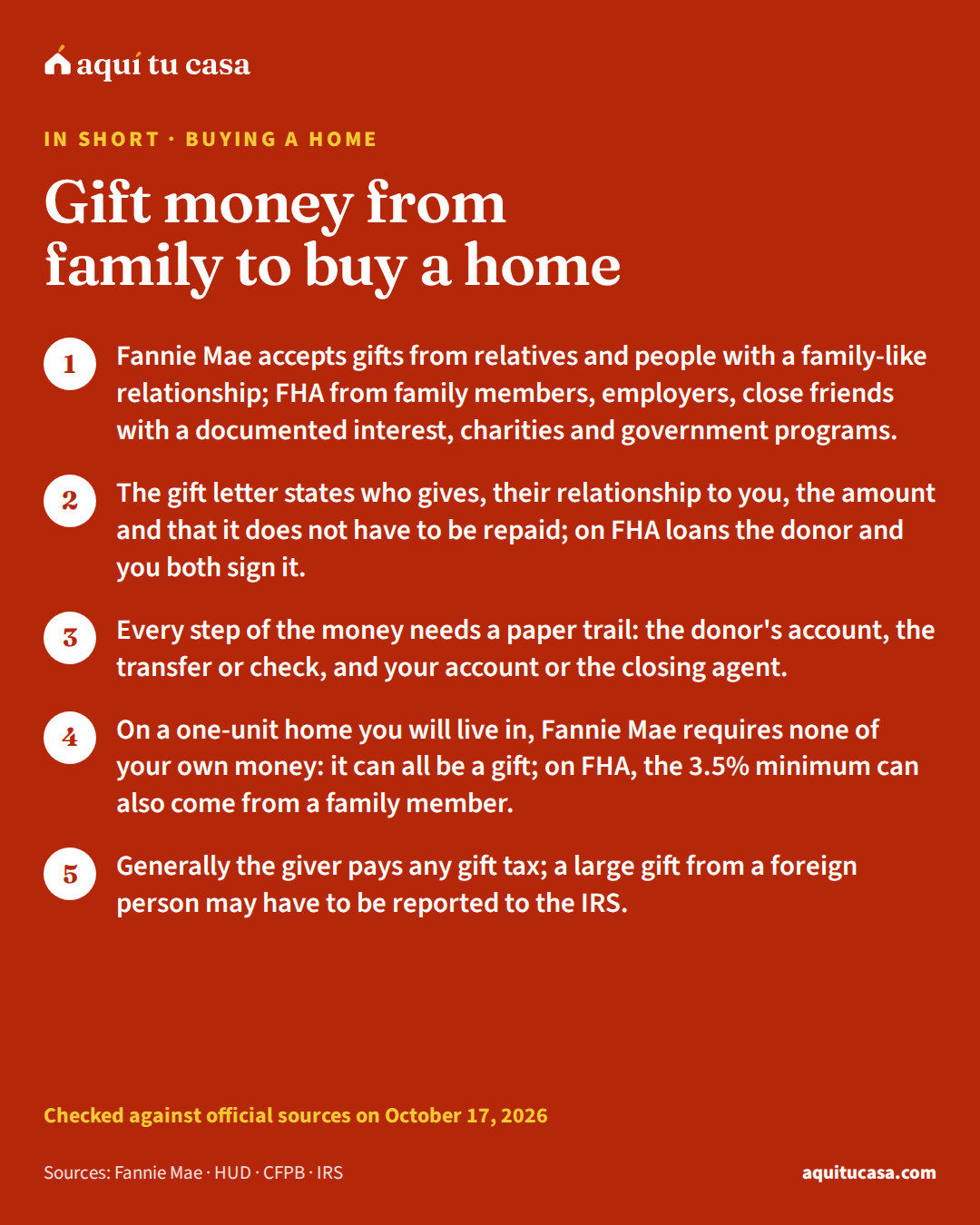
- Buying a home Gift money from family to buy a home Who can give you money for the down payment, what the gift letter must say, how the transfer is documented and what happens with taxes. 11 minute read
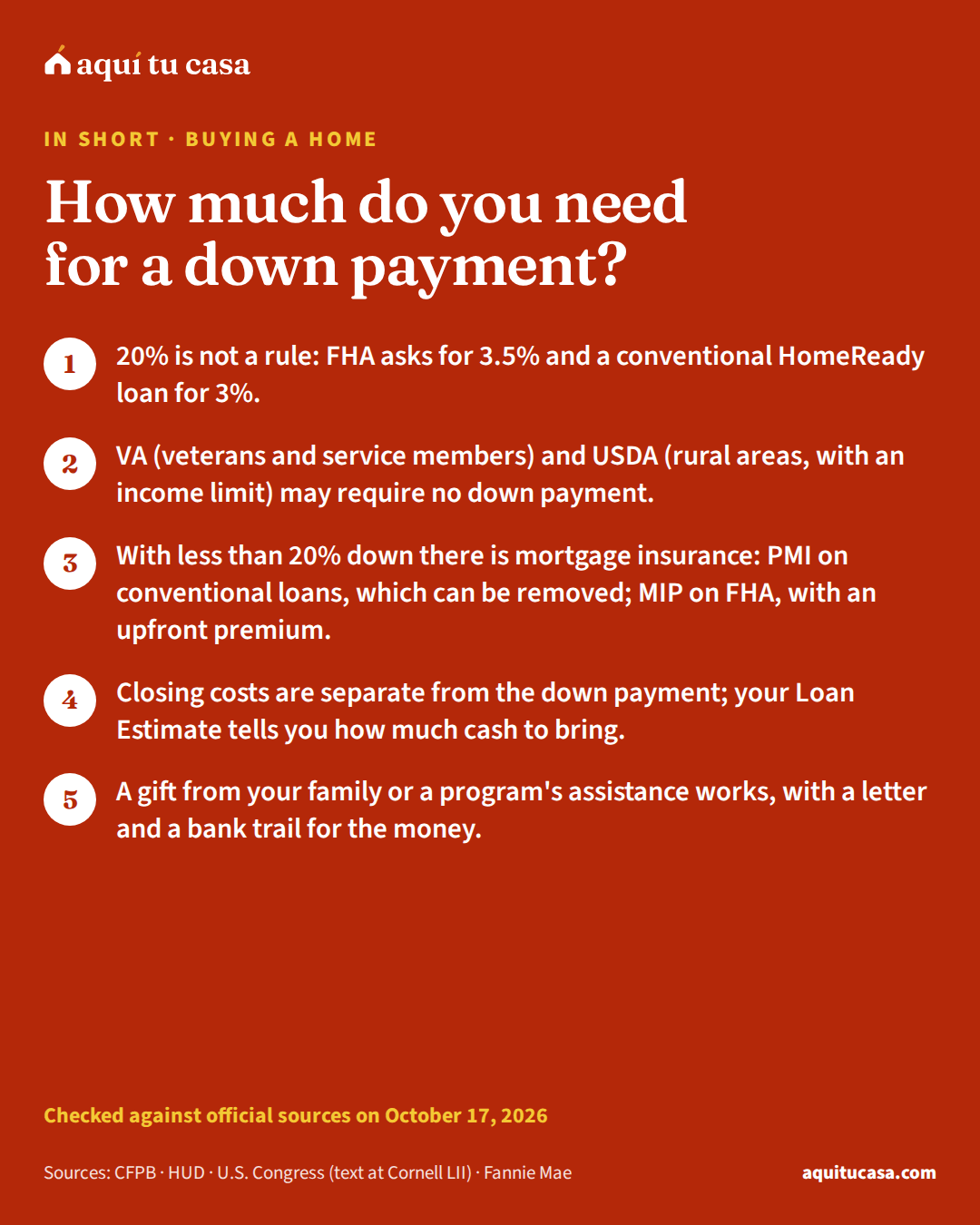
- Buying a home How much do you need for a down payment? 20% is not required: what each loan asks for (FHA, conventional, VA, USDA), what changes with less than 20% down, and where the money can come from. 11 minute read
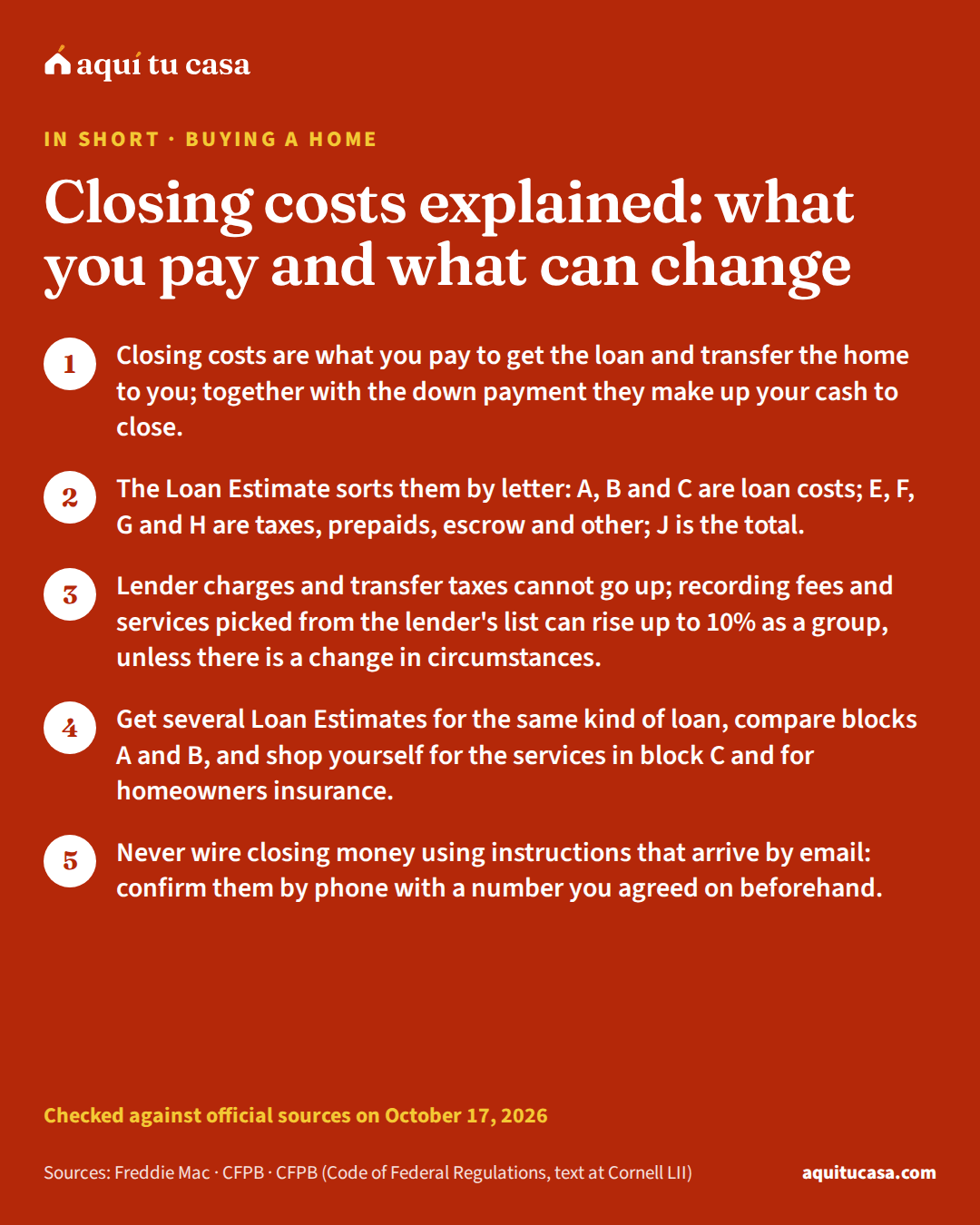
- Buying a home Closing costs explained: what you pay and what can change What closing costs are, how to read them on your Loan Estimate, which charges cannot go up before closing and how to compare offers to pay less. 14 minute read
Tools for this topic
Was this guide useful?
Thank you. Your answer stays in your browser; nothing is sent.