Green card holders and mortgages: what lenders ask for
With a green card you get the same mortgages as a citizen: what FHA, Fannie Mae and USDA say, the papers you need and what to check if your card expires.
Verified against official sources on October 17, 2026 26 official sources

Show contents
In short
What you need to know
Quick answer
Yes: with permanent residence (a green card) you can apply for the same mortgages as a citizen. HUD says a permanent resident may be eligible for FHA under the same requirements, terms and conditions as a citizen; Fannie Mae buys loans from permanent residents on the same terms; and for USDA a permanent resident is a "qualified alien." What changes is the paperwork: the lender must have evidence of your permanent residence, so it helps to have your card current and in order before you apply.
What matters most
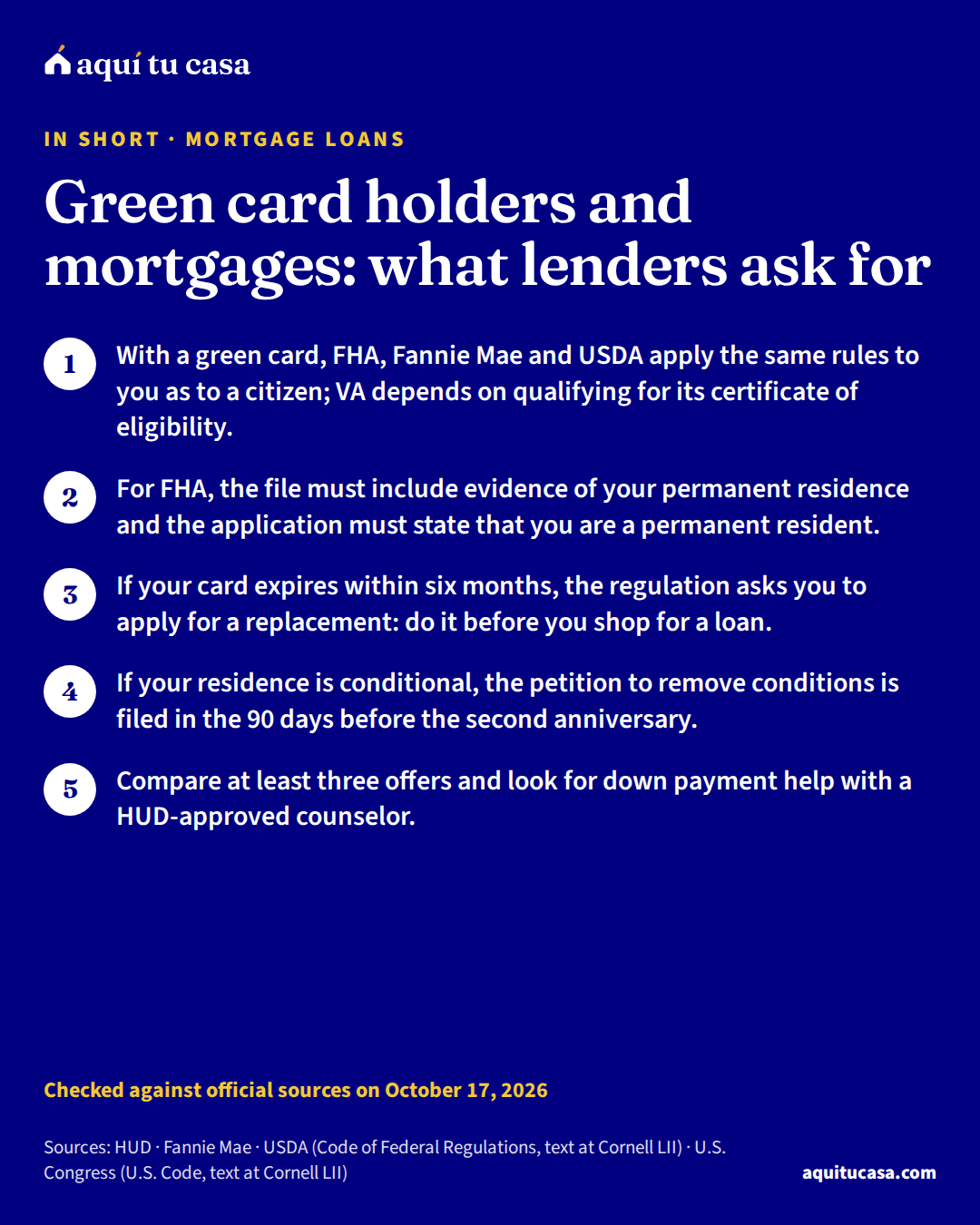
- With a green card, FHA, Fannie Mae and USDA apply the same rules to you as to a citizen; VA depends on qualifying for its certificate of eligibility.
- For FHA, the file must include evidence of your permanent residence and the application must state that you are a permanent resident.
- If your card expires within six months, the regulation asks you to apply for a replacement: do it before you shop for a loan.
- If your residence is conditional, the petition to remove conditions is filed in the 90 days before the second anniversary.
Is this for you?
This guide is for you if…
- You are a permanent resident (you have a green card) and want to know which mortgages you can apply for.
- Your card expires soon or is a conditional residence card, and you want to know what to check before applying.
- You are buying with relatives who have a different status and want to understand what the application looks like.
Get direct help first if…
- You have TPS, parole, DACA or only a work permit: start with the guides for those situations.
- Your question is about your immigration case (renewing, removing conditions, becoming a citizen): you can ask a representative accredited by the Department of Justice or an immigration lawyer.
If you have permanent residence (a green card), the short answer is good news: mortgage rules treat you like a citizen. This guide explains what FHA, Fannie Mae, USDA and VA say, which documents the lender will review and what is worth sorting out before you apply, especially if your card is about to expire or your residence is conditional.
- As a citizen, for a permanent resident at FHA and Fannie Mae
- Same terms1
- FHA minimum down payment with a credit score of 580 or more
- 3.5%2
- Before your card expires, when the regulation asks you to apply for a replacement
- 6 months13
- Before the second anniversary, to ask for the conditions on a conditional residence to be removed
- 90 days14
The rule: the same terms as a citizen
The rules of the major programs say it in similar words:
- FHA. HUD says a borrower with lawful permanent resident status may be eligible for an FHA loanFHA loanAn FHA loan is a mortgage made by a private lender and insured by the Federal Housing Administration (FHA), an agency of the U.S. government. That insurance protects the lender if you stop paying, which is why the lender can accept a lower down payment and a less-than-perfect credit history than on a conventional loan. Federal law sets the minimum cash investment at 3.5% of the property's value and caps the loan amount at the FHA limit, which changes by county. In exchange for the insurance you pay a mortgage insurance premium.See the full definition if they meet the same requirements, terms and conditions as a citizen. The current rule applies to case numbers assigned from May 25, 2025.1 FHA’s handbook, revised in August 2026, keeps it.2
- Reverse mortgages. The same HUD letter applies to FHA’s HECM reverse mortgages; the reverse mortgage guide explains how they work.1
- Fannie Mae. For conventional loansconventional loanA conventional loan is any mortgage that is not insured or guaranteed by the federal government: it is not FHA, VA or USDA. The lender, or the companies that buy the loans (Fannie Mae and Freddie Mac), carry the risk. When the amount is within the conforming loan limit the loan is called "conforming"; above it, it is a "jumbo" loan. It usually asks for a higher credit score than an FHA loan and, if your down payment is less than 20% of the price, you are normally required to buy private mortgage insurance (PMI) until you build enough equity in the home.See the full definition, Fannie Mae buys mortgages from lawful permanent residents on the same terms as citizens.3
- USDA. The guaranteed USDA loanUSDA loanA USDA loan is a mortgage from the Rural Housing Service, part of the U.S. Department of Agriculture (USDA). It is meant for low- and moderate-income families buying a home in an area the USDA considers rural, and it can be offered with no down payment. There are two paths: the USDA guarantees a loan made by a private lender, or it lends directly to very-low-income families. To qualify, your income must be within the limit for your area and the home must be in an eligible area, which you can check on the USDA's map.See the full definition requires being a citizen, a national or a qualified alienqualified alien"Qualified alien" is a term in a federal law, 8 U.S.C. 1641, used to decide who may apply for or receive certain federal public benefits. The law defines it with a list of categories. They include lawful permanent residents, people granted asylum, refugees, certain people paroled into the country for at least one year, people whose deportation is being withheld, Cuban and Haitian entrants and, in certain cases, people subjected to battery or extreme cruelty. The same law has exceptions and other conditions, so the definition alone does not say whether a person can receive a benefit.See the full definition,7 and the first category on that list in the law is a person admitted as a permanent resident.8
That does not mean approval is guaranteed: as with a citizen, they will review your income, credit, debts and down payment.5 But your status does not close any of these programs to you.

Which documents you will be asked for
For FHA, HUD is specific: the file must include evidence of your permanent residence and the uniform loan application (URLA) must indicate that you are a permanent resident. HUD adds that USCIS provides the evidence of that status and that a Social Security card is not enough to prove immigration status.1 The document the registration regulation identifies for a permanent resident is Form I-551, the Permanent Resident Card.12
The URLA is Fannie Mae Form 1003 (or Freddie Mac Form 65).1 The CFPB suggests starting to fill it out before you talk to lenders: it is commonly used and, even if your lender asks for other things, it is a good starting point to know which information you will need.17 When you complete it with the lender, check that the application says you are a permanent resident: for FHA, HUD requires it to say so.
Fannie Mae does not set a list: the lender decides with the documentation it deems appropriate and must confirm your identity before extending credit.34 Each borrower also needs a valid Social Security number or an ITIN.4 As a permanent resident, Social Security can assign you a number.15
Before you apply
1. Check the date on your card
Today
The regulation asks you to apply for a replacement when the card will expire within six months, or if it was lost or your name changed.13
2. Gather your income papers
The first week
Tax returns, W-2s, a pay stub, bank statements, proof of identity and your Social Security number.17
Try it with your numbersDocument checklist3. Look for down payment help
Before you choose a loan
Many states and local organizations help first-time buyers.21
Try it with your numbersWhich programs might I qualify for?4. Request at least three Loan Estimates
They arrive no later than 3 business days after you apply
Compare the rate, the APR, the down payment and the closing costs.23
Try it with your numbersCompare loans
If your card expires soon or is being replaced
The regulation asks a permanent resident to apply for a replacement card when it was lost, stolen or destroyed; when it will expire within six months; and when their name or other information has legally changed.13 If you are about to apply for a loan, check the date before you start.
What does a lender do if your card is expired or being replaced? The rules do not give a list. HUD asks for “evidence” of permanent residence and says USCIS provides it;1 Fannie Mae lets each lender decide with the documentation it deems appropriate.3 So the concrete question is for each lender: “Which evidence of permanent residence do you accept if my card is expired or being replaced?”

Your income, your taxes and your credit
Fannie Mae requires your income to be stable, have a documented history and be reasonably expected to continue. Noncitizens face the same employment and income verification as citizens, whatever the source of income.5 If you are self-employed, the buying a home when self-employed guide explains which papers to gather.
For taxes, the IRS says that if you are a lawful permanent resident at any time during the calendar year, you are a resident for federal tax purposes, and you remain one unless you renounce in writing or USCIS or a federal court terminates your status.16 The CFPB recommends gathering, before you talk to lenders, your signed federal tax returnstax returnA tax return is the yearly form you use to report your income to the IRS and figure the tax you owe, so you can pay what is due or get a refund. The federal return for individuals is Form 1040. In general you must file if your gross income is above the minimum the IRS sets for your filing status, or if you had a certain amount of net earnings from self-employment; even when you do not have to, filing can pay off. You need your SSN or ITIN, and those of everyone else on the return, plus documents such as your W-2s and 1099s.See the full definition for the last two years, your W-2s, your most recent pay stub, documentation of other income, your bank statements, the source of your down payment and proof of identity.17 If you earn part of your income in cash or from several jobs, start collecting proof for each source now: Fannie Mae’s rule asks for a documented history of each income you want to use to qualify.5
For FHA, your credit scorecredit scoreA credit score is a number that predicts how likely you are to pay back a loan on time. It is computed from the information in your credit report: whether you pay on time, how much you owe relative to your limits, how long you have used credit and how many new accounts you opened. FICO is one brand of score; VantageScore is another, and each lender decides which one it uses. A higher score usually brings a lower interest rate and more loan options; each program publishes the minimum it accepts. You can check your report for free and dispute errors.See the full definition changes what you can get: with 580 or more you can get maximum financing, with 500 to 579 the loan is limited to 90% of the value, and below 500 you are not eligible.2 The credit from zero guide explains how to build it if you are starting out.
All programs, including USDA and VA
As a permanent resident, you can look at every program and choose the one that suits you best:
Four paths and what each one asks for
Low down payment
FHA
Same terms
Conventional (Fannie Mae)
Request a Loan Estimate for each path you are interested in and compare the total cost.23
If you are a servicemember or veteran, the CFPB says you need the VA certificate of eligibility to go that route;17 the VA home loan guide explains how to request it. For USDA, first check whether the home you want is in an area USDA designates as rural.10
If you are a first-time buyer, many states and local organizations help with the down payment or closing costs; the CFPB suggests finding them through a HUD-approved counseling agency or the HOPE Hotline, (888) 995-4673.21 The down payment assistance guide explains how they work, and each program sets its own eligibility rules.
Example with real numbers
Cash to close on a typical home with FHA
With the typical US home value, the FHA minimum down payment and Freddie Mac's closing cost range.
- Home price (typical US value)
- $332,700
- FHA minimum down payment (3.5%)
- $11,645
- Closing costs (2% to 5% of the price)
- $6,654 to $16,635
- Cash to close, before credits
- $18,299 to $28,280
This is an example with national numbers.224 Your real numbers are on your Loan Estimate.
Run it with your numbersClosing costsWhat a lender may ask you
Regulation B allows the lender to ask about your permanent residency and immigration status, and those of anyone else on the application,18 and to take them into account.19 What the law prohibits is discrimination based on race, color, religion, national origin, sex, marital status or age in any part of the loan.20 If you think you were given worse terms because of where you come from, the housing discrimination guide explains where to complain.

If this is you
You are buying with relatives who have a different status
The lender may ask about the status of each person on the application,18 and at Fannie Mae each borrower needs an SSN or ITIN.4 See the buying with family guide.
You run your own business
Your income must be stable and documented, the same as a citizen's.5
You served in the Armed Forces
If you qualify for the certificate of eligibility, a VA loan often requires no down payment.11 See the VA home loan guide.
You are a first-time buyer
Look for down payment help with a HUD-approved counselor.21
Costly mistakes
Mistake: Thinking you must be a citizen to get an FHA loan.
Instead: A permanent resident may be eligible on the same terms as a citizen.1
Mistake: Bringing only your Social Security card as proof of status.
Instead: HUD says it is not enough: bring your Permanent Resident Card.112
Mistake: Applying with a card that expires in a few months without requesting a replacement.
Instead: Apply for the replacement when it will expire within six months, as the regulation says.13
Mistake: Forgetting the date to remove the conditions on a conditional residence.
Instead: Write down the 90 days before the second anniversary.14
Mistake: Taking the first offer.
Instead: The CFPB recommends contacting at least three lenders.22

What to do this week
- Check the date on your Permanent Resident Card; if it expires within six months, start the replacement.13
- Gather your tax returns, pay stubs and bank statements with the document checklist.5
- Look for assistance programs in which programs do I qualify for or with a HUD-approved housing counselorHUD-approved housing counselorA HUD-approved housing counselor works at an agency HUD has approved to provide housing counseling: independent, expert advice customized to your situation about buying a home, renting, a missed mortgage payment, a foreclosure or credit problems. The agencies usually charge little or nothing; many serve in Spanish and offer the homebuyer education course several assistance programs require. They are not lenders or real estate agents and sell you nothing. Your county page lists the official agencies with phone numbers.See the full definition, whose advice is often free.2125
- Request a Loan EstimateLoan EstimateThe Loan Estimate is a three-page form you receive from the lender within days of applying for a mortgage. In the same format at every bank, it sums up the terms of the loan being offered: amount, interest rate, whether the payment can change, the estimated monthly payment with taxes and insurance, the itemized closing costs and how much cash you need at closing. Because every lender uses the same form, it lets you compare offers side by side. It commits you to nothing: requesting one is not accepting the loan.See the full definition from at least three lenders and compare them in compare loans.2223
- Try your numbers in how much house can I afford; for FHA, the minimum down paymentdown paymentThe down payment is the part of the home's price you pay out of your own pocket when you buy; the loan covers the rest. In U.S. Spanish it is also called enganche, cuota inicial or entrada. Each loan type has its own minimum: FHA requires at least 3.5% of the value, VA and USDA loans may require none, and conventional loans ask for more if you want to avoid private mortgage insurance. A larger down payment lowers the loan, the monthly payment and the total interest; many state programs help families put it together.See the full definition is 3.5% with a score of 580 or more.2
Your numbers
The minimum for this loan is 3.5%. More down lowers the monthly payment.
Adjust advanced details
First number: share of income for housing. Second: housing plus debts. Lender references, not fixed rules.
Let's do the math
Estimated top price
National figure$227,000
Limited by the housing payment: at that price it would be about $1,883 a month, 28% of your income.
- By the housing payment (28% of income)Limits you$227,000
- By your total debts (36% of income)$292,000
- By your cash (down payment + closing)$330,500
- Typical home in the United States
- $332,700
- Your cap is 68% of the typical home.
What changes if…?
- …you save $10,000 more$227,000
- …you cut $200 a month in debts$227,000
Your maximum price with four loans
Same income, debts and savings; only the down payment and the loan type change. ITIN uses an example down payment and rate.
| FHA 3.5% | Conventional 5% | Conventional 20% | ITIN 15% (example) | |
|---|---|---|---|---|
| Maximum price | $227,000 | $232,000 | $93,000 | $119,000 |
| Payment per month | $1,883 | $1,882 | $616 | $898 |
Educational estimate, not a pre-approval. Uses example insurance (0.5% of value per year) and example closing costs (3% of price); the tax is the place’s typical rate.
Ready to see the numbers? Find your county here
See how this applies in your county: its loan limits, prices and rents, from the official data.
Printable checklist
Frequently asked questions
Can I get an FHA loan with a green card?
Yes. HUD says a borrower with lawful permanent resident status may be eligible for FHA under the same requirements, terms and conditions as a citizen. The file must include evidence of your permanent residence, and a Social Security card alone is not enough to prove status.
Do I need a bigger down payment because I am not a citizen?
Under FHA and Fannie Mae rules, no: the same terms apply as for a citizen. The FHA minimum down payment is 3.5% with a score of 580 or more, and Fannie Mae's HomeReady can start at 3% if you meet the income limit. Each lender may have its own additional requirements: compare.
My green card expires soon. Can I apply for the loan?
The regulation asks you to apply for a replacement card when it will expire within six months. HUD requires evidence of your permanent residence and Fannie Mae leaves it to the lender to decide which documents it accepts. Ask each lender which evidence it accepts if your card is about to expire or is being replaced.
I have a two-year conditional green card. Does it count?
The law says that residence is obtained on a conditional basis and that the petition to remove the conditions is filed in the 90 days before the second anniversary; if it is not filed, residence ends on that date. Ask each lender how it treats a conditional card, and for questions about your case talk to an accredited representative or a lawyer.
Can I use a USDA or VA loan?
For USDA, a permanent resident is a 'qualified alien,' so the status rule is met; the home must be in an area USDA designates as rural. A VA loan depends on qualifying for its Certificate of Eligibility (COE), and it often requires no down payment.
Can the lender ask about my status?
Yes. Regulation B allows a lender to ask about your permanent residency and immigration status, and to take them into account. What it may not do is discriminate against you because of your national origin.
How do I file taxes as a permanent resident?
According to the IRS, if you are a lawful permanent resident at any time during the year, you are a resident for federal tax purposes. The CFPB recommends having your signed federal tax returns for the last two years on hand before you talk to lenders.
Sources
Every figure in this guide comes from one of these official sources. The number next to a sentence leads to the source behind it.
Each source on one line: who publishes it, its title, its address and the date we read it.
- 1. HUD · HUD Mortgagee Letter 2025-09, Revisions to Residency Requirements · hud.gov · Accessed October 17, 2026
- 2. HUD · FHA Single Family Housing Policy Handbook 4000.1 · hud.gov · Accessed October 17, 2026
- 3. Fannie Mae · Fannie Mae Selling Guide B2-2-02, Non-U.S. Citizen Borrower Eligibility Requirements · selling-guide.fanniemae.com · Accessed October 17, 2026
- 4. Fannie Mae · Fannie Mae Selling Guide B2-2-01, General Borrower Eligibility Requirements · selling-guide.fanniemae.com · Accessed October 17, 2026
- 5. Fannie Mae · Fannie Mae Selling Guide B3-3.1-01, General Income Information · selling-guide.fanniemae.com · Accessed October 17, 2026
- 6. Fannie Mae · Fannie Mae Selling Guide B5-6-01, HomeReady Mortgage Loan and Borrower Eligibility · selling-guide.fanniemae.com · Accessed October 17, 2026
- 7. USDA (Code of Federal Regulations, text at Cornell LII) · 7 CFR §3555.151, Eligibility requirements (Single Family Housing Guaranteed Loan Program) · law.cornell.edu · Accessed October 17, 2026
- 8. U.S. Congress (U.S. Code, text at Cornell LII) · 8 U.S.C. §1641, Definitions (qualified alien) · law.cornell.edu · Accessed October 17, 2026
See the other 18 sources
- 9. USDA (Code of Federal Regulations, text at Cornell LII) · 7 CFR §3555.103, Maximum loan amount · law.cornell.edu · Accessed October 17, 2026
- 10. USDA (Code of Federal Regulations, text at Cornell LII) · 7 CFR §3555.201, Site requirements · law.cornell.edu · Accessed October 17, 2026
- 11. U.S. Department of Veterans Affairs · Purchase loan · va.gov · Accessed October 17, 2026
- 12. Department of Homeland Security (Code of Federal Regulations, text at Cornell LII) · 8 CFR §264.1, Registration and fingerprinting · law.cornell.edu · Accessed October 17, 2026
- 13. Department of Homeland Security (Code of Federal Regulations, text at Cornell LII) · 8 CFR §264.5, Application for a replacement Permanent Resident Card · law.cornell.edu · Accessed October 17, 2026
- 14. U.S. Congress (U.S. Code, text at Cornell LII) · 8 U.S.C. §1186a, Conditional permanent resident status for certain alien spouses and sons and daughters · law.cornell.edu · Accessed October 17, 2026
- 15. Social Security Administration (Code of Federal Regulations, text at Cornell LII) · 20 CFR §422.104, Who can be assigned a social security number · law.cornell.edu · Accessed October 17, 2026
- 16. IRS · U.S. tax residency - Green card test · irs.gov · Accessed October 17, 2026
- 17. CFPB · Create a loan application packet · consumerfinance.gov · Accessed October 17, 2026
- 18. CFPB (Code of Federal Regulations, text at Cornell LII) · Regulation B, 12 CFR §1002.5, Rules concerning requests for information · law.cornell.edu · Accessed October 17, 2026
- 19. CFPB (Code of Federal Regulations, text at Cornell LII) · Regulation B, 12 CFR §1002.6, Rules concerning evaluation of applications · law.cornell.edu · Accessed October 17, 2026
- 20. U.S. Congress (U.S. Code, text at Cornell LII) · Equal Credit Opportunity Act, 15 U.S.C. §1691, Scope of prohibition · law.cornell.edu · Accessed October 17, 2026
- 21. CFPB · Where can I find information on programs for first-time home buyers? · consumerfinance.gov · Accessed October 17, 2026
- 22. CFPB · Contact multiple lenders · consumerfinance.gov · Accessed October 17, 2026
- 23. CFPB · What is a Loan Estimate? · consumerfinance.gov · Accessed October 17, 2026
- 24. Freddie Mac · What Are Closing Costs and How Much Will I Pay? · myhome.freddiemac.com · Accessed October 17, 2026
- 25. CFPB · Find a Housing Counselor · consumerfinance.gov · Accessed October 17, 2026
- 26. U.S. Department of Justice (EOIR) · Can Someone Represent You Before EOIR? · justice.gov · Accessed October 17, 2026
Keep reading
Related guides
If this guide helped, these follow the same path.

Mortgage loans 11 minute read
DACA and mortgages: what FHA, Fannie Mae and USDA say today
If you have DACA and want to buy a home: what FHA, Fannie Mae and USDA rules say today, what a lender may ask you and how to compare offers.
- Since case numbers assigned May 25, 2025, FHA only accepts citizens, permanent residents and citizens of Micronesia, the Marshall Islands and Palau: DACA was left out.
- Fannie Mae buys loans from lawful non-permanent residents on the same terms as citizens, but each lender decides which documents it accepts.
- USDA requires being a citizen, a national or a 'qualified alien' under 8 U.S.C. §1641; check the list before assuming anything.
- Mortgage loans TPS, parole and work permits: which mortgages are open If you have TPS, parole or a work permit (EAD): what FHA, Fannie Mae and USDA say today, what documents a lender checks and how to compare offers. 10 minute read
- Mortgage loans Mortgage loan types: FHA, conventional, VA and USDA What each mortgage type asks for, what its insurance costs, fixed or adjustable rate, points and APR. A neutral comparison with official sources. 14 minute read
- Buying a home How much do you need for a down payment? 20% is not required: what each loan asks for (FHA, conventional, VA, USDA), what changes with less than 20% down, and where the money can come from. 11 minute read
Tools for this topic
Was this guide useful?
Thank you. Your answer stays in your browser; nothing is sent.