Housing discrimination: how to file a complaint
What the Fair Housing Act prohibits when you rent, how national origin and children are covered, and how to file with HUD or your state on time.
Verified against official sources on October 17, 2026 23 official sources

Show contents
In short
What you need to know
Quick answer
The Fair Housing Act prohibits a landlord from refusing to rent to you, giving you different conditions, lying about whether a home is available or publishing ads with preferences because of your race, color, religion, sex, familial status, national origin or disability. You can file a complaint with HUD, online or at 1-800-669-9777, no later than one year after it happened, or sue in court within 2 years. Many states and cities have their own agency, and some protect more, such as immigration status or language. Retaliating against you for complaining is also illegal.
What matters most
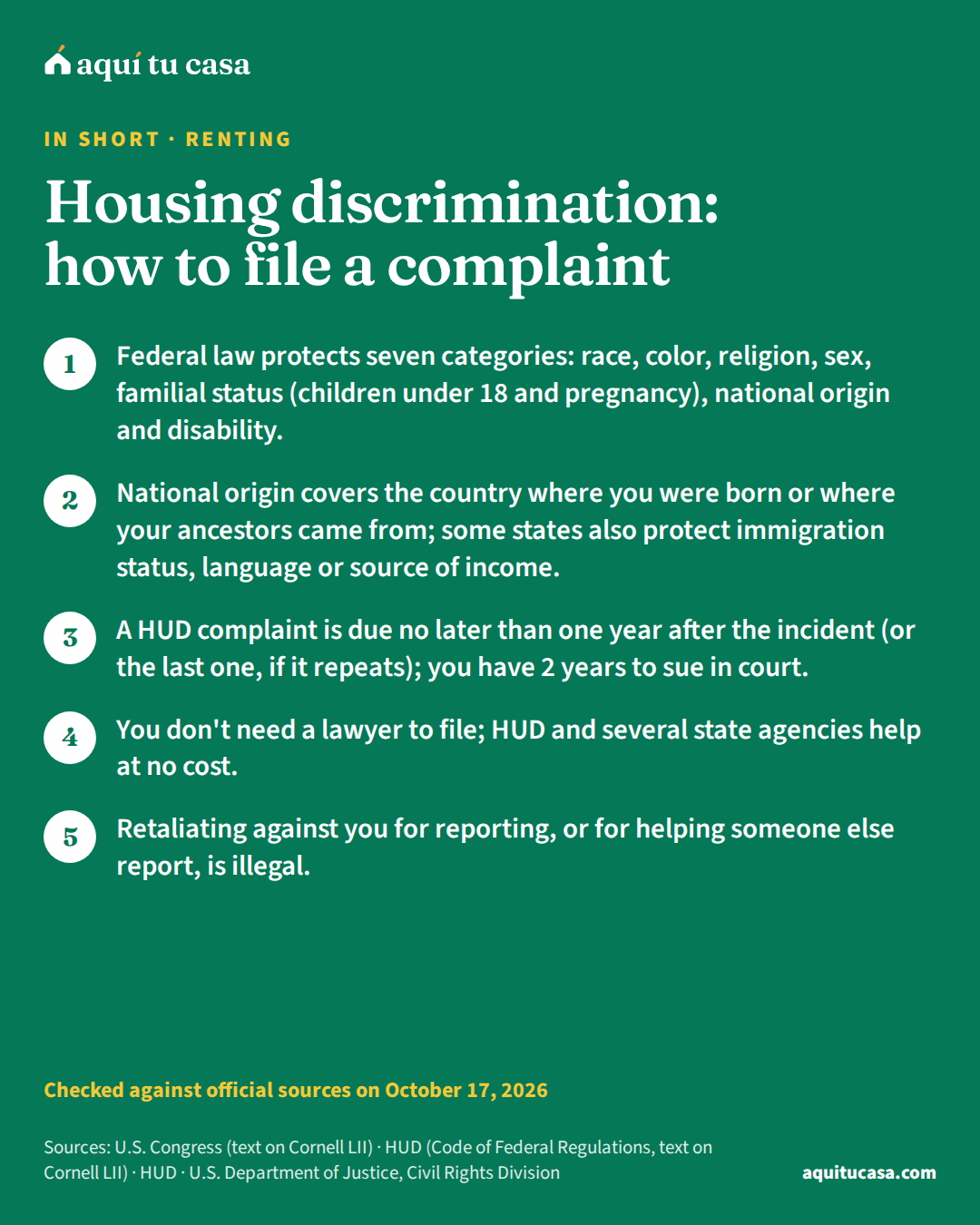
- Federal law protects seven categories: race, color, religion, sex, familial status (children under 18 and pregnancy), national origin and disability.
- National origin covers the country where you were born or where your ancestors came from; some states also protect immigration status, language or source of income.
- A HUD complaint is due no later than one year after the incident (or the last one, if it repeats); you have 2 years to sue in court.
- You don't need a lawyer to file; HUD and several state agencies help at no cost.
Is this for you?
This guide is for you if…
- You were turned down for a home, given different rules or treated differently, and you think it was because of your national origin, your family, your religion, your sex, your color or a disability.
- You saw an ad that says no children or that prefers a certain kind of tenant.
- You want to know where and by when you can file a complaint, and whether you need a lawyer.
Get direct help first if…
- Your problem is a repair or a rent increase that affects all tenants equally: start with the guide on repairs and housing conditions.
- Your landlord changed the locks or cut off utilities: read the guide on illegal lockouts and call legal aid today.
- You have questions about your immigration case: this guide does not answer them; a Justice Department accredited representative or a legal aid office can guide you.
“It’s already rented,” even though the ad is still up. “We don’t take children here.” “For you, the deposit is double.” Many Latino families hear lines like these and don’t know whether they are illegal or who to tell. This guide explains what the Fair Housing ActFair Housing ActThe Fair Housing Act is the federal law that makes it illegal to refuse to sell or rent a dwelling, or to discriminate in its terms, because of race, color, religion, sex, familial status (having children), national origin or disability. It applies to landlords, real estate agents and managers, and also to banks and lenders when their practices make housing or credit unavailable for those reasons. National origin covers your language and the country you come from, regardless of immigration status. If you believe you were discriminated against, you can file a complaint with HUD at no cost; many states add protections.See the full definition prohibits when you rent, how national origin, language and immigration status fit in, and how to file a complaint with HUD, your state or the courts before the deadline. What each state says varies; we use federal law and a few states as examples.
What the Fair Housing Act prohibits
When a home is for rent, federal law makes it illegal to refuse to rent or negotiate, or to make the home “unavailable,” because of race, color, religion, sex, familial status or national origin. It also prohibits giving you different terms, conditions or services for those reasons; publishing ads that show a preference or rejection; and telling you a home is not available when it is.1 Disability is protected in the same section, which covers refusing to permit reasonable modifications (at the tenant’s expense) or to make reasonable accommodations in the rules when they are needed.1
HUD’s rule gives concrete examples: using different lease terms, such as the rent, the security depositsecurity depositA security deposit is money you pay the landlord when you start renting as security that you will follow the lease: pay the rent and take care of the home. The money still belongs to you. The landlord holds it and, when you move out, must return it minus the charges the law allows, such as past-due rent or damage beyond normal wear and tear. You should not be charged for damage that was already there when you moved in. The maximum amount and the deadline to return it depend on your state's law and sometimes your city's.See the full definition or the conditions; failing or delaying repairs; and harassment for any of those reasons.8 The CFPB sums it up: generally, a landlord cannot sexually harass you, refuse to rent to you, evict you or set different rules because of your race, color, national origin, religion, sex, familial status or disability.17
| Protected category | What it covers, according to the law or the agency |
|---|---|
| Race and color | Different treatment because of race or skin color |
| National origin | The country where you were born or where your ancestors came from |
| Religion | Different treatment because of your religion |
| Sex | Includes sexual harassment |
| Familial status | Households with children under 18, pregnancy and anyone seeking custody of a child |
| Disability | Includes reasonable accommodations and modifications |
That is what the law and the agencies say: HUD lists the seven categories,14 the Justice Department explains national origin,16 the statute defines familial status2 and the CFPB mentions sexual harassment.17 If you or your landlord receive federal housing assistance, the CFPB adds that you are also protected based on age.17
National origin, language and immigration status
For immigrant families, this is the key part. The Justice Department explains that national origin discrimination can be based on the country where you were born or where your ancestors came from.16 The CFPB says the same: “country of origin or ancestry.”17 The federal list does not separately mention language or immigration status, but some states do:
- California: the Attorney General explains that private landlords may not discriminate based on citizenship, immigration status or primary language, or on source of income, such as a Section 8 voucher. In most cases they may not ask about your immigration status, and they may never threaten to reveal it to pressure you to leave.18
- New York: in New York City, immigration status is protected, and statewide you may not be discriminated against based on your lawful source of income, including Section 8 vouchers.19
- Illinois: a landlord may ask about your immigration status only when state or federal law requires it.22
If you believe you were treated differently because of your origin, and your language or accent was part of it, describe everything in your complaint. The agency decides which law applies; you don’t have to know in advance. The tenant rights pages for California, New York and Illinois collect what we verified about immigration status questions in those states. The guide on renting without a Social Security number or credit explains what can and can’t be asked when you apply.
Signs of discrimination when renting
Discrimination rarely announces itself. These are situations the law and the agencies describe:
- You’re told nothing is available, but someone else is shown the unit.1
- You’re asked for a bigger deposit, higher rent or different rules than other tenants.8
- You’re asked for more income, more documents or better credit than other applicants.21
- You’re evicted or threatened with eviction because of your origin or your family.17
- The ad says “no kids,” “adults only” or shows a preference for a certain origin.1
- You’re given an unreasonable limit on occupants because you have children.16
- Your repairs take longer than your neighbors’ because of your origin or your family.8
- You’re harassed, sexually or because of your origin.8
About children: the law protects households with children under 18 and people who are pregnant,2 and in New York the Attorney General adds that a landlord may not require tenants to remain childless.19 There is one exception: certain housing for people 55 and older can operate as housing for older persons.16 The guide on sharing a home and occupancy limits explains how many people can live in a home and who signs.
About disability: if you need an accommodation in a rule or a physical modification, the law protects your right to ask for it.1 When you contact HUD’s fair housing office, you can also ask for disability-related accommodations and aids.15

How to report it, step by step
From what happened to a complaint
1. Write down and save everything
The same day
Date, time, who spoke and what they said. Screenshots of the ad and messages saved somewhere safe, not only on your phone.22
2. Get help if you want it
When you're ready
HUD's fair housing office can help you file; so can an organization, an individual or a lawyer.12
3. Choose where to file
Before the deadline
With HUD, online or at 1-800-669-9777, or with a certified state or local agency.14
4. File within one year
From the last incident
If it repeated or continues, the year runs from the last incident.9
5. The agency investigates
HUD notifies the respondent within 10 days
HUD must finish within 100 days unless that is impracticable, and tries conciliation between the parties.4
6. If you choose, sue in court
Up to 2 years
You can sue whether or not you filed a complaint; time spent in the HUD process doesn't count.5
HUD’s rule lists the information to provide: your name and how to reach you; who you believe discriminated against you and their address; the address and description of the home; and a brief description of what happened, with the date and why you believe it was because of race, color, religion, national origin, sex, disability or having children.11 You can file by mail or phone with a HUD fair housing office or with a state or local agency HUD has certified, and any other HUD office will help you file.10 You can even file if you know discrimination is about to happen.13
HUD, your state or the courts
You have more than one path, and sometimes they connect. If your complaint falls under a state or local agency certified by HUD, HUD must refer it to that agency before acting; HUD certifies only agencies whose laws and remedies are substantially equivalent to federal law.4
Three ways to report
Federal
Complaint to HUD
Depends on your state
State or local agency
If you're unsure, start by calling HUD or your state agency; they will tell you whether your case is theirs.
Example with real numbers
How to count the deadlines
An example under federal law. State deadlines may differ.
- The landlord turns you down
- The day it happens
- If it repeats or the discrimination continues
- The deadline runs from the last incident9
- Complaint to HUD
- Up to one year later4
- Lawsuit in court
- Up to 2 years, not counting the time your complaint is being processed5
Don't wait until the last day: keep the date of the last incident and file as soon as you can.
Some examples of state agencies: in California, the Attorney General points to the state’s Civil Rights Department.18 In New York, the Division of Human Rights takes reports at (844) 697-3471, and the city’s Commission on Human Rights accepts complaints within one year.2019 In Texas, the Workforce Commission generally requires that the owner have more than three properties.21 In Illinois, immigration status discrimination can be reported to the Department of Human Rights within one year, or taken to state court within two.22
Retaliation: reporting is protected
Fear of losing your home keeps many people quiet, especially in mixed-status families. Federal law makes it illegal to coerce, intimidate, threaten or interfere with anyone exercising their fair housing rights or helping someone else exercise them.6 HUD’s rule prohibits retaliation because you filed a complaint, testified or took part in a proceeding, or because you reported discrimination to the landlord or another authority.7 In Illinois, the Department of Human Rights says the same: it is unlawful to retaliate against or intimidate anyone for reporting.22 If it happens, include it in your complaint.
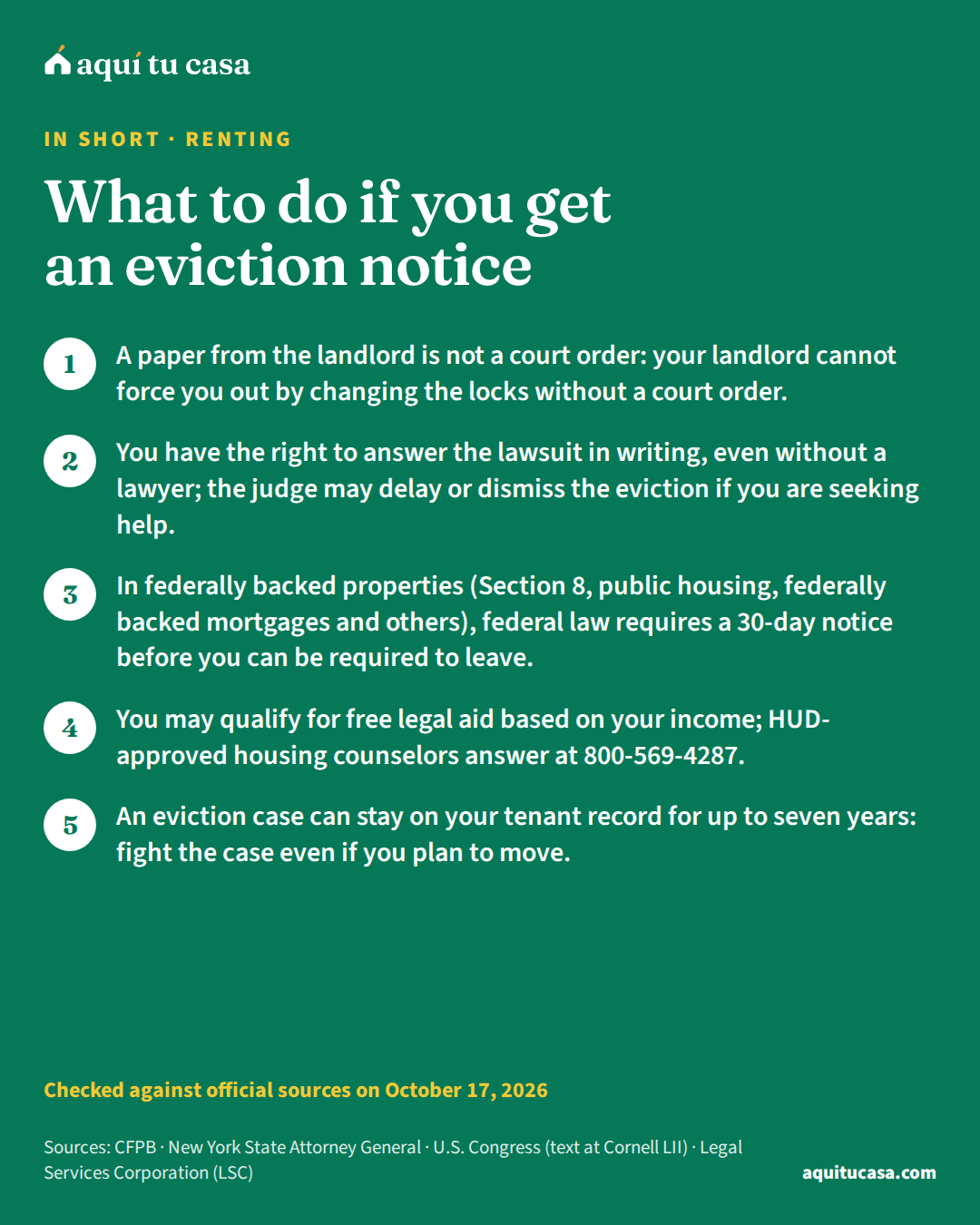
If an eviction noticeeviction noticeAn eviction notice, also called a notice to quit or notice to vacate, is the written letter in which the landlord demands that you leave the home within a certain time. In general the landlord must give you this notice before starting an eviction case in court. At a minimum it should say why the landlord wants you out and what you can do to avoid it, such as paying the back rent. Your state's law decides when it can be given, how it must be delivered and how much time you get. The notice is not a court order: with the notice alone, the landlord cannot remove you.See the full definition arrives after you complain, tell legal aid on the very first call: it may be part of the same case. The guide What to do if you get an eviction notice explains the steps, and the one on repairs and housing conditions covers how states protect tenants who ask for repairs.
If this is you
You're undocumented and afraid to report
In Illinois you can report regardless of immigration status, and an interpreter is provided.22 If sharing your information worries you, talk first with an accredited representative or legal aid.
You're turned down for your children or pregnancy
Familial status is protected: children under 18, pregnancy and anyone seeking custody.2
You need a disability accommodation
Refusing a reasonable accommodation in the rules can be discrimination.1 HUD provides accommodations and aids when it serves you.15
You're turned down for your Section 8 voucher
Federal law doesn't list it, but California and New York protect source of income, including vouchers.18 Ask your state agency.
Costly mistakes
Mistake: Waiting to see if it goes away.
Instead: The HUD deadline is one year from the last incident; file as soon as you can.9
Mistake: Not saving the ad or the messages.
Instead: Take screenshots right away and save messages somewhere safe.22
Mistake: Believing you have to pay a lawyer to report.
Instead: HUD can help you file, and in New York reporting is free and no lawyer is needed.20
Mistake: Filing the same complaint in Texas with both TWC and HUD.
Instead: TWC warns that it can't be filed with both; choose one.21
Mistake: Staying quiet for fear of retaliation.
Instead: Retaliating because you reported is illegal, and you can include it in the complaint.7

What to do this week
- Write down what happened, with dates, and save screenshots of the ad and the messages.22
- Note the date of the last incident and count one year from there.9
- Call HUD at 1-800-669-9777 or your state’s civil rights agency.14
- If you’d like guidance, look for free legal aid near you with the Legal Services Corporation’s search; the guide to free legal aid explains who qualifies.23
- If your landlord threatens you after you complain, write it down and add it to your complaint.6
Ready to see the numbers? Find your county here
See how this applies in your county: its loan limits, prices and rents, from the official data.
Printable checklist
Frequently asked questions
Can a landlord turn me down for having children?
Generally, no. The Fair Housing Act protects familial status: households with children under 18 and people who are pregnant. The Justice Department explains that landlords also cannot impose special conditions on families with children, such as an unreasonable limit on the number of occupants. There is an exception for certain housing for people 55 and older.
Can I be discriminated against for my accent or for not speaking English?
The federal list protects national origin, which can be based on the country where you were born or where your ancestors came from. Some states go further: California also protects primary language. If you believe you were treated differently because of your origin, describe everything in your complaint; the agency decides.
Can a landlord ask about my immigration status?
The Fair Housing Act does not include immigration status in its list, but some states do limit it. In California, in most cases landlords may not ask; in Illinois, only when state or federal law requires it; in New York City, immigration status is protected against discrimination. If your immigration case worries you, talk with an accredited representative or legal aid.
How long do I have to report?
With HUD, no later than one year after the discrimination happened or ended; if it repeated or continues, one year from the last incident. To sue in court, 2 years, not counting the time your complaint was being processed. State agencies set their own deadlines: in Texas, one year.
Do I need a lawyer to file a complaint?
No. HUD's fair housing office can help you file, and you can ask an organization, an individual or a lawyer for help. In New York and Illinois, the state agencies say reporting is free and no lawyer is needed.
Can I report if I'm undocumented?
The Illinois Department of Human Rights says anyone can report discrimination in that state regardless of immigration status, including undocumented people, and that it provides interpreters. HUD asks for your name, address and phone numbers to reach you. If sharing your information worries you, talk first with an accredited representative or legal aid.
What if the landlord retaliates because I complained?
That is illegal. The Fair Housing Act prohibits intimidating, threatening or interfering with anyone exercising their rights, and HUD's rule prohibits retaliation for filing a complaint or reporting discrimination to the landlord or another authority. You can include the retaliation in your complaint.
Sources
Every figure in this guide comes from one of these official sources. The number next to a sentence leads to the source behind it.
Each source on one line: who publishes it, its title, its address and the date we read it.
- 1. U.S. Congress (text on Cornell LII) · Fair Housing Act, 42 U.S.C. §3604, Discrimination in the sale or rental of housing and other prohibited practices · law.cornell.edu · Accessed October 17, 2026
- 2. U.S. Congress (text on Cornell LII) · Fair Housing Act, 42 U.S.C. §3602, Definitions · law.cornell.edu · Accessed October 17, 2026
- 3. U.S. Congress (text on Cornell LII) · Fair Housing Act, 42 U.S.C. §3603, Effective dates of certain prohibitions (exemptions) · law.cornell.edu · Accessed October 17, 2026
- 4. U.S. Congress (text on Cornell LII) · Fair Housing Act, 42 U.S.C. §3610, Administrative enforcement; preliminary matters · law.cornell.edu · Accessed October 17, 2026
- 5. U.S. Congress (text on Cornell LII) · Fair Housing Act, 42 U.S.C. §3613, Enforcement by private persons · law.cornell.edu · Accessed October 17, 2026
- 6. U.S. Congress (text on Cornell LII) · Fair Housing Act, 42 U.S.C. §3617, Interference, coercion, or intimidation · law.cornell.edu · Accessed October 17, 2026
- 7. HUD (Code of Federal Regulations, text on Cornell LII) · 24 CFR §100.400, Prohibited interference, coercion or intimidation · law.cornell.edu · Accessed October 17, 2026
- 8. HUD (Code of Federal Regulations, text on Cornell LII) · 24 CFR §100.65, Discrimination in terms, conditions and privileges and in services and facilities · law.cornell.edu · Accessed October 17, 2026
See the other 15 sources
- 9. HUD (Code of Federal Regulations, text on Cornell LII) · 24 CFR §103.35, Is there a time limit on when I can file? · law.cornell.edu · Accessed October 17, 2026
- 10. HUD (Code of Federal Regulations, text on Cornell LII) · 24 CFR §103.30, How should I bring a claim that I am the victim of discrimination? · law.cornell.edu · Accessed October 17, 2026
- 11. HUD (Code of Federal Regulations, text on Cornell LII) · 24 CFR §103.25, What information should I provide to HUD? · law.cornell.edu · Accessed October 17, 2026
- 12. HUD (Code of Federal Regulations, text on Cornell LII) · 24 CFR §103.20, Can someone help me with filing a claim? · law.cornell.edu · Accessed October 17, 2026
- 13. HUD (Code of Federal Regulations, text on Cornell LII) · 24 CFR §103.15, Can I file a claim if the discrimination has not yet occurred? · law.cornell.edu · Accessed October 17, 2026
- 14. HUD · Helping Americans · hud.gov · Accessed October 17, 2026
- 15. HUD · Contact information for FHEO Offices · hud.gov · Accessed October 17, 2026
- 16. U.S. Department of Justice, Civil Rights Division · The Fair Housing Act · justice.gov · Accessed October 17, 2026
- 17. CFPB · Your tenant and debt collection rights · consumerfinance.gov · Accessed October 17, 2026
- 18. California Attorney General · Landlord-Tenant Issues · oag.ca.gov · Accessed October 17, 2026
- 19. New York Attorney General · Residential Tenants' Rights Guide · ag.ny.gov · Accessed October 17, 2026
- 20. New York State Division of Human Rights · Report Discrimination · dhr.ny.gov · Accessed October 17, 2026
- 21. Texas Workforce Commission, Civil Rights Division · Housing Discrimination - Fair Housing · twc.texas.gov · Accessed October 17, 2026
- 22. Illinois Department of Human Rights · Immigration Status & Housing Frequently Asked Questions · dhr.illinois.gov · Accessed October 17, 2026
- 23. Legal Services Corporation (LSC) · I Need Legal Help · lsc.gov · Accessed October 17, 2026
Keep reading
Related guides
If this guide helped, these follow the same path.

Renting 11 minute read
How to rent without a Social Security number or credit
What a landlord can ask for, what to offer instead of an SSN and credit, how much rent fits your income and your rights if you are turned down.
- Each landlord decides what to ask for: ask what they accept instead of a Social Security number and a credit history.
- Without credit, your file speaks for you: photo ID, proof of income, bank statements and references.
- If a report gets you rejected or asked for a cosigner or a bigger deposit, they must name the company; the copy is free if you ask within 60 days.
- Renting Your lease explained: what to check before you sign What a lease is, which clauses to read before you sign, the lead paint disclosure, your fair housing rights and where to get free help. 15 minute read
- Renting Repairs as a renter: how to ask and what to do Which repairs fall on the landlord, how to request them in writing, when to call your city's code inspectors and the risks of withholding rent. 13 minute read
- Renting What to do if you get an eviction notice Notice, lawsuit and the judge's order: what you can do at each moment, where free legal help is and what federal law says about the 30-day notice. 14 minute read
Tools for this topic
Was this guide useful?
Thank you. Your answer stays in your browser; nothing is sent.