Sharing a home: occupancy limits and who signs the lease
How many people can live in a home, when an occupancy limit discriminates against families with children, and what to know before subletting.
Verified against official sources on October 17, 2026 10 official sources

Show contents
In short
What you need to know
Quick answer
There is no single national limit on how many people can live in a home. HUD considers two persons per bedroom reasonable as a general rule, but it also looks at the size of the bedrooms and the unit, the children's ages, the layout and local law. The Fair Housing Act bars landlords from refusing to rent to you because you have children under 18, while still allowing reasonable occupancy limits. To sublet or add someone, check your lease and your state's law: in Texas, for example, you need the landlord's prior consent.
What matters most
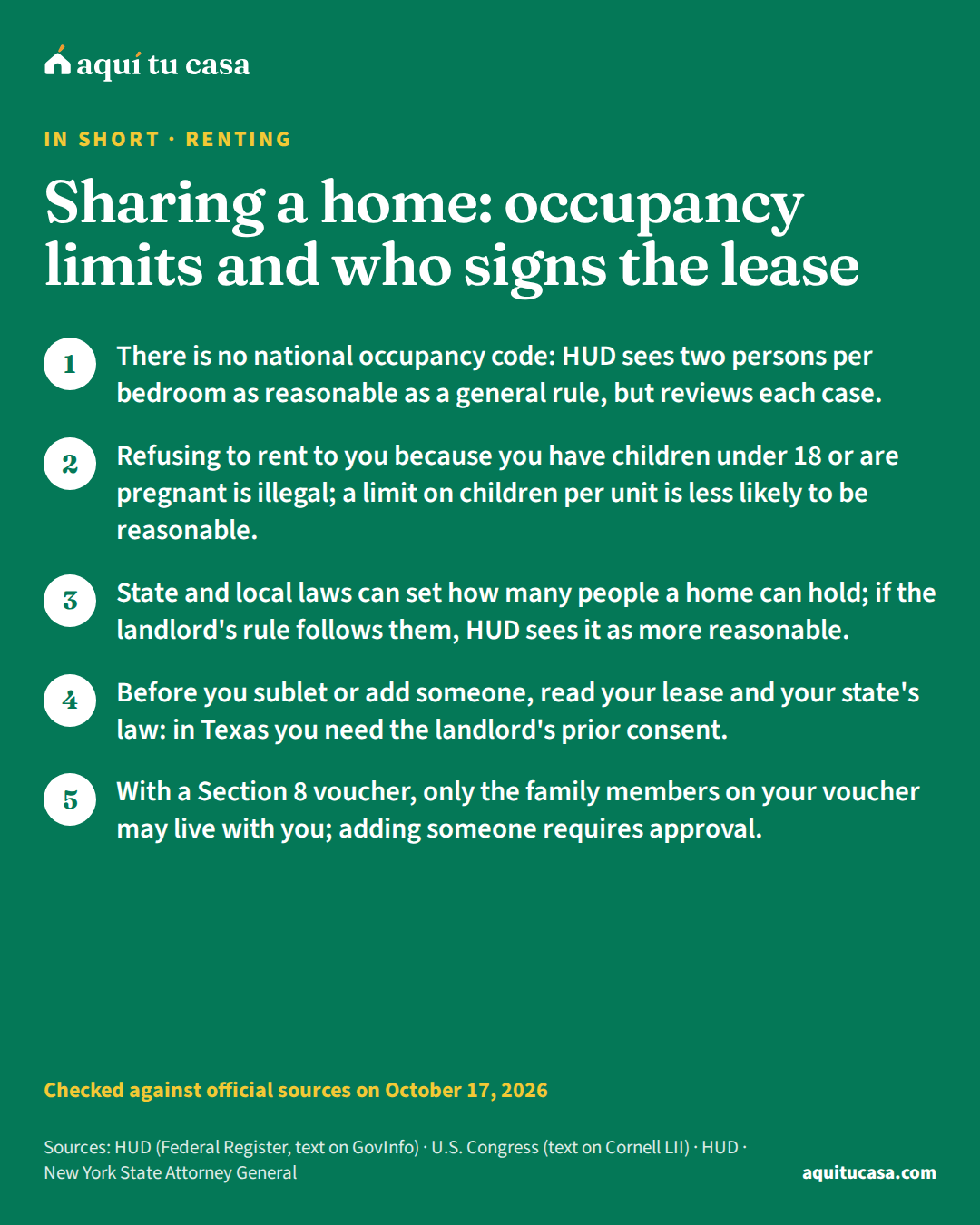
- There is no national occupancy code: HUD sees two persons per bedroom as reasonable as a general rule, but reviews each case.
- Refusing to rent to you because you have children under 18 or are pregnant is illegal; a limit on children per unit is less likely to be reasonable.
- State and local laws can set how many people a home can hold; if the landlord's rule follows them, HUD sees it as more reasonable.
- Before you sublet or add someone, read your lease and your state's law: in Texas you need the landlord's prior consent.
Is this for you?
This guide is for you if…
- You are going to share a house or apartment with relatives or roommates so the rent works.
- A landlord told you there are too many people, or that they don't rent to families with children, and you want to know what the law says.
- You want to sublet a room or have someone move in with you and don't know whether you need permission.
Get direct help first if…
- You already got an eviction notice: read the eviction notice guide first and look for free legal aid.
- You have an open discrimination case or a lawsuit: talk with free legal aid about your case; this guide only explains the general rules.
Sharing a home with relatives or roommates helps make the rent work, but it raises questions: how many people can live there, whether a landlord can turn you down because of your children, and what happens to someone who is not on the lease. This guide is for renters who share or plan to. It explains HUD’s occupancy standard, what the Fair Housing ActFair Housing ActThe Fair Housing Act is the federal law that makes it illegal to refuse to sell or rent a dwelling, or to discriminate in its terms, because of race, color, religion, sex, familial status (having children), national origin or disability. It applies to landlords, real estate agents and managers, and also to banks and lenders when their practices make housing or credit unavailable for those reasons. National origin covers your language and the country you come from, regardless of immigration status. If you believe you were discriminated against, you can file a complaint with HUD at no cost; many states add protections.See the full definition protects and what to know before you sublet.
Why sharing a home comes with rules
Many families share to pay less. According to the Census Bureau’s American Community Survey, 51% of renter households pay 30% or more of their income on rent. The rent burden page has the numbers for your area.

When you share, three kinds of rules come into play. First, the federal law against discrimination: a landlord cannot reject your family for having children.4 Second, occupancy limits: the same law allows reasonable local, state or federal limits on how many people can live in a home.5 Third, your leaseleaseA lease, or rental agreement, is the contract in which the owner or landlord gives you the right to live in and use a property for a set period of time in exchange for payment, usually rent. While the lease lasts you have possession, but the landlord still owns the property. The lease says how much you pay and when, who handles maintenance and how the agreement can end. Your rights as a tenant are usually spelled out in the lease and in your state and local laws. Before complaining to the landlord, it helps to read the lease and make sure you are also following the rules you agreed to.See the full definition and your state’s law, which say who can live with you and whether you can sublet.
How many people can live in a home
There is no national occupancy code. In 1998, HUD adopted as official policy a 1991 memorandum from its General Counsel, Frank Keating, explaining how it reviews landlords’ occupancy rules when someone complains of discrimination against families with children.1
The core idea: HUD considers a policy of two persons per bedroom reasonable as a general rule. But that can be rebutted, and HUD does not decide a case based only on the number of people per bedroom. Landlords may set reasonable requirements based on the number and size of bedrooms and the overall size of the home.1
HUD looks at these factors:1
| Factor | What HUD reviews |
|---|---|
| Size of the bedrooms and the unit | Whether the bedrooms are large and the living areas spacious, or the home is very small |
| Children’s ages | An infant is not the same as a teenager in the same bedroom |
| Layout | Whether there is a den or study besides the bedrooms |
| Other physical limits | The capacity of the septic, sewer or other building systems |
| State and local law | If the landlord’s rule follows government occupancy requirements, HUD sees it as more reasonable |
The policy gives examples. A family of five is turned down for an apartment with two large bedrooms and spacious living areas; another family of five, for a small two-bedroom mobile home. Depending on the other facts, the first could be discrimination and the second not. Age works the same way: two parents with an infant in a large one-bedroom apartment are not the same as two parents with a teenager.1
Your state and city can also set how many people a home can hold, and federal law does not override those limits when they are reasonable.5 Because they vary from place to place, ask your city or county housing or code enforcement office. The tenant rights in your state pages are a good starting point.
Families with children: what the law protects
The Fair Housing Act protects “familial status”: having children under 18 who live with you, or with another person who has legal custody of them. The protection also covers anyone who is pregnant or in the process of getting custody of a child.2
Under that law, a landlord cannot refuse to rent to you, refuse to negotiate with you or set different conditions because you have children. Nor can they publish an ad saying, for example, that children are not allowed.4
A reasonable occupancy limit is allowed.5 HUD’s policy explains how to tell it apart from a pretext for excluding families. Warning signs include a landlord who makes comments against children, has discriminatory rules for common areas, discourages families or enforces the rule only against families with children. And a rule limiting the number of children per unit is less likely to be reasonable than one limiting the total number of people.1

Who is on the lease and who isn’t
When several people share, it matters who signed the lease. The rules change by state. New York has a detailed law, which the state Attorney General explains this way:8
- A landlord may not limit occupancy to the person who signed the lease, or to that person and immediate family.
- If the lease names only one tenant, that tenant may share with immediate family, one additional occupant and that occupant’s dependent children, provided the tenant or spouse lives there.
- The tenant must tell the landlord the occupant’s name within 30 days of moving in, or of the landlord’s request.
- If the named tenant moves out, the remaining occupant has no right to stay without the landlord’s express consent.
- The landlord may limit the total number of people to comply with overcrowding standards.
Three ways to live in a rented home (New York example)
Signed
Tenant on the lease
Didn't sign
Occupant or roommate
Before anyone moves in, everyone should know which of the three they are; in other states, your lease and state law set the rules.9
If you are not on the lease, ask whether you can be added. If someone asks you to cosign a lease, that guide explains the risks. And if you share with people who are not family, check whether your renters insurance covers their things or whether each person needs a policy.
Subletting a room or the whole home
To subletsubletTo sublet, or sublease, is to rent all or part of the home you rent to another person, for a shorter time than your own lease. It is a new contract between you and that person: you become their landlord, but the owner has no contract with them. You remain responsible to the owner for meeting your lease. The owner can forbid subletting, although some places allow it in certain cases despite that ban. In public housing, the federal rule requires the lease to prohibit subletting.See the full definition is to rent the home you rent to someone else. You almost always need permission.
In Texas, the Property Code says that during the lease you may not rent the home to someone else without the landlord’s prior consent.9
In New York, the Attorney General explains that subletting means leaving the apartment temporarily. Tenants in buildings with four or more apartments have the right to sublet with the landlord’s advance consent; in buildings with three or fewer, they do not. If the landlord agrees, you remain responsible for the lease, including future rent. And a sublet that does not comply with the law may be grounds for eviction.8
Before you sublet or add someone
1. Read your lease
Before you say yes
Look for what it says about occupants and subletting. In Texas, subletting without the landlord's prior consent is not allowed.9
2. Ask for permission in writing
Before the person moves in
In New York, a sublet request goes by certified mail, return receipt requested, with the details of the sublet.8
3. Wait for the answer
In New York, up to 30 days
If the landlord does not answer in writing within that time, New York law counts it as consent.8
4. Tell the landlord who lives with you
In New York, within 30 days
Give the landlord the occupant's name after they move in, or when the landlord asks.8
5. Keep copies of everything
Always
A sublet that does not comply with the law may be grounds for eviction; your copies show what you asked and what you were told.8
Other states’ rules are in their own law; the Texas tenant rights page, for example, gathers what that state says. If the landlord threatens to remove you for having someone else living there, the eviction notice guide explains the first steps.
If you have a housing voucher (Section 8)
With a Housing Choice VoucherHousing Choice Voucher (Section 8)The Housing Choice Voucher, the program almost everyone calls Section 8, is the country's largest federal rental assistance. HUD pays rental subsidies so eligible families can afford decent, safe and sanitary housing. Local public housing agencies administer it with HUD funds. The family finds its own home on the private market; if the agency approves the unit and the tenancy, it contracts with the owner to pay part of the rent, and the family pays the rest. Waiting lists are usually long and open for limited periods.See the full definition, the rules on who lives with you are the program’s. HUD says you must follow its rules about who lives with you and allow only the family members listed on your voucher to live in the home. For a birth, adoption or court-awarded custody, it is enough to inform the agency. Adding anyone else requires the approval of the public housing agencypublic housing agency (PHA)A public housing agency (PHA) is a state, county, municipal or other governmental entity or public body authorized to operate public housing or rental assistance programs. These are the agencies that locally administer the Housing Choice Vouchers (Section 8) and public housing with HUD funds: they open and manage the waiting lists, review eligibility and income, inspect units and pay the owner its share of the rent. Each county usually has one or several; your page shows the ones serving your area with their phone numbers.See the full definition.10
Moving someone in without permission can put your assistance at risk. Before you share, ask your housing agency. The guide to Section 8 and mixed-status families explains how the program works.
If this is you
You have children or are pregnant
The law bars refusing to rent to you because of familial status.2 A limit on children per unit is less likely to be reasonable.1
You share with roommates
Know who signed the lease. In New York, if the named tenant moves out, the occupant has no right to stay without the landlord's consent.8
You have a housing voucher
Only the family members on the voucher may live with you; adding someone requires approval.10
You live in housing for older persons
The federal familial status rules do not apply to housing for older persons.5

If you think you faced discrimination
If a landlord rejected your family for having children, or used an occupancy limit as a pretext, you can report it to HUD. The law gives you one year from when the practice occurred or ended to file.6 HUD asks you to do it as soon as possible and to give the name and address of the landlord or company, the address of the home and a short description of what happened. You can report online or talk with an intake specialist at 1-800-669-9777. Retaliating against you for reporting is illegal.7
Keep evidence: ads, messages, emails and the names of the people you spoke with. The guide Housing discrimination: how to file a complaint walks through the process step by step. If you want advice about your case, the free legal aid guide explains how to find it.
Common mistakes when sharing
Mistake: Believing there is a fixed national number of people per bedroom.
Instead: HUD sees two per bedroom as reasonable as a general rule, but looks at size, children's ages and local law.1
Mistake: Accepting a 'no children here' without asking.
Instead: Refusing to rent to you because you have children is prohibited; keep evidence and consider reporting it.4
Mistake: Subletting a room without asking permission.
Instead: In Texas you need the landlord's prior consent; read your lease first.9
Mistake: Letting the only person on the lease move out without notice.
Instead: Talk with the landlord first: the occupant who stays may have no right to remain.8
Mistake: Adding a relative to your Section 8 home without approval.
Instead: Get your housing agency's approval before they move in.10
What to do this week
- Read your lease: what it says about occupants, guests and subletting.9
- List who lives or will live in the home, with ages, and compare it with the number and size of the bedrooms.1
- Ask your city or county housing or code office whether there is a local occupancy limit.5
- If you are going to sublet or add someone, ask for permission in writing and keep the answer.8
- If you have a housing voucher, get your housing agency’s approval before adding anyone.10
- If you were turned down because of your children, keep the evidence and report it to HUD within one year.6
Your income
Let's do the math
Rent that fits your budget (30% of income)
$2,018
With an income of $6,728 a month. Up to $3,364 would already be a severe burden (50% of income).
Compared with HUD’s Fair Market Rent in the United States
- 2 bedrooms$1,750Fits · 26%Needs $33.65 an hour
The wage needed pays that rent without going over 30% of income, working 40 hours a week all year.
The typical rent households actually pay in the United States is $1,413 a month (Census).
A reference to give you an idea. Each landlord and each program sets its own requirements.
Ready to see the numbers? Find your county here
See how this applies in your county: its loan limits, prices and rents, from the official data.
Printable checklist
Frequently asked questions
How many people can live in a two-bedroom apartment?
There is no fixed national number. HUD says a policy of two persons per bedroom is reasonable as a general rule, but it depends on the size of the bedrooms and the unit, the children's ages, the layout and your state's or city's occupancy laws.
Can a landlord refuse to rent to me because I have children?
The Fair Housing Act bars refusing to rent to you because of familial status: having children under 18, being pregnant or being in the process of getting custody of a child. There are exceptions, such as certain housing for older persons and rooms in small buildings where the owner lives, although discriminatory ads are not allowed there either.
Can a landlord set a limit on children per apartment?
Under HUD's policy, a rule limiting the number of children per unit is less likely to be reasonable than one limiting the total number of people. If it happened to you, keep evidence and consider reporting it to HUD.
Can I sublet a room in my apartment?
It depends on your lease and your state's law. In Texas, during the lease you may not rent the home to someone else without the landlord's prior consent. In New York, tenants in buildings with four or more apartments have the right to sublet with the landlord's advance consent, following written steps.
Can a relative who is not on the lease move in with me?
Read your lease first. In New York, a sole tenant may share with immediate family, one additional occupant and that occupant's dependent children, and must tell the landlord the occupant's name. With a housing voucher, you need the housing agency's approval to add someone, except for a birth, adoption or custody.
What happens if the person who signed the lease moves out?
In New York, if the named tenant moves out, the remaining occupant has no right to stay without the landlord's express consent. That is why every adult moving in should know who is on the lease.
Where do I complain if a landlord discriminates against my family?
You can report it to HUD online or at 1-800-669-9777. The law gives you one year from when it happened to file, and HUD asks you to do it as soon as possible. Free legal aid can advise you about your case.
Sources
Every figure in this guide comes from one of these official sources. The number next to a sentence leads to the source behind it.
Each source on one line: who publishes it, its title, its address and the date we read it.
- 1. HUD (Federal Register, text on GovInfo) · Fair Housing Enforcement--Occupancy Standards Notice of Statement of Policy (63 FR 70256) · govinfo.gov · Accessed October 17, 2026
- 2. U.S. Congress (text on Cornell LII) · 42 U.S.C. §3602, Definitions (Fair Housing Act) · law.cornell.edu · Accessed October 17, 2026
- 3. U.S. Congress (text on Cornell LII) · 42 U.S.C. §3603, Effective dates of certain prohibitions (exemptions) · law.cornell.edu · Accessed October 17, 2026
- 4. U.S. Congress (text on Cornell LII) · 42 U.S.C. §3604, Discrimination in the sale or rental of housing · law.cornell.edu · Accessed October 17, 2026
- 5. U.S. Congress (text on Cornell LII) · 42 U.S.C. §3607, Religious organization or private club exemption (occupancy limits; housing for older persons) · law.cornell.edu · Accessed October 17, 2026
- 6. U.S. Congress (text on Cornell LII) · 42 U.S.C. §3610, Administrative enforcement; preliminary matters · law.cornell.edu · Accessed October 17, 2026
- 7. HUD · Report Housing Discrimination · hud.gov · Accessed October 17, 2026
- 8. New York State Attorney General · Residential Tenants' Rights Guide · ag.ny.gov · Accessed October 17, 2026
See the other 2 sources
- 9. Texas Legislature · Texas Property Code, Chapter 91, Provisions Generally Applicable to Landlords and Tenants · tcss.legis.texas.gov · Accessed October 17, 2026
- 10. HUD · Housing Choice Voucher Tenants · hud.gov · Accessed October 17, 2026
Keep reading
Related guides
If this guide helped, these follow the same path.

Renting 15 minute read
Your lease explained: what to check before you sign
What a lease is, which clauses to read before you sign, the lead paint disclosure, your fair housing rights and where to get free help.
- Your rights are in your lease and in your state or local laws: read them together before you sign.
- Check the rent and due date, fees, the deposit, utilities, repairs, entry, occupants, subletting and how the lease ends.
- A landlord cannot charge fees you did not agree to, refuse necessary repairs or lock you out without a court order.
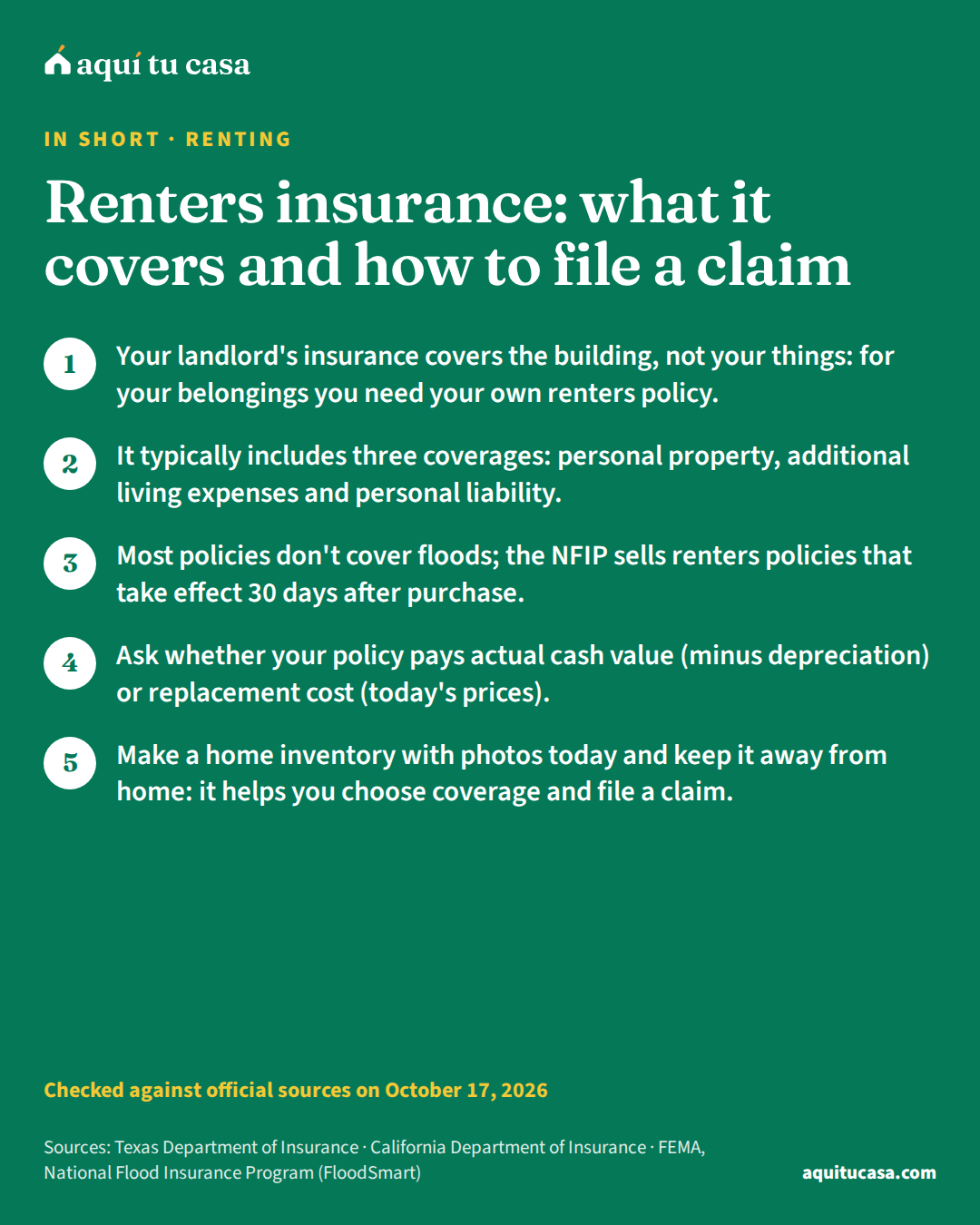
- Renting Renters insurance: what it covers and how to file a claim What renters insurance covers, why it leaves out floods, actual cash value vs. replacement cost, liability coverage and how to file a claim. 13 minute read
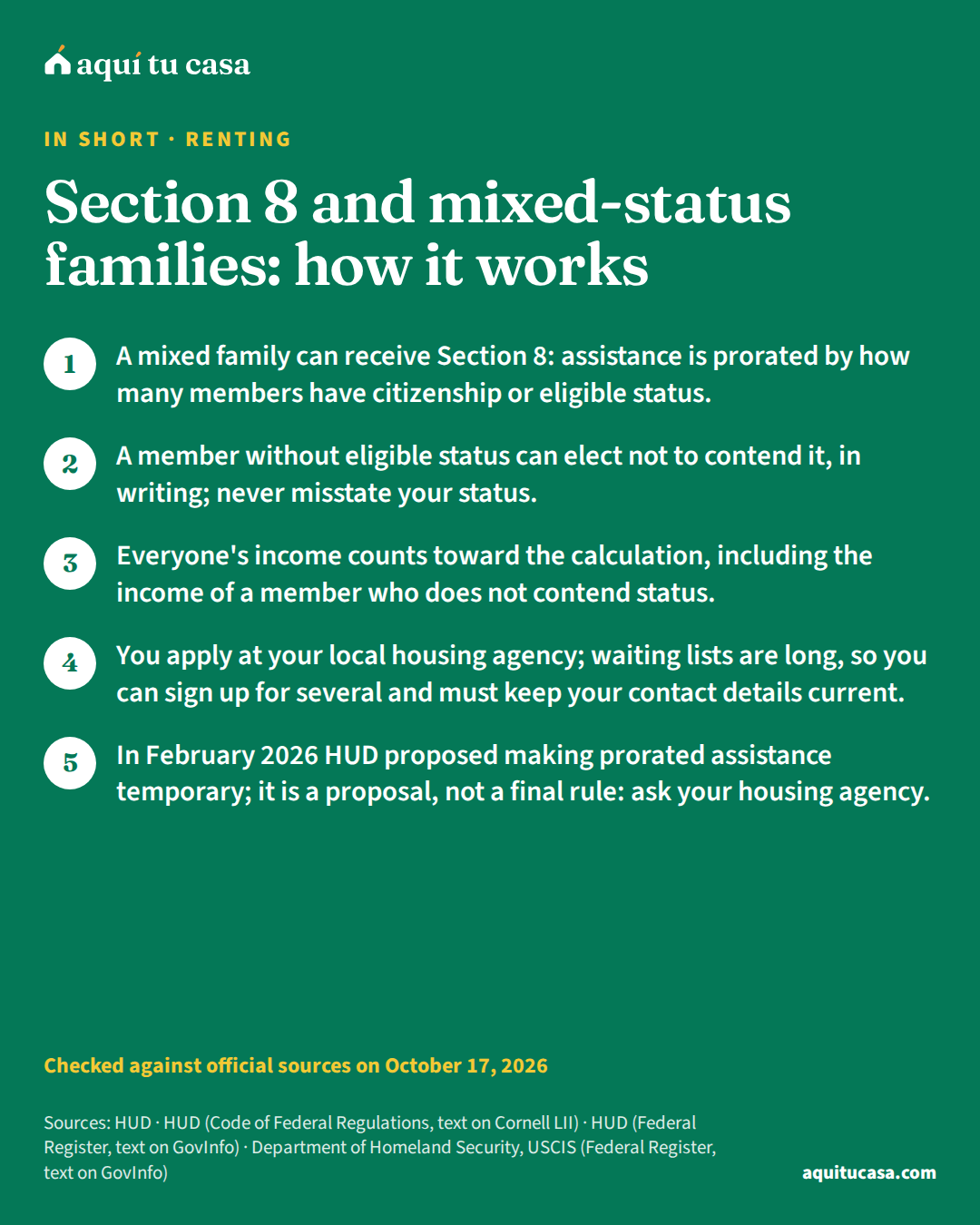
- Renting Section 8 and mixed-status families: how it works How the Section 8 voucher works, how aid is prorated in a mixed-status family, how to apply through your housing agency and what HUD proposed. 12 minute read
- Renting What to do if you get an eviction notice Notice, lawsuit and the judge's order: what you can do at each moment, where free legal help is and what federal law says about the 30-day notice. 14 minute read
Tools for this topic
Was this guide useful?
Thank you. Your answer stays in your browser; nothing is sent.