Co-signing a loan or lease: the risks before you sign
What co-signing a loan or a lease means, what you can be made to pay, how it affects your credit and a future mortgage, and how to protect yourself.
Verified against official sources on October 17, 2026 15 official sources

Show contents
In short
What you need to know
Quick answer
Co-signing means you promise to pay someone else's debt if they do not, up to the full amount plus fees. The creditor can collect from you without first trying the borrower, and late payments can show up on your credit report. If you later apply for a mortgage, that debt generally counts in your debt-to-income ratio unless 12 months of on-time payments by the other person are documented. Before you sign, check whether you could make the payments yourself and ask to receive the statements.
What matters most
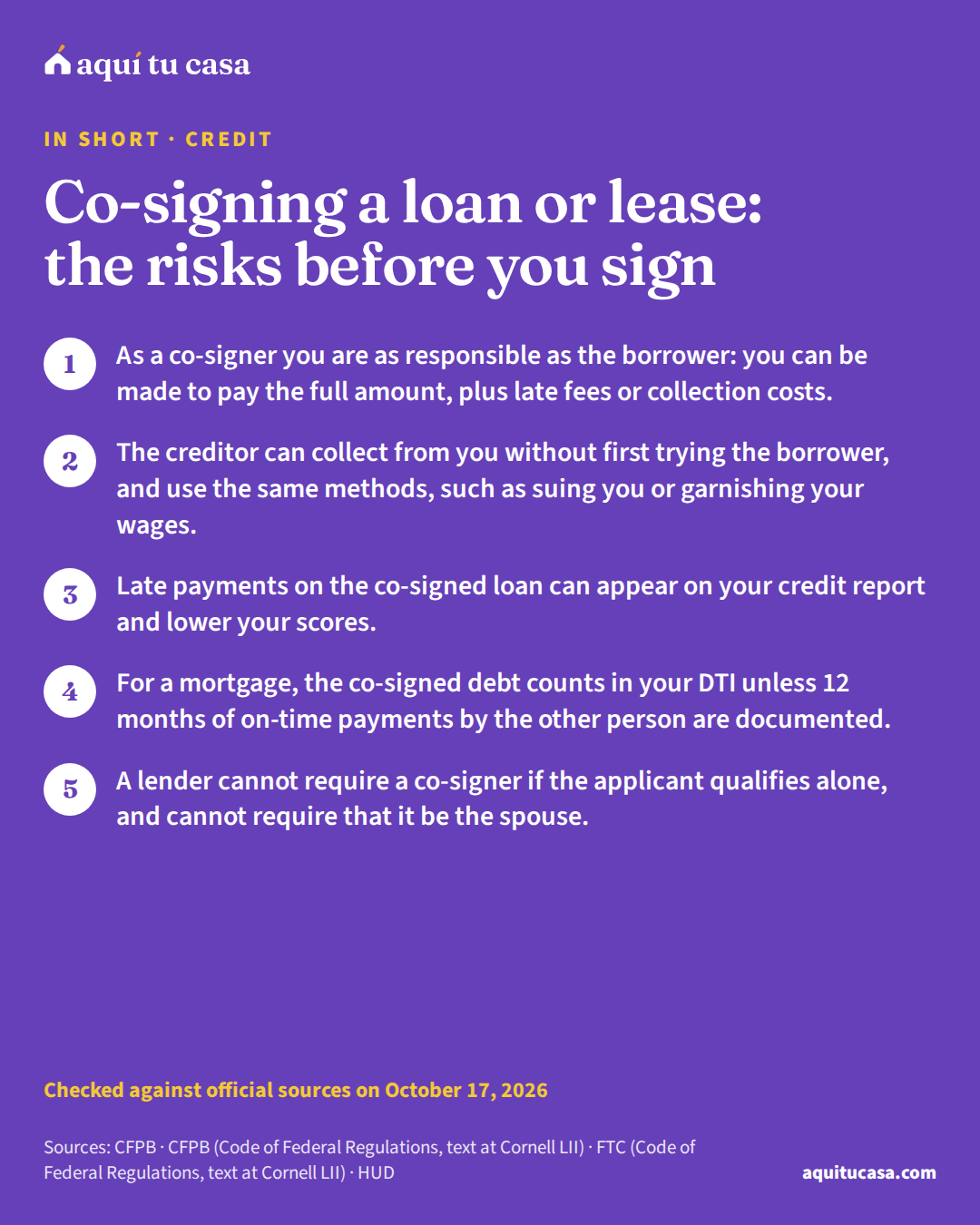
- As a co-signer you are as responsible as the borrower: you can be made to pay the full amount, plus late fees or collection costs.
- The creditor can collect from you without first trying the borrower, and use the same methods, such as suing you or garnishing your wages.
- Late payments on the co-signed loan can appear on your credit report and lower your scores.
- For a mortgage, the co-signed debt counts in your DTI unless 12 months of on-time payments by the other person are documented.
Is this for you?
This guide is for you if…
- A child, relative or friend asked you to co-sign their car loan, student loan, credit card or lease.
- You already co-signed and want to know what you can be made to pay and how it affects you if they fall behind.
- You want to buy a home and you co-signed someone else's loan.
Get direct help first if…
- You are buying a home together with a relative and you will both be owners: that is being a co-borrower, which has its own rules.
- You have already been sued over a debt you co-signed: look for legal help today; this guide only explains the general rules.
When someone in your family cannot qualify for a loan or a lease alone, it is common for them to ask you to sign as a co-signerco-signerA co-signer is a person who signs another person's loan or credit account to back it up, and by doing so becomes responsible for the debt. If the borrower does not pay, the creditor can collect up to the full debt from the co-signer, plus late fees or collection costs, without first trying to collect from the borrower, and the default may become part of the co-signer's credit record. A federal FTC rule calls for the co-signer to get a written notice explaining these risks before signing. On a mortgage, according to Fannie Mae, a co-signer signs the note and shares liability for the debt with the borrower but has no ownership interest in the home on the title.See the full definition. This guide is for you before you decide, or if you already signed: it explains what you commit to pay, how it affects your credit and a future mortgage, what cannot be required of you and how to protect yourself.
- Of the debt you can be made to pay if the borrower does not, plus late fees or collection costs
- The full amount5
- Student loan co-signers made at least one payment for the borrower, according to a survey cited by the CFPB
- 1 in 48
- Of on-time payments by the other person for a mortgage lender to be able to leave that debt out
- 12 months11
What co-signing means
According to the CFPB, a co-signer is someone, such as a parent, relative or friend, who adds their income and credit record to another person’s loan application so they qualify or get better terms. In return, the co-signer promises to pay if the primary borrower does not.1
Why are you being asked? Being told you need a co-signer generally means the lender will not offer the loan based solely on the applicant’s own income and credit. A co-signer with good credit helps them qualify or get a lower interest rate.2 In other words, the lender is counting on your credit and your money.
The key point: you are as responsible as the borrower, even if you do not have the same rights to what was bought. On a car loan, the co-signer is responsible for the loan even if they never drove the car.2 On a mortgage, Fannie Mae describes guarantors and co-signers as people who sign the promissory notepromissory noteThe promissory note (or simply the note) is the document you sign at closing to promise you will repay the loan to the lender. It describes what you are agreeing to: how much you owe, the interest rate, the payment dates, the total you will pay, the length of the loan, whether the payments can change and where to send them. It is separate from the mortgage or deed of trust, the document that gives the lender the right to take the home if you do not pay. Some terms, such as a prepayment penalty, may be in an addendum to the note. You can ask for copies of the documents before closing to review them.See the full definition and are jointly liable for it with the borrower, but who are not owners on the title.13
The law does not depend on what the paper calls you. Under the FTC rule on credit practices, you are a co-signer if you become responsible for someone else’s debt without getting anything in return, including when your signature is requested as a condition of giving them credit, whether or not the document says so.6
Primary borrower and co-signer, side by side
Who receives the loan
Primary borrower
Signing as a co-signer means accepting that, if the other person does not pay, the debt is yours.5
What you can be made to pay
The FTC requires that, before you become obligated, the lender or retail installment seller give you a separate document called the “Notice to Cosigner.”5 That rule applies to lenders and retail installment sellers within the FTC’s jurisdiction.6 In short, the notice says:5
- You are being asked to guarantee this debt; think carefully. If the borrower does not pay, you will have to.
- You may have to pay up to the full amount of the debt, plus late fees or collection costs.
- The creditor can collect from you without first trying to collect from the borrower, using the same methods: suing you, garnishing your wages and others.
- If the debt is ever in default, that may become part of your credit record.
- This notice is not the contract that makes you liable.
With a car loan, if no one pays, the lender may repossess and sell the car and, depending on your state’s law, sue you and the borrower for what is left.1 With a private student loan, lenders often hire collection agencies to collect from the co-signer, and the co-signer can also be sued.7 If a debt collector contacts you, you have rights: our debt collection guide explains them.
The CFPB cites a 2019 survey that found a quarter of student loan co-signers ended up making at least one payment because the borrower did not.8
How it affects your credit
Late or missed payments on a co-signed loan affect both credit histories: yours and the borrower’s.7 They can appear on your credit reports and lower your scores, which makes it harder to get credit later.1 If the loan defaults, it goes on your credit reportcredit reportA credit report is a statement that has information about your credit activity and current credit situation: your loans and cards, the balances, whether you have paid on time, accounts in collection and who has checked your credit. Credit reporting companies, also called credit bureaus, compile it from what banks and creditors report; your credit score is computed from it. When you apply for a mortgage, the lender pulls your report from the three bureaus. You have the right to see it for free and to dispute anything that is wrong.See the full definition just as it does on the borrower’s.8
To find out in time, the CFPB suggests asking the lender to send you the monthly statements or give you online account access,1 talking with the borrower when payments start and checking your credit report.8 Our guide on how to read your credit report shows you where each account appears.

If you later want to buy a home
Here is a risk many families do not see coming. When you apply for a mortgage, the debt you co-signed generally counts as yours in your debt-to-income ratio (DTI)debt-to-income ratio (DTI)Your debt-to-income ratio (DTI) is all your monthly debt payments divided by your gross monthly income, that is, income before taxes. If you pay a certain amount each month across a car, cards, student loans and the mortgage you are asking for, and you earn three times that, your DTI is one third. Lenders use it to measure whether you can manage the payment; each loan type and lender sets its own limit, and assistance programs usually publish theirs. Paying down debt before applying improves your DTI.See the full definition.
- FHA loan. HUD Handbook 4000.1 calls co-signer debts “contingent liabilities.” The lender must include that monthly payment in your obligations unless it documents that the creditor cannot pursue you if the other person does not pay, or that the other person has made 12 months of on-time payments.11
- Conventional loan (Fannie Mae). If you are obligated on a non-mortgage debt but are not the one paying it, the lender may leave that payment out of your DTI. For that it needs the most recent 12 months of canceled checks or bank statements from the person paying, with no late payments.12
Example with real numbers
How a co-signed loan counts in your DTI
An example in words, using the FHA and Fannie Mae rules.
- Your own monthly debts
- Counted, as always
- Payment on the loan you co-signed
- Added to your debts
- If the person paying has 12 months on time and it is documented
- The lender may leave it out
- Your debt-to-income ratio (DTI)
- Higher while that payment counts
For FHA, the lender needs proof of 12 months of on-time payments by the other person.11 For Fannie Mae, 12 months of canceled checks or bank statements with no late payments from the person paying.12 Run your own numbers in the calculator.
Run it with your numbersHow much house can I afford?If you plan to buy a home soon, start keeping proof now that the other person is paying: their checks or bank statements. Our debt-to-income ratio guide explains how it is calculated and how to lower it.
What a lender cannot require of you
- It cannot force you to co-sign. The CFPB says a lender cannot force you to put your information on someone else’s loan.1
- It cannot require a co-signer if the applicant qualifies alone. If they are told they need one, they can ask whether they would be approved without a co-signer and on what terms.2
- It cannot require that the co-signer be the spouse. Under Regulation B, a creditor cannot require the signature of a spouse or anyone else if the applicant qualifies; if another person is needed, it may ask for a co-signer but cannot require that it be the spouse.3 One exception: for a mortgage or home equity loan, a lender may ask for the spouse’s signature if state law requires it to use the property as collateral.4
If you feel uncomfortable or pressured to sign, the CFPB says you can walk away. And if you have a problem with a financial institution, you can submit a complaint to the CFPB.1

Student loans and leases
Private student loans. To qualify, the student may need a co-signer.7 Some loans allow the co-signer to be released if the borrower makes payments for a certain length of time; the requirements are in the terms and conditions and on the lender’s or servicer’s website.9 If you are a grandparent: according to the CFPB, private student loan companies cannot garnish a co-signer’s Social Security, although they can sue you. Only federal loans can lead to Social Security garnishment, and most do not require a co-signer.10
Leases. A landlord may ask for a co-signer because of what a tenant screening report says. If they do so because of that report, federal law requires them to give you an adverse action notice, including your right to a free copy of the report if you request it within 60 days.14 The federal sources we reviewed do not set rules for what the co-signer of a leaseleaseA lease, or rental agreement, is the contract in which the owner or landlord gives you the right to live in and use a property for a set period of time in exchange for payment, usually rent. While the lease lasts you have possession, but the landlord still owns the property. The lease says how much you pay and when, who handles maintenance and how the agreement can end. Your rights as a tenant are usually spelled out in the lease and in your state and local laws. Before complaining to the landlord, it helps to read the lease and make sure you are also following the rules you agreed to.See the full definition owes: that depends on the lease and your state’s law. Read it in full before signing. Our guide on renting without a Social Security number or credit explains other options.
Before you sign as a co-signer
1. Ask whether it is really needed
First of all
A lender cannot require a co-signer if the applicant qualifies alone; ask whether they would be approved without you and on what terms.2
2. Do the math as if the payment were yours
Before you say yes
Check your budget: if the other person does not pay, you will be asked to.1
Try it with your numbersFamily budget3. Read the notice and the contract
Before you sign
The “Notice to Cosigner” sums up your risk, but the contract is what binds you.5
4. Ask for the statements
From the first month
Ask the lender for monthly statements or online access so you learn about a late payment in time.1
5. Check your credit report
From time to time
Late payments on the co-signed loan can appear on your report.8
6. Ask for release when possible
When the borrower qualifies
Some loans allow the co-signer to be released; the requirements are in the loan terms.9
If this is you
Your son or daughter asks you to sign their car loan
If they do not pay, you will be asked to, and the lender may repossess the car and, depending on your state, sue you both.1
You are a grandparent asked to co-sign a student loan
A private lender cannot garnish your Social Security, but it can sue you.10
You want to buy a home and co-signed before
That debt counts in your DTI unless 12 months of on-time payments by the other person are documented.11
You are asked to co-sign a lease
What you owe depends on the lease and your state's law; read it in full before signing.14
Costly mistakes
Mistake: Signing because it is “just a signature.”
Instead: As a co-signer you can be made to pay the full amount, plus fees, without the borrower being pursued first.5
Mistake: Learning about the late payment from a collection letter.
Instead: Ask for statements or online access from the first month.1
Mistake: Forgetting you co-signed when you apply for your mortgage.
Instead: Gather 12 months of proof that the other person pays on time.12
Mistake: Co-signing because the lender said it “has to be the spouse.”
Instead: A creditor cannot require that the co-signer be the spouse.3
Mistake: Signing someone else's lease without reading it.
Instead: What you owe depends on that lease and your state's law.14

What to do this week
- If you were asked to co-sign, ask whether the applicant would qualify without you and on what terms.2
- Build your budget as if the payment were yours; the family budget tool helps.1
- Read the “Notice to Cosigner” and the full contract before signing.5
- If you already co-signed, ask for the statements or online access, and check your credit report.8
- If you plan to buy a home, gather 12 months of proof of the other person’s payments.11 A HUD-approved housing counselorHUD-approved housing counselorA HUD-approved housing counselor works at an agency HUD has approved to provide housing counseling: independent, expert advice customized to your situation about buying a home, renting, a missed mortgage payment, a foreclosure or credit problems. The agencies usually charge little or nothing; many serve in Spanish and offer the homebuyer education course several assistance programs require. They are not lenders or real estate agents and sell you nothing. Your county page lists the official agencies with phone numbers.See the full definition can review your numbers with you, often at little or no cost.15
Your numbers
The minimum for this loan is 3.5%. More down lowers the monthly payment.
Adjust advanced details
First number: share of income for housing. Second: housing plus debts. Lender references, not fixed rules.
Let's do the math
Estimated top price
National figure$227,000
Limited by the housing payment: at that price it would be about $1,883 a month, 28% of your income.
- By the housing payment (28% of income)Limits you$227,000
- By your total debts (36% of income)$292,000
- By your cash (down payment + closing)$330,500
- Typical home in the United States
- $332,700
- Your cap is 68% of the typical home.
What changes if…?
- …you save $10,000 more$227,000
- …you cut $200 a month in debts$227,000
Your maximum price with four loans
Same income, debts and savings; only the down payment and the loan type change. ITIN uses an example down payment and rate.
| FHA 3.5% | Conventional 5% | Conventional 20% | ITIN 15% (example) | |
|---|---|---|---|---|
| Maximum price | $227,000 | $232,000 | $93,000 | $119,000 |
| Payment per month | $1,883 | $1,882 | $616 | $898 |
Educational estimate, not a pre-approval. Uses example insurance (0.5% of value per year) and example closing costs (3% of price); the tax is the place’s typical rate.
Ready to see the numbers? Find your county here
See how this applies in your county: its loan limits, prices and rents, from the official data.
Printable checklist
Frequently asked questions
What happens if the person I co-signed for does not pay?
You will be asked to pay. You may have to pay up to the full amount of the debt, plus late fees or collection costs, and the creditor can collect from you without first trying the borrower. Late payments can show up on your credit report, and after a default you can be sued.
Does co-signing affect my credit?
It can. According to the CFPB, late or missed payments on a co-signed loan affect both people's credit history, and a default goes on your report. That is why it is worth getting the statements and checking your credit report.
If I co-signed a loan, does it affect buying a home?
Generally yes: for an FHA loan, the lender must count that debt in your monthly obligations unless it documents that the other person made 12 months of on-time payments. Fannie Mae also allows leaving it out of your DTI with 12 months of canceled checks or bank statements from the person paying, with no late payments.
Can I stop being a co-signer?
It depends on the loan. Some private student loans allow the co-signer to be released if the borrower makes payments for a certain length of time; the requirements are in the loan terms and on the lender's website. Ask the lender or servicer what options your loan has.
Can I be forced to co-sign my spouse's loan?
Not if your spouse qualifies alone. Under Regulation B, a creditor cannot require the signature of a spouse or anyone else if the applicant qualifies, and if it asks for a co-signer, it cannot require that it be the spouse. There are exceptions when state law requires it to secure a property.
Can they take my Social Security if I co-signed a student loan?
According to the CFPB, private student loan companies cannot garnish a co-signer's Social Security, but they can sue you in court to collect. Only federal student loans can lead to garnishment of Social Security, and most do not require a co-signer.
What must the lender give me before I co-sign?
The FTC rule calls for the lender or retail installment seller to give you, before you are obligated, a separate document called the “Notice to Cosigner” explaining that you may have to pay the whole debt and that the creditor can collect from you without going after the borrower first. That notice is not the contract: the contract is what binds you, so read it too.
Sources
Every figure in this guide comes from one of these official sources. The number next to a sentence leads to the source behind it.
Each source on one line: who publishes it, its title, its address and the date we read it.
- 1. CFPB · Should I agree to co-sign someone else’s car loan? · consumerfinance.gov · Accessed October 17, 2026
- 2. CFPB · Why would I need a co-signer for an auto loan? · consumerfinance.gov · Accessed October 17, 2026
- 3. CFPB (Code of Federal Regulations, text at Cornell LII) · Regulation B, 12 CFR §1002.7, Rules concerning extensions of credit · law.cornell.edu · Accessed October 17, 2026
- 4. CFPB · Does my spouse have to co-sign my mortgage loan? · consumerfinance.gov · Accessed October 17, 2026
- 5. FTC (Code of Federal Regulations, text at Cornell LII) · Credit Practices Rule, 16 CFR §444.3, Unfair or deceptive cosigner practices · law.cornell.edu · Accessed October 17, 2026
- 6. FTC (Code of Federal Regulations, text at Cornell LII) · Credit Practices Rule, 16 CFR §444.1, Definitions · law.cornell.edu · Accessed October 17, 2026
- 7. CFPB · What is a co-signer for a student loan? · consumerfinance.gov · Accessed October 17, 2026
- 8. CFPB · Tips for student loan co-signers · consumerfinance.gov · Accessed October 17, 2026
See the other 7 sources
- 9. CFPB · If I co-signed for a private student loan, can I be released from the loan? · consumerfinance.gov · Accessed October 17, 2026
- 10. CFPB · If I co-sign for my grandchild's student loan, can the lender garnish my Social Security check if they don't repay the loan? · consumerfinance.gov · Accessed October 17, 2026
- 11. HUD · FHA Single Family Housing Policy Handbook 4000.1 · hud.gov · Accessed October 17, 2026
- 12. Fannie Mae · Fannie Mae Selling Guide B3-6-05, Monthly Debt Obligations · selling-guide.fanniemae.com · Accessed October 17, 2026
- 13. Fannie Mae · Fannie Mae Selling Guide B2-2-04, Guarantors, Co-Signers, or Non-Occupant Borrowers on the Subject Transaction · selling-guide.fanniemae.com · Accessed October 17, 2026
- 14. CFPB · What should I do if my rental application is denied because of a tenant screening report? · consumerfinance.gov · Accessed October 17, 2026
- 15. CFPB · Find a Housing Counselor · consumerfinance.gov · Accessed October 17, 2026
Keep reading
Related guides
If this guide helped, these follow the same path.

Buying a home 14 minute read
Debt-to-income ratio (DTI): what it is and how to lower it
What the debt-to-income ratio (DTI) is, how to calculate it, which payments count, the caps FHA, Fannie Mae, VA and USDA publish and how to lower it.
- DTI = monthly debt payments ÷ gross monthly income; the new home's payment is part of the math.
- There are two ratios: housing (front-end) and total (back-end); each program uses one or both.
- Caps vary by program: Fannie Mae, FHA, VA and USDA publish their own, and the lender can be stricter.
- Credit How to read your credit report, line by line Where to get your free credit reports, what each part says, how long negative items can stay and how to spot errors or identity theft. 13 minute read
- Credit Credit from zero: how to start your history in the U.S. What credit reports and scores are, how to get them for free, and how to start a history from nothing with a secured card or a credit-builder loan. 16 minute read
- Credit Debt collection: your rights with debt collectors What a debt collector must tell you, how to dispute in writing, when and how often they can call, old debts, and what to do if you are sued. 16 minute read
Tools for this topic
Was this guide useful?
Thank you. Your answer stays in your browser; nothing is sent.