Renters insurance: what it covers and how to file a claim
What renters insurance covers, why it leaves out floods, actual cash value vs. replacement cost, liability coverage and how to file a claim.
Verified against official sources on October 17, 2026 7 official sources

Show contents
In short
What you need to know
Quick answer
Renters insurance protects your belongings, which your landlord's insurance does not cover. According to the Texas Department of Insurance, it typically includes three coverages: personal property, additional living expenses if a covered loss forces you out of your home, and personal liability if someone is hurt in your home. It does not fix the building and almost never covers floods: for that there is the renters policy of the National Flood Insurance Program (NFIP). The law does not require it, but some landlords do.
What matters most
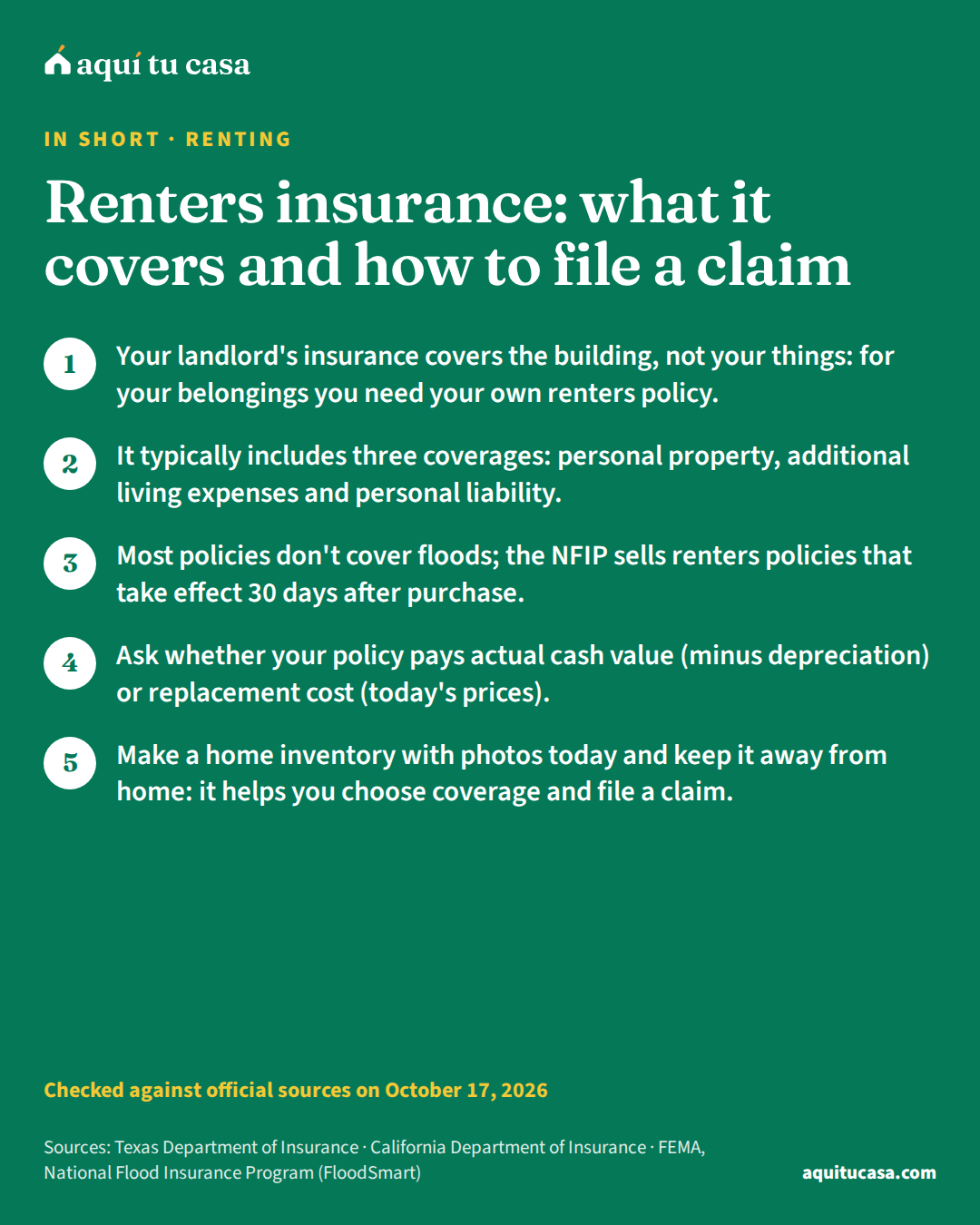
- Your landlord's insurance covers the building, not your things: for your belongings you need your own renters policy.
- It typically includes three coverages: personal property, additional living expenses and personal liability.
- Most policies don't cover floods; the NFIP sells renters policies that take effect 30 days after purchase.
- Ask whether your policy pays actual cash value (minus depreciation) or replacement cost (today's prices).
Is this for you?
This guide is for you if…
- You rent a house or apartment and want to know whether you need insurance for your belongings and what it covers.
- Your landlord or your lease requires renters insurance and you don't know what to ask before you buy it.
- You live in an area that floods and want to know what actually protects you.
- You had a fire, a burglary or water damage and are about to file a claim.
Get direct help first if…
- You own your home: the home insurance guide explains the homeowners policy, escrow and what your lender requires.
- Your landlord won't fix damage to the building: renters insurance does not pay for building repairs; start with the guide to your lease.
If you rent, the building’s insurance belongs to the landlord and does not protect your belongings. This guide is for renters who want to understand renters insurancerenters insuranceRenters insurance, also called tenants insurance, protects your belongings and protects you when you rent. The landlord's insurance covers the building, but not your furniture, clothes or electronics. It usually includes three coverages: your personal property, even if it is stolen away from home; additional living expenses if a covered loss forces you to move out for a while; and personal liability if someone is hurt in your home. A standard policy does not cover floods, which are insured separately. Some landlords require it.See the full definition: what it covers, what it leaves out (like floods), actual cash value versus replacement cost, liability coverage and how to file a claim. It summarizes what the Texas and California insurance departments and the federal flood insurance program publish.
What renters insurance covers
According to the Texas Department of Insurance (TDI), your landlord’s insurance won’t cover your personal items. To protect them from theft or damage, say from a burst pipe, you need your own renters policy.1 The California Department of Insurance (CDI) puts it the same way: your landlord does not insure your personal property.5
TDI says a renters policy typically includes three coverages:1
| Coverage | What it pays for |
|---|---|
| Personal property | Your belongings, even items stolen from your car or while you travel |
| Additional living expenses | The extra cost of food, rent and other things if a covered loss forces you out for a while |
| Personal liability | Protects you if someone is injured in your home and pays legal costs if you are liable and sued |
In California, CDI describes a renters policy in four parts: personal property (Coverage C), loss of use (D), personal liability (E) and medical payments to others (F).5 Coverage C protects your belongings and those of family members who live with you.5
There is one thing your policy does not do: fix the house or the building. The building owner’s policy pays for that.2 Which repairs fall on the landlord and which on you depends on your lease and your state’s rules; the guide to your lease helps you read it, and the guide to repairs and housing conditions explains what to do when something breaks.

What it doesn’t cover: floods and special limits
Most renters policies cover losses from fire, smoke, theft or vandalism and certain kinds of water damage. They don’t cover losses from floods.1 FloodSmart, the website of FEMA’s National Flood Insurance Program (NFIP), says the same about most homeowners and renters insurance.6
That is what flood insuranceflood insuranceFlood insurance is a separate policy that can cover a building, its contents, or both, when flood water causes damage. Most homeowners insurance policies do not cover that damage. Most of these policies are backed by FEMA's National Flood Insurance Program (NFIP) and bought through insurers and agents. If your home is in a high-risk flood area and your mortgage is backed by the federal government, the lender is required to demand it; outside those areas it is optional, but floods happen there too.See the full definition is for. The NFIP sells renters policies that protect what you own inside your home: furniture, clothes, television, computers, rugs and some artwork, up to $100,000 of damage. This is called contents coverage.6 You can buy one if your city or town participates in the NFIP, and most communities in the country do.7
Before you buy, keep three things in mind:6
- Coverage starts 30 days after purchase, with some exceptions.
- It does not cover cash, things you keep in a basement, or temporary housing while repairs are made.
- It lasts one year, and every company that sells it charges the same rates.
Your renters policy also has a dollar limit: the most it will pay, even if replacing your things costs more. Some policies set lower limits for certain items. TDI lists common limits of $100 for cash, $2,500 for items used for business and $500 for jewelry and watches.1 CDI explains that these special limits are not added on top of the overall limit; they sit inside it. To cover something more valuable, you add an endorsement, also called a “rider” or “floater.”5
Actual cash value or replacement cost
When the insurer pays you for something you lost, it calculates the payment one of two ways. TDI explains them like this:2
- Replacement cost: pays to repair or replace your belongings at today’s prices.
- Actual cash value: pays replacement cost minus depreciation, the value an item loses through wear and age.
CDI’s glossary adds detail: replacement cost is what it costs to replace an item with something new of like kind and quality in the local market, and actual cash value never exceeds your policy limit.5
TDI offers this example: you paid $1,300 for a laptop two years ago, and the same kind now sells for $500. A basic renters policy would pay $500 if the laptop were destroyed. You can buy a policy that covers the replacement value of your items, but it costs more.1 That is why TDI says to make sure the policy you buy will pay to replace your belongings.1
Two ways to pay for your belongings
ACV
Actual cash value
Ask which one your policy has before you buy; the difference shows up exactly when you file a claim.1
Example with real numbers
Your sofa burns: how the payment is figured
An example in words, with no figures, to show where each check comes from.
- With actual cash value
- Today's price of a similar sofa, minus depreciation2
- With replacement cost, first check
- The sofa's actual cash value2
- With replacement cost, after you replace it
- The rest of your claim2
- Either way
- Your deductible is subtracted and the payment stops at your policy limit3
Your own figures are on the declarations page, the first page of your policy: coverages, limits and deductibles.2 To see what you can afford each month for rent and insurance, use the rent calculator.
Run it with your numbersHow much rent can I afford?
Liability: if someone gets hurt in your home
Liability is the part of the policy that protects you from claims by other people. According to TDI, in a renters policy it protects you if someone is injured in your home and pays legal costs if you are liable and taken to court.1
CDI explains two coverages that go together:5
- Personal liability (Coverage E): applies when you or someone in your household is legally responsible for injuring another person. It normally includes your defense. It does not protect you in every situation; for example, it does not cover an intentional act.
- Medical payments to others (Coverage F): pays reasonable medical expenses for people accidentally hurt in your home, like a neighbor’s child who falls while playing. It does not cover your own injuries or those of people who live with you, and it is not a substitute for health insurance.
In California, CDI says a renters policy generally has liability coverage with a minimum of $100,000, medical payments with a minimum of $1,000 and loss of use at 20% of personal property coverage.5 Those are general California figures; yours are in your policy.
For homeowners policies, TDI explains that liability coverage also pays if you’re responsible for damaging someone else’s property, plus your court costs if you’re sued because of an accident.2 If you worry about causing damage to the building or a neighbor, ask your agent whether your renters policy includes it.
How much coverage to buy and how the deductible works
Your policy pays up to a dollar limit for your belongings. To know how much you need, TDI recommends filling out a home inventory.1 CDI says the most reliable source of what your things are worth is you, and asks you to count everyday items: kitchen utensils, linens, curtains, clothes and shoes.5
How to make the inventory, according to TDI:2
- List what you own. If you can, note the purchase date, value and serial number.
- Photograph or videotape every room, with closets and drawers open.
- Keep the list and receipts for major items in a fireproof safe or at another location.
- Update it from time to time.
The deductibledeductibleA deductible is the part of an insurance claim you pay yourself. When you have a covered loss, the insurance company subtracts the deductible from the claim amount and pays you the rest. You may have a different deductible for each type of coverage. You will find it on the first page of your policy, called the declarations page, along with your coverages and limits. In taxes, the word "deductible" means something else: an expense that can lower the taxes you owe.See the full definition is the part of a claim you pay yourself.2 It can be a fixed amount or a percentage, and on home policies it applies to each claim. In general, the higher the deductible, the cheaper the policy. TDI suggests thinking about how much you could pay if your things were damaged, and warns that filing small claims may raise what you pay later.3
What you pay for insurance is the premiuminsurance premiumAn insurance premium is what you pay the insurance company in exchange for your policy's protection. It can be paid in one lump sum or, more often, in periodic installments for the life of the contract. Each company decides whether to sell you a policy and how much to charge. For home insurance it usually looks at the cost to rebuild the home, building materials, location, nearness to a fire station, your past claims and, at some companies, your credit score. Discounts can lower it. If you stop paying the premium, the company can cancel your policy.See the full definition. Each company has its own rules for deciding whether to sell you a policy and what to charge, so prices differ from one insurer to the next. Some use your credit score to set the price, but none can turn you down based only on your credit.2
What depends on your landlord and your state
The law doesn’t require renters insurance, according to TDI, but some landlords do.1 If your leaseleaseA lease, or rental agreement, is the contract in which the owner or landlord gives you the right to live in and use a property for a set period of time in exchange for payment, usually rent. While the lease lasts you have possession, but the landlord still owns the property. The lease says how much you pay and when, who handles maintenance and how the agreement can end. Your rights as a tenant are usually spelled out in the lease and in your state and local laws. Before complaining to the landlord, it helps to read the lease and make sure you are also following the rules you agreed to.See the full definition requires it, read that clause before signing so you know what is being asked and from when.
In Texas, there is a Consumer Bill of Rights for home and renters insurance; your insurer gives you a copy when you buy or renew.2 And under a state law (House Bill 531), before you rent the landlord must tell you if they know the home is in a 100-year flood plain or flooded at least once in the past five years, and must encourage you to buy flood insurance. The NFIP can be reached at 877-336-2627.4
In California, if no company will sell you a homeowners or renters policy because you don’t meet its requirements, CDI points to special programs. One is the California FAIR Plan: a basic fire policy for the structure and contents, with no liability or theft coverage.5
If you live in another state, look up the consumer line of your state’s insurance department: that is the place to ask about the rules there.
How to file a claim
From the damage to the check
1. Tell your insurer as soon as possible
The same day, if you can
Most companies have deadlines for filing a claim.2
2. List the damage and take photos
Before you repair anything
Write down what was damaged and take photos or video. Make only temporary repairs to protect your belongings.2
3. The insurer acknowledges your claim
In Texas, within 15 days
It may ask for a proof of loss form listing everything you lost, down to the kitchen utensils.2
4. The insurer accepts or denies it
In Texas, 15 business days after it has all your information
If it denies the claim, it must tell you why in writing. It can take longer if it tells you why, or after a major disaster.2
6. If you disagree
When you get the offer
Tell the insurer why. You can ask for an appraisal if the problem is the amount, or file a written complaint.2
The deadlines in steps 3 to 5 are the ones Texas law sets, according to TDI.2 Other states have their own rules; ask your state insurance department.
If you had to leave your home, additional living expenses are paid only up to your policy limit. TDI recommends watching your spending so it doesn’t run out before you can move back.2
If you can’t reach an agreement with the insurer, TDI lays out your options. Appraisal is for disputes about the amount, not about whether the policy covers the loss. You can also file a written complaint with TDI or go to court. Its question line is 800-252-3439.2 If a problem with your landlord gets complicated, free legal aid is one option.
How to buy a policy without surprises
CDI asks you to compare prices, coverage, conditions and complaint information, and not to rely only on what someone else tells you, even an agent.5 Since each company charges differently, it pays to get several quotes.2
When the policy arrives, read it: check that the coverages, limits and premium are what you agreed to.5 A homeowners policy is a different product; the home insurance guide explains it.
If this is you
You share your home with roommates
In California, personal property coverage protects your belongings and those of family members who live with you.5 If you share with people who are not family, ask whether each person needs a policy. More in the guide to sharing a home.
You are a student and a dependent
Your parents' homeowners policy may cover your belongings even if you don't live with them, usually up to 10% of their personal property coverage.1
You had a fire or a burglary
Tell your insurer as soon as possible, take photos before repairing and keep receipts.2 If you have to leave your home, ask about additional living expenses.1
You are worried about the price
A higher deductible usually lowers the premium, but think about how much you could pay if something is damaged.3

Costly mistakes
Mistake: Assuming your landlord's insurance covers your things.
Instead: Your landlord's insurance doesn't cover your personal items; that is what renters insurance is for.1
Mistake: Thinking your renters policy covers a flood.
Instead: Ask about an NFIP renters policy; it takes effect 30 days after purchase.6
Mistake: Buying without knowing whether it pays actual cash value or replacement cost.
Instead: Ask which one it has: replacement cost pays at today's prices.2
Mistake: Having no list of your belongings.
Instead: Make an inventory with photos and keep it in a safe place away from home.5
Mistake: Making permanent repairs before the insurer sees the damage.
Instead: Make only temporary repairs and take photos first.2
Mistake: Paying the agent in cash.
Instead: Pay by check made out to the insurance company or the agency.5
What to do this week
- Check your lease or ask your landlord whether renters insurance is required.1
- Make your inventory: a list, photos of every room and receipts for major items, kept away from home.2
- Get quotes from several companies and compare coverage, conditions and complaints, not just price.5
- Ask each one: actual cash value or replacement cost? What special limits apply? What is the deductible?1
- If you live where it floods, ask about an NFIP renters policy.6
- Save your insurer’s phone number and your state insurance department’s; in Texas it is 800-252-3439.2
Your income
Let's do the math
Rent that fits your budget (30% of income)
$2,018
With an income of $6,728 a month. Up to $3,364 would already be a severe burden (50% of income).
Compared with HUD’s Fair Market Rent in the United States
- 2 bedrooms$1,750Fits · 26%Needs $33.65 an hour
The wage needed pays that rent without going over 30% of income, working 40 hours a week all year.
The typical rent households actually pay in the United States is $1,413 a month (Census).
A reference to give you an idea. Each landlord and each program sets its own requirements.
Ready to see the numbers? Find your county here
See how this applies in your county: its loan limits, prices and rents, from the official data.
Printable checklist
Frequently asked questions
What does renters insurance cover?
According to the Texas Department of Insurance, it typically covers your personal property (even items stolen from your car or while traveling), extra living costs if a covered loss forces you out for a while, and liability if someone is hurt in your home. It covers losses from fire, smoke, theft or vandalism and certain water damage.
Does my landlord's insurance cover my belongings?
No. The Texas and California insurance departments both say your landlord's insurance does not cover your personal property. The landlord's policy pays to fix the building; your renters policy pays for your things.
Is renters insurance required?
Not by law, according to the Texas Department of Insurance, but some landlords require it. If your lease requires it, read that part before you sign so you know what is being asked of you.
Does renters insurance cover floods?
Usually not. For that there is the National Flood Insurance Program (NFIP) renters policy, which covers your belongings up to $100,000. It takes effect 30 days after purchase, with some exceptions, and you can buy it if your community participates in the NFIP.
What is the difference between actual cash value and replacement cost?
Replacement cost pays to replace your belongings at today's prices. Actual cash value pays that cost minus depreciation, the value an item loses with wear and age. A policy that pays replacement value costs more, according to the Texas Department of Insurance.
Does my policy cover my roommates' things?
In California, personal property coverage protects your belongings and those of family members who live with you. If you share with people who are not family, ask the agent whether their things are covered or whether each person needs a policy.
What if someone gets hurt in my apartment?
The liability part of your policy protects you if you are legally responsible and pays legal costs if you are sued. Medical payments coverage pays reasonable medical bills for guests hurt by accident, but not your own injuries or those of people who live with you.
What can I do if the insurer won't pay a fair amount?
First tell the company why you disagree. In Texas you can ask for an appraisal if the dispute is about the amount, file a written complaint with the Department of Insurance (800-252-3439) or go to court. In other states, call your state insurance department.
Sources
Every figure in this guide comes from one of these official sources. The number next to a sentence leads to the source behind it.
Each source on one line: who publishes it, its title, its address and the date we read it.
- 1. Texas Department of Insurance · Renters insurance: What does it cover and how much does it cost? · tdi.texas.gov · Accessed October 17, 2026
- 2. Texas Department of Insurance · Home insurance guide · tdi.texas.gov · Accessed October 17, 2026
- 3. Texas Department of Insurance · What to know about deductibles · tdi.texas.gov · Accessed October 17, 2026
- 4. Texas Department of Insurance · Texas law encourages renters to buy flood coverage · tdi.texas.gov · Accessed October 17, 2026
- 5. California Department of Insurance · Residential Insurance: Homeowners and Renters · insurance.ca.gov · Accessed October 17, 2026
- 6. FEMA, National Flood Insurance Program (FloodSmart) · Flood insurance coverage and rates · floodsmart.gov · Accessed October 17, 2026
- 7. FEMA, National Flood Insurance Program (FloodSmart) · Who's eligible for NFIP flood insurance? · floodsmart.gov · Accessed October 17, 2026
Keep reading
Related guides
If this guide helped, these follow the same path.

Owning a home 13 minute read
Home insurance explained: what it covers, how much to buy
What home insurance covers, why the lender requires it, how to choose the amount and the deductible, why flood is separate and what happens if it lapses.
- It covers damage to the house and your belongings, living expenses if you cannot live there and your liability toward others; the policy's face amount is the cap.
- Insure for replacement cost (rebuilding) and, per the NAIC, for at least 80 percent of that value; a higher deductible lowers the premium but comes out of your pocket on every claim.
- Flood and earthquake are not in the typical policy: flood insurance is separate, typically takes 30 days to take effect and is mandatory in high-risk areas with a federally backed mortgage.
- Renting Security deposits: how much and how to get yours back What a security deposit is, how much a landlord may charge in your state, what can be deducted, when it must be returned and where to complain if it isn't. 14 minute read
- Renting Sharing a home: occupancy limits and who signs the lease How many people can live in a home, when an occupancy limit discriminates against families with children, and what to know before subletting. 11 minute read
Tools for this topic
Was this guide useful?
Thank you. Your answer stays in your browser; nothing is sent.