Repairs as a renter: how to ask and what to do
Which repairs fall on the landlord, how to request them in writing, when to call your city's code inspectors and the risks of withholding rent.
Verified against official sources on October 17, 2026 16 official sources

Show contents
In short
What you need to know
Quick answer
According to the CFPB, your landlord cannot refuse to make necessary repairs or endanger your health and safety; state laws spell out what the landlord must maintain and how to ask. Request the repair in writing, with photos and dates, and keep a copy. If it isn't fixed within a reasonable time, call your city's code enforcement office or health department; with a Section 8 voucher, also tell your housing agency. Before you deduct a repair or stop paying rent, ask legal aid: every state has its own rules, and a mistake can end in an eviction notice.
What matters most
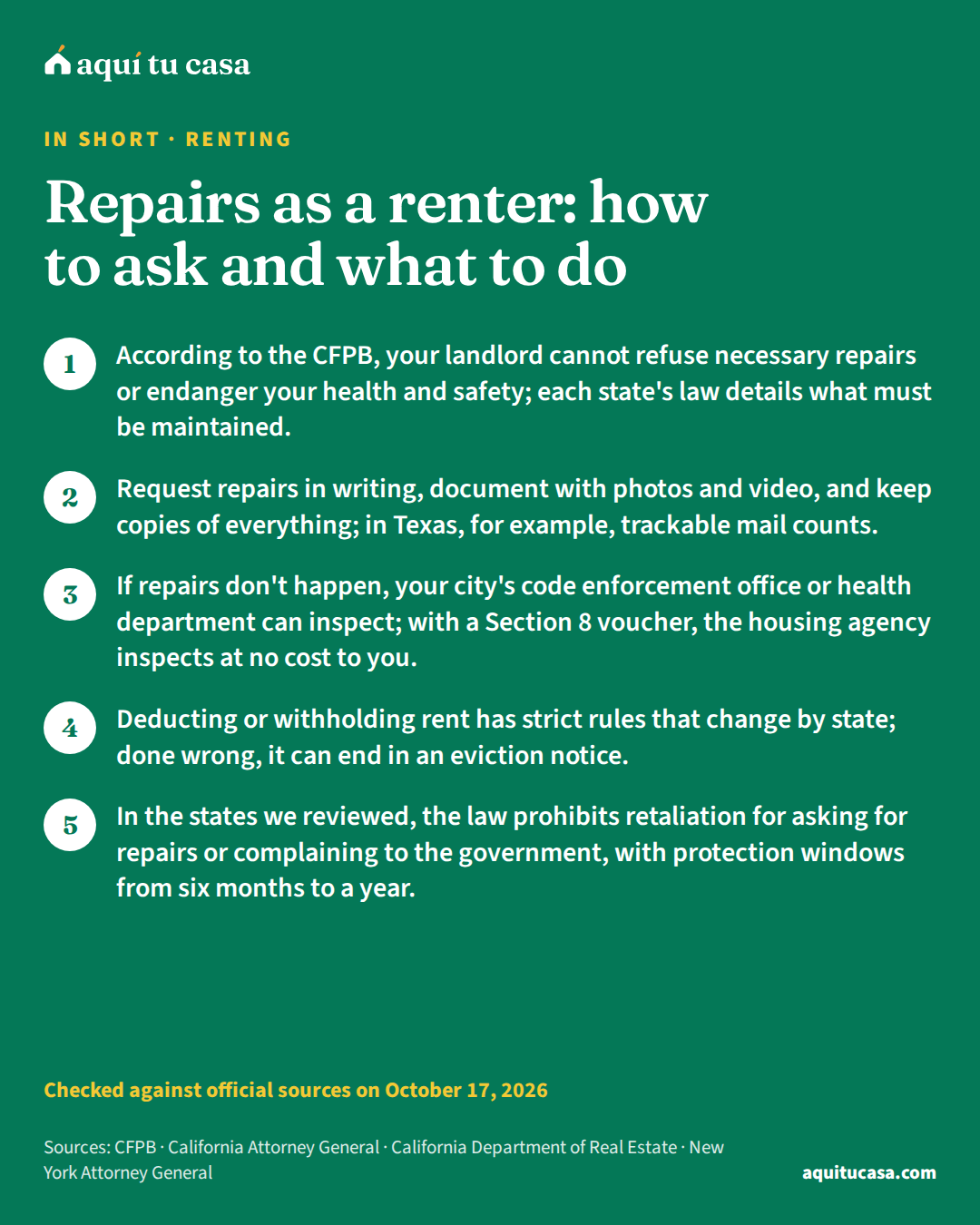
- According to the CFPB, your landlord cannot refuse necessary repairs or endanger your health and safety; each state's law details what must be maintained.
- Request repairs in writing, document with photos and video, and keep copies of everything; in Texas, for example, trackable mail counts.
- If repairs don't happen, your city's code enforcement office or health department can inspect; with a Section 8 voucher, the housing agency inspects at no cost to you.
- Deducting or withholding rent has strict rules that change by state; done wrong, it can end in an eviction notice.
Is this for you?
This guide is for you if…
- You rent a home with a serious problem (no hot water, no heat, leaks, pests, broken locks) and the landlord won't fix it.
- You want to request a repair in a way that leaves a record.
- You are wondering whether you can deduct a repair from the rent or stop paying until it is fixed.
Get direct help first if…
- Your landlord cut off your water or power, or changed the locks to make you leave: read the guide on illegal lockouts and call legal aid today.
- You already got an eviction notice or a lawsuit: start with the guide on what to do if you get an eviction notice, and tell legal aid about the problems with the home.
- You think repairs are being denied because of your national origin, your family or a disability: also read the guide on housing discrimination.
A leak that never gets fixed, a heater that won’t start in winter, roaches that keep coming back, a broken lock. Many families put up with it for months because they don’t know what they can ask for or how to ask without putting their home at risk. This guide explains which repairs fall on the landlord, how to request them so there is a record, who to call if nothing happens and what risks come with shortcuts involving the rent. The rules vary a lot from state to state: we use the CFPB and HUD for federal rules, and several states’ laws and attorneys general as examples, never as a national rule.
- To fix a life-threatening deficiency with a Section 8 voucher, from the housing agency's notice
- 24 hours13
- For other repairs the housing agency confirms, with a voucher
- 30 days13
- The time Texas law presumes is reasonable for a repair
- 7 days5
- Homes where the landlord must disclose known lead and give you a pamphlet
- Before 197815
What the landlord must maintain
Start with the federal baseline. According to the CFPB, your landlord cannot refuse to make necessary repairs, fail to pay for utilities under their control or endanger tenants’ health and safety. Your specific rights are usually spelled out in your leaseleaseA lease, or rental agreement, is the contract in which the owner or landlord gives you the right to live in and use a property for a set period of time in exchange for payment, usually rent. While the lease lasts you have possession, but the landlord still owns the property. The lease says how much you pay and when, who handles maintenance and how the agreement can end. Your rights as a tenant are usually spelled out in the lease and in your state and local laws. Before complaining to the landlord, it helps to read the lease and make sure you are also following the rules you agreed to.See the full definition and in your state or local law.1
Many states call this “habitability.” The California Attorney General explains it this way: the landlord must keep the home safe and well-maintained, with working plumbing, heating, electricity, floors and stairs; a roof and walls that keep water out; windows and doors with working locks; and no roaches, rats or other vermin. Even if you knew the home fell short when you moved in, fixing it is still the landlord’s responsibility.2
In New York, the Attorney General explains the “warranty of habitability”: you have the right to a livable, safe and sanitary apartment even if your lease is only verbal, and a clause asking you to give up that right is void. Its examples include a regular lack of heat or hot water and an insect infestation that is never dealt with.4 Other states write it into their statutes:
| State | What the law says (examples) |
|---|---|
| Arizona | Do whatever is necessary to keep the home fit and habitable; running and hot water, reasonable heat and air-conditioning where installed |
| North Carolina | Keep the home fit and habitable; promptly repair electrical, plumbing and heating if you give written notice, except in emergencies |
| Florida | Comply with building, housing and health codes; outside single-family homes and duplexes, unless agreed in writing, pest control, locks and keys, winter heat, running and hot water |
| Texas | Make a diligent effort to repair conditions that materially affect health or safety, if you give notice and are current on rent |
That is what the laws of Arizona,7 North Carolina,10 Florida6 and Texas5 say. The Texas tenant rights, California and other state pages collect the rules we have verified.
Responsibility runs both ways. In California, tenants must keep the home clean, use appliances properly and avoid damage; a tenant who causes damage may have to pay for it.2 In New York, a problem the tenant caused is not the landlord’s breach.4 That is why a move-in inspectionmove-in inspectionA move-in inspection is the walk-through of the home done before you move in to record in writing the condition of the unit and the equipment that comes with it. In public housing, the federal rule requires the agency and the tenant to inspect it together and sign a statement of its condition. Another inspection is done when you move out. The difference between the condition at move-in and at move-out is the basis for any charge against your deposit, if the damage goes beyond normal wear and tear. That record helps keep you from being charged for damage that was already there.See the full definition helps so much: photos from the day you arrived show what was already wrong.
How to request a repair, step by step
Asking the right way is half the battle. The California Attorney General says you have a right to ask for repairs when there are health or safety problems, and recommends always doing it in writing, documenting with texts, emails, letters, certified mail, photos and videos, and keeping a copy of everything.2
From the leak to the paper trail
1. Document the problem
The day you notice it
Take dated photos and video. Note how long it has been happening and what damage it causes.2
2. Tell the landlord in writing
Right away
Send it to the person or place where you pay rent. Describe the problem and ask for the repair.5
3. Use a delivery method that leaves a trail
When you send it
Certified mail with return receipt, an email or a message you can save. In Texas, trackable mail counts.5
5. If nothing happens, call the inspectors
After that period
Your city's code enforcement office or health department can inspect the home.2
6. Ask before touching the rent
Before you deduct or withhold
Every state has strict rules. A legal aid office can tell you which ones apply.3
Why so much paperwork? Because several rules hinge on the notice. In Texas, the landlord must repair if you notify the person or place where you pay rent, you are current on rent and the problem affects health or safety; for the landlord to be liable to you, you need a second written notice or a first notice sent by trackable mail.5 In North Carolina, the duty to repair electrical, plumbing and heating depends on written notice, except in emergencies.10 In New York, a rent reduction requires that the landlord knew about the defect.4
If it isn’t fixed: your city’s inspectors
According to the California Attorney General, if a landlord refuses to make repairs, tenants should contact their local code enforcement office or health department. Some cities or counties also have a rent board that deals with building health and safety.2 Look for that office on your city’s or county’s website.
Complaining to the government is protected in several states: Florida, Texas and Arizona specifically list a complaint to the building, housing or health code agency among the actions a landlord cannot retaliate against.659 The details are below.
Three paths when repairs don't happen, and their risks
Code or health inspection
Repair and deduct
Before touching the rent, ask a legal aid office which of these paths your state allows.1

Before you deduct or stop paying rent
It is the most common question and the riskiest. The California Department of Real Estate’s guide sums it up: each remedy has its own risks and requirements, so use them carefully. In that state, repair-and-deduct covers serious health and safety defects, the repair can’t cost more than one month’s rent and it can’t be used more than twice in 12 months. If the defects weren’t serious enough, the landlord can sue you to recover what you deducted or serve a 3-day notice to pay rent or quit.3
Other states set other conditions. In Arizona, for minor defects, the cost must be under $300 or half a month’s rent, whichever is greater; you must give written notice, wait ten days, use a licensed contractor and provide an itemized statement.8 In Texas, the deduction can’t exceed one month’s rent or $500, whichever is greater, and if you withhold rent or deduct without following the law, the landlord can recover damages.5 In New York you can withhold rent, but the landlord can sue you for nonpayment and you can countersue.4 In Florida, if you raise any defense other than payment in an eviction, you must deposit the rent with the court during the case.6
If you stop paying without following your state’s rules, you may receive the notice for late rent. This table shows that notice in the states we have verified:
Notice for late rent, by state
| State | Notice for late rent |
|---|---|
| Alabama | 7 business days |
| Alaska | 7 days |
| Arizona | 5 calendar days |
| Arkansas | 3 days |
| California | 3 court days |
| Colorado | 10 days |
| District of Columbia | 10 days |
| Florida | 3 days |
| Georgia | 3 business days |
| Hawaii | 10 calendar days |
| Idaho | 3 days |
| Illinois | 5 days |
| Indiana | 10 days |
| Iowa | 3 days |
| Kansas | 3 calendar days |
| Kentucky | 7 days |
| Louisiana | 5 days |
| Maryland | 10 days |
| Massachusetts | 14 days |
| Michigan | 7 days |
| Minnesota | 14 days |
| Mississippi | 3 days |
| Montana | 3 days |
| Nebraska | 7 calendar days |
| Nevada | 7 judicial days |
| New Hampshire | 7 days |
| New Mexico | 3 days |
| New York | 14 days |
| North Carolina | 10 days |
| North Dakota | 3 days |
| Ohio | 3 days |
| Oklahoma | 5 days |
| Oregon | 10 days |
| Pennsylvania | 10 days |
| Rhode Island | 5 days |
| South Carolina | 5 days |
| Tennessee | 14 days |
| Texas | 3 days |
| Utah | 3 business days |
| Vermont | 14 days |
| Virginia | 14 days |
| Washington | 14 days |
| Wisconsin | 5 days |
| Wyoming | 3 days |
This is the notice you may get if you stop paying without following your state's rules.3 Tap your state for the details. Source: each state's laws
The guide What to do if you get an eviction notice explains each step, and the eviction timeline tool lays out the dates. If you get a notice and the home has health or safety problems, the California Attorney General says it is very important to tell a lawyer or the court.2

Retaliation: you can’t be punished for complaining
Asking for a repair shouldn’t cost you your home. In California, the Attorney General says it is illegal to try to evict a tenant who asked for repairs or to take away services the tenant already had, such as storage or parking.2 Other states put time frames on landlord retaliationlandlord retaliationLandlord retaliation happens when the landlord punishes you for using a legal right. For example, the landlord tries to evict you because you complained in good faith to a government office about health or safety problems in the home, or because you organized with other tenants. Not every state recognizes it, and each one defines and proves it differently. In addition, the federal Fair Housing Act prohibits retaliating against a person for filing a housing discrimination complaint or taking part in that process.See the full definition:
- Texas: for six months after you request a repair or complain to the code office, the landlord cannot evict you, raise your rent or end your lease in retaliation.5
- Arizona: a complaint within the previous six months creates a presumption that the landlord’s action is retaliation.9
- New York: if the landlord sues within a year of a good faith complaint, the law requires the landlord to show it isn’t retaliation.4
- North Carolina: you can defend an eviction by showing it responds to a good faith complaint made in the previous 12 months.11
- Florida: the protection requires that you acted in good faith.6
There is an important limit: in Texas, Arizona, North Carolina and Florida, the law makes clear that an eviction because you owe rent does not count as retaliation.59116 Keep paying while you push for repairs, unless legal aid tells you otherwise.
If the landlord won’t make repairs because of your national origin, your family or a disability, it may be discrimination: the federal fair housing rule prohibits failing or delaying repairs because of race, color, religion, sex, disability, familial status or national origin.16 The guide on housing discrimination explains how to report it.
If you have a Section 8 voucher or live in HUD housing
You have one more route. HUD says to always tell your landlord or manager about the problem, and if you have a housing choice voucherHousing Choice Voucher (Section 8)The Housing Choice Voucher, the program almost everyone calls Section 8, is the country's largest federal rental assistance. HUD pays rental subsidies so eligible families can afford decent, safe and sanitary housing. Local public housing agencies administer it with HUD funds. The family finds its own home on the private market; if the agency approves the unit and the tenancy, it contracts with the owner to pay part of the rent, and the family pays the rest. Waiting lists are usually long and open for limited periods.See the full definition or live in public housing, to contact your public housing agencypublic housing agency (PHA)A public housing agency (PHA) is a state, county, municipal or other governmental entity or public body authorized to operate public housing or rental assistance programs. These are the agencies that locally administer the Housing Choice Vouchers (Section 8) and public housing with HUD funds: they open and manage the waiting lists, review eligibility and income, inspect units and pay the owner its share of the rent. Each county usually has one or several; your page shows the ones serving your area with their phone numbers.See the full definition; if you live in a HUD-assisted building, the Multifamily Housing Complaint Line is (800) 685-8470. HUD adds that all of its assisted properties are inspected to make sure they are decent, safe and sanitary.12 The CFPB also says that if you live in subsidized housing you can report a bad landlord to HUD.1
With a voucher, the federal rule sets deadlines. If you report a life-threatening deficiency to the housing agency, it must inspect and notify the owner within 24 hours, and the owner then has 24 hours to fix it. If it isn’t life-threatening, the agency has 15 days to inspect and the owner 30 days to repair, or any extension the agency approves. The inspection costs you nothing.13
Lead in older homes
If your home was built before 1978, the federal rule requires the landlord, before you sign, to give you an EPA-approved pamphlet about lead and to tell you about any lead-based paint or lead hazards they know of. The rule does not require testing or removing the lead.14 There are exceptions, such as housing for older adults or people with disabilities and studios without a separate bedroom, unless a child under 6 lives or will live there.15 If paint is peeling and you have young children, report it in writing like any other repair and ask your city’s health office.
If this is you
You have a Section 8 voucher
Tell your housing agency too: a life-threatening deficiency is inspected within 24 hours, at no cost to you.13
You have young children in an older home
In homes built before 1978, the landlord must give you the lead pamphlet and tell you what they know.14
You're afraid to complain because of your status
In California, a landlord can never threaten to reveal your immigration status to pressure you or to retaliate.2 In other states, ask legal aid.
You have no water, heat or power
If the landlord cuts services on purpose, it's not a pending repair: read the guide on illegal lockouts. If it's a breakdown, give written notice and call the inspectors.2

Costly mistakes
Mistake: Reporting the repair only by word of mouth.
Instead: Request it in writing and keep a copy; in several states, the rules depend on the notice.2
Mistake: Stopping rent payments to apply pressure.
Instead: Withholding rent has strict rules; done wrong, the landlord can sue you for nonpayment.4
Mistake: Deducting a big repair without checking the cap.
Instead: Caps vary: in California, up to one month's rent; in Texas, one month or $500, whichever is greater.5
Mistake: Not calling the inspectors for fear of retaliation.
Instead: Several states protect complaints to the code or health office.5
Mistake: Moving out without documenting how you left the home.
Instead: Photos and written notices also protect your deposit; damage you cause may be on you.2
The guide to your security deposit explains how to get it back; the one on your lease covers which repair clauses to check; and the one on renters insurance explains what it covers, and what it doesn’t, if damage affects your belongings.
What to do this week
- Take dated photos and video of the problem.2
- Send your request in writing to the person or place where you pay rent, and keep the proof of delivery.5
- If you have a voucher, tell your public housing agency too.12
- If a reasonable time passes with no answer, call the code enforcement office or health department.2
- Before deducting or withholding rent, call a free legal aid office or a housing counselorHUD-approved housing counselorA HUD-approved housing counselor works at an agency HUD has approved to provide housing counseling: independent, expert advice customized to your situation about buying a home, renting, a missed mortgage payment, a foreclosure or credit problems. The agencies usually charge little or nothing; many serve in Spanish and offer the homebuyer education course several assistance programs require. They are not lenders or real estate agents and sell you nothing. Your county page lists the official agencies with phone numbers.See the full definition.1
Your income
Let's do the math
Rent that fits your budget (30% of income)
$2,018
With an income of $6,728 a month. Up to $3,364 would already be a severe burden (50% of income).
Compared with HUD’s Fair Market Rent in the United States
- 2 bedrooms$1,750Fits · 26%Needs $33.65 an hour
The wage needed pays that rent without going over 30% of income, working 40 hours a week all year.
The typical rent households actually pay in the United States is $1,413 a month (Census).
A reference to give you an idea. Each landlord and each program sets its own requirements.
Ready to see the numbers? Find your county here
See how this applies in your county: its loan limits, prices and rents, from the official data.
Printable checklist
Frequently asked questions
Which repairs are the landlord's responsibility?
It depends on your state, but the laws we reviewed all ask, in different words, for a home that is safe and fit to live in. In California that includes working plumbing, heat, electricity, safe floors and stairs, a roof and walls that keep water out, working locks and no roaches or rats. Damage you cause may be your responsibility.
Do I have to request repairs in writing?
It is the safest way. The California Attorney General recommends making requests in writing and keeping a copy. North Carolina's law requires written notice except in emergencies, and in Texas a second written notice or a trackable mailing is what makes the landlord liable. A text message or email also leaves a record.
How long does the landlord have to make repairs?
Each state sets it. In Texas the law presumes seven days is a reasonable time; in Florida and Arizona there are 7- and 10-day periods after written notice for certain remedies. With a Section 8 voucher, if the housing agency confirms a life-threatening deficiency, the owner has 24 hours; otherwise, 30 days.
Can I deduct the repair from my rent?
In some states, with limits and strict steps. In California the repair can't cost more than one month's rent or be used more than twice in 12 months; in Texas the deduction can't exceed one month's rent or $500, whichever is greater; in Arizona you must use a licensed contractor. Done wrong, the landlord can sue you or serve a notice to pay or quit.
Can I stop paying rent until it's fixed?
It's risky. In New York the Attorney General explains you can withhold rent, but the landlord can sue you for nonpayment. In Florida, if you raise any defense other than payment in an eviction, you must deposit the rent with the court. Talk to legal aid first.
Can I be evicted for complaining?
Several states prohibit it as retaliation. In Texas the landlord cannot evict you in retaliation within six months after you request a repair; in New York, if you are sued within a year of your complaint, the landlord must show it isn't retaliation. But in Texas, as in Arizona and North Carolina, an eviction for unpaid rent does not count as retaliation.
Who do I call if the landlord won't fix it?
The California Attorney General says to contact your local code enforcement office or health department. If you have a voucher or live in public housing, HUD says to contact your housing agency; in HUD-assisted buildings, its Multifamily Housing Complaint Line at (800) 685-8470.
Sources
Every figure in this guide comes from one of these official sources. The number next to a sentence leads to the source behind it.
Each source on one line: who publishes it, its title, its address and the date we read it.
- 1. CFPB · Your tenant and debt collection rights · consumerfinance.gov · Accessed October 17, 2026
- 2. California Attorney General · Landlord-Tenant Issues · oag.ca.gov · Accessed October 17, 2026
- 3. California Department of Real Estate · California Tenants: A Guide to Residential Tenants' and Landlords' Rights and Responsibilities · dre.ca.gov · Accessed October 17, 2026
- 4. New York Attorney General · Residential Tenants' Rights Guide · ag.ny.gov · Accessed October 17, 2026
- 5. Texas Legislature · Texas Property Code, Chapter 92, Residential Tenancies · tcss.legis.texas.gov · Accessed October 17, 2026
- 6. Florida Legislature · Florida Statutes, Chapter 83, Part II, Residential Tenancies · leg.state.fl.us · Accessed October 17, 2026
- 7. Arizona Legislature · Ariz. Rev. Stat. §33-1324, Landlord to maintain fit premises · azleg.gov · Accessed October 17, 2026
- 8. Arizona Legislature · Ariz. Rev. Stat. §33-1363, Self-help for minor defects · azleg.gov · Accessed October 17, 2026
See the other 8 sources
- 9. Arizona Legislature · Ariz. Rev. Stat. §33-1381, Retaliatory conduct prohibited · azleg.gov · Accessed October 17, 2026
- 10. North Carolina General Assembly · N.C. Gen. Stat. §42-42, Landlord to provide fit premises · ncleg.gov · Accessed October 17, 2026
- 11. North Carolina General Assembly · N.C. Gen. Stat. §42-37.1, Defense of retaliatory eviction · ncleg.gov · Accessed October 17, 2026
- 12. HUD · Helping Americans · hud.gov · Accessed October 17, 2026
- 13. HUD (Code of Federal Regulations, text on Cornell LII) · 24 CFR §982.405, PHA unit inspection · law.cornell.edu · Accessed October 17, 2026
- 14. EPA and HUD (Code of Federal Regulations, text on Cornell LII) · 40 CFR §745.107, Disclosure requirements for sellers and lessors · law.cornell.edu · Accessed October 17, 2026
- 15. EPA and HUD (Code of Federal Regulations, text on Cornell LII) · 40 CFR §745.103, Definitions (target housing) · law.cornell.edu · Accessed October 17, 2026
- 16. HUD (Code of Federal Regulations, text on Cornell LII) · 24 CFR §100.65, Discrimination in terms, conditions and privileges and in services and facilities · law.cornell.edu · Accessed October 17, 2026
Keep reading
Related guides
If this guide helped, these follow the same path.

Renting 15 minute read
Your lease explained: what to check before you sign
What a lease is, which clauses to read before you sign, the lead paint disclosure, your fair housing rights and where to get free help.
- Your rights are in your lease and in your state or local laws: read them together before you sign.
- Check the rent and due date, fees, the deposit, utilities, repairs, entry, occupants, subletting and how the lease ends.
- A landlord cannot charge fees you did not agree to, refuse necessary repairs or lock you out without a court order.
- Renting Security deposits: how much and how to get yours back What a security deposit is, how much a landlord may charge in your state, what can be deducted, when it must be returned and where to complain if it isn't. 14 minute read
- Renting What to do if you get an eviction notice Notice, lawsuit and the judge's order: what you can do at each moment, where free legal help is and what federal law says about the 30-day notice. 14 minute read
- Renting Illegal lockouts and utility shutoffs by a landlord If your landlord changed the locks, removed your things or cut off water or power to make you leave: what several states' laws say and what to do today. 12 minute read
Tools for this topic
Was this guide useful?
Thank you. Your answer stays in your browser; nothing is sent.