Buying a home with seasonal, tip or cash income
How FHA and Fannie Mae count seasonal and farm work, tips and cash income for a mortgage, and which records to start keeping today.
Verified against official sources on October 31, 2026 9 official sources

Show contents
In short
What you need to know
Quick answer
Yes, you can buy a home if you work by the season, live on tips or are paid in cash, but your income has to be on paper. FHA and Fannie Mae generally ask for two years in the same kind of work and use an average of those years, not your best month. Tips count if you report them: the IRS asks for a daily record and that you tell your employer each month, and Fannie Mae accepts Form 4137 for the tips your employer did not report. Cash income only counts if it appears on your tax returns and in records such as your bank's.
What matters most
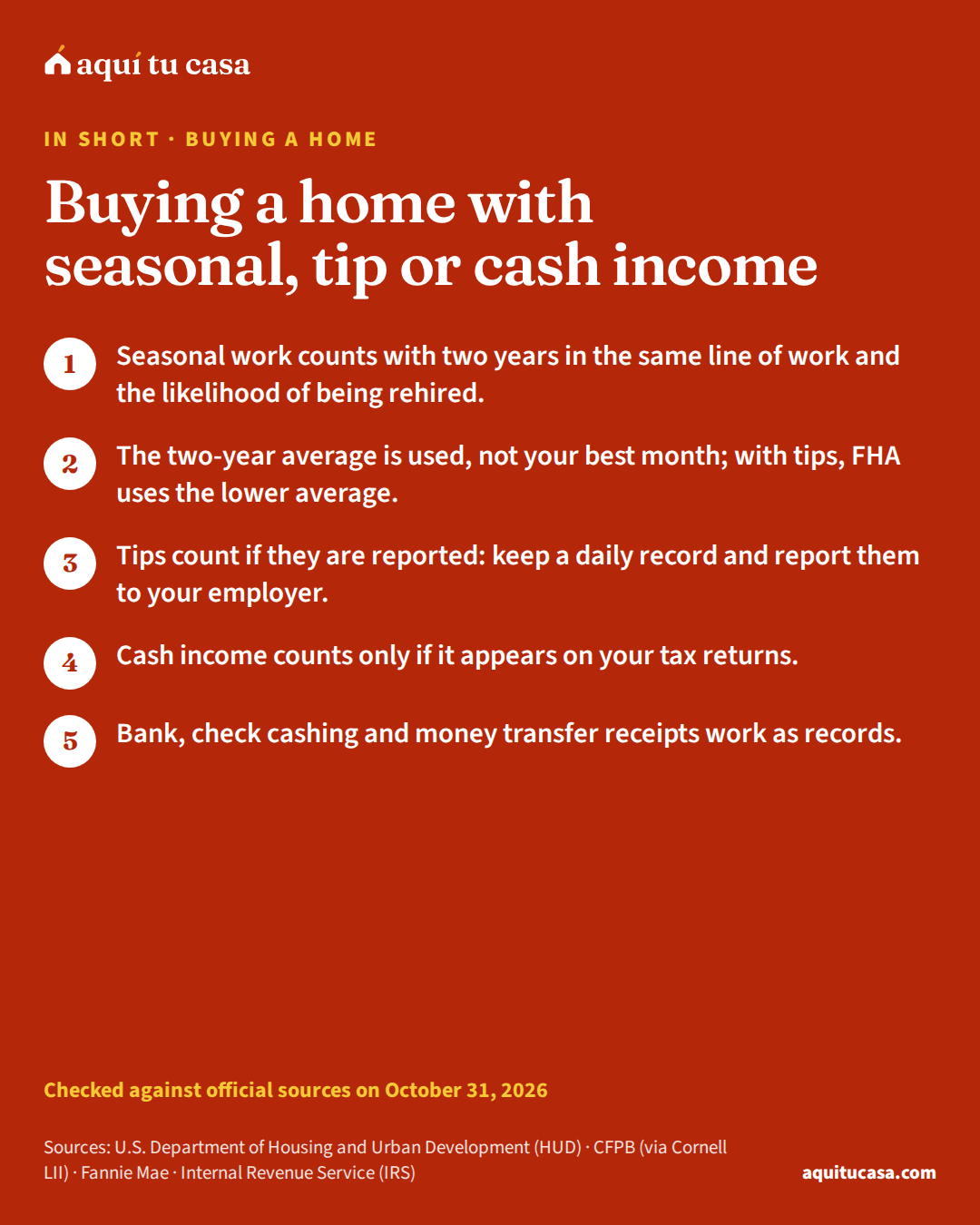
- Seasonal work counts with two years in the same line of work and the likelihood of being rehired.
- The two-year average is used, not your best month; with tips, FHA uses the lower average.
- Tips count if they are reported: keep a daily record and report them to your employer.
- Cash income counts only if it appears on your tax returns.
Is this for you?
This guide is for you if…
- You work by the season: in the fields, construction, a hotel or a packing plant.
- A big part of your income is tips, in cash or on cards.
- You are paid in cash and want that income to count toward buying a home.
Get direct help first if…
- You have your own business and file a Schedule C: read «Buying a home when self-employed» first.
- Your question is about cash savings, not your income: read «Cash savings and your mortgage».
Many families live on work that does not pay the same all year: harvests, construction, seasonal hotels, restaurants. Others get a good part of their income in tips or cash. All of it can count toward a mortgage. The condition is that the lender can verify it on paper. This guide explains what FHA and Fannie Mae ask for, and which records to start keeping today, even if you are not ready to buy yet.
The basic rule: income has to be on paper
Under Regulation Z, the lender must verify your income with reasonably reliable third-party records. It can use an IRS tax-return transcript, and the examples the rule gives include your tax returns, your bank’s records, receipts from check cashing services and receipts from money transfers.2 On an FHA loan, the lender may also only count income that is legally derived and, when required, reported on your tax returnstax returnA tax return is the yearly form you use to report your income to the IRS and figure the tax you owe, so you can pay what is due or get a refund. The federal return for individuals is Form 1040. In general you must file if your gross income is above the minimum the IRS sets for your filing status, or if you had a certain amount of net earnings from self-employment; even when you do not have to, filing can pay off. You need your SSN or ITIN, and those of everyone else on the return, plus documents such as your W-2s and 1099s.See the full definition.1
This matters a lot if you are paid in cash. According to the IRS, income is reported on your return even if it is part-time or temporary, even if you do not get a 1099 or W-2 and even if you are paid in cash.7 What you do not report, the lender cannot use. If you keep your savings in cash, the guide Cash savings and your mortgage explains how to get them into the bank without problems.
If you work by the season or in the fields
Seasonal work is work that is not year round, no matter how many hours a week you work.1 It does not disqualify you. What the programs ask for is stability over the years:
FHA. It counts if you have worked the same line of work for the past two years and are likely to be rehired next season. Income is calculated as the average of the previous two full years. And the unemployment benefits you collect between seasons can also count, if documented for two full years and reasonably likely to continue.1
Fannie Mae. It asks for the verification of employmentverification of employment (VOE)Verification of employment (VOE) is when the lender confirms that you work where your mortgage application says and that you still do. It can use documents you provide, such as pay stubs and W-2 forms, or, with your authorization, check directly with your employer or with an employment verification company. On loans Fannie Mae buys, the lender does a final check (called a verbal VOE) as late in the process as possible, by phone, in writing or through such a company. If you are self-employed, it must confirm that your business exists and is still operating.See the full definition form, or your most recent pay stub and two years of W-2 formsForm W-2Form W-2 (Wage and Tax Statement) is the document your employer must prepare for each employee. It shows the wages you were paid and the taxes withheld from your pay, such as income tax and Social Security and Medicare taxes. The employer files it with the government and sends you a copy, on paper or electronically, in January or February so you can file your tax return. If it does not arrive or has errors, you first ask your employer to fix it; if you still do not get it, the IRS can help you obtain it.See the full definition, plus a call to confirm your job. It requires at least a two-year history and averages the year to date with the two previous years. Seasonal unemployment can count if it is clearly tied to seasonal layoffs, expected to recur and shown on your tax returns.3
If you have your own farm or ranch and file Schedule F, Fannie Mae calculates your farm income from that schedule. The lender can add back deductions such as depreciation, but some farm program payments, co-op distributions or insurance payments may not count if they are one-time.5 If you work in agriculture and are looking for housing, also see the guide to USDA farm labor housing and mutual self-help.
Seasonal income, two programs
HUD Handbook 4000.1
FHA
- Two years in the same line of work and likely to be rehired
- Average of the previous two full years
- Unemployment between seasons can count, with two years documented
Selling Guide B3-3.3-08
Fannie Mae (conventional)
- Minimum two-year history
- Average of the year to date and the two previous years
- Seasonal unemployment: tied to layoffs, recurring and reported
In both cases, what helps most is two years of W-2s or tax returns showing the same pattern.
If you live on tips
For the IRS, all tips are income, cash or not, and subject to federal income tax. “Cash” tips include those paid by check or by credit or debit card. The IRS asks for three things:6
- A daily record of your tips.
- Reporting them to your employer each month, by the 10th of the following month, unless they total less than $20 in the month from that employer.
- Putting all of them on your return. If you did not report some to your employer, you use Form 4137.
That record is what later lets you use them to buy a home. FHA counts tips if you have received them for the past two years and they are likely to continue; it can accept less than two years if it is documented that you earned them consistently for at least one year. It uses the lesser of the two-year average (or the time you have earned them) and the last-year average.1 Fannie Mae asks for the verification of employment or your pay stub and two years of W-2s; if your employer does not report your tips, it accepts two years of returns with Form 4137. It recommends a two-year history, but 12 months may be enough with positive factors. If your income declined, the lender must confirm it has stabilized.4
The IRS also explains that a new law created a deduction for certain cash tips, for 2025 through 2028.6 Ask at a free tax preparation site whether it applies to you; the guide Free tax filing: VITA, TCE and Free File explains where.

Example with real numbers
Why the average matters more than your best month
An example in words, not a real case, of how FHA counts tips.
- Two years ago
- You earned tips all year and reported them
- Last year
- You earned fewer tips
- Two-year average
- Comes out higher because it includes the good year
- Last-year average
- Comes out lower
- What FHA uses
- The lesser of the two averages
That is what HUD Handbook 4000.1 says.1 Use the how-much-house calculator with the lower income, so there are no surprises.
Run it with your numbersHow much house can I afford?Build your file starting today
Even if buying is years away, the papers are gathered today. These steps help:
Your income file, step by step
6. Gather your papers for the lender
Before preapproval
Use the document checklist so you do not forget anything.2
Try it with your numbersDocument checklist
If you do not have a Social Security number, your returns filed with an ITIN are also records of your income: read Filing taxes with an ITIN and why it matters for buying. And if you also have a business of your own, Buying a home when self-employed explains how that income is counted.
What to ask the lender, and warning signs
Before asking for preapproval, ask these questions. The answers tell you whether the lender understands your kind of income:
- Which average will you use? For seasonal work, the two-year one; for tips on FHA, the lower of the two averages.11
- Does my seasonal unemployment count? Ask which papers it needs and for how many years.3
- Will you accept my tips with Form 4137? Fannie Mae allows it when your employer did not report them.4
- Which third-party records do you accept? Bank, check cashing and money transfer receipts are on Regulation Z’s list.2
Be careful if someone tells you that you can “put a higher income” on the application because nobody will check, or offers you employment papers that are not real. Knowingly lying on a mortgage application to influence the lender is a federal crime, with fines of up to one million dollars or up to 30 years in prison.8 If you cannot document enough income with your tax returns, read the guide to non-QM and bank statement loans to learn their costs and risks, or wait until you have two full years of records.
If this is your situation
You are paid in cash
Report it all and deposit it: the lender verifies with tax returns and bank records.12
You have your own farm
Fannie Mae calculates your income from Schedule F and can add back depreciation.5
You work the harvest every year
With two years in the same work and the likelihood of returning, your seasonal income counts.1
You work in a restaurant
Keep your daily record and report your tips to your employer by the 10th.6
You file with an ITIN
Your returns are valid records of your income for the lender.2

Costly mistakes
Mistake: Not reporting your tips to pay less tax.
Instead: What you do not report does not count as income for your loan.16
Mistake: Changing the kind of work you do every season.
Instead: FHA asks for two years in the same line of work to count seasonal income.1
Mistake: Building your budget on your best month.
Instead: The programs use averages; FHA uses the lower one for tips.1
Mistake: Cashing your checks without keeping the receipts.
Instead: Check cashing receipts work as records of your income.2
Mistake: Throwing away your unemployment benefit letters.
Free help
A HUD-approved housing counselor can review your papers and tell you what is missing before you ask for preapproval, often for free.9 The guide HUD-approved housing counselors explains how to find one. And to file your taxes with your tips or seasonal income, you can go to a VITA site. Bring your W-2s, your pay stubs, your tip record and your unemployment benefit letters, so your return shows all your income. That return is the paper the lender will ask you for later.

What to do this week
- Start your daily tip record, if you receive tips.6
- Find your W-2s and tax returns for the last two years.3
- Keep the unemployment benefit letters for each season.1
- Deposit your pay in the bank and keep check cashing and money transfer receipts.2
- Build your document checklist and try the how-much-house calculator.2
- Read the guide to the FHA loan for the rest of the requirements.
Your numbers
The minimum for this loan is 3.5%. More down lowers the monthly payment.
Adjust advanced details
First number: share of income for housing. Second: housing plus debts. Lender references, not fixed rules.
Let's do the math
Estimated top price
National figure$227,000
Limited by the housing payment: at that price it would be about $1,883 a month, 28% of your income.
- By the housing payment (28% of income)Limits you$227,000
- By your total debts (36% of income)$292,000
- By your cash (down payment + closing)$330,500
- Typical home in the United States
- $332,700
- Your cap is 68% of the typical home.
What changes if…?
- …you save $10,000 more$227,000
- …you cut $200 a month in debts$227,000
Your maximum price with four loans
Same income, debts and savings; only the down payment and the loan type change. ITIN uses an example down payment and rate.
| FHA 3.5% | Conventional 5% | Conventional 20% | ITIN 15% (example) | |
|---|---|---|---|---|
| Maximum price | $227,000 | $232,000 | $93,000 | $119,000 |
| Payment per month | $1,883 | $1,882 | $616 | $898 |
Educational estimate, not a pre-approval. Uses example insurance (0.5% of value per year) and example closing costs (3% of price); the tax is the place’s typical rate.
Ready to see the numbers? Find your county here
See how this applies in your county: its loan limits, prices and rents, from the official data.
Printable checklist
Frequently asked questions
I only work six months a year. Can I qualify?
Yes, if you have worked the same line of work for the past two years and are likely to be rehired. FHA uses the average of the previous two full years; Fannie Mae, the year to date plus the two previous years.
Does the unemployment I collect between seasons count?
It can. FHA accepts it if documented for two full years and reasonably likely to continue. Fannie Mae requires it to be tied to seasonal layoffs, to recur and to appear on your tax returns.
My employer does not report my tips. What do I do?
Report them yourself. If you did not report them to your employer, the IRS asks for Form 4137 on your return. Fannie Mae accepts two years of returns with that form instead of the W-2.
I have only had tips for a year. Do they count?
They can. FHA accepts less than two years if it is documented that you earned them consistently for at least one year. Fannie Mae may accept 12 months with positive factors.
I am paid in cash and do not report it all. Can I use that income?
Not what you do not report. On FHA, the lender can only count income reported on your tax returns when required. The IRS says cash income must be reported too.
My tip income went down this year. What happens?
With Fannie Mae, if it declined, the lender must confirm it has stabilized; otherwise it cannot be used. With FHA, the lesser of the two-year average and the last-year average is used.
I have my own farm and file Schedule F. How is it counted?
Fannie Mae calculates your farm income from Schedule F and can add back depreciation and other deductions. Some farm program or insurance payments may not count if they are one-time.
Sources
Every figure in this guide comes from one of these official sources. The number next to a sentence leads to the source behind it.
Each source on one line: who publishes it, its title, its address and the date we read it.
- 1. U.S. Department of Housing and Urban Development (HUD) · Handbook 4000.1, FHA Single Family Housing Policy Handbook · hud.gov · Accessed October 31, 2026
- 2. CFPB (via Cornell LII) · 12 CFR §1026.43, Minimum standards for transactions secured by a dwelling (Regulation Z) · law.cornell.edu · Accessed October 31, 2026
- 3. Fannie Mae · Selling Guide B3-3.3-08, Seasonal Income · selling-guide.fanniemae.com · Accessed October 31, 2026
- 4. Fannie Mae · Selling Guide B3-3.3-02, Bonus, Commission, Overtime, and Tip Income · selling-guide.fanniemae.com · Accessed October 31, 2026
- 5. Fannie Mae · Selling Guide B3-3.6-06, Income or Loss Reported on IRS Form 1040, Schedule F · selling-guide.fanniemae.com · Accessed October 31, 2026
- 6. Internal Revenue Service (IRS) · Tip recordkeeping and reporting · irs.gov · Accessed October 31, 2026
- 7. Internal Revenue Service (IRS) · Gig economy tax center · irs.gov · Accessed October 31, 2026
- 8. U.S. Congress (via Cornell LII) · 18 U.S.C. §1014, Loan and credit applications generally · law.cornell.edu · Accessed October 31, 2026
See the other 1 sources
- 9. Consumer Financial Protection Bureau (CFPB) · Find a housing counselor · consumerfinance.gov · Accessed October 31, 2026
Keep reading
Related guides
If this guide helped, these follow the same path.

Buying a home 13 minute read
Buying a home when you're self-employed: what lenders ask
How lenders check your income if you are self-employed or paid on a 1099: tax returns, Schedule C, IRS transcripts, profit and loss and bank statements.
- Lenders treat you as self-employed if you own 25% or more of a business; the IRS also includes independent contractors and gig workers.
- Expect to be asked for two years of signed tax returns with every schedule, or IRS transcripts, and to sign Form 4506-C.
- The income that counts comes from the net profit on your returns, with some adjustments; FHA uses the lesser of the two-year and the one-year average.
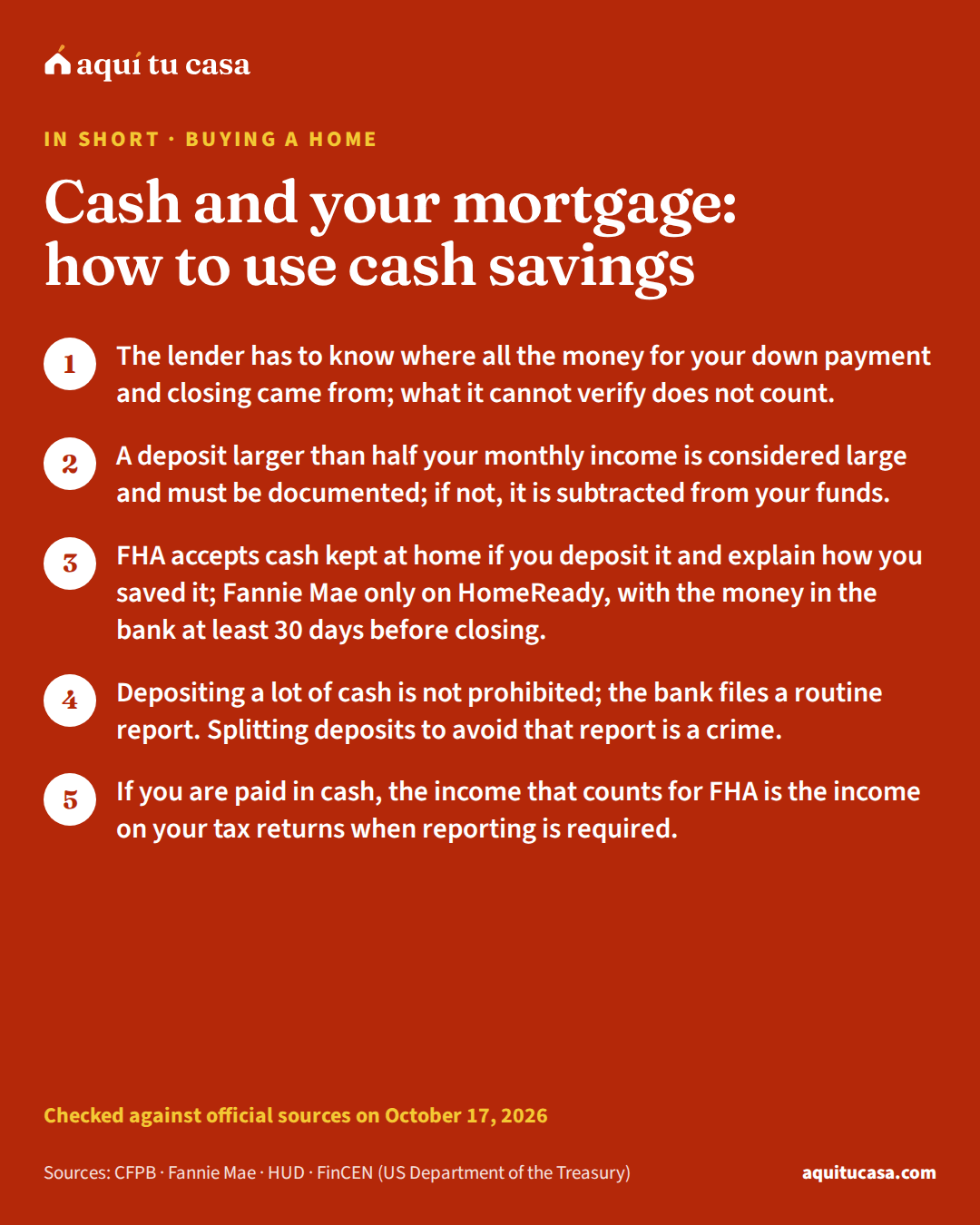
- Buying a home Cash and your mortgage: how to use cash savings If you save or get paid in cash: why the lender asks where your money came from, what a large deposit is and how to move your cash into the bank. 11 minute read
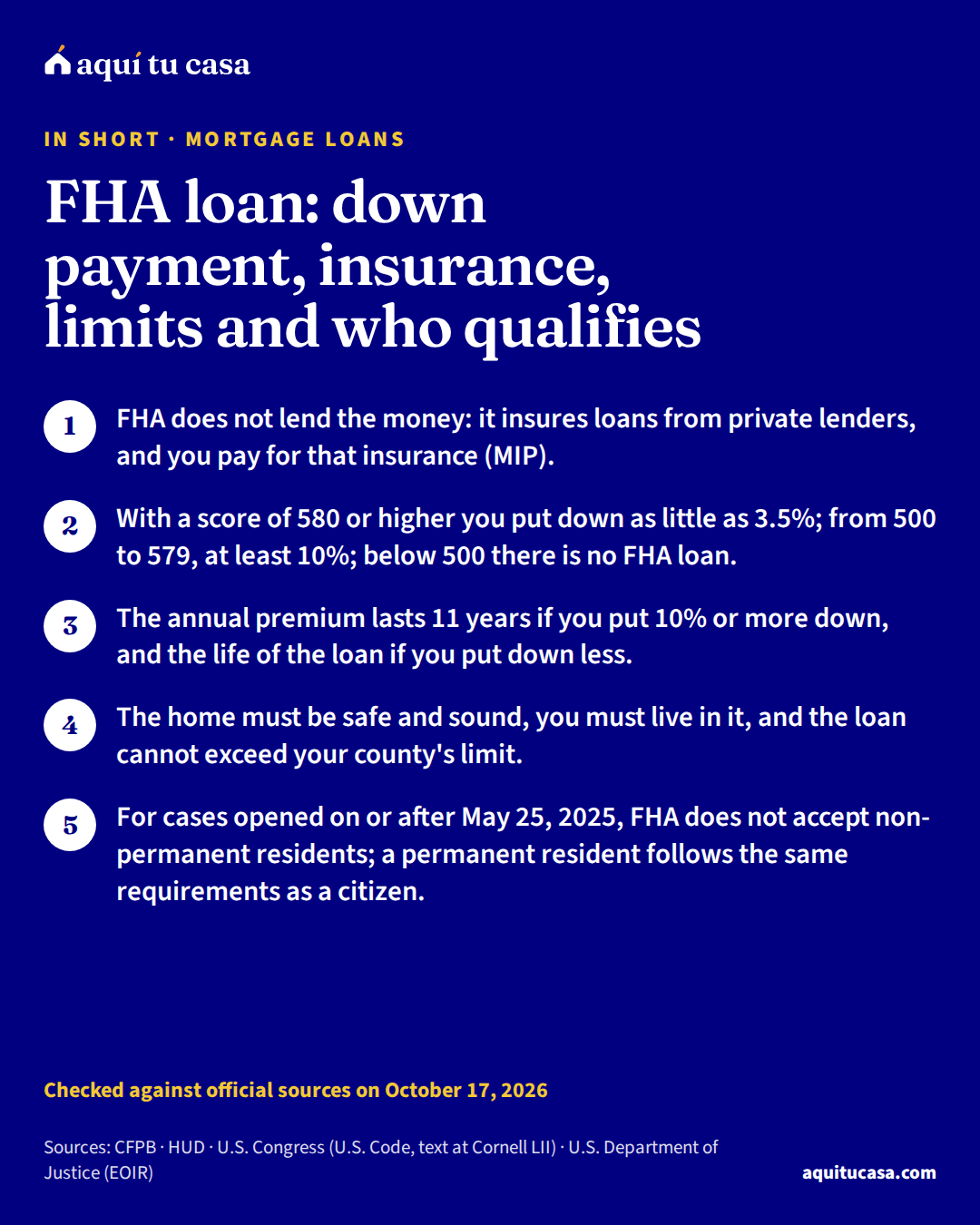
- Mortgage loans FHA loan: down payment, insurance, limits and who qualifies How an FHA loan works: the down payment and credit score HUD requires, MIP mortgage insurance, your county limit, the home and the residency rules. 14 minute read
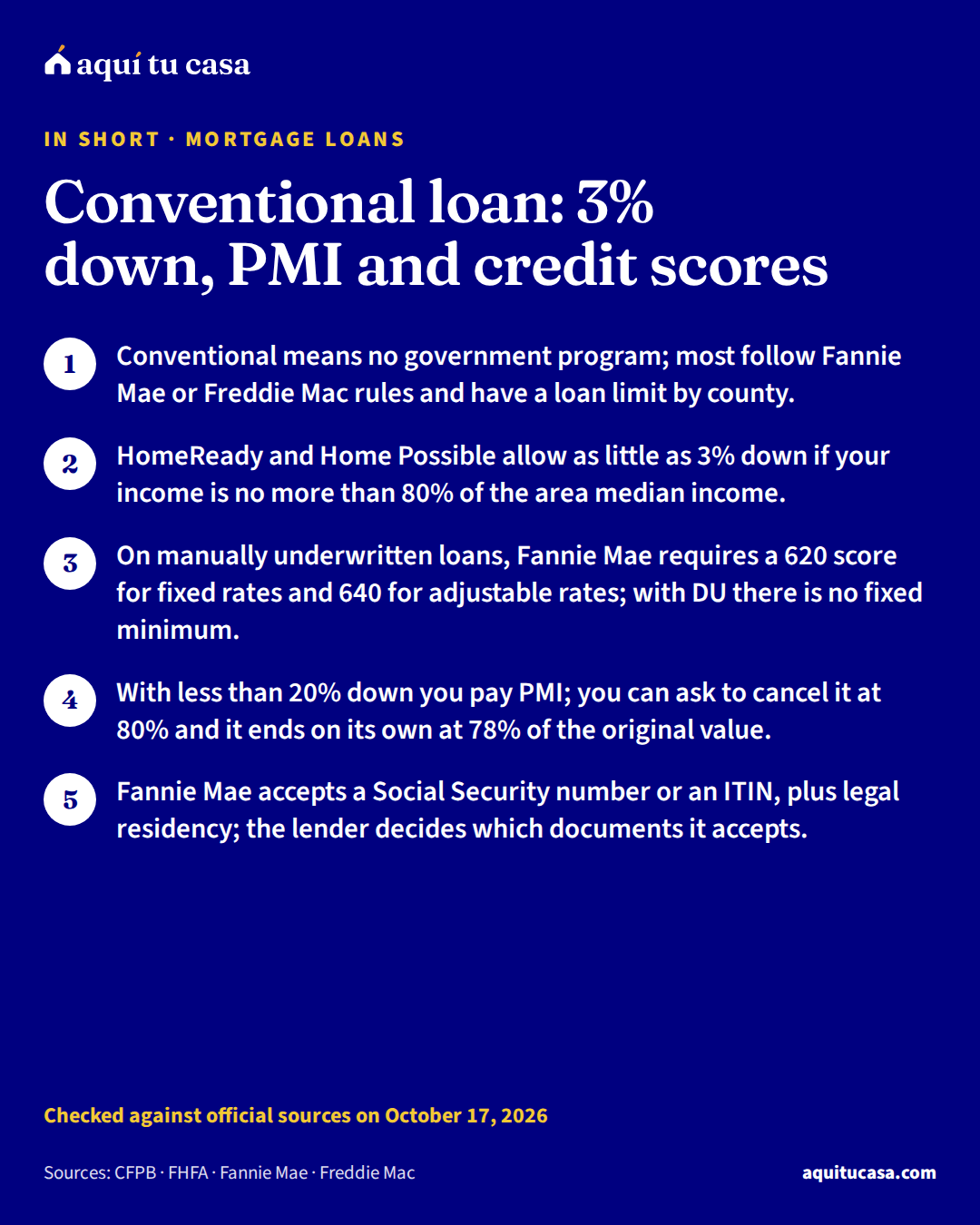
- Mortgage loans Conventional loan: 3% down, PMI and credit scores How a conventional loan works: HomeReady and Home Possible from 3% down, the credit score Fannie Mae requires, PMI and when the law ends it. 12 minute read
Tools for this topic
Was this guide useful?
Thank you. Your answer stays in your browser; nothing is sent.