FHA loan: down payment, insurance, limits and who qualifies
How an FHA loan works: the down payment and credit score HUD requires, MIP mortgage insurance, your county limit, the home and the residency rules.
Verified against official sources on October 17, 2026 13 official sources

Show contents
In short
What you need to know
Quick answer
An FHA loan is made by a private lender and insured by the Federal Housing Administration (FHA), which is part of HUD. With a credit score of 580 or higher, the minimum down payment is 3.5%; from 500 to 579, at least 10%; below 500 you do not qualify. It always carries mortgage insurance: an upfront premium of 1.75% and an annual premium that, with less than 10% down, lasts for the life of the loan. The maximum amount depends on your county, and for case numbers assigned on or after May 25, 2025, FHA accepts only citizens, permanent residents and citizens of Micronesia, the Marshall Islands and Palau.
What matters most
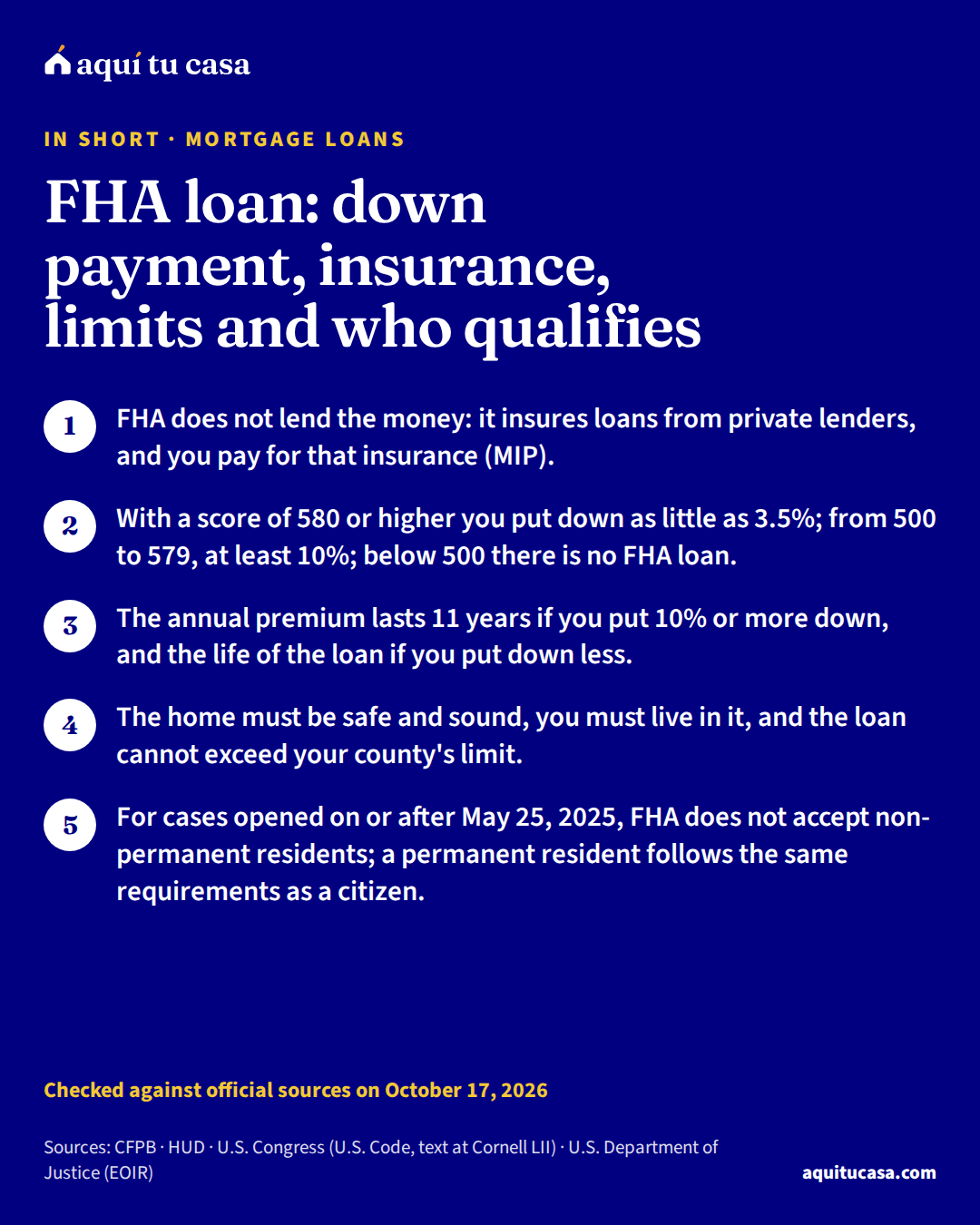
- FHA does not lend the money: it insures loans from private lenders, and you pay for that insurance (MIP).
- With a score of 580 or higher you put down as little as 3.5%; from 500 to 579, at least 10%; below 500 there is no FHA loan.
- The annual premium lasts 11 years if you put 10% or more down, and the life of the loan if you put down less.
- The home must be safe and sound, you must live in it, and the loan cannot exceed your county's limit.
Is this for you?
This guide is for you if…
- You want to buy a home with a small down payment or with a credit score that is not high.
- A lender offered you an FHA loan and you want to understand the mortgage insurance and what it costs.
- You are a citizen or a permanent resident and want to know what you will be asked for.
Get direct help first if…
- You do not have permanent residence or citizenship: FHA no longer accepts non-permanent residents; the ITIN mortgage guide explains other options.
- You want to buy a home to rent out without living in it: FHA requires at least one borrower to live in the home.
- You already have an FHA loan and want to refinance it: start with the refinancing guide.
The FHA loanFHA loanAn FHA loan is a mortgage made by a private lender and insured by the Federal Housing Administration (FHA), an agency of the U.S. government. That insurance protects the lender if you stop paying, which is why the lender can accept a lower down payment and a less-than-perfect credit history than on a conventional loan. Federal law sets the minimum cash investment at 3.5% of the property's value and caps the loan amount at the FHA limit, which changes by county. In exchange for the insurance you pay a mortgage insurance premium.See the full definition is the mortgage many families use for their first home, because it asks for a small down paymentdown paymentThe down payment is the part of the home's price you pay out of your own pocket when you buy; the loan covers the rest. In U.S. Spanish it is also called enganche, cuota inicial or entrada. Each loan type has its own minimum: FHA requires at least 3.5% of the value, VA and USDA loans may require none, and conventional loans ask for more if you want to avoid private mortgage insurance. A larger down payment lowers the loan, the monthly payment and the total interest; many state programs help families put it together.See the full definition and accepts lower credit scores than most conventional loans. Using the rules HUD publishes, this guide explains how much you need to put down, what the insurance costs, how much you can borrow in your county, what gets checked in the home and who can apply today.
What an FHA loan is
The FHA (Federal Housing Administration) does not lend you the money. A private lenderlenderThe lender is the financial institution that lends you the money for your mortgage. The mortgage is the agreement that gives the lender the right to take your home if you do not repay what it lent you. After closing, it is common for another company, the loan servicer, to collect your payments and keep track of the loan; it may be the same company that lent you the money or a different one. On the Loan Estimate, the lender's name appears on the first page, and the last page lists it as "Lender" with its NMLS or license number.See the full definition makes the loan, and FHA regulates and insures it.1 That insurance protects the lender if the homeowner stops paying, and you pay for it. Qualifying standards are generally more flexible than for a conventional loan. FHA is part of HUD, the Department of Housing and Urban Development.2
According to the CFPB, an FHA loan:1
- allows a down payment as low as 3.5%;
- accepts lower scores than most conventional loansconventional loanA conventional loan is any mortgage that is not insured or guaranteed by the federal government: it is not FHA, VA or USDA. The lender, or the companies that buy the loans (Fannie Mae and Freddie Mac), carry the risk. When the amount is within the conforming loan limit the loan is called "conforming"; above it, it is a "jumbo" loan. It usually asks for a higher credit score than an FHA loan and, if your down payment is less than 20% of the price, you are normally required to buy private mortgage insurance (PMI) until you build enough equity in the home.See the full definition;
- has a maximum loan amount that varies by county;
- always carries mortgage insurance.
Is it cheaper than a conventional loan? That depends on you. The CFPB says that with good credit and a medium down payment (10 to 15 percent), FHA tends to cost more. With a lower score or a small down payment, it can often be the cheapest option. There is no fixed rule: get quotes for both and compare the total cost.1 The conventional loan guide covers the other half of that comparison, and mortgage loan types puts all four types side by side.
Down payment and credit score: what HUD requires
HUD publishes its rules in Handbook 4000.1. What you put in from your own pocket is called the Minimum Required Investment (MRI)FHA minimum required investment (MRI)The minimum required investment (MRI) is the cash, or its equivalent, that you must put in yourself when you buy with an FHA loan. Federal law sets it at no less than 3.5% of the property's adjusted value, which is the lower of the purchase price (minus any inducements to purchase) and the appraised value. That money cannot come from the seller, from anyone who benefits from the sale, or from anyone they reimburse. It is not everything you pay: your total required investment also includes the closing costs you pay.See the full definition: at least 3.5% of the “Adjusted Value.” On a purchase, that value is the lower of the price (minus any inducements to buy) and the home’s value. The loan can reach 96.5% of that value, which is the maximum loan-to-value ratioloan-to-value ratio (LTV)The loan-to-value ratio (LTV) compares the amount of your mortgage with the appraised value of the property. It is expressed as a percentage: a loan that covers almost the whole value has a high LTV; one with a large down payment, a low LTV. Lenders use it to measure risk: the higher the LTV, the stricter the requirements and the more likely you will be asked for mortgage insurance. Over time, as you pay down principal or the home gains value, your LTV falls, which can let you cancel PMI on a conventional loan.See the full definition.3 On a $332,700 home, the typical US value, 3.5% comes to $11,645.
Your credit scorecredit scoreA credit score is a number that predicts how likely you are to pay back a loan on time. It is computed from the information in your credit report: whether you pay on time, how much you owe relative to your limits, how long you have used credit and how many new accounts you opened. FICO is one brand of score; VantageScore is another, and each lender decides which one it uses. A higher score usually brings a lower interest rate and more loan options; each program publishes the minimum it accepts. You can check your report for free and dispute errors.See the full definition decides how much you can borrow. HUD uses a “Minimum Decision Credit Score”: if your report shows three scores, the middle one counts; if it shows two different ones, the lower one counts. If several people apply together, the lowest of all counts.3
| Your score | What FHA allows |
|---|---|
| 580 or higher | Maximum financing: down payment from 3.5% |
| 500 to 579 | A loan of up to 90% of the value: you put down at least 10% |
| Below 500 | Not eligible |
| No score (non-traditional or insufficient history) | Maximum financing, but your loan is underwritten by hand |
That table sums up HUD’s handbook.3 If your loan is manually underwrittenmanual underwritingManual underwriting is when the lender evaluates your mortgage application by reviewing your credit, income, savings and debts itself, instead of relying on an automated system's recommendation. Fannie Mae allows both: its automated system (Desktop Underwriter) or manual underwriting. For FHA loans, HUD requires manual underwriting when the automated system returns a “Refer” or the file must be downgraded to a manual review, and also for borrowers with no credit score who use nontraditional credit. The rules can be stricter: at Fannie Mae, the maximum debt-to-income ratio is lower.See the full definition, HUD caps your debt-to-income ratio (DTI)debt-to-income ratio (DTI)Your debt-to-income ratio (DTI) is all your monthly debt payments divided by your gross monthly income, that is, income before taxes. If you pay a certain amount each month across a car, cards, student loans and the mortgage you are asking for, and you earn three times that, your DTI is one third. Lenders use it to measure whether you can manage the payment; each loan type and lender sets its own limit, and assistance programs usually publish theirs. Paying down debt before applying improves your DTI.See the full definition. With a score below 580 or no score, the house payment cannot exceed 31% of your income and your total fixed payments cannot exceed 43%.3 The guide debt-to-income ratio and how to lower it explains the math, and nontraditional credit for a mortgage explains which history counts if you have no score.
Where can the money come from? Your minimum investment cannot come from the seller or anyone who profits from the sale. It can be a gift from a relative, your employer or union, a close friend with a documented interest, a charity or a government homebuying program.3 The gift money from family guide covers the paperwork. Many down payment assistancedown payment assistance (DPA)Down payment assistance (DPA) is money a public or nonprofit program contributes toward your down payment and sometimes your closing costs. Many states, local governments and nonprofits offer programs to make homeownership more affordable; most focus on low- and moderate-income families buying their first home, and some target teachers, firefighters and other public service employees. The help can be a grant you never repay, a second loan with no payments that is forgiven over the years or repaid when you sell, and many can be used with a regular FHA or conventional loan.See the full definition programs can be used with an FHA loan.11
What about closing costs? The seller, the agents and other interested parties can contribute up to 6% of the sales price toward your closing costs, prepaids and points. Anything above that cap counts as an inducement to buy, and none of that money can be used for your minimum investment.3
FHA mortgage insurance (MIP)
Every FHA loan carries mortgage insurancemortgage insuranceMortgage insurance protects the lender, not you, if you fall behind on your loan payments. You pay for it, as part of the monthly payment and sometimes also as an upfront charge. It exists because it lets the lender accept a lower down payment. On an FHA loan it is called the mortgage insurance premium (MIP) and is charged by the FHA; on a conventional loan with a small down payment it is called private mortgage insurance (PMI) and comes from a private insurer. The rules for when you can stop paying it differ in each case.See the full definition, called MIPFHA mortgage insurance premium (MIP)The FHA mortgage insurance premium (MIP) is what you pay for the insurance the FHA requires on all of its loans. That insurance protects the lender, not you, if you fall behind. It has two parts: an upfront premium (upfront MIP or UFMIP), paid with your closing costs or added to the loan, and an annual premium collected in your monthly payment. Federal law authorizes HUD to charge both and caps them. According to the CFPB, it costs the same no matter your credit score. If you add the upfront premium to the loan, the loan amount and the total cost go up.See the full definition. The CFPB points out that it protects the lender, not you, and that it raises the cost of your loan.6 It has two parts:
- Upfront premium (UFMIP). It is 1.75% of the base loan amount.4 It can be added to the loan,3 but then the loan amount and the total cost go up.6
- Annual premium. It is paid monthly, inside your payment. Its rate and how long it lasts depend on the loan-to-value ratio, the base loan amount and the term.3
On a loan of more than 15 years whose base amount is at or below HUD’s threshold, the annual premium works like this. HUD set that threshold at the national conforming loan limitconforming loan limitThe conforming loan limit is the maximum mortgage amount Fannie Mae and Freddie Mac may buy from lenders. Those two companies back most conventional loans, so a loan within the limit ("conforming") usually gets better terms than a larger one ("jumbo"). The Federal Housing Finance Agency (FHFA) sets it every year using the formula in the HERA law, and high-cost areas have a higher limit. Each county's FHA loan limit is computed from this number.See the full definition; above it, premiums are higher, and on loans of 15 years or less they are lower.4
| Your down payment | Loan-to-value (LTV) | Annual premium | How long it lasts |
|---|---|---|---|
| 10% or more | 90% or less | 50 basis points (0.50%) | 11 years |
| 5% to under 10% | Above 90% up to 95% | 50 basis points (0.50%) | Life of the loan |
| Under 5% | Above 95% | 55 basis points (0.55%) | Life of the loan |
According to the CFPB, FHA insurance costs the same no matter your score, with only a slight increase if you put down less than 5%. On a conventional loan, private mortgage insurance (PMIprivate mortgage insurance (PMI)Private mortgage insurance (PMI) is a type of mortgage insurance you might be required to buy on a conventional loan when your down payment is less than 20% of the purchase price. It protects the lender, not you, if you stop making payments. It is normally paid monthly as part of your payment, and the cost depends on your credit score and how much you put down. Unlike FHA insurance, PMI can be canceled once your balance falls far enough relative to the home's value; the lender must explain the rules to you.See the full definition) varies with your down payment and score, and for borrowers with good credit it is generally cheaper than FHA’s.6
How long the annual premium lasts, by down payment
Loan-to-value of 90% or less
You put down 10% or more
If you wonder when your FHA insurance ends, the CFPB says to ask your loan servicer.7
Example with real numbers
What an FHA loan costs per month on a typical home
With the typical US home value, the minimum down payment and the average 30-year rate of 7.18% (November 5, 2026).
- Home price (typical US value)
- $332,700
- Minimum down payment (3.5%)
- $11,645
- Upfront premium (1.75%), added to the loan
- $5,618
- Loan with the upfront premium
- $326,674
- Principal and interest per month
- $2,213
- FHA annual premium, the monthly share
- $147
- Property tax and homeowners insurance, per month
- $261 and $139
- Estimated monthly payment
- $2,759
This is an example with national numbers; the homeowners insurance is a sample estimate.43 Your rate, taxes and insurance will differ: enter yours in the calculator.
Run it with your numbersMortgage calculator

How much you can borrow: your county’s FHA limit
The FHA loan limitFHA loan limitThe FHA loan limit is the maximum mortgage amount the Federal Housing Administration can insure in a county or metropolitan area. The law computes it from the area's median home price: in general it is 115% of that price, but never less than a national floor (65% of the conforming loan limit) nor more than a national ceiling (150% of that limit). That is why expensive counties have higher limits. There is a separate limit for one-, two-, three- and four-unit homes. HUD publishes the limits every year and we show them for every county.See the full definition is the most FHA will insure in your area. An FHA loan cannot exceed that limit, and under most programs the maximum loan is the lesser of the area limit and the percentage of value HUD allows.3 The law sets it from each area’s prices: for a one-unit home, 115% of the area’s median home price, with a floor and a ceiling set by the same law.8
HUD calculates limits by metropolitan area and county and publishes new limits for each calendar year. Each limit sits at the low-cost area limit, at the high-cost area limit or somewhere in between.3 In the data we publish, the limit for a one-unit home ranges from $541,287 in the lowest-cost counties to $1,299,500 in the highest-cost ones.
If the home has 2 to 4 units (for example, a duplex where you live in one unit and rent the other), the limit is higher. But the building cannot have more than four units, and you must buy all of it.9 Look up your county on our FHA loan limits page, or in the HUD tool the CFPB walks through.9
FHA limit and typical home value, by state
| State | FHA limit (1 unit) | Typical home value |
|---|---|---|
| Alabama | $541,287 | $209,900 |
| Alaska | $541,287 – $596,850 | $352,900 |
| Arizona | $541,287 – $609,500 | $394,500 |
| Arkansas | $541,287 | $188,000 |
| California | $541,287 – $1,249,125 | $734,700 |
| Colorado | $541,287 – $1,249,125 | $539,400 |
| Connecticut | $541,287 – $977,500 | $366,900 |
| Delaware | $541,287 – $630,200 | $352,000 |
| District of Columbia | $1,249,125 | $737,100 |
| Florida | $541,287 – $990,150 | $359,000 |
| Georgia | $541,287 – $718,750 | $303,300 |
| Hawaii | $586,500 – $1,299,500 | $839,100 |
| Idaho | $541,287 – $1,249,125 | $418,600 |
| Illinois | $541,287 | $263,300 |
| Indiana | $541,287 | $218,200 |
| Iowa | $541,287 | $208,000 |
| Kansas | $541,287 | $217,200 |
| Kentucky | $541,287 | $205,600 |
| Louisiana | $541,287 | $216,500 |
| Maine | $541,287 – $615,250 | $296,600 |
| Maryland | $541,287 – $1,249,125 | $419,900 |
| Massachusetts | $541,287 – $1,249,125 | $562,100 |
| Michigan | $541,287 | $231,600 |
| Minnesota | $541,287 – $552,000 | $329,300 |
| Mississippi | $541,287 | $169,800 |
| Missouri | $541,287 | $230,300 |
| Montana | $541,287 – $754,400 | $375,800 |
| Nebraska | $541,287 – $603,750 | $238,600 |
| Nevada | $541,287 – $736,000 | $435,400 |
| New Hampshire | $541,287 – $962,550 | $402,500 |
| New Jersey | $541,287 – $1,249,125 | $454,400 |
| New Mexico | $541,287 – $692,300 | $248,100 |
| New York | $541,287 – $1,249,125 | $423,800 |
| North Carolina | $541,287 – $805,000 | $288,900 |
| North Dakota | $541,287 | $249,900 |
| Ohio | $541,287 – $591,100 | $214,800 |
| Oklahoma | $541,287 | $199,800 |
| Oregon | $541,287 – $762,450 | $477,600 |
| Pennsylvania | $541,287 – $630,200 | $254,500 |
| Puerto Rico | $541,287 – $690,000 | $131,500 |
| Rhode Island | $787,750 | $404,200 |
| South Carolina | $541,287 – $690,000 | $259,000 |
| South Dakota | $541,287 – $541,650 | $257,400 |
| Tennessee | $541,287 – $1,029,250 | $286,700 |
| Texas | $541,287 – $813,050 | $283,800 |
| Utah | $541,287 – $1,163,800 | $489,400 |
| Vermont | $541,287 – $575,000 | $316,600 |
| Virginia | $541,287 – $1,249,125 | $383,700 |
| Washington | $541,287 – $1,063,750 | $564,600 |
| West Virginia | $541,287 – $1,249,125 | $162,600 |
| Wisconsin | $541,287 – $552,000 | $266,500 |
| Wyoming | $541,287 – $1,249,125 | $309,700 |
Where there is a range, it runs from the county with the lowest limit to the one with the highest.3 Source: HUD · Census Bureau (ACS)
The home has to qualify too
On an FHA loan, the appraisalhome appraisalAn appraisal is a written document that gives a professional appraiser's opinion of how much a property is worth. The lender orders it before approving the mortgage, because the home is the loan's collateral and the lender does not want to lend more than it is worth. If the appraisal comes in below the price you agreed, the bank bases the loan on the lower value and you will have to cover the difference, renegotiate the price or walk away if your contract allows it. An appraisal is not an inspection: it measures value, not the home's condition.See the full definition also checks the home. HUD requires every FHA-insured home to be safe, sound and secure: these are the Minimum Property Requirements (MPR). New homes must also meet the Minimum Property Standards (MPS). If the home falls short, the appraiser notes the repairs needed and their estimated cost. If there are defects that cannot be fixed, the lender must reject the home; if they can be fixed, it approves the home only after confirming they were corrected.3
What counts as a defect? Defective construction, ongoing settlement, excessive dampness, leaks, decay, termites and environmental hazards, among others. If the appraiser cannot confirm the home meets the requirements, an inspection by a qualified person may be required: for example, for standing water against the foundation, faulty electrical or plumbing systems, signs of pests, or a leaking or worn-out roof.3
You must live in the home. At least one borrower must move in within 60 days of signing and intend to live there for at least one year. FHA will not insure more than one home as the same person’s principal residence, with exceptions, nor a loan meant to buy investment properties.3
Who can apply today: residency and Social Security
You do not need to be a citizen to get an FHA loan. But each borrower must give the lender evidence of a valid Social Security number, with a few exceptions, such as people who work for the World Bank or a foreign embassy.3
Residency rules changed in 2025. Under Mortgagee Letter 2025-09, for case numbers assigned on or after May 25, 2025, HUD eliminated eligibility for non-permanent residents. Today, besides citizens, these borrowers can qualify:5
- Lawful permanent residents, on the same requirements, terms and conditions as a citizen. Your file must include evidence of your residence, which USCIS provides.
- Citizens of Micronesia, the Marshall Islands and Palau, with evidence of their citizenship.
A Social Security card is not enough to prove your immigration or work status.5 If you only have an ITINITIN (Individual Taxpayer Identification Number)An ITIN is a nine-digit number the IRS, the federal tax agency, issues to people who need a U.S. taxpayer identification number to file taxes and are not eligible for a Social Security number. It is for tax purposes only: it does not authorize you to work in the United States, does not qualify you for Social Security benefits or the Earned Income Tax Credit, and says nothing about your immigration status. You apply with Form W-7, and it expires if it goes unused for several years. Some lenders accept an ITIN for a mortgage.See the full definition, the ITIN mortgages guide explains the options that exist.
If you are buying with family. All borrowers, whether or not they will live in the home, take title, sign the note and sign the mortgage documents. A co-signerco-signerA co-signer is a person who signs another person's loan or credit account to back it up, and by doing so becomes responsible for the debt. If the borrower does not pay, the creditor can collect up to the full debt from the co-signer, plus late fees or collection costs, without first trying to collect from the borrower, and the default may become part of the co-signer's credit record. A federal FTC rule calls for the co-signer to get a written notice explaining these risks before signing. On a mortgage, according to Fannie Mae, a co-signer signs the note and shares liability for the debt with the borrower but has no ownership interest in the home on the title.See the full definition is liable for the debt and signs the note but is not an owner. And a co-borrowerco-borrowerA co-borrower is a person who applies for the mortgage with you, signs the note and is responsible for the debt just as you are. On an FHA loan, all borrowers and co-borrowers, whether or not they will live in the home, must take title in their own name or a living trust, be obligated on the note and sign the security documents. It is not the same as a co-signer: according to Fannie Mae, a co-signer signs the note and is liable for the debt but has no ownership interest on the title. Co-borrowers who will not live in the home have their own rules.See the full definition or co-signer who will not live in the home must be a citizen or have their principal residence in the United States.3 The buying with family guide explains how each person’s income counts.
This section describes the rule in force when we verified this guide. Residency rules can change: check the verification date above.
How to apply for an FHA loan, step by step
From credit score to keys
1. Check your credit
Before you look at homes
Review your reports. If the lender sees three scores, HUD uses the middle one; if it sees two different ones, the lower one.3
Try it with your numbersCredit plan2. Gather your documents
Before you apply
Proof of your Social Security number, pay stubs, W-2 forms and tax returns.3
Try it with your numbersDocument checklist3. Find FHA-approved lenders
Before you make an offer
HUD publishes a list of FHA lenders. Get quotes from several.2
4. Compare Loan Estimates
No later than 3 business days after you apply
Everyone uses the same form: compare the rate, the MIP and the closing costs.10
Try it with your numbersCompare loans5. Make your offer and book your inspection
When you sign the contract
The lender should have given you form HUD-92564-CN at first contact.3
6. The appraisal checks the home
Before closing
If repairs are needed, they must be done before the lender approves the home.3
7. You sign and move in
Within 60 days of signing
At least one borrower must live in the home for at least one year.3
Try it with your numbersClosing costs
To find lenders, the CFPB says HUD publishes a list of FHA lenders and answers questions at (800) 225-5342.2 Ask several for a Loan EstimateLoan EstimateThe Loan Estimate is a three-page form you receive from the lender within days of applying for a mortgage. In the same format at every bank, it sums up the terms of the loan being offered: amount, interest rate, whether the payment can change, the estimated monthly payment with taxes and insurance, the itemized closing costs and how much cash you need at closing. Because every lender uses the same form, it lets you compare offers side by side. It commits you to nothing: requesting one is not accepting the loan.See the full definition: the lender must give it to you within three business days of your application, and getting one does not mean the loan is approved.10 The guides how to choose a mortgage lender and closing costs explained help you compare.

If this is you
You are buying for the first time
Many state and local programs help with the down payment and can be used with FHA.11 Find your state's in assistance programs.
You have no credit score
You can get maximum financing, but your loan is underwritten by hand3 and your payments cannot exceed the 31% and 43% caps.3
You are buying with family
Every borrower goes on the title,3 and a relative can give you the down payment.3
You have an ITIN or a temporary permit
FHA no longer accepts non-permanent residents.5 The ITIN mortgage guide explains other options.
A HUD-approved housing counselorHUD-approved housing counselorA HUD-approved housing counselor works at an agency HUD has approved to provide housing counseling: independent, expert advice customized to your situation about buying a home, renting, a missed mortgage payment, a foreclosure or credit problems. The agencies usually charge little or nothing; many serve in Spanish and offer the homebuyer education course several assistance programs require. They are not lenders or real estate agents and sell you nothing. Your county page lists the official agencies with phone numbers.See the full definition can go over whether an FHA offer fits your goals, often for free or at low cost.13

Common mistakes
Mistake: Thinking FHA lends you the money.
Instead: A private lender makes the loan: compare several offers.1
Mistake: Assuming MIP drops off on its own, like PMI.
Instead: With less than 10% down, the annual premium lasts the life of the loan.4
Mistake: Asking the seller to cover your down payment.
Instead: The seller can help with closing costs, up to 6% of the price, but not with your minimum investment.3
Mistake: Trusting that the appraisal checked everything.
Instead: The appraisal looks for a safe, sound home; get your own inspection too.3
Mistake: Showing your Social Security card as proof of status.
Instead: It is not enough: the lender asks for the permanent residence evidence USCIS provides.5
Mistake: Shopping for homes above your county's limit.
Instead: Check the FHA limit before you make offers.9
What to do this week
- Review your credit reports with the guide how to read your credit report; remember that HUD uses the middle of the three scores the lender sees.3
- Look up your county’s FHA limit on FHA loan limits.3
- Work out your payment with the insurance included in the mortgage calculator.4
- Ask about down payment assistance programs that work with FHA.11
- Get Loan Estimates from several FHA lenders and compare them.10
- If you want to go over your numbers with someone, a HUD-approved housing counselor gives independent advice, often for free or at low cost.13
Your numbers
Starts at the typical home value in the United States. Change it to the price you have in mind.
That is $11,645 (3.5% of the price). The usual minimum for this loan is 3.5%.
This week's average ± a quarter or half point.
National average as of November 5, 2026 (Freddie Mac); your rate may be different.
Adjust advanced details
Let's do the math
Estimated monthly payment
National figure$2,759
at 7.18% · 30 years
- Loan amount
- $326,673
- Total interest
- $470,006
- Paid off in
- November 2056
Includes $5,618 FHA upfront mortgage insurance premium.
Does it fit the income?
Comfortable
up to $1,884 a month
Tight
$1,884 to $2,422 a month
Hard
more than $2,422 a month
Your payment · 41%
Compared with the typical household income in the United States ($80,734 a year). Reference: HUD calls paying more than 30% of income for housing a cost burden.
| Principal & interest | $2,213 |
|---|---|
| Property tax | $261 |
| Home insurance | $139 |
| FHA mortgage insurance (MIP) | $147 |
How does it compare with incomes?
For this payment to be 28% of your income, you'd need to earn about $118,260 a year. With your other debts, to stay under 36%: about $91,980 a year.
You need at least $11,645 for the down payment, plus closing costs.
This is an estimate to give you an idea, not a loan offer. Your real payment depends on your rate, your credit, and the insurance and taxes on the home you buy.
Total monthly payment $2,759; principal and interest $2,213.
Ready to see the numbers? Find your county here
See how this applies in your county: its loan limits, prices and rents, from the official data.
Printable checklist
Frequently asked questions
What is the minimum down payment on an FHA loan?
HUD requires a minimum investment of 3.5% of the home's value if your score is 580 or higher. With a score from 500 to 579, the loan cannot exceed 90% of the value, so you put down at least 10%. On a $332,700 home, the typical US value, 3.5% comes to $11,645, plus closing costs.
What credit score do I need for an FHA loan?
Under HUD's handbook, at 580 or higher you can get maximum financing; from 500 to 579, up to 90% of the value; and below 500 you are not eligible. If you have no credit score, you can still get maximum financing, but your loan is underwritten manually.
Can I get rid of FHA mortgage insurance?
It depends on your down payment. On a loan of more than 15 years, if you put 10% or more down, the annual premium lasts 11 years; if you put down less, it lasts for the life of the loan. The CFPB says FHA rules differ from PMI rules and that questions about your FHA insurance go to your loan servicer.
Can I get an FHA loan with an ITIN or a work permit?
For case numbers assigned on or after May 25, 2025, HUD eliminated eligibility for non-permanent residents. Citizens, permanent residents and citizens of Micronesia, the Marshall Islands and Palau can qualify, and each borrower must show a valid Social Security number. The ITIN mortgage guide explains other options. Rules can change: check the verification date.
What is the most I can borrow with FHA?
It depends on your county. The law sets the limit from each area's median home price, and HUD publishes new limits every year. In our data, the limit for a one-unit home ranges from $541,287 to $1,299,500; look up your county on our FHA loan limits page.
Can I buy a duplex with an FHA loan?
Yes, if the building has four units or fewer, you buy the whole building and you live in one of the units. Limits are higher for multi-unit homes. At least one borrower must move in within 60 days of signing and live there for at least one year.
Can the seller pay my closing costs on an FHA loan?
Yes, up to a point. The seller, agents and other interested parties can contribute up to 6% of the sales price toward your closing costs, prepaids and points. Anything above that cap counts as an inducement, and none of it can go toward your minimum investment.
Can my family give me the down payment?
Yes. HUD accepts gifts from a family member, your employer or union, a close friend with a documented interest, a charity or a government homeownership program. It is money you do not repay; the gift money guide explains the paperwork.
Sources
Every figure in this guide comes from one of these official sources. The number next to a sentence leads to the source behind it.
Each source on one line: who publishes it, its title, its address and the date we read it.
- 1. CFPB · FHA loans · consumerfinance.gov · Accessed October 17, 2026
- 2. CFPB · What is an FHA loan? · consumerfinance.gov · Accessed October 17, 2026
- 3. HUD · FHA Single Family Housing Policy Handbook 4000.1 (issued August 12, 2026) · hud.gov · Accessed October 17, 2026
- 4. HUD · Mortgagee Letter 2023-05: Reduction of FHA Annual Mortgage Insurance Premium (MIP) Rates · hud.gov · Accessed October 17, 2026
- 5. HUD · Mortgagee Letter 2025-09: Revisions to Residency Requirements · hud.gov · Accessed October 17, 2026
- 6. CFPB · What is mortgage insurance and how does it work? · consumerfinance.gov · Accessed October 17, 2026
- 7. CFPB · When can I remove private mortgage insurance (PMI) from my loan? · consumerfinance.gov · Accessed October 17, 2026
- 8. U.S. Congress (U.S. Code, text at Cornell LII) · 12 U.S.C. §1709, Insurance of mortgages (National Housing Act) · law.cornell.edu · Accessed October 17, 2026
See the other 5 sources
- 9. CFPB · What are the FHA loan limits for my county? · consumerfinance.gov · Accessed October 17, 2026
- 10. CFPB · What is a Loan Estimate? · consumerfinance.gov · Accessed October 17, 2026
- 11. CFPB · Special loan programs · consumerfinance.gov · Accessed October 17, 2026
- 12. U.S. Department of Justice (EOIR) · Can Someone Represent You Before EOIR? · justice.gov · Accessed October 17, 2026
- 13. CFPB · Find a Housing Counselor · consumerfinance.gov · Accessed October 17, 2026
Keep reading
Related guides
If this guide helped, these follow the same path.

Mortgage loans 14 minute read
Mortgage loan types: FHA, conventional, VA and USDA
What each mortgage type asks for, what its insurance costs, fixed or adjustable rate, points and APR. A neutral comparison with official sources.
- No loan type is best for everyone: according to the CFPB, each is designed for different situations; if several fit, get several quotes.
- FHA insurance lasts the life of the loan if you put down less than 10%; a conventional loan's PMI ends by law at 78% of the original value, if you are current.
- VA and USDA require no down payment if you qualify; VA charges no monthly insurance and USDA charges guarantee fees.
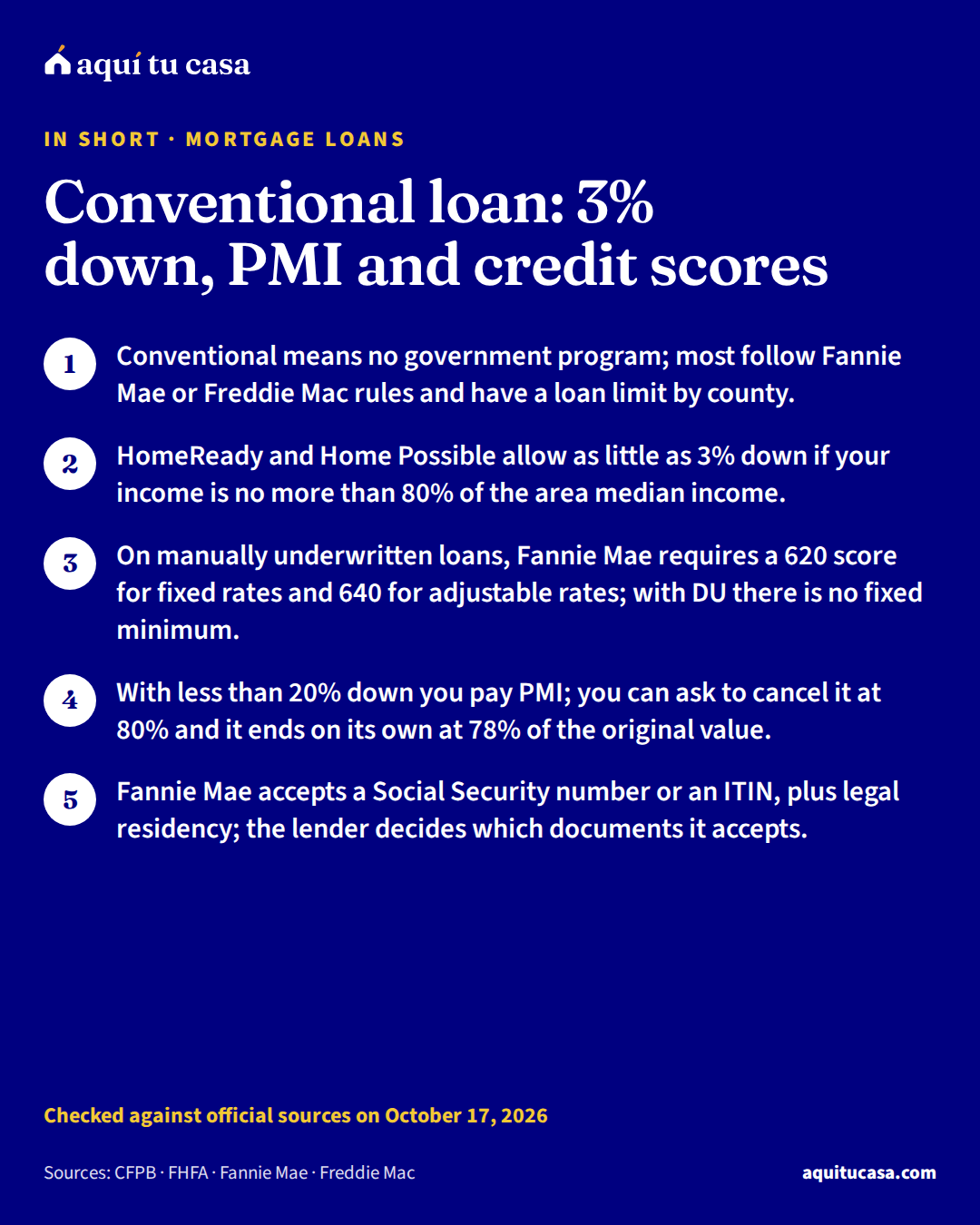
- Mortgage loans Conventional loan: 3% down, PMI and credit scores How a conventional loan works: HomeReady and Home Possible from 3% down, the credit score Fannie Mae requires, PMI and when the law ends it. 12 minute read
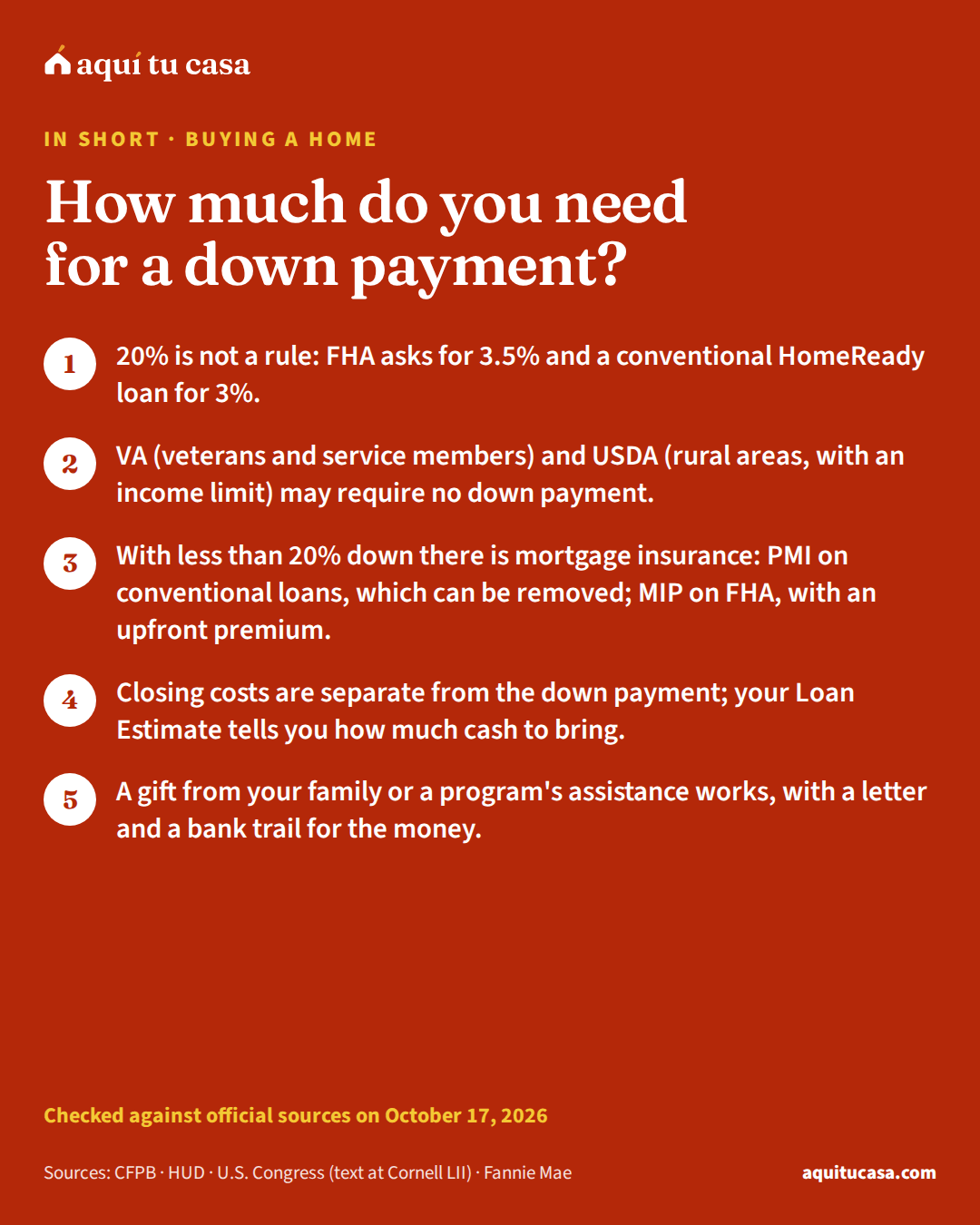
- Buying a home How much do you need for a down payment? 20% is not required: what each loan asks for (FHA, conventional, VA, USDA), what changes with less than 20% down, and where the money can come from. 11 minute read
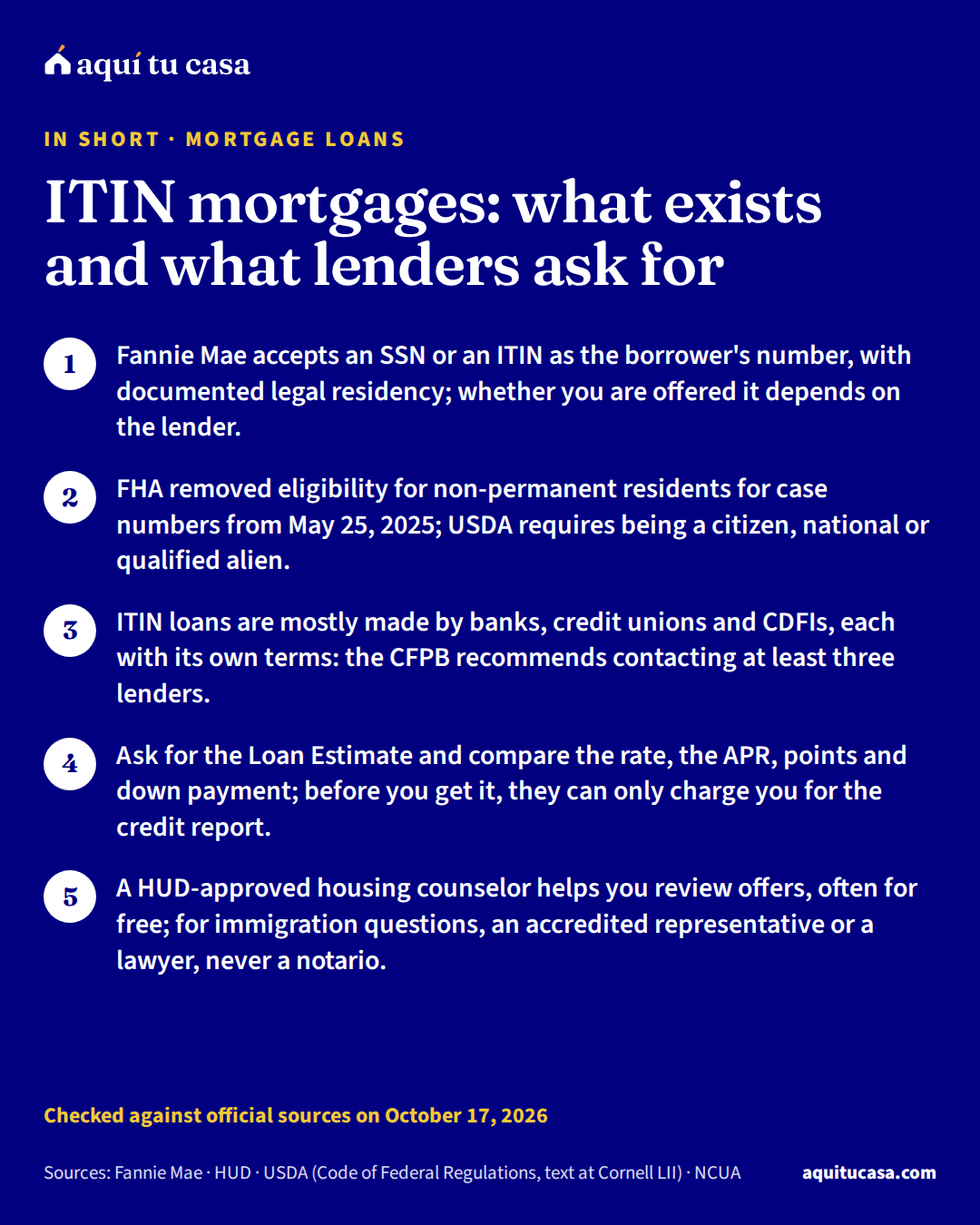
- Mortgage loans ITIN mortgages: what exists and what lenders ask for Which home loans accept an ITIN and which do not: Fannie Mae's rule, what FHA and USDA say, who lends and how to compare offers. 12 minute read
Tools for this topic
Was this guide useful?
Thank you. Your answer stays in your browser; nothing is sent.