Refinancing from an ITIN loan to conventional or FHA
If you bought with an ITIN loan and your situation changed: what Fannie Mae and FHA require to refinance, what to check in your loan, and your rights.
Verified against official sources on October 17, 2026 18 official sources

Show contents
In short
What you need to know
Quick answer
It depends on the program, not just on you. Fannie Mae accepts a Social Security number or an ITIN, plus lawful permanent or non-permanent residence, and the lender decides which documents it accepts. FHA, for case numbers assigned on or after May 25, 2025, accepts only citizens, permanent residents and citizens of Micronesia, the Marshall Islands and Palau, and requires a valid Social Security number. Before you refinance, check whether your current loan has a prepayment penalty, compare at least three Loan Estimates, and remember you have three business days to cancel a refinance with a new lender.
What matters most
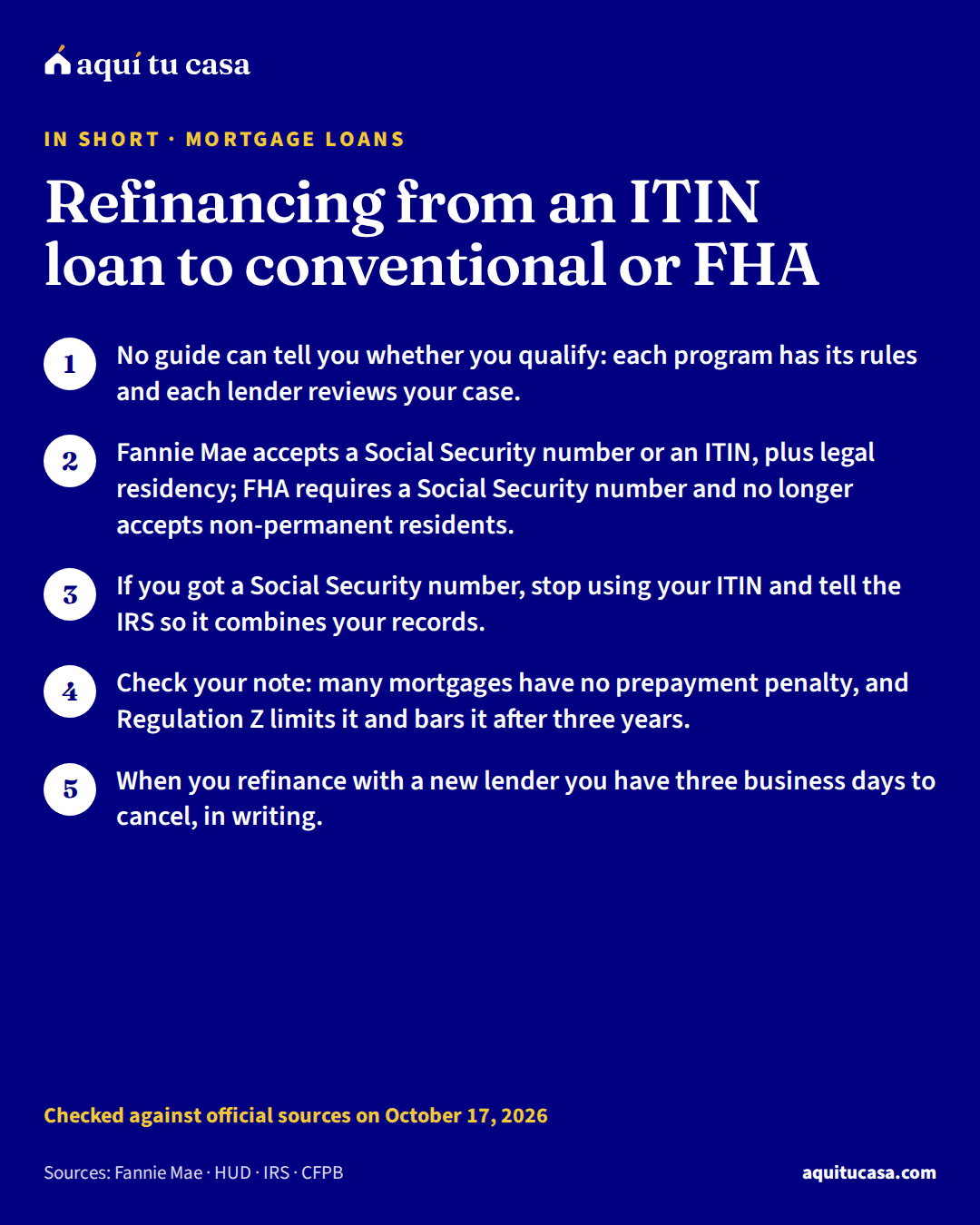
- No guide can tell you whether you qualify: each program has its rules and each lender reviews your case.
- Fannie Mae accepts a Social Security number or an ITIN, plus legal residency; FHA requires a Social Security number and no longer accepts non-permanent residents.
- If you got a Social Security number, stop using your ITIN and tell the IRS so it combines your records.
- Check your note: many mortgages have no prepayment penalty, and Regulation Z limits it and bars it after three years.
Is this for you?
This guide is for you if…
- You bought your home with an ITIN loan and now have a Social Security number or permanent residence.
- You want to know what a conventional loan (Fannie Mae) and an FHA loan require before you apply to refinance.
- You want to check whether your current loan has a prepayment penalty and what rights you have when you refinance.
Get direct help first if…
- You have a question about your immigration case: this guide does not answer it; talk to an attorney or an accredited representative.
- You are already behind on payments: start with the guide on what to do if you cannot pay your mortgage.
- You have not bought a home yet: the ITIN mortgage guide explains how to buy.
This guide is for people who bought their home with an ITINITIN (Individual Taxpayer Identification Number)An ITIN is a nine-digit number the IRS, the federal tax agency, issues to people who need a U.S. taxpayer identification number to file taxes and are not eligible for a Social Security number. It is for tax purposes only: it does not authorize you to work in the United States, does not qualify you for Social Security benefits or the Earned Income Tax Credit, and says nothing about your immigration status. You apply with Form W-7, and it expires if it goes unused for several years. Some lenders accept an ITIN for a mortgage.See the full definition loan and are now in a different situation: a Social Security number, permanent residence or a different income. It explains what a conventional loan and an FHA loan require to refinancerefinanceTo refinance is to take out a new mortgage loan to pay off and replace the one you have. According to the CFPB, common reasons are to lower the interest rate, lower the monthly payment or borrow additional money. When you refinance you usually pay closing costs again. If your payment goes down, the CFPB says to understand how much of the drop comes from a lower rate and how much from a longer loan term. In many refinances you have a right to cancel (right of rescission) until midnight of the third business day, but not if you refinance with the same lender without borrowing more.See the full definition, what to check in your current loan and what rights you have. It does not tell you whether you qualify: that depends on your case, your lender and the rules in force, which can change.
Before you start: what changed and what did not
A change in your immigration status or your ID number does not change your loan by itself. Your current mortgage stays the same until you pay it off, for example by refinancing. What can change are the programs you can apply to for a new loan, because each one has its own rule:
- Conventional loan (Fannie Mae). Each borrower needs a valid Social Security number or an ITIN, plus documented legal residency.1 Fannie Mae accepts lawful permanent and non-permanent residents on the same terms as citizens, and the lender decides which documents it accepts in your case.2
- FHAFHA loanAn FHA loan is a mortgage made by a private lender and insured by the Federal Housing Administration (FHA), an agency of the U.S. government. That insurance protects the lender if you stop paying, which is why the lender can accept a lower down payment and a less-than-perfect credit history than on a conventional loan. Federal law sets the minimum cash investment at 3.5% of the property's value and caps the loan amount at the FHA limit, which changes by county. In exchange for the insurance you pay a mortgage insurance premium.See the full definition loan. For case numbers assigned on or after May 25, 2025, it accepts only citizens, lawful permanent residents and citizens of Micronesia, the Marshall Islands and Palau.6 Each borrower must also show a valid Social Security number.7
If you got a Social Security number: tell the IRS
According to the IRS, the ITIN is for people who need a number for federal taxes but are not eligible for a Social Security number (SSN); for example, someone with a U.S. work visa qualifies for an SSN. You cannot have both.9
When you get your SSN, the IRS asks for two things:9
- Stop using the ITIN and use your SSN for taxes.
- Tell the IRS, by letter or at a local office, so it combines all your tax records under your SSN. The letter says you were assigned an SSN and want your records combined, and includes your name, address, ITIN (with a copy of the CP565 notice, if you have it) and a copy of your Social Security card.
If you do not tell the IRS, you may not get credit for all wages paid and taxes withheld. The IRS voids the ITIN and moves all the information you filed under it to the SSN.9 The guides what is an ITIN and filing taxes with an ITIN explain why your tax returns matter for a loan.
Refinancing into a conventional loan
Fannie Mae has two kinds of refinance. Both require you to meet its ID-number and residency rules.12
Limited cash-out. You take out a new first mortgage on the same home to pay off the one you have. At least one borrower on the new loan must be on title when you apply. Paying off your current loan can include amounts such as a prepayment penalty, and you can finance closing costs, points and prepaids. The cash you receive cannot exceed the greater of 1% of the new loan or $2,000. If the new loan is above 95% of the value, Fannie Mae requires the loan being paid off to be a Fannie Mae loan, except with HomeReady.3
Cash-out. You take a loan larger than your balance and receive the difference. The mortgage you pay off must be at least 12 months old, and at least one borrower must have been on title for six months or more, with exceptions such as an inheritance.4 The guide HELOC vs. cash-out refinance compares the two ways to take money out of your home.
HomeReady. If your income is no more than 80% of the area median income, HomeReady can also be used for a limited cash-out refinance.5 The conventional loan guide explains its rules, credit scores and private mortgage insurance (PMI).
One Fannie Mae detail: if there are Social Security number issues the lender cannot resolve, it must validate the number directly with the Social Security Administration; if it cannot be validated, the loan is not eligible.1

Refinancing into an FHA loan
FHA calls a no cash-out refinance of any mortgage, where all the money pays the home’s mortgages and the costs, a “rate and term” refinance. With a cash-out refinance, the money can be used for anything.7
The two FHA refinances, side by side
No cash out
Rate and term
Both follow FHA's residency and Social Security number rules.67
With FHA you pay mortgage insurance again: an upfront premium of 1.75% of the base loan amount, with exceptions, plus an annual premium.8 The FHA loan guide explains how long that premium lasts depending on your loan-to-value ratio.

Your current loan: the prepayment penalty
Before you apply for a new loan, check the one you have. According to the CFPB, some lenders charge a prepayment penaltyprepayment penaltyA prepayment penalty is a fee some lenders charge if you pay off all or part of your mortgage early. Not every mortgage has one; if yours does, you agreed to it at closing. According to the CFPB, it usually applies if you pay off the whole balance within a certain number of years, for example when you sell or refinance, and sometimes if you pay a large amount at once; it does not normally apply to small extra principal payments. Many states limit these penalties. The Loan Estimate says whether the loan has one, and the details may be in the note or an addendum.See the full definition if you pay off your mortgage early, for example when you sell or refinance, within a certain number of years (usually three or five). If you have one, you agreed to it at closing; not all mortgages have one. The CFPB advises reading the fine print to know when and how much you would pay.10
Regulation Z sets limits. On the consumer loans secured by a home that the rule covers, a penalty is allowed only if the loan has a rate that cannot go up, is a qualified mortgagequalified mortgage (QM)A qualified mortgage (QM) is, according to the CFPB, a loan with less risky features and protections that make it more likely you can afford it. Under the ability-to-repay rule, the lender must make a good-faith effort to determine whether you can repay; if the loan is a QM, the lender is presumed to have followed that rule. In general, a QM cannot have an interest-only period, negative amortization or, with some exceptions, a balloon payment; it cannot exceed the rule's maximum term; it has limits on upfront points and fees; and the lender must verify your income and debts. FHA, VA and USDA loans are qualified loans.See the full definition and is not higher-priced. Even then, it cannot apply more than three years after closing, or exceed 2% of the balance you prepay in the first two years or 1% in the third. And a lender that offers you a loan with a penalty must also offer you one without it.11
What it costs and how to compare
Refinancing brings closing costs again. According to the CFPB, all loans have origination costs; a loan advertised as “no cost” covers them with a higher rate or by adding them to the loan, which means paying more over time or having less equity in your home.14
The CFPB recommends getting Loan EstimatesLoan EstimateThe Loan Estimate is a three-page form you receive from the lender within days of applying for a mortgage. In the same format at every bank, it sums up the terms of the loan being offered: amount, interest rate, whether the payment can change, the estimated monthly payment with taxes and insurance, the itemized closing costs and how much cash you need at closing. Because every lender uses the same form, it lets you compare offers side by side. It commits you to nothing: requesting one is not accepting the loan.See the full definition from at least three lenders, comparing the APRannual percentage rate (APR)The annual percentage rate (APR) is a broader measure of the cost of borrowing money than the interest rate. Besides the interest, it includes certain loan charges, such as discount points and some lender fees, spread over the life of the loan and expressed as a yearly percentage. That is why the APR is almost always a little higher than the interest rate. It is useful for comparing offers: if two loans have the same interest rate but a different APR, the one with the higher APR charges more in fees.See the full definition, which adds the rate, points and other charges, and asking whether you can pay off the new loan early without a penalty.13 The lender must give you the Loan Estimate within three business days of your application, and getting one does not mean you are approved.12 The refinancing your mortgage guide explains how to work out how many months it takes to recover what you pay, and the refinance tool does the math with your numbers.
From a new number to a new loan
1. Sort out your numbers
As soon as you get your SSN
Stop using the ITIN and ask the IRS to combine your tax records.9
2. Check your current loan
Before you ask for offers
Look in your note for a prepayment penalty and how long it applies.10
3. Get at least three Loan Estimates
They arrive no later than 3 business days after you apply
Compare the APR, the closing costs and whether the new loan has a penalty.13
Try it with your numbersCompare loans4. Ask which documents they accept
On the first call
On a conventional loan, the lender decides which residency documents it accepts.2
5. Sign and count three business days
After closing
If you refinance with a new lender, you can cancel in writing within that window.15
Try it with your numbersShould I refinance?
Your right to cancel after signing
On most refinances you have the right of rescissionright of rescissionThe right of rescission lets you cancel certain loans that use your home as collateral, such as a refinance or a home equity loan, after you sign. According to the CFPB, you have until midnight of the third business day (Saturdays count), and that clock starts once three things happen: you sign the promissory note, you receive the Truth in Lending disclosure (usually the Closing Disclosure) and you receive two copies of the notice of your right to cancel. You must give notice in writing. It does not apply to a loan to buy or build your principal home.See the full definition: three business days to cancel after signing, counting Saturdays but not Sundays or holidays. The clock starts once you have signed the note, received the Closing Disclosure and received two copies of the notice of your right to cancel. You must give notice in writing; calling or visiting is not enough. Your money must be returned within 20 calendar days, and you still owe your original loan.15
You do not have that right if you refinance with the same lender and borrow no additional money, or if the lender is a state agency.16

If this is you
You still only have an ITIN
Fannie Mae accepts an ITIN with documented legal residency,1 but each lender decides which documents it accepts.2 The ITIN mortgage guide explains how to ask.
You want to take cash out of your home
With Fannie Mae, your mortgage must be at least 12 months old;4 with FHA, the maximum is 80% of the value.7
Your income is low or moderate
HomeReady can be used for a limited cash-out refinance if your income is no more than 80% of the area median income.5
If you want to go over the numbers with someone, a HUD-approved housing counselorHUD-approved housing counselorA HUD-approved housing counselor works at an agency HUD has approved to provide housing counseling: independent, expert advice customized to your situation about buying a home, renting, a missed mortgage payment, a foreclosure or credit problems. The agencies usually charge little or nothing; many serve in Spanish and offer the homebuyer education course several assistance programs require. They are not lenders or real estate agents and sell you nothing. Your county page lists the official agencies with phone numbers.See the full definition can tell you whether an offer’s terms fit your goals, often for free or at low cost.18

Common mistakes
Mistake: Continuing to use your ITIN after you get a Social Security number.
Instead: Use your SSN and ask the IRS to combine your records.9
Mistake: Refinancing without checking whether your loan has a penalty.
Instead: Look in your note; Regulation Z limits it and bars it after three years.11
Mistake: Showing your Social Security card as proof of status for FHA.
Instead: It is not enough: FHA asks for the permanent residence evidence USCIS provides.6
Mistake: Accepting a “no cost” refinance without looking at the rate.
Instead: Those costs are covered with a higher rate or added to the loan.14
Mistake: Asking a notario whether your status works for a loan.
Instead: Only an attorney or an accredited representative can give you legal advice.17
Mistake: Cancelling the refinance by phone.
Instead: Cancellation must be in writing, within the three business days.15
What to do this week
- If you already have a Social Security number, send the IRS the letter to combine your records and keep a copy.9
- Look in your note and your Closing Disclosure for a prepayment penalty.10
- Ask your loan servicer for your current balance; you need it to compare offers.
- Get Loan Estimates from at least three lenders and compare them with compare loans.13
- If you have questions about your status, talk to an attorney or an accredited representative, not a notario.17
- If you want to go over your numbers with someone, a HUD-approved housing counselor gives independent advice, often free or at low cost.18
Your two loans
Today's loan
The new loan
Adjust advanced details
Your plans
Let's do the math
Your payment would drop by
Enter what you owe, your rate and the time left on today's loan to see the comparison.
This is an educational estimate, not a loan offer. Taxes, insurance and mortgage insurance are not included. Your Loan Estimate has the real figures.
Ready to see the numbers? Find your county here
See how this applies in your county: its loan limits, prices and rents, from the official data.
Printable checklist
Frequently asked questions
Can I refinance my ITIN loan into a conventional loan?
Fannie Mae's Selling Guide accepts a valid Social Security number or an ITIN, plus documented legal residency, and buys loans to lawful permanent and non-permanent residents on the same terms as citizens. The lender decides which documents it accepts, so the answer depends on your case and on each lender. Your credit, income and home value also count.
What about an FHA loan?
For case numbers assigned on or after May 25, 2025, FHA accepts only citizens, lawful permanent residents and citizens of Micronesia, the Marshall Islands and Palau, and each borrower must show a valid Social Security number. A Social Security card alone does not prove status. Rules can change: check the verification date.
What do I do with my ITIN once I get a Social Security number?
According to the IRS, you cannot have both. Stop using the ITIN, use your Social Security number for taxes, and tell the IRS by letter or at a local office so it combines all your tax records under your new number.
Does my ITIN loan have a prepayment penalty?
Not all mortgages have one; if yours does, you agreed to it at closing and it is in your note. Regulation Z allows a penalty only on certain fixed-rate qualified mortgages, and even then it cannot exceed 2% of the balance in the first two years or 1% in the third, or apply after three years. If you are not sure, ask your loan servicer.
Can I take cash out when I refinance?
With a Fannie Mae conventional loan, a cash-out refinance requires your current mortgage to be at least 12 months old and you to have been on title for at least six months. With FHA, you must have lived in the home for the previous 12 months, paid on time and stay at or below 80% of the value. Without cash-out, Fannie Mae limits the cash you receive to the greater of 1% of the loan or $2,000.
Can I change my mind after signing the refinance?
On most refinances you have three business days to cancel, counting Saturdays but not Sundays or holidays. You must give notice in writing. It does not apply if you refinance with the same lender and borrow no additional money. If you cancel, you still owe your original loan.
When is refinancing worth it?
It depends on the rate, the closing costs, any penalty you have and how long you plan to stay. The CFPB recommends getting Loan Estimates from at least three lenders and comparing the APR. A loan advertised as no-cost covers those costs with a higher rate or by adding them to the loan.
Who can help me with questions about my status?
Only an attorney or an accredited representative can give you legal advice about your immigration case; notarios and consultants cannot. For the refinance numbers, a HUD-approved housing counselor gives independent advice, often free or at low cost.
Sources
Every figure in this guide comes from one of these official sources. The number next to a sentence leads to the source behind it.
Each source on one line: who publishes it, its title, its address and the date we read it.
- 1. Fannie Mae · Selling Guide B2-2-01, General Borrower Eligibility Requirements · selling-guide.fanniemae.com · Accessed October 17, 2026
- 2. Fannie Mae · Selling Guide B2-2-02, Non–U.S. Citizen Borrower Eligibility Requirements · selling-guide.fanniemae.com · Accessed October 17, 2026
- 3. Fannie Mae · Selling Guide B2-1.3-02, Limited Cash-Out Refinance Transactions · selling-guide.fanniemae.com · Accessed October 17, 2026
- 4. Fannie Mae · Selling Guide B2-1.3-03, Cash-Out Refinance Transactions · selling-guide.fanniemae.com · Accessed October 17, 2026
- 5. Fannie Mae · Selling Guide B5-6-01, HomeReady Mortgage Loan and Borrower Eligibility · selling-guide.fanniemae.com · Accessed October 17, 2026
- 6. HUD · Mortgagee Letter 2025-09: Revisions to Residency Requirements · hud.gov · Accessed October 17, 2026
- 7. HUD · FHA Single Family Housing Policy Handbook 4000.1 (issued August 12, 2026) · hud.gov · Accessed October 17, 2026
- 8. HUD · Mortgagee Letter 2023-05: Reduction of FHA Annual Mortgage Insurance Premium (MIP) Rates · hud.gov · Accessed October 17, 2026
See the other 10 sources
- 9. IRS · Individual Taxpayer Identification Number (ITIN) · irs.gov · Accessed October 17, 2026
- 10. CFPB · What is a prepayment penalty? · consumerfinance.gov · Accessed October 17, 2026
- 11. CFPB (Code of Federal Regulations, text at Cornell LII) · Regulation Z, 12 CFR §1026.43, Minimum standards for transactions secured by a dwelling · law.cornell.edu · Accessed October 17, 2026
- 12. CFPB · What is a Loan Estimate? · consumerfinance.gov · Accessed October 17, 2026
- 13. CFPB · How do I find the best loan available when I'm shopping for a home mortgage loan? · consumerfinance.gov · Accessed October 17, 2026
- 14. CFPB · Is there such a thing as a no-cost or no-closing cost loan or refinancing? · consumerfinance.gov · Accessed October 17, 2026
- 15. CFPB · Can I change my mind after I sign the loan closing documents for my second mortgage or refinance? What is the right of rescission? · consumerfinance.gov · Accessed October 17, 2026
- 16. CFPB · Are there situations where I would not have a right of rescission? · consumerfinance.gov · Accessed October 17, 2026
- 17. U.S. Department of Justice (EOIR) · Can Someone Represent You Before EOIR? · justice.gov · Accessed October 17, 2026
- 18. CFPB · Find a Housing Counselor · consumerfinance.gov · Accessed October 17, 2026
Keep reading
Related guides
If this guide helped, these follow the same path.

Mortgage loans 12 minute read
ITIN mortgages: what exists and what lenders ask for
Which home loans accept an ITIN and which do not: Fannie Mae's rule, what FHA and USDA say, who lends and how to compare offers.
- Fannie Mae accepts an SSN or an ITIN as the borrower's number, with documented legal residency; whether you are offered it depends on the lender.
- FHA removed eligibility for non-permanent residents for case numbers from May 25, 2025; USDA requires being a citizen, national or qualified alien.
- ITIN loans are mostly made by banks, credit unions and CDFIs, each with its own terms: the CFPB recommends contacting at least three lenders.
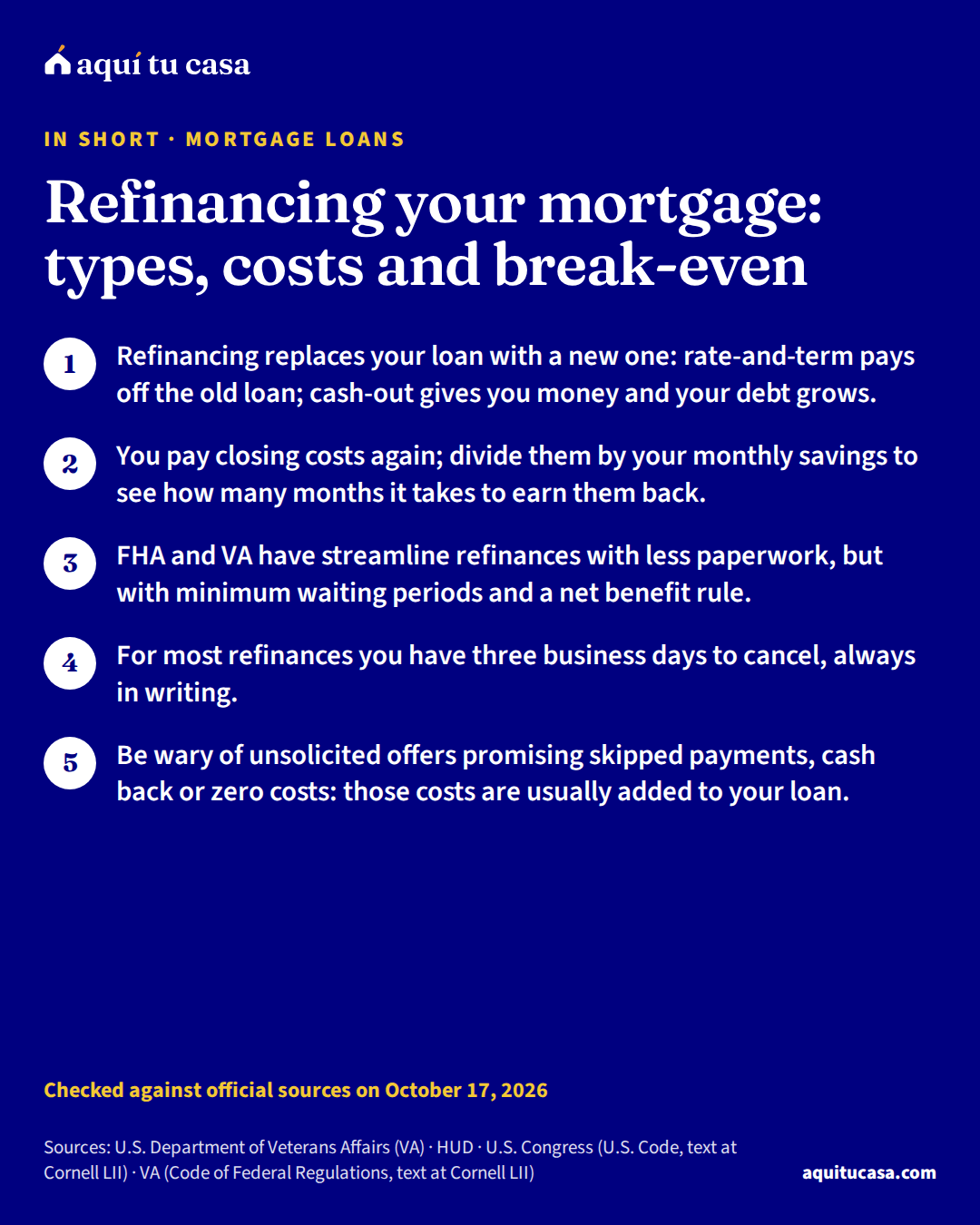
- Mortgage loans Refinancing your mortgage: types, costs and break-even Refinancing explained: rate-and-term vs cash-out, closing costs, the break-even point and FHA and VA streamline refinances. 12 minute read
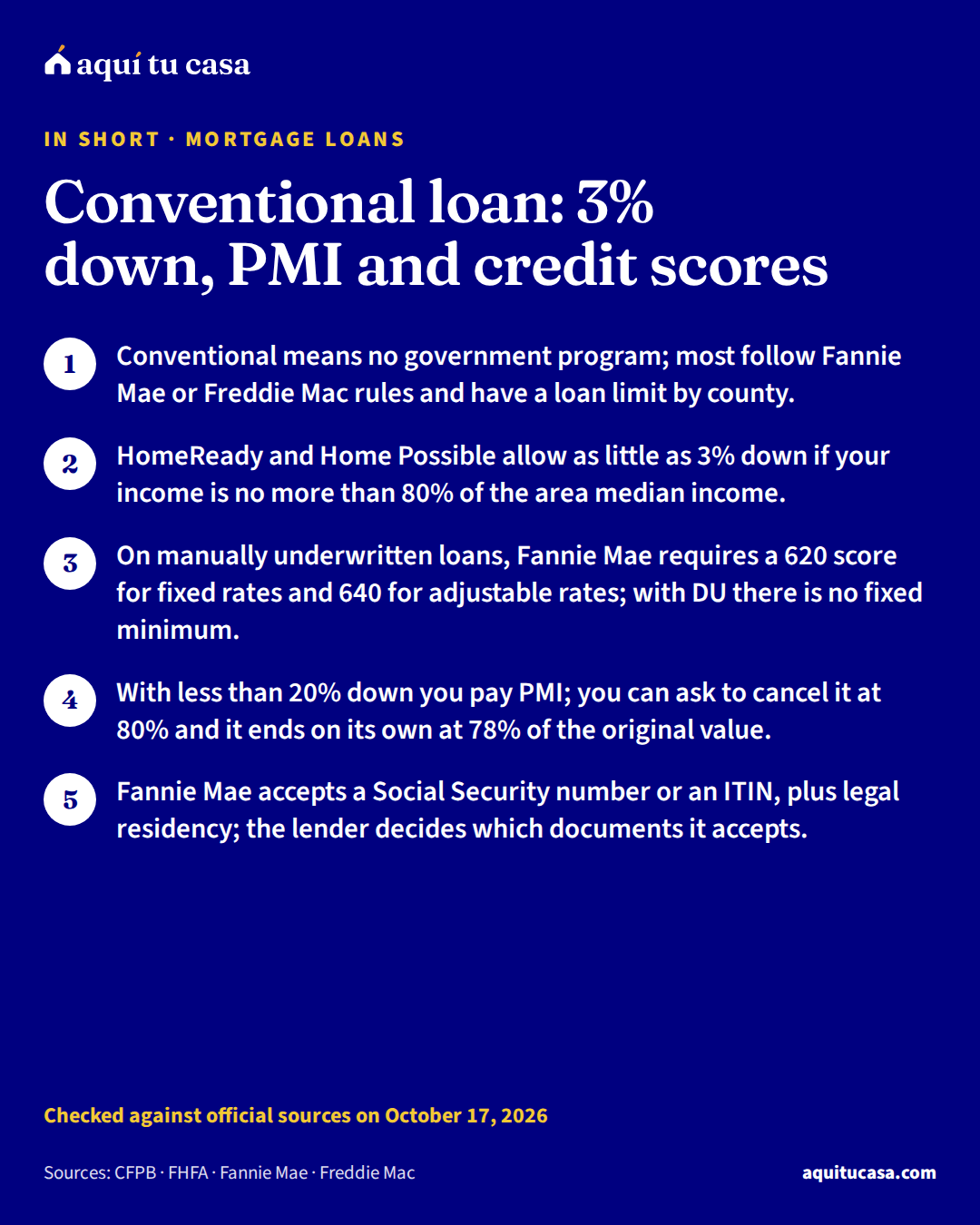
- Mortgage loans Conventional loan: 3% down, PMI and credit scores How a conventional loan works: HomeReady and Home Possible from 3% down, the credit score Fannie Mae requires, PMI and when the law ends it. 12 minute read
- Mortgage loans FHA loan: down payment, insurance, limits and who qualifies How an FHA loan works: the down payment and credit score HUD requires, MIP mortgage insurance, your county limit, the home and the residency rules. 14 minute read

Tools for this topic
Was this guide useful?
Thank you. Your answer stays in your browser; nothing is sent.