Refinancing your mortgage: types, costs and break-even
Refinancing explained: rate-and-term vs cash-out, closing costs, the break-even point and FHA and VA streamline refinances.
Verified against official sources on October 17, 2026 17 official sources

Show contents
In short
What you need to know
Quick answer
Refinancing means replacing your mortgage with a new one on different terms. In a rate-and-term refinance, the new loan only pays off the old one and the costs; in a cash-out refinance, you take money out of your home's value and your debt grows. Both come with closing costs: VA suggests dividing those costs by your monthly savings to see whether it is worth it. FHA and VA offer streamline refinances with less paperwork, and for most refinances you have three business days to cancel after signing.
What matters most
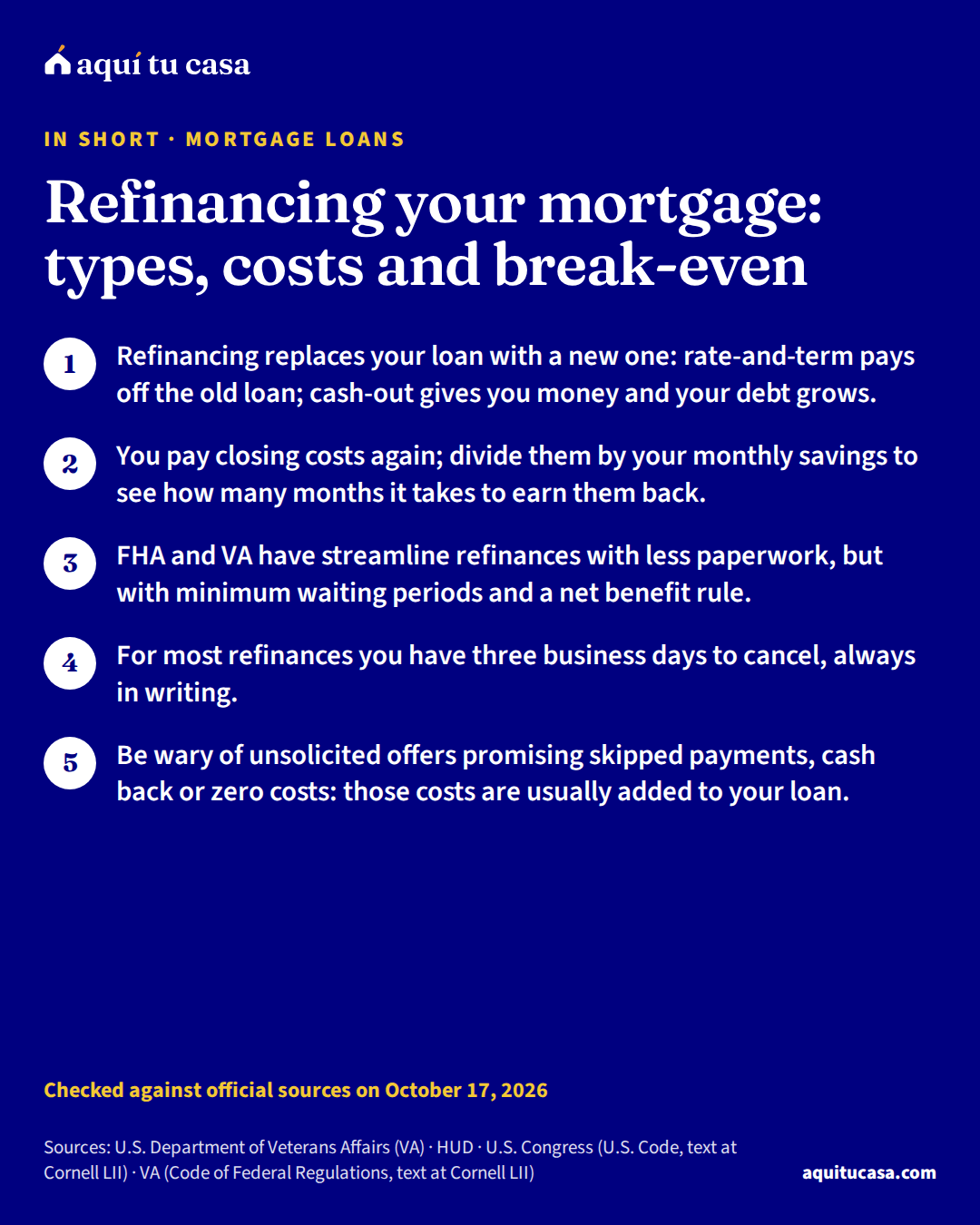
- Refinancing replaces your loan with a new one: rate-and-term pays off the old loan; cash-out gives you money and your debt grows.
- You pay closing costs again; divide them by your monthly savings to see how many months it takes to earn them back.
- FHA and VA have streamline refinances with less paperwork, but with minimum waiting periods and a net benefit rule.
- For most refinances you have three business days to cancel, always in writing.
Is this for you?
This guide is for you if…
- You already have a mortgage and want to know whether swapping it for another one might make sense.
- You have an FHA or VA loan and have heard about streamline refinancing.
- You keep getting refinance offers and want to know what to check before you respond.
Get direct help first if…
- You are behind on your payments: start with the guide on what to do if you can't pay your mortgage, because a refinance is not always possible.
- You want to compare a home equity line of credit (HELOC) with a cash-out refinance: that comparison has its own guide.
- You are 62 or older and thinking about a reverse mortgage: that is a different product with its own guide.
This guide is for anyone who already has a mortgage and is thinking about replacing it. It explains the two main types of refinancingrefinanceTo refinance is to take out a new mortgage loan to pay off and replace the one you have. According to the CFPB, common reasons are to lower the interest rate, lower the monthly payment or borrow additional money. When you refinance you usually pay closing costs again. If your payment goes down, the CFPB says to understand how much of the drop comes from a lower rate and how much from a longer loan term. In many refinances you have a right to cancel (right of rescission) until midnight of the third business day, but not if you refinance with the same lender without borrowing more.See the full definition, the costs you pay again, how to work out how many months it takes to earn them back, how FHA and VA streamline refinances work, and your right to cancel after signing.
What refinancing is and the main types
Refinancing means replacing your current loan with a new one on different terms.1 The new loan’s money pays off the debt you already have and, in some cases, lets you take money out of your home’s value.2
HUD Handbook 4000.1, which holds the rules for FHA loans, separates two broad types:2
- No cash-out. The money only pays off the existing debt and the transaction costs. The most common is the rate-and-term refinance: all the money pays the mortgages on the home and the costs. It is used to change the rate, move from an adjustable rateadjustable-rate mortgage (ARM)An adjustable-rate mortgage (ARM) is a loan whose interest rate can change, usually in step with a market index. It often starts with a fixed rate for an initial period (for example, the first few years) and then adjusts at set intervals, so your payment can go up or down. The contract sets caps on how much the rate can rise at each adjustment and in total. Before accepting one, check on the Loan Estimate how high your payment could reach and whether you could afford it.See the full definition to a fixed ratefixed-rate mortgageA fixed-rate mortgage is a home loan whose interest rate is set when you take out the loan and does not change over its whole life. The part of your payment that covers principal and interest is therefore the same every month, from the first payment to the last; what can change is what you pay for taxes and insurance if they ride in the same payment. It is the most common choice in the United States and the one almost every state assistance program uses. The most common terms are thirty and fifteen years.See the full definition, or change the term.
- Cash-out. You take money out of your home’s value, and that money is not limited to specific purposes. Your debt ends up larger.
Rate-and-term or cash-out, side by side
No cash-out
Rate-and-term
Either way you pay closing costs again: run the numbers before you sign.1
If what you need is money for a repair or to pay off debts, a cash-out refinance is not the only option: the HELOC vs cash-out refinance guide compares the two.
Closing costs come back
A refinance is a new loan, with its own closing costsclosing costsClosing costs are all of the costs you pay on closing day on top of the down payment: lender fees, the appraisal, the credit report, title insurance, the closing agent's fees, any transfer taxes your state or county charges and the first deposits into the escrow account. The lender must itemize them on the Loan Estimate within days of your application and confirm them on the Closing Disclosure before you sign. Some can be paid by the seller, and several state programs help cover them.See the full definition. VA warns that they can add up to thousands of dollars.1 You see them on the Loan EstimateLoan EstimateThe Loan Estimate is a three-page form you receive from the lender within days of applying for a mortgage. In the same format at every bank, it sums up the terms of the loan being offered: amount, interest rate, whether the payment can change, the estimated monthly payment with taxes and insurance, the itemized closing costs and how much cash you need at closing. Because every lender uses the same form, it lets you compare offers side by side. It commits you to nothing: requesting one is not accepting the loan.See the full definition, which the lender must give you within three business days of your application. That form shows the estimated rate, the monthly payment and total closing costs, and every lender uses the same one, so you can compare.9 The closing costs guide explains how to read it.
Some lenders advertise “no closing cost” refinances. According to the CFPB, every loan has costs: the lender covers them with a higher rate in exchange for a credit, or adds them to the loan amount. A higher rate makes you pay more over time, and a larger loan raises your payments and reduces your home equityhome equityHome equity (or equity) is what your home is worth today minus what you still owe on the mortgages on it. You can borrow against that equity: with a home equity loan, which you receive as a lump sum and which usually has a fixed rate; with a HELOC; or with a cash-out refinance. In all of these the home is the collateral and, if you do not repay, the lender could take it. With a reverse mortgage, the balance grows each month and your equity goes down.See the full definition.7
Check your current loan too. Some have a prepayment penaltyprepayment penaltyA prepayment penalty is a fee some lenders charge if you pay off all or part of your mortgage early. Not every mortgage has one; if yours does, you agreed to it at closing. According to the CFPB, it usually applies if you pay off the whole balance within a certain number of years, for example when you sell or refinance, and sometimes if you pay a large amount at once; it does not normally apply to small extra principal payments. Many states limit these penalties. The Loan Estimate says whether the loan has one, and the details may be in the note or an addendum.See the full definition: a fee if you pay off the whole balance early, for example by refinancing, within a certain number of years. Not every mortgage has one, and if yours does, you agreed to it at closing.8
Break-even: how many months to earn back what you pay
Refinancing at a lower rate can lower your monthly payment, but you pay closing costs first. VA suggests a simple calculation: divide your closing costs by how much you expect to save each month, to see whether it is worth it.1 The result is the number of months it takes to earn back what you paid.
Example with real numbers
How to work out your break-even point
No made-up numbers: use the figures on your own Loan Estimate.
- A: Closing costs on the new loan (from your Loan Estimate)
- A
- B: How much lower your monthly payment is with the new loan
- B
- Months to earn back the costs
- A ÷ B
This is the calculation VA suggests.1 On a VA IRRRL, the law requires the result to be no more than 36 months.3 Work out your new payment with your rate and balance.
Run it with your numbersMortgage calculatorFor a VA IRRRL, this idea is the law: VA guarantees the loan only if fees and costs (not counting taxes, escrow amounts or the VA funding fee) are recouped through lower monthly payments within 36 months of the loan being issued.3 For any other refinance, compare that number of months with how long you expect to keep the home and the loan.

The rate you are offered depends on your situation. According to the CFPB, rates can change daily, and a rate lockrate lockA rate lock (or lock-in) means your interest rate will not change between the offer and closing, as long as you close within the agreed time frame and your application does not change. Rates can change daily; if yours is not locked, it can change at any time. Even when locked, it can change if your loan amount, credit score, verified income or appraisal changes. Extending a lock can cost money, and if rates fall you may be stuck with the higher rate. The first page of the Loan Estimate says whether your rate is locked and until when.See the full definition means your rate will not change between the offer and closing as long as you close within the time frame and your application does not change. Locks typically last 30, 45 or 60 days; extending one can be expensive, and if rates drop afterward, a locked rate does not drop with them. Page 1 of the Loan Estimate shows whether your rate is locked and until when.11
FHA and VA streamline refinances
If you already have an FHA or VA loan, there are versions with less paperwork. According to the CFPB, VA loans often offer low-cost streamlined refinances.16
FHA streamline. This is the refinance of a loan that is already FHA-insured, with limited credit documentation; its money must pay off your FHA first mortgage. There are two options: credit qualifying, where the lender reviews your credit and ability to pay but does not order an appraisalhome appraisalAn appraisal is a written document that gives a professional appraiser's opinion of how much a property is worth. The lender orders it before approving the mortgage, because the home is the loan's collateral and the lender does not want to lend more than it is worth. If the appraisal comes in below the price you agreed, the bank bases the loan on the lower value and you will have to cover the difference, renegotiate the price or walk away if your contract allows it. An appraisal is not an inspection: it measures value, not the home's condition.See the full definition; and non-credit qualifying, where it does not review your credit or capacity or order an appraisal.2 To apply, at least six full months must have passed since the first payment due date of your current loan and at least 210 days since it closed, and you must have made at least six payments.2 The lender also has to confirm a net benefit to you: a lower combined rate (the interest rate plus the MIPFHA mortgage insurance premium (MIP)The FHA mortgage insurance premium (MIP) is what you pay for the insurance the FHA requires on all of its loans. That insurance protects the lender, not you, if you fall behind. It has two parts: an upfront premium (upfront MIP or UFMIP), paid with your closing costs or added to the loan, and an annual premium collected in your monthly payment. Federal law authorizes HUD to charge both and caps them. According to the CFPB, it costs the same no matter your credit score. If you add the upfront premium to the loan, the loan amount and the total cost go up.See the full definition rate), a move from adjustable to fixed, or a shorter term. Going from fixed to fixed without shortening the term, the new combined rate must be at least 0.5 percentage points lower.2
VA IRRRL. The interest rate reduction refinance loan (IRRRL) is for people who already have a VA loan and refinance it into another VA loan. You must be able to certify that you live or used to live in the home. It is used to lower your payment with a lower rate or to move from an adjustable to a fixed rate. You get it from a bank, mortgage company or credit union, not from VA, and terms vary from one to another. You can add the costs to the new loan or take a higher rate so the lender pays them, and you may pay the VA funding fee.1 The law also requires that, going from fixed to fixed, the new rate be at least 50 basis points lower, and that you have made six consecutive monthly payments and 210 days have passed since the first payment on your current loan.3
| FHA streamline | VA IRRRL | |
|---|---|---|
| Who it is for | People who already have an FHA loan | People who already have a VA loan |
| Minimum wait | Six months since the first payment and 210 days since closing | Six consecutive payments and 210 days since the first payment |
| Net benefit | Lower combined rate, fixed rate or shorter term | Lower rate and costs recouped within 36 months |
VA’s regulation adds another protection: a lender can skip verifying your income on a streamline only if you are not 30 days or more past due, the balance does not go up (except allowed fees), points and fees do not exceed 3 percent of the loan, and the rate goes down, unless you are moving from adjustable to fixed.4 The VA home loan guide explains the funding fee and its exemptions.
Taking cash out: the cash-out refinance
A cash-out refinancecash-out refinanceIn a cash-out refinance you take out a new mortgage for more than you still owe and receive the difference in cash. It is a way to borrow against the equity in your home. Under Fannie Mae's rules, the new loan is a first mortgage on the same home that pays off any existing mortgages, or a new mortgage on a home that is owned free and clear. According to FHFA's Office of Inspector General, Fannie Mae and Freddie Mac place no restrictions on how the cash is used. Your debt goes up and the home remains the collateral.See the full definition lends you more than you owe and gives you the difference. With FHA, the loan cannot exceed 80 percent of the home’s adjusted value, a home with a mortgage must have at least six months of payments on the current loan, and a home with no mortgage can be refinanced this way too.2
VA also has a cash-out refinance, to take money out of your home’s value (to pay off debt, pay for school or make improvements) or to move a non-VA loan into a VA loan. You need a COE, must meet credit and income standards and must live in the home. The lender asks for recent pay stubs and W-2s, many also for tax returns, and orders an appraisal.5

Your right to cancel after signing
For most refinances you have the right of rescission: three business days to cancel after signing. Saturdays count; Sundays and legal public holidays do not. The clock starts once three things have happened: you signed the promissory notepromissory noteThe promissory note (or simply the note) is the document you sign at closing to promise you will repay the loan to the lender. It describes what you are agreeing to: how much you owe, the interest rate, the payment dates, the total you will pay, the length of the loan, whether the payments can change and where to send them. It is separate from the mortgage or deed of trust, the document that gives the lender the right to take the home if you do not pay. Some terms, such as a prepayment penalty, may be in an addendum to the note. You can ask for copies of the documents before closing to review them.See the full definition, you received the Truth in Lending disclosure (usually the Closing Disclosure) and you received two copies of the notice of your right to cancel.13 You have until midnight of the third business day after the last of these.15
To cancel, notify the lender in writing: a phone call or visit is not enough. You can use the lender’s form or a letter. The money you paid must be returned within 20 calendar days after the lender receives your notice. If you cancel, you still owe your original loan.13 While the period runs, the lender may not hand over the loan money, except into escrow.15
You do not have this right if you refinance with the same lender without borrowing more, or when the lender is a state agency.14 If you refinance with the same lender and do take cash out, the right applies to the new portion.15 If you never received those documents or they had certain errors, you may have up to three years to cancel.13 In that case, free legal aidlegal aidLegal aid is the free civil legal help that nonprofit organizations and their lawyers provide to low-income people in civil, not criminal, matters. In housing, that includes representing families facing eviction or foreclosure, alongside matters such as custody, child support, protection from domestic violence and access to benefits. In the United States, the Legal Services Corporation, created by Congress, funds a nationwide network of these organizations; its finder points you to the one in your area. Each sets its own income limits.See the full definition in your area can review your papers, if you wish.
Offers that sound too good to be true
VA and the CFPB warned service members and Veterans about unsolicited refinance offers that look official. They promise extremely low rates, thousands of dollars in cash back, skipped payments or no out-of-pocket costs. According to that warning, the advertised rate may be for a 15-year or adjustable-rate loan or may require points; VA prohibits advertising skipped payments as a way to get cash in an IRRRL; and those “benefits” are generally added to your loan and increase the balance.6

To get fewer offers in the mail, the warning lists 888-5-OPTOUT (888-567-8688), and for calls, the National Do Not Call Registry at donotcall.gov.6 If you have a VA loan and doubt an offer, you can call VA at (877) 827-3702, Monday through Friday, 8 a.m. to 6 p.m. Eastern.6 The housing scams guide has more warning signs.
If this is you
You have a VA loan
An IRRRL refinances your VA loan with less paperwork, and the law requires its costs to be recouped within 36 months.13
You have an FHA loan
A non-credit qualifying FHA streamline needs no appraisal, but it requires a net benefit and a minimum wait.22
You need money to repair the home
A cash-out refinance is one option; the HELOC vs cash-out guide compares both. With FHA, up to 80% of the adjusted value.2
You are behind on payments
On a VA streamline, the income-verification exemption requires not being 30 days or more past due.4 Start with the can't pay my mortgage guide.

Costly mistakes
Mistake: Answering a letter or call that “looks official” and promises cash or skipped payments.
Instead: Those benefits are generally added to your loan: get the Loan Estimate in writing and compare.6
Mistake: Looking only at the advertised rate.
Instead: Compare the APR on at least three Loan Estimates.10
Mistake: Paying points without checking that the rate goes down.
Instead: Make sure you actually get a lower rate in exchange for the points.10
Mistake: Forgetting the prepayment penalty on your current loan.
Instead: Check whether your mortgage has one before you refinance.8
Mistake: Refinancing without working out how many months it takes to earn back the costs.
Instead: Divide the closing costs by your monthly savings.1
Mistake: Calling the lender to cancel within the three days.
Instead: Cancellation must be in writing; keep a copy.13
What to do this week
- Find your latest mortgage statement and check your rate, balance and whether you have a prepayment penalty.8
- Ask at least three lenders for a Loan Estimate for the same kind of refinance, and compare the APR.10
- Do the break-even math: closing costs divided by your monthly savings.1 The compare loans tool and the mortgage calculator help with the payments.
- If you have an FHA or VA loan, ask about a streamline and check whether the minimum wait has passed.23
- Before you sign, write down the deadline to cancel and have a letter ready in case you change your mind.13
- If you want to go over your options with someone, a HUD-approved housing counselorHUD-approved housing counselorA HUD-approved housing counselor works at an agency HUD has approved to provide housing counseling: independent, expert advice customized to your situation about buying a home, renting, a missed mortgage payment, a foreclosure or credit problems. The agencies usually charge little or nothing; many serve in Spanish and offer the homebuyer education course several assistance programs require. They are not lenders or real estate agents and sell you nothing. Your county page lists the official agencies with phone numbers.See the full definition gives independent advice, often free or at low cost.17 Find one through the HUD-approved counselors guide.
Your numbers
We start with the typical home value in the United States. Enter the price you are looking at.
Adjust advanced details
FHA
Estimated monthly payment
$2,759
Principal and interest, tax, homeowners insurance and mortgage insurance.
- Down payment
- $11,645 (3.5%)
- Mortgage insurance
- $147 a monthFHA annual premium · whole term
- Upfront premium or fee
- $5,618FHA upfront mortgage insurance · added to the loan
- Paid in 5 years
- $141,609
- Balance after 5 years
- $308,088
- County limit
- Find your county to see the limit
Rules and notes
- Minimum down payment of 3.5% with a score of 580 or more; between 500 and 580 at least 10% is required.In effect since September 14, 2016 · Source ↗
- Mortgage insurance: 1.75% upfront plus an annual premium; with less than 10% down it lasts the whole term.In effect since March 20, 2023 · Source ↗
- Only citizens, lawful permanent residents and citizens of the Freely Associated States; non-permanent residents are no longer eligible.In effect since May 25, 2025 · Source ↗
Conventional, 3% down
Estimated monthly payment
$2,747
Principal and interest, tax, homeowners insurance and mortgage insurance.
- Down payment
- $9,981 (3%)
- Mortgage insurance
- $161 a monthPMI (example) · ends around year 13
- Upfront premium or fee
- None
- Paid in 5 years
- $140,854
- Balance after 5 years
- $304,358
- County limit
- Find your county to see the limit
Rules and notes
- Fannie Mae requires a minimum score of 620 on manually underwritten fixed-rate loans; its automated system (DU) sets no fixed minimum.In effect since April 22, 2026 · Source ↗
- Private mortgage insurance (PMI) with less than 20% down; it cancels on its own at 78% of the original value.In effect since January 1, 2024 · Source ↗
- Fannie Mae buys loans to lawful permanent and non-permanent residents on the same terms as citizens; the lender verifies the status.In effect since July 28, 2015 · Source ↗
Conventional, 5% down
Estimated monthly payment
$2,698
Principal and interest, tax, homeowners insurance and mortgage insurance.
- Down payment
- $16,635 (5%)
- Mortgage insurance
- $158 a monthPMI (example) · ends around year 12
- Upfront premium or fee
- None
- Paid in 5 years
- $137,950
- Balance after 5 years
- $298,082
- County limit
- Find your county to see the limit
Rules and notes
- Fannie Mae requires a minimum score of 620 on manually underwritten fixed-rate loans; its automated system (DU) sets no fixed minimum.In effect since April 22, 2026 · Source ↗
- Private mortgage insurance (PMI) with less than 20% down; it cancels on its own at 78% of the original value.In effect since January 1, 2024 · Source ↗
- Fannie Mae buys loans to lawful permanent and non-permanent residents on the same terms as citizens; the lender verifies the status.In effect since July 28, 2015 · Source ↗
Conventional, 20% down
Lowest paymentEstimated monthly payment
$2,202
Principal and interest, tax, homeowners insurance and mortgage insurance.
- Down payment
- $66,540 (20%)
- Mortgage insurance
- None
- Upfront premium or fee
- None
- Paid in 5 years
- $108,184
- Balance after 5 years
- $251,017
- County limit
- Find your county to see the limit
Rules and notes
- Fannie Mae requires a minimum score of 620 on manually underwritten fixed-rate loans; its automated system (DU) sets no fixed minimum.In effect since April 22, 2026 · Source ↗
- Private mortgage insurance (PMI) with less than 20% down; it cancels on its own at 78% of the original value.In effect since January 1, 2024 · Source ↗
- Fannie Mae buys loans to lawful permanent and non-permanent residents on the same terms as citizens; the lender verifies the status.In effect since July 28, 2015 · Source ↗
VA
Estimated monthly payment
$2,702
Principal and interest, tax, homeowners insurance and mortgage insurance.
- Down payment
- $0 (0%)
- Mortgage insurance
- None
- Upfront premium or fee
- $7,153VA funding fee · added to the loan
- Paid in 5 years
- $138,137
- Balance after 5 years
- $320,517
- County limit
- Find your county to see the limit
Rules and notes
- Military service requirements by period of service; you must meet VA's and your lender's credit standards.In effect since September 22, 2026 · Source ↗
- No down payment as long as the price is not above the appraisal; funding fee of 2.15% on first use with no down payment (exempt: zero). No monthly mortgage insurance.In effect since April 7, 2023 · Source ↗
- Up to the conforming limit with no down payment in most areas; more with a down payment.In effect since January 7, 2026 · Source ↗
USDA
Estimated monthly payment
$2,773
Principal and interest, tax, homeowners insurance and mortgage insurance.
- Down payment
- $0 (0%)
- Mortgage insurance
- $97 a monthUSDA annual fee · whole term
- Upfront premium or fee
- $3,327USDA upfront fee · added to the loan
- Paid in 5 years
- $142,404
- Balance after 5 years
- $316,909
- County limit
- No county limit
Rules and notes
- Home in an eligible rural area and income within the area limit; finances the full price for those who qualify.In effect since December 9, 2013 · Source ↗
- Upfront fee of 1% and annual fee of 0.35% of the balance.In effect since October 1, 2026 · Source ↗
- Each lender sets the score.
- Applicants must show they are U.S. citizens, U.S. non-citizen nationals or qualified aliens, as the federal rule defines them.In effect since November 29, 2022 · Source ↗
ITIN loan (example)
ExampleEstimated monthly payment
$2,315
Principal and interest, tax, homeowners insurance and mortgage insurance.
- Down payment
- $49,905 (15%)
- Mortgage insurance
- None
- Upfront premium or fee
- None
- Paid in 5 years
- $114,945
- Balance after 5 years
- $266,705
- County limit
- No county limit
Rules and notes
- Not a federal program: each lender sets the down payment, rate and documents. The 15% is only an example; rates are usually higher.
- They usually ask for ITIN tax returns for the last two years and more reserves; compare several lenders.
An educational estimate, not a loan offer. The same rate for every program (the real one differs); homeowners insurance is an example (0.5% of the value a year) and so is PMI (0.6% a year). The rules quoted are dated; check with your lender.
Ready to see the numbers? Find your county here
See how this applies in your county: its loan limits, prices and rents, from the official data.
Printable checklist
Frequently asked questions
When does it make sense to refinance a mortgage?
It depends on your numbers. VA suggests dividing your closing costs by how much you expect to save each month to see whether it is worth it. For IRRRLs, the law requires those costs to be recouped within 36 months through lower payments. A HUD-approved housing counselor can review your situation, often for free.
How much does refinancing cost?
You pay closing costs again, and VA says they can add up to thousands of dollars. Your real figure is on the Loan Estimate, which the lender must give you within three business days of your application. A loan advertised as no-cost covers those costs with a higher rate or by adding them to the loan.
What is a streamline refinance?
It is a refinance with less paperwork for people who already have an FHA or VA loan. In a non-credit qualifying FHA streamline, your credit is not analyzed and no appraisal is ordered; with a VA IRRRL, you refinance your VA loan to lower the rate or switch to a fixed rate. Both require a net benefit to you and a minimum time since the previous loan.
Can I cancel a refinance after I sign?
For most refinances, yes: you have three business days (Saturdays count) after you sign, receive the Closing Disclosure and receive two copies of the notice of your right to cancel. You must notify the lender in writing. If you refinance with the same lender without borrowing more, you do not have this right.
How long do I have to wait to refinance?
It depends on the program. For an FHA streamline, at least 210 days must have passed since the old loan closed and six months since its first payment. For a VA IRRRL, the law requires six consecutive monthly payments and 210 days since the first payment. For an FHA cash-out refinance, at least six months of payments.
Can I take cash out of my home when I refinance?
Yes, with a cash-out refinance. With FHA, the loan cannot exceed 80 percent of the home's adjusted value. Your debt grows: VA says to understand how the new loan amount relates to your home's value.
Can I refinance if I have a home equity line of credit (HELOC)?
You may need approval from the HELOC lender to refinance your first mortgage. According to the CFPB, that lender can refuse, and then you may need to pay off the HELOC first.
Sources
Every figure in this guide comes from one of these official sources. The number next to a sentence leads to the source behind it.
Each source on one line: who publishes it, its title, its address and the date we read it.
- 1. U.S. Department of Veterans Affairs (VA) · Interest rate reduction refinance loan · va.gov · Accessed October 17, 2026
- 2. HUD · FHA Single Family Housing Policy Handbook 4000.1 · hud.gov · Accessed October 17, 2026
- 3. U.S. Congress (U.S. Code, text at Cornell LII) · 38 U.S.C. §3709, Refinancing of housing loans · law.cornell.edu · Accessed October 17, 2026
- 4. VA (Code of Federal Regulations, text at Cornell LII) · 38 CFR §36.4340, Underwriting standards, processing procedures, lender responsibility, and lender certification · law.cornell.edu · Accessed October 17, 2026
- 5. U.S. Department of Veterans Affairs (VA) · Cash-out refinance loan · va.gov · Accessed October 17, 2026
- 6. U.S. Department of Veterans Affairs (VA News) · VA and the Consumer Financial Protection Bureau warn against home loan refinancing offers that sound too good to be true · news.va.gov · Accessed October 17, 2026
- 7. CFPB · Is there such a thing as a no-cost or no-closing cost loan or refinancing? · consumerfinance.gov · Accessed October 17, 2026
- 8. CFPB · What is a prepayment penalty? · consumerfinance.gov · Accessed October 17, 2026
See the other 9 sources
- 9. CFPB · What is a Loan Estimate? · consumerfinance.gov · Accessed October 17, 2026
- 10. CFPB · How do I find the best loan available when I'm shopping for a home mortgage loan? · consumerfinance.gov · Accessed October 17, 2026
- 11. CFPB · What's a lock-in or a rate lock on a mortgage? · consumerfinance.gov · Accessed October 17, 2026
- 12. CFPB · Does a HELOC affect my ability to refinance my first mortgage loan? · consumerfinance.gov · Accessed October 17, 2026
- 13. CFPB · Can I change my mind after I sign the loan closing documents for my second mortgage or refinance? What is the right of rescission? · consumerfinance.gov · Accessed October 17, 2026
- 14. CFPB · Are there situations where I would not have a right of rescission? · consumerfinance.gov · Accessed October 17, 2026
- 15. CFPB (Code of Federal Regulations, text at Cornell LII) · Regulation Z, 12 CFR §1026.23, Right of rescission · law.cornell.edu · Accessed October 17, 2026
- 16. CFPB · Special loan programs · consumerfinance.gov · Accessed October 17, 2026
- 17. CFPB · Find a Housing Counselor · consumerfinance.gov · Accessed October 17, 2026
Keep reading
Related guides
If this guide helped, these follow the same path.

Mortgage loans 11 minute read
HELOC vs cash-out refinance: how they compare
A home equity line of credit (HELOC) or a cash-out refinance: how each works, what it costs, your rights and the risks to your home.
- Both options use your home equity (what it is worth minus what you owe) as collateral: if you don't pay, you could lose your home.
- A HELOC is a line you draw on as needed, almost always at a variable rate; when the draw period ends, payments often rise sharply.
- A cash-out refinance swaps your mortgage for a bigger one: one payment, but usually higher closing costs and more years of debt.
- Mortgage loans VA home loans: who qualifies, the COE and what it costs How a VA home loan works: who qualifies, getting your Certificate of Eligibility (COE), the funding fee and the rule that you must live in the home. 14 minute read
- Mortgage loans Mortgage loan types: FHA, conventional, VA and USDA What each mortgage type asks for, what its insurance costs, fixed or adjustable rate, points and APR. A neutral comparison with official sources. 14 minute read
- Buying a home Closing costs explained: what you pay and what can change What closing costs are, how to read them on your Loan Estimate, which charges cannot go up before closing and how to compare offers to pay less. 14 minute read

Tools for this topic
Was this guide useful?
Thank you. Your answer stays in your browser; nothing is sent.