HELOC vs cash-out refinance: how they compare
A home equity line of credit (HELOC) or a cash-out refinance: how each works, what it costs, your rights and the risks to your home.
Verified against official sources on October 17, 2026 15 official sources

Show contents
In short
What you need to know
Quick answer
A HELOC is a line of credit on your home's value: you draw money when you need it during a set period, almost always at a variable rate, and then repay it. A cash-out refinance replaces your mortgage with a bigger one and gives you the difference at once, with a single monthly payment, but usually with higher closing costs. With both, your home is the collateral: the CFPB warns that if you don't pay, you could lose it. With both, you have three business days to cancel.
What matters most
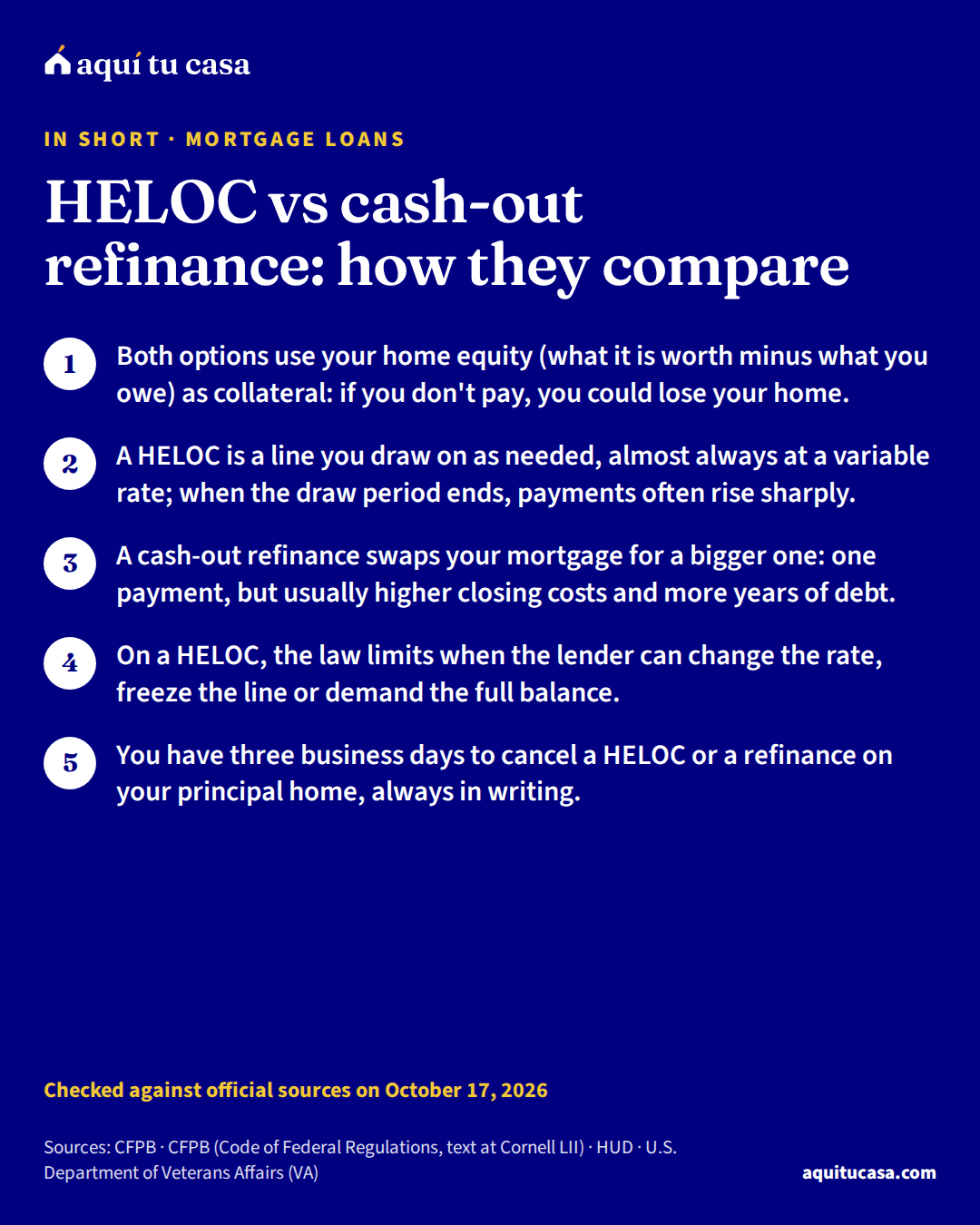
- Both options use your home equity (what it is worth minus what you owe) as collateral: if you don't pay, you could lose your home.
- A HELOC is a line you draw on as needed, almost always at a variable rate; when the draw period ends, payments often rise sharply.
- A cash-out refinance swaps your mortgage for a bigger one: one payment, but usually higher closing costs and more years of debt.
- On a HELOC, the law limits when the lender can change the rate, freeze the line or demand the full balance.
Is this for you?
This guide is for you if…
- You own your home and need money for a repair, an improvement or another large expense.
- You were offered a home equity line of credit (HELOC) and want to understand it before signing.
- You are comparing a HELOC with a cash-out refinance.
Get direct help first if…
- You only want to lower your mortgage rate without taking cash: the refinancing guide covers rate-and-term refinances.
- You are 62 or older and thinking about a reverse mortgage: it has its own rules and its own guide.
- You are already behind on payments: start with the guide on what to do if you can't pay your mortgage.
This guide is for homeowners who need money and are thinking about using their home’s value to get it. It compares the two most common ways, the home equity line of credit (HELOC)home equity line of credit (HELOC)A home equity line of credit (HELOC) lets you borrow again and again against the equity in your home: what the home is worth minus what you owe on your mortgage. During the draw period you can take out money up to your credit limit, usually with special checks or a card. When that period ends you can no longer borrow and you enter the repayment period, when payments are often much higher; sometimes the whole balance is due at once. It usually has a variable interest rate. If you do not repay it, you could lose your home.See the full definition and the cash-out refinancecash-out refinanceIn a cash-out refinance you take out a new mortgage for more than you still owe and receive the difference in cash. It is a way to borrow against the equity in your home. Under Fannie Mae's rules, the new loan is a first mortgage on the same home that pays off any existing mortgages, or a new mortgage on a home that is owned free and clear. According to FHFA's Office of Inspector General, Fannie Mae and Freddie Mac place no restrictions on how the cash is used. Your debt goes up and the home remains the collateral.See the full definition, with their costs, their risks and what the law gives you.
What they have in common: your home is the collateral
Both options lend you money against your home equityhome equityHome equity (or equity) is what your home is worth today minus what you still owe on the mortgages on it. You can borrow against that equity: with a home equity loan, which you receive as a lump sum and which usually has a fixed rate; with a HELOC; or with a cash-out refinance. In all of these the home is the collateral and, if you do not repay, the lender could take it. With a reverse mortgage, the balance grows each month and your equity goes down.See the full definition: what your home is worth minus what you owe on your mortgage.1 And with both, your home is at risk.4
The CFPB puts it plainly: only consider a HELOC if you are confident you can keep up with the payments, because if you fall behind or can’t repay on schedule, you could lose your home.1 HELOCs and home equity loans are second mortgagessecond mortgageA second mortgage (or junior lien) is a loan you take out using your home as collateral while you still have another loan secured by it. Home equity loans and HELOCs are common examples. It is called "second" because, if you stop paying and the home is sold to pay the debts, this loan is paid after the first one; if there is not enough money, the second lender may not get everything it is owed. That is why it often has a higher interest rate. It adds to your total debt and, if you cannot repay it, you could lose your home.See the full definition: if the home is sold to pay the debts, they are paid after the first mortgage, which is why they often carry higher rates. And taking one on adds to your total debt.3
Example with real numbers
How much equity you have in your home
A calculation in words, with your own numbers: A is what your home is worth and B is what you owe on your mortgage.
- A: Your home's value (from an appraisal)
- A
- B: What you owe on your mortgage
- B
- Your home equity
- A − B
- Maximum FHA cash-out loan (80% of the adjusted value)
- 80% of A
- Cash possible with FHA, before closing costs
- 80% of A − B
Equity is the value minus what you owe.1 The 80% is FHA's limit for a cash-out refinance.9 Other lenders and programs use other limits, and closing costs come out of what you receive.
Run it with your numbersClosing costsHow a HELOC works
A HELOC is an “open-end” line of credit: you borrow repeatedly against your home’s value.1 It works in two stages.
The life of a HELOC
1. You apply for the HELOC
At application
You receive the disclosures and the CFPB booklet; no nonrefundable fee can be charged until three business days later.5
2. The line opens
Three business days to cancel
You can cancel in writing, and the fees you paid are returned.4
3. Draw period
Could last 10 years, for example
You draw up to your limit with special checks or a card, and make minimum payments.1
4. Repayment period
When the draw period ends
You can no longer draw; payments are often much higher, or you must repay everything at once.1
The draw period. You can generally spend up to your limit at any time during this period, which could last 10 years, for example. Some plans require a minimum draw each time or a minimum balance, and many have minimum payments based on what you owe.1 Others allow interest-only payments during the draw period.4
The repayment period. When the draw period ends, you can no longer take money out. The lender may set a schedule to repay the full balance, and payments are often significantly higher. In some cases you must repay everything you owe as soon as this period begins.1 That large payment is called a balloon paymentballoon paymentA balloon payment is a large, one-time payment at the end of the loan term, higher than the payments before it and sometimes much higher. On the Loan Estimate, "Balloon Payment" means any payment that is more than two times a regular payment. Loans with a balloon payment usually have shorter terms and lower monthly payments that do not pay off the whole debt. If you cannot make the final payment, you may have to refinance or sell the home, or face foreclosure. With limited exceptions, a Qualified Mortgage (QM) cannot have a balloon payment.See the full definition, and if you can’t pay it in full, you could lose your home.4
The rate. HELOCs usually have a variable rateadjustable-rate mortgage (ARM)An adjustable-rate mortgage (ARM) is a loan whose interest rate can change, usually in step with a market index. It often starts with a fixed rate for an initial period (for example, the first few years) and then adjusts at set intervals, so your payment can go up or down. The contract sets caps on how much the rate can rise at each adjustment and in total. Before accepting one, check on the Loan Estimate how high your payment could reach and whether you could afford it.See the full definition, so your payment can change from month to month. Some let you move part of the balance to a fixed rate, which is usually higher but more predictable.1 A variable rate has two parts, the index and the margin, and some lenders offer a very low introductory (“teaser”) rate for a short time.4
The costs. Some lenders waive up-front costs and others charge them: for example, an appraisalhome appraisalAn appraisal is a written document that gives a professional appraiser's opinion of how much a property is worth. The lender orders it before approving the mortgage, because the home is the loan's collateral and the lender does not want to lend more than it is worth. If the appraisal comes in below the price you agreed, the bank bases the loan on the lower value and you will have to cover the difference, renegotiate the price or walk away if your contract allows it. An appraisal is not an inspection: it measures value, not the home's condition.See the full definition, an application fee that might not be refunded if you are turned down, and closing costs such as the title search and recording. If you sell your home, you generally must pay off the HELOC in full immediately. And the terms of the line may prohibit renting out your home.4
How a cash-out refinance works
Here you replace your current mortgage with a bigger one and take the difference in cash.4 The money is not limited to specific purposes.9 With FHA, the new loan cannot exceed 80 percent of the home’s adjusted value, and the property must have at least six months of payments on the current loan.9
The advantage is that you keep just one mortgage payment. The disadvantages, according to the CFPB booklet: closing costs are generally higher, it may take longer to pay off your mortgage and the rate may end up higher than your current mortgage’s.4 VA warns that closing costs can add up to thousands of dollars and says to understand how the new loan compares with your home’s value.10 If a lender offers to do it “at no cost,” it covers the costs with a higher rate or adds them to the loan, and a larger loan raises your payments and reduces your equity.11

For a cash-out refinance you receive a Loan EstimateLoan EstimateThe Loan Estimate is a three-page form you receive from the lender within days of applying for a mortgage. In the same format at every bank, it sums up the terms of the loan being offered: amount, interest rate, whether the payment can change, the estimated monthly payment with taxes and insurance, the itemized closing costs and how much cash you need at closing. Because every lender uses the same form, it lets you compare offers side by side. It commits you to nothing: requesting one is not accepting the loan.See the full definition, as with any mortgage; for a HELOC you do not: you receive Truth-in-Lending disclosures.8 The refinancing guide explains closing costs and how to work out how many months it takes to earn them back.
Side by side
HELOC and cash-out refinance
Line of credit
HELOC
With both, your home is the collateral: get offers in writing and compare the total cost, not just the monthly payment.42
There is a third option similar to a HELOC: the home equity loan. It gives you the money as a lump sum, usually at a fixed rate, and it is also a second mortgage: if you can’t repay it, the lender could foreclose on your home.2
What the law gives you on a HELOC
Regulation Z, which carries out the federal Truth in Lending Act, sets clear rules for HELOCs:5
- Information from the start. The lender must give you the HELOC disclosures and the CFPB booklet when it gives you an application.
- No nonrefundable fees up front. No one may charge a nonrefundable application fee until three business days after you receive those disclosures and the booklet.
- If terms change. If a term changes before the line opens (other than index movement) and you decide not to open it, all fees must be refunded.
- The rate changes only with a public index. The lender cannot change the rate on its own: it must use an index it does not control and that the public can see.
- They can’t demand the full balance for any reason. Only for fraud or material misrepresentation, failure to make the payments, or something you do that harms the collateral.
What the lender can do is stop extending credit or lower your limit while your home’s value is significantly below the appraisal for the line, while it reasonably believes you can’t pay because of a material change in your finances, or while you are in default of a material obligation.5 If that happens, the CFPB booklet suggests talking with the lender to find out the reason.4
The HELOC lender must also give you a list of HUD-approved housing counselorsHUD-approved housing counselorA HUD-approved housing counselor works at an agency HUD has approved to provide housing counseling: independent, expert advice customized to your situation about buying a home, renting, a missed mortgage payment, a foreclosure or credit problems. The agencies usually charge little or nothing; many serve in Spanish and offer the homebuyer education course several assistance programs require. They are not lenders or real estate agents and sell you nothing. Your county page lists the official agencies with phone numbers.See the full definition in your area, who offer free or low-cost help with budgeting and money.4

Taxes: when the interest is deductible
According to IRS Publication 936, you can no longer deduct interest on a loan secured by your home to the extent the money was not used to buy, build or substantially improve your home. And to deduct mortgage interest you must itemize deductions on Schedule A of Form 1040.14 If you want someone to review your return, an IRS VITAVITA (free tax preparation)VITA (Volunteer Income Tax Assistance) and TCE (Tax Counseling for the Elderly) are IRS programs that offer free basic tax return preparation by IRS-certified volunteers. They are meant for people with moderate income, people with disabilities and limited-English speakers; TCE focuses on people sixty and older. The IRS sets no program-wide income limit, but individual sites may set their own. Many sites serve in Spanish and help with ITIN applications and renewals. Filing taxes every year builds the record lenders ask for.See the full definition site is one option.
Before you borrow against your home

The CFPB urges caution about using home equity to pay off higher-interest debts: you are not really paying them off, just replacing one loan with another, with your home as collateral. It also warns about trading short-term debt for long-term debt, which can mean paying interest for many more years.3 Before using a home equity loan to pay off debts, the CFPB suggests talking with a credit counselor about alternatives that do not put your home at risk.2
In its booklet, the CFPB compares a HELOC with other money sources. With a personal line of credit or a credit card your home is not at risk, although the rate is higher.4 And if you plan to refinance your first mortgage later, keep in mind that with a HELOC you may need its lender’s permission, or to pay it off first.13
If the money is for a repair, also read the contractor scams guide: some scammers offer to “arrange the financing” along with the work.
If this is you
You need money for a repair
A HELOC lets you draw as the work is paid for; a cash-out refinance gives you everything at once with one payment.14
You are 62 or older
A reverse mortgage (HECM) is another way to use your home's value, with its own rules. See the reverse mortgage guide.4
You want to roll your debts into one
The CFPB warns that this does not really pay them off: you swap them for another debt with your home as collateral.3
You already struggle to pay the mortgage
Another debt on your home puts it at more risk.3 Start with the can't pay my mortgage guide.
Costly mistakes
Mistake: Looking only at a HELOC's introductory rate.
Instead: Ask about the index, the margin and how high the variable rate can go.4
Mistake: Not planning for the repayment period.
Instead: Work out the payment after the draw period ends: it is often much higher.1
Mistake: Comparing only the monthly payment.
Instead: Compare the fees and the total cost of each offer.2
Mistake: Choosing a cash-out refinance without looking at closing costs.
Instead: They are generally higher than for a HELOC; ask for the Loan Estimate.48
Mistake: Using home equity to pay off credit cards without changing habits.
Instead: Remember that you are swapping one debt for another, with your home as collateral.3
Mistake: Paying a nonrefundable fee the day you apply.
Instead: The law does not allow it until three business days after you receive the disclosures.5

What to do this week
- Work out your equity: what your home is worth minus what you owe on your mortgage.1
- Write down what you need the money for and how long you expect to take to repay it; compare that with the draw and repayment periods.1
- Ask for the disclosures on at least one HELOC and the Loan Estimate for a cash-out refinance, and compare fees, rate and total cost.58
- Use the mortgage calculator to see your payment with a bigger loan, and the closing cost calculator to estimate what you would pay.
- Before you sign, write down the deadline to cancel.7
- If you want to go over your options with someone, a HUD-approved housing counselor gives independent advice, often free or at low cost.15 Find one through the HUD-approved counselors guide.
Your numbers
Starts at the typical home value in the United States. Change it to the price you have in mind.
That is $11,645 (3.5% of the price). The usual minimum for this loan is 3.5%.
This week's average ± a quarter or half point.
National average as of November 5, 2026 (Freddie Mac); your rate may be different.
Adjust advanced details
Let's do the math
Estimated monthly payment
National figure$2,759
at 7.18% · 30 years
- Loan amount
- $326,673
- Total interest
- $470,006
- Paid off in
- November 2056
Includes $5,618 FHA upfront mortgage insurance premium.
Does it fit the income?
Comfortable
up to $1,884 a month
Tight
$1,884 to $2,422 a month
Hard
more than $2,422 a month
Your payment · 41%
Compared with the typical household income in the United States ($80,734 a year). Reference: HUD calls paying more than 30% of income for housing a cost burden.
| Principal & interest | $2,213 |
|---|---|
| Property tax | $261 |
| Home insurance | $139 |
| FHA mortgage insurance (MIP) | $147 |
How does it compare with incomes?
For this payment to be 28% of your income, you'd need to earn about $118,260 a year. With your other debts, to stay under 36%: about $91,980 a year.
You need at least $11,645 for the down payment, plus closing costs.
This is an estimate to give you an idea, not a loan offer. Your real payment depends on your rate, your credit, and the insurance and taxes on the home you buy.
Total monthly payment $2,759; principal and interest $2,213.
Ready to see the numbers? Find your county here
See how this applies in your county: its loan limits, prices and rents, from the official data.
Printable checklist
Frequently asked questions
Which is better, a HELOC or a cash-out refinance?
It depends on what you need the money for, your current rate and how long you expect to take to repay it. The CFPB says a HELOC lets you draw and repay over years, almost always at a variable rate, and that a cash-out refinance leaves you with one payment but usually higher closing costs. A HUD-approved housing counselor can review your situation, often for free.
Can I lose my home with a HELOC?
The CFPB says yes: if you fall behind or can't repay on schedule, you could lose your home, because it is the collateral. That is why it recommends considering a HELOC only if you are confident you can keep up with the payments.
Why does a HELOC payment go up so much?
When the draw period ends, repayment begins, and according to the CFPB monthly payments are often significantly higher. In some cases you must repay everything at once. And the rate is usually variable, so the payment can change from month to month.
Can the bank freeze my HELOC?
Yes, in certain cases. Under Regulation Z, the lender may stop extending credit or lower your limit if your home's value drops significantly below the appraisal, if it believes you can't pay because of a material change in your finances, or if you default on the agreement.
Can I cancel a HELOC after signing?
Yes. You have three business days to cancel the line when it is opened, by notifying the lender in writing. The lender must return the fees you paid, including application and appraisal fees.
Can I deduct HELOC interest on my taxes?
According to IRS Publication 936, you can no longer deduct interest on a loan secured by your home to the extent the money was not used to buy, build or substantially improve the home, and you must itemize to deduct it. If you want help with your return, you can look for an IRS VITA site.
Do I get a Loan Estimate for a HELOC?
No. According to the CFPB, for a HELOC you receive Truth-in-Lending disclosures instead of a Loan Estimate. A cash-out refinance does come with a Loan Estimate.
Sources
Every figure in this guide comes from one of these official sources. The number next to a sentence leads to the source behind it.
Each source on one line: who publishes it, its title, its address and the date we read it.
- 1. CFPB · What is a home equity line of credit (HELOC)? · consumerfinance.gov · Accessed October 17, 2026
- 2. CFPB · What is a home equity loan? · consumerfinance.gov · Accessed October 17, 2026
- 3. CFPB · What is a second mortgage loan or junior-lien? · consumerfinance.gov · Accessed October 17, 2026
- 4. CFPB · What you should know about home equity lines of credit (HELOC) · files.consumerfinance.gov · Accessed October 17, 2026
- 5. CFPB (Code of Federal Regulations, text at Cornell LII) · Regulation Z, 12 CFR §1026.40, Requirements for home equity plans · law.cornell.edu · Accessed October 17, 2026
- 6. CFPB (Code of Federal Regulations, text at Cornell LII) · Regulation Z, 12 CFR §1026.15, Right of rescission (open-end credit) · law.cornell.edu · Accessed October 17, 2026
- 7. CFPB · Can I ever waive my right to rescind on my mortgage loan? · consumerfinance.gov · Accessed October 17, 2026
- 8. CFPB · What is a Loan Estimate? · consumerfinance.gov · Accessed October 17, 2026
See the other 7 sources
- 9. HUD · FHA Single Family Housing Policy Handbook 4000.1 · hud.gov · Accessed October 17, 2026
- 10. U.S. Department of Veterans Affairs (VA) · Cash-out refinance loan · va.gov · Accessed October 17, 2026
- 11. CFPB · Is there such a thing as a no-cost or no-closing cost loan or refinancing? · consumerfinance.gov · Accessed October 17, 2026
- 12. CFPB · Can I change my mind after I sign the loan closing documents for my second mortgage or refinance? What is the right of rescission? · consumerfinance.gov · Accessed October 17, 2026
- 13. CFPB · Does a HELOC affect my ability to refinance my first mortgage loan? · consumerfinance.gov · Accessed October 17, 2026
- 14. IRS · Publication 936 (2025), Home Mortgage Interest Deduction · irs.gov · Accessed October 17, 2026
- 15. CFPB · Find a Housing Counselor · consumerfinance.gov · Accessed October 17, 2026
Keep reading
Related guides
If this guide helped, these follow the same path.

Protect yourself from scams 11 minute read
Contractor and home repair scams: how to protect yourself
How to spot a dishonest contractor, check a license, sign a solid contract, pay safely and cancel a sale made at your home.
- Be wary of anyone who knocks on your door, pressures you to decide today or scares you with a 'free inspection'.
- Ask for the license number and look it up on your state contracting board or agency's website; if it isn't listed, it's not a good option.
- Sign a complete contract, never a blank one: work, materials, permits, dates, total price and payment schedule.
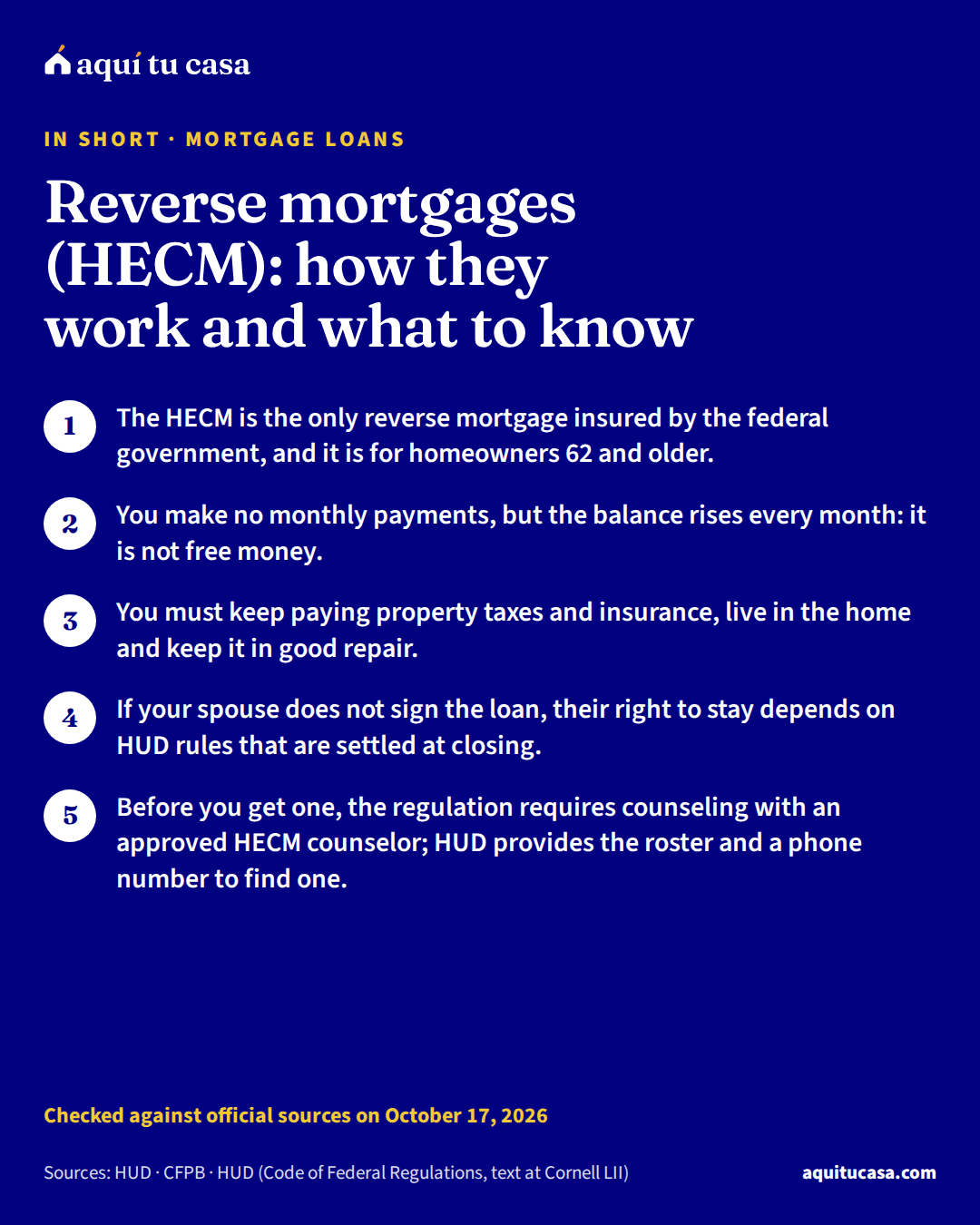
- Mortgage loans Reverse mortgages (HECM): how they work and what to know What a HECM reverse mortgage is, who can get one, the required counseling, what happens to your spouse and heirs, and how to avoid scams. 13 minute read
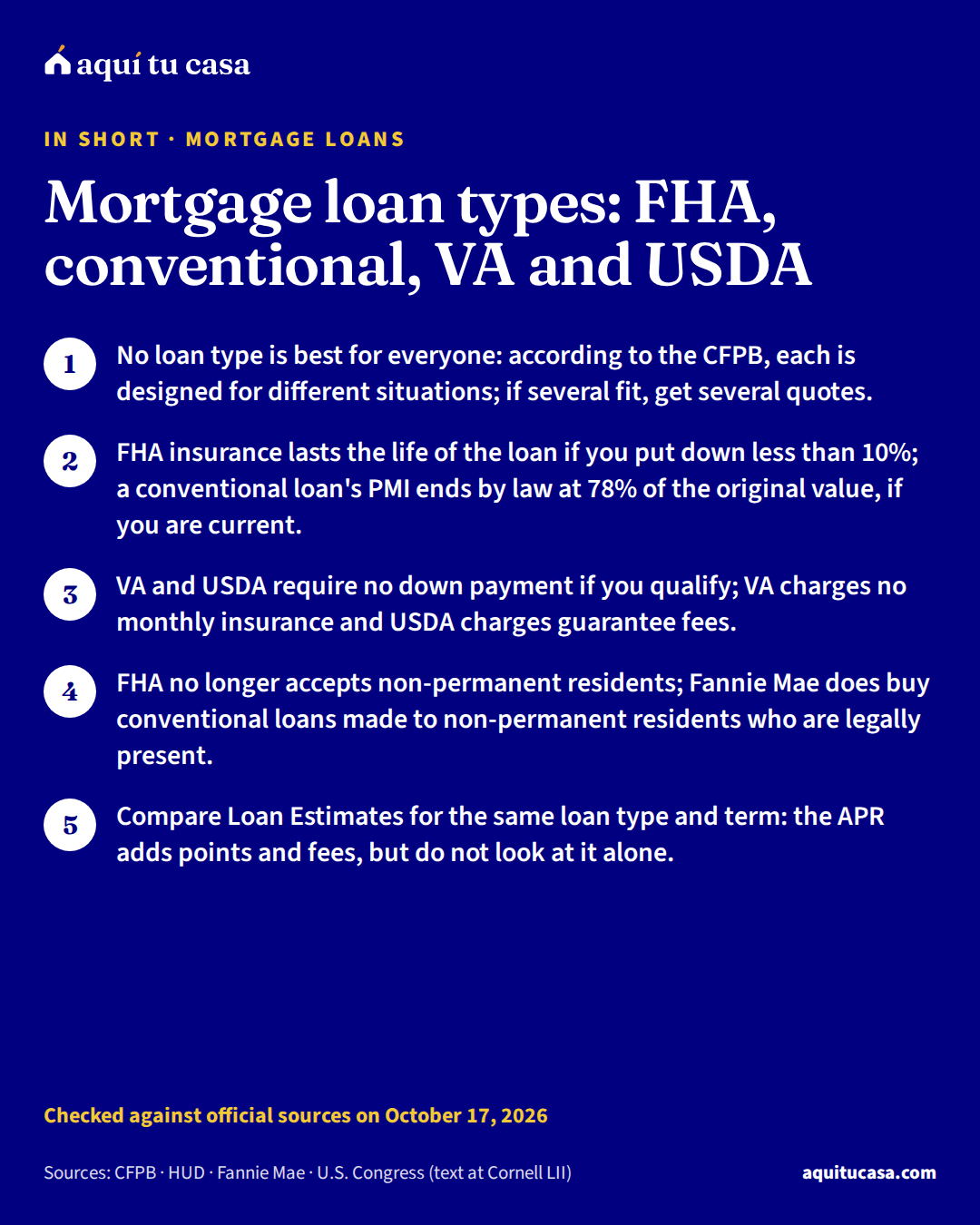
- Mortgage loans Mortgage loan types: FHA, conventional, VA and USDA What each mortgage type asks for, what its insurance costs, fixed or adjustable rate, points and APR. A neutral comparison with official sources. 14 minute read
Tools for this topic
Was this guide useful?
Thank you. Your answer stays in your browser; nothing is sent.