Contractor and home repair scams: how to protect yourself
How to spot a dishonest contractor, check a license, sign a solid contract, pay safely and cancel a sale made at your home.
Verified against official sources on October 17, 2026 12 official sources

Show contents
In short
What you need to know
Quick answer
To protect yourself from a dishonest contractor: don't hire someone who knocks on your door or pressures you to decide today, get two or three written estimates, check the license on your state contracting board's website and sign a complete contract before paying. Don't pay with cash, wire transfers or gift cards, and hold the final payment until the work is finished. If you bought at home for $25 or more, the FTC Cooling-Off Rule gives you three business days to cancel.
What matters most
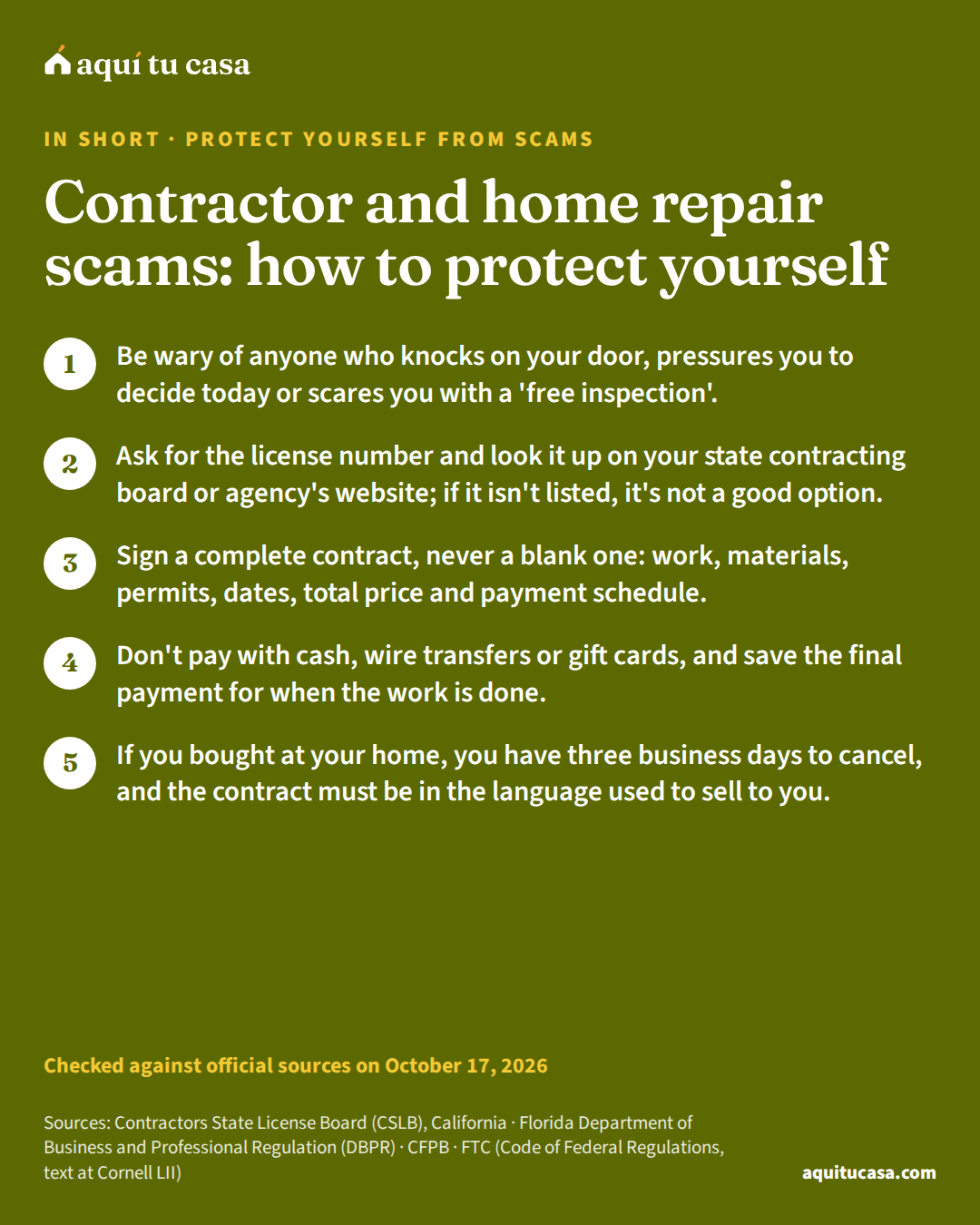
- Be wary of anyone who knocks on your door, pressures you to decide today or scares you with a 'free inspection'.
- Ask for the license number and look it up on your state contracting board or agency's website; if it isn't listed, it's not a good option.
- Sign a complete contract, never a blank one: work, materials, permits, dates, total price and payment schedule.
- Don't pay with cash, wire transfers or gift cards, and save the final payment for when the work is done.
Is this for you?
This guide is for you if…
- You need to repair or improve your home and want to hire someone without getting scammed.
- A contractor knocked on your door, offered you a job or is pressuring you to sign today.
- Your home was damaged by a storm or another disaster and repair offers are coming in.
Get direct help first if…
- You already signed and the work was botched or abandoned: go straight to the section on what to do if you were scammed.
- You are looking for money for the repair: the HELOC vs cash-out guide compares financing options.
- Someone is offering to save your home from foreclosure: that has its own scam guide.
This guide is for homeowners who need to repair or improve their home and want to do it without falling for a scam. It explains how dishonest contractors operate, how to check a license, what the contract should say, how to pay safely and what rights you have to cancel. According to California’s CSLB, most licensed contractors are competent and honest;2 this guide helps you spot the ones who aren’t.
How dishonest contractors operate
California’s Contractors State License Board (CSLB) describes the most common scams:1
- Door to door. Someone knocks and offers roofing, painting or paving at a reduced price. You pay, they do little or nothing and abandon the job.
- Pressure. They push you to decide now, so you don’t compare bids or check licenses.
- Scares. They offer a “free inspection” and then claim your wiring, plumbing or roof is dangerous, to sell you unnecessary, overpriced work.
- Cash. They demand cash, sometimes even driving you to the bank to get it.
- Illegal down payments. They ask for a bigger down payment than the law allows, saying they need money for supplies and workers.
- No contract. They say nothing needs to be in writing.
After a storm or another disaster, the risk goes up. The CFPB warns that contractors may come to your door offering repairs, with “limited time only” deals, claims that material prices will rise or promises to move you to the front of the line.7

Before you hire: how to choose and verify
The CFPB recommends asking people you trust for referrals, contacting your local builders’ association and getting written estimates from two or three contractors to compare. It advises against picking someone going door to door, someone from out of state or someone who refuses to show ID or contact information, and against paying up front without a signed contract.6 The CSLB adds: be wary of a bid that is much lower than the others.2
How to verify a contractor
1. Ask for referrals and several estimates
Before you decide
Get written estimates from two or three contractors, for the same job.6
2. Write down the license number
At the first visit
Ask for their license and a picture ID, and confirm it is the same person.2
3. Look it up on your state's website
Before you sign
Use your state contracting board or agency's site; if they aren't listed, they're not a good option.6
4. Check for complaints
Before you sign
Also check with your state licensing board and attorney general.6
5. Ask about insurance and permits
Before you sign
General liability, workers' compensation and who pulls the permit.6
How to check a license in your state
The CFPB recommends writing down the contractor’s license or registration number and looking it up on your state contracting board or agency’s website, or calling its hotline, to make sure it is valid. If they aren’t listed, they are not a good option. Also check with that board and your state attorney general for complaints or discipline.6
Two examples of how these official searches work:
- California. The CSLB lets you search by license number, business name, contractor name or Home Improvement Salesperson registration, and shows information including complaint disclosure.3 There, anyone doing work of $500 or more must be licensed, and you can verify a license online or at (800) 321-2752.1 Ads must show the license number, but seeing a number doesn’t mean the license is valid: check its status.2
- Florida. The Department of Business and Professional Regulation (DBPR) has an online search by name, license number, city or county, or license type.5
If you live in another state, look for the board or agency that licenses contractors on your state government’s official website.

The contract: what it should say
According to the CFPB, never sign a contract without reading it carefully, and ask about anything you don’t understand. You can always walk away if you feel uncomfortable. The contract should state who pays for materials, their quantity and quality, who gets the permits, start and completion dates, the total price and a payment schedule, and every promise made to you verbally. Get copies of the signed contract, guarantees and warranties before work begins.6
The CSLB adds: never sign a blank or partially blank contract, and record any change in a signed “change order.” In California, every project over $500 needs a written contract that identifies the contractor with address and license number.4
A solid contract or a warning sign
In writing
Solid contract
If they promised something verbally, ask for it to be written into the contract.6
How to pay without losing your money
The CFPB says never to pay by wire transfer, gift card, virtual currency or cash, because it can be harder to get your money back, and to wait to make the final payment until the work is done to your satisfaction.7 Get a receipt for every payment and keep your paperwork.6 The CSLB recommends putting a payment schedule in the contract and not letting payments get ahead of the work.1
Example with real numbers
A payment schedule that follows the work
An example in words; in California, the down payment has a legal limit.
- Down payment at signing
- In California, no more than 10% of the price or $1,000, whichever is less
- Payments during the job
- Only for work already done, with a receipt
- How you pay
- Never cash, wire transfer or gift cards
- Final payment
- When the work is finished to your satisfaction
The down payment limit is California law, according to the CSLB.4 The other rules are recommendations from the CFPB and the CSLB.71 Plan the cost in your budget.
Run it with your numbersFamily budgetIf the contractor offers financing
The CFPB recommends shopping for the best lenderlenderThe lender is the financial institution that lends you the money for your mortgage. The mortgage is the agreement that gives the lender the right to take your home if you do not repay what it lent you. After closing, it is common for another company, the loan servicer, to collect your payments and keep track of the loan; it may be the same company that lent you the money or a different one. On the Loan Estimate, the lender's name appears on the first page, and the last page lists it as "Lender" with its NMLS or license number.See the full definition yourself instead of just taking the contractor’s referral.6 Be careful with two offers in particular:
- PACE loans. They are repaid through your property taxesproperty taxProperty tax is the tax the county, city, school district and other local bodies charge real property owners every year to pay for schools, police, fire and other public services. It is computed on the value the assessor's office assigns to your home, at each body's rate, minus the exemptions you qualify for, such as the primary-residence exemption in many states. If you have a mortgage you normally pay it month by month inside your payment, through the escrow account. It is generally deductible on your federal return if you itemize.See the full definition, which go up, sometimes a lot. You could lose your home in a tax sale, most lenders won’t refinance your mortgage if you have one, and salespeople may claim, without having to prove it, that the upgrades “pay for themselves.”8
- Reverse mortgagesreverse mortgageA reverse mortgage is a loan secured by your home for older homeowners. In the most common kind, HUD's Home Equity Conversion Mortgage (HECM), the youngest borrower must be 62 or older at closing. Instead of making monthly payments, you receive money; interest and fees are added to the balance each month, so the debt grows and your equity shrinks. The home stays in your name, but you must live in it, pay property taxes and insurance and keep it in good condition. It is repaid when you no longer live there, usually by selling the home. To get a HECM you must receive counseling from a HUD-approved agency.See the full definition. The CFPB warns that a contractor who suggests a reverse mortgage to pay for repairs may be running a scam.9 The reverse mortgage guide explains how they work.
If the loan places a security interest or lienlienA lien is a legal right a creditor holds in your property to make sure you repay a debt. It usually prevents the property from being sold until the debt is paid, and if you do not pay, the creditor may be able to take the property. Your mortgage is a lien on your home: when you pay it off, the lien is released and that shows up in your county's property records. There are other kinds, such as a federal tax lien, which is the government's legal claim against all your property when you do not pay a tax debt.See the full definition on your principal home, Regulation Z gives you until midnight of the third business day to cancel it, in writing. During that period, no money may be handed over, no work done and no materials delivered.12 The HELOC vs cash-out guide compares other ways to pay for a repair using your home’s value.
Your right to cancel a sale made at your home
The FTC Cooling-Off Rule protects door-to-door sales: goods or services for your household that a seller offers in person and that you agree to buy away from the seller’s business, such as at your home, even if you invited the seller. It applies if the price is $25 or more at your home, or $130 or more elsewhere. A business day is any day except Sunday and federal holidays.10
What the seller must do:11
- Give you at signing a complete contract or receipt in the same language used to sell to you, for example Spanish, with the date and the seller’s name and address.
- Include the statement that you may cancel before midnight of the third business day.
- Give you two copies of a cancellation form (“NOTICE OF CANCELLATION”) and tell you orally that you can cancel.
- Refund all your payments within 10 business days after receiving your cancellation.
To cancel, mail or deliver a signed and dated copy of the notice, or another written notice. The seller may not misrepresent your right to cancel or make you waive it in the contract.11
If you were already scammed
According to the CFPB, if repairs weren’t done properly or you think you were ripped off, you can complain to your local law enforcement agency and your state attorney general, and to the state or local agency that licenses or regulates contractors. You can also consult a lawyer about a lawsuit for damages.6 Free legal aidlegal aidLegal aid is the free civil legal help that nonprofit organizations and their lawyers provide to low-income people in civil, not criminal, matters. In housing, that includes representing families facing eviction or foreclosure, alongside matters such as custody, child support, protection from domestic violence and access to benefits. In the United States, the Legal Services Corporation, created by Congress, funds a nationwide network of these organizations; its finder points you to the one in your area. Each sets its own income limits.See the full definition in your area is an option if you want help with your case. If you think you were charged gouging prices after a disaster, contact your state attorney general.7
Keep the contract, receipts, messages and photos of the work. And if the damage came from a storm or a fire, the home insurance guide explains how a claim works.
If this is you
Someone offers you a “free inspection”
The CSLB describes this tactic: after the inspection, they scare you into unnecessary, overpriced work.1 Get another estimate.
Your home was damaged in a disaster
Be wary of anyone at your door or offering to move you to the front of the line, and never pay cash.7
The contractor offers financing
Shop for the lender yourself; if the loan places a lien on your home, you have three business days to cancel.612
They sold to you in Spanish
In a door-to-door sale, the contract and cancellation notice must be in Spanish.11

Costly mistakes
Mistake: Hiring whoever knocked on your door with a today-only offer.
Instead: Get two or three written estimates and check licenses.6
Mistake: Assuming a license number in an ad is enough.
Instead: Look it up on your state's website: a number doesn't mean it's valid.2
Mistake: Paying cash or by wire transfer.
Instead: Pay in a way that leaves a record and get a receipt.76
Mistake: Paying everything before the job is done.
Instead: Hold the final payment until the work is finished to your satisfaction.6
Mistake: Signing a blank contract or trusting verbal promises.
Instead: Everything should be in writing, including changes.46
Mistake: Taking the contractor's loan without comparing.
Instead: Shop for other lenders and check the risks, such as those of a PACE loan.68
What to do this week
- If someone offered you a job at your door, don’t sign or pay today.7
- Get written estimates from two or three contractors for the same job.6
- Look up each one’s license number on your state contracting board’s website.6
- Check that the contract includes the work, materials, permits, dates, total price and payment schedule.6
- If you signed at home and changed your mind, send your cancellation in writing before midnight of the third business day.11
- Plan the cost in your family budget, and read the housing scams guide for other traps.
Your household this month
Let's do the math
Left each month
Enter what at least one person takes home to see the result.
What helps
- Pay savings first: set the goal aside the day the money arrives, before flexible spending.
- Add up the bills that come every few months (car insurance, school) and divide by twelve.
- If income changes, plan on a low month and save the extra from good months.
- A HUD-approved housing counselor can go over the budget with you, often for free.
This is a planning tool with your numbers, not a credit evaluation or an approval. The split reference is only a guide.
Ready to see the numbers? Find your county here
See how this applies in your county: its loan limits, prices and rents, from the official data.
Printable checklist
Frequently asked questions
How do I know if a contractor is licensed?
Ask for the license or registration number and look it up on your state contracting board or agency's website, or call its hotline. The CFPB says that if they aren't listed, they are not a good option. In California, for example, the CSLB lets you search by number, business name or contractor name.
How much should I pay a contractor up front?
It depends on your state. In California, the law does not allow a down payment of more than 10 percent of the price or $1,000, whichever is less. The CFPB recommends paying nothing up front without a signed contract and holding the final payment until the work is done to your satisfaction.
Can I cancel a contract I signed at home?
If it was a door-to-door sale of $25 or more at your home, the FTC Cooling-Off Rule gives you until midnight of the third business day to cancel, in writing. The seller must give you two copies of the cancellation notice and refund what you paid within 10 business days.
Do they have to give me the contract in Spanish?
In a door-to-door sale, the Cooling-Off Rule says the contract or receipt must be in the same language the seller mainly used to sell to you, for example Spanish, and so must the cancellation notice.
Why shouldn't I pay cash?
The CFPB says never to pay by wire transfer, gift card, virtual currency or cash, because it can be harder to get your money back. Pay in a way that leaves a record and get a receipt for every payment.
The contractor is offering financing. What should I check?
The CFPB recommends shopping for the lender yourself instead of just taking the contractor's referral. A PACE loan is repaid through your property taxes and could put you at risk of losing your home in a tax sale. And if the loan places a lien on your home, you have three business days to cancel it and work cannot start during that period.
Where do I complain if a contractor scammed me?
According to the CFPB, you can complain to local law enforcement, your state attorney general and the state or local agency that licenses contractors. You can also consult a lawyer; free legal aid in your area is an option.
Sources
Every figure in this guide comes from one of these official sources. The number next to a sentence leads to the source behind it.
Each source on one line: who publishes it, its title, its address and the date we read it.
- 1. Contractors State License Board (CSLB), California · What You Should Know Before You Hire a Contractor · cslb.ca.gov · Accessed October 17, 2026
- 2. Contractors State License Board (CSLB), California · How do I find the right licensed contractor? · cslb.ca.gov · Accessed October 17, 2026
- 3. Contractors State License Board (CSLB), California · Check a Contractor License or Home Improvement Salesperson (HIS) Registration · cslb.ca.gov · Accessed October 17, 2026
- 4. Contractors State License Board (CSLB), California · What Should I Look for in a Contract and Binding Agreements? · cslb.ca.gov · Accessed October 17, 2026
- 5. Florida Department of Business and Professional Regulation (DBPR) · Licensing Portal - License Search · myfloridalicense.com · Accessed October 17, 2026
- 6. CFPB · How can I find and work with contractors to rebuild after a disaster? · consumerfinance.gov · Accessed October 17, 2026
- 7. CFPB · How do I avoid scams and fraud after a disaster? · consumerfinance.gov · Accessed October 17, 2026
- 8. CFPB · I am considering a PACE loan for home improvements. What should I keep in mind before signing up? · consumerfinance.gov · Accessed October 17, 2026
See the other 4 sources
- 9. CFPB · What is a reverse mortgage? · consumerfinance.gov · Accessed October 17, 2026
- 10. FTC (Code of Federal Regulations, text at Cornell LII) · 16 CFR §429.0, Definitions (Rule Concerning Cooling-Off Period for Sales Made at Homes or at Certain Other Locations) · law.cornell.edu · Accessed October 17, 2026
- 11. FTC (Code of Federal Regulations, text at Cornell LII) · 16 CFR §429.1, The Rule (Cooling-Off Period for Sales Made at Homes or at Certain Other Locations) · law.cornell.edu · Accessed October 17, 2026
- 12. CFPB (Code of Federal Regulations, text at Cornell LII) · Regulation Z, 12 CFR §1026.23, Right of rescission · law.cornell.edu · Accessed October 17, 2026
Keep reading
Related guides
If this guide helped, these follow the same path.

Mortgage loans 11 minute read
HELOC vs cash-out refinance: how they compare
A home equity line of credit (HELOC) or a cash-out refinance: how each works, what it costs, your rights and the risks to your home.
- Both options use your home equity (what it is worth minus what you owe) as collateral: if you don't pay, you could lose your home.
- A HELOC is a line you draw on as needed, almost always at a variable rate; when the draw period ends, payments often rise sharply.
- A cash-out refinance swaps your mortgage for a bigger one: one payment, but usually higher closing costs and more years of debt.
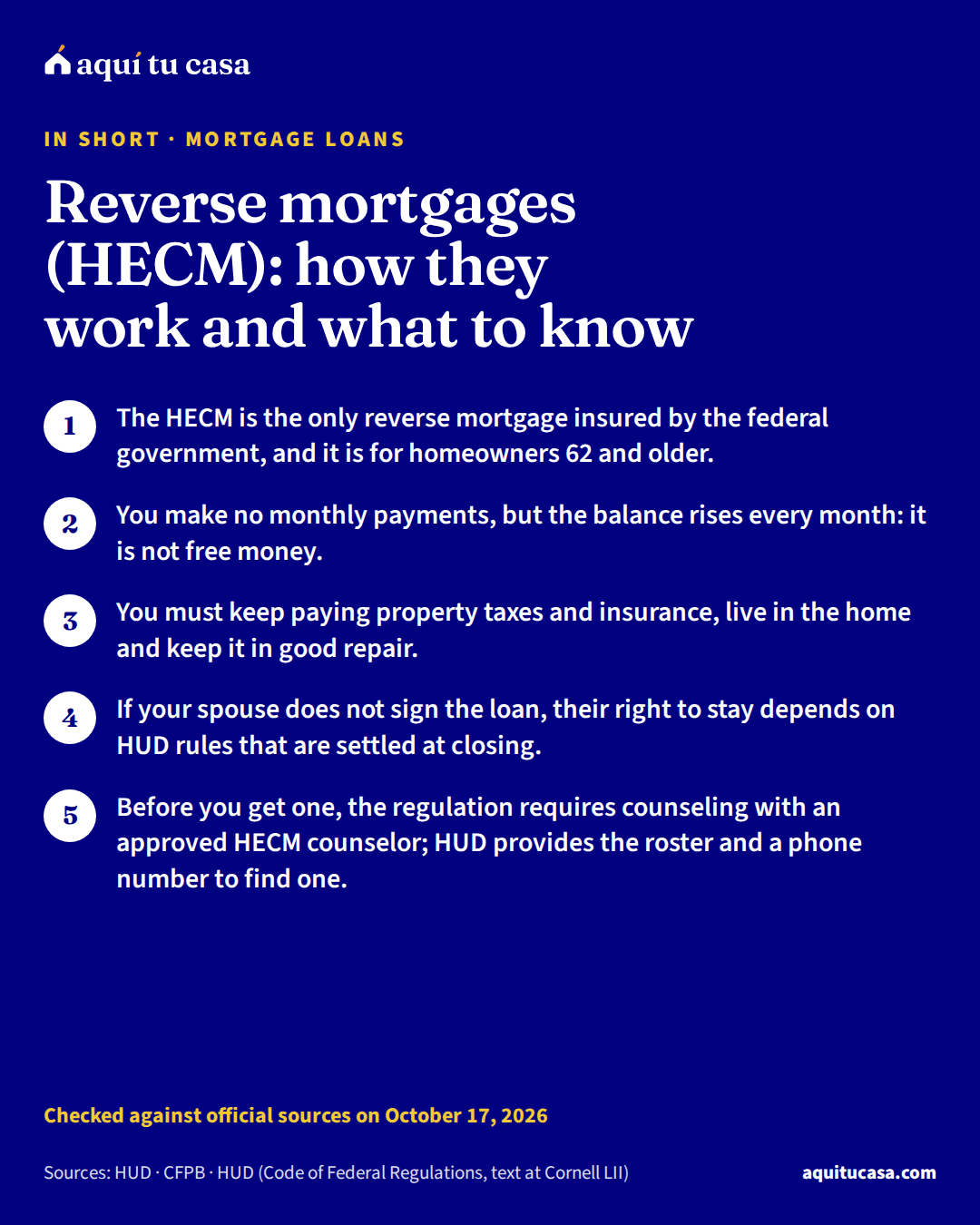
- Mortgage loans Reverse mortgages (HECM): how they work and what to know What a HECM reverse mortgage is, who can get one, the required counseling, what happens to your spouse and heirs, and how to avoid scams. 13 minute read
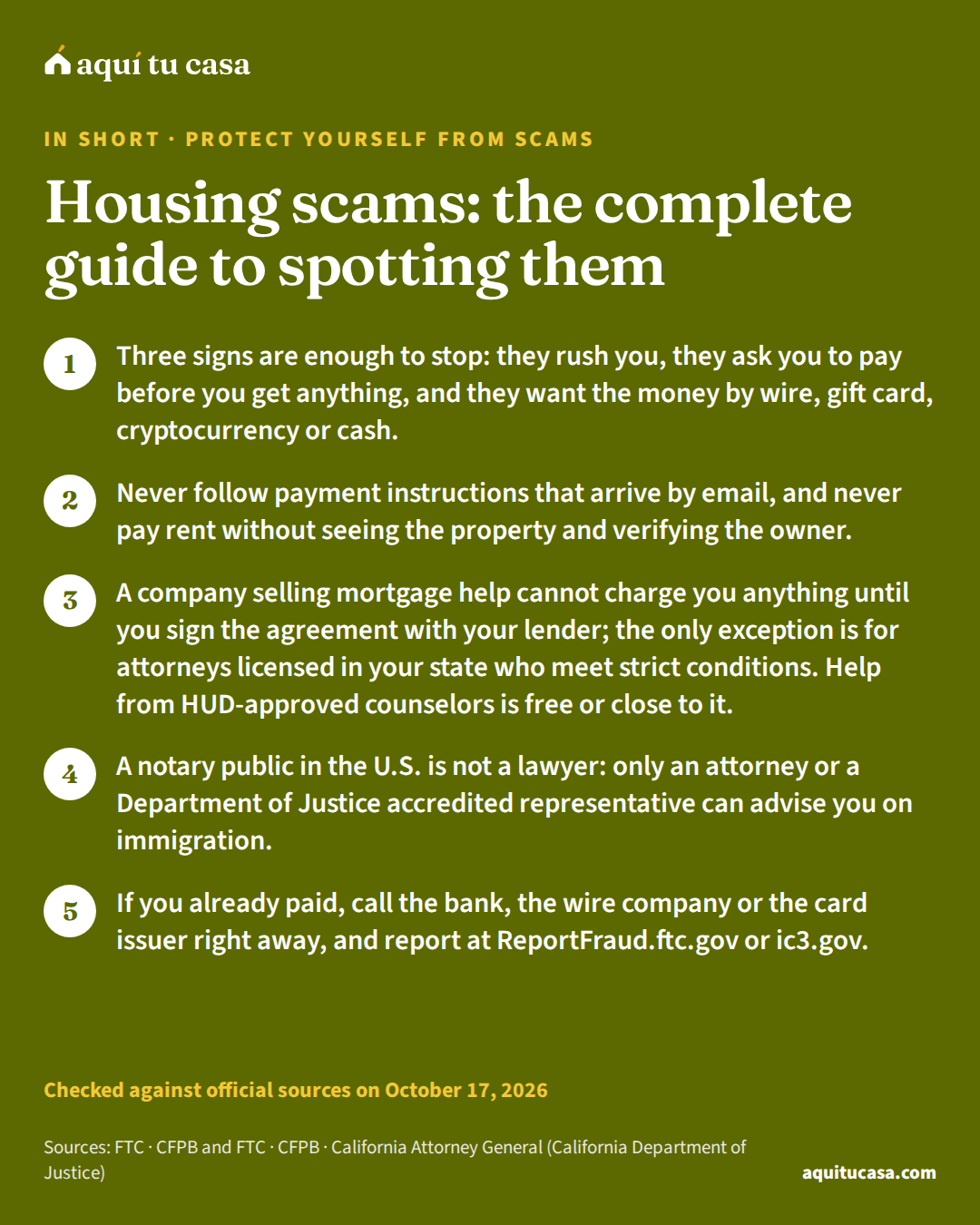
- Protect yourself from scams Housing scams: the complete guide to spotting them The rental, mortgage, title, contractor, credit and moving scams families run into most: how to spot them, what to do and where to report them. 17 minute read
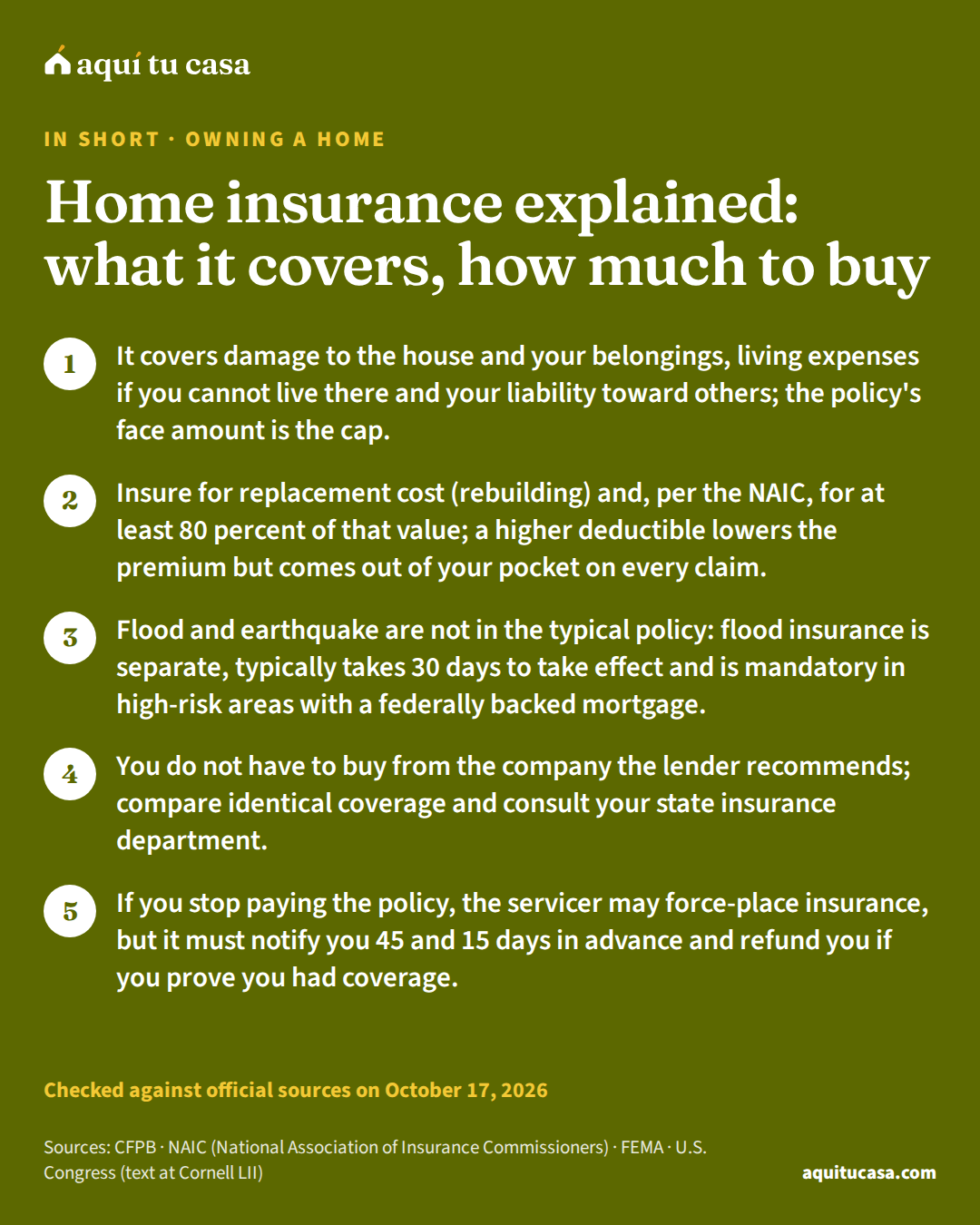
- Owning a home Home insurance explained: what it covers, how much to buy What home insurance covers, why the lender requires it, how to choose the amount and the deductible, why flood is separate and what happens if it lapses. 13 minute read
Tools for this topic
Was this guide useful?
Thank you. Your answer stays in your browser; nothing is sent.