Nontraditional credit for a mortgage: buying with no score
How Fannie Mae and FHA accept rent, utilities, insurance and remittances as credit history when you have no score: requirements, documents and limits.
Verified against official sources on October 17, 2026 8 official sources

Show contents
In short
What you need to know
Quick answer
If your credit reports do not produce a score, you are not shut out: Fannie Mae and FHA let lenders build a nontraditional credit history from payments you already make, such as rent, utilities, phone, insurance and, at Fannie Mae, even remittances. Each reference must show 12 months of payments; FHA asks for three references and Fannie Mae for four in manual underwriting (three for HomeReady). In return the limits are stricter: for example, Fannie Mae sets a 36% maximum debt-to-income ratio and FHA 31/43, and in many cases Fannie Mae requires a homebuyer course before closing.
What matters most
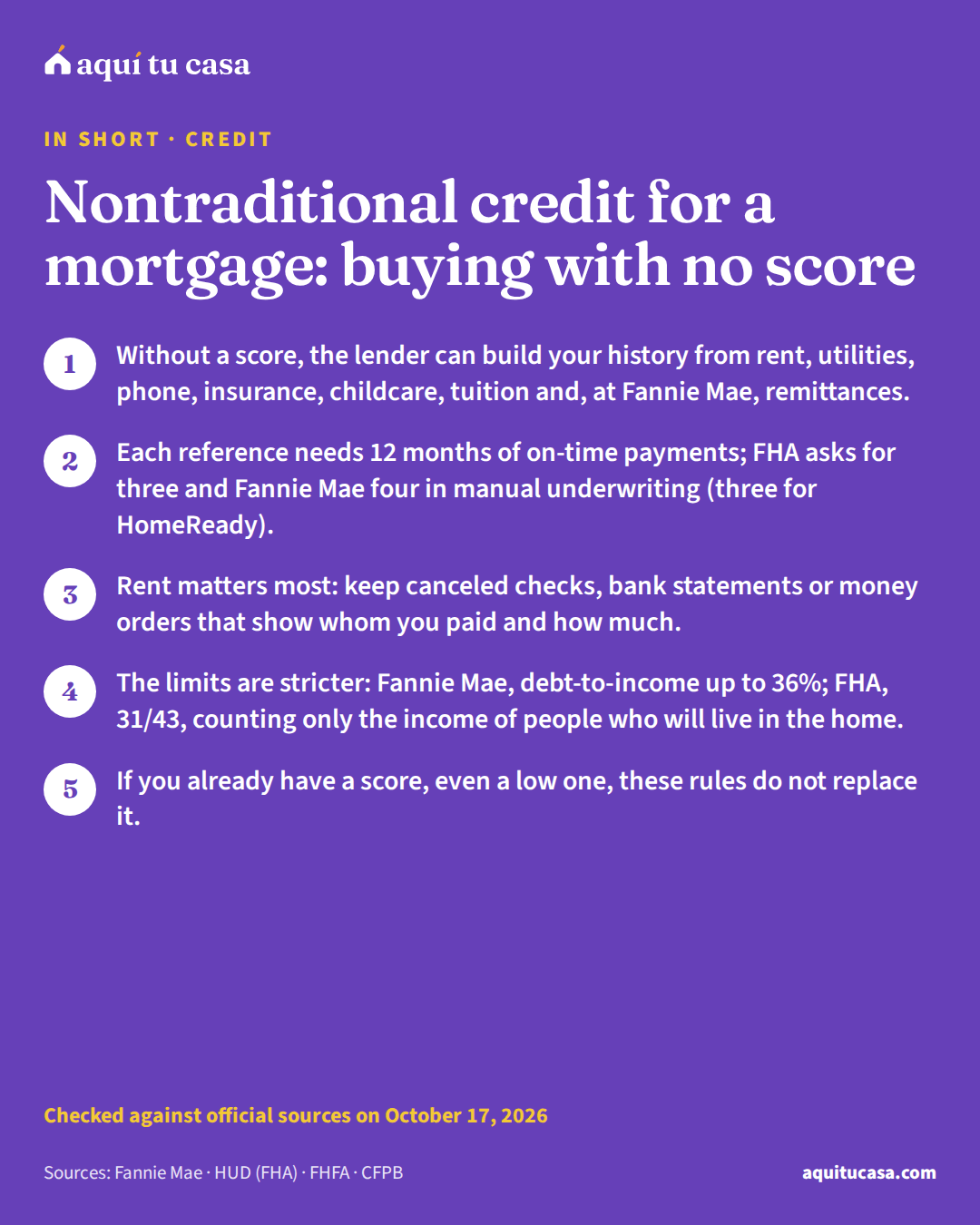
- Without a score, the lender can build your history from rent, utilities, phone, insurance, childcare, tuition and, at Fannie Mae, remittances.
- Each reference needs 12 months of on-time payments; FHA asks for three and Fannie Mae four in manual underwriting (three for HomeReady).
- Rent matters most: keep canceled checks, bank statements or money orders that show whom you paid and how much.
- The limits are stricter: Fannie Mae, debt-to-income up to 36%; FHA, 31/43, counting only the income of people who will live in the home.
Is this for you?
This guide is for you if…
- You want to buy a home and your credit reports do not produce a score because you have almost no accounts.
- You have paid rent, power, phone or insurance on time for years, but none of it shows on your report.
- You send remittances or save every month and want to know whether that counts for a mortgage.
Get direct help first if…
- You already have a score, even a low one: these rules are not used to replace it; start with the guide on what moves your score.
- You have a recent bankruptcy or foreclosure: Fannie Mae requires re-establishing traditional credit with a score in that case.
- Your main question is whether you can borrow with an ITIN or based on your status: that is another guide, the one on ITIN mortgages.
If your credit reports do not produce a score because you have almost no accounts, you can still apply for a mortgage. Fannie Mae and FHA have rules for building a history from payments you already make: rent, power, phone, insurance. This guide is for anyone who wants to buy without a score: it explains which payments count, how many you need, how they are documented and what limits come with them, based on the Fannie Mae Selling Guide and HUD Handbook 4000.1.
What nontraditional credit is
Nontraditional creditnontraditional creditNontraditional credit, sometimes called alternative credit, is a way to show you pay on time when you have no credit score or a very short traditional credit history. Under Fannie Mae's rules, the lender first checks all three credit bureaus; if there is no score, it documents your regular payments over the most recent twelve months, such as rent, utilities (electricity, gas, water, phone, internet), insurance, child care, school tuition or steady money transfers. How many references are needed depends on the loan product and how it is underwritten. In general it cannot replace a score you already have, even a low one.See the full definition is a payment history that does not come from cards or loans reported to the credit bureaus. According to Fannie Mae, if one or more borrowers have no credit scorecredit scoreA credit score is a number that predicts how likely you are to pay back a loan on time. It is computed from the information in your credit report: whether you pay on time, how much you owe relative to your limits, how long you have used credit and how many new accounts you opened. FICO is one brand of score; VantageScore is another, and each lender decides which one it uses. A higher score usually brings a lower interest rate and more loan options; each program publishes the minimum it accepts. You can check your report for free and dispute errors.See the full definition or a limited traditional history, the lender must establish an acceptable nontraditional credit history.1 For FHA loans, HUD Handbook 4000.1 says the same in other words: if no traditional report is available, the lender must develop your credit history under the nontraditional and insufficient credit rules.6
Before that, the lender has to check all three credit bureaus and confirm that your credit reportcredit reportA credit report is a statement that has information about your credit activity and current credit situation: your loans and cards, the balances, whether you have paid on time, accounts in collection and who has checked your credit. Credit reporting companies, also called credit bureaus, compile it from what banks and creditors report; your credit score is computed from it. When you apply for a mortgage, the lender pulls your report from the three bureaus. You have the right to see it for free and to dispute anything that is wrong.See the full definition has your correct name, Social Security number and current address, to rule out that the missing history is an ordering error.1 That is why it pays to check your reports first: the guide AnnualCreditReport.com step by step shows you how.
Another change is coming. FHFA says the newer score models approved for Fannie Mae and Freddie Mac take more data into account, including rent payment history; for now, lenders can choose between Classic FICO and VantageScore 4.0.7 If your rent is reported to the bureaus, it may start counting that way too: see how to report your rent.
Which payments count
Fannie Mae accepts periodic payments made at intervals no longer than every three months.2 FHA has its own list, with priority for rent, phone and utilities.6 Side by side:
| Type of payment | Fannie Mae | FHA |
|---|---|---|
| Rent to a landlord or management company | Yes, as a housing payment | Yes, on the main list |
| Power, gas, water, TV, internet (if not included in rent) | Yes | Yes, on the main list |
| Phone and cell phone | Yes | Yes, on the main list |
| Insurance not paid by payroll deduction (auto, renter’s, life, medical) | Yes | Yes |
| Childcare and tuition | Yes | Yes |
| Stores (furniture, appliance, department) | Yes | Yes |
| Medical bills | Yes | Yes, the part not covered by insurance |
| Lease of a car or goods | Yes | Yes (car lease and rent-to-own) |
| Loan from a person with written terms | Yes | Yes |
| Savings with regular deposits for 12 months | Yes, if the balance grows | Yes, if the balance grows |
| Remittances sent consistently for 12 months | Yes | Not on the list |
| Account where you are an authorized user (12 months of payments) | Not on the list | Yes |
Fannie Mae also accepts as a housing payment a privately held mortgage not reported to the bureaus and the property taxes on a home you already own.2 For FHA, the references in the second part of the list (insurance, childcare, tuition and the rest) are used when the three from rent, phone or utilities cannot be obtained.6

How many references and for how long
Fannie Mae and FHA, without a score
Selling Guide
Fannie Mae (conventional loan)
In both, well-documented rent has a special place: FHA puts it on its main list6 and Fannie Mae waives minimum reserves if someone documents a housing history.1
At Fannie Mae, the lender must interview you to identify all of your references for the most recent 12 months, and it has to include them all, not only the ones showing good payments.2 If a borrower without a score has no references at all, the loan may still be eligible if no more than 30% of the qualifying income comes from that person.2
If two borrowers are on the same lease, that payment counts as one reference for each of them, even if only one paid.3 And if someone on your application is not a U.S. citizen and lacks enough references here, Fannie Mae requires the lender to use credit references from other countries to make up the number.3
How each payment is documented
The lender can build the history from your papers, from the creditor’s, or with a special report the bureaus produce, the “nontraditional mortgage credit report”.3 HUD explains that this report is designed for people who lack the accounts that appear on a traditional report, that it cannot use phrases like “satisfactory” and that it must show 12 months of each account.6
Put together your nontraditional credit file
1. Gather 12 months of rent
First
Canceled checks or, instead, bank statements, copies of money orders or other proof that shows whom you paid and how much.3
3. Gather your utility bills
Power, gas, water, phone, internet
They only count separately if they are not included in your rent and you can document the payments.2
4. Add other debts you pay every month
Insurance, childcare, tuition, stores
With the agreement or debt terms and canceled checks or bills marked paid, or debits on your bank statement that name the creditor.3
5. Collect your savings statements or remittance receipts
12 months
Savings must grow through deposits at least every three months; remittances must show consistent transfers.2
References from a creditor must state how many times you were 30, 60 and 90 days late; a statement like “current” is not enough on its own.3 If the lender verifies references independently on an FHA loan, it has to use a published address or phone number for the provider and get 12 months of canceled checks or other proof of payment.6
What counts as a good history
Fannie Mae sets clear rules for each reference: no late housing payments in the past 12 months; only one account, excluding housing, with a 30-day late payment in that year; and no collections (other than medical) or judgments in the past 24 months. Even without a score, the lender also considers any negative item that appears on your report.3
For FHA, the underwriter looks at your overall pattern, not just an isolated late payment. It may consider your history acceptable if you paid all housing and installment payments on time for the past 12 months and had no more than two 30-day late payments in the past 24 months. A housing payment counts as late if it is not paid within the month it is due.6

The limits when you have no score
Buying without a score comes with stricter rules. On a Fannie Mae conventional loanconventional loanA conventional loan is any mortgage that is not insured or guaranteed by the federal government: it is not FHA, VA or USDA. The lender, or the companies that buy the loans (Fannie Mae and Freddie Mac), carry the risk. When the amount is within the conforming loan limit the loan is called "conforming"; above it, it is a "jumbo" loan. It usually asks for a higher credit score than an FHA loan and, if your down payment is less than 20% of the price, you are normally required to buy private mortgage insurance (PMI) until you build enough equity in the home.See the full definition with manual underwriting, the home must be a one-unit principal residence; the transaction must be a purchase or limited cash-out refinance; and the loan cannot exceed the baseline limit.1
Example with real numbers
Fannie Mae, manual underwriting, no score
What changes when no report produces a score, with today's national baseline limit.
- Type of home
- One unit, your principal residence
- Maximum loan amount
- The one-unit baseline limit: $832,750
- Maximum debt-to-income ratio
- 36%
- Reserves
- None if you document your rent; otherwise at least 12 months
- Before closing
- A homebuyer course or counseling from a HUD-approved agency
Rules from the Fannie Mae Selling Guide.1 The course applies when no borrower on the purchase has a score.5 Work out how much home you could afford with your own numbers.
Run it with your numbersHow much house can I afford?The maximum debt-to-income ratiodebt-to-income ratio (DTI)Your debt-to-income ratio (DTI) is all your monthly debt payments divided by your gross monthly income, that is, income before taxes. If you pay a certain amount each month across a car, cards, student loans and the mortgage you are asking for, and you earn three times that, your DTI is one third. Lenders use it to measure whether you can manage the payment; each loan type and lender sets its own limit, and assistance programs usually publish theirs. Paying down debt before applying improves your DTI.See the full definition is 36%. There are no minimum reservesreservesReserves are the cash and other easy-to-cash assets you still have available after the mortgage closes. They are measured in months: how many full monthly house payments (principal, interest, taxes, insurance and association dues) you could cover with them. Under Fannie Mae's rules, they include money in checking or savings accounts, investments, the vested part of a retirement account and the cash value of a life insurance policy; personal loans and the money you use to close do not count. An eligible gift can also be used. How many months are required depends on the loan and the property.See the full definition if at least one borrower documents a housing payment history; if no one can, at least 12 months of reserves are required. Non-occupant co-borrowers are allowed if they meet Fannie Mae’s rules for them.1 The guide to the debt-to-income ratio explains how it is calculated.

If your loan goes through Fannie Mae’s automated system (DU), the rules change. If no one on the application has a credit or installment account on their report, the home can have one to four units, but all borrowers must live in it, and DU decides whether reserves are needed.1 DU can also use your rent history if you have rented for at least 12 months, pay $300 or more a month and have no mortgage on your report, a limited history or no score. If the rent is not on your report, the lender enters your rent and gets 12 months of data from your bank: the account must be yours and must be the one you pay rent from.4 With a 12-month report from your bank, DU can assess your cash flow, and if it approves you, that report can replace the nontraditional references.4
On an FHA loanFHA loanAn FHA loan is a mortgage made by a private lender and insured by the Federal Housing Administration (FHA), an agency of the U.S. government. That insurance protects the lender if you stop paying, which is why the lender can accept a lower down payment and a less-than-perfect credit history than on a conventional loan. Federal law sets the minimum cash investment at 3.5% of the property's value and caps the loan amount at the FHA limit, which changes by county. In exchange for the insurance you pay a mortgage insurance premium.See the full definition, a borrower without a score is eligible for maximum financing, but the loan is manually underwritten.6 The house payment cannot exceed 31% of your effective income and total fixed payments 43% (what the handbook calls 31/43). And those ratios are computed only with the income of the people who will live in the home and sign the loan: the income of a co-borrower who will not live there does not count.6
If this is you
You have paid rent for years
Rent is the reference that weighs most: gather 12 months of checks, bank statements or money orders.3
You pay almost everything in cash
Ask your landlord for a verification and start paying in ways that leave a record.3 See how cash savings work with your mortgage.
You are buying with a relative
For FHA without a score, only the income of people who will live in the home counts.6 More in buying with family.
You have an ITIN or just arrived
If you lack enough references here, Fannie Mae requires using references from other countries.3 Residency rules are a separate matter: see the ITIN mortgages guide.

Mistakes that hold up your loan
Mistake: Paying rent in cash without a receipt.
Instead: Use money orders, payments from your bank or ask for receipts: the proof must show whom you paid and how much.3
Mistake: Bringing only the good references.
Instead: Fannie Mae requires including all references, not just those showing good payments.2
Mistake: Counting the power bill separately when it is included in your rent.
Instead: If the utility is included in the rent, it does not count as another reference.2
Mistake: Falling behind on rent the year before you buy.
Instead: Fannie Mae accepts no late housing payments in the past 12 months.3
Mistake: Asking for nontraditional credit to cover a low score.
Instead: It is not accepted if you already have a score; work on raising it.1
Mistake: Counting on the income of a relative who will not live with you on an FHA loan.
Instead: Without a score, FHA uses only the income of the people who will live in the home.6
What to do this week
- Get your three reports and confirm your information is correct; the lender will check them first.1
- List everything you pay each month and mark what you can prove with 12 months of records.2
- Gather your proof of rent, or ask your landlord for a letter with your payments.3
- If you send remittances or save every month, keep the receipts and statements.2
- Work out your debt-to-income ratio with the how much house can I afford calculator and get your papers ready with the document checklist.1
- If you want help, a HUD-approved housing counselorHUD-approved housing counselorA HUD-approved housing counselor works at an agency HUD has approved to provide housing counseling: independent, expert advice customized to your situation about buying a home, renting, a missed mortgage payment, a foreclosure or credit problems. The agencies usually charge little or nothing; many serve in Spanish and offer the homebuyer education course several assistance programs require. They are not lenders or real estate agents and sell you nothing. Your county page lists the official agencies with phone numbers.See the full definition can go over your file with you, often at little or no cost,8 and their counseling also satisfies the course Fannie Mae requires.5
Your numbers
The minimum for this loan is 3.5%. More down lowers the monthly payment.
Adjust advanced details
First number: share of income for housing. Second: housing plus debts. Lender references, not fixed rules.
Let's do the math
Estimated top price
National figure$227,000
Limited by the housing payment: at that price it would be about $1,883 a month, 28% of your income.
- By the housing payment (28% of income)Limits you$227,000
- By your total debts (36% of income)$292,000
- By your cash (down payment + closing)$330,500
- Typical home in the United States
- $332,700
- Your cap is 68% of the typical home.
What changes if…?
- …you save $10,000 more$227,000
- …you cut $200 a month in debts$227,000
Your maximum price with four loans
Same income, debts and savings; only the down payment and the loan type change. ITIN uses an example down payment and rate.
| FHA 3.5% | Conventional 5% | Conventional 20% | ITIN 15% (example) | |
|---|---|---|---|---|
| Maximum price | $227,000 | $232,000 | $93,000 | $119,000 |
| Payment per month | $1,883 | $1,882 | $616 | $898 |
Educational estimate, not a pre-approval. Uses example insurance (0.5% of value per year) and example closing costs (3% of price); the tax is the place’s typical rate.
Ready to see the numbers? Find your county here
See how this applies in your county: its loan limits, prices and rents, from the official data.
Printable checklist
Frequently asked questions
Can I buy a home without a credit score?
Yes, under some programs. Fannie Mae says that if you have no score or a limited history, the lender must establish an acceptable nontraditional history, and HUD Handbook 4000.1 allows the same for manually underwritten FHA loans. Each program has its own rules on references, debts and income.
Which payments count as nontraditional credit?
Rent and utilities (power, gas, water, phone, internet) are the most common. Insurance not paid through payroll, childcare, tuition, store payments, medical bills and a personal loan with written terms can also count. Fannie Mae also accepts savings with regular deposits and consistent remittances over 12 months.
Do the remittances I send my family count as history?
For Fannie Mae loans, they can: the Selling Guide accepts wire remittance statements showing a consistent amount sent over the most recent 12 months. Keep the receipt for every transfer.
How many references do I need?
FHA asks for three, with at least one from rent, phone or utilities. Fannie Mae asks for four in manual underwriting (three for HomeReady) and, when its DU system requires them, at least two, one of them housing. Each must cover the most recent consecutive 12 months.
I pay rent in cash. How do I prove it?
Fannie Mae accepts canceled checks and, instead, bank statements, copies of money orders or other reasonable methods that show whom you paid and how much, or direct verification from the landlord. FHA asks for 12 months of canceled checks or other proof of payment, or a reference from the management company instead; if you rent from a family member, that reference does not replace the proof of payment.
Do I have to take a course to buy without a score?
For Fannie Mae loans, in many cases yes: if no borrower on the purchase has a score (or, in DU, none has a credit account on their report), at least one must complete a homebuyer education course before closing. It can be in person, online or by phone, or be replaced by counseling from a HUD-approved agency.
Can I use the income of a relative who will not live in the home?
For FHA, if a borrower has no score, ratios are computed only with the income of the people who will live in the home and sign the loan. Fannie Mae permits non-occupant co-borrowers in manual underwriting if they meet its section B2-2-04.
I have a low score. Can I ask them to use nontraditional credit instead?
Not to replace it. Fannie Mae does not accept a nontraditional history if the lender can obtain your score, or if your score is below the minimum, except for some HomeReady loans. The guide on what moves your score explains how to raise it.
Sources
Every figure in this guide comes from one of these official sources. The number next to a sentence leads to the source behind it.
Each source on one line: who publishes it, its title, its address and the date we read it.
- 1. Fannie Mae · Selling Guide B3-5.4-01, Eligibility Requirements for Loans with Nontraditional Credit · selling-guide.fanniemae.com · Accessed October 17, 2026
- 2. Fannie Mae · Selling Guide B3-5.4-02, Number and Types of Nontraditional Credit References · selling-guide.fanniemae.com · Accessed October 17, 2026
- 3. Fannie Mae · Selling Guide B3-5.4-03, Documentation and Assessment of a Nontraditional Credit History · selling-guide.fanniemae.com · Accessed October 17, 2026
- 4. Fannie Mae · Selling Guide B3-2-03, Risk Factors Evaluated by DU · selling-guide.fanniemae.com · Accessed October 17, 2026
- 5. Fannie Mae · Selling Guide B2-2-06, Homeownership Education and Housing Counseling · selling-guide.fanniemae.com · Accessed October 17, 2026
- 6. HUD (FHA) · Single Family Housing Policy Handbook 4000.1 · hud.gov · Accessed October 17, 2026
- 7. FHFA · Credit Scores · fhfa.gov · Accessed October 17, 2026
- 8. CFPB · Find a Housing Counselor · consumerfinance.gov · Accessed October 17, 2026
Keep reading
Related guides
If this guide helped, these follow the same path.

Mortgage loans 12 minute read
ITIN mortgages: what exists and what lenders ask for
Which home loans accept an ITIN and which do not: Fannie Mae's rule, what FHA and USDA say, who lends and how to compare offers.
- Fannie Mae accepts an SSN or an ITIN as the borrower's number, with documented legal residency; whether you are offered it depends on the lender.
- FHA removed eligibility for non-permanent residents for case numbers from May 25, 2025; USDA requires being a citizen, national or qualified alien.
- ITIN loans are mostly made by banks, credit unions and CDFIs, each with its own terms: the CFPB recommends contacting at least three lenders.
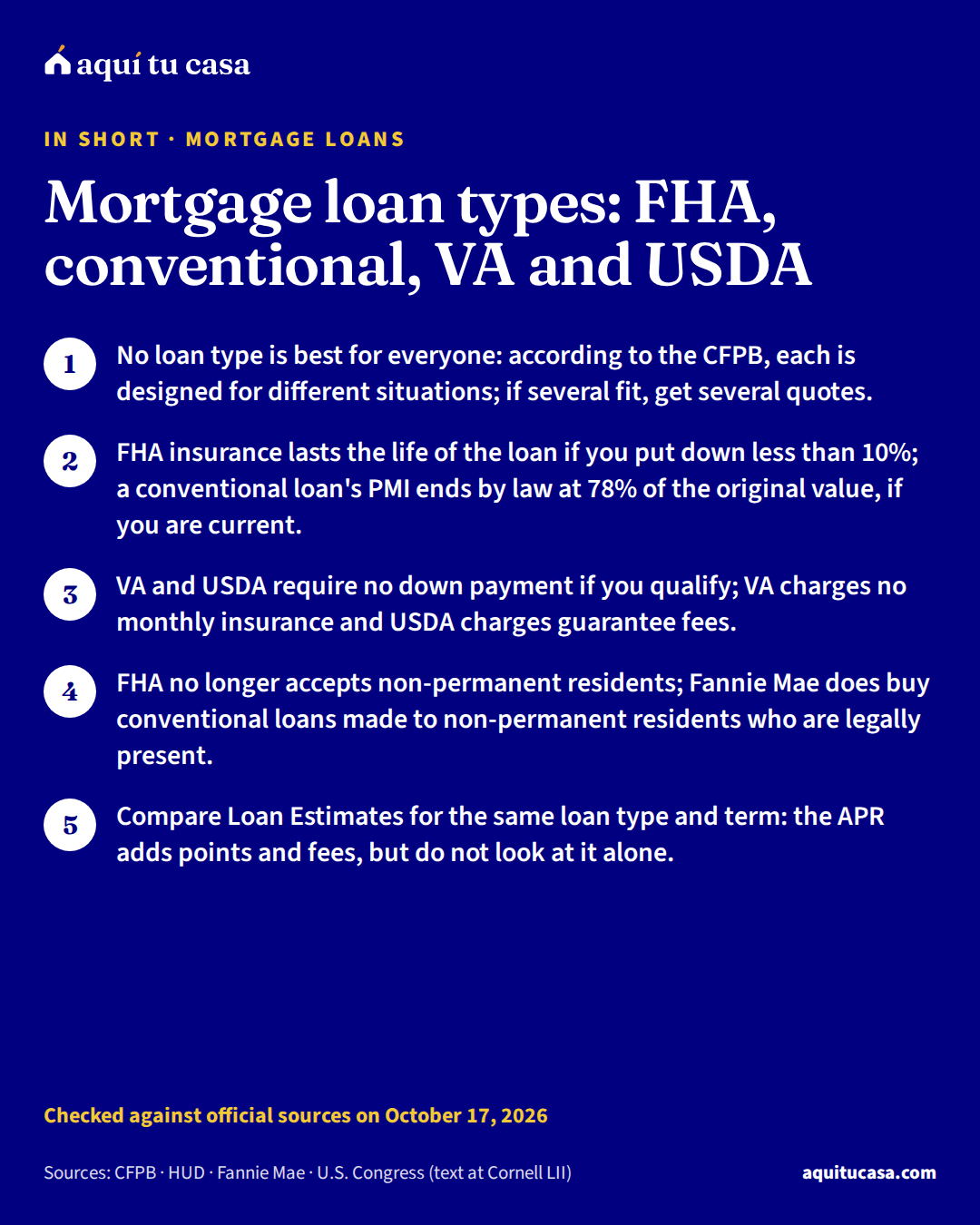
- Mortgage loans Mortgage loan types: FHA, conventional, VA and USDA What each mortgage type asks for, what its insurance costs, fixed or adjustable rate, points and APR. A neutral comparison with official sources. 14 minute read
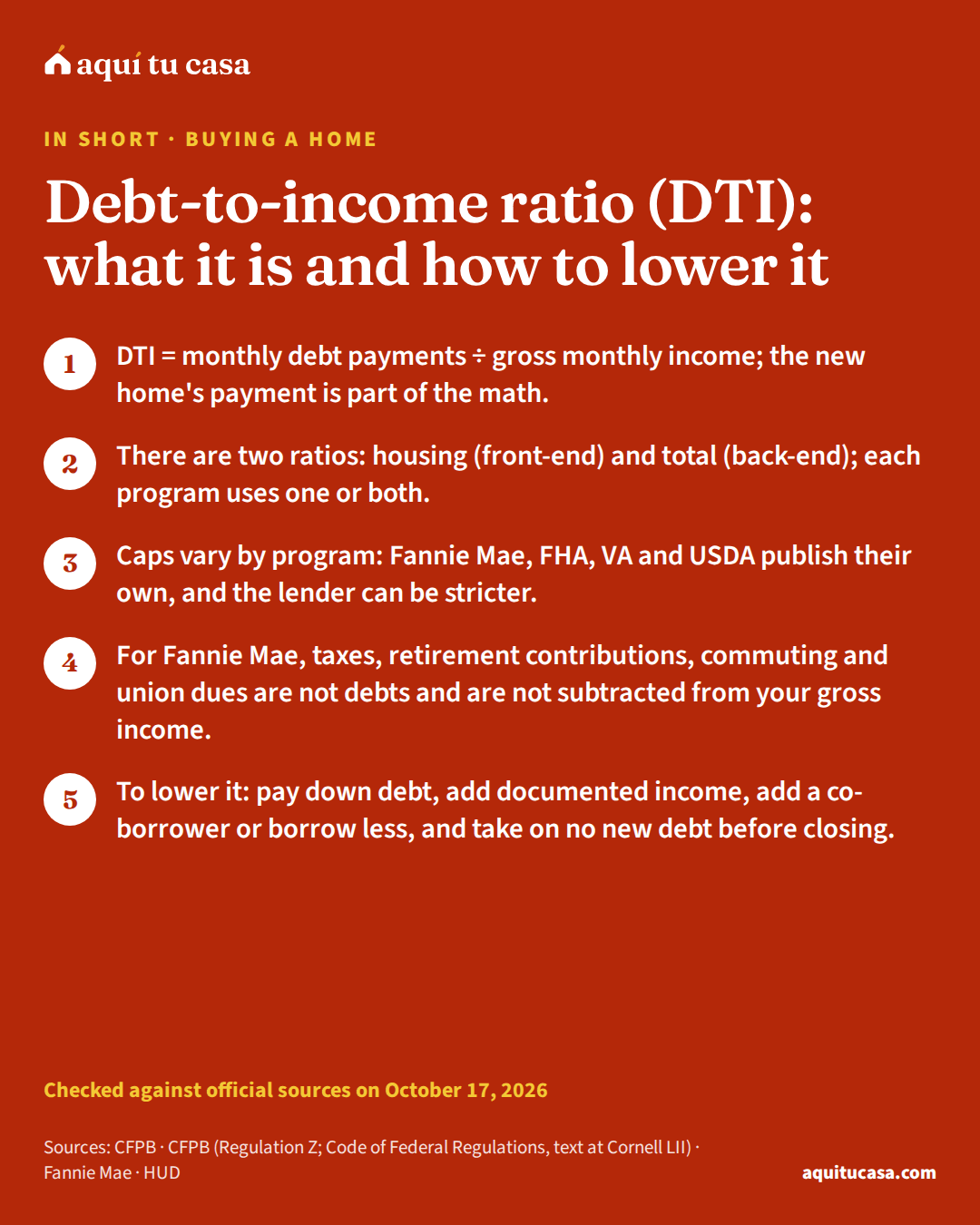
- Buying a home Debt-to-income ratio (DTI): what it is and how to lower it What the debt-to-income ratio (DTI) is, how to calculate it, which payments count, the caps FHA, Fannie Mae, VA and USDA publish and how to lower it. 14 minute read
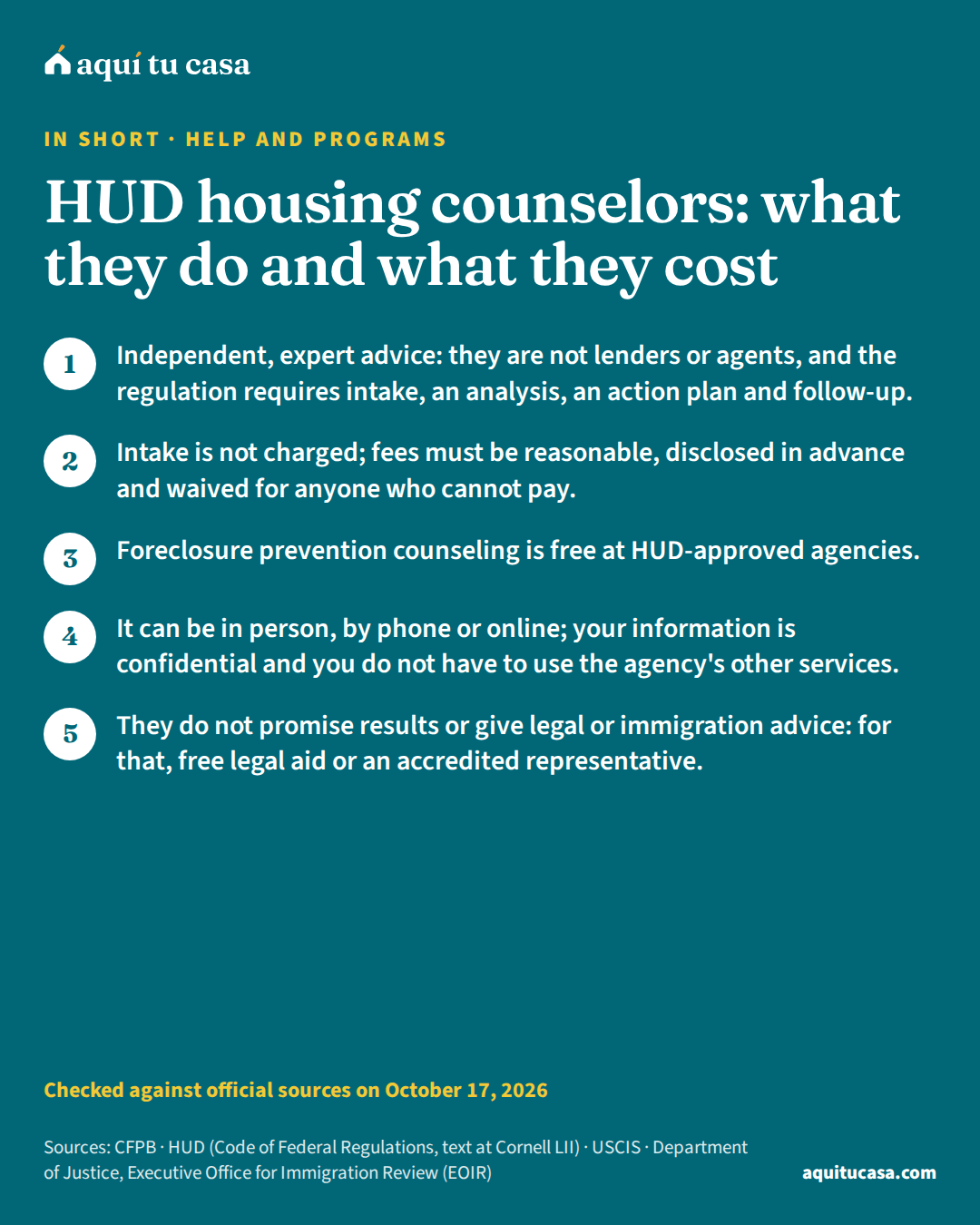
- Help and programs HUD housing counselors: what they do and what they cost What a HUD-approved housing counselor does, what they help with (buying, renting, missed payments, credit), what they may charge and how to find one. 11 minute read
Tools for this topic
Was this guide useful?
Thank you. Your answer stays in your browser; nothing is sent.