USDA farm labor housing and mutual self-help homes
How USDA farm labor housing (Sections 514 and 516) and mutual self-help housing (Section 523), where families build their homes together, work.
Verified against official sources on October 31, 2026 18 official sources

Show contents
In short
What you need to know
Quick answer
USDA has two kinds of help for rural families who work the land. Farm labor housing (Sections 514 and 516) is rental housing built by nonprofits, governments or farmers for people who earn a substantial part of their income from farm work; no one can require you to work for a particular employer to live there, and your rent is based on your income. Mutual self-help (Section 523) is for low-income families who build their homes in groups of 4 to 10, with a USDA Section 502 loan and an organization's guidance; each family works on everyone's homes.
What matters most
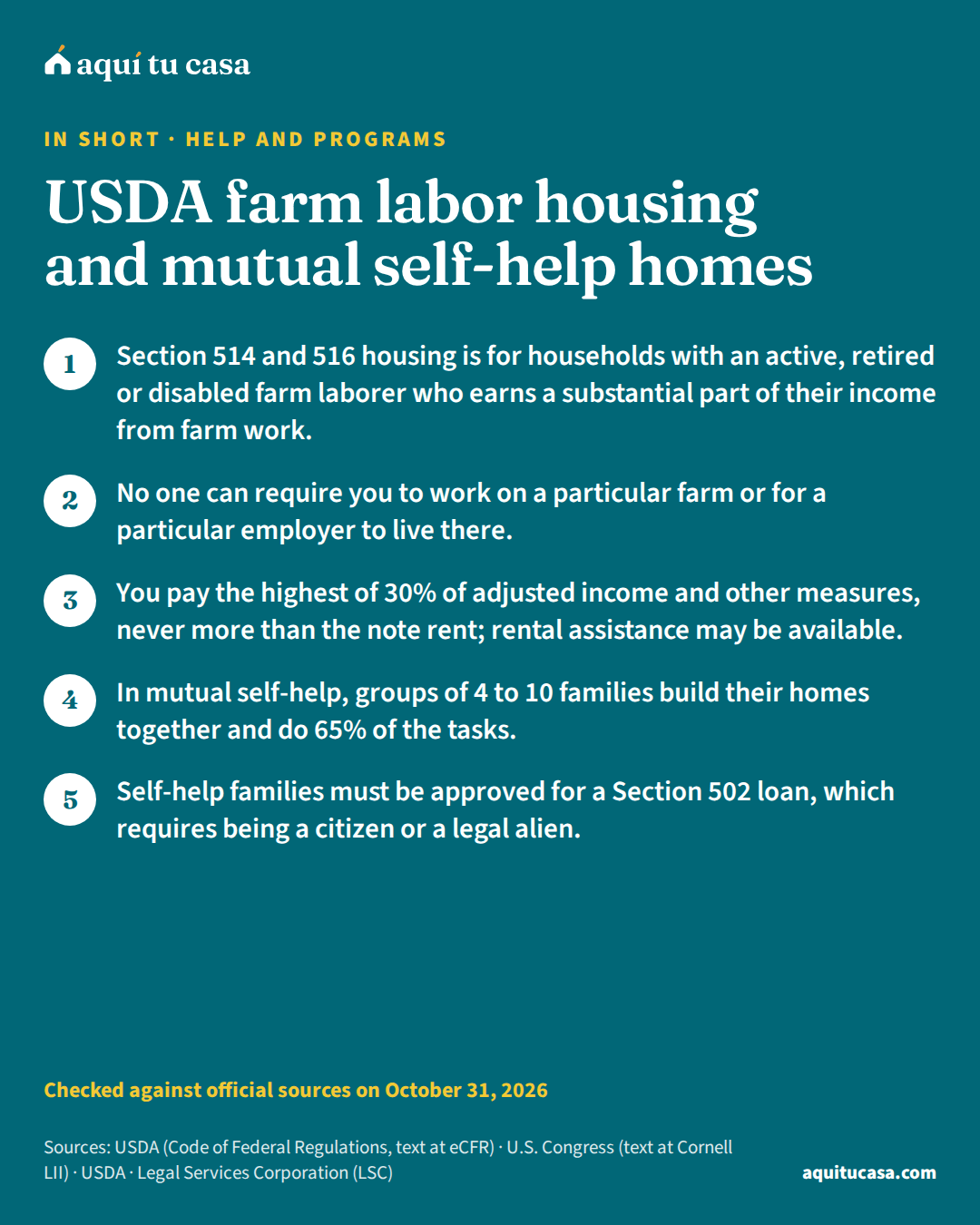
- Section 514 and 516 housing is for households with an active, retired or disabled farm laborer who earns a substantial part of their income from farm work.
- No one can require you to work on a particular farm or for a particular employer to live there.
- You pay the highest of 30% of adjusted income and other measures, never more than the note rent; rental assistance may be available.
- In mutual self-help, groups of 4 to 10 families build their homes together and do 65% of the tasks.
Is this for you?
This guide is for you if…
- You work in the fields, in harvesting, packing or livestock, or did until you retired or became disabled, and you are looking for rent you can afford.
- You work by the season and move from place to place following the harvests.
- Your family has a low income in a rural area and wants to build its own home with other families.
Get direct help first if…
- You want to buy an existing home with a bank loan: our USDA loan guide explains the guaranteed loan.
- You have problems with your employer over wages or working conditions: this guide is about housing; free legal aid can advise you.
The land feeds the country, but the people who work it often cannot find a home at a fair price. This guide is for families who work in agriculture and for low-income families in rural areas. It explains two programs of USDA, the Department of Agriculture: farm labor housing, under Sections 514 and 516, and mutual self-help housing, under Section 523, in which several families build their homes together.
- Of your region's income limit, the least you must earn from farm work to qualify (50% for a migrant in seasonal housing)
- 65%7
- Of farm work in the last 12 months, another way to show you qualify
- 110 days7
- Families per group in mutual self-help
- 4 to 1011
- Of the construction tasks, the share families do with their own labor
- 65%11
Two different programs
Farm labor housing (Sections 514 and 516). It is rental housing, on or off a farm, for farm workers.1 It aims to increase affordable, decent, safe and sanitary housing for people who work the land, and can include furnished seasonal housing.4 Off-farm housing is built by nonprofits, including farmworker organizations, tribes, community organizations and state or local governments; grants go to them.5 On-farm housing is built by farmers or farmer associations for the workers in their own operation, with loans only.9
Mutual self-help (Section 523). It is for very-low- and low-income families who want to become owners. USDA gives grants to organizations to guide and supervise groups of families who build their own homes.10
Farm labor housing or mutual self-help
Rentals
Farm labor housing (514 and 516)
Both programs are USDA programs for rural areas.17
Who qualifies for farm labor housing
What counts as farm work. The regulation defines it broadly: cultivating the soil; raising or harvesting agricultural or aquacultural commodities; catching, handling, planting, drying, packing, grading, storing or preserving them unprocessed; or delivering them to storage, market or a carrier. It does not matter who employs you, but self-employment does not count.1
Who is a “domestic farm laborer.” The regulation says it is a person who receives a substantial part of their income from farm work, not self-employed, in the United States, Puerto Rico or the Virgin Islands, and who is a U.S. citizen, or lives here after being legally admitted for permanent residence, or is a person legally admitted to the United States and authorized to work in agriculture. The definition can include immediate family members living with them.1
Retired and disabled workers count too. A retired farm laborer is at least 55 and worked in the fields the last 5 years before retiring, or most of the last 10. And a disabled one was working in the fields when they became disabled.1
Household and income. To live in off-farm housing, the household must include a domestic farm laborer tenant or co-tenant, a retired one or a disabled one, and must be income eligible. On top of that, the tenant or co-tenant must earn a substantial part of their income from farm work:7
- Farm earnings must be at least 65% of the agency’s published annual income limit for the region.
- For a migrant worker in seasonal housing, 50% is enough.
- If earnings data are not available, having worked at least 110 whole days in farm work in the previous 12 months counts, with days of at least 7 hours.
- After a natural disaster such as a drought, flood or freeze, the 12 months before the disaster are used.
Example with real numbers
A harvest worker who moves each season
An example in words of how eligibility is checked.
- Their work
- Harvesting and packing fruit, for several employers
- Where they live
- Seasonal off-farm housing
- What they must earn from farm work
- At least 50% of the region's income limit, as a migrant in seasonal housing
- If they have no pay stubs
- Having worked at least 110 whole days in farm work last year can count
- If a freeze ruined the harvest
- The 12 months before the disaster are used
- What cannot be required of them
- Working for a particular employer to live there
The example's rules come from USDA's regulation.77 Use the calculator to see how much rent you can afford on your income.
Run it with your numbersHow much rent can I afford?Your rights and what you pay
No work condition. In off-farm housing, no owner can require you to work on a particular farm or for a particular employer as a condition of living there. And no one can discriminate against you because of race, color, religion, sex, age, disability, familial status or national origin.7
Your rent. What you pay is based on your income and whether you get rental assistance. It is the highest of 30% of your monthly adjusted income, 10% of your gross monthly income, the housing part of a public assistance payment if you get one, or the basic rent if you do not get the agency’s rental assistance. You never pay more than the note rent.3
Rental assistance and seasons. Income-eligible tenants can get rental assistance. Seasonal housing must have set opening and closing dates, and off-season it can be rented on short-term leases.6 When the need for farmworker housing drops, units can be rented to other families who qualify for rural housing, until they are needed again.7
The order. Active farm laborer households come first, very low income first, then low and then moderate. Next come retired or disabled workers who worked in the local farm labor market, and then those who worked elsewhere.8

How to apply for farm labor housing
You apply at the property, with the owner or manager. The form asks, among other things, for your name and address, how many people live with you and their birth dates, your income, whether you need an accessible unit, a certification that the unit will be your primary residence and that you are a citizen or a qualified alien, and your Social Security number.2 The regulation defines a “legal or qualified alien” as any person lawfully admitted to the country who meets the criteria in section 214 of the federal housing law.1
From application to keys
2. Fill out the application
When you apply
With your information, your household's, your income and the certifications.2
3. Get on the waiting list
When you hand in the application
The date and time of a complete application set your place on the list.2
4. Complete anything missing
If they tell you
If something is missing, they must tell you in writing within 10 days.2
5. Get the answer in writing
Within 10 days of a complete application
They tell you whether you were selected, placed on the list or rejected.2
If you already have a leaseleaseA lease, or rental agreement, is the contract in which the owner or landlord gives you the right to live in and use a property for a set period of time in exchange for payment, usually rent. While the lease lasts you have possession, but the landlord still owns the property. The lease says how much you pay and when, who handles maintenance and how the agreement can end. Your rights as a tenant are usually spelled out in the lease and in your state and local laws. Before complaining to the landlord, it helps to read the lease and make sure you are also following the rules you agreed to.See the full definition, our guide to your lease explains what to check. And if you do not have a Social Security number for other rentals, our guide on renting without a Social Security number or credit explains your options.
Mutual self-help: building your home with other families
In mutual self-help, families organize in groups of generally 4 to 10 and use their own labor to lower the cost of their homes. They finish the work by exchanging labor: today everyone works on your house, tomorrow on your neighbor’s. For new construction, this is the method used.11
The program looks for families who otherwise would not qualify as owners: generally families below 50% of median income, living in substandard housing or lacking the skills to be owners. Very-low-income families get priority.10
Who can take part. Very-low- or low-income families who can do their share of the work, regardless of the head of household’s disability, age, race, national origin, religion, family status or sex. Before the work starts they must be approved for a Section 502 rural housing loan or a similar loan, have enough time to build and want to work with other families. Each family works on the others’ homes until 65% of the tasks are done. Only if a family becomes incapacitated, and with prior approval, can someone else do their share.11
What the organization does. The organization that receives the grant recruits families and helps them get loans; holds meetings to explain the program and homeownership topics such as payments, taxes, insurance and upkeep; helps find land, choose plans the families can afford and get cost estimates; prepares loan applications; and supervises and trains families during the work.11 It can be a state or local government, a public nonprofit corporation, a tribe or a private nonprofit corporation.11 The organization helps with the application, but only USDA Rural Development can approve or deny it.12

The Section 502 loan each family needs
For self-help, each family needs a direct USDA loanUSDA loanA USDA loan is a mortgage from the Rural Housing Service, part of the U.S. Department of Agriculture (USDA). It is meant for low- and moderate-income families buying a home in an area the USDA considers rural, and it can be offered with no down payment. There are two paths: the USDA guarantees a loan made by a private lender, or it lends directly to very-low-income families. To qualify, your income must be within the limit for your area and the home must be in an eligible area, which you can check on the USDA's map.See the full definition under Section 502 or a similar loan.11 This is what the Section 502 regulation requires:14
- Income. At approval, the household’s adjusted income cannot exceed the area’s low-income limit, and at closing, the moderate-income limit.
- Citizenship or status. Be a U.S. citizen or a noncitizen who qualifies as a legal alien.
- Live in the home. It must be your principal residence.
- Not already own a home, with exceptions.
- Be able to pay. Principal, interest, taxes and insurance should not exceed 33% of your repayment income, and with your other monthly debts, 41%. See our guide on debt-to-income ratio to do the math.
- The homebuyer course. If you are a first-time buyer, you must complete a course from a certified provider, with exceptions. Our guide on homebuyer education courses explains how to find one.
Rate and term. The loan uses USDA’s rate in effect at approval or closing, whichever is lower, and current rates are available at any Rural Development office. The term is no more than 33 years, or 38 if your adjusted income does not exceed 60% of area median income and you need it to afford the payment. There are payment subsidies, such as interest credit, that are recaptured if you transfer title or stop living in the home.15
To check whether an area is rural for USDA and whether your household might qualify, and to contact a program representative, use USDA’s eligibility site.17 Our USDA loan guide explains the guaranteed loan, which is a different program.
If this is you
You work the harvest and move each season
As a migrant in seasonal housing, earning 50% of your region's income limit from farm work is enough.7
You retired after years in the fields
If you are at least 55 and worked in the fields the last 5 years, you count as a retired farm laborer.1
Your family wants to build its own home
In mutual self-help, you build with a group of 4 to 10 families and an organization that guides them.11
You are buying for the first time
The Section 502 loan requires a homebuyer course from a certified provider.14
Costly mistakes
Mistake: Agreeing to live in off-farm housing in exchange for working for the owner.
Instead: No one can require you to work for a particular employer to live there.7
Mistake: Not applying because you have no pay stubs.
Instead: Having worked at least 110 whole days in farm work last year also counts.7
Mistake: Handing in an incomplete application and not coming back.
Instead: Your place on the list is set by the date of the complete application; finish what is missing.2
Mistake: Starting to build before the loan is approved.
Instead: In self-help, each family must be approved for the Section 502 loan before starting.11
Mistake: Thinking the self-help organization approves your loan.
Instead: The organization helps with the application, but only Rural Development approves or denies it.12
Mistake: Selling or leaving the home without thinking about the payment subsidy.
Instead: Section 502 payment subsidies are recaptured if you transfer title or stop living there.15

What to do this week
- Gather proof of your farm work: pay stubs, letters from your employer or a record of the days you worked.7
- Ask at the farm labor housing in your area for the application and get on the list.2
- If you want to build with other families, look for the self-help organization in your area and ask when the next group starts.11
- Check on USDA’s eligibility site whether your area is rural and whether your household might qualify.17
- If you have a problem with your housing or your application, look for free legal aid; LSC has a search tool.18
Your income
Let's do the math
Rent that fits your budget (30% of income)
$2,018
With an income of $6,728 a month. Up to $3,364 would already be a severe burden (50% of income).
Compared with HUD’s Fair Market Rent in the United States
- 2 bedrooms$1,750Fits · 26%Needs $33.65 an hour
The wage needed pays that rent without going over 30% of income, working 40 hours a week all year.
The typical rent households actually pay in the United States is $1,413 a month (Census).
A reference to give you an idea. Each landlord and each program sets its own requirements.
Ready to see the numbers? Find your county here
See how this applies in your county: its loan limits, prices and rents, from the official data.
Printable checklist
Frequently asked questions
Who can live in USDA farm labor housing?
A household that includes a domestic farm laborer who is working now, a retired one or a disabled one, and that is income eligible. The tenant must earn a substantial part of their income from farm work, for example at least 65% of the region's income limit, or have worked at least 110 whole days in farm work in the past year.
What counts as a 'domestic farm laborer'?
The regulation defines it as a person who earns a substantial part of their income from farm work, not self-employment, in the United States, Puerto Rico or the Virgin Islands, and who is a citizen, a lawful permanent resident, or a person legally admitted to the United States and authorized to work in agriculture. It can include the immediate family members who live with them.
Can the owner make me work on their farm to live there?
In off-farm labor housing, no. The regulation bars requiring a tenant to work on a particular farm or for a particular employer as a condition of living there, and bars discrimination based on race, color, religion, sex, age, disability, familial status or national origin.
How much rent do I pay?
The highest of 30% of your monthly adjusted income, 10% of your gross monthly income, the housing part of a public assistance payment, or the basic rent unless you get rental assistance; and never more than the note rent. Eligible tenants may get rental assistance.
What is mutual self-help?
It is a method in which groups of generally 4 to 10 low-income families build their homes by exchanging labor, guided by an organization that receives a Section 523 grant. Each family helps on the others' homes until 65% of the tasks are done, and must be approved for a Section 502 loan before starting.
Do I need to know how to build?
Not necessarily. The organization recruits families, explains the program, helps find land, house plans and cost estimates, prepares loan applications, and supervises and trains families during construction. What you do need is enough time to work and a desire to work with other families.
Can I join self-help if I am not a U.S. citizen?
The Section 502 loan the families need requires being a U.S. citizen or a noncitizen who qualifies as a 'legal alien' under section 214 of the federal housing law, which includes permanent residents, refugees, asylees and other categories. Which category you fit is an immigration question: an attorney or an accredited representative can advise you.
Sources
Every figure in this guide comes from one of these official sources. The number next to a sentence leads to the source behind it.
Each source on one line: who publishes it, its title, its address and the date we read it.
- 1. USDA (Code of Federal Regulations, text at eCFR) · 7 CFR §3560.11, Definitions (Direct Multi-Family Housing Loans and Grants) · ecfr.gov · Accessed October 31, 2026
- 2. USDA (Code of Federal Regulations, text at eCFR) · 7 CFR §3560.154, Tenant selection · ecfr.gov · Accessed October 31, 2026
- 3. USDA (Code of Federal Regulations, text at eCFR) · 7 CFR §3560.203, Tenant contributions · ecfr.gov · Accessed October 31, 2026
- 4. USDA (Code of Federal Regulations, text at eCFR) · 7 CFR §§3560.552–3560.553, Off-farm labor housing: program objectives and purposes · ecfr.gov · Accessed October 31, 2026
- 5. USDA (Code of Federal Regulations, text at eCFR) · 7 CFR §3560.555, Eligibility requirements for off-farm labor housing loans and grants · ecfr.gov · Accessed October 31, 2026
- 6. USDA (Code of Federal Regulations, text at eCFR) · 7 CFR §§3560.568 and 3560.573, Seasonal off-farm labor housing and rental assistance · ecfr.gov · Accessed October 31, 2026
- 7. USDA (Code of Federal Regulations, text at eCFR) · 7 CFR §3560.576, Occupancy restrictions · ecfr.gov · Accessed October 31, 2026
- 8. USDA (Code of Federal Regulations, text at eCFR) · 7 CFR §3560.577, Tenant priorities for labor housing · ecfr.gov · Accessed October 31, 2026
See the other 10 sources
- 9. USDA (Code of Federal Regulations, text at eCFR) · 7 CFR §§3560.603–3560.605, On-farm labor housing · ecfr.gov · Accessed October 31, 2026
- 10. USDA (Code of Federal Regulations, text at eCFR) · 7 CFR §1944.401, Objective (Self-Help Technical Assistance Grants) · ecfr.gov · Accessed October 31, 2026
- 11. USDA (Code of Federal Regulations, text at eCFR) · 7 CFR §1944.403, Definitions (Self-Help Technical Assistance Grants) · ecfr.gov · Accessed October 31, 2026
- 12. USDA (Code of Federal Regulations, text at eCFR) · 7 CFR §1944.423, Loan packaging and 502 RH application submittal · ecfr.gov · Accessed October 31, 2026
- 13. USDA (Code of Federal Regulations, text at eCFR) · 7 CFR §3550.10, Definitions · ecfr.gov · Accessed October 31, 2026
- 14. USDA (Code of Federal Regulations, text at eCFR) · 7 CFR §3550.53, Eligibility requirements (Section 502) · ecfr.gov · Accessed October 31, 2026
- 15. USDA (Code of Federal Regulations, text at eCFR) · 7 CFR §§3550.66–3550.68, Interest rate, repayment period and payment subsidies (Section 502) · ecfr.gov · Accessed October 31, 2026
- 16. U.S. Congress (text at Cornell LII) · 42 U.S.C. §1436a, Restriction on use of assisted housing by non-resident aliens · law.cornell.edu · Accessed October 31, 2026
- 17. USDA · USDA Income and Property Eligibility Site · eligibility.sc.egov.usda.gov · Accessed October 31, 2026
- 18. Legal Services Corporation (LSC) · I Need Legal Help · lsc.gov · Accessed October 31, 2026
Keep reading
Related guides
If this guide helped, these follow the same path.

Mortgage loans 12 minute read
USDA loan: no down payment in rural areas
How the USDA guaranteed loan works: rural areas, the household income limit, guarantee fees, who can apply and the steps from address to keys.
- USDA requires no down payment: the loan can reach the appraised value plus the upfront guarantee fee.
- You pay an upfront fee of 1% and an annual fee of 0.35%, which can be passed on to the borrower.
- The income of everyone who lives in the home counts, whether or not they sign the loan.
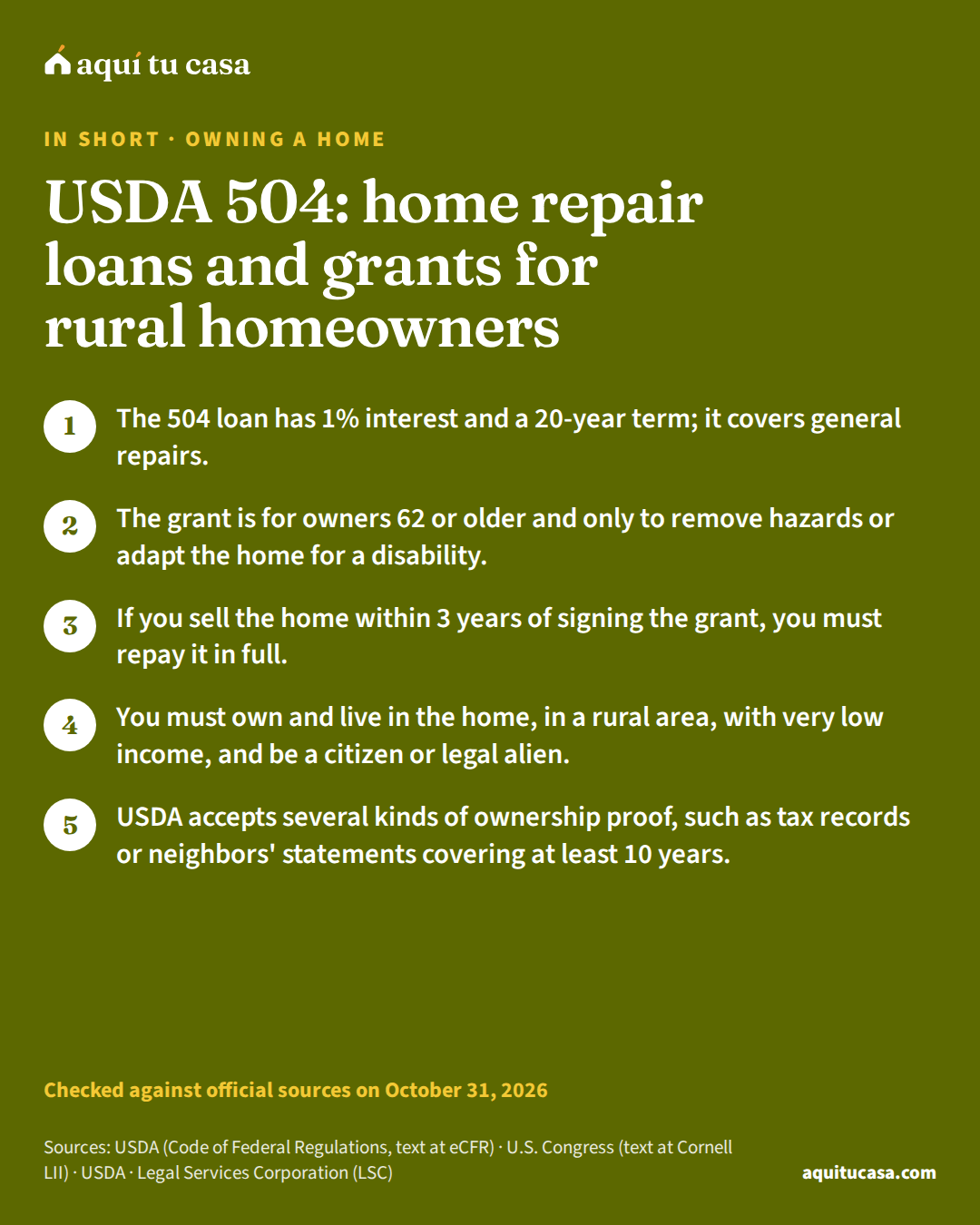
- Owning a home USDA 504: home repair loans and grants for rural homeowners USDA Section 504 repair loans and grants for very-low-income rural homeowners: the age rule for grants, the 1% interest rate and how to apply. 13 minute read
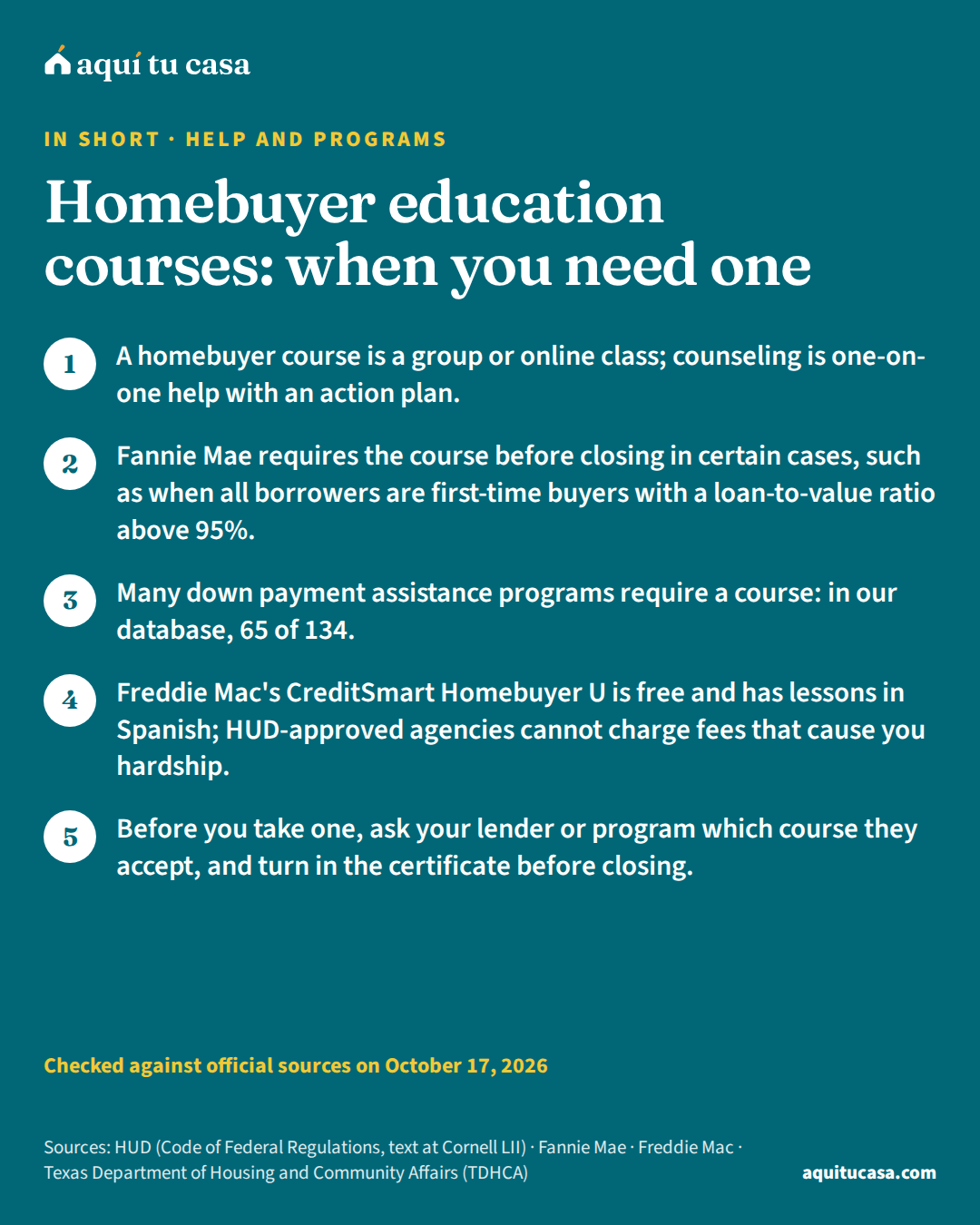
- Help and programs Homebuyer education courses: when you need one What a homebuyer education course is, when Fannie Mae, Freddie Mac and assistance programs require one, and where to take it for free or in Spanish. 10 minute read
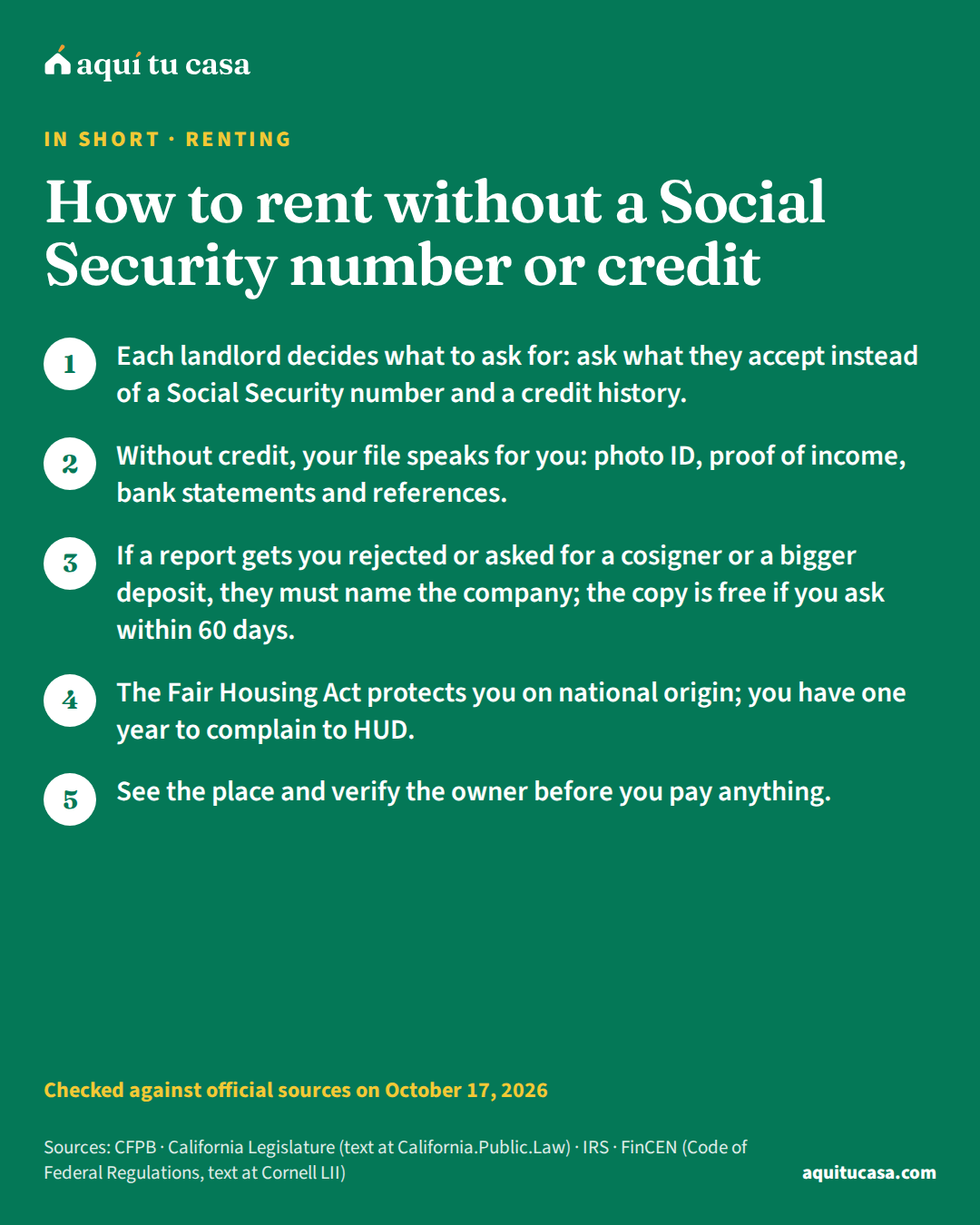
- Renting How to rent without a Social Security number or credit What a landlord can ask for, what to offer instead of an SSN and credit, how much rent fits your income and your rights if you are turned down. 11 minute read
Tools for this topic
Was this guide useful?
Thank you. Your answer stays in your browser; nothing is sent.