USDA 504: home repair loans and grants for rural homeowners
USDA Section 504 repair loans and grants for very-low-income rural homeowners: the age rule for grants, the 1% interest rate and how to apply.
Verified against official sources on October 31, 2026 16 official sources

Show contents
In short
What you need to know
Quick answer
USDA's Section 504 program helps very-low-income homeowners who live in their home in a rural area repair it. The loan is at 1% interest over 20 years and covers general repairs. The grant, which you do not repay, is only for people 62 or older and only to remove health or safety hazards or adapt the home for a disability; if you sell within 3 years, you pay it back. You must be a citizen or qualify as a "legal alien" under federal housing law. The caps depend on a national limit USDA sets.
What matters most
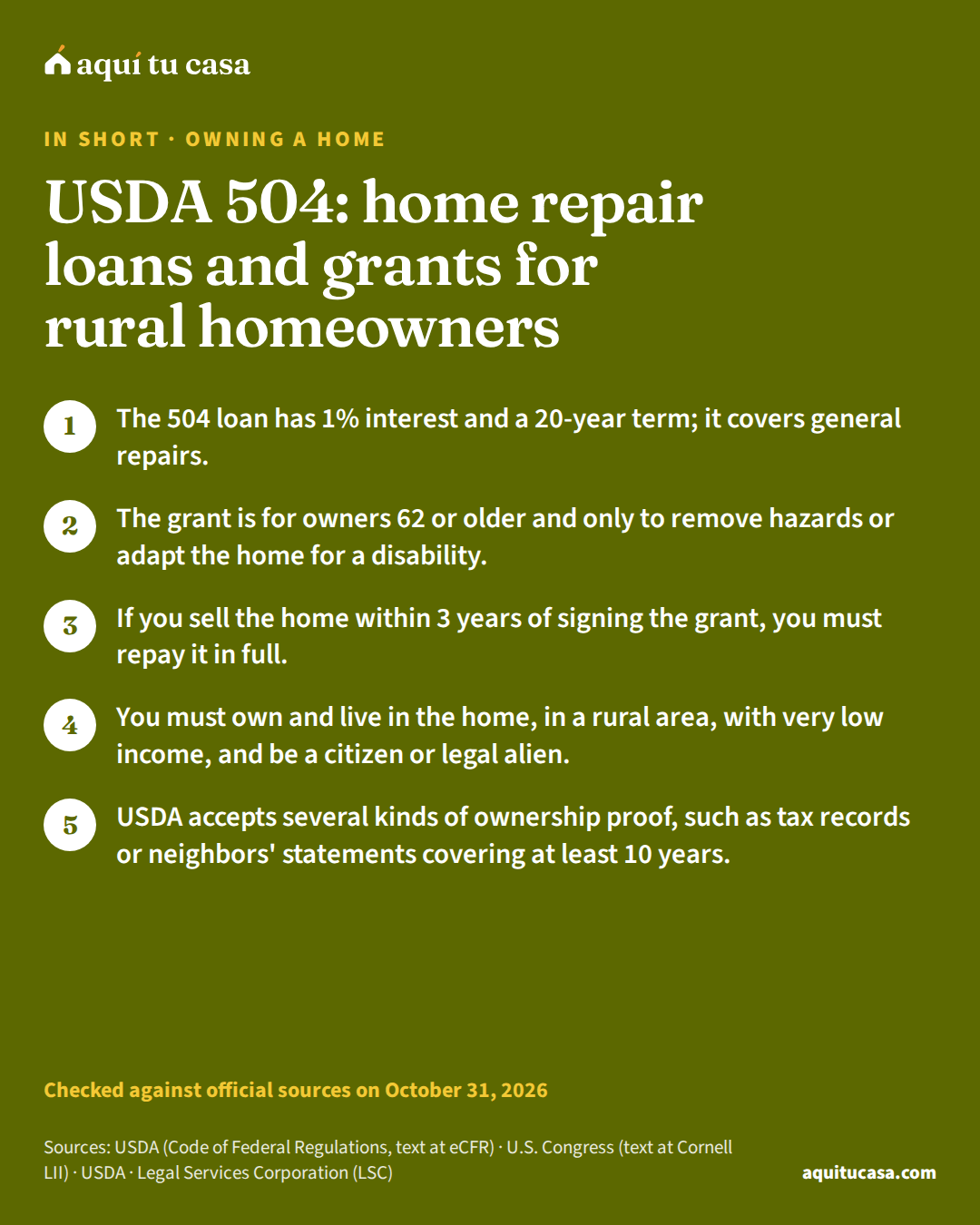
- The 504 loan has 1% interest and a 20-year term; it covers general repairs.
- The grant is for owners 62 or older and only to remove hazards or adapt the home for a disability.
- If you sell the home within 3 years of signing the grant, you must repay it in full.
- You must own and live in the home, in a rural area, with very low income, and be a citizen or legal alien.
Is this for you?
This guide is for you if…
- You own and live in a home in a rural area, your income is very low and the house needs repairs, such as the roof, the heating or the bathroom.
- You are 62 or older and your home has a health or safety hazard you cannot afford to fix.
- Someone in your household has a disability and you need to adapt the home.
Get direct help first if…
- You want to buy a home: our USDA loan guide explains the guaranteed purchase loan.
- You rent your home: repairs are the landlord's job; our renter repairs guide explains your rights.
In the countryside, a home is often a family’s for life, and repairs do not wait: the leaking roof, the failing heater, the bathroom that does not work for someone in a wheelchair. This guide is for you if you own and live in a home in a rural area and your income is very low. It explains USDA’s Section 504 program, run by the Department of Agriculture: who qualifies, what can be fixed, what the loan costs, who can get the grant and how to apply.
What the 504 program is
USDA’s Section 504 program gives loans and grants to very-low-income homeowners who live in their homes in rural areas, so they can repair them.3 There are two tools, and they do different things:4
- The loan pays for general repairs and improvements, or to remove health and safety hazards, as long as the home stays modest.
- The grant is not repaid. It can be used only to remove health and safety hazards, or to adapt the home for a household member with a disability. Unused grant money is returned.
Besides the work itself, the money can pay costs of getting the loan or grant, such as title, closing or the appraisal; special design features or equipment for a physical disability; connections to water, sewer, electricity or gas; property taxes due at closing; and fees to nonprofits that prepare the application.4
The 504 loan and grant
Repaid, at 1%
Loan
You can apply for both; USDA looks at your age, your income and what the home needs.5
Who qualifies
The regulation sets these conditions:5
- Own and live in the home.
- For the grant, be 62 or older when you apply.
- Very low income. At approval, the household’s adjusted income cannot exceed the very-low-income limit for your area.
- Citizenship or eligible immigration status, as explained below.
- No other way out. You must be unable to get help on reasonable terms from other sources and lack enough personal resources.
- Legal capacity to sign, or a court-appointed guardian who signs for you.
The “household” is everyone expected to live in the home, except live-in aides and foster children or adults. USDA develops the very-low-income limit in consultation with HUD. And the rural area is the one defined by federal housing law.2 To check whether your home is in an eligible area and whether your household might qualify, USDA’s eligibility site has a section for each; it also lets you contact a program representative.15
Your savings. If you have assets, part of them is used first. Elderly families must use net assets over $20,000 to reduce their request, and other families, assets over $15,000. The home and a minimum lot do not count for this.5 For USDA, an elderly family has a head, spouse or sole member who is 62 or older or disabled, or two or more people living together at least one of whom is.2
For the loan, your credit. You must show with a budget that you can repay it; if you fall short, a cosigner or other household members can join. You also need a history showing you pay your debts. A delinquency of more than 30 days in the last 12 months, a foreclosure in the last 36 months or an unresolved tax lien counts against you. A bankruptcy whose debts were discharged more than 36 months ago does not. If you are rejected for credit, you are told the reason and where the information came from.5
If you are not a citizen: what the rule says
The regulation puts it in these words: the applicant must be a U.S. citizen or a noncitizen who qualifies as a “legal alien,” as the regulation defines it.5 And it defines “legal alien” as any person lawfully admitted to the country who meets the criteria in section 214 of the Housing and Community Development Act of 1980 (42 U.S.C. §1436a).2
That law says assistance can go to a noncitizen only if they are a resident of the United States and fall into one of these categories:14
- Lawful permanent resident.
- Someone who entered before June 30, 1948 and is deemed a permanent resident by the Attorney General.
- A refugee, or a person granted asylum that has not been terminated.
- Someone lawfully present on parole for emergent reasons or reasons in the public interest.
- Someone lawfully present because their deportation is being withheld.
- Someone admitted for temporary or permanent residence under section 245A of the immigration law.
- Someone lawfully resident under the Compacts of Free Association with the Marshall Islands, Micronesia and Palau.
The same law says this rule applies to assistance under section 1474, the 504 repair program. And if at least one family member has established eligibility and other members’ ineligibility has not been established, the assistance is prorated by how many people are eligible.14
Which homes and repairs qualify
The area. Loans are made only in areas USDA’s Rural Housing Service designates as rural. If your area stops being rural and you already have a loan from the Service, you can still get 504 assistance.7
The lot and the home. The lot must not be large enough to split into more than one site. The home must be modest for the area and not designed to produce income. After the repairs it does not have to be perfect, but it cannot be left with major health or safety hazards. All work must meet local building codes.7
Mobile or manufactured homesmanufactured homeA manufactured home is a home built in a factory and moved in one or more sections, on its own chassis, to the site. Federal law defines it this way, with or without a permanent foundation, including its plumbing, heating, air-conditioning and electrical systems. Many people call it a mobile home or trailer. For Fannie Mae, it must meet HUD's federal standards; modular homes and what it calls prefabricated or panelized homes do not count as manufactured homes. It can be titled as real estate, generally when it sits on a permanent foundation on land the owner also owns, or as personal property, which is usually financed with a chattel loan.See the full definition. They can be repaired to remove hazards if you own the home and the land, lived there before applying, and the home is or will be on a permanent foundation paid for with program funds.4 Our guide on buying land or a manufactured home explains more about these homes.
What cannot be paid for. The program does not pay for a new home, repairs to a home that would still have major hazards, moving a mobile home to another site, off-site improvements other than utility connections, or debts from before the application, with some exceptions.4
How to prove the home is yours
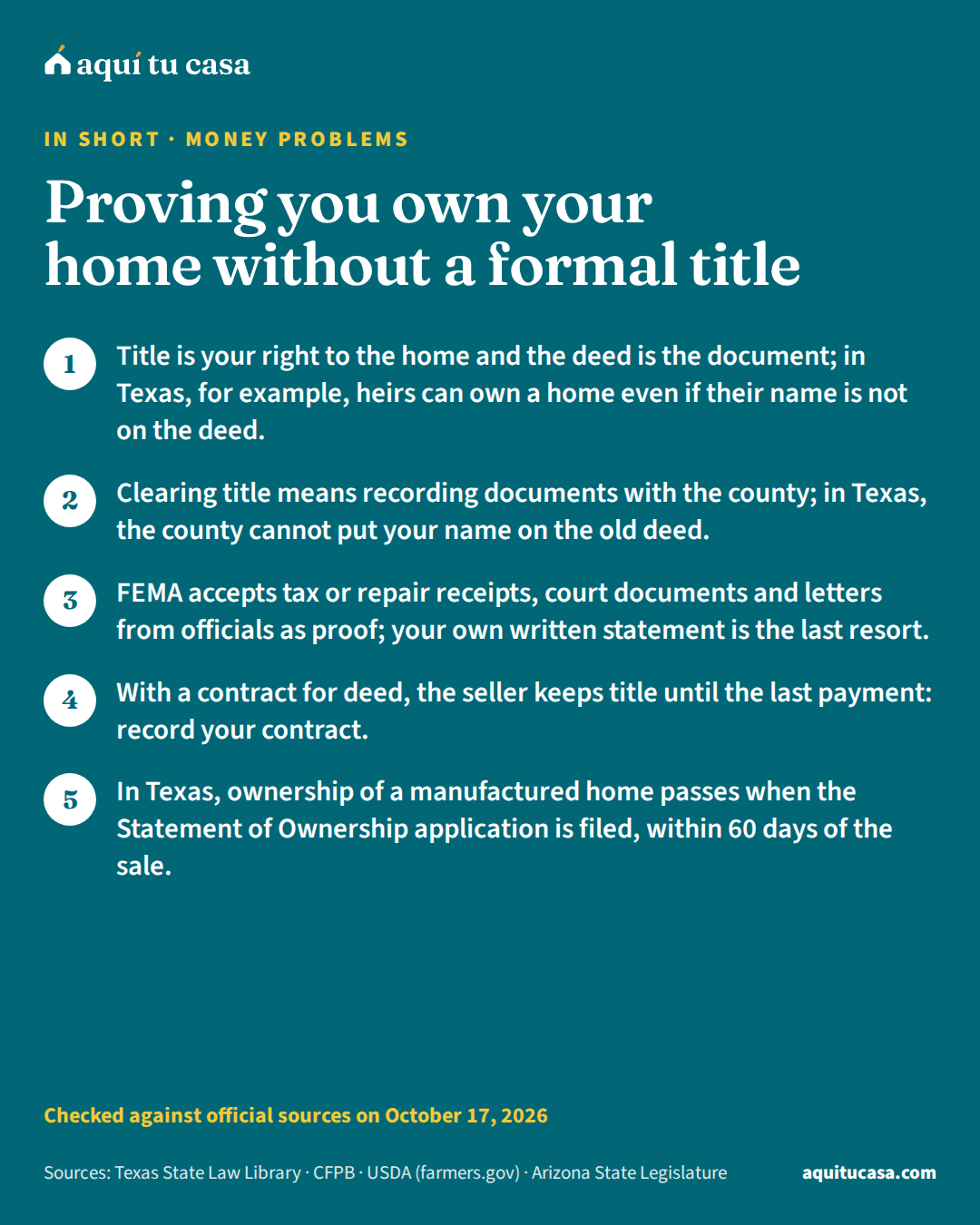
Many families live in a home they inherited or bought without a formal deed. The regulation accepts several forms of ownership:8
- Full ownership, with a deed in your name.
- A secure written lease; for the grant, with at least 5 years left.
- A life estate that gives you possession and use of the home.
- An undivided share of a property, for example among siblings who inherited, if there is no reason to think your position as owner-occupant is at risk. Heirs’ propertyheirs' propertyHeirs' property is, according to the Department of Agriculture (USDA), family land owned jointly by the descendants of someone who died without the estate going through probate. The heirs have the right to use it but do not have clear title to sell it, and each generation usually adds more owners. Without proof of ownership it can be hard to get federal benefits, and a third party could force a partition sale. In Florida, a special law protects heirs in partition lawsuits: the value is set by an appraisal and the other owners can buy out whoever asked for the sale.See the full definition is sometimes like this.
- A contract for deedcontract for deedA contract for deed is a home purchase on an installment plan: you pay the seller in monthly installments instead of getting a mortgage loan from a lender. The seller keeps the deed, which shows who legally owns the home, until you make all the payments. Meanwhile, you typically pay the property taxes, insurance, repairs and maintenance. The CFPB warns that most carry risks: if you miss a payment, the seller often tries to evict you right away and might try to keep the money you paid. Protections vary from state to state.See the full definition or land purchase contract, if you are current on the payments.
And if you have none of those papers, USDA may accept other evidence: local tax records showing you as owner and that you pay the taxes; sworn statements from people in your community that you have lived there as the owner for at least 10 years; or any document commonly accepted as proof of ownership, even if it is not recorded.8
Our guides on proving you own your home without a formal title and on wills, TOD deeds and inheriting a home explain how to put those papers in order.
How much you can borrow and what you sign
The regulation does not set the caps in dollars. Your total 504 loans cannot exceed an amount USDA sets based on average loans and repair costs, and never more than 20% of the national average area loan limit. The loan is also limited to what you can repay at 1% interest over 20 years. And the lifetime total of grants to a household or a home cannot exceed 10% of that limit.10 For the current amount, contact a USDA program representative through the eligibility site.15
Example with real numbers
A 70-year-old owner with a damaged roof
An example in words of how the rules fit together.
- Her age
- 70: she can apply for the grant
- The repair
- The roof leaks over the electrical wiring
- What the grant can pay
- Removing health and safety hazards, up to the lifetime cap
- If she needs more money
- A loan at 1% over 20 years, if her budget allows
- If her 504 debt reaches $7,500
- The home is secured with a mortgage
- If she sells the home within 3 years
- She repays the whole grant
The example's rules come from USDA's regulation.41011912 Use the family budget tool to see how much you could pay each month.
Run it with your numbersFamily budgetSecurity and insurance. When your 504 debt reaches $7,500 or more, the property is secured with a mortgage. USDA does not require being the first lienlienA lien is a legal right a creditor holds in your property to make sure you repay a debt. It usually prevents the property from being sold until the debt is paid, and if you do not pay, the creditor may be able to take the property. Your mortgage is a lien on your home: when you pay it off, the lien is released and that shows up in your county's property records. There are other kinds, such as a federal tax lien, which is the government's legal claim against all your property when you do not pay a tax debt.See the full definition, but total debts on the home cannot exceed its value. If your secured debt is over $15,000 at loan approval, you must keep hazard insurance. And if the home is in a Special Flood Hazard Areaspecial flood hazard area (SFHA)A special flood hazard area (SFHA) is an area FEMA identifies on its maps as being at high risk of flooding. On the maps it shows up as zones that start with A, or with V on the coast, where there is also a hazard from storm waves. If your home is in one of these zones, in a community that takes part in the National Flood Insurance Program (NFIP), and you have a government-backed mortgage or one from a regulated lender, the law requires you to carry flood insurance. The lender must tell you in writing if the home is in one of these zones.See the full definition, you must carry flood insurance for the life of the loan.9 Our flood insurance guide explains how it works.
The grant. You sign an agreement saying that if you sell the property less than 3 years after signing, you repay the whole grant.12
If you live in a border colonia
For coloniascolonia (border community)Under federal law, a colonia is a community in Arizona, California, New Mexico or Texas, in the U.S.-Mexico border region, that is identified as a colonia by criteria such as a lack of drinkable water, adequate sewage systems and decent, safe and sanitary housing, and that existed as a colonia before the law was passed. Those four states must set aside part of their federal community development funds for water, sewage and housing in colonias. The CFPB notes that many landowners and developers in Texas border colonias have offered financing through contracts for deed.See the full definition along the border with Mexico, there is also a Water and Waste Disposal (WWD) grant for individuals. It helps you connect to a community water and sewer system: it can pay for the lines to your home, the connection to your plumbing, connection fees and basic plumbing if your home has none. The lifetime total cannot exceed $5,000. You do not need to be 62, but you must own and live in the home in the colonia, and the whole household’s taxable income must be below the Department of Health and Human Services poverty guidelines.13
How to apply, step by step
From application to repair
1. Check your area and income
Before you apply
USDA's eligibility site lets you check your home's area and your household's potential eligibility.15
2. Gather proof of ownership
Before you apply
Deed, contract, tax records or neighbors' statements covering at least 10 years.8
3. File a complete written application
When you are ready
In USDA's format. It is accepted even if there are no funds at the moment.6
4. Answer what they ask
If they write to you
If something is missing, they tell you in writing; if they ask you to confirm your interest, answer on time.6
5. Get the decision in writing
When the review is done
If you do not qualify, they tell you why; you can ask for an appeal hearing.1
When funds run short, USDA gives priority to applications to remove health and safety hazards. Among equal applications received the same day, veterans get preference, and then requests are funded first-come, first-served.6 That is why it helps to explain in your application what hazard your home has.
If USDA makes a decision against you, it must tell you in writing, with your right to a hearing before USDA’s National Appeals Division. Any adverse decision can also be reviewed by the next-level supervisor.1 Free legal aidlegal aidLegal aid is the free civil legal help that nonprofit organizations and their lawyers provide to low-income people in civil, not criminal, matters. In housing, that includes representing families facing eviction or foreclosure, alongside matters such as custody, child support, protection from domestic violence and access to benefits. In the United States, the Legal Services Corporation, created by Congress, funds a nationwide network of these organizations; its finder points you to the one in your area. Each sets its own income limits.See the full definition can advise you; LSC has a search tool.16
If this is you
You are 62 or older and the heater has stopped working
You can apply for the grant to remove that hazard, and for a loan if you need more.4
You need a ramp or an accessible bathroom
The grant and the loan can pay to adapt the home for a household member with a disability.4
You inherited the home with your siblings
An undivided share of a property can count as proof of ownership.8
You bought with a contract for deed
A land purchase contract works if you are current on the payments.8
You have an ITIN or a temporary status
The rule requires being a citizen or a legal alien under federal housing law; ask an accredited representative about your case.2

Costly mistakes
Mistake: Not applying because USDA says there are no funds.
Instead: Applications are accepted even when funds are not available at the moment.6
Mistake: Paying a company to get the grant for you.
Instead: Program money cannot pay for-profit companies to prepare or refer applications.4
Mistake: Thinking you do not qualify without a deed.
Instead: USDA accepts tax records, neighbors' statements and other proof.8
Mistake: Selling the home a year after getting the grant.
Instead: If you sell within 3 years, you repay the whole grant.12
Mistake: Ignoring a letter asking you to confirm your interest.
Instead: If you do not answer in time, they can withdraw your application.6
Mistake: Dropping flood insurance when your home is in a flood zone.
Instead: With a 504 loan, you must keep it for the life of the loan.9
What to do this week
- List the repairs your home needs and mark the ones that are a health or safety hazard.4
- Check on USDA’s eligibility site whether your home is in an eligible area.15
- Gather your proof of ownership and that you live in the home.8
- Gather proof of income for everyone who lives with you.2
- File the application in writing and keep a copy, even if you are told there are no funds.6
Your household this month
Let's do the math
Left each month
Enter what at least one person takes home to see the result.
What helps
- Pay savings first: set the goal aside the day the money arrives, before flexible spending.
- Add up the bills that come every few months (car insurance, school) and divide by twelve.
- If income changes, plan on a low month and save the extra from good months.
- A HUD-approved housing counselor can go over the budget with you, often for free.
This is a planning tool with your numbers, not a credit evaluation or an approval. The split reference is only a guide.
Ready to see the numbers? Find your county here
See how this applies in your county: its loan limits, prices and rents, from the official data.
Printable checklist
Frequently asked questions
How much can I borrow or receive through the 504 program?
The regulation does not set a dollar figure: the loan cannot exceed an amount USDA sets, which can never be more than 20% of the national average area loan limit, and it is limited to what you can repay at 1% over 20 years. The lifetime total of grants cannot exceed 10% of that limit. For the current amount, contact a USDA program representative.
Do I have to repay the grant?
No, unless you sell the property less than 3 years after signing the grant agreement. In that case you must repay all of it. The loan is repaid, at 1% interest over 20 years.
How old do I have to be?
For the grant, 62 or older at the time you apply. For the loan, the regulation sets no minimum age, but you must be able to repay it under a budget.
Can I apply if I am not a U.S. citizen?
The regulation requires being a U.S. citizen or a noncitizen who qualifies as a 'legal alien' under section 214 of the federal housing law. That law includes, among other categories, permanent residents, refugees, asylees and people with certain kinds of parole. Which category you fit is an immigration question: an attorney or an accredited representative can advise you.
The house was my parents' and the deed is not in my name. Can I qualify?
Possibly. The regulation accepts several forms of ownership, such as an undivided interest in a shared property or a life estate. And if you do not have those papers, USDA may accept tax records showing you as owner and that you pay the taxes, or sworn statements from neighbors that you have lived there as the owner for at least 10 years.
Can it be used for a mobile home?
Yes, to remove health and safety hazards, if you own the home and the land, lived there before applying, and the home is or will be on a permanent foundation paid for with program funds. It cannot be used to move the home to another site.
Can someone charge me to get the grant for me?
The regulation bars using program funds to pay fees or commissions to for-profit companies for packaging your application or referring you. It does allow fees to tax-exempt nonprofits that package applications. Be wary of anyone who asks for money up front to 'get you' the money.
Sources
Every figure in this guide comes from one of these official sources. The number next to a sentence leads to the source behind it.
Each source on one line: who publishes it, its title, its address and the date we read it.
- 1. USDA (Code of Federal Regulations, text at eCFR) · 7 CFR §3550.4, Reviews and appeals · ecfr.gov · Accessed October 31, 2026
- 2. USDA (Code of Federal Regulations, text at eCFR) · 7 CFR §3550.10, Definitions · ecfr.gov · Accessed October 31, 2026
- 3. USDA (Code of Federal Regulations, text at eCFR) · 7 CFR §3550.101, Program objectives (Section 504) · ecfr.gov · Accessed October 31, 2026
- 4. USDA (Code of Federal Regulations, text at eCFR) · 7 CFR §3550.102, Grant and loan purposes · ecfr.gov · Accessed October 31, 2026
- 5. USDA (Code of Federal Regulations, text at eCFR) · 7 CFR §3550.103, Eligibility requirements · ecfr.gov · Accessed October 31, 2026
- 6. USDA (Code of Federal Regulations, text at eCFR) · 7 CFR §3550.104, Applications · ecfr.gov · Accessed October 31, 2026
- 7. USDA (Code of Federal Regulations, text at eCFR) · 7 CFR §§3550.105–3550.106, Site and dwelling requirements · ecfr.gov · Accessed October 31, 2026
- 8. USDA (Code of Federal Regulations, text at eCFR) · 7 CFR §3550.107, Ownership requirements · ecfr.gov · Accessed October 31, 2026
See the other 8 sources
- 9. USDA (Code of Federal Regulations, text at eCFR) · 7 CFR §§3550.108 and 3550.110, Security and insurance requirements (loans only) · ecfr.gov · Accessed October 31, 2026
- 10. USDA (Code of Federal Regulations, text at eCFR) · 7 CFR §3550.112, Maximum loan and grant · ecfr.gov · Accessed October 31, 2026
- 11. USDA (Code of Federal Regulations, text at eCFR) · 7 CFR §3550.113, Rates and terms (loans only) · ecfr.gov · Accessed October 31, 2026
- 12. USDA (Code of Federal Regulations, text at eCFR) · 7 CFR §3550.114, Repayment agreement (grants only) · ecfr.gov · Accessed October 31, 2026
- 13. USDA (Code of Federal Regulations, text at eCFR) · 7 CFR §§3550.115–3550.119, Section 306C Water and Waste Disposal Grants · ecfr.gov · Accessed October 31, 2026
- 14. U.S. Congress (text at Cornell LII) · 42 U.S.C. §1436a, Restriction on use of assisted housing by non-resident aliens · law.cornell.edu · Accessed October 31, 2026
- 15. USDA · USDA Income and Property Eligibility Site · eligibility.sc.egov.usda.gov · Accessed October 31, 2026
- 16. Legal Services Corporation (LSC) · I Need Legal Help · lsc.gov · Accessed October 31, 2026
Keep reading
Related guides
If this guide helped, these follow the same path.

Owning a home 13 minute read
Home maintenance: how to budget for repairs
How to plan and save for home maintenance and repairs: what insurance does not cover, what the IRS says and what help exists to fix up your home.
- Your mortgage payment is only part of what your home costs: the CFPB says to budget and save for maintenance and repairs too.
- Official sources do not give a fixed percentage; use your past unexpected expenses to set a goal and put money aside every month.
- Most policies do not cover wear and tear, continuous leaks or termites: you pay for those.
- Protect yourself from scams Contractor and home repair scams: how to protect yourself How to spot a dishonest contractor, check a license, sign a solid contract, pay safely and cancel a sale made at your home. 11 minute read
- Money problems Proving you own your home without a formal title Inherited home never transferred, contract for deed or mobile home: which papers prove it is yours and why they matter to FEMA, insurers and lenders. 13 minute read

Tools for this topic
Was this guide useful?
Thank you. Your answer stays in your browser; nothing is sent.