Flood insurance (NFIP): who needs it and what it covers
Why home insurance does not cover floods, when you must buy NFIP coverage, what it covers, the 30-day wait, flood zones and how to file a claim.
Verified against official sources on October 17, 2026 14 official sources
Show contents
In short
What you need to know
Quick answer
Standard homeowners insurance does not cover floods: for that you need a separate policy, bought through FEMA's National Flood Insurance Program (NFIP) or from a private insurer. It is required if your home is in a high-risk zone (A or V) and you have a federally backed mortgage, but it is recommended in every zone. For a home, the NFIP covers up to $250,000 for the building and up to $100,000 for your belongings, and coverage starts 30 days after you buy it, unless you buy it when you close your mortgage.
What matters most
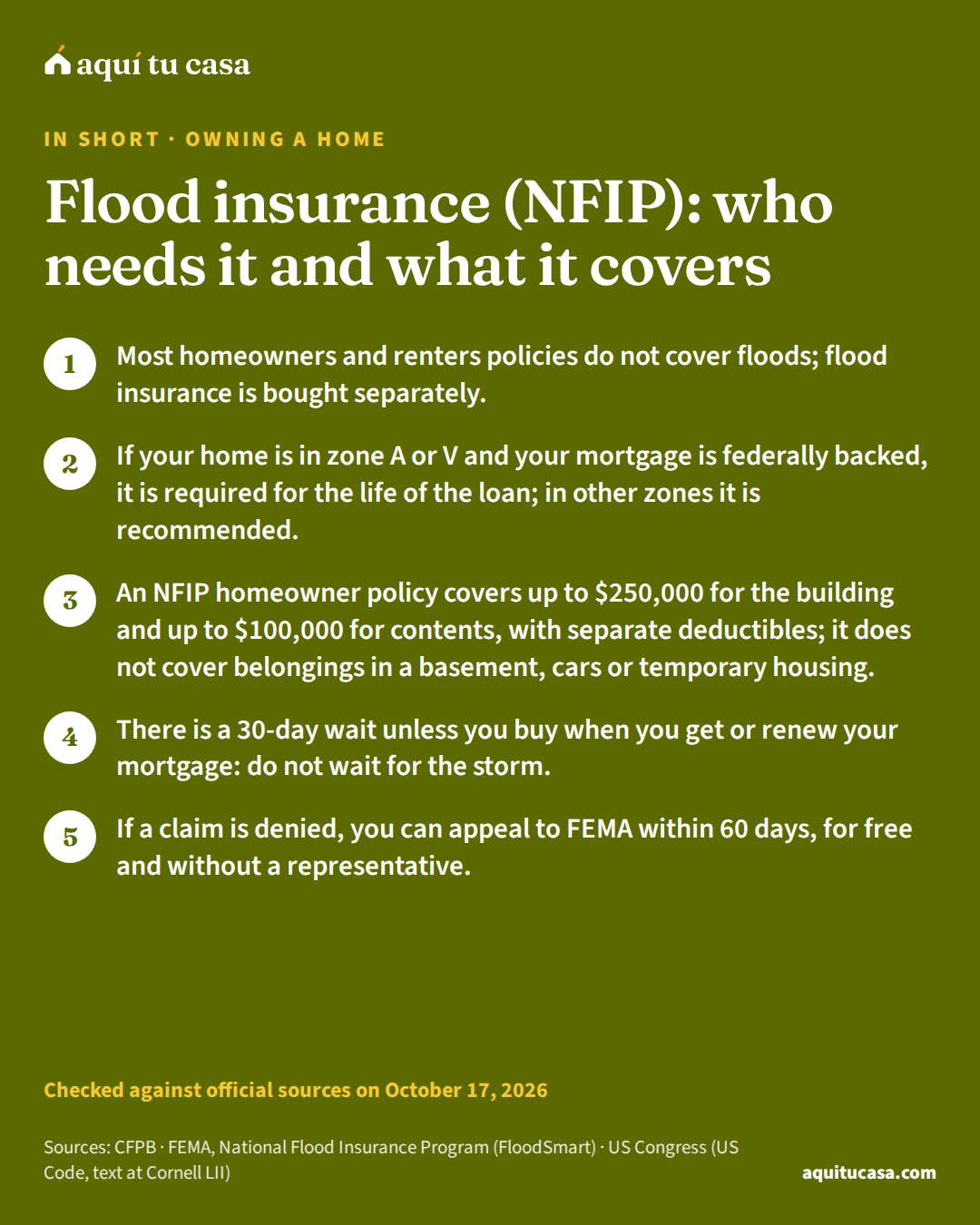
- Most homeowners and renters policies do not cover floods; flood insurance is bought separately.
- If your home is in zone A or V and your mortgage is federally backed, it is required for the life of the loan; in other zones it is recommended.
- An NFIP homeowner policy covers up to $250,000 for the building and up to $100,000 for contents, with separate deductibles; it does not cover belongings in a basement, cars or temporary housing.
- There is a 30-day wait unless you buy when you get or renew your mortgage: do not wait for the storm.
Is this for you?
This guide is for you if…
- You are buying or already own a home and want to know whether you need flood insurance, even if you do not live by the ocean or a river.
- Your lender told you your home is in a high-risk flood zone and asked you to buy coverage.
- You rent and want to protect your belongings, or you already flooded and need to file a claim.
Get direct help first if…
- Your question is about wind, fire or theft damage: your homeowners policy covers that (or not); start with that guide.
- You own a business: the NFIP has commercial policies with other limits that this guide does not explain.
Everyone lives in an area with some flood risk, not just people by the ocean or a river.4 This guide is for homeowners and renters who want to know whether their insurance covers them, for buyers looking at a home in a flood zone and for anyone who has already flooded: it explains why homeowners insurance does not cover floods, when NFIP coverage is required, what it covers and what it does not, the wait before it starts, how it is paid and how to file a claim.
Why your homeowners insurance does not cover you
According to the CFPB, standard homeowners insurancehomeowners insuranceHomeowners insurance pays for losses and damage to your property if something unexpected happens, like a fire or a burglary, and usually includes liability coverage if someone is hurt at your home. Lenders require it as long as you have a mortgage, because the home is their collateral, and almost always collect it inside your monthly payment through the escrow account. The price depends on the location, the rebuilding cost, the deductible and your history. A standard policy does not cover floods or, in many states, earthquakes: those risks are insured separately.See the full definition does not cover damage from earthquakes or floods, although it may be possible to add that coverage.1 FloodSmart, the website of FEMA’s National Flood Insurance Program (NFIP), says the same about most homeowners and renters policies.2 That is why flood insuranceflood insuranceFlood insurance is a separate policy that can cover a building, its contents, or both, when flood water causes damage. Most homeowners insurance policies do not cover that damage. Most of these policies are backed by FEMA's National Flood Insurance Program (NFIP) and bought through insurers and agents. If your home is in a high-risk flood area and your mortgage is backed by the federal government, the lender is required to demand it; outside those areas it is optional, but floods happen there too.See the full definition exists: a separate policy with its own premium and its own deductible.
The NFIP sells policies to homeowners, renters and businesses. Any homeowner who lives in a community that participates in the program can buy one, including condo and townhouse owners.2 A community participates if it follows the NFIP’s floodplain management rules, and most communities in the country do.3
Counting on government aid is not a plan either. FloodSmart explains that federal disaster assistance only comes if the president declares a disaster, that most floods do not get that declaration, and that the aid usually comes as loans repaid with interest; flood insurance claim payments, on the other hand, do not have to be paid back.3
Is it required? Flood zones and loans
FEMA’s flood maps divide the country into zones. Zones starting with A (A, AE, AH, AO, AR and A99) and V (V and VE) are high risk. If your home is in one of them and you have a federally backed mortgage, you must buy flood insurance as a condition of the loan; if you do not have that kind of mortgage, FloodSmart still strongly recommends it.4
What FloodSmart says by zone
Zones A and V
High risk
Zones B, C and X
Moderate or low risk
Find your zone at the FEMA Flood Map Service Center or through your community's floodplain administrator.4
The rule comes from federal law. Regulated lenders may not make, increase, extend or renew a loan on a home in a special flood hazard area (SFHA) where coverage is available unless the home is insured against floods for the life of the loan, for at least the loan balance or the maximum coverage available, whichever is less. They must accept private insurance that meets those requirements, and coverage is not required for a detached structure that does not serve as a residence.11
There are two other cases where coverage is required. Some banks require it even if you do not live in a high-risk area. And if your home received federal disaster assistance in the past, you must have flood insurance to get it again; the requirement goes with the home, so it also applies if you bought it from someone who received that aid.3
If you disagree with your zone, there are two routes. You can request a map change with a Letter of Map Amendment (LOMA) or Letter of Map Revision (LOMR).4 And you and your lender can jointly ask FEMA, with technical information, to review whether the home is in a flood hazard area; FEMA must answer by letter within 45 days, and its decision is final.11

What it covers and what it does not
For a home, the NFIP has two coverages: building, up to $250,000, and contents, up to $100,000 for your belongings inside the home. They are usually bought separately and each has its own deductibledeductibleA deductible is the part of an insurance claim you pay yourself. When you have a covered loss, the insurance company subtracts the deductible from the claim amount and pays you the rest. You may have a different deductible for each type of coverage. You will find it on the first page of your policy, called the declarations page, along with your coverages and limits. In taxes, the word "deductible" means something else: an expense that can lower the taxes you owe.See the full definition. If you rent, contents coverage protects your belongings up to $100,000.2
| Covered | Not covered |
|---|---|
| Electrical and plumbing systems | Cash, precious metals and valuable papers |
| Refrigerator, stove and built-in appliances | Cars and other vehicles |
| Installed carpet, cabinets, foundation walls and stairs | Belongings kept in a basement |
| Clothing, furniture and electronics (contents) | Things outside the building: landscaping, deck, fence, pool |
| Valuables such as original artwork, up to a cap (contents) | Temporary housing and extra living costs during repairs |
The list summarizes what FloodSmart publishes, which also notes that the cause matters: the policy covers water from a sewer that backed up during a heavy rainstorm, but not from a sewer backup caused by clogged pipes.2 NFIP policies also do not cover mold damage.7
If a flood badly damages your home and it is in a special flood hazard area, Increased Cost of Compliance (ICC) coverage may help. It provides up to $30,000 to elevate, move or rebuild the home when your community determines the damage equals 50% or more of its pre-flood market value, or that it was damaged repeatedly. It is claimed separately, and combined with the building claim it cannot exceed that coverage limit.9

The 30-day wait: when to buy
A new policy does not protect you right away. FloodSmart says coverage starts 30 days after you buy, with four exceptions.2 The law counts those 30 days from when you complete the application and pay the initial premium.12
When your policy starts and when it renews
The practical lesson: do not wait for a storm forecast. If you buy when the water is already coming, the 30-day wait means your new policy will not cover that flood.2 Continuous coverage has another advantage: FloodSmart says it lets you lock in a lower rate even if your map or zone changes, and that letting your policy lapse can cost you certain discounts.5
What it costs and how it is paid
We do not publish premium prices: every policy is different. FloodSmart explains that your rate depends on three things: where your home is, how it is built and what it would cost to replace. The more than 48 companies that sell NFIP policies use the same method, so all of them offer the same rate.2 A quote from an agent gives you your number; FloodSmart lists the NFIP’s number, 877-336-2627, if you need help.4
Example with real numbers
Example: you buy a home in zone AE with a federally backed mortgage
A general case, with no prices; your lender and your agent give you the numbers for your home.
- Are you told before you sign?
- Yes, in writing and a reasonable time ahead13
- Is coverage required?
- Yes, for the life of the loan11
- Minimum building coverage
- The loan balance or the maximum available, whichever is less11
- When does it start?
- No wait, if you buy it when the loan closes2
- How is it paid?
- Usually in your monthly payment, through escrow11
- Can it be private insurance?
- Yes, if it meets the coverage requirements11
Your belongings go on a separate contents policy with its own deductible.2 The calculator shows how your monthly payment changes with insurance.
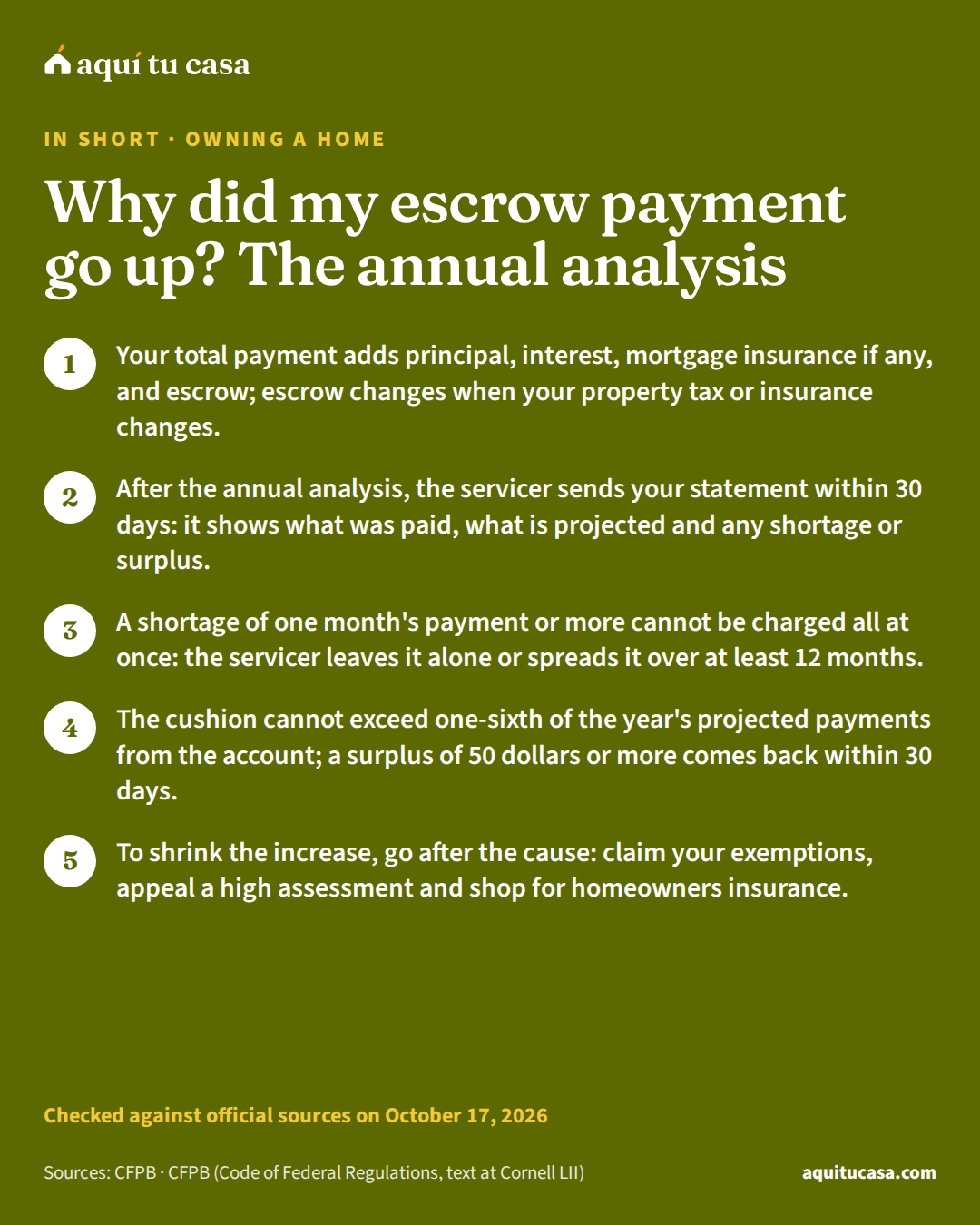
Run it with your numbersMortgage calculatorIf your loan comes from a regulated institution, the law says that, with some exceptions, the flood premium is paid to the lender or servicer along with your loan payments and deposited in your escrowescrow accountAn escrow account is an account set up by your mortgage lender to pay certain property-related expenses on your behalf, mainly property taxes and homeowners insurance. The money comes from a portion of your monthly mortgage payment: each month you contribute a share and the loan servicer pays the bills when they come due. That is why your payment is higher than principal and interest alone, and why it can change when taxes or the insurance premium go up. In some states the word also names the period between the offer and the closing.See the full definition account.11 So if the premium goes up, your monthly payment can go up; the guide on why your escrow payment went up explains how it is recalculated.
There are ways to manage the cost. If your zone is about to move to higher risk, FloodSmart recommends buying or renewing before the change: the premium usually cannot rise more than 18% a year until it reaches the full risk rate. And if you buy a home in a higher-risk zone, you may be able to assume the prior owner’s NFIP policy, whose rate also usually cannot rise more than 18% a year; a new policy starts at the full rate, less discounts.4 An elevation certificate, which shows how high the home sits compared with expected floodwaters, does not set your rate but can identify discounts; most homeowners do not need one to buy coverage, except in zones A or V, and your community may already have one on file.6
If your lender says you are missing coverage
If your home is in a flood hazard area and the lender or servicer finds you have no flood insurance, or not enough, it must notify you to buy coverage at your expense. If you do not buy it within 45 days of the notice, it must buy it for you and may charge you the premium and fees, even back to the date your coverage lapsed.11
If you are buying a home, the notice must come earlier. When a regulated lender determines the home is in a special flood hazard area, it must notify you in writing a reasonable time before you sign. The notice warns that the home is in that area, explains the insurance requirements and says you can buy coverage through the NFIP or from a private insurer.13 The guide on how to buy a home step by step shows where this step fits.
If this is you
You are buying a home
If the home is in a flood zone, the lender's notice must reach you before you sign.13 Buying coverage at loan closing avoids the 30-day wait.2
You rent your home
NFIP contents coverage protects your furniture, clothing and electronics up to $100,000. Most renters policies do not cover floods.2
You already flooded
Report the loss to your insurer as soon as possible and document everything before throwing anything away. If there is a disaster declaration, also apply for federal aid.7
You prefer to read in Spanish
FloodSmart has pages in Spanish, such as the one on what to know before buying a policy.10

If you flood: how to file a claim
FloodSmart says to start your claim as soon as possible. Report the flood to your insurer; you will be assigned an adjuster who inspects the home. Before the visit, take photos and videos, write down the make, model and serial number of appliances and keep samples of damaged carpet, flooring and curtains. Ask the adjuster to show their Flood Control Number card and review the estimate they prepare carefully. Payment can take four to eight weeks, and if you have a mortgage, the check is made out to you and your mortgage company.7
If your claim is denied or you disagree with the amount, talk to your adjuster or insurer first. If that does not resolve it, you can appeal to FEMA within 60 calendar days of the date on the denial letter, in writing, with a copy of the letter and your evidence. Appealing costs nothing and you do not need anyone to represent you. If you instead complete an appraisal to settle the amount, you can no longer appeal to FEMA. To sue your insurer you have one year from the denial, and appealing does not extend that deadline.8
Common mistakes
Mistake: Believing your homeowners or renters policy covers floods.
Instead: Most do not; you need a separate flood policy.2
Mistake: Buying coverage once a storm is forecast.
Instead: A new policy takes 30 days to start, with some exceptions.2
Mistake: Thinking nothing happens outside high-risk zones.
Instead: One in three claims comes from low- and moderate-risk zones.4
Mistake: Letting your policy lapse.
Instead: It does not renew on its own; renew every year to keep coverage and discounts.5
Mistake: Keeping valuables in the basement.
Instead: Belongings kept in a basement are not covered.2
Mistake: Throwing out damaged items before documenting them.
Instead: Take photos and videos, note make and model, and keep samples.7
What to do this week
- Look up your address at the FEMA Flood Map Service Center or ask your community’s floodplain administrator for your zone.4
- Read your homeowners or renters policy and confirm whether it excludes floods; the home insurance guide helps you read it.1
- Ask an insurance agent for a quote, for the building and for your belongings separately.2
- If you already have a policy, note the expiration date: it does not renew on its own.5
- Take photos and videos of your home and belongings today, with the make, model and serial number of appliances.7
- If the cost of coverage strains your budget, a HUD-approved housing counselorHUD-approved housing counselorA HUD-approved housing counselor works at an agency HUD has approved to provide housing counseling: independent, expert advice customized to your situation about buying a home, renting, a missed mortgage payment, a foreclosure or credit problems. The agencies usually charge little or nothing; many serve in Spanish and offer the homebuyer education course several assistance programs require. They are not lenders or real estate agents and sell you nothing. Your county page lists the official agencies with phone numbers.See the full definition gives independent advice, often free or at low cost.14
Your numbers
Starts at the typical home value in the United States. Change it to the price you have in mind.
That is $11,645 (3.5% of the price). The usual minimum for this loan is 3.5%.
This week's average ± a quarter or half point.
National average as of November 5, 2026 (Freddie Mac); your rate may be different.
Adjust advanced details
Let's do the math
Estimated monthly payment
National figure$2,759
at 7.18% · 30 years
- Loan amount
- $326,673
- Total interest
- $470,006
- Paid off in
- November 2056
Includes $5,618 FHA upfront mortgage insurance premium.
Does it fit the income?
Comfortable
up to $1,884 a month
Tight
$1,884 to $2,422 a month
Hard
more than $2,422 a month
Your payment · 41%
Compared with the typical household income in the United States ($80,734 a year). Reference: HUD calls paying more than 30% of income for housing a cost burden.
| Principal & interest | $2,213 |
|---|---|
| Property tax | $261 |
| Home insurance | $139 |
| FHA mortgage insurance (MIP) | $147 |
How does it compare with incomes?
For this payment to be 28% of your income, you'd need to earn about $118,260 a year. With your other debts, to stay under 36%: about $91,980 a year.
You need at least $11,645 for the down payment, plus closing costs.
This is an estimate to give you an idea, not a loan offer. Your real payment depends on your rate, your credit, and the insurance and taxes on the home you buy.
Total monthly payment $2,759; principal and interest $2,213.
Ready to see the numbers? Find your county here
See how this applies in your county: its loan limits, prices and rents, from the official data.
Printable checklist
Frequently asked questions
Does my homeowners insurance cover floods?
Generally no. The CFPB says standard homeowners insurance does not cover floods, and FloodSmart, the website of FEMA's NFIP, says the same about most homeowners and renters policies. For that you need a separate flood insurance policy.
Am I required to buy flood insurance?
If your home is in a special flood hazard area (zones A or V) and you have a government-backed mortgage, yes, for the life of the loan. Some banks require it even outside high-risk areas, and if your home received federal disaster assistance before, it is required too.
How long until coverage starts?
Usually 30 days after you buy. There is no wait if you buy when making, increasing, extending or renewing your mortgage, or if you change coverage at renewal; there is a one-day wait if your zone was just remapped to high risk and you buy within 12 months.
How much does NFIP insurance cover?
For a home, the building policy covers up to $250,000 and the contents policy up to $100,000. They are bought separately and have separate deductibles. Renters can buy contents coverage.
How much does flood insurance cost?
It depends on where your home is, how it is built and what it would cost to replace. With the NFIP, every company offers the same rates, so a quote from an agent gives you your number. An elevation certificate can identify discounts.
Can I buy private flood insurance instead of the NFIP?
Yes. The law requires regulated lenders to accept private flood insurance that meets the same coverage requirements, and the flood hazard notice must say coverage is available through the NFIP and from private insurers.
I rent. Can I insure my belongings against floods?
Yes. FloodSmart says the NFIP has renters policies that protect your belongings, such as furniture, clothing and electronics, up to $100,000.
What do I do if my claim is denied?
Talk to your adjuster or insurer. If that does not resolve it, you can appeal to FEMA within 60 calendar days of the date on the denial letter, at no cost and without a representative. To sue your insurer you have one year from the denial, and an appeal does not extend that deadline.
Sources
Every figure in this guide comes from one of these official sources. The number next to a sentence leads to the source behind it.
Each source on one line: who publishes it, its title, its address and the date we read it.
- 1. CFPB · What is homeowner's insurance? Why is homeowner's insurance required? · consumerfinance.gov · Accessed October 17, 2026
- 2. FEMA, National Flood Insurance Program (FloodSmart) · Buy a Flood Insurance Policy · floodsmart.gov · Accessed October 17, 2026
- 3. FEMA, National Flood Insurance Program (FloodSmart) · Eligibility · floodsmart.gov · Accessed October 17, 2026
- 4. FEMA, National Flood Insurance Program (FloodSmart) · What is my flood zone? · floodsmart.gov · Accessed October 17, 2026
- 5. FEMA, National Flood Insurance Program (FloodSmart) · Renew a Policy · floodsmart.gov · Accessed October 17, 2026
- 6. FEMA, National Flood Insurance Program (FloodSmart) · Get an Elevation Certificate · floodsmart.gov · Accessed October 17, 2026
- 7. FEMA, National Flood Insurance Program (FloodSmart) · How to start a flood insurance claim · floodsmart.gov · Accessed October 17, 2026
- 8. FEMA, National Flood Insurance Program (FloodSmart) · How to appeal a denied flood insurance claim · floodsmart.gov · Accessed October 17, 2026
See the other 6 sources
- 9. FEMA, National Flood Insurance Program (FloodSmart) · Rebuild Better (Increased Cost of Compliance) · floodsmart.gov · Accessed October 17, 2026
- 10. FEMA, National Flood Insurance Program (FloodSmart) · Adquiera una póliza de seguro de inundación · floodsmart.gov · Accessed October 17, 2026
- 11. US Congress (US Code, text at Cornell LII) · 42 U.S.C. §4012a, Flood insurance purchase and compliance requirements and escrow accounts · law.cornell.edu · Accessed October 17, 2026
- 12. US Congress (US Code, text at Cornell LII) · 42 U.S.C. §4013, Nature and limitation of insurance coverage · law.cornell.edu · Accessed October 17, 2026
- 13. US Congress (US Code, text at Cornell LII) · 42 U.S.C. §4104a, Notice requirements · law.cornell.edu · Accessed October 17, 2026
- 14. CFPB · Find a Housing Counselor · consumerfinance.gov · Accessed October 17, 2026
Keep reading
Related guides
If this guide helped, these follow the same path.

Owning a home 13 minute read
Property tax explained: how it is calculated and paid
Who charges property tax, how it is calculated, how it is paid through escrow, which exemptions and appeals exist and what part is deductible.
- It is a local tax: assessed value of the home × the rates of the county, city and school district, minus exemptions. Your county sets the bill.
- With a mortgage you pay it through escrow: the servicer collects it in your monthly payment, pays it for you and reviews the account every year; a shortage is repaid over at least 12 months.
- Exemptions (such as the primary residence one) and the appeal of the assessed value have deadlines; they are on your state's page with their source.
- Owning a home Why did my escrow payment go up? The annual analysis Why your payment changes with escrow even at a fixed rate: the annual analysis, shortages, deficiencies, the cushion and how to dispute an error. 12 minute read
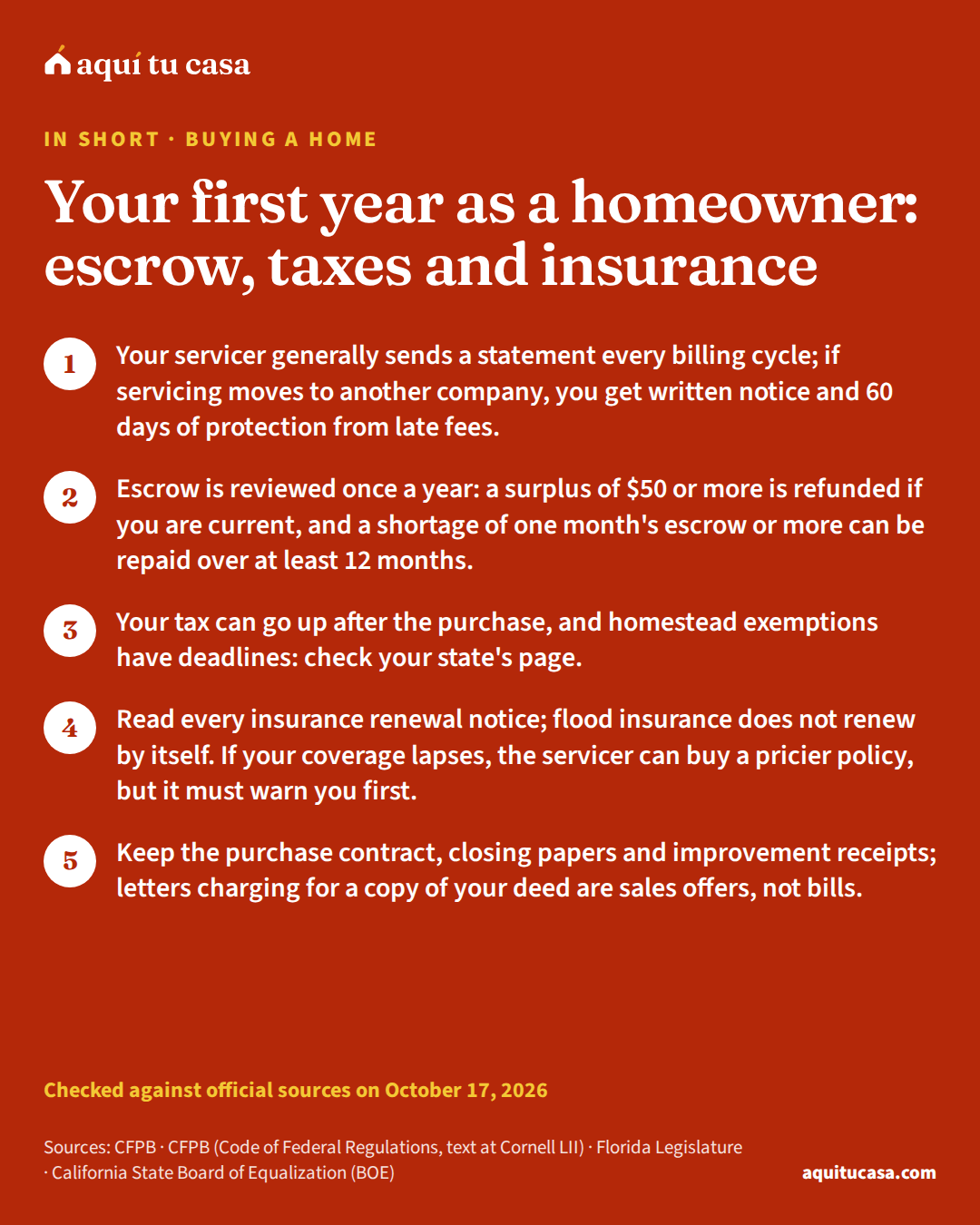
- Buying a home Your first year as a homeowner: escrow, taxes and insurance Who collects your mortgage and what happens if that changes, the yearly escrow review, taxes, exemptions, insurance, records and scams aimed at new owners. 13 minute read
Tools for this topic
Was this guide useful?
Thank you. Your answer stays in your browser; nothing is sent.