
Family budget
How much is left for housing each month.
What you get → what is left
Someone shared this page with you.
Questions and answers
Every question our 29 guides about owning a home answer, grouped by guide. Each answer is the guide's own and leads to it, with its sources.
Open a question to read its answer. Each group ends with the full guide, its sources and, when it has one, its calculator.
We found no questions with those words. Try another word or open a topic.
From the guide
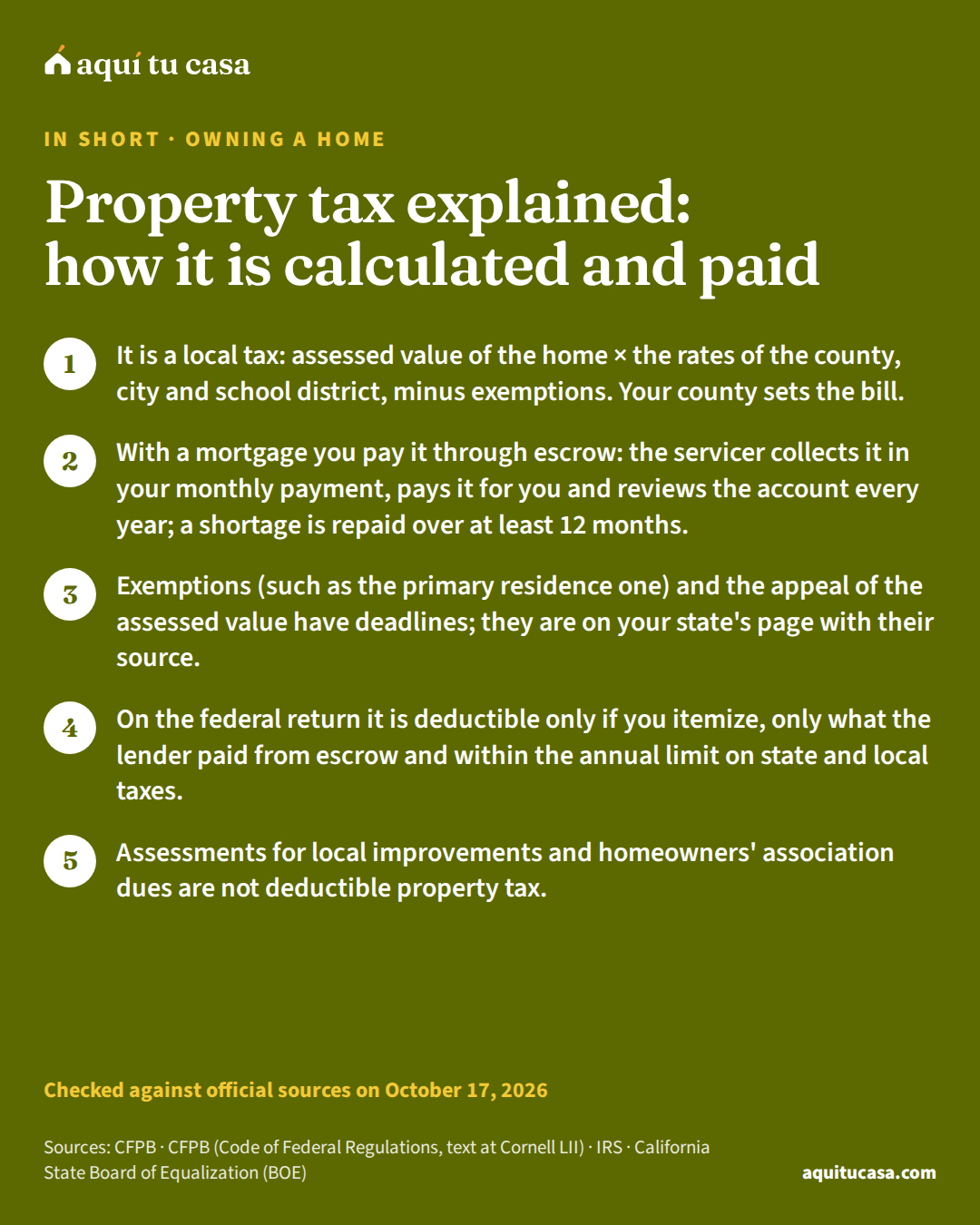
Who charges property tax, how it is calculated, how it is paid through escrow, which exemptions and appeals exist and what part is deductible.
Verified on October 17, 2026 9 official sources
Because the property tax and insurance paid from your escrow account change every year, and the servicer adjusts your payment after the annual analysis. Ask for the annual escrow statement: it shows what went up.
Read the full guideThere are two paths: claim the exemptions you are entitled to (for example, the primary residence exemption where it exists) and appeal the assessed value if you think it is above market value. Both have deadlines set by your state or county; check your state's page.
Read the full guideOnly if you itemize deductions on Schedule A, only the part that actually reached the taxing authority (if you pay through escrow, what the lender paid) and within the annual limit on the deduction for state and local taxes. An IRS VITA site helps you for free to decide whether itemizing pays.
Read the full guidePenalties and consequences are set by each state and can go as far as a tax sale of the home. If you have a mortgage with escrow, the servicer pays it while you are current; if you have no escrow or fell behind, talk as soon as possible to a HUD-approved housing counselor and to free legal aid.
Read the full guideAccording to the Census Bureau's American Community Survey (ACS), the typical homeowner pays $3,119 a year, and dividing that median by the typical home value gives an effective rate of 0.94%. But it varies a lot from state to state and county to county: look yours up in the state table or on your county's page.
Read the full guideBecause in some states the assessed value resets when the home changes hands. In California, the base value is set when the home changes ownership; in Florida, the home is assessed at just value on January 1 of the year after the change of ownership. Ask the county what that home would pay with the reset value and your exemptions.
Read the full guideAfter the annual analysis, if there is a surplus of 50 dollars or more, the servicer must refund it within 30 days. If there is a shortage of one month's payment or more, it may ask you to repay it in equal monthly payments over at least 12 months. You will see it on the annual escrow statement.
Read the full guideIt depends on the state. In California you file once with the county assessor, by February 15 to get the full exemption that year; in Florida, by March 1. Check your state's page for the dates and your county's form.
Read the full guideThe data behind these guides
The guides on Owning a home cite these figures. They update when their sources publish new ones; what you see here is current.
See all the dataSources: U.S. Census Bureau (Average 2020–2024) · FHFA (2025 data)
From the guide
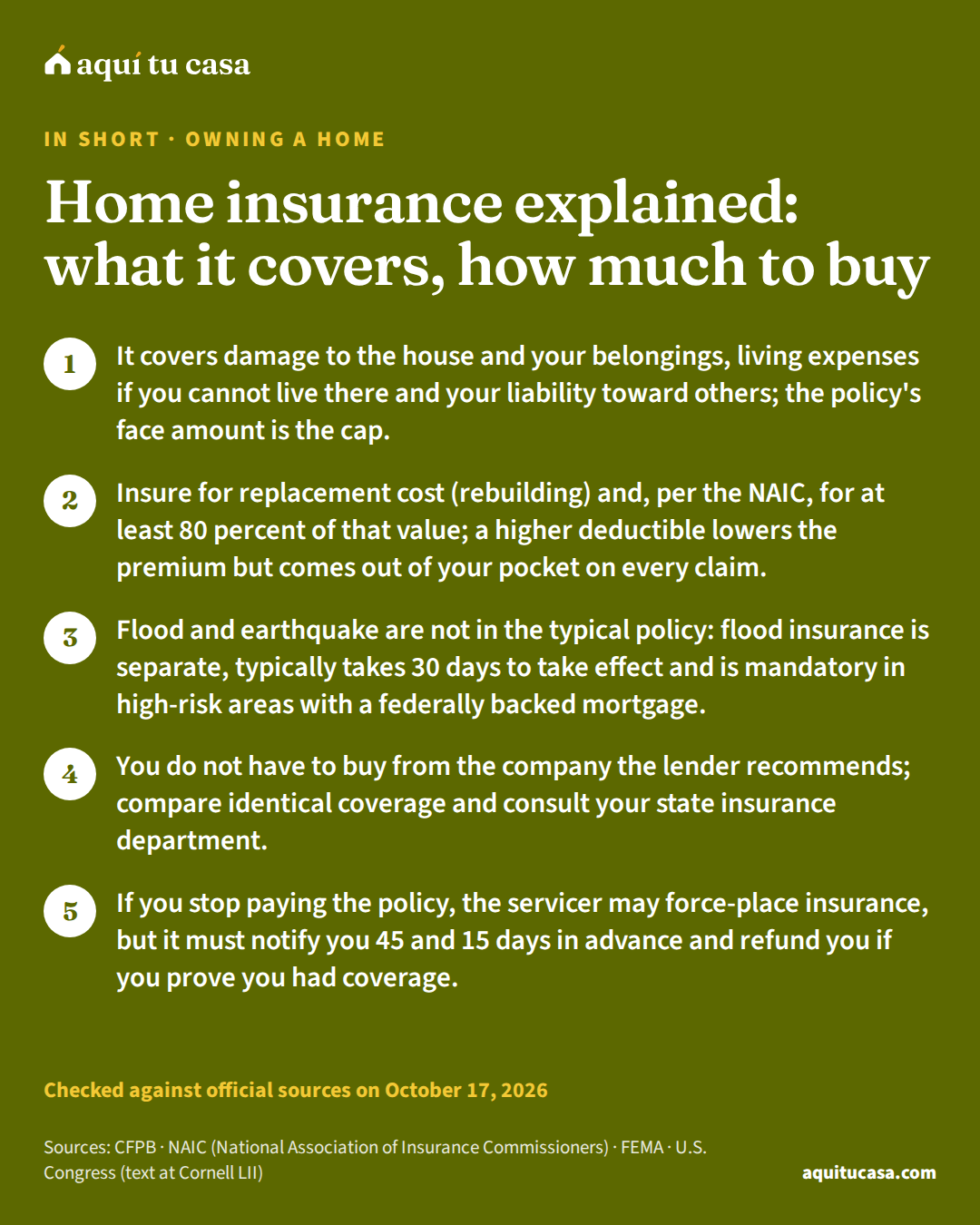
What home insurance covers, why the lender requires it, how to choose the amount and the deductible, why flood is separate and what happens if it lapses.
Verified on October 17, 2026 14 official sources
Yes. You can shop separately and choose the provider and plan; the NAIC reminds you that you are not required to buy from the company your lender recommends. What the lender can require is proof of coverage.
Read the full guideFor replacement cost, that is, what it would cost to rebuild or repair it, which is not the purchase price (the land does not burn). The NAIC says to insure at least 80 percent of that value and to review it with your agent at least once a year.
Read the full guideThe typical policy does not cover floods. Look up your address at FEMA's Flood Map Service Center: if you are in a special flood hazard area and have a federally backed mortgage, it is mandatory, and some banks require it even if you don't live in a high-risk area. If it is not required, the decision is yours; an NFIP policy takes effect 30 days after you buy it, with exceptions such as buying it when you take out the mortgage.
Read the full guideThe loan servicer may buy force-placed insurance and charge you, and it is usually more expensive and may protect only the lender. First it has to notify you in writing at least 45 days ahead and remind you 15 days ahead; if you prove you had coverage, it must cancel it and refund the overlapping period.
Read the full guideIt depends on the home, the location, the coverage and the deductible, and the premium is set by the insurance company you choose, not by the lender. Get quotes using the same numbers. The insurance figure in our calculator comes from an example rate: it shows how your payment changes, but it is not a quote or an average.
Read the full guideAccording to the CFPB, you usually pay the first 6 to 12 months of premiums at or before closing. After that, if you have an escrow account, the insurance goes into your monthly payment and the loan servicer pays it for you.
Read the full guideReplacement cost pays to repair or replace at today's prices; actual cash value pays that minus depreciation. In the Texas Department of Insurance's example, for a 10-year-old roof that costs $10,000 to replace today and a $2,000 deductible, you pay $2,000 out of pocket with replacement cost and $5,000 with actual cash value.
Read the full guideThe Texas Department of Insurance recommends telling the company why you disagree. If that does not resolve it, one option is appraisal, which is for disputes about the amount, not about whether the policy covers the loss. In Texas you can also file a written complaint with the Department; ask your state insurance department how it works where you live.
Read the full guide
From the guide
What a repair estimate and contract should say according to the FTC and ENERGY STAR, and where to look up a contractor's license in your state.
Verified on November 6, 2026 14 official sources
The estimate is the offer: according to the FTC, it should state the work, materials, completion date and price. The contract is the agreement you sign: it adds the contractor's details and license, the start and end dates, spoken promises and your right to cancel if you sign at home.
Read the full guideThe FTC recommends getting several, not automatically choosing the lowest and asking for an explanation if there's a big difference among them. To compare them, ask that all be for the same work.
Read the full guideIt depends on the state. The FTC says some states limit it and your state's consumer protection agency can tell you the law. In California, for example, the CSLB says the deposit should never exceed 10 percent of the price or $1,000, whichever is less. After a disaster, FEMA recommends not paying more than half up front.
Read the full guideAsk that the change be in writing, with its price. The CSLB calls it a change order: once signed, it becomes part of the contract.
Read the full guideLook up their license number on your state's or city's official page. This guide lists the pages for California, Florida, Texas, Nevada, New Mexico, New York City, New Jersey and Denver. If your state isn't on the list, find the contractor board on your state government's official site.
Read the full guideThe FTC says that if you talk with the salesperson or contractor in another language, depending on where you live and what you're buying, you may be entitled to a copy of the contract in that language. And don't sign a document in a language you don't understand.
Read the full guideOften, yes. The FTC's Cooling-Off Rule gives you until midnight of the third business day to cancel certain sales made at your home, and the seller must give you two copies of the cancellation form. It doesn't cover emergencies or repairs you asked for.
Read the full guide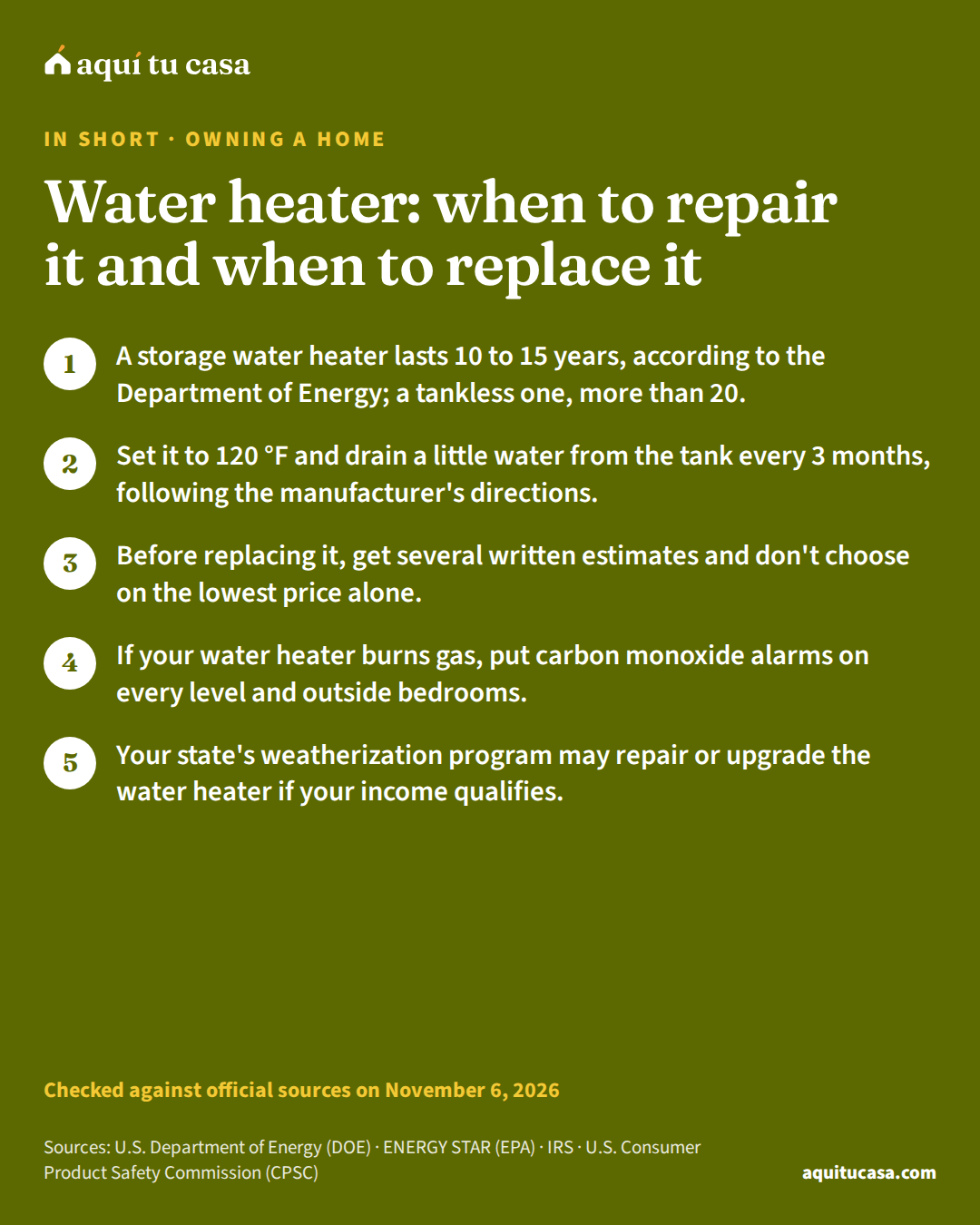
From the guide
How long a water heater lasts, how to care for it, what to check before replacing it, which types save energy and which public help can pay for the repair.
Verified on November 6, 2026 7 official sources
According to the Department of Energy's Energy Saver Guide, most storage water heaters last 10 to 15 years, and tankless ones can last more than 20 years. If you don't know its age, look at your purchase papers.
Read the full guideIt depends on its age, how often it has failed and what you are quoted. The Department of Energy says a new efficient model may cost more up front than repairing the old one, but the energy savings continue over its whole life. Get two or more written estimates: one for the repair and one for the replacement.
Read the full guideThe Department of Energy recommends 120 °F, a temperature it considers safe for most people. Turning it down is also one of the four ways it names to spend less.
Read the full guideAccording to the Department of Energy, in homes that use 41 gallons of hot water a day or less, a gas tankless water heater can be 24% to 34% more efficient than a storage model. In homes that use a lot of hot water, around 86 gallons a day, the difference drops to 8% to 14%.
Read the full guideThe IRS says the energy efficient home improvement credit, which covered water heaters, could be claimed for improvements made through December 31, 2025. If you made the change before that date, ask a free tax service how to claim it.
Read the full guideYour state's Weatherization Assistance Program (WAP) may include water heater repairs or upgrades. Nevada's, for example, says so on its page. According to the Department of Energy, households at or below 200% of the federal poverty guidelines qualify, and there is almost always a waitlist.
Read the full guideThe CPSC recommends carbon monoxide alarms on every level of the home and outside sleeping areas. If someone has a headache, dizziness, nausea or sleepiness for no reason, get outside and call 911.
Read the full guide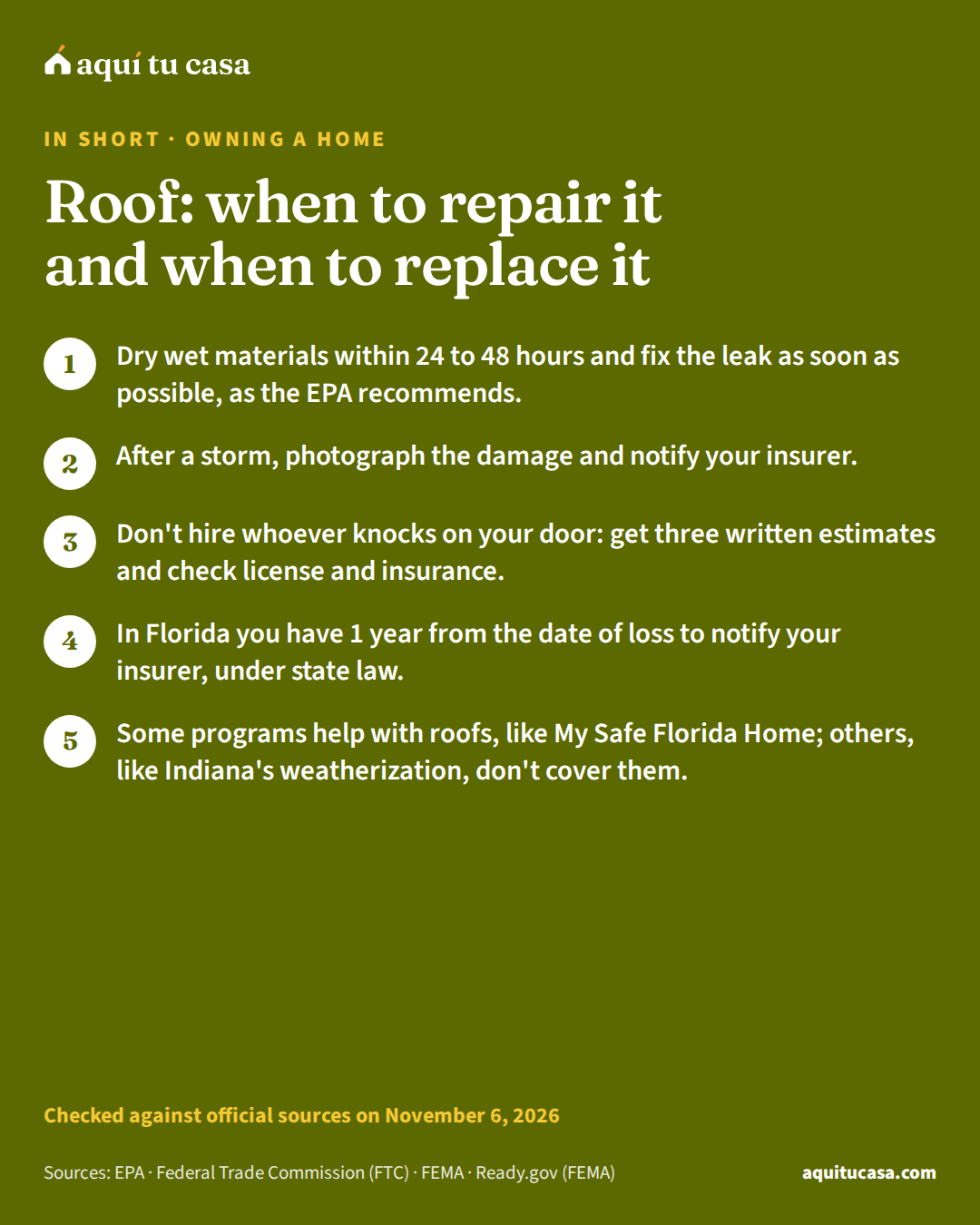
From the guide
What to do if your roof leaks, how to avoid scams after a storm, what Florida's law and insurance rules say and which programs help pay for a roof.
Verified on November 6, 2026 12 official sources
The official sources we reviewed don't give one life for all roofs: it depends on the material, the climate and the care. What they do recommend is checking and fixing leaks as soon as possible and cleaning gutters regularly.
Read the full guideCatch the water, dry what got wet and take photos. The EPA says that if you dry materials within 24 to 48 hours after the leak, in most cases mold will not grow. Then get written estimates for the repair.
Read the full guideThe FTC warns that these sellers show up after windstorms and floods, pressure you and ask for cash. Ask people you trust for recommendations, check license and insurance, get three written estimates and sign a contract before work starts.
Read the full guideFEMA recommends not paying more than half the costs of repairs in advance, and the FTC recommends not paying everything at the start. The FTC says some states limit the down payment a contractor can ask for; ask your state's consumer protection agency.
Read the full guideFlorida law says a claim or reopened claim is barred unless you notified the insurer within 1 year after the date of loss, and a supplemental claim within 18 months. For a hurricane, the date of loss is the day it made landfall.
Read the full guideIt depends on the state. The District of Columbia's lists roof repair among its typical measures, but Indiana's says it typically does not pay for roofing. Ask your state's agency.
Read the full guideNo. FEMA says its housing inspectors don't climb on roofs or enter crawl spaces, and that FEMA never charges for an inspection. If someone who says they are from FEMA asks you for money, that's a sign of a scam.
Read the full guide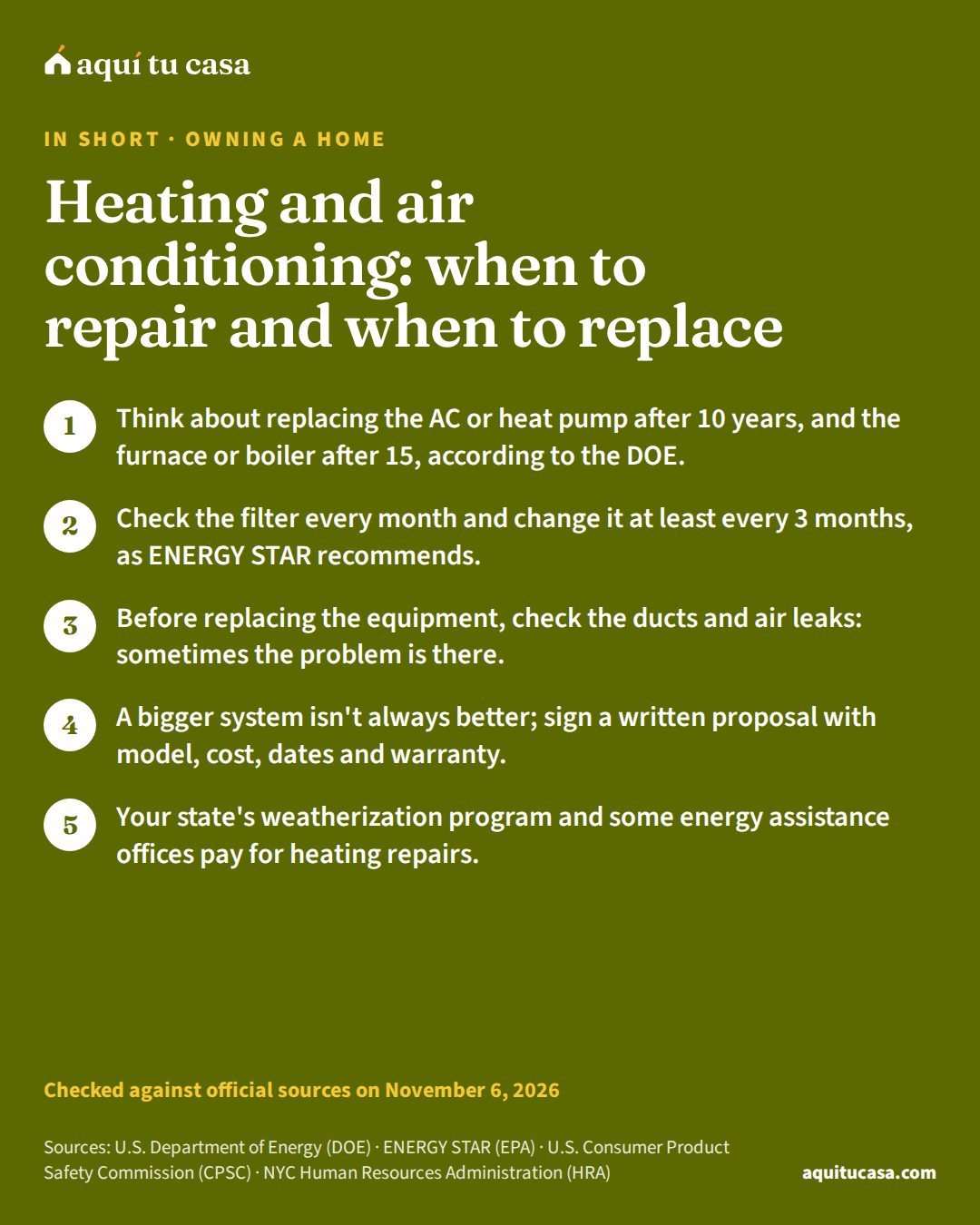
From the guide
When to think about replacing your AC or furnace, the upkeep ENERGY STAR recommends, how to hire a technician and which public help pays for the repair.
Verified on November 6, 2026 11 official sources
The DOE doesn't give an exact life, but it says to think about replacing your system if the heat pump or air conditioner is more than 10 years old, or the furnace or boiler is more than 15 years old.
Read the full guideENERGY STAR recommends a contractor check-up every year before each season: cooling in the spring and heating in the fall. Check the filter every month and change it at least every 3 months.
Read the full guideNot necessarily. ENERGY STAR says a bigger system isn't always better, and that the contractor should size it based on your house, insulation and windows.
Read the full guideIt's equipment that heats in winter and cools in summer. According to ENERGY STAR, in most zones it can go in when the central air conditioner or the furnace needs replacing. If your winters are very cold, ask about a model certified for cold climates.
Read the full guideYes, in many places. Your state's weatherization program may repair or replace heating and cooling equipment; Missouri's, for example, says so on its page. In New York City, the HERR benefit pays up to $4,000 for a repair and $8,000 for a replacement of heating equipment. In New Jersey, energy assistance includes emergency heating system services.
Read the full guideThe IRS says the energy efficient home improvement credit, which covered heat pumps, could be claimed for improvements made through December 31, 2025.
Read the full guideIf you suspect carbon monoxide poisoning, the CPSC says to get outside to fresh air right away and call 911. Put carbon monoxide alarms on every level of the home and outside sleeping areas.
Read the full guide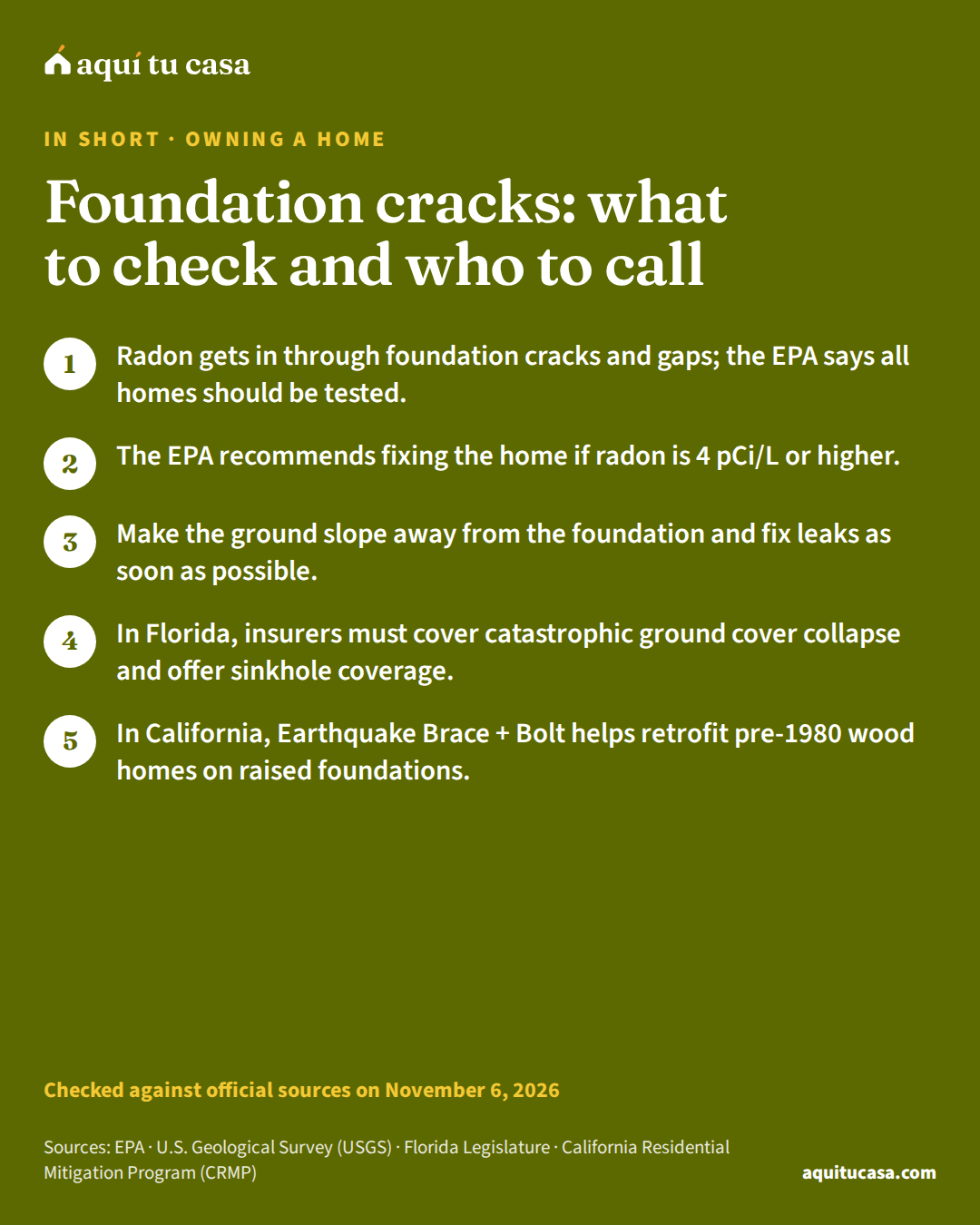
From the guide
What the EPA, the USGS and insurance laws say about cracks, moisture, radon and sinkholes, and which programs help you strengthen your home's foundation.
Verified on November 6, 2026 7 official sources
We found no official source that gives one measurement for every home. What we know from the EPA is that cracks let water and radon in. If you're worried, note whether it grows or lets water through, and get several written estimates from licensed contractors.
Read the full guideAccording to the EPA, radon moves up through the ground and into the home through cracks and other holes in the foundation, such as cracks in floors and walls and gaps around pipes. Any home can have radon, new or old.
Read the full guideThe EPA says there are low-cost do-it-yourself kits you can get by mail and in some hardware stores. Short-term tests stay in the home for two to 90 days. Your state radon office has lists of qualified testers.
Read the full guideIt helps, but it isn't enough by itself. The EPA says the method mainly used is a pipe and fan that pulls radon from under the house, and that sealing cracks makes that system more effective and cost-efficient.
Read the full guideIt depends on your state and your policy. In Florida, the law says every insurer must cover catastrophic ground cover collapse and offer, for an additional premium, coverage for sinkhole losses, with a deductible of 1, 2, 5 or 10 percent of the dwelling limits.
Read the full guideIn California, Earthquake Brace + Bolt offers up to $3,000 to retrofit wood homes built before 1980 on raised foundations, and up to $7,000 more for income-eligible homeowners. Registration is open for a limited time each year.
Read the full guideBe careful with anyone who knocks on your door and pushes you to decide today: the FTC says that's a scammer's tactic. Get several written estimates and look up each contractor's license on your state's page.
Read the full guide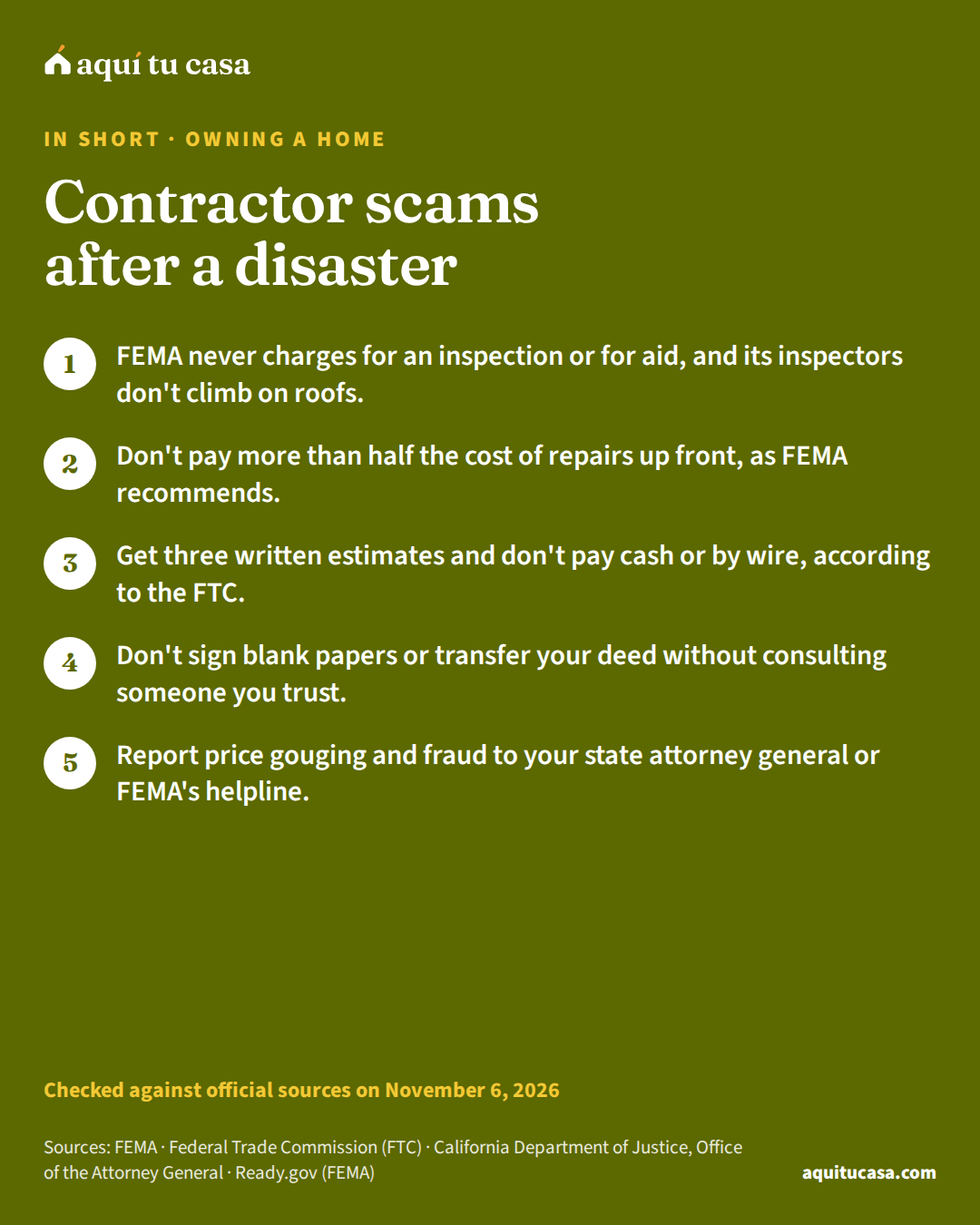
From the guide
How to spot a fake FEMA inspector or a contractor taking advantage of a storm, what the law says about price gouging and where to report it.
Verified on November 6, 2026 7 official sources
FEMA says its inspector always wears an official government badge and you can ask to see it. They won't ask for your nine-digit registration number (they already have it), won't ask for bank details, won't charge and won't climb on the roof.
Read the full guideFEMA says DHS, FEMA, the SBA and other federal agencies never charge for disaster assistance or for help filling out the application. Don't believe anyone who promises a grant in exchange for a deposit.
Read the full guideFEMA recommends not paying more than half the cost of repairs in advance. The FTC adds: don't pay by cash or wire, and don't start without a signed contract.
Read the full guidePossibly. The FTC's Cooling-Off Rule gives you until midnight of the third business day to cancel certain sales made at your home. But it doesn't cover sales needed to meet an emergency or repairs you asked for; things you buy beyond that repair are covered.
Read the full guideIt depends on your state. In California, the law prohibits raising the price of many goods and services, including building materials and repair services, by more than 10% after an emergency is declared. Report it to your state attorney general.
Read the full guideSomeone may have used your information. FEMA asks you to call its Helpline at 800-621-3362, 7 a.m. to 11 p.m. ET, every day. The identity theft guide explains the other steps.
Read the full guideThe FTC recommends trying to resolve it with them first and sending a letter by certified mail. If it isn't resolved, go to your state attorney general or consumer protection office. Free legal aid in your area may help with the case.
Read the full guideTools
The calculators these guides use. Each one leaves you with a result you can use today.
How much is left for housing each month.
What you get → what is left
Your monthly payment with taxes and insurance.
What you get → monthly payment
Your home's estimated tax per year and per month.
What you get → tax per year
The price your income can carry.
What you get → maximum price

From the guide
USDA Section 504 repair loans and grants for very-low-income rural homeowners: the age rule for grants, the 1% interest rate and how to apply.
Verified on October 31, 2026 16 official sources
The regulation does not set a dollar figure: the loan cannot exceed an amount USDA sets, which can never be more than 20% of the national average area loan limit, and it is limited to what you can repay at 1% over 20 years. The lifetime total of grants cannot exceed 10% of that limit. For the current amount, contact a USDA program representative.
Read the full guideNo, unless you sell the property less than 3 years after signing the grant agreement. In that case you must repay all of it. The loan is repaid, at 1% interest over 20 years.
Read the full guideFor the grant, 62 or older at the time you apply. For the loan, the regulation sets no minimum age, but you must be able to repay it under a budget.
Read the full guideThe regulation requires being a U.S. citizen or a noncitizen who qualifies as a 'legal alien' under section 214 of the federal housing law. That law includes, among other categories, permanent residents, refugees, asylees and people with certain kinds of parole. Which category you fit is an immigration question: an attorney or an accredited representative can advise you.
Read the full guidePossibly. The regulation accepts several forms of ownership, such as an undivided interest in a shared property or a life estate. And if you do not have those papers, USDA may accept tax records showing you as owner and that you pay the taxes, or sworn statements from neighbors that you have lived there as the owner for at least 10 years.
Read the full guideYes, to remove health and safety hazards, if you own the home and the land, lived there before applying, and the home is or will be on a permanent foundation paid for with program funds. It cannot be used to move the home to another site.
Read the full guideThe regulation bars using program funds to pay fees or commissions to for-profit companies for packaging your application or referring you. It does allow fees to tax-exempt nonprofits that package applications. Be wary of anyone who asks for money up front to 'get you' the money.
Read the full guide
From the guide
What a land survey is, where to find yours, who can mark your property lines, what an easement is and what to do if you disagree with a neighbor.
Verified on October 31, 2026 4 official sources
It is the work of a licensed land surveyor who measures your land and locates its property lines, corners and any easements. In California, for example, the law says only licensed land surveyors can do that work.
Read the full guideNot every home has one. In Stanislaus County, California, for example, recorded surveys are found in the county's map index, and deeds are at the county recorder's office. Ask at yours.
Read the full guideNot as legal proof. USGS says its US Topo maps are not legal documents. To know exactly where your property lines are, you need a licensed land surveyor.
Read the full guideIt is a legal or equitable right to use someone else's land for a special purpose, such as utilities or a driveway. It can affect where you can build or put up a fence.
Read the full guideUsually not. The Stanislaus County office, for example, says it cannot survey private land because it is an agency paid with public funds; you hire a private licensed land surveyor.
Read the full guideHire a licensed land surveyor to locate the line. Some counties offer free mediation, such as Stanislaus in California. If you cannot settle it, free legal aid can advise you.
Read the full guideIt depends on the lender and the area. If one is required, on the CFPB's sample Loan Estimate that fee appears among the services you can shop for, so you can compare prices.
Read the full guide
From the guide
Exemptions, assessment freezes, deferrals and credits on property tax for older homeowners: how each one works and the verified programs in your state.
Verified on October 31, 2026 7 official sources
It depends on the state. What is most common in the programs in this guide is that the tax is lowered, frozen, deferred or partly refunded. Age changes by state: in Texas and Illinois the examples in this guide start at 65, and Washington's exemption at 61.
Read the full guideAn exemption lowers the value your tax is calculated on, for example $60,000 more for school tax in Texas. A freeze keeps your assessment from rising as long as you keep qualifying, like Illinois's freeze for low-income seniors. Some states have both.
Read the full guideIt means not paying now and paying later. In Illinois it works like a loan against the home's value, with a recorded lien. In Washington, the deferred amount accrues 5% simple interest and is repaid when you sell, when the owner dies or when the home is no longer their primary residence.
Read the full guideThe debt stays on the house. In Washington, the deferral must be repaid when the owner dies or the home is sold; in Illinois, the state recovers it with interest when the home is sold or transferred. Talk to your family before applying.
Read the full guideIn some states, yes. Missouri's credit and Pennsylvania's rebate also include qualifying renters. In Missouri the maximum for renters is $750, and in Pennsylvania the rebate can be up to $1,000.
Read the full guideIt depends on the program. In Illinois, the freeze is applied for every year with Form PTAX-340, and in Cook County the senior exemption is also applied for every year. Other programs are applied for once. Ask your county assessor's office.
Read the full guideUsually at your county assessor's or appraiser's office, and sometimes at the state revenue department. In Arizona, for example, the valuation freeze is requested with Form 82104 through the county assessor. The table in this guide links to your state's property tax page.
Read the full guide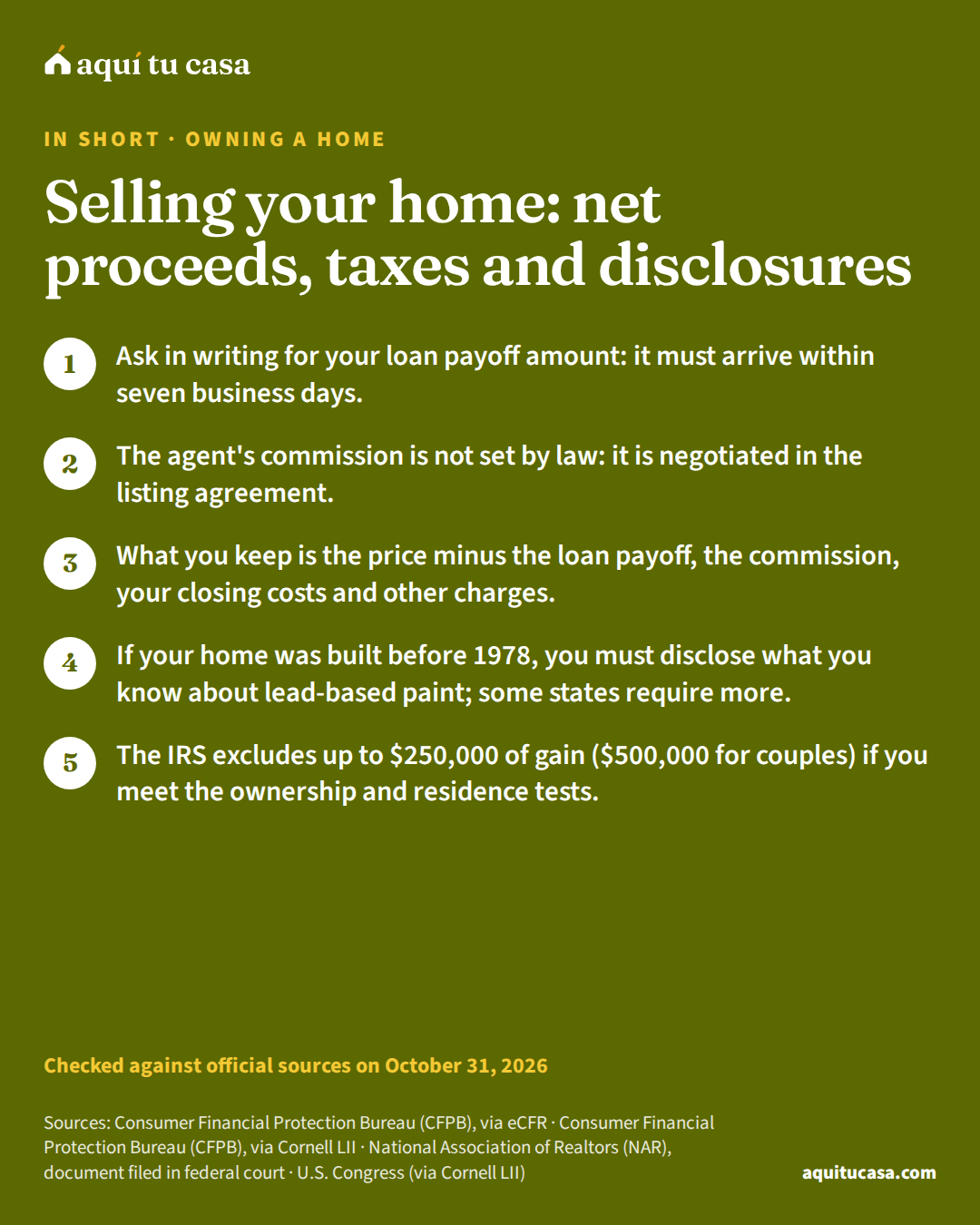
From the guide
How to get your mortgage payoff amount, negotiate with your agent, figure what you keep, what to disclose to the buyer and the IRS home sale exclusion.
Verified on October 31, 2026 9 official sources
Read the full guide Do the math: How much will I keep when I sell?
Ask your servicer in writing for a payoff statement. The law says it must give you the exact balance to pay off the loan on a specific date within seven business days. Your monthly statement does not show that exact number.
Read the full guideNo. Under the NAR settlement, its agents must tell you in writing, in the listing agreement, that commissions are not set by law and are fully negotiable. Ask what services are included and negotiate before you sign.
Read the full guideIf the home was built before 1978, federal law requires you to disclose what you know about lead-based paint and give a pamphlet and time for an inspection. Some states also require a notice about the home's condition; in Texas, for example, it is required for a single-unit home.
Read the full guideOften not. If you owned and lived in the home at least 24 months of the last 5 years, you can exclude up to $250,000 of gain, or $500,000 if married filing jointly. If you gain more, or do not meet the tests, part may be taxable.
Read the full guideIf you received a Form 1099-S, yes: you must report the sale even with no taxable gain. IRS VITA sites prepare basic returns for free for people who qualify.
Read the full guideYes. When you pay off your loan in full at the sale, the servicer must return what is left in your escrow account within 20 business days.
Read the full guideNot based on race, color, religion, sex, disability, familial status or national origin. The Fair Housing Act prohibits ads showing those preferences, even if you sell without an agent.
Read the full guide
From the guide
When escrow is required, how it is waived or canceled, what happens if you pay property taxes yourself and how to avoid falling behind or paying penalties.
Verified on October 31, 2026 9 official sources
It depends on the loan. FHA requires escrow for taxes and insurance, and so does a higher-priced loan. On a conventional loan, the lender may waive escrow under its written policy, looking at whether you can handle the large tax and insurance payments.
Read the full guideOne whose APR exceeds the average prime offer rate for a comparable loan by 1.5 percentage points or more, for a first lien within the Freddie Mac limit (2.5 points if above it). On those loans, the law requires escrow.
Read the full guideNot before five years after closing, if you ask, your balance is less than 80% of the home's original value and you are current. It also ends when you pay off the loan.
Read the full guideSome lenders charge a fee to waive escrow. Your Closing Disclosure shows it as an 'Escrow Waiver Fee', along with what you are estimated to pay yourself in the first year.
Read the full guideYour local government can charge penalties and interest and take other actions. The servicer can also add amounts to your loan, add escrow back or buy more expensive insurance if you stop paying for coverage. The escrow closing notice explains those consequences.
Read the full guideThe servicer must pay on time. On an FHA loan, if it pays late, it cannot pass the penalties on to you unless the late payment came from your error or omission and it tried to get the billing information.
Read the full guideNot necessarily. The IRS says you can deduct only the taxes the lender actually paid from escrow to the taxing authority; your tax bill shows that amount.
Read the full guide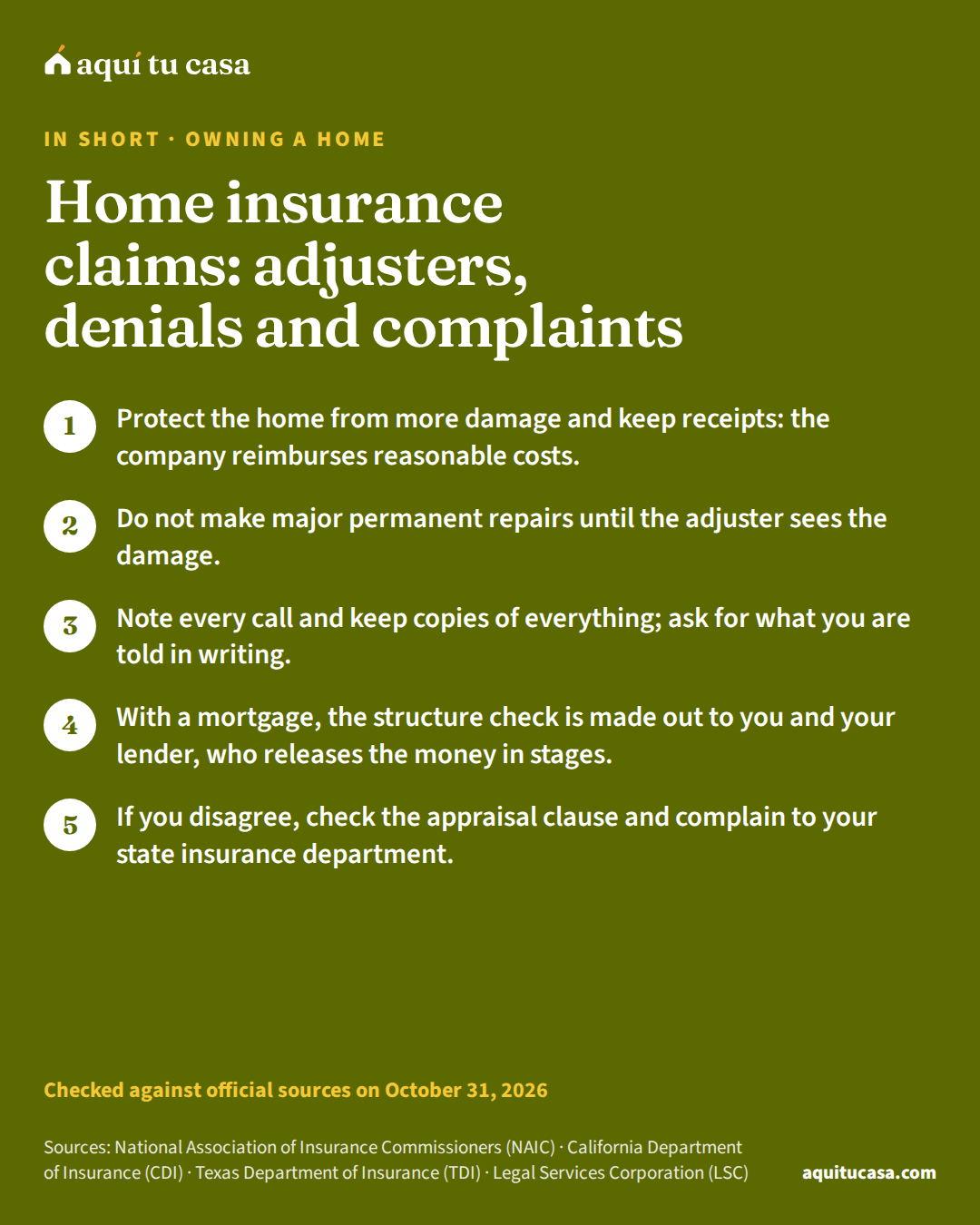
From the guide
How to file and document a home insurance claim, what each kind of adjuster does, the check with your lender and what to do if you are denied or underpaid.
Verified on October 31, 2026 5 official sources
Not always. The NAIC explains that how many claims you file can affect your premium and whether your policy is renewed, and that if repairs cost little more than your deductible, you might prefer to pay yourself. Most companies report your claims to databases such as CLUE.
Read the full guideMake temporary repairs to prevent more damage, such as boarding windows or putting plastic on the roof, and keep the receipts. But do not make major permanent repairs until the adjuster has seen the damage.
Read the full guideThe company's adjuster is assigned by your insurer; they may be an employee or an independent contractor. A public adjuster is someone you hire to negotiate with the company, and they charge you. In Texas they must be licensed and can charge up to 10% of the total the company pays.
Read the full guideBecause the lender has an interest in getting the home repaired. According to the California Department of Insurance, the lender must endorse the check, usually puts the money in an account and releases it as the work progresses.
Read the full guideMany policies have loss-of-use or additional living expense coverage. Keep receipts for housing, food, extra transportation and moving. The company usually advances money, which counts toward the final payment.
Read the full guideAsk for the reasons in writing. Talk to the claims manager and send your documents. Check whether your policy has an appraisal clause. If it is not resolved, complain to your state insurance department and look for legal help.
Read the full guideNot always. In Texas, for example, the department cannot make a company pay unless not paying violates the law or the policy, or decide whether damage came from a storm or wear and tear. But it does contact the company and ask for a response.
Read the full guide
From the guide
What a home warranty covers and what homeowners insurance covers, why one does not replace the other, what to ask before buying one and who regulates them.
Verified on October 31, 2026 5 official sources
No. The California Department of Insurance says they do not overlap or replace each other. Insurance covers damage from major events, such as fires; a warranty covers repairs to appliances and systems from wear. If you have a mortgage, the lender generally requires insurance.
Read the full guideNo. In Texas, TDLR says you are not required to buy a residential service contract when you buy a new or existing home. If the seller pays for one, the California Department of Insurance says you can choose the company.
Read the full guideAccording to the Texas guide, most policies do not cover flooding, continuous water leaks, termites or rodents, wear and tear, earthquakes or losses when the home is vacant for a while. Flood coverage is a separate policy.
Read the full guideHow much it costs and how long it lasts, what it covers and what it does not, whether there is a payment cap, whether there is a service call fee, whether a pre-existing condition voids coverage, who picks the technician, how fast repairs happen and whether they replace what cannot be repaired.
Read the full guideIt depends on the contract. In California, warranties cover defects that existed when you bought or leased, but all of them have exclusions. In Texas, TDLR suggests asking whether a pre-existing condition voids coverage. Get the answer in writing before you sign.
Read the full guideAsk for the denial in writing and check the exclusion they cite. In Texas, TDLR has an ombudsman for delays and denials and takes complaints; in California, the Department of Insurance helps if your appeal is denied. You can also report to the FTC at ReportFraud.ftc.gov.
Read the full guideIt may not be. The FTC warns those calls might be telemarketers looking for your money or personal information. Do not give out details over the phone; look up the company yourself and check whether it is licensed in your state.
Read the full guideChange topic without leaving the questions.

These answers explain the rules but do not know your situation. These organizations go over it with you, free.