Property taxes: paying through escrow or on your own
When escrow is required, how it is waived or canceled, what happens if you pay property taxes yourself and how to avoid falling behind or paying penalties.
Verified against official sources on October 31, 2026 9 official sources

Show contents
In short
What you need to know
Quick answer
With an escrow account, you pay a share of property taxes and insurance each month along with your mortgage, and the servicer pays the bills. Without escrow, you pay directly, sometimes in one or two large payments a year. Often you cannot choose: FHA requires escrow, and so does a higher-priced loan, for at least five years. On a conventional loan, the lender may waive escrow if it believes you can handle those large payments, sometimes for a fee. If you pay on your own, set money aside each month and note the due dates: falling behind can bring penalties and the servicer adding escrow back.
What matters most
- With escrow you pay taxes and insurance little by little; without it, you pay directly, sometimes in one or two large sums.
- FHA requires escrow, and so does a higher-priced loan, for at least five years.
- On a conventional loan, the lender can waive escrow, but it keeps the right to require it later.
- If your escrow is canceled, you must get a notice with the date, the reason and what happens if you do not pay.
Is this for you?
This guide is for you if…
- You are buying a home and want to know whether you can pay taxes and insurance yourself instead of through escrow.
- You already have an escrow account and want to cancel it, or the servicer wants to close it.
- You pay property taxes on your own and want to get organized so you do not fall behind.
Get direct help first if…
- Your escrow payment went up and you want to understand the annual analysis or a shortage: read «Why did my escrow payment go up?».
- You are already behind on property taxes: read «Behind on property taxes and tax sales».
Property taxesproperty taxProperty tax is the tax the county, city, school district and other local bodies charge real property owners every year to pay for schools, police, fire and other public services. It is computed on the value the assessor's office assigns to your home, at each body's rate, minus the exemptions you qualify for, such as the primary-residence exemption in many states. If you have a mortgage you normally pay it month by month inside your payment, through the escrow account. It is generally deductible on your federal return if you itemize.See the full definition and homeowners insurance are two large bills that come once or twice a year. There are two ways to pay them: little by little, each month, through an escrowescrow accountAn escrow account is an account set up by your mortgage lender to pay certain property-related expenses on your behalf, mainly property taxes and homeowners insurance. The money comes from a portion of your monthly mortgage payment: each month you contribute a share and the loan servicer pays the bills when they come due. That is why your payment is higher than principal and interest alone, and why it can change when taxes or the insurance premium go up. In some states the word also names the period between the offer and the closing.See the full definition account your servicer manages, or directly yourself, when they come due. This guide explains when you can choose, how escrow is waived or canceled and how to get organized if you pay on your own. Our guide Why did my escrow payment go up? covers the annual analysis, shortages and surpluses.4
When escrow is required
Often the decision is not yours:
- FHA loan. The servicer must require that your monthly payment include escrow for property taxes, special assessmentsspecial assessmentA special assessment is a charge, separate from regular dues, that a homeowners association, a city, a county or a special district can impose, usually to pay for construction, major repairs or the upkeep of facilities. In Florida, the summary you get before buying in a community with a mandatory association warns that you will have to pay any special assessments the association imposes, that you may owe others to the local government or a special district, and that not paying could result in a lien on your property. In Arizona, when you buy you must be told about special assessments the board has approved but not yet charged.See the full definition, homeowners insurance, flood insurance if applicable, FHA mortgage insurance and other charges that can take priority over the mortgage. Condo or HOA fees do not go there.2 Our FHA loan guide explains the program.
- Higher-priced loan. If your APRannual percentage rate (APR)The annual percentage rate (APR) is a broader measure of the cost of borrowing money than the interest rate. Besides the interest, it includes certain loan charges, such as discount points and some lender fees, spread over the life of the loan and expressed as a yearly percentage. That is why the APR is almost always a little higher than the interest rate. It is useful for comparing offers: if two loans have the same interest rate but a different APR, the one with the higher APR charges more in fees.See the full definition exceeds the average prime offer rateaverage prime offer rate (APOR)The average prime offer rate (APOR) is a benchmark annual percentage rate (APR). It is derived from the interest rates, points and other terms that a representative sample of lenders is currently offering on low-risk mortgage loans. The CFPB describes it as an estimate of the rate people with good credit typically pay for a similar mortgage, and publishes it in a table updated at least weekly. Federal rules compare your loan's APR with the APOR to decide whether it is a higher-priced loan or a high-cost mortgage.See the full definition for a comparable loan by 1.5 percentage points or more (2.5 points if the loan is above the Freddie Mac limit), it is a higher-priced mortgage loan.1 In that case, the lender may not make the loan on your principal dwelling without setting up, before closing, an escrow account for taxes and the insurance it requires.1
- Conventional loan. Generally it must have escrow for taxes and insurance. Fannie Mae advocates escrow, especially if your credit history has problems or you are a first-time buyer. Unless the law requires it, the lender may waive escrow on your loan, under a written policy that is not based only on how much you owe compared with the home’s value but also on whether you can handle the large tax and insurance payments.3
Watch the waiver. Even if the lender waives escrow, your loan documents keep the escrow provision, and the right to require it when appropriate.3 If you do not pay on time, it can be put back.
Where you see it before you sign
Your Closing DisclosureClosing DisclosureThe Closing Disclosure is a required five-page form with the final details of the mortgage you selected: the loan terms, your monthly payment, every closing cost and how much cash you must bring on signing day. The lender must give it to you at least three business days before closing, so you can compare it with your Loan Estimate and ask about any change. If an important number changes, the three-day period starts again. Keep it: you will need it for your taxes.See the full definition has a section on the escrow account, also called impound or trust. It says whether you will have escrow:4
- If you will have escrow, it shows what you will pay into escrow the first year, what is not paid through escrow, the initial payment that works as a cushionescrow cushionAn escrow cushion is, under Regulation X, extra money your loan servicer can require you to keep in your escrow account to cover unexpected payments, or payments that come due before your deposits reach the account. The federal rule caps the cushion, and your state's law or your mortgage can set a lower limit. It is factored in when the account is opened and in each annual analysis, when the servicer figures your escrow payments for the coming year.See the full definition and your monthly escrow payment.
- If you will not, it says why, that you must pay taxes and insurance directly, possibly in one or two large payments a year, what you are estimated to pay the first year and any fee for not having escrow (Escrow Waiver Fee).
If you are offered an escrow waiver, compare that fee with what it takes to have the money ready every time taxes come due. Our guide Closing Disclosure explained covers the other pages.
With escrow or on your own
Little by little
With an escrow account
- You pay a share of taxes and insurance each month
- The servicer pays the bills when they come due
- There is a cushion and an analysis each year
- Required on FHA and higher-priced loans
Large sums
No escrow, you pay
- You pay directly, maybe in one or two payments a year
- You watch the dates and save the money
- There may be a fee to waive escrow
- If you fall behind, escrow can be put back
What matters is that the money is ready when the bill is due; pick the path that helps you do that.
If you pay property taxes on your own
If you do not have escrow, the calendar is yours. Each county has its own dates; some offer installments, and some give a discount for paying in full.6 Get organized:
- Find your bill and the due dates at your county tax office. Our guide Property tax explained covers how it is calculated.
- Divide the total by 12 and set that amount aside each month in a separate account. Do the same for homeowners insurance.
- Set reminders before each date.
- Keep your payment receipts.
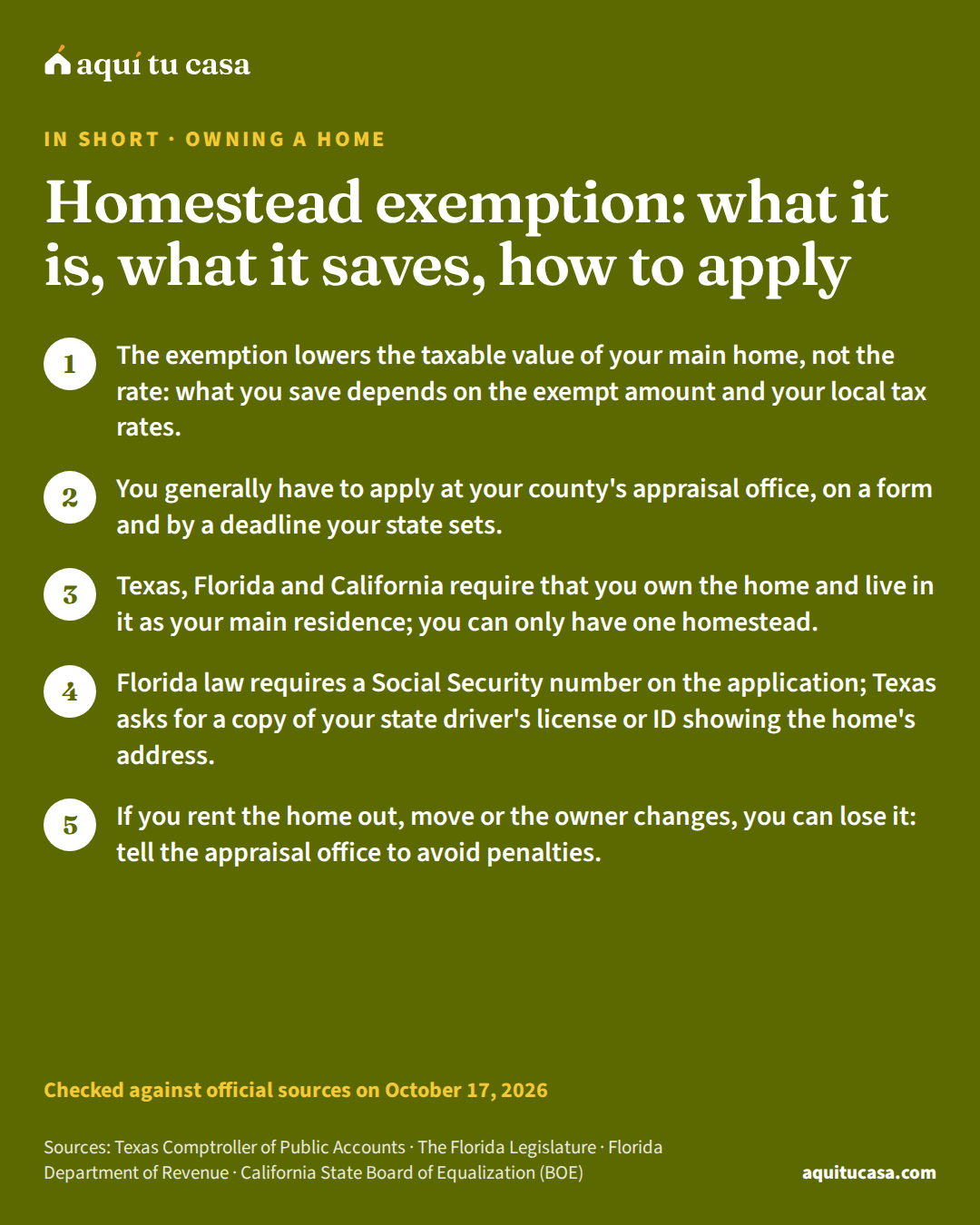
- Check whether you qualify for an exemption, such as the homestead exemptionhomestead exemptionA homestead exemption is a legal protection for the home where you and your family live. It can keep certain creditors from collecting your debts out of your main home, and it can also lower the property tax on that home. In Texas, for example, the residence homestead exemption removes part of your home's value from the tax calculation; to get it you must own the home, live there as your principal residence and apply. State laws vary widely: some cap the amount protected and others depend on the size of the property or the owner's age.See the full definition, which can lower the tax. Our guide Homestead exemption explains it.
The property tax calculator helps you estimate how much to set aside each month. This table shows each state’s typical effective property tax rate, so you can see the size of the bill:
Effective property tax rate, by state
| State | Property tax (effective rate) |
|---|---|
| Alabama | 0.38% |
| Alaska | 1.11% |
| Arizona | 0.48% |
| Arkansas | 0.55% |
| California | 0.7% |
| Colorado | 0.48% |
| Connecticut | 1.81% |
| Delaware | 0.5% |
| District of Columbia | 0.58% |
| Florida | 0.76% |
| Georgia | 0.77% |
| Hawaii | 0.27% |
| Idaho | 0.49% |
| Illinois | 2.01% |
| Indiana | 0.74% |
| Iowa | 1.39% |
| Kansas | 1.29% |
| Kentucky | 0.75% |
| Louisiana | 0.55% |
| Maine | 1.02% |
| Maryland | 0.97% |
| Massachusetts | 1.07% |
| Michigan | 1.25% |
| Minnesota | 1.02% |
| Mississippi | 0.72% |
| Missouri | 0.85% |
| Montana | 0.72% |
| Nebraska | 1.49% |
| Nevada | 0.47% |
| New Hampshire | 1.66% |
| New Jersey | 2.11% |
| New Mexico | 0.7% |
| New York | 1.55% |
| North Carolina | 0.66% |
| North Dakota | 0.99% |
| Ohio | 1.31% |
| Oklahoma | 0.8% |
| Oregon | 0.81% |
| Pennsylvania | 1.3% |
| Puerto Rico | 0.49% |
| Rhode Island | 1.21% |
| South Carolina | 0.48% |
| South Dakota | 1.06% |
| Tennessee | 0.5% |
| Texas | 1.49% |
| Utah | 0.52% |
| Vermont | 1.59% |
| Virginia | 0.73% |
| Washington | 0.81% |
| West Virginia | 0.53% |
| Wisconsin | 1.42% |
| Wyoming | 0.57% |
The effective rate is the typical tax as a share of home value; your county's and your home's may differ. Source: Census Bureau (ACS)

If you have escrow: what the servicer must do
With escrow, paying is the servicer’s job. On an FHA loan, it must pay the bills as they come due. If it pays late, it cannot pass the penalties on to you, unless the late payment came from your error or omission and it tried to get the billing information.2 So if the tax bill comes to you, send a copy to your loan servicerloan servicerThe loan servicer is the company that sends you your mortgage statements and handles the day-to-day tasks of the loan: it processes your payments, answers your questions, keeps track of principal and interest paid and manages your escrow account, if you have one. It can also offer options if you fall behind and, in certain cases, start a foreclosure. It may be the same company that lent you the money or a different one, and it is common for another company to take over the loan after closing.See the full definition.
Installments or in full? If your county offers lump sum or installments, with no discount for paying in full and no extra charge for installments, the servicer must pay in installments. If there is a discount for paying in full, it may pay in full to take advantage of it. The CFPB encourages it to follow your preference, and you and the servicer can agree on a different method or date if you agree voluntarily.6
On your federal taxes. If you pay through escrow, you may not be able to deduct everything you paid into escrow. The IRS says you can deduct only the taxes the lender actually paid from escrow to the taxing authority, and your bill shows that amount.7 The Form 1098Form 1098Form 1098, Mortgage Interest Statement, is the IRS form on which whoever collects your mortgage interest, usually your lender or loan servicer, reports how much interest you paid during the year. It can also show points you paid when buying your main home, mortgage insurance premiums, the balance you owe and other items, such as property tax paid from the escrow account. You generally receive a copy. If you itemize deductions, you use it to deduct mortgage interest on Schedule A, only to the extent the law allows.See the full definition your servicer sends also helps. The IRS’s VITA and TCE programs prepare basic returns for free for people who qualify.8
If you want to cancel your escrow
1. Check what kind of loan you have
Before you ask
On FHA, escrow is required; on a higher-priced loan, for at least five years.2
2. Check your balance and payments
Before you ask
For a higher-priced loan: balance below 80% of the original value and current.1
Try it with your numbersAmortization schedule3. Ask the servicer's policy
When you call
On a conventional loan, a waiver depends on a written policy and whether you can handle the large payments.3
4. Read the closing notice
Before it closes
It must reach you at least three business days ahead if you asked for it.5
5. Open your separate savings account
The same month
Set aside one-twelfth of taxes and insurance each month.4
If your escrow is canceled: the closing notice
If the escrow account on your loan will be canceled, whether you asked or not, the lender or servicer must give you an Escrow Closing Notice. It must tell you the date you will no longer have escrow and the reason, that you must pay taxes and insurance directly, possibly in one or two large payments a year, any fee for closing it, and a phone number for questions. It also explains the consequences of not paying: what your local government can do if taxes go unpaid, and what the servicer can do, such as adding amounts to your loan, adding escrow back or buying you insurance that may cost more and cover less. If you asked for it, the notice must reach you at least three business days before closure; if you did not, at least 30 business days before.5
If you get a notice like that and did not ask for it, call the number on it and ask why. If your insurance lapses unpaid, our guide Home insurance explained explains force-placed insuranceforce-placed insuranceForce-placed insurance is hazard insurance your loan servicer buys for your home when you do not have the homeowners insurance your mortgage requires, when your policy has lapsed or when it does not cover enough. The servicer charges you for it, it usually costs much more than a policy you buy yourself, and it often protects only the lender. Before charging you, federal law requires the servicer to send you written notices. If you show that you did have insurance, it must cancel the policy and refund what you paid for the time you had both.See the full definition.
Example with real numbers
A couple paying property taxes on their own
An example in words, not a real case, of how they get organized without escrow.
- Their loan
- Conventional, and the lender agreed to waive escrow
- What they saw at closing
- The Closing Disclosure showed their first-year costs and the fee for not having escrow
- Every month
- They set aside one-twelfth of taxes and insurance in a savings account
- Before each due date
- They pay the county and the insurer and keep the receipts
- What they avoid
- Late penalties and the servicer putting escrow back
What the Closing Disclosure shows comes from Regulation Z.4 Use the property tax calculator to estimate how much to set aside.
Run it with your numbersProperty taxIf this is you
It is your first home
Fannie Mae advocates escrow, especially for first-time homeowners.3
Your loan is FHA
Escrow is required: taxes, insurance and FHA mortgage insurance go in your payment.2
Your income changes month to month
If you pay on your own, set aside one-twelfth each month in a separate account.4
You want to cancel your escrow
On a higher-priced loan, not before five years, with a balance under 80% and current.1
You qualify for a tax exemption
Apply with your county and, if you have escrow, send the new bill to your servicer.

Mistakes that cost you
Mistake: Waiving escrow without the money set aside.
Instead: Without escrow you pay directly, maybe in one or two large payments a year.4
Mistake: Thinking an escrow waiver is permanent.
Instead: The loan keeps the escrow provision and the right to require it.3
Mistake: Asking to cancel a higher-priced loan's escrow too early.
Instead: Not before five years, and only with a balance under 80% and current.1
Mistake: Ignoring an escrow closing notice.
Instead: Read it: it gives the date, the reason and the consequences of not paying.5
Mistake: Deducting everything you paid into escrow.
Instead: Only what the lender paid to the taxing authority is deductible.7
Mistake: Keeping the tax bill without telling the servicer.
Instead: Send them a copy; they must pay on time from escrow.2
Free help
If you are not sure whether escrow fits you, or paying the taxes is hard, a HUD-approved housing counselorHUD-approved housing counselorA HUD-approved housing counselor works at an agency HUD has approved to provide housing counseling: independent, expert advice customized to your situation about buying a home, renting, a missed mortgage payment, a foreclosure or credit problems. The agencies usually charge little or nothing; many serve in Spanish and offer the homebuyer education course several assistance programs require. They are not lenders or real estate agents and sell you nothing. Your county page lists the official agencies with phone numbers.See the full definition can help for free or at low cost; search by ZIP code on the CFPB’s website.9 If you are already behind, our guide Behind on property taxes explains your options, and How to appeal your property assessment explains how to ask for a review of your home’s value.
What to do this week
- Check your Closing Disclosure for whether you have escrow and how much you pay each month.4
- Check what kind of loan you have: FHA, conventional or higher-priced.1
- Find your latest tax bill and write down the due dates.6
- If you pay on your own, open a separate savings account for taxes and insurance.4
- If you want to cancel your escrow, call your servicer and ask what conditions it requires.3
Your home and your county
We use the typical rate and value of the place you pick.
Typical home value in the United States (Census, ACS 2024). Enter your assessed value.
Let's do the math
Estimated tax per year
$3,127
About $261 a month, at a rate of 0.94% on $332,700.
Per month
$261
If you pay through escrow, your lender adds about this much to your payment.
The math
- Your home's value
- $332,700
- Taxable value
- $332,700
- Rate
- × 0.94%
- Tax per year
- $3,127
The rate changes within the county
Each home pays the districts it sits in (city, schools, services), and each sets its own rate. This rate is a county average, not your home's.
Your county's tax or assessor's office publishes your assessment, each district's rate and how to apply for an exemption or appeal.
This is an educational estimate from county averages, not your tax bill. Your bill depends on your home's districts, your assessment and your exemptions.
Ready to see the numbers? Find your county here
See how this applies in your county: its loan limits, prices and rents, from the official data.
Printable checklist

Frequently asked questions
Can I choose not to have an escrow account?
It depends on the loan. FHA requires escrow for taxes and insurance, and so does a higher-priced loan. On a conventional loan, the lender may waive escrow under its written policy, looking at whether you can handle the large tax and insurance payments.
What is a higher-priced mortgage loan?
One whose APR exceeds the average prime offer rate for a comparable loan by 1.5 percentage points or more, for a first lien within the Freddie Mac limit (2.5 points if above it). On those loans, the law requires escrow.
When can I cancel the escrow on a higher-priced loan?
Not before five years after closing, if you ask, your balance is less than 80% of the home's original value and you are current. It also ends when you pay off the loan.
How much does it cost not to have escrow?
Some lenders charge a fee to waive escrow. Your Closing Disclosure shows it as an 'Escrow Waiver Fee', along with what you are estimated to pay yourself in the first year.
What happens if I pay the taxes myself and fall behind?
Your local government can charge penalties and interest and take other actions. The servicer can also add amounts to your loan, add escrow back or buy more expensive insurance if you stop paying for coverage. The escrow closing notice explains those consequences.
If escrow pays late, do I pay the penalty?
The servicer must pay on time. On an FHA loan, if it pays late, it cannot pass the penalties on to you unless the late payment came from your error or omission and it tried to get the billing information.
Can I deduct everything I paid into escrow on my taxes?
Not necessarily. The IRS says you can deduct only the taxes the lender actually paid from escrow to the taxing authority; your tax bill shows that amount.
Sources
Every figure in this guide comes from one of these official sources. The number next to a sentence leads to the source behind it.
Each source on one line: who publishes it, its title, its address and the date we read it.
- 1. Consumer Financial Protection Bureau (CFPB), via eCFR · 12 CFR §1026.35, Requirements for higher-priced mortgage loans (Regulation Z) · ecfr.gov · Accessed October 31, 2026
- 2. U.S. Department of Housing and Urban Development (HUD) · Handbook 4000.1, FHA Single Family Housing Policy Handbook · hud.gov · Accessed October 31, 2026
- 3. Fannie Mae · Selling Guide B2-1.5-04, Escrow Accounts · selling-guide.fanniemae.com · Accessed October 31, 2026
- 4. Consumer Financial Protection Bureau (CFPB), via eCFR · 12 CFR §1026.38, Content of disclosures for certain mortgage transactions (Closing Disclosure) · ecfr.gov · Accessed October 31, 2026
- 5. Consumer Financial Protection Bureau (CFPB), via eCFR · 12 CFR §1026.20, Disclosure requirements regarding post-consummation events (Regulation Z) · ecfr.gov · Accessed October 31, 2026
- 6. Consumer Financial Protection Bureau (CFPB), via Cornell LII · 12 CFR §1024.17, Escrow accounts (Regulation X) · law.cornell.edu · Accessed October 31, 2026
- 7. Internal Revenue Service (IRS) · Publication 530, Tax Information for Homeowners · irs.gov · Accessed October 31, 2026
- 8. Internal Revenue Service (IRS) · Free tax return preparation for qualifying taxpayers · irs.gov · Accessed October 31, 2026
See the other 1 sources
- 9. Consumer Financial Protection Bureau (CFPB) · Find a housing counselor · consumerfinance.gov · Accessed October 31, 2026
Keep reading
Related guides
If this guide helped, these follow the same path.
Owning a home 12 minute read
Why did my escrow payment go up? The annual analysis
Why your payment changes with escrow even at a fixed rate: the annual analysis, shortages, deficiencies, the cushion and how to dispute an error.
- Your total payment adds principal, interest, mortgage insurance if any, and escrow; escrow changes when your property tax or insurance changes.
- After the annual analysis, the servicer sends your statement within 30 days: it shows what was paid, what is projected and any shortage or surplus.
- A shortage of one month's payment or more cannot be charged all at once: the servicer leaves it alone or spreads it over at least 12 months.
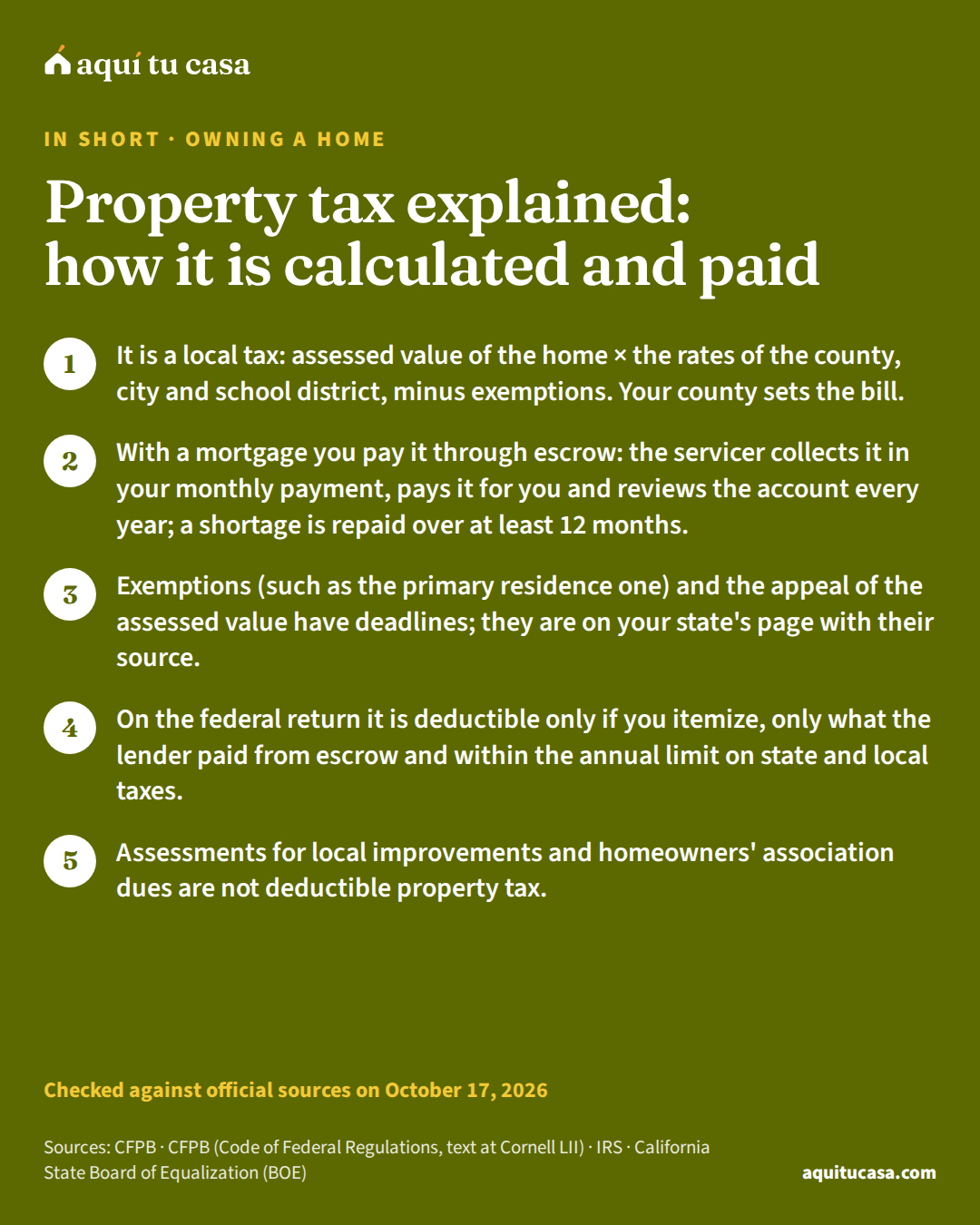
- Owning a home Property tax explained: how it is calculated and paid Who charges property tax, how it is calculated, how it is paid through escrow, which exemptions and appeals exist and what part is deductible. 13 minute read
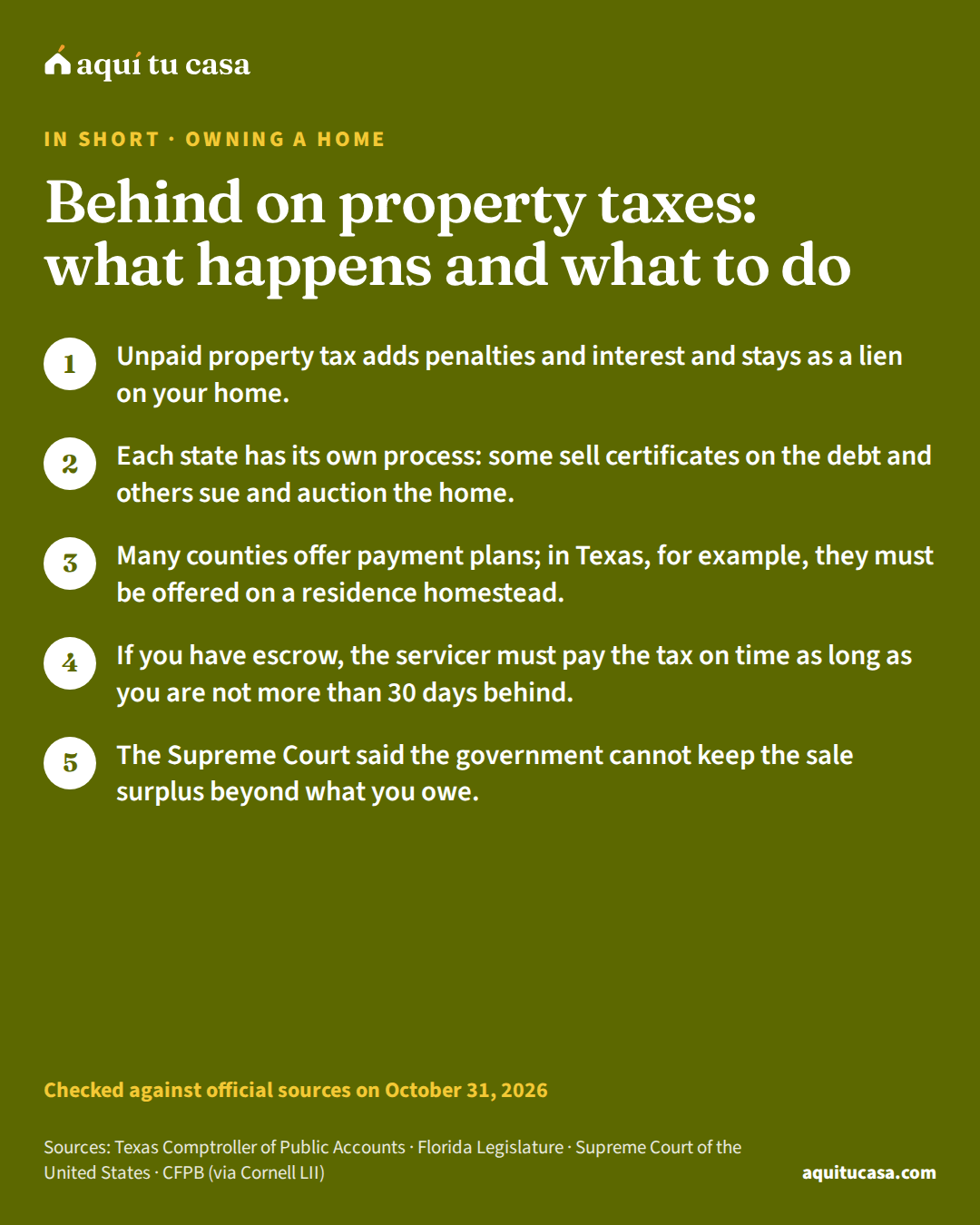
- Owning a home Behind on property taxes: what happens and what to do What happens if you do not pay your property tax: penalties, interest, a lien, tax certificate or home sales, and how to catch up with your county. 11 minute read
- Owning a home Homestead exemption: what it is, what it saves, how to apply What the homestead exemption is, who qualifies, how much it lowers your home's value in Texas, Florida and California, how to apply and which dates matter. 13 minute read
Tools for this topic
Was this guide useful?
Thank you. Your answer stays in your browser; nothing is sent.