Behind on property taxes: what happens and what to do
What happens if you do not pay your property tax: penalties, interest, a lien, tax certificate or home sales, and how to catch up with your county.
Verified against official sources on October 31, 2026 8 official sources

Show contents
In short
What you need to know
Quick answer
If you do not pay your property tax on time, your county adds penalties and interest, and the debt stays as a lien on your home. If it stays unpaid, depending on your state the county may sell a certificate on the debt or sue and auction the home. Rules and deadlines vary a lot by state: in Texas the penalty reaches 12% in July; in Florida interest can reach 18% a year. Call your county tax office today and ask about payment plans, deferrals and exemptions. If a sale is already coming, look for free legal aid.
What matters most
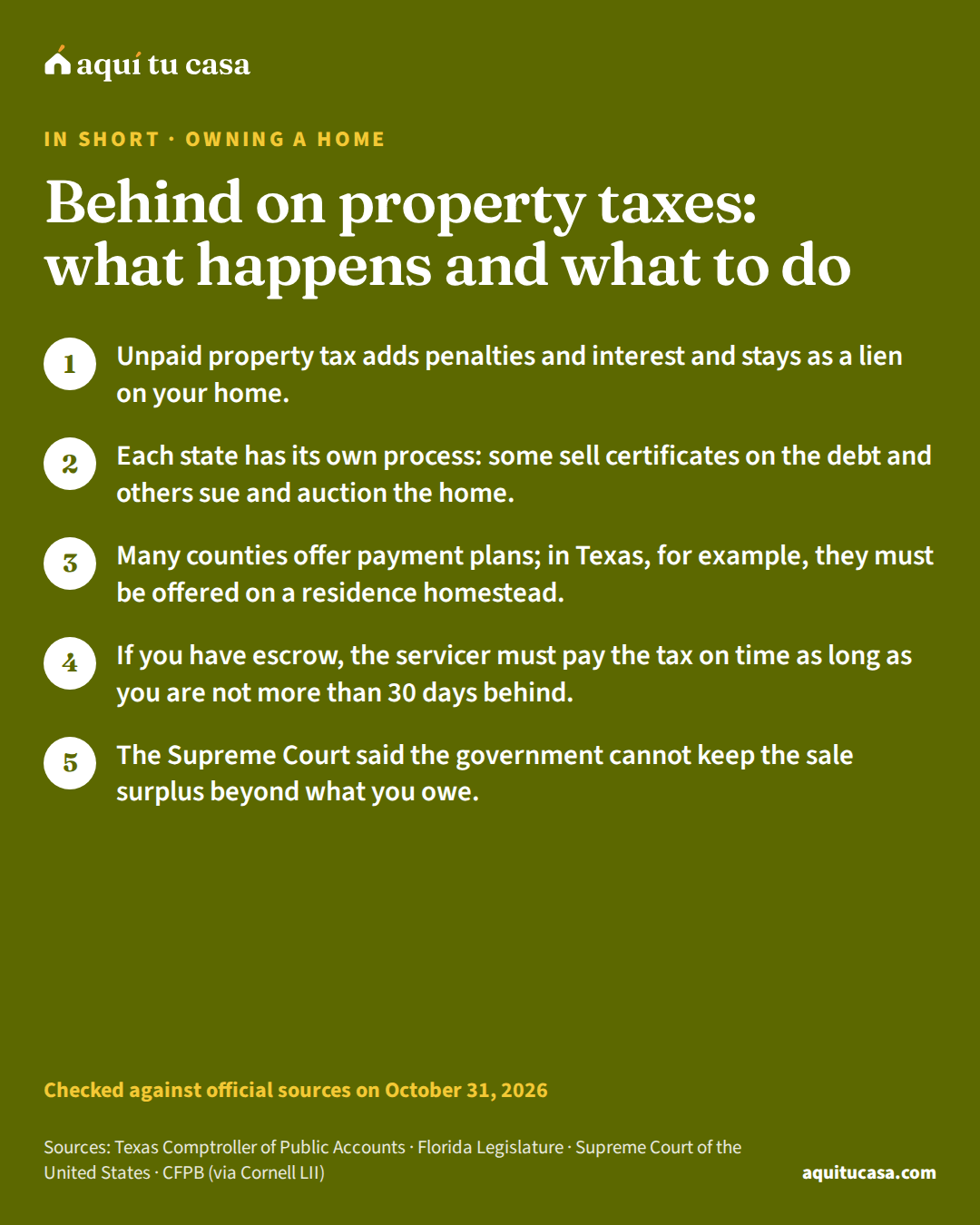
- Unpaid property tax adds penalties and interest and stays as a lien on your home.
- Each state has its own process: some sell certificates on the debt and others sue and auction the home.
- Many counties offer payment plans; in Texas, for example, they must be offered on a residence homestead.
- If you have escrow, the servicer must pay the tax on time as long as you are not more than 30 days behind.
Is this for you?
This guide is for you if…
- You own your home, did not pay your property tax on time and received a delinquency notice.
- You pay the tax yourself (no escrow) and could not cover it this year.
- You inherited a home with back taxes or were told about a tax sale.
Get direct help first if…
- Your escrow payment went up because the tax went up: read «Why did my escrow payment go up?».
- You think your home's assessment is too high: read the guide on appealing your assessment first, which has its own deadlines.
Falling behind on property tax is more common than it seems, especially if you pay it yourself and not through your mortgage. The problem is that the debt grows fast and stays attached to your home. This guide explains what happens when you do not pay, with examples from the official laws and pages of Texas and Florida, and what you can do today to catch up. Rules vary by state and county: your county tax office has the final word on your account.
What happens when you do not pay on time
Property taxproperty taxProperty tax is the tax the county, city, school district and other local bodies charge real property owners every year to pay for schools, police, fire and other public services. It is computed on the value the assessor's office assigns to your home, at each body's rate, minus the exemptions you qualify for, such as the primary-residence exemption in many states. If you have a mortgage you normally pay it month by month inside your payment, through the escrow account. It is generally deductible on your federal return if you itemize.See the full definition has a delinquency date. After that date, penalties and interest begin. In Texas, for example, in most cases taxes are due by January 31, and anything unpaid on February 1 is delinquent. The taxing unit must give you at least 21 days after mailing your bill, and the delinquency date is printed on your bill.1
Careful: not getting the bill does not protect you. In Texas, not receiving it does not change what you owe, the delinquency date or the lien on your home.1 If you moved or the bill never arrived, call your county before the date.
This is how the debt grows in Texas:1
- On February 1, a 6% penalty and 1% interest are added.
- The penalty goes up 1% each month until it reaches 12% on July 1.
- Interest continues at 1% a month, with no maximum.
- If the taxing unit hires a private attorney to collect, that attorney can add another penalty of up to 20%.
In Florida, delinquent tax on a home carries 18% interest a year from the delinquency date until a certificate is sold, with a 3% minimum charge if you pay before the sale.3 Other states have their own numbers. Check your bill or ask your county.
The lien: the debt sticks to your home
Back property tax is not an ordinary debt. It stays as a lienlienA lien is a legal right a creditor holds in your property to make sure you repay a debt. It usually prevents the property from being sold until the debt is paid, and if you do not pay, the creditor may be able to take the property. Your mortgage is a lien on your home: when you pay it off, the lien is released and that shows up in your county's property records. There are other kinds, such as a federal tax lien, which is the government's legal claim against all your property when you do not pay a tax debt.See the full definition on your property. In Texas, each taxing unit holds a lien on each property, which attaches automatically every January 1. That lien gives the courts the power to foreclose and seize the home, even if ownership changed. The home is auctioned and the proceeds pay the taxes. And nobody can buy your home with clear title until all the back taxes are paid.1
If you have a mortgage, back taxes are also a problem with your loan. In the Fannie Mae and Freddie Mac uniform mortgage, you agree to pay the taxes that have or may attain priority over the mortgage. If you pay those taxes yourself and do not pay on time, the lender may pay them and you must pay that money back; it may also revoke your permission to pay directly and move you to escrow.8 Our guide Why did my escrow payment go up? explains what happens to your monthly payment after that.
Two ways to collect: auction or certificates
Each state collects back taxes in its own way. These two official examples show the two most common ones:
Two paths, depending on your state
Texas example
Lawsuit and auction
- You get at least one delinquency notice
- The collector may offer a payment plan; on a homestead it must
- The last resort is a lawsuit; court costs are added to your debt
- The court can order the home auctioned
Florida example
Certificate sale
- The collector sells a certificate on your debt to an investor
- The winner is whoever bids the lowest interest rate, up to 18% a year
- You pay the debt by redeeming the certificate, with its interest
- After 2 years, the certificate holder can apply for a tax deed
Either way, paying or setting up a plan before the sale is what protects your home.
In Texas: lawsuit and auction. The collector sends you at least one delinquency notice, often more. Some collectors let you pay in installments for up to 36 months; they are not required to offer it, except on a residence homestead. Before you sign, know that the law treats your signature as an irrevocable admission that you owe those taxes. The collector’s last resort is to sue you, and court costs are added to your debt.1
In Florida: certificates. The county tax collector sells tax certificates on properties with unpaid taxes. Each certificate goes to whoever pays the debt and bids the lowest interest rate, up to the maximum; if nobody buys it, it is struck to the county. If you pay everything before the certificate is awarded, it is not issued. Afterward, the debt is paid by “redeeming” the certificate.4 The certificate holder can apply for a tax deed after 2 years have passed since April 1 of the year it was issued. If the home has a homestead exemption, the opening bid at that auction also includes half of the latest assessed value.5
How a tax debt can move forward, using Florida as the example
1. Delinquency date
The date on your bill
18% yearly interest starts, with a 3% minimum if you pay before the sale.3
2. Certificate sale
On your county's calendar
An investor pays your debt and you now owe the investor, at the rate won in the sale.4
3. You can redeem
After the certificate is sold
You pay the debt, interest and costs to the collector to cancel the certificate.4
4. Tax deed application
2 years after April 1 of the certificate's year
The certificate holder can ask for the home to go to auction.5
5. The auction
After the application
On a homestead, the opening bid includes half of the latest assessed value.5

If you have escrow, the servicer must pay
If you pay the tax through your mortgage, with an escrowescrow accountAn escrow account is an account set up by your mortgage lender to pay certain property-related expenses on your behalf, mainly property taxes and homeowners insurance. The money comes from a portion of your monthly mortgage payment: each month you contribute a share and the loan servicer pays the bills when they come due. That is why your payment is higher than principal and interest alone, and why it can change when taxes or the insurance premium go up. In some states the word also names the period between the offer and the closing.See the full definition account, paying it is your loan servicer’sloan servicerThe loan servicer is the company that sends you your mortgage statements and handles the day-to-day tasks of the loan: it processes your payments, answers your questions, keeps track of principal and interest paid and manages your escrow account, if you have one. It can also offer options if you fall behind and, in certain cases, start a foreclosure. It may be the same company that lent you the money or a different one, and it is common for another company to take over the loan after closing.See the full definition job. Under Regulation X, the servicer must pay the taxes on time, by the deadline to avoid a penalty, and must advance the money if your account is short, as long as your mortgage payment is not more than 30 days overdue. It can then collect the shortageescrow shortageAn escrow shortage is, under Regulation X, the amount by which your escrow account falls short of the balance it should have when your loan servicer analyzes the account. The servicer reviews the account every year, and it can come up short if, for example, your property taxes or insurance went up. If the shortage is less than one month's escrow payment, the servicer can leave it, ask you to pay it within a short time or spread it over monthly payments; if it is larger, the servicer can leave it or spread it over equal monthly payments for at least twelve months.See the full definition from you.7
If you have escrow and get a delinquency notice:
- Call the tax office and ask whether it received payment and on what date.
- Call the servicer and ask when it paid.
- If the delay was the servicer’s fault, ask in writing for it to pay the penalty and fix it.
Keep a receipt for every payment. In Texas, the collector must give you a receipt if you ask, and it helps prove your mortgage company paid.1
Ways to catch up
Ask your county about all of these options. These Texas examples show what may exist:
- A payment plan. Some collectors give up to 36 months, and in Texas they must offer it on a homestead.1
- A penalty waiver. In certain cases the law requires or allows waiving penalty or interest, for example if the error was the taxing unit’s or the appraisal district’s. But in most cases you must pay the tax by the 21st day after you learn of the delinquency and ask for the waiver in writing before the 181st day after the delinquency date.1
- A deferral if you are 65 or older or have a disability. You can defer the tax on your homestead; the deferred amount carries 5% annual interest and no penalties accrue while the agreement lasts. You can also pay in four equal installments without penalty, if you make the first one and ask for the agreement before the delinquency date.2 Our guide Property tax relief for older homeowners covers programs in other states.
- If you are on active military duty. In Texas you can pay back taxes without penalty or interest; payment is due 60 days after your discharge, your return to the state for more than 10 days or your return to non-active reserve status.1
And so you do not fall behind again, check whether you are missing an exemption. The homestead exemptionhomestead exemptionA homestead exemption is a legal protection for the home where you and your family live. It can keep certain creditors from collecting your debts out of your main home, and it can also lower the property tax on that home. In Texas, for example, the residence homestead exemption removes part of your home's value from the tax calculation; to get it you must own the home, live there as your principal residence and apply. State laws vary widely: some cap the amount protected and others depend on the size of the property or the owner's age.See the full definition on your main home can lower your tax, and if your assessed valueassessed valueAssessed value, or assessment, is the value the local government's assessor gives your property to calculate property tax. It is only for taxes: it is not the appraisal a lender orders for your mortgage. The assessor first estimates market value, usually by comparing your home with similar homes that sold recently. In some places the assessment equals full market value, and in others it is a fraction of it. The assessor does not decide how much you pay: that depends on the rates set by the county, the city and the school district.See the full definition is too high, you can appeal it. Our guides on the homestead exemption and how to appeal your property assessment explain the steps.

If your home is sold: the surplus is yours
If the home is sold for taxes and brings in more than you owed, that surplus belongs to you. The Supreme Court said so on May 25, 2023, in Tyler v. Hennepin County: a county had sold a woman’s condo over back taxes and kept everything left over. The Court said a taxpayer is entitled to the surplus beyond the debt, and that the government cannot take more than it is owed.6
Each state has its own way to claim that money, and there are usually deadlines. If your home was sold for taxes or is about to be, look for free legal aidlegal aidLegal aid is the free civil legal help that nonprofit organizations and their lawyers provide to low-income people in civil, not criminal, matters. In housing, that includes representing families facing eviction or foreclosure, alongside matters such as custody, child support, protection from domestic violence and access to benefits. In the United States, the Legal Services Corporation, created by Congress, funds a nationwide network of these organizations; its finder points you to the one in your area. Each sets its own income limits.See the full definition as soon as possible: our guide Free legal aid explains how.
Example with real numbers
A Texas homeowner who paid late
An example in words, not a real case, of how the debt grows under Texas rules.
- She does not pay before February 1
- A 6% penalty and 1% interest are added
- Still unpaid in July
- The penalty reaches 12% and interest continues at 1% a month
- The taxing unit hires an attorney to collect
- Another penalty of up to 20% can be added
- She calls the collector
- Because it is her homestead, she must be offered a payment plan
- What she decides
- Sign a plan she can really pay and write down every payment date
The rules come from the Texas Comptroller.11 Use the property tax calculator to see what you pay in your county.
Run it with your numbersProperty taxIf this is you
You pay the tax yourself and came up short
Call your county today and ask about a payment plan before the penalty grows.1
You are 65 or older
Ask about a deferral or penalty-free installments; in Texas you ask before the delinquency date.2
You inherited a home with back taxes
The lien stays with the home even when ownership changes; talk with the county soon.1
You are on active duty
In Texas you can pay back taxes without penalty or interest after your service.1
You were told about a tax sale
Look for legal aid today and ask how much you need to pay or redeem before the sale.4
You were charged a penalty for the county's mistake
Ask in writing for a waiver; in Texas, before the 181st day after the delinquency date.1
Mistakes that cost you
Mistake: Thinking you owe nothing because the bill never arrived.
Instead: In Texas, not getting the bill does not change what you owe or the delinquency date.1
Mistake: Waiting until you have all the money to call.
Instead: Ask about a payment plan now; in Texas it must be offered on a homestead.1
Mistake: Signing a plan you cannot keep up with.
Instead: In Texas, your signature counts as admitting the debt; sign only what you can meet.1
Mistake: Missing the deadline to ask for a penalty waiver.
Instead: In Texas, ask in writing before the 181st day after the delinquency date.1
Mistake: Assuming an escrow penalty is your fault.
Instead: If you are not more than 30 days behind on the mortgage, the servicer must pay on time.7
Mistake: Giving up on the surplus if the home is sold.
Instead: That surplus is yours; look for legal aid to claim it.6

What to do this week
- Find your bill and notices, and write down the delinquency date and how much you owe today.1
- Call your county tax office and ask about payment plans, deferrals and penalty waivers.1
- If you have escrow, also call the servicer and ask when it paid.7
- If you are 65 or older, have a disability or are in the military, ask about the special options.2
- If you were told about a sale, look for free legal aid today.6
- Build your family budget with the plan payment included, and read Property tax explained to understand your bill.
Your home and your county
We use the typical rate and value of the place you pick.
Typical home value in the United States (Census, ACS 2024). Enter your assessed value.
Let's do the math
Estimated tax per year
$3,127
About $261 a month, at a rate of 0.94% on $332,700.
Per month
$261
If you pay through escrow, your lender adds about this much to your payment.
The math
- Your home's value
- $332,700
- Taxable value
- $332,700
- Rate
- × 0.94%
- Tax per year
- $3,127
The rate changes within the county
Each home pays the districts it sits in (city, schools, services), and each sets its own rate. This rate is a county average, not your home's.
Your county's tax or assessor's office publishes your assessment, each district's rate and how to apply for an exemption or appeal.
This is an educational estimate from county averages, not your tax bill. Your bill depends on your home's districts, your assessment and your exemptions.
Ready to see the numbers? Find your county here
See how this applies in your county: its loan limits, prices and rents, from the official data.
Printable checklist
Frequently asked questions
Can I lose my home for not paying property tax?
Yes, if the debt stays unpaid. In Texas, for example, the tax lien gives the courts the power to seize and auction the property. In Florida, a tax certificate buyer can apply for a tax deed after 2 years. That is why acting early matters.
What is a tax certificate?
In some states, such as Florida, the county sells your tax debt to an investor. The investor pays the taxes and you now owe the investor, with interest. If you do not pay, after a while the investor can apply for a tax deed and the home can go to auction.
Can I set up a payment plan?
Many counties allow it. In Texas, some collectors let you pay delinquent taxes in installments for up to 36 months, and they must offer it on a residence homestead. Before signing, remember that in Texas the agreement counts as an admission that you owe those taxes.
I have escrow. Why did I get a delinquency notice?
If your mortgage payment is not more than 30 days late, the servicer must pay the taxes on time from your escrow. If you got a notice, call the servicer and the tax office, and ask in writing for it to be fixed.
Will the penalty be waived if I never got the bill?
Usually not: in Texas, not receiving the bill does not change what you owe or the delinquency date. But penalties are waived in some cases, for example when the error was the county's. In Texas you must ask in writing before the 181st day after the delinquency date.
If my home is sold for taxes, do I lose everything left over?
The Supreme Court said in the Tyler case, in 2023, that a taxpayer is entitled to the surplus beyond the debt and that the government cannot take more than it is owed. Ask legal aid how to claim that surplus in your state.
I am 65 or older. Is there help?
In several states, yes. In Texas, people 65 or older or with a disability can defer the tax on their homestead, with 5% annual interest, or pay it in four installments without penalty if they ask before the delinquency date. Also read the guide on property tax relief for older homeowners.
Sources
Every figure in this guide comes from one of these official sources. The number next to a sentence leads to the source behind it.
Each source on one line: who publishes it, its title, its address and the date we read it.
- 1. Texas Comptroller of Public Accounts · Paying Your Taxes · comptroller.texas.gov · Accessed October 31, 2026
- 2. Texas Comptroller of Public Accounts · Payment Options · comptroller.texas.gov · Accessed October 31, 2026
- 3. Florida Legislature · Fla. Stat. §197.172, Interest rate; calculation and minimum · leg.state.fl.us · Accessed October 31, 2026
- 4. Florida Legislature · Fla. Stat. §197.432, Sale of tax certificates for unpaid taxes · leg.state.fl.us · Accessed October 31, 2026
- 5. Florida Legislature · Fla. Stat. §197.502, Application for obtaining tax deed by holder of tax sale certificate · leg.state.fl.us · Accessed October 31, 2026
- 6. Supreme Court of the United States · Tyler v. Hennepin County, 598 U.S. 631 · supremecourt.gov · Accessed October 31, 2026
- 7. CFPB (via Cornell LII) · 12 CFR §1024.17, Escrow accounts (Regulation X) · law.cornell.edu · Accessed October 31, 2026
- 8. Fannie Mae and Freddie Mac · Form 3010, Florida Mortgage (Spanish translation) · sf.freddiemac.com · Accessed October 31, 2026
Keep reading
Related guides
If this guide helped, these follow the same path.

Owning a home 13 minute read
Property tax explained: how it is calculated and paid
Who charges property tax, how it is calculated, how it is paid through escrow, which exemptions and appeals exist and what part is deductible.
- It is a local tax: assessed value of the home × the rates of the county, city and school district, minus exemptions. Your county sets the bill.
- With a mortgage you pay it through escrow: the servicer collects it in your monthly payment, pays it for you and reviews the account every year; a shortage is repaid over at least 12 months.
- Exemptions (such as the primary residence one) and the appeal of the assessed value have deadlines; they are on your state's page with their source.
- Owning a home Property tax relief for older homeowners Exemptions, assessment freezes, deferrals and credits on property tax for older homeowners: how each one works and the verified programs in your state. 10 minute read
- Owning a home Homestead exemption: what it is, what it saves, how to apply What the homestead exemption is, who qualifies, how much it lowers your home's value in Texas, Florida and California, how to apply and which dates matter. 13 minute read
- Owning a home How to appeal your property tax assessment, step by step How to read your notice of value, what evidence works, how the informal review and hearing work, and protest deadlines in Texas, Florida and California. 13 minute read
Tools for this topic
Was this guide useful?
Thank you. Your answer stays in your browser; nothing is sent.