Property tax relief for older homeowners
Exemptions, assessment freezes, deferrals and credits on property tax for older homeowners: how each one works and the verified programs in your state.
Verified against official sources on October 31, 2026 7 official sources

Show contents
In short
What you need to know
Quick answer
Many states help older homeowners with property tax, each in its own way, and the programs in this guide have to be applied for. There are four common forms: an exemption, which lowers the value you pay tax on; a freeze, which keeps your home's assessment from rising; a deferral, which lets you pay later, with interest and a lien on the house; and a credit or rebate, which gives back part of what you paid. Age, income and deadlines change from state to state. The table in this guide shows each state's verified programs.
What matters most
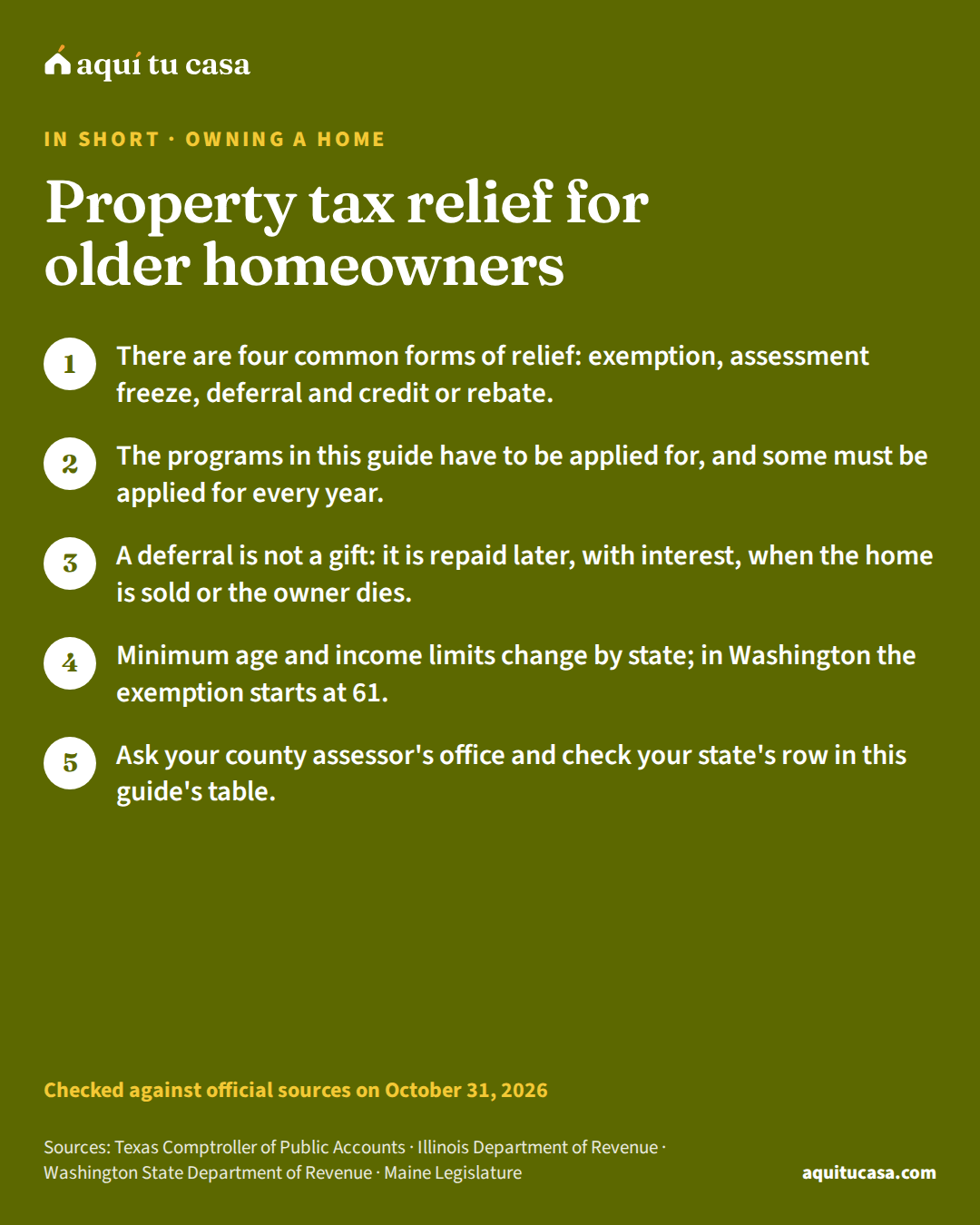
- There are four common forms of relief: exemption, assessment freeze, deferral and credit or rebate.
- The programs in this guide have to be applied for, and some must be applied for every year.
- A deferral is not a gift: it is repaid later, with interest, when the home is sold or the owner dies.
- Minimum age and income limits change by state; in Washington the exemption starts at 61.
Is this for you?
This guide is for you if…
- You are 60 or older, own your home and your property tax goes up every year.
- You help your parents or grandparents pay the taxes on their home.
- You want to know whether your state has an exemption, a freeze or a deferral for older owners.
Get direct help first if…
- You do not have the basic homestead exemption yet: start with our homestead exemption guide.
- You already owe back taxes and were told of a tax sale: call your county tax office today and get legal aid.
Property tax can go up even when your income does not, and that weighs more once you are retired. The good news is that many states have programs for older homeowners. This guide explains the four most common forms of relief, with real examples from several states’ official pages, and points you to the verified programs in yours. It does not replace your county office: the rules change by state and relief has to be applied for.
Four forms of relief
Each state builds its help its own way. The programs in this guide fall into four forms. Knowing which is which helps you ask the right questions at your county office. Our guide Property tax explained explains how property taxproperty taxProperty tax is the tax the county, city, school district and other local bodies charge real property owners every year to pay for schools, police, fire and other public services. It is computed on the value the assessor's office assigns to your home, at each body's rate, minus the exemptions you qualify for, such as the primary-residence exemption in many states. If you have a mortgage you normally pay it month by month inside your payment, through the escrow account. It is generally deductible on your federal return if you itemize.See the full definition is calculated.
1. The exemption: lowers the value you pay on. An amount is taken off your home’s assessed valueassessed valueAssessed value, or assessment, is the value the local government's assessor gives your property to calculate property tax. It is only for taxes: it is not the appraisal a lender orders for your mortgage. The assessor first estimates market value, usually by comparing your home with similar homes that sold recently. In some places the assessment equals full market value, and in others it is a fraction of it. The assessor does not decide how much you pay: that depends on the rates set by the county, the city and the school district.See the full definition before the tax is calculated. In Texas, for example, school districts must give an additional $60,000 exemption on the main home of people 65 or older or with a disability, and each taxing unit can add a local exemption for them of at least $3,000.1 In Illinois, the senior exemption lowers the equalized assessed value by up to $8,000 in Cook County and its neighbors, and up to $5,000 elsewhere.2
2. The freeze: the assessment does not rise. Your home’s value stays fixed for tax purposes, even if prices go up in your neighborhood. In Illinois, the freeze for low-income seniors keeps the equalized assessed value from rising as long as you keep qualifying, and you apply every year with Form PTAX-340.2 In Arizona, the valuation protection option fixes the value of your primary residence for three years that can be renewed; you apply with Form 82104 through the county assessor.5 A freeze fixes the value; ask your county how your tax is calculated on that value.
3. The deferral: you pay later. You do not pay now, but the debt stays on the house. In Illinois it works like a loan against the property’s value: a lienlienA lien is a legal right a creditor holds in your property to make sure you repay a debt. It usually prevents the property from being sold until the debt is paid, and if you do not pay, the creditor may be able to take the property. Your mortgage is a lien on your home: when you pay it off, the lien is released and that shows up in your county's property records. There are other kinds, such as a federal tax lien, which is the government's legal claim against all your property when you do not pay a tax debt.See the full definition is recorded and the state recovers the deferred amount with interest when the home is sold or transferred.2 In Washington, the deferred amount accrues 5% simple interest and must be repaid when you sell, when the owner dies or when the home is no longer their primary residenceprincipal residenceYour principal residence is the home where you live permanently and spend most of the year. According to FHA, a person can have only one principal residence at a time. Lenders tell it apart from a second home, which you occupy in addition to your principal residence but for less than most of the year, and from an investment property, which you own but do not live in. Fannie Mae buys loans on all three, but it applies a loan-level price adjustment (LLPA) to loans on investment properties.See the full definition.3
4. The credit or rebate: you get part of it back. You pay the tax and the state gives back part of it based on your income. In Missouri, the credit known as the “circuit breaker” can reach $1,100 for owners and $750 for renters, depending on what you paid and your household income.6 In Pennsylvania, the rebate can be up to $1,000 for people 65 or older, widows and widowers 50 or older and people with disabilities 18 or older, with household income of $48,110 or less.7
Exemption, freeze or deferral
You pay less
Exemption
- An amount is taken off the assessment before the tax is calculated
- Example: $60,000 more off school tax in Texas from age 65
- Nothing is repaid: it is a discount
The assessment stays put
Freeze
- The home's value stays fixed for tax purposes while you qualify
- Example: Illinois, applied for every year with Form PTAX-340
- Ask how your tax is calculated on the frozen value
You pay later
Deferral
- You do not pay now; the debt stays on the house
- Example: in Washington it accrues 5% simple interest
- Repaid when you sell, when the owner dies or when you stop living there
Many states combine several forms; ask about all of them at your county office.
Who qualifies: age, income and main home
There is no national rule. Each program sets its own age, income limit and conditions. These official examples show how different they can be:
- Age. In Texas and Illinois the programs in this guide start at 65.12 In Washington, the exemption starts at 61.3 In Pennsylvania, the rebate includes widows and widowers from 50 and people with disabilities from 18.7
- Income. Many programs have a limit. In Washington it depends on your county’s threshold.3 In Maine, under current law, the state deferral requires income under $80,000 and liquid assets under $100,000, or $150,000 for all owners together if the home has several owners.4
- Main home. Nearly all the programs are for the home you live in. In Washington, for example, the deferral must be repaid if the home stops being your primary residence.3
- Disability. Several programs also include people with disabilities, with or without an age limit. In Maine, the deferral includes people who cannot work because of a disability.4
How to apply, step by step
From the first call to the discount on your bill
1. Check your bill
Today
See which exemptions you already have; if you do not see the main-home one, start there.
2. Call your county assessor's office
This week
Ask about the senior exemption, freeze, deferral and credit.5
4. File the form
Within the program's deadline
Some are filed once and others every year, like Illinois's freeze.2
5. Check the next bill
When it arrives
Make sure the relief shows up; if not, call and ask why.
If you pay the tax through your mortgage, the relief lowers what your servicer pays each year from your escrowescrow accountAn escrow account is an account set up by your mortgage lender to pay certain property-related expenses on your behalf, mainly property taxes and homeowners insurance. The money comes from a portion of your monthly mortgage payment: each month you contribute a share and the loan servicer pays the bills when they come due. That is why your payment is higher than principal and interest alone, and why it can change when taxes or the insurance premium go up. In some states the word also names the period between the offer and the closing.See the full definition account. Our guide Why did my escrow payment go up? explains how and when your payment is adjusted. And if you think your home’s assessment is too high, you can appeal it in addition to asking for relief: our guide How to appeal your property assessment explains the assessment appealproperty tax appealA property tax appeal is the formal process to ask that the value the local government gave your property be changed, if you think it is too high or has errors. Each state calls it something different: in Texas it is a protest to the appraisal review board, and in New York it is a grievance with the municipality. Often you can first talk informally with the assessor's office. There are strict deadlines and it is up to you to bring evidence, such as sales of similar homes. The appeal reviews the value, not the tax rate.See the full definition.
Example with real numbers
A 70-year-old homeowner in Illinois, outside Cook County
An example in words, not a real case, of how programs can add up.
- Her senior homestead exemption
- Lowers the equalized assessed value by up to $5,000 outside the Cook area
- If her income is under the limit
- She can apply for the freeze, which keeps the equalized assessed value from rising
- What she has to do every year
- File Form PTAX-340 for the freeze
- If that is still not enough
- She can ask about the deferral, which puts a lien on the house
- What she decides
- Apply for the exemption and the freeze, and talk with her family before deferring
The rules in the example come from the Illinois Department of Revenue.2 Use the property tax calculator to see what you pay today in your county.
Run it with your numbersProperty tax
Your state’s programs
The table shows, for each state with a page on this site, the relief programs for older homeowners we have verified on its official page or in its law. Tap your state’s name to see each program’s detail, with the source quote and the date it was checked. If your state does not appear, that does not mean it has no relief: ask your county assessor’s office.
Property tax relief for older homeowners, by state
| State | Relief for older owners |
|---|---|
| Alabama | Basic homestead exemption (type H-1) · No state property tax for owners over 65, disabled or blind |
| Alaska | $150,000 exemption for owners 65 and older and disabled veterans |
| Arizona | Senior Property Valuation Protection (valuation freeze) |
| Colorado | Senior homestead exemption (owners 65 and older) |
| Connecticut | Tax credit for owners 65 and older or totally disabled (Circuit Breaker) |
| Delaware | School property tax credit for owners 65 and older |
| District of Columbia | 50% reduction for seniors and disabled owners |
| Georgia | $4,000 exemption for people 65 and older with low income · Floating inflation-proof exemption for people 62 and older |
| Idaho | Property Tax Reduction program |
| Illinois | Senior Citizens Homestead Exemption · Low-income Senior Citizens Assessment Freeze |
| Indiana | Supplemental homestead deduction (rises each year) · Credits for owners 65 and older |
| Iowa | Additional exemption for owners 65 and older |
| Kansas | Homestead refund (Form K-40H) · SAFESR refund for low-income seniors (Form K-40PT) |
| Kentucky | Homestead exemption for owners 65 or older or totally disabled |
| Louisiana | Assessment freeze for owners 65 and older and people with disabilities |
| Maine | State property tax deferral for owners 65 and older or with a disability |
| Massachusetts | Local senior exemption (clause 41C) |
| Mississippi | Regular homestead exemption (Tier 1) · Age or disability exemption (Tier 2) |
| Missouri | Property Tax Credit ("circuit breaker") for seniors and people with disabilities |
| Montana | Elderly Homeowner/Renter Credit (age 62 and older) |
| Nebraska | Homestead exemption for seniors, people with disabilities and veterans |
| New Jersey | ANCHOR, Senior Freeze and Stay NJ: one combined application · $250 deduction for seniors and disabled persons |
| New Mexico | Value freeze for low-income owners 65 and older or with disabilities |
| New York | Basic STAR school tax relief · Enhanced STAR for owners 65 and older |
| North Carolina | Elderly or Disabled Homestead Exclusion |
| North Dakota | Homestead credit for people 65 or older or with a disability |
| Ohio | Homestead exemption for seniors and people with disabilities |
| Oklahoma | Additional homestead exemption for lower-income households |
| Oregon | Property tax deferral for senior and disabled homeowners (apply by April 15) |
| Pennsylvania | Property Tax/Rent Rebate Program (PTRR) |
| Rhode Island | State property tax relief for people 65 and older or with a disability |
| South Dakota | Assessment freeze for seniors and people with disabilities |
| Tennessee | Property tax relief for older, disabled and disabled-veteran homeowners |
| Texas | School-district homestead exemption |
| Utah | Low-income homeowner's tax credit |
| Virginia | Local exemption or deferral for people 65 and older or with disabilities |
| Washington | Exemption for people 61 and older or with disabilities · Property tax deferral for people 60 and older or with disabilities |
| West Virginia | $20,000 homestead exemption for owners 65 or older or disabled · Senior citizens' tax credit for low-income homeowners |
| Wyoming | Long-term homeowner's exemption (65 and older) |
Each program has its own age, income limit and deadline, and some must be applied for every year; check the detail on your state's page.2 Source: each state's official tax pages

What to know before you defer
A deferral can help you stay in your home when money is short, but it has a cost. In Illinois it works like a loan against your home’s value, with a recorded lien, and the state recovers it with interest when the home is sold or transferred.2 In Washington, you must have enough equity in the home to secure what the state pays, the deferred amount accrues 5% simple interest, and it is repaid when you sell, when the owner dies or when you stop living there.3
That means your heirs may receive the house with that debt. Talk to your family before applying. And before you sign, ask the office three questions: how much interest the deferred amount accrues, when it has to be repaid and what happens if you move in with family or into a care home. Write down the answers, the date and the name of the person who gave them. Our guide Wills, transfer-on-death deeds and inheriting a home explains how to leave the house in order. If you are thinking about a reverse mortgagereverse mortgageA reverse mortgage is a loan secured by your home for older homeowners. In the most common kind, HUD's Home Equity Conversion Mortgage (HECM), the youngest borrower must be 62 or older at closing. Instead of making monthly payments, you receive money; interest and fees are added to the balance each month, so the debt grows and your equity shrinks. The home stays in your name, but you must live in it, pay property taxes and insurance and keep it in good condition. It is repaid when you no longer live there, usually by selling the home. To get a HECM you must receive counseling from a HUD-approved agency.See the full definition to pay your expenses, read our reverse mortgage (HECM) guide first: it is also a debt on the house.
If this is you
You turned 65 and live in Texas
Apply for the additional $60,000 school tax exemption and ask about your city's or county's local exemption.1
Your income is low and the assessment rises every year
Ask whether your state has a freeze; in Illinois it is applied for every year with Form PTAX-340.2
Your home is paid off but you have little cash
A deferral lets you pay later, with interest and a lien on the house.2
You are older and you rent
Some states, such as Missouri and Pennsylvania, also give a credit or rebate to qualifying renters.6
You have a disability and are under 65
Several programs include you; in Pennsylvania, the rebate starts at 18 with a disability.7
You help your parents with their taxes
Go over their state's table and the bill together, and note each deadline.2
Mistakes that cost you
Mistake: Thinking relief arrives on its own when you reach the age.
Instead: It has to be applied for; in Cook County, the senior exemption is applied for every year.2
Mistake: Not renewing the freeze.
Instead: In Illinois you must file Form PTAX-340 every year for the freeze.2
Mistake: Deferring without talking to your family.
Instead: The deferred amount is repaid with interest when the home is sold or the owner dies.3
Mistake: Moving out of the home without telling anyone.
Instead: In Washington, the deferral must be repaid when the home stops being your primary residence.3
Mistake: Skipping the rebate because you rent.
Instead: Missouri and Pennsylvania also help qualifying renters.7
Mistake: Paying someone to fill out the application.
Instead: Pennsylvania offers free help with the application; ask your county or your state.7

What to do this week
- Find your latest property tax bill and see which exemptions you already have.
- Check your state’s programs in this guide’s table and open your state’s page.
- Call your county assessor’s office and ask about the senior exemption, freeze, deferral and credit.5
- Gather proof of your age, that you live in the home and of last year’s income.3
- Mark each program’s deadline on your calendar and whether you must apply every year.2
- If you are thinking about a deferral, talk with your family first about what will happen to the house.3
Your home and your county
We use the typical rate and value of the place you pick.
Typical home value in the United States (Census, ACS 2024). Enter your assessed value.
Let's do the math
Estimated tax per year
$3,127
About $261 a month, at a rate of 0.94% on $332,700.
Per month
$261
If you pay through escrow, your lender adds about this much to your payment.
The math
- Your home's value
- $332,700
- Taxable value
- $332,700
- Rate
- × 0.94%
- Tax per year
- $3,127
The rate changes within the county
Each home pays the districts it sits in (city, schools, services), and each sets its own rate. This rate is a county average, not your home's.
Your county's tax or assessor's office publishes your assessment, each district's rate and how to apply for an exemption or appeal.
This is an educational estimate from county averages, not your tax bill. Your bill depends on your home's districts, your assessment and your exemptions.
Ready to see the numbers? Find your county here
See how this applies in your county: its loan limits, prices and rents, from the official data.
Printable checklist
Frequently asked questions
At what age do I stop paying property tax?
It depends on the state. What is most common in the programs in this guide is that the tax is lowered, frozen, deferred or partly refunded. Age changes by state: in Texas and Illinois the examples in this guide start at 65, and Washington's exemption at 61.
What is the difference between an exemption and a freeze?
An exemption lowers the value your tax is calculated on, for example $60,000 more for school tax in Texas. A freeze keeps your assessment from rising as long as you keep qualifying, like Illinois's freeze for low-income seniors. Some states have both.
What is a property tax deferral?
It means not paying now and paying later. In Illinois it works like a loan against the home's value, with a recorded lien. In Washington, the deferred amount accrues 5% simple interest and is repaid when you sell, when the owner dies or when the home is no longer their primary residence.
If I defer my tax, do my children inherit the debt?
The debt stays on the house. In Washington, the deferral must be repaid when the owner dies or the home is sold; in Illinois, the state recovers it with interest when the home is sold or transferred. Talk to your family before applying.
Is there help if I rent?
In some states, yes. Missouri's credit and Pennsylvania's rebate also include qualifying renters. In Missouri the maximum for renters is $750, and in Pennsylvania the rebate can be up to $1,000.
Do I have to apply every year?
It depends on the program. In Illinois, the freeze is applied for every year with Form PTAX-340, and in Cook County the senior exemption is also applied for every year. Other programs are applied for once. Ask your county assessor's office.
Where do I apply for relief?
Usually at your county assessor's or appraiser's office, and sometimes at the state revenue department. In Arizona, for example, the valuation freeze is requested with Form 82104 through the county assessor. The table in this guide links to your state's property tax page.
Sources
Every figure in this guide comes from one of these official sources. The number next to a sentence leads to the source behind it.
Each source on one line: who publishes it, its title, its address and the date we read it.
- 1. Texas Comptroller of Public Accounts · Property Tax Exemptions · comptroller.texas.gov · Accessed October 31, 2026
- 2. Illinois Department of Revenue · Property Tax Relief · tax.illinois.gov · Accessed October 31, 2026
- 3. Washington State Department of Revenue · Property tax exemptions and deferrals · dor.wa.gov · Accessed October 31, 2026
- 4. Maine Legislature · 36 MRSA §6251, State property tax deferral program; eligibility · legislature.maine.gov · Accessed October 31, 2026
- 5. Arizona Department of Revenue · Property Tax FAQs · azdor.gov · Accessed October 31, 2026
- 6. Missouri Department of Revenue · Property Tax Credit · dor.mo.gov · Accessed October 31, 2026
- 7. Pennsylvania Department of Revenue · Property Tax/Rent Rebate Program · pa.gov · Accessed October 31, 2026
Keep reading
Related guides
If this guide helped, these follow the same path.

Mortgage loans 13 minute read
Reverse mortgages (HECM): how they work and what to know
What a HECM reverse mortgage is, who can get one, the required counseling, what happens to your spouse and heirs, and how to avoid scams.
- The HECM is the only reverse mortgage insured by the federal government, and it is for homeowners 62 and older.
- You make no monthly payments, but the balance rises every month: it is not free money.
- You must keep paying property taxes and insurance, live in the home and keep it in good repair.
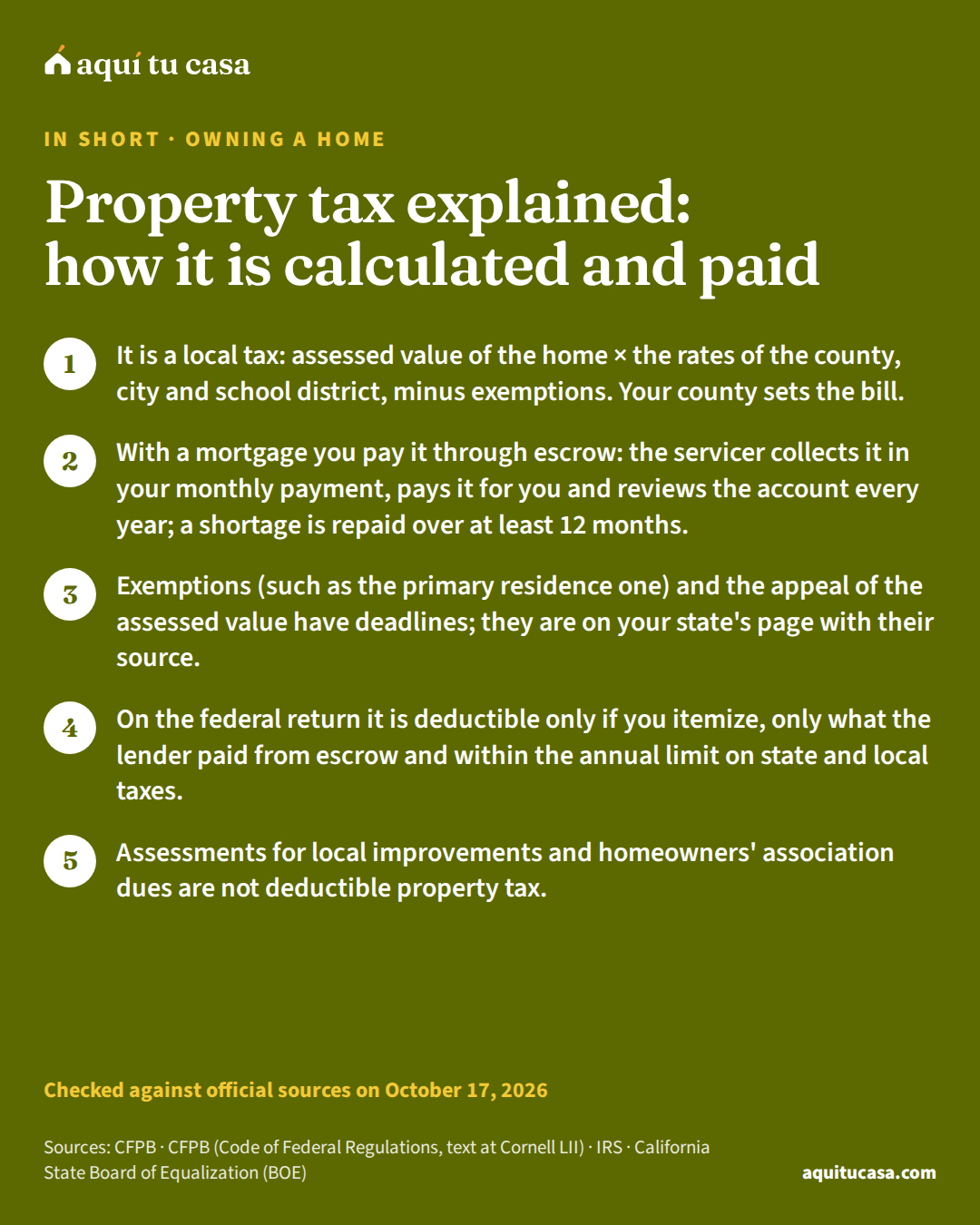
- Owning a home Property tax explained: how it is calculated and paid Who charges property tax, how it is calculated, how it is paid through escrow, which exemptions and appeals exist and what part is deductible. 13 minute read
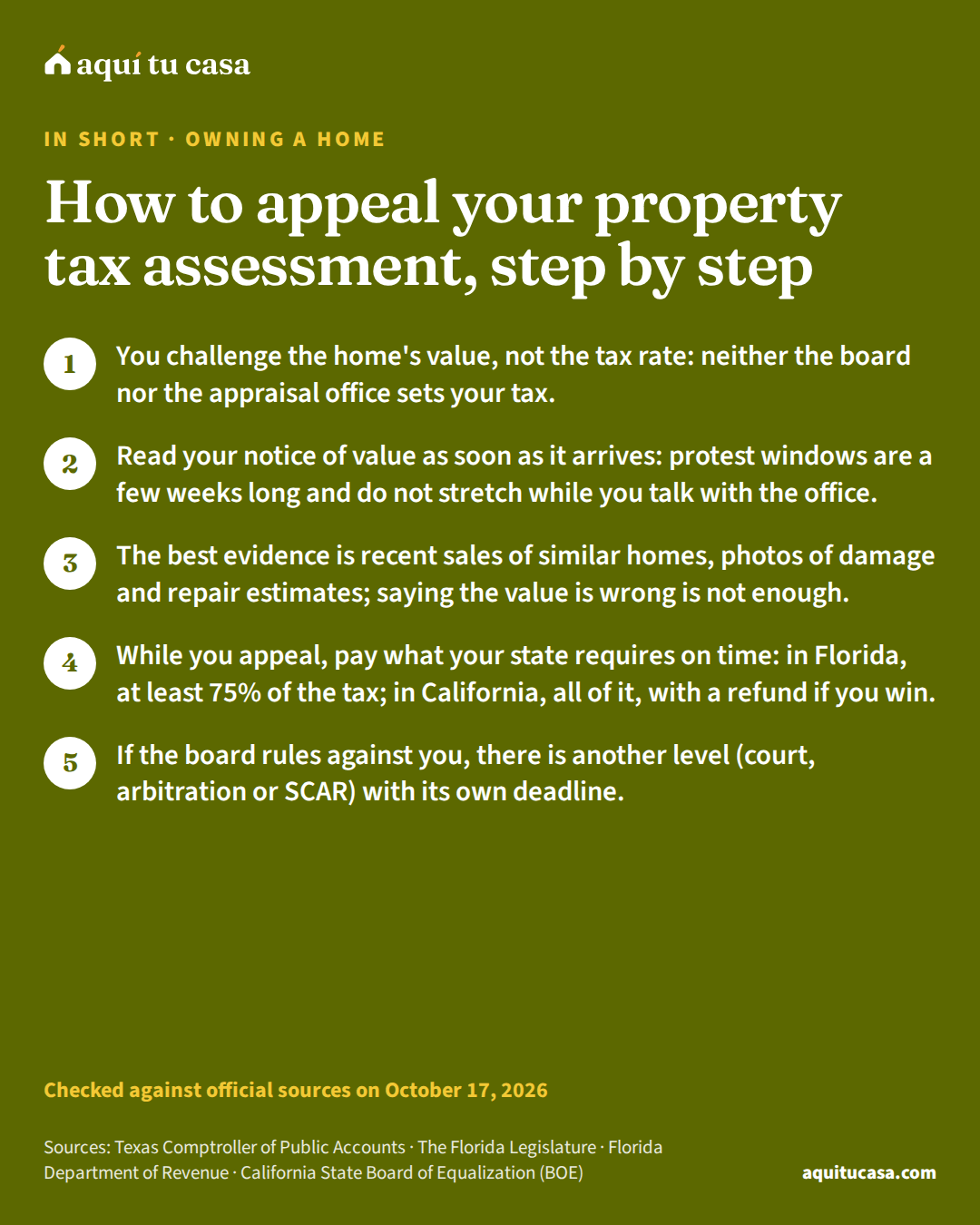
- Owning a home How to appeal your property tax assessment, step by step How to read your notice of value, what evidence works, how the informal review and hearing work, and protest deadlines in Texas, Florida and California. 13 minute read
Tools for this topic
Was this guide useful?
Thank you. Your answer stays in your browser; nothing is sent.