Wills, transfer-on-death deeds and inheriting a home
What a will requires, how a transfer-on-death deed works, what happens to the mortgage when you inherit a home and what heirs' property is.
Verified against official sources on October 17, 2026 23 official sources

Show contents
In short
What you need to know
Quick answer
When an owner dies, the home passes according to their will, the way the title is held or, in some states, a transfer-on-death (TOD) deed recorded during their life; if there is none of that, state law decides who inherits. If the home has a mortgage, the federal Garn-St Germain Act keeps the lender from demanding full payment because of a transfer to a relative after the borrower's death, and Regulation X requires the servicer to tell you which documents it needs to confirm you as a successor. The rules vary a lot from state to state; free legal aid is one option for guidance.
What matters most
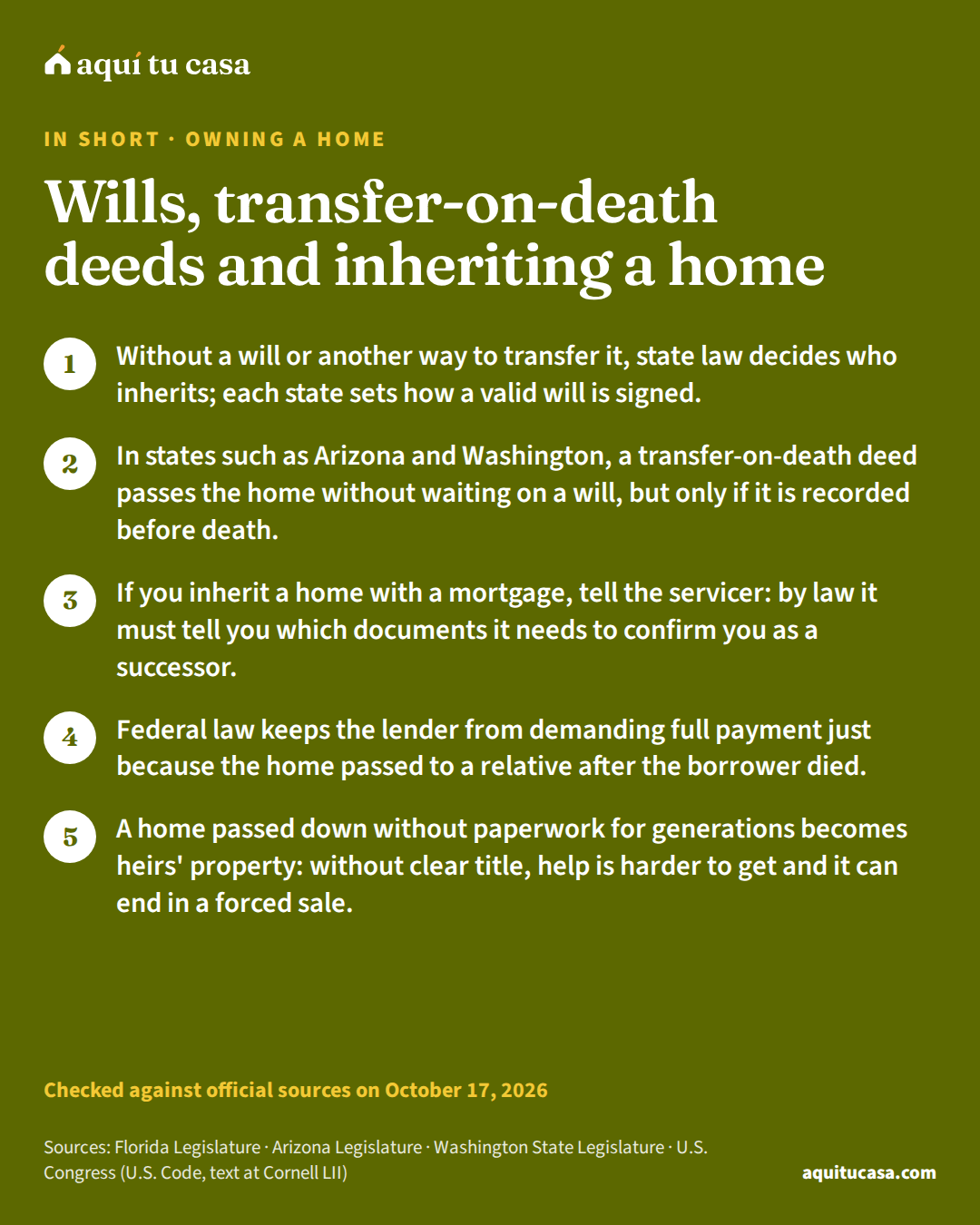
- Without a will or another way to transfer it, state law decides who inherits; each state sets how a valid will is signed.
- In states such as Arizona and Washington, a transfer-on-death deed passes the home without waiting on a will, but only if it is recorded before death.
- If you inherit a home with a mortgage, tell the servicer: by law it must tell you which documents it needs to confirm you as a successor.
- Federal law keeps the lender from demanding full payment just because the home passed to a relative after the borrower died.
Is this for you?
This guide is for you if…
- You own your home and want to understand how it can pass to your family: a will, a transfer-on-death deed or other ways.
- A relative who owned a home has died, maybe with a mortgage, and you want to know your rights with the loan servicer.
- Your family lives in an inherited home that was never put in anyone's name.
Get direct help first if…
- There is already a court case (probate, partition or foreclosure): look for free legal guidance as soon as you can; this guide only explains the general rules.
- You want to know what to write in your will or which deed is right for you: that is individual legal advice, and we do not give it here.
- Your relative had a reverse mortgage: the rules are different and have their own guide.
This guide is for families thinking about the future of their home and for people who just lost a loved one who owned one. It explains, based on what the law and official agencies say, how a home can pass to family: a will, a transfer-on-death (TOD) deed and inheritance without paperwork. It also covers your rights with the mortgage servicer if you inherit. It is not legal advice: the rules vary a lot from state to state, and for your situation free legal aid is one option.
- In Florida, at a minimum, to sign a valid will
- 2 witnesses2
- In Arizona and Washington, when a TOD deed must be recorded to be valid
- Before death6
- Homes where federal law protects a relative who inherits from a demand for immediate payment
- Up to 4 units8
- In Florida, for a co-heir to elect to buy out a cotenant who wants heirs' property sold
- 45 days20
How a home can pass to family
When an owner dies, the home passes to other people in one of several ways. How the title is held can decide it: in a joint tenancy with right of survivorship, when one co-owner dies the other gets full ownership;14 our guide on how to hold title with family explains those forms. Otherwise, the home passes by will, by a transfer-on-death deed where the law allows one, or under the state’s inheritance rules.
If there is no will, state law decides who inherits. In Florida, for example, anything not left in a valid will passes to the heirs the code names, and the death is what gives them that right.1 Every state has its own rules, so what you see here from Florida, Arizona and Washington are examples, not your state’s rule.
Wills: each state sets the rules
A will is the document in which a person says who gets their property when they die. Each state’s law says how it must be signed to be valid, and the differences matter.
In Florida, every will must be in writing. The person making it must sign at the end, in front of at least two witnesses, and the witnesses sign in front of that person and of each other. No special wording is needed if those formalities are followed.2 In Arizona, a paper will is also in writing and is signed by at least two people who witnessed the signing.3 But Arizona also accepts a holographic will: even without witnesses, it is valid if the signature and the main provisions are in the handwriting of the person making it.4
| Florida | Arizona | |
|---|---|---|
| In writing? | Yes | Yes |
| Witnesses | At least two, who sign in front of the testator and each other | At least two who witnessed the signing |
| Handwritten will with no witnesses | Not enough: it must follow the formalities | Valid if the signature and main provisions are handwritten |
Florida has another rule that affects many families. Under its law and constitution, a homestead may not be left by will if the owner is survived by a spouse or minor children; it can be left to the spouse only when there are no minor children.5 So in Florida a will may not decide what happens to the home, even if it says so in writing.
The transfer-on-death (TOD) deed
Some states allow a deed that the owner signs and records during their life but that only passes the home to the person they chose when they die. It is called a transfer on death deed (TOD) or, in Arizona, a beneficiary deed. It is a deeddeedA deed is the legal document the seller uses to transfer ownership of the home to you. The seller signs it at closing, it lists the names of all the buyers and you receive a copy. Afterward, the settlement agent records it with the county records office; that recording puts the public on notice that you are now the owner. There are several types: a warranty deed gives the most promises about the title, and a quitclaim deed promises nothing. Do not confuse it with a deed of trust, which is the mortgage document.See the full definition recorded with the county; in Washington, the law says it is not a will.7
In Arizona, a beneficiary deed passes the home to the beneficiary when the owner dies, along with any mortgages and lienslienA lien is a legal right a creditor holds in your property to make sure you repay a debt. It usually prevents the property from being sold until the debt is paid, and if you do not pay, the creditor may be able to take the property. Your mortgage is a lien on your home: when you pay it off, the lien is released and that shows up in your county's property records. There are other kinds, such as a federal tax lien, which is the government's legal claim against all your property when you do not pay a tax debt.See the full definition on it. It is valid only if signed and recorded with the county before the owner’s death. The owner can revoke it at any time by recording a revocation, and if there are several, the last one recorded before death controls. The beneficiary does not have to sign, consent or even be told, and a will does not revoke it.6
Washington’s law says something similar: the deed is revocable, takes the same capacity as making a will and must be recorded with the county before death. While the owner is alive, it does not take away the right to sell or mortgage the home, and it gives the beneficiary no right to it. At death, the beneficiary takes the home with its mortgages and liens, and is liable for certain claims against the estate as state law provides.7
Will and TOD deed, side by side
For all your property
Will
Both depend on your state's law; where TOD deeds exist, what counts is what was recorded in time.6

If you inherit a home with a mortgage
The mortgage does not disappear when the borrower dies. The CFPB talks about continuing to make payments or seeking a modification,13 and in Arizona and Washington the home passes to the beneficiary of a TOD deed with its mortgages and liens.67 But federal law and CFPB rules give you important protections.
The first is the Garn-St Germain Act. Many loans have a due-on-sale clause, which lets the lender demand the whole debt if the home is transferred without its consent. For a home with fewer than five units, the law does not let the lender use that clause because of a transfer to a relative resulting from the borrower’s death, when the borrower’s spouse or children become owners, a transfer by will, inheritance or operation of law on the death of a joint tenant, or a move into a living trust in which the borrower remains a beneficiary.8
The second is Regulation X. Someone who receives the home through those transfers is a successor in interest.9 The loan servicerloan servicerThe loan servicer is the company that sends you your mortgage statements and handles the day-to-day tasks of the loan: it processes your payments, answers your questions, keeps track of principal and interest paid and manages your escrow account, if you have one. It can also offer options if you fall behind and, in certain cases, start a foreclosure. It may be the same company that lent you the money or a different one, and it is common for another company to take over the loan after closing.See the full definition must have procedures so that, when it learns the borrower has died, it promptly makes it easy to communicate with potential successors.12 If you write to it saying you may be a successor, with the borrower’s name and information to find the account, it must answer in writing with the documents it needs and a phone number.11 Once confirmed, you are treated as a borrower under the escrow and loan servicing rules.10
If you inherit a home with a mortgage, step by step
1. Tell the loan servicer
As soon as you can
It is the company that sends the monthly statement. It may ask for proof of your right to the home.13
2. Ask in writing which documents it needs
With the borrower's name and the account number
The servicer must answer in writing with the list of documents and a contact phone number.11
3. Gather the proof it asks for
Depending on your state
It may be a copy of the executed will and the death certificate, or a letter from the executor.13
4. Wait for the servicer's decision
Promptly, after you send the documents
Its procedures must let it decide promptly and tell you whether you are confirmed, need to send more documents and which ones, or are not a successor.12
5. Once confirmed, ask about your options
After confirmation
Ask how to keep making payments or how to seek a loan modification.13
If you want to take over the loan, the CFPB explains that if you already have title to the home, for example through inheritance, its rules do not require the lender or servicer to evaluate your ability to repay before letting you take over the mortgage.14 The CFPB also says the proof you are asked for may vary from state to state, and that you can ask how to keep paying or seek a loan modificationloan modificationA loan modification is a change in the terms of your mortgage that you agree on with your loan servicer when you have trouble paying. It is a type of loss mitigation, meaning one of the options to avoid foreclosure. It can extend the time you have to repay, lower the interest rate, or defer or reduce part of the principal balance, which can lower your monthly payment. Often you start with a trial modification for a few months; if you make those payments on time, the change becomes permanent.See the full definition.13 If the payments are hard to make, our can’t pay my mortgage guide explains the options, and if your relative had a reverse mortgagereverse mortgageA reverse mortgage is a loan secured by your home for older homeowners. In the most common kind, HUD's Home Equity Conversion Mortgage (HECM), the youngest borrower must be 62 or older at closing. Instead of making monthly payments, you receive money; interest and fees are added to the balance each month, so the debt grows and your equity shrinks. The home stays in your name, but you must live in it, pay property taxes and insurance and keep it in good condition. It is repaid when you no longer live there, usually by selling the home. To get a HECM you must receive counseling from a HUD-approved agency.See the full definition, our reverse mortgage guide covers that case.
The inherited home’s basis and taxes
For taxes, a home’s basis matters when you sell it: the IRS says it is the starting point for figuring a gain or loss.16 And the basis of an inherited home is figured differently from that of a home received as a gift.
Example with real numbers
Inheriting the home or receiving it as a gift during life
How the IRS figures basis in each case, in words. Your situation may have special rules.
- You inherit the home when the owner dies
- Generally, its fair market value on the date of death
- The home is given to you during the owner's life
- It depends on the giver's basis, the value on that day and any gift tax paid
- What basis is for
- Figuring your gain or loss if you ever sell
According to IRS Publication 551, there are exceptions, such as the alternate valuation date the estate's personal representative may choose.15 Basis is the starting point for figuring a gain or loss when you sell.16
The CFPB mentions that some families transfer the home from parents to children before the parent dies.14 If your family is thinking about that, know that the IRS figures the basis of a gift from the giver’s basis, not from the value on the date of death.15 If you have questions about your tax return, our free legal aid guide explains where to look for free tax help. And if you inherit the home and will live in it, our homestead exemption guide explains that property tax break.

Heirs’ property: when no one put the home in their name

Many families live for years in a home still in the name of a grandparent who has died. The USDA calls this heirs’ property: family land owned by the descendants of a person who died whose estate never went through probate. The heirs can use the property but do not have a clear or marketable titletitleTitle is your legal right to own and possess a property. The deed is the document showing that the seller transferred that right to you, and legal title is the title that can be documented in public records. As part of the purchase, a title search is done to see whether anyone else has a claim against the home; common claims come from a previous owner's unpaid taxes or from contractors who say they were not paid for work on the home. Title insurance protects you if such a claim shows up later.See the full definition. The land passes down without a will or deed to prove who owns it, and each generation usually adds more heirs. Without proof of ownership, it can be hard to get federal benefits, and it could end in forced partition sales requested by third parties.17
Some states have special laws for these cases. In Florida it is called the Uniform Partition of Heirs Property Act.18 Under it, heirs property is property held by several co-owners in common, with no recorded agreement on how to divide it, where at least one got their share from a relative and, for example, 20% or more of the property is held by co-owners who are relatives.19 If someone asks the court to divide it, the court sets its fair market value, generally with an appraisalhome appraisalAn appraisal is a written document that gives a professional appraiser's opinion of how much a property is worth. The lender orders it before approving the mortgage, because the home is the loan's collateral and the lender does not want to lend more than it is worth. If the appraisal comes in below the price you agreed, the bank bases the loan on the lower value and you will have to cover the difference, renegotiate the price or walk away if your contract allows it. An appraisal is not an inspection: it measures value, not the home's condition.See the full definition.21 And if a co-owner asked for a sale, the others can tell the court, no later than 45 days after the notice, that they want to buy that share at the price that comes from that value.20
A home without clear title also attracts scammers who forge deeds; our deed theft guide explains how to protect yourself.
Where to get free help
To deal with the loan servicer or go over your payments, a HUD-approved housing counselorHUD-approved housing counselorA HUD-approved housing counselor works at an agency HUD has approved to provide housing counseling: independent, expert advice customized to your situation about buying a home, renting, a missed mortgage payment, a foreclosure or credit problems. The agencies usually charge little or nothing; many serve in Spanish and offer the homebuyer education course several assistance programs require. They are not lenders or real estate agents and sell you nothing. Your county page lists the official agencies with phone numbers.See the full definition gives independent advice, often at little or no cost.22 The CFPB also mentions the HOPE Hotline, open 24 hours a day, at (888) 995-4673.13
For questions about a will, a deed or probate, free legal aidlegal aidLegal aid is the free civil legal help that nonprofit organizations and their lawyers provide to low-income people in civil, not criminal, matters. In housing, that includes representing families facing eviction or foreclosure, alongside matters such as custody, child support, protection from domestic violence and access to benefits. In the United States, the Legal Services Corporation, created by Congress, funds a nationwide network of these organizations; its finder points you to the one in your area. Each sets its own income limits.See the full definition is an option, never a requirement. The Legal Services Corporation funds civil legal aid offices for low-income people; on its site you find the nearest one by entering your address or city, and LawHelp.org has free legal information and forms.23
If this is you
You own your home and are thinking about your children
Arizona and Washington have a deed that passes the home at death, if it is recorded during life.67 In Florida, check the homestead rule if you have a spouse or minor children.5
Your father or mother died and the home has a mortgage
Tell the servicer and ask in writing for the list of documents to confirm you as a successor.11

Mistakes that can cost your family the home
Mistake: Signing a TOD deed and not recording it with the county.
Instead: In Arizona and Washington it is valid only if recorded before the owner dies.67
Mistake: Thinking a new will cancels a beneficiary deed.
Instead: In Arizona, a will does not revoke it: it is revoked with a recorded document.6
Mistake: Waiting until you have every paper before talking to the servicer.
Instead: Tell it early and ask in writing which documents it needs.1311
Mistake: Believing the bank can demand the whole debt because you inherited.
Instead: Federal law bars that for a transfer to a relative resulting from the borrower's death.8
Mistake: Leaving the home in the name of someone who died for years.
Instead: Without clear title, help is harder to get and it can end in a forced sale.17
Mistake: Transferring the home during life without knowing how it changes the tax basis.
Instead: The IRS figures basis differently for a gifted home and an inherited one.15
What to do this week
- Find the deed to your home and see how it says the owners hold title; our guide on how to hold title with family explains each form.
- If you are considering a transfer-on-death deed, check whether your state’s law allows it and how it is recorded; in Arizona and Washington, it must be recorded during life.67
- If you inherited a home with a mortgage, write to the servicer with the borrower’s name and the account number, and keep a copy.11
- Gather the death certificate, the will if there is one, and any letter from the executor.13
- Ask the servicer how to keep making payments while everything is sorted out, or what options exist if you cannot; a HUD-approved housing counselor can guide you, often for free.1322
- If the home is still in the name of a relative who died, look for a free legal aid office near you; it is an option, never a requirement.23
Your household this month
Let's do the math
Left each month
Enter what at least one person takes home to see the result.
What helps
- Pay savings first: set the goal aside the day the money arrives, before flexible spending.
- Add up the bills that come every few months (car insurance, school) and divide by twelve.
- If income changes, plan on a low month and save the extra from good months.
- A HUD-approved housing counselor can go over the budget with you, often for free.
This is a planning tool with your numbers, not a credit evaluation or an approval. The split reference is only a guide.
Ready to see the numbers? Find your county here
See how this applies in your county: its loan limits, prices and rents, from the official data.
Printable checklist
Frequently asked questions
What is a transfer-on-death (TOD) deed?
It is a deed the owner signs and records during their life that passes the home to the person they chose only when they die. Arizona calls it a beneficiary deed and Washington a transfer on death deed. In both states it can be revoked and must be recorded with the county before death.
Does my state allow TOD deeds?
It depends on the state: this guide shows the laws of Arizona and Washington, which do. Check your state's law or ask a free legal aid office; that is an option, never a requirement.
What happens to the mortgage if I inherit the home?
The debt stays with the home. Tell the loan servicer; under Regulation X, if you write saying you may be a successor, it must answer in writing with the documents it needs. Once confirmed, you are treated as a borrower under the servicing rules, and you can ask how to keep paying or seek a loan modification.
Can the bank demand full payment because my father died?
For a home with fewer than five units, the federal Garn-St Germain Act does not let the lender use the due-on-sale clause because of a transfer to a relative resulting from the borrower's death, or when the spouse or children become owners. The debt and the payments continue.
What documents can the servicer ask for?
The CFPB says that in an inheritance, proof might include a copy of the executed will and the death certificate, or a letter from the executor. The servicer should tell you what it needs, and what you can get varies from state to state.
Do I need to qualify for a new loan to keep the mortgage?
Not necessarily. The CFPB says that if you already have title to the home, for example through inheritance, its rules do not require the lender or servicer to evaluate your ability to repay before letting you take over the loan.
What happens if my relative died without a will?
State law decides who inherits. In Florida, for example, anything not left in a valid will passes to the heirs the code names. If the home is never put in anyone's name, it can become heirs' property, without clear title.
What is the tax basis of an inherited home?
According to the IRS, it is generally the home's fair market value on the date of death. If the home is given to you during the owner's life, basis is figured differently: it depends on the giver's basis. Basis is used to figure your gain if you ever sell.
Sources
Every figure in this guide comes from one of these official sources. The number next to a sentence leads to the source behind it.
Each source on one line: who publishes it, its title, its address and the date we read it.
- 1. Florida Legislature · Florida Statutes §732.101, Intestate estate · leg.state.fl.us · Accessed October 17, 2026
- 2. Florida Legislature · Florida Statutes §732.502, Execution of wills · leg.state.fl.us · Accessed October 17, 2026
- 3. Arizona Legislature · Arizona Revised Statutes §14-2502, Execution of paper wills; witnessed wills; holographic wills · azleg.gov · Accessed October 17, 2026
- 4. Arizona Legislature · Arizona Revised Statutes §14-2503, Holographic will · azleg.gov · Accessed October 17, 2026
- 5. Florida Legislature · Florida Statutes §732.4015, Devise of homestead · leg.state.fl.us · Accessed October 17, 2026
- 6. Arizona Legislature · Arizona Revised Statutes §33-405, Beneficiary deeds; recording · azleg.gov · Accessed October 17, 2026
- 7. Washington State Legislature · Revised Code of Washington, chapter 64.80, Uniform real property transfer on death act · app.leg.wa.gov · Accessed October 17, 2026
- 8. U.S. Congress (U.S. Code, text at Cornell LII) · 12 U.S.C. §1701j-3, Preemption of due-on-sale prohibitions (Garn-St Germain Act) · law.cornell.edu · Accessed October 17, 2026
See the other 15 sources
- 9. CFPB (Code of Federal Regulations, text at Cornell LII) · Regulation X, 12 CFR §1024.31, Definitions · law.cornell.edu · Accessed October 17, 2026
- 10. CFPB (Code of Federal Regulations, text at Cornell LII) · Regulation X, 12 CFR §1024.30, Scope · law.cornell.edu · Accessed October 17, 2026
- 11. CFPB (Code of Federal Regulations, text at Cornell LII) · Regulation X, 12 CFR §1024.36, Requests for information · law.cornell.edu · Accessed October 17, 2026
- 12. CFPB (Code of Federal Regulations, text at Cornell LII) · Regulation X, 12 CFR §1024.38, General servicing policies, procedures, and requirements · law.cornell.edu · Accessed October 17, 2026
- 13. CFPB · How do I get mortgage information about a home I inherited? · consumerfinance.gov · Accessed October 17, 2026
- 14. CFPB · I recently inherited a house. The mortgage lender said it's required to determine my 'ability to repay' before it will let me take over the mortgage loan. Is this true? · consumerfinance.gov · Accessed October 17, 2026
- 15. IRS · Publication 551, Basis of Assets · irs.gov · Accessed October 17, 2026
- 16. IRS · Publication 530, Tax Information for Homeowners · irs.gov · Accessed October 17, 2026
- 17. USDA (farmers.gov) · Heirs' Property Landowners · farmers.gov · Accessed October 17, 2026
- 18. Florida Legislature · Florida Statutes §64.201, Short title (Uniform Partition of Heirs Property Act) · leg.state.fl.us · Accessed October 17, 2026
- 19. Florida Legislature · Florida Statutes §64.202, Definitions (Uniform Partition of Heirs Property Act) · leg.state.fl.us · Accessed October 17, 2026
- 20. Florida Legislature · Florida Statutes §64.207, Cotenant buyout · leg.state.fl.us · Accessed October 17, 2026
- 21. Florida Legislature · Florida Statutes §64.206, Determination of value · leg.state.fl.us · Accessed October 17, 2026
- 22. CFPB · Find a Housing Counselor · consumerfinance.gov · Accessed October 17, 2026
- 23. Legal Services Corporation · Get Legal Help · lsc.gov · Accessed October 17, 2026
Keep reading
Related guides
If this guide helped, these follow the same path.

Buying a home 10 minute read
How to hold title to a home with your family
Joint tenancy, tenancy in common and community property: what some state laws say, what loans require and where to find free legal help.
- Title is legal ownership of the home; the deed is the document that shows it, and it states how you own it.
- In a joint tenancy with right of survivorship, the share of an owner who dies passes to the others; in a tenancy in common there is no such right.
- In Arizona, Florida and Washington, without express words in the deed, two or more owners hold as tenants in common, with special rules for spouses.
- Buying a home Title insurance and your home's title: what they protect What your home's title is, the difference between the lender's and the owner's title insurance, where they appear on the Loan Estimate and how to compare. 10 minute read
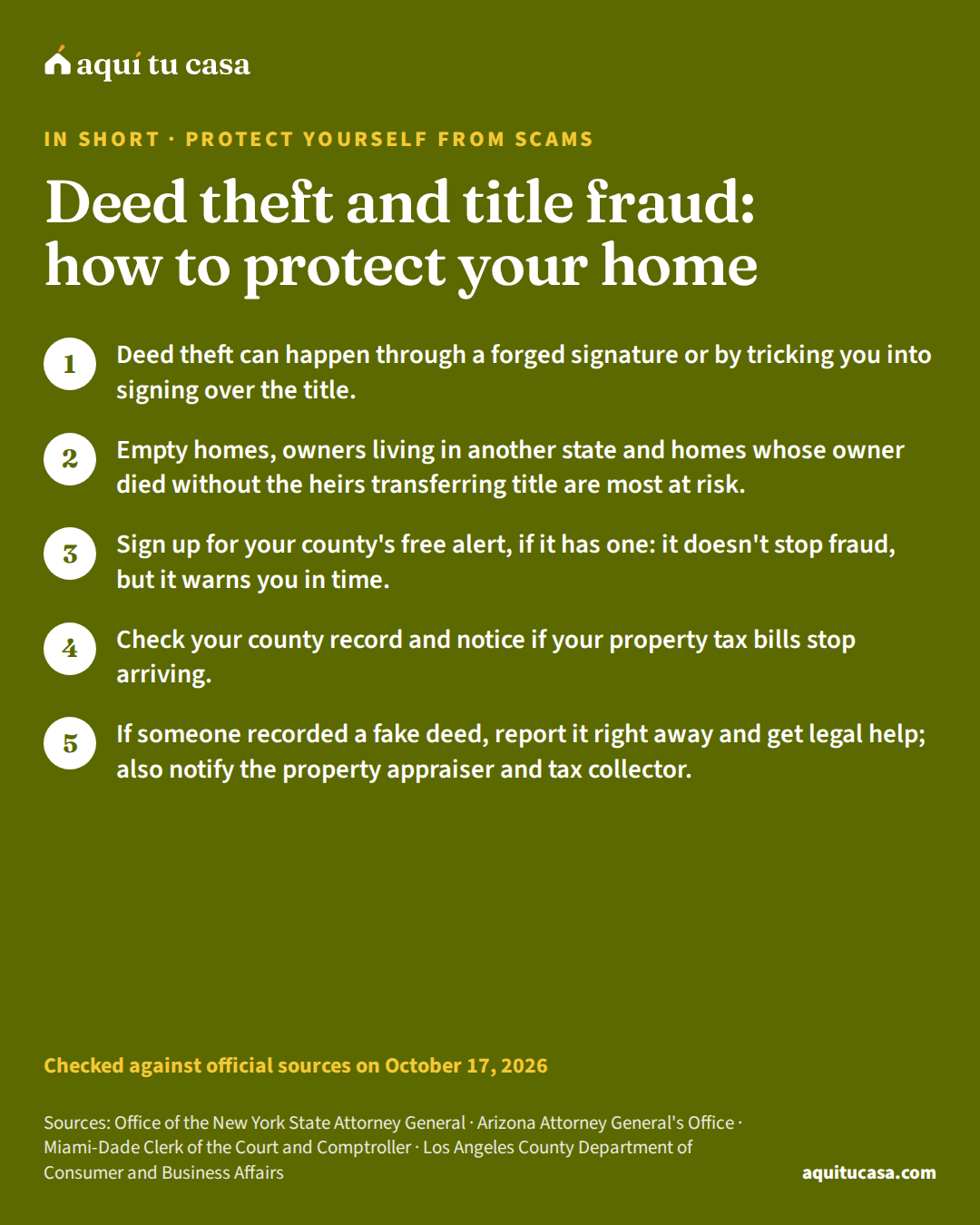
- Protect yourself from scams Deed theft and title fraud: how to protect your home What deed theft is, who is most at risk, the warning signs, your county's property alerts and what to do if someone records a fake deed. 10 minute read
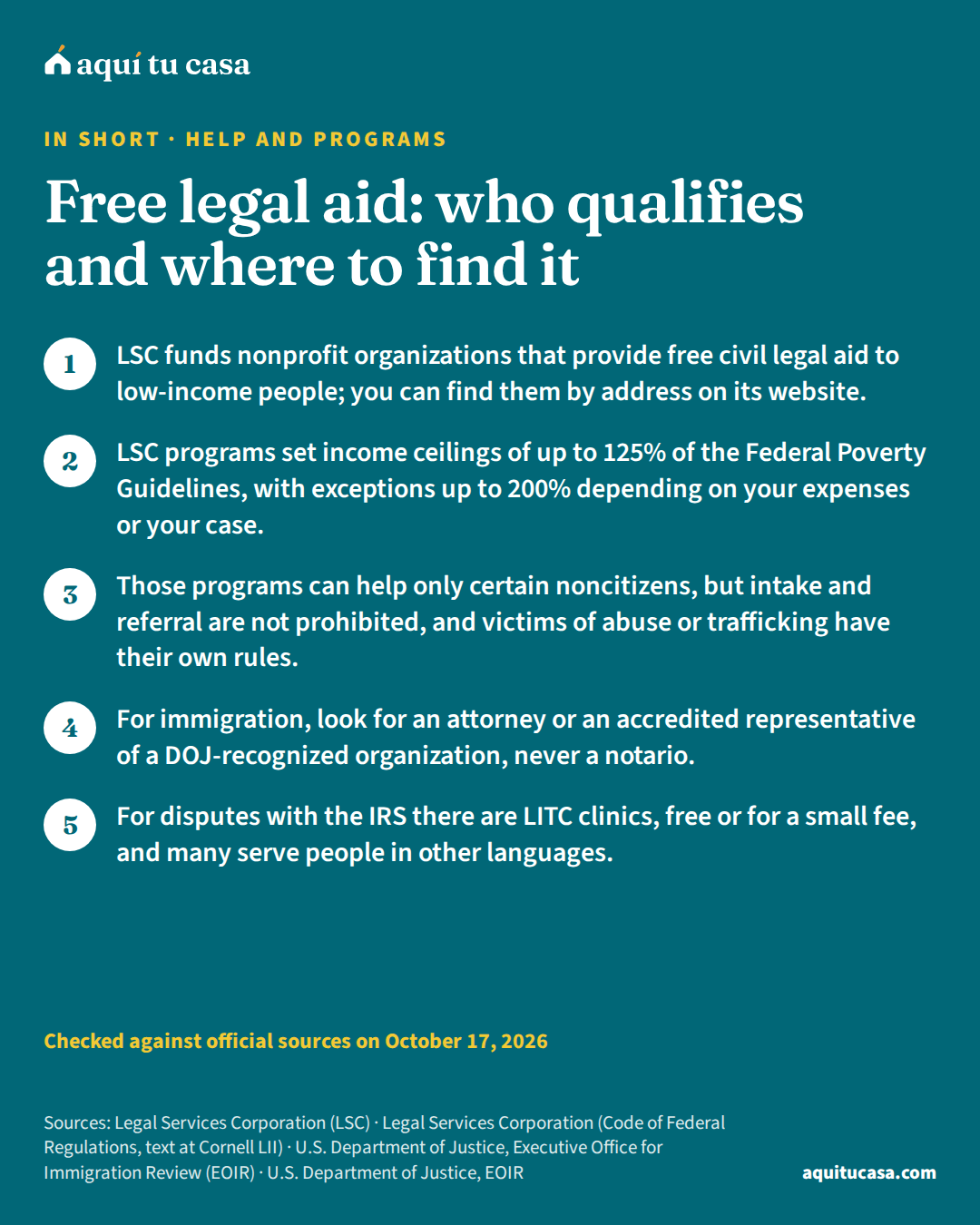
- Help and programs Free legal aid: who qualifies and where to find it What free legal aid is, who qualifies, which rules apply if you are not a citizen, and where to get help with immigration and tax problems. 11 minute read

Tools for this topic
Was this guide useful?
Thank you. Your answer stays in your browser; nothing is sent.